
http://storify.com/digiphile/tracking-the-tweets-about-the-first-ignitegov-at-g.js
Weighing a more balanced view of Government 2.0
There’s a lot to consider in Gartner analyst Andrea DiMaio’s newest post, toward a more “balanced view of government 2.0. Balanced views are good, as are research, evidence, case studies and solid reporting.
Unfortunately, I’m at the GOSCON Conference at the moment, so I can’t respond at length. I’m very glad he finds this blog informative. I’d also direct readers to the Gov 2.0 section at O’Reilly Radar for more content and other perspectives.
One thing I’d pose as a cautionary note to his last post is that the state of government 2.0 or open government can’t be measured simply by the answers of government CIOs, particularly at the federal level. It’s in the hands of more people than that, with respect to the “we government” meme that the Personal Democracy Forum has articulated.
That’s why, while Gartner’s view is both influential and something that many executives will clearly still spend money to gain, watching what’s happening at the state and local level is critical – and perhaps not reflected in its data gathering. I could well be wrong, naturally.
Resource-starved government entities at the state level are more likely to adopt free and open tools that require investments in time, much like the campaigns that are bootstrapping using social media and YouTube this election season instead of expensive TV buys. Just look at the choices that California has made for a precedent, where open government is connecting citizens to e-services with social media.
I’ve been asking a lot more questions about private sector value created from open government data. There are definitely examples that weren’t in that blog post that DiMaio referenced. That post should not be taken as comprehensive or exhaustive, merely easily referenced initiatives that I could offer to an audience that came fresh to the topic. Those include BrightScope (whose government 2.0 story TechCrunch covered last weekend), Passur Aeropspace, transit apps, or numerous healthcare apps that fold in CHDI data.
That said, the CIO panel at GOSCON just dropped several data points you might consider:
The data.ca.gov California apps contest yielded several startups, said CarolynLawson, including:
NYSenate.gov uses Drupal and a host of other technology choices that apparently have affected their bottom line. “We spent one million less last year, relative to the historical timeline,” said NY Senate CIO Andrew Hoppin.
If that open source framework is adopted elsewhere, similar cost savings to open government might be be available for you to cite.
Eight lessons for social media and politics from Politico, Facebook and media
Ten years ago, staffers thought Al Gore was weird for texting Tipper. Fast forward a decade to late 2010, when any politician who doesn’t use check email on a smartphone or monitor what the media and voters are saying on social media platforms risks being judged out of step. As the midterm elections loom large next month, a large majority of the United States House and Senate are on Facebook. A smaller majority uses Twitter, YouTube and Flickr. While the effectiveness of that usage varies from candidate to candidate, the question of whether social media is a fad is largely settled.
One of the great unanswered questions of this election with respect to social media will be whether fan or follower numbers have any predictive value with respect to elections. Another will be whether more interactive candidates are more successful. What remains is to decide which strategies and tactics will make the difference in winning elections.
Earlier tonight, a panel of experts from media, campaigns and academia came together at George Washington University for “Going Viral: How Campaigns are Using Social Media,” an event jointly sponsored by Politico and Facebook. The panel featured:
- Ben Smith, Politico, moderator
- Mindy Finn, EngageDC
- Adam Conner, Facebook
- Sam Arora, Democrat for Delegate (MD)
- Matthew Hindman, George Washington University
- Philip de Vellis, Murphy Putnam Media
What was the high level take away? You can judge yourself: Video of the panel on political campaigns and social media is available at CSPAN and embedded below:
http://c.brightcove.com/services/viewer/federated_f9?isVid=1
Politico’s own Meredith Shiner reported that “social media still has much to prove.” As Shiner noted, Finn told the audience that “Despite the increased attention paid by the media to political Facebook and Twitter accounts, campaigns today still spend less than 5 percent of their media expenditures online.” Determining whether that spend is consistent across all campaigns would be useful. That said, part of the allure of social media is that it requires an investment in time and expertise, not classical media buys. Sarah Palin, Scott Brown and Barack Obama could use Twitter, Facebook and YouTube to achieve awareness of their messages without huge campaign war chests. For underfunded campaigns, using those tools isn’t a choice. It’s a necessity.
Drawing from those take aways, here are eight more lessons for social media and politics:
1) Politicians have to use social media themselves to realize its full potential. Most campaigns are on Facebook. As Facebook’s Adam Conner pointed out, however, what remains is for candidates to understand tech personally and use it. “When you put a communications manager or staffer in between 140 characters or a Facebook update,” he said, “it’s much less authentic.”
2) Social media is not going away. “It’s the place we all have to be,” said Smith. As citizens turn to the Internet for government data, information, e-services, not to mention news, media and government entities have to “fish where the fish are.”
3) Very few Congressional candidates are doing a good job with these tools. At least, that was Professor Matthew Hindman’s take at the event. Judging from the feeds of many candidates, there’s clearly a learning curve with respect to style, conventions and technical acumen. Posting press releases to Twitter or Facebook does not realize their potential. Neither does treating the platforms the same way. For instance, Finn said that “tweeting from Facebook” is one of her pet peeves. Connor had seen enough “double third person posting” by staff to find it annoying. Voters are likely no different.
4) Social media enables candidates to build the intensity of support. While tweets and updates may not sway independents in of themselves, building strong online communities of supporters can translate into electoral success.
5) Friend power is important. Online, people are increasingly finding news stories from one other on Facebook, Twitter or other social networks, as opposed to through a search engine. That makes creating content with high “shareability” key, whether it’s embeddable videos, polling widgets or tweetable campaign slogans.
6. Leaving negative comments online builds trust, up to a point. In order for voters to see a page is a place for debate, you need to leave as many negative comments up as possible, said de Vellis, with the exception of abusive or pornographic content, which should be moderated. “Leave as much up as much as you can stomach,” said Finn. If the site is a place for supporters, “they’ll jump in and support you.” Conner suggested setting a policy up ahead of time, which a campaign can use to tramp down bad publicity. He said that it’s even more imporatnt to internal staff to have discussions ahead of time to get universal understanding of that policy.
7. This is the year of mobile. Again. As Pew Internet researcher Susannah Fox powerfully articulated in her presentation on the power of mobile this fall, 82 percent of American adults have a cell phone. Six in 10 American adults go online wirelessly with a laptop or mobile device. “Mobile was the final front in the access revolution,” she said. “It has erased the digital divide. A mobile device is the Internet for many people. Access isn’t the point anymore. It’s what people are doing with the access that matters.” As important as social media may become to the future of campaigns, reaching voters using email, text messages and calls to their cellphones – good old “Web 1.0” – is still paramount, along with a ground game to get them to the polls.
8. Candidates who use social media personally are more likely to use it on campaigns and ultimately in governance, says Adam Conner.
Once in office, the challenges of using technology for open government are even greater. Just ask the staffers at the Obama Administration and federal agencies, where open government initiatives in beta are moving from plans to implementation.
Telling the story of social media and politics
Befitting the occasion, below are selected tweets and images from the event, curated using Storify:
http://storify.com/digiphile/going-viral-how-campaigns-are-using-social-media.js
VIDEO: “One giant check-in for mankind” as @Foursquare blasts off with @NASA
http://storify.com/digiphile/one-giant-checkin-for-mankind-the-story-of-foursqu.js

"NASA-Foursquare" from JESS3
In Coders We Trust: Laurel Ruma breaks down Gov 2.0 at Ignite NYC
“We’re moving from the Social Web to the Civic Web. IT and geeks matter. What we can do with open data and the internet is very important. If government is a platform, we need people to create apps and others to open up data sets.”-Laurel Ruma, Gov 2.0 Evangelist, O’Reilly Media
If you want a great introduction to what Gov 2.0 is and why it matters, look no further than her 5 minute talk from Ignite NYC is embedded below.
Adding social context to low public transparency ratings for federal government
What does open government need to break through the awareness barrier? A new study of federal government transparency efforts released by NextGov and ForeSeeResults gave all entities in the survey low marks in court of public opinion. Here’s the executive summary:
“Nearly two years after a memorandum to the federal government calling for ambitious and sweeping open government initiatives, many are wondering if the goals of openness, democratic participation, and collaboration have taken root and, if so, how successful the efforts have been.
ForeSee Results, in partnership with Nextgov, designed a comprehensive survey to assess how citizens grade four government entities (the government overall, the White House, Congress, and federal agencies and departments) in terms of Open Government Initiative (OGI) principles like transparency and trust. The goals of the research were:
• To get a baseline, quantifiable measurement of citizen trust and perceptions of transparency against which future measurements can be benchmarked
• To compare key citizen-facing government entities
There were four key findings in the study:
- All measured entities received low scores when it comes to transparency, citizen satisfaction, and trust.
- The White House received the highest score as the most transparent of the four measured entities.
- There is a clear and proven relationship between transparency, satisfaction and trust.
- Congress has the lowest score of any of the four entities.
To get a sense of what the online community thought about the study, I fired up Twitter and collected the feedback I received after asking a few questions using Storify, a social media curation tool.
http://storify.com/digiphile/public-transparency-ratings-for-the-federal-govern.js
Reflections from Manor Govfresh: Voices of Open Government and Gov 2.0
If you’re looking for the faces of government 2.0, look no further. The video above, released today by Manor New Tech High‘s “Digital Dojo,” features more than a dozen voices (including this correspondent) talking about what Manor.Govfresh meant to them and what open government means to the country.
“I am very excited to be at Manor Govfresh because it’s the first time I’ve ever been to a conference that doesn’t just talk about change but actually does it,” said White House deputy CTO for open government Beth Noveck. “What’s exciting about Manor Govfresh is that it’s brought together so many people who are interested in municipal innovation and using technology to actually make a difference in local communities here in Manor, Texas, in Deleon, Texas, and across America, to actually make government work better.”
When you watch the video, of course, you’ll hear many more voices than Noveck’s, which is of course the point. The movement towards open government at the local level puts the growth of government 2.0 in context. As Stacy Viselli said this morning in a comment on Radar, “Communities and neighborhoods have been moving their organizations online for a while now and are looking for ways to do more. It creates an optimum environment for collaborative projects that include local governments, business, civic associations, nonprofits, and community foundations. Sometimes it’s not about the data so much as it is about providing a platform that empowers communities do what they are already doing–better.”
For more on how local governments are using technology to deliver smarter government, read about how Gov 2.0 is growing locally. And for more on Manor Govfresh, read about harnessing the civic surplus for open government.
Gov 2.0 Daily Dispatch: A Storify Experiment in Open Government Curation
U.S. Navy releases new Social Media Handbook

“Re-verify our range to target… one tweet only”
–Captain Marko Ramius
Yesterday, the U.S. Navy publicly released its new social media handbook. The updated guide, embedded, below provides sailors with a guide secure use of Facebook, Twitter and the rest of the networked world.
“The rapid growth of social media platforms and technologies have flattened and democratized the communications environment in ways we are just beginning to comprehend,” says D. J. Moynihan, Navy chief of information, in the introduction. “Social media is an effective channel to communicate relevant, aligned and targeted information to the stakeholders that we want to reach, including some we have had a hard time reaching before. As with the advent of other communication technologies – phone, fax, websites – we must exercise caution to use these tools safely and effectively, and we must educate our Soldiers and families to do the same.”
Navy Command Social Media Handbook – Online Versionhttp://static.slidesharecdn.com/swf/doc_player.swf?doc=navycommandsocialmediahandbookweb-101013124845-phpapp02&stripped_title=navy-command-social-media-handbook-web&userName=USNavySocialMedia
View more documents from US Navy Social Media.
This handbook should make for good weekend reading. As I thought about what it means to have more sailors online, I couldn’t help but recall an apt mock WWII propaganda poster by Brian Lane Winfield Moore: “Loose tweets sink fleets.”

Steady as she goes, gentleman. You don’t have to sit in a crow’s nest to see the need to take care with the new media platforms.
UPDATED: The L.A. Times called the Navy’s new social media policy “required reading for political campaigners.” Craig Howie compared these new rules of engagement for a virtually enhanced battlefield to the campaign front. The metaphor is probably inevitable in this heated election season, and given the advice in the handbook, useful.
USA.gov launches new iPhone app on its 10th Anniversary
This October marks the 10th anniversary of USA.gov, the nation’s search engine for government. And, as it turns out, now there’s an app for that. Nope, it’s not Apps.gov of even Apps.USA.gov. The General Services Administration quietly added a new USA.gov iPhone app to iTunes a few days ago. Why is it important? When American look for government information, they use search engines. While most of them go to Google and Bing, now they have another option when they fire up a smartphone.
The new app integrates access to a useful government dataset for citizens: a product recall database. The same access is available through a Product Recall app online, for Android or on mobile devices at Recalls.gov. That also means that citizens don’t have to have a smartphone to access public data, a issue for accessibility and the digital divide. For those inclined, the app also provides mobile search for local, state and federal websites, including predictive search.
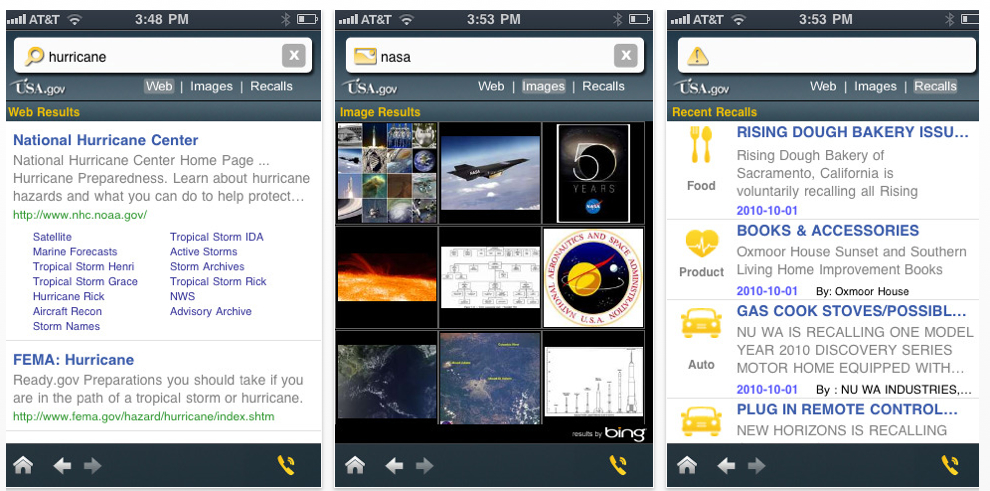
The new USA.gov app is beautifully designed, lightweight and didn’t crash on me after ten minutes of searching and browsing. The integration of a “tap to call” feature with the iPhone on the home screen also preserves a handy “Gov 1.0” feature as well: 1 800 FED INFO.
As the app description in iTunes notes, the app makes public data like birth, marriage and death records freely available to all citizens (provided that they have an iOS device with an Internet connection). Search.USA.gov provides similar access on both mobile and desktop users, for folks who prefer a Web browser to an app. Information about schools, passport and visas, tax codes, government jobs and Social Security benefits is also available.
The addition of the USA.gov to iTunes ends a quiet but important lag in getting a free government app onto the world’s largest mobile application platform. When Apps.USA.gov launched, Apple apps were conspicuously absent. Months later, the legal difficulties between the feds and Cupertino appear to resolved.
As a result, parents can search the FDA database to see which toys have been recalled. While it’s true that analysts can (and no doubt will) point to the USA.gov app as the latest example of “shiny app syndrome,” making a better interface for open data is a win for everyone.
 E Pluribus Unum