President Obama to host Google+ Hangout on January 31st

20140123-231418.jpg

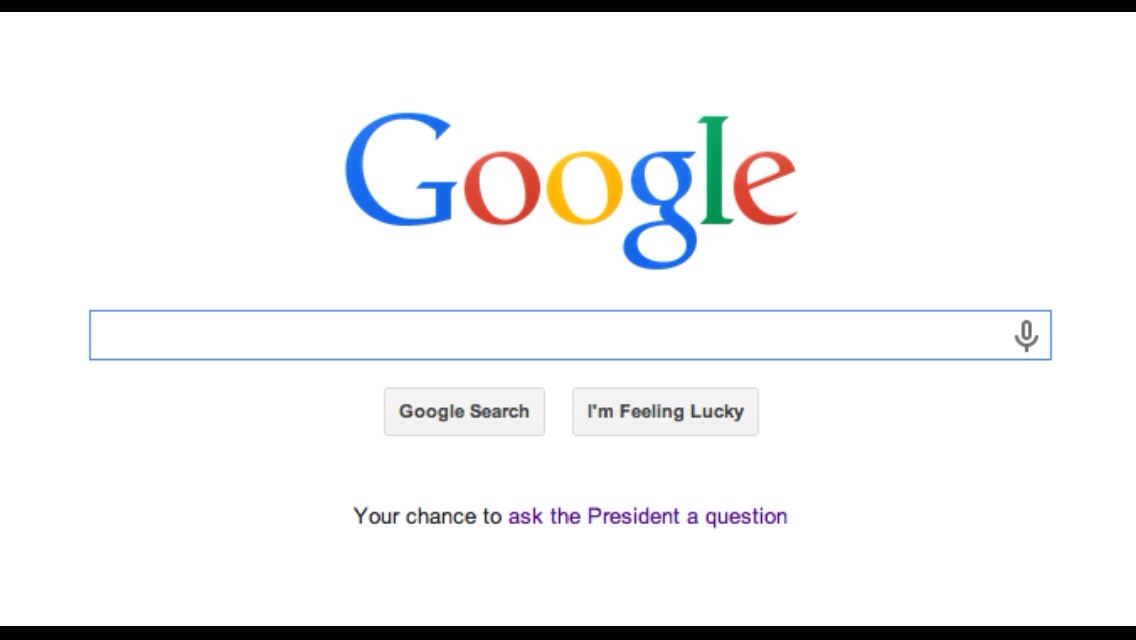
The Google home page currently has a link to ask President Obama a question in a Google+ Hangout. That’s some mighty popular online real estate devoted to citizen engagement.

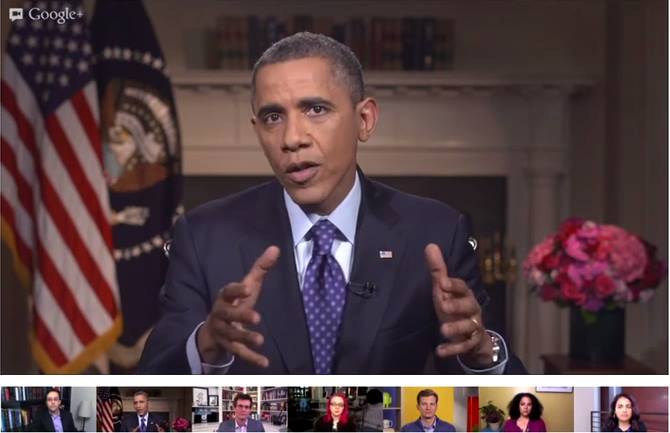
The first presidential hangout featured real questions from citizens. I hope this one is up to the same standard.

You can see publicly shared questions on the #AskObama2014 hashtag on YouTube or Google+.

More details on the “virtual road trip” with President Obama are available at the official Google blog.

We are, once again, living in the future.

obama-hangout

California court rules blogger has same First Amendment protections as traditional media

Here’s the summary of the decision, published earlier today:

The panel affirmed in part and reversed in part the district
court’s judgment awarding compensatory damages to a
bankruptcy trustee on a defamation claim against an Internet
blogger.

The panel held that Gertz v. Robert Welch, Inc., 418 U.S. 323, 350 (1974) (holding that the First Amendment required only a “negligence standard for private defamation actions”), is not limited to cases with institutional media defendants.
The panel further held that the blog post at issue addressed a matter of public concern, and the district court should have instructed the jury that it could not find the blogger liable for defamation unless it found that she acted negligently. The panel held that the bankruptcy trustee did not become a “public official” simply by virtue of court appointment, or by receiving compensation from the court. The panel remanded for a new trial on the blog post at issue, and affirmed the district court’s summary judgment on the other blog posts
that were deemed constitutionally protected opinions.

You can read the whole thing ruling (appropriately enough) or the backstory on the case of the Obsidian Finance Group and defendant Crystal Cox, whom Benjamin Souede and Eugene Volokh represented.

The ruling provides support for the view that the First Amendment applies more broadly to protect speech by all American citizens and acts of journalism, as opposed to solely protecting publications by institutional, credentialed media.

Will White House epetitions drive change or disillusionment?

20131213-220556.jpg

An epetition for The White House that really worked? Yep. 

P.J. Vogt, a producer for NPR’s “On The Media,” was surprised to find that a “We the People” epetition had played a role in the FCC moving to make a deal with wireless carriers that will allow consumers to unlock their cellphones.

He’s not alone. Historic lows in trust in the federal government mean that any progress toward a positive outcome — like legal unlocking of mobile devices — is viewed skeptically in public discourse.

Should carriers actually allow consumers to unlock those devices, it would be the the open government platform has now played a role in U.S. history.

I’ve been following the White House epetition system since it launched, more than 2 years ago. Prior to the 2012 election, this open government effort was a relatively slow burn, in terms of growth. Until the fall of 2012, the most significant role it had played came in January of that year, when the White House took an official position on petitions on the Stop Online Piracy Act (SOPA) and PROTECT IP Act (PIPA), changing the political context for the bills.

As I’ve observed before, on the evening of December 20, 2012, however, President Barack Obama responded to 32 different e-petitions related to gun violence. It was the first direct response to an e-petition at The White House by a President of the United States. While this remains the only e-petition that the President has responded to personally, before or since, it was a milestone in digital government, marking the first time that the President spoke directly to the people through the Internet about an issue they had collectively asked to be addressed using the Internet.

By January 2013, it had 5 million users. Now, there are over 10 million. It’s the first open government platform to reach that scale of use, in no small part due to the epic response to the Death Star petition that drew both Internet-wide and mainstream media attention.

And here’s the thing: most of those users are satisfied with the responses. Not all of them have resulted in policy shifts — in fact, only a few have, like a rulemaking on online puppy mills — but the ones that did are significant: SOPA/PIPA, increasing public access to scientific research online, and supporting consumers unlocking their mobile devices.

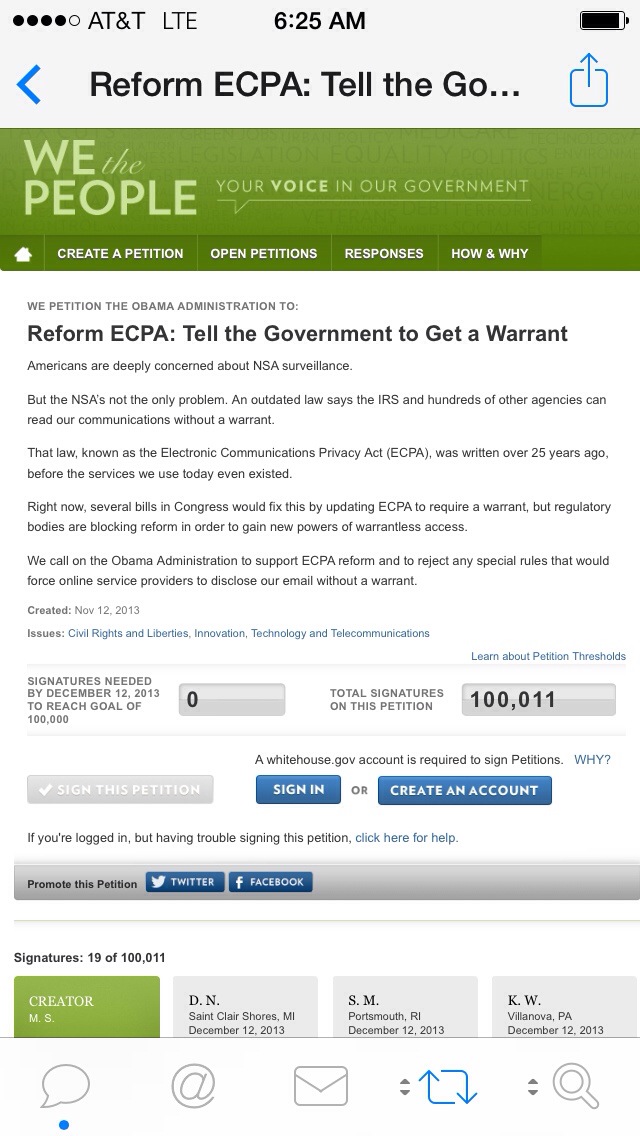
More challenging requests lie ahead. An epetition for the administration to reform the Electronic Communications Privacy Act just passed the 100,000 signature threshold this week, requiring a response.

The epetition will join a dozen or so popular online petitions that have passed the threshold, some of which have lingered unanswered for over a year.

This tardiness of response might lead critics of the administration to conclude that this White House putting off public responses to popular petitions it finds politically inconvenient, like the one to pardon Edward Snowden.

Even if that’s the case, if this trend continues, these epetitions from the American people look a bit less like a useless exercise in democracy theater at week’s end.

In 2014, the White House has announced a plan to launch a public version of the application programming interface (API) for “We The People,” enabling third parties to build applications on top of it.

Should mainstream adoption continue, American citizens may find a bonafide means to exercise their right to petition the United States government for the redress of grievances in the public desire of the twenty-first century.

New partnership with Microsoft and Bing lets citizens Skype the White House

ask-whitehouse-skype

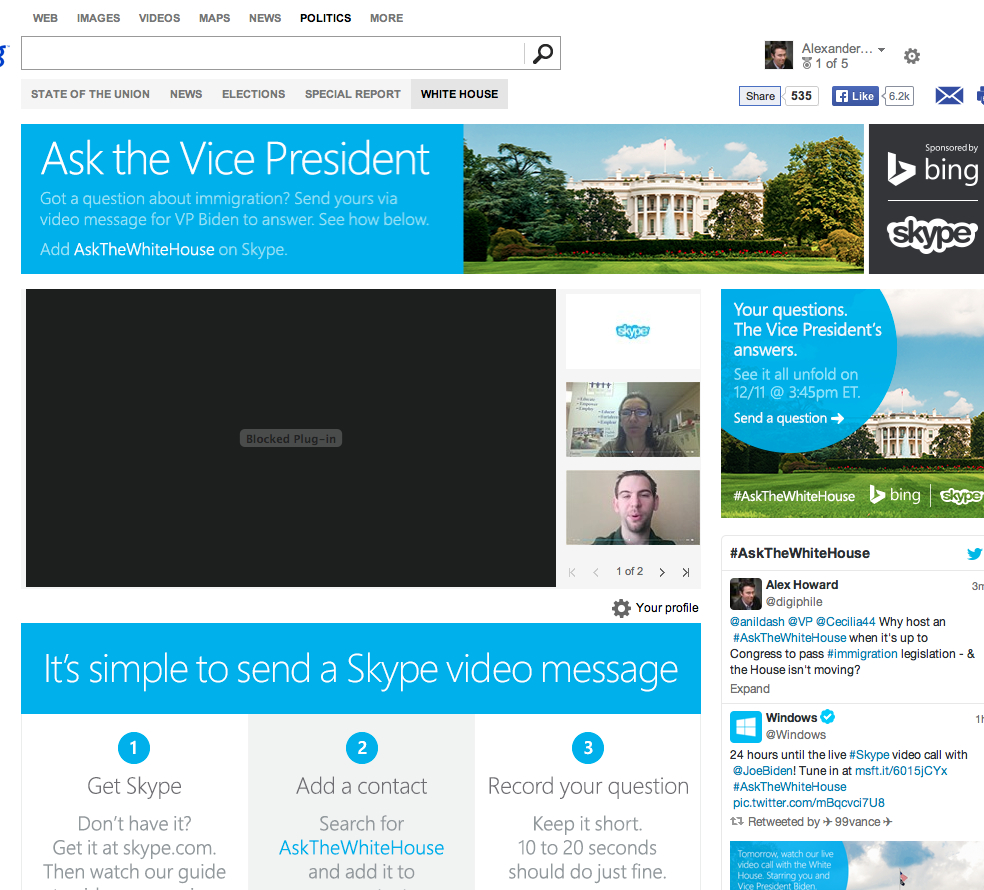
For almost five years now, the Obama administration has encouraged the American people to ask or answer questions over the Internet. On Wednesday, December 11th, we’ll see a new wrinkle: the White House is using a collaboration between Microsoft’s search engine, Bing, and Skype to enable people to ask questions from their house.

The occasion is a conversation on immigration reform with Vice President Joe Biden and the Director of the Domestic Policy Council, Cecilia Muñoz. In addition to questions posed on Twitter at #AskTheWhiteHouse (virtually old hat in 2013), people will be able to use Skype to record short messages, as campaign manager Lucy Woolfenden explained at Skype’s blog. According to Woolfenden, “a select group of questioners” will also connect to the White House via live Skype Video Calls. (The criteria for their selection was not disclosed.)

That the use of real-time online video links between elected officials and Americans isn’t exactly a groundbreaking of technology in government in late 2013, which says something about the world we live in. It’s hard to believe that almost two years ago, President Obama joined a Google+ Hangout in January 2012, followed by many more Hangouts from the White House by members of his administration.

Even with the rampant cynicism and historic lows in public trust in government, however, there’s reason to hope for something interesting to come out of the event. The first Hangout with the president featured real, tough questions from citizens that made news on the use of drones. Earlier this year, an unexpected question on “patent trolls” posed to Mr. Obama by Adafruit founder Limor Fried led to a series a series of executive actions in June.

That isn’t to say that recorded questions or the live Skype conversation tomorrow will lead to executive action on an immigration issue, like deportation policy, or even make news. It does mean the livestream at Bing.com/whitehouse and wh.gov/live tomorrow may be a bit more interesting.

While this is a novel use of Skype, the context for it is much the same as past efforts, where the Obama administration is trying to use its bully pulpit and social media prowess to engage the public to put more pressure on Congress on a given policy agenda. (In this case, it’s trying to move stalled immigration reform legislation forward. It’s not at all clear whether the effort will change any votes in the Republican-controlled House of Representatives.)

There’s one other new media angle teased by Crittenden last week to watch: “for greater interactivity, live polls will map public engagement with the conversation in real time.”

We’ll see how that goes, but the fact that Bing is being used to host the conversation and analyze engagement is something of a coup for Microsoft’s public sector team, which has not been a major part of the mix of this administration’s digital public engagement strategies, as the White House has tumbled further into social media over the years.

Historic lows in trust in government creates icy headwinds for U.S. open government policies

Open government advocates in the United States can expect to find public support for more accountability on a host of federal programs and policies among an electorate deeply distrustful of the White House’s commitment to more transparency regarding them.

Anyone interested in engaging the public regarding rules, regulations and proposed laws, however, should take note of the tenor of the comments on the coverage of the second United States National Action Plan on Open Government. They are a bellwether for the degree of damage to public trust in government that now persists in the United States.

If you feel like reading through the comments on “White House promises more transparency in second Open Government plan” at The Verge or “White House announces second open government plan” at Politico or “New White House plan reaffirms commitment to open data” at The Washington Post, you’ll find anger, disbelief and mockery.

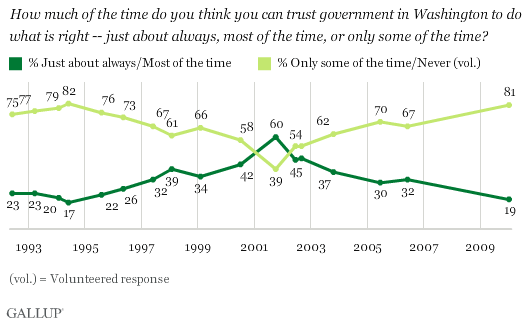
gallup-polls-trust-government

I couldn’t find a single positive or even neutral comment on any of the stories. Considered in the context of the current political climate in the United States, that’s not surprising.

Gallup polling data from September 2013 indicated then that the trust of Americans in government had now fallen to historic lows.

After the government shutdown this fall and the messy rollout of the Affordable Care Act over the past two months, including a high stakes Internet failure at Healthcare.gov, I suspect that a Gallup poll taken today would find that even fewer people trust that the executive or legislative branch of the federal government of the United States.

If my own article on the White House’s second open government national action plan gains more attention, I expect to find similar sentiments from people who choose to comment.

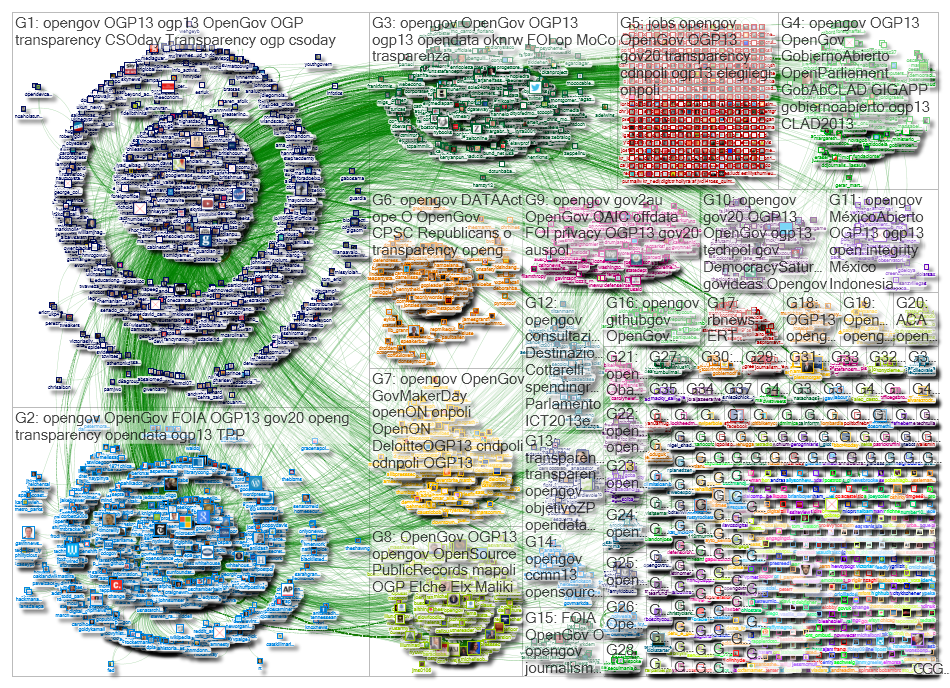
Map of open government communities generated by social network analysis of Twitter

Graph-12287

The map above was created on November 20 by researcher Marc Smith using a dataset of tweets that contained “opengov” over the past month. You can explore an interactive version of it here.

The social network analysis is, by its nature, a representation of only the data used to create it. It’s not a complete picture of open government communities offline, or even the totality of the communities online: it’s just the people who tweeted about open gov.

That said, there are some interesting insights to be gleaned.

1) The biggest network is the one for the Open Government Partnership (OGP), on the upper left (G1), which had its annual summit during the time period in question. That likely affected the data set.

2) I’m at the center of the U.S. open government community on the bottom left (G2) (I’m doing something right!) and am connected throughout these communities, though I need to work on my Spanish. This quadrant is strongly interconnected and includes many nodes linked up to OGP and around the world. (Those are represented by the green lines.)

3) Other communities include regional networks, like Spain (G4) and Spanish-speaking (G11) open government organizations, Germany (G3), Italy (G12), Canada (G7), Greece (G5) and Australia (G9), and ideological networks, like the White House @OpenGov initiative (G8) and U.S. House Majority Leader (G6). These networks have many links to one another, although Mexico looks relatively isolated. Given that Indonesia has a relatively high Twitter penetration, its relative absence from the map likely reflects users there not tweeting with “opengov.”

4) The relative sparseness of connections between the Republican open government network and other open government communities strongly suggests that, despite the overwhelming bipartisan support for the DATA Act in the House, the GOP isn’t engaging and linked up to the broader global conversation yet, an absence that should both concern its leaders and advocates in the United States that would like to see effective government rise above partisan politics. This community is also only tweeting links to its own (laudable) open government initiatives and bills in the House, as opposed to what’s happening outside of DC.

5) You can gain some insight into the events and issues that matter in these communities by looking at the top links shared. Below, I’ve shared the top links from Smith’s NodeXL analysis:
Top URLs in Tweet in Entire Graph:

https://healthcare.gov/
http://www.opengovguide.com/
https://www.gov.uk/government/topical-events/open-government-partnership-summit-2013
http://www.opengovpartnership.org/get-involved/london-summit-2013
https://govmakerday.eventbrite.com/
http://blogs.worldbank.org/youthink/can-young-people-make-your-government-more-accountable
http://www.opengovpartnership.org/london-summit-2013
http://paper.li/DGateway/1350366870
https://www.thunderclap.it/projects/5907-more-open-government-ogp13
http://www.youtube.com/playlist?feature=edit_ok&list=PLMDgGB-pYxdFNupM0kiHFPjwv8by2alxY

Top URLs in Tweet in G1 (Open Government Partnership):

https://www.gov.uk/government/topical-events/open-government-partnership-summit-2013
https://www.thunderclap.it/projects/5907-more-open-government-ogp13
http://www.opengovpartnership.org/london-summit-2013
http://www.thunderclap.it/tipped/5907/twitter
http://www.opengovpartnership.org/get-involved/london-summit-2013
http://www.youtube.com/playlist?feature=edit_ok&list=PLMDgGB-pYxdFNupM0kiHFPjwv8by2alxY
https://www.thunderclap.it/projects/5907-more-open-government-ogp13?locale=en
http://www.opengovguide.com/
https://www.gov.uk/government/consultations/open-government-partnership-uk-national-action-plan-2013
http://www.opengovpartnership.org/open-government-awards-launched-reward-transparent-accountable-and-effective-public-programs#sthash.xl5Bwn5D.dpuf

Top URLs in Tweet in G2 (US OpenGov Community):

http://www.usgovernmentmanual.gov/
http://www.huffingtonpost.com/danielle-brian/in-wake-of-snowden-us-mus_b_4192804.html?utm_hp_ref=tw
http://e-pluribusunum.com/2013/11/05/farm-bill-foia-open-government-epa/
http://www.knightfoundation.org/blogs/knightblog/2013/10/28/new-project-aims-connect-dots-open-data/
http://www.whitehouse.gov/lWV7k
http://sunlightfoundation.com/blog/2013/11/15/opengov-voices-pdf-liberation-hackathon-at-sunlight-in-dc-and-around-the-world-january-17-19-2014/
http://sunlightfoundation.com/blog/2013/11/14/recent-developments-show-desire-for-trade-talk-transparency/
http://sunlightfoundation.com/blog/2013/10/22/how-much-did-healthcare-gov-actually-cost/
http://www.consumerfinance.gov/blog/making-regulations-easier-to-use/
http://sunlightfoundation.com/blog/2013/11/19/house-keeps-data-act-momentum-moving/

Top URLs in Tweet in G3 (Germany):

http://paper.li/DGateway/1350366870
http://oknrw.de/
http://www.opengovpartnership.org/blog/christian-heise/2013/11/18/german-grand-coalition-might-agree-joining-ogp
http://dati.comune.bologna.it/node/962
http://www.globalhealthhub.org/thehive/
https://www.facebook.com/events/1431657647046016
http://aiddata.org/blog/this-week-open-data-for-open-hearts-and-open-minds
http://www.opengovpartnership.org/get-involved/london-summit-2013
http://www.freiburg.de/pb/,Lde/541381.html
http://digitaliser.dk/resource/2534864

Top URLs in Tweet in G4 (Spain):

http://www.opengovguide.com/
http://www.cepal.org/cgi-bin/getprod.asp?xml=/ilpes/capacitacion/0/50840/P50840.xml&xsl=/ilpes/tpl/p15f.xsl&base=/ilpes/tpl/top-bottom.xsl
https://vine.co/v/hpZErXPd6rq
http://thepowerofopengov.tumblr.com/
http://es.scribd.com/collections/4376877/Case-Studies
https://vine.co/v/hpZiw7TXanI
https://vine.co/v/hpZIV002zar
http://aga.org.mx/SitePages/DefinicionGob.aspx
http://www.opengovpartnership.org
http://inicio.ifai.org.mx/Publicaciones/La%20promesa%20del%20Gobierno%20Abierto.pdf

Top URLs in Tweet in G5 (Greece):

https://healthcare.gov/
http://venturebeat.com/2013/10/23/so-much-for-opengov-quantcast-traffic-on-healthcare-gov-hidden-by-the-owner/
http://elegilegi.org/
http://opengov.seoul.go.kr/
http://venturebeat.com/2013/10/23/so-much-for-opengov-quantcast-traffic-on-healthcare-gov-hidden-by-the-owner/?utm_source=twitterfeed&utm_medium=twitter
http://www.aspeninstitute.org/about/blog/biases-open-government-blind-us?utm_source=as.pn&utm_medium=urlshortener
http://www.opengov.gr/consultations/?p=1744
http://www.aspeninstitute.org/about/blog/biases-open-government-blind-us
http://www.opengov.gr/minfin/?p=4076
http://OpenGov.com

Top URLs in Tweet in G6 (GOP):

http://houselive.gov/
https://www.cosponsor.gov/details/hr2061
http://oversight.house.gov/release/oversight-leaders-introduce-bipartisan-data-act/
http://instagram.com/p/g3uvs_sYYr/
http://cpsc.gov/live
https://cosponsor.gov/details/hr2061-113
http://www.youtube.com/watch?v=Bnn3IsOhulE&feature=youtu.be
http://www.cpsc.gov/en/Regulations-Laws–Standards/Rulemaking/Final-and-Proposed-Rules/Hand-Held-Infant-Carriers/
http://www.speaker.gov/press-release/opengov-house-representatives-makes-us-code-available-bulk-xml
http://docs.house.gov/billsthisweek/20131118/BILLS-113hr2061XML.xml

Top URLs in Tweet in G7 (Canada):

https://govmakerday.eventbrite.com/
http://www.ontario.ca/government/open-government-initial-survey
http://govmakerday.eventbrite.com
http://www.thestar.com/opinion/commentary/2013/10/29/the_promise_and_challenges_of_open_government.html
http://www.marsdd.com/2013/10/31/open-government-three-stages-for-codeveloping-solutions/
http://www.thestar.com/opinion/commentary/2013/11/09/rob_ford_and_the_emerging_crisis_of_legitimacy.html
https://www.ontario.ca/government/open-government-initial-survey
http://govmakerday-estw.eventbrite.com
http://www.ontario.ca/open
http://gov20radio.com/2013/10/gtec2013/

Top URLs in Tweet in G8 (@OpenGov):

https://healthcare.gov/
http://www.whitehouse.gov/lWV7k
http://www.consumerfinance.gov/blog/making-regulations-easier-to-use/
http://aseyeseesit.blogspot.com/2012/01/economy-hasnt-stalled-for-members-of.html
http://www.commonblog.com/2013/10/23/eagle-tribune-editorial-public-records-need-to-be-available-to-its-citizenry/
http://mobile.twitter.com/OpenGov
http://blogs.state.gov/stories/2013/10/31/making-governments-more-open-effective-and-accountable
http://open.dc.gov/
http://www.sielocal.com/SieLocal/informe/1025/Ingresos-por-el-concepto-de-multas
http://mei-ks.net/?page=1,5,787

Top URLs in Tweet in G9 (Australia):

http://paper.li/cortado/1291646564
http://icma.org/en/icma/knowledge_network/documents/kn/Document/305680/Transparency_20_The_Fundamentals_of_Online_Open_Government
http://www.oaic.gov.au/about-us/corporate-information/annual-reports/oaic-annual-report-201213/
https://controllerdata.lacity.org/
http://cogovsnapshot.cofluence.co/
https://info.granicus.com/Online-Open-Gov-October-29-2013.html?page=Home-Page
http://www.oaic.gov.au/news-and-events/subscribe
https://oaic.govspace.gov.au/2013/10/30/community-attitudes-to-privacy-survey-results/
http://www.cebit.com.au/cebit-news/2013/towards-open-government-esnapshot-australia-2013
http://journalistsresource.org/studies/politics/digital-democracy/government-transparency-conflicts-public-trust-privacy-recent-research-ideas

Top URLs in Tweet in G10:

http://on.undp.org/pUdJj
http://europeandcis.undp.org/blog/2013/10/17/a-template-for-developing-a-gov20-opengov-project/?utm_source=%40OurTweets
http://www.govloop.com/profiles/blogs/12-favorite-quotes-from-code-for-america-summit
http://www.accessinitiative.org/blog/2013/10/east-kalimantan-community%E2%80%99s-struggles-underscore-need-proactive-transparency-indonesia
http://www.scribd.com/doc/178983441/Montenegro-Inspiring-Story-open-government
http://www.scribd.com/doc/178988676/Indonesia-case-study-open-government
http://www.setimes.com/cocoon/setimes/xhtml/en_GB/features/setimes/features/2013/10/18/feature-01?utm_source=%40OurTweets
http://www.opengovpartnership.org/summary-london-summit-commitments
http://feedly.com/k/1arGpdC
http://slid.es/kendall/open-records

ODNI declassifies more intelligence documents after White House order, ACLU, EFF suits

I’m still digesting the additional documents the U.S. director of national intelligence released last night. The New York Times’ coverage of the latest documents released notes that they include a 2006 “ruling in which the Foreign Intelligence Surveillance Court first approved a program to systematically track Americans’ emails during the Bush administration.”

The opinion, signed by Judge Colleen Kollar-Kotelly, permitted the NSA to gather email addresses and other forms of Internet communication in bulk  — but not the content of those communications. Law professor Orin Kerr has “major problems” with the FISC opinion:

“By imagining that the statute provides more protection than it does, and by then construing the ambiguity in the statute in the government’s favor, the FISC’s opinion ends up approving a program that Congress did not contemplate using privacy protections Congress did not contemplate either,” he wrote, at his blog. “The resulting opinion endorses a program that appears to be pretty far from the text of the statute.”

Taken in sum, the Guardian holds that these FISA court opinions show that the NSA demonstrated disregard for the privacy protections that are constitutionally afforded to American citizens under the Fourth Amendment.

Transparency, at last?

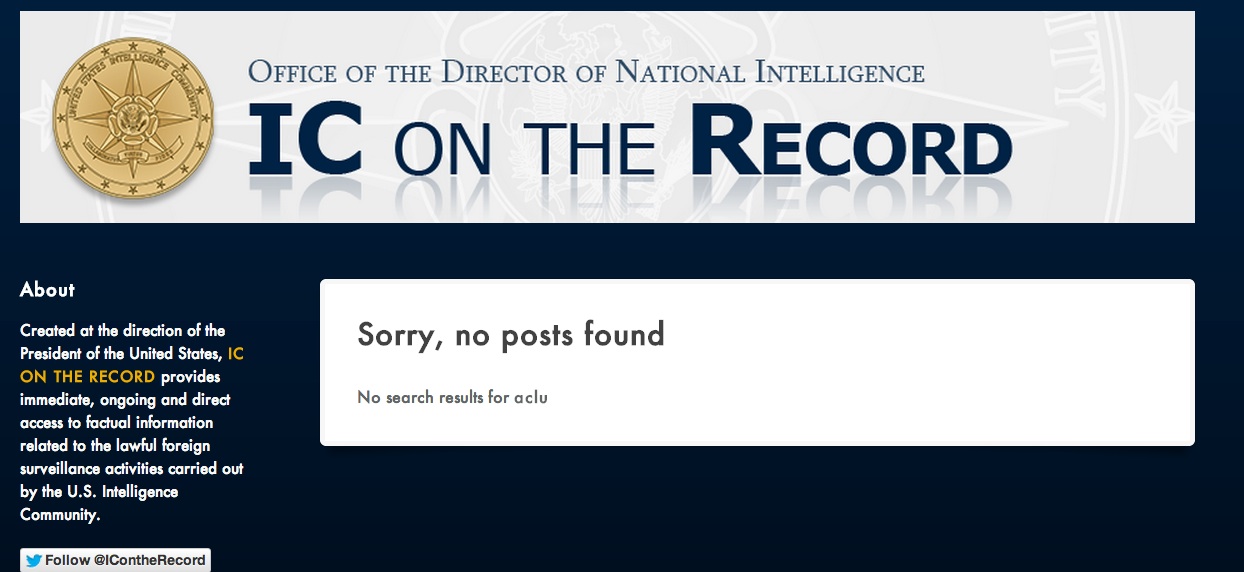
On the one hand, the intelligence community’s Tumblr blog and Twitter account have been an effective means of distributing and publicizing the document releases it is publishing on odni.gov, its website. That’s a measure of transparency, although the redacted, scanned documents are not “opening the kimono” all the way.

On the other hand, if you only read the ODNI’s press release and posts at that tumblr (which are quite similar,) you wouldn’t know that the documents released are not only pursuant to President Barack Obama directive to DNI Clapper to declassify information relevant to NSA bulk data collection.

aclu icontherecord

As Cyrus Farivar reported for Ars Technica, “the documents, which include annual reports from the Attorney General to Congress, memos, presentations, and training documents, were released in relation to an Electronic Frontier Foundation and American Civil Liberties Union [Freedom of Information Act] lawsuit.”

The overarching context for the release of nearly 2000 documents are the leaks of former NSA contractor Edward Snowden, whose disclosures to The Guardian and Washington Post prompted President Barack Obama’s directive to ODNI.<

So, this is what "open government" looks like in 2013: networked, nuanced and opaque. Official documents are released in response to the reports of whistleblowers,  and then distributed through the government's official channels online and reported, factchecked and through the 4th and 5th Estates.

This dynamic only bound to get more interesting from here on out.

Should Congress criminalize online “revenge pornography”?

1-Blind-JusticeAShould “revenge porn” be made a crime? In California, revenge porn could soon be illegal.

This weekend, in an op-ed for CNN.com, University of Maryland law professor Danielle Citron argues that Congress and other states in the union also should move to criminalize sharing nude pictures of a person without that person’s consent.

“New Jersey is the only state to make it a felony to disclose a person’s nude or partially nude images without that person’s consent,” she writes. “The New Jersey statute is a helpful model for states like California that are considering proposals to criminalize revenge porn. Congress should amend the federal cyberstalking law, 18 U.S.C. § 2261A, to cover the use of any interactive computer service to produce or disclose a sexually graphic visual depiction of an individual without that individual’s consent.”

Citron argues that that, given the profound effects upon someone’s personal and professional life in the schools, workplaces and communities they inhabit “offline,” criminalizing this online action is a necessary curb on the damage it can do. She makes a strong case that the U.S. Code should catch up to the pace of technological change.

We’re several years past the time the world crossed a Rubicon, with respect to the ability to share embarrassing images of one another. The global adoption of cheap camera phones, smartphones, social networks, search engines and wireless Internet access has created a tidal wave of disruptions across industries, governments and nations. Taking pictures with the world has been made trivially easy by those technologies, a capability that can capture both our best and worst moments.

When combined with the capacity to share those images with the rest of humanity in an instant, billions of people now wield great power in their back pockets. Whether they uphold the responsibility that comes with it is in question, given what history shows us of humans acting badly to those who have less power in society. The power to publicize and shame others is not equally distributed, given the expense of devices, data, and unequal access between the sexes.

In her op-ed, Citron anticipates the First Amendment concerns of organizations like the ACLU, arguing that it’s possible to craft sufficient limits into legislation — again, using New Jersey’s law as a model — that will enable the United States to preserve constitutional protections for free speech online.

“First Amendment protections are less rigorous for purely private matters because the threat of liability would not risk chilling the meaningful exchange of ideas,” writes Citron.

“Listeners and speakers have no legitimate interest in nude photos or sex tapes published without the subjects’ permission. That online users can claim a prurient interest in viewing sexual images does not transform them into a matter of legitimate public concern. Nonconsensual pornography lacks First Amendment value as a historical matter, and could be understood as categorically unprotected as obscenity. Although the Court’s obscenity doctrine has developed along different lines with distinct justifications, nonconsensual pornography can be seen as part of obscenity’s long tradition of proscription.”

The American Civil Liberties Union opposes the California legislation and the Electronic Frontier Foundation has expressed concerns with how broadly it has been drafted.

Legal precision in how legislatures make revenge porn a criminal offense really will matter here, given both existing statutes and the number of entities that are involved in the act, from the person who took the image to the site that hosts it to the people who spread it.

Making anyone but the original person who broke the trust of another by uploading the picture culpable would run up against Section 230 of the United States Communications Decency Act, which provides “intermediary liability,” protecting online platforms from being held liable for user-generated content shared on them.

As more people gain the ability to take, store and share digital images, however, improving systems that govern non-consensual surveillance and distribution looks precisely like the kind of thorny problem that our elected representatives should grapple with in the 21st century.

Societies around the world will need to find answers that reconcile online civil rights with longstanding constitutional protections. The way the United States handles the issue could be a model for other states to consider — or not, if a dysfunctional Congress proves unable to enact effective legislation, a scenario that unfortunately seems all too likely over the next year.

Intelligence community turns to Tumblr and Twitter to provide more transparency on NSA surveillance programs


Yesterday afternoon, the Office of the Director of National Intelligence began tumbling towards something resembling more transparency regarding the National Security Agency’s electronic surveillance programs.

The new tumblog, “Intelligence Community on the Record,” is a collection of  statementsdeclassified documents, congressional testimony by officials, speeches & mediainterviewsfact sheets, details of oversight & legal compliance, and video. It’s a slick, slim new media vehicle, at least as compared to many government websites, although much of the content itself consists of redacted PDFs and images. (More on that later.) It’s unclear why ODNI chose Tumblr as its platform, though the lack of hosting costs, youthful user demographics and easy publishing have to have factored in.

In the context of the global furor over electronic surveillance that began this summer when the Washington Post and Guardian began publishing stories based upon the “NSA Files” leaked by former NSA contractor Edward Snowden, the new tumblr has been met with a rather …skeptical reception online.

Despite its reception, the new site does represent a followthrough on President Obama’s commitment to set up a website to share information with the American people about these programs. While some people in the federal technology sector are hopeful:

…the site won’t be enough, on its own. The considerable challenge that it and the intelligence community faces is the global climate of anger, fear and distrust that have been engendered by a summer of fiery headlines. Despite falling trust in institutions, people still trust the media more than the intelligence community, particularly with respect to its role as a watchdog.

Some three hours after it went online, a series of new documents went online and were tweeted out through the new Twitter account, @IConTheRecord:

The launch of the website came with notable context.

First, as the Associated Press reported, some of the documents released were made public after a lawsuit by the Electronic Frontier Foundation (EFF). In a significant court victory, the EFF succeeded in prompting the release of a 2011 secret court opinion finding NSA surveillance unconstitutional. It’s embedded below, along with a release on DNI.gov linked through the new tumblr.

The opinion showed that the NSA gathered thousands of Americans’ emails before the court struck down the program, causing the agency to recalibrate its practices.

Second, Jennifer Valentino and Siobhan Gorman Carpenter reported at The Wall Street Journal that the National Security Agency can reach 75% of Internet traffic in the United States. Using various programs, the NSA applies algorithms to filter and gather specific information from a dozen locations at major Internet junctions around North America. The NSA defended these programs as both legal and “respectful of Americans’ privacy,” according to Gorman and Valentino: According to NSA spokeswoman Vanee Vines, if American communications are “incidentally collected during NSA’s lawful signals intelligence activities,” the agency follows “minimization procedures that are approved by the U.S. attorney general and designed to protect the privacy of United States persons.”

The story, which added more reporting to confirm what has been published in the Guardian and Washington Post, included a handy FAQ with a welcome section detailed what was “new” in the Journal’s report. The FAQ also has clear, concise summaries of fun questions you might still have about these NSA programs after a summer of headlines, like “What privacy issues does this system raise?” or “Is this legal?”

The NSA subsequently released a statement disputing aspects of the Journal’s reporting, specifically the “the impression” that NSA is sifting through 75% of U.S. Internet communications, which the agency stated is “just not true.” The WSJ has not run a correction, however, standing by its reporting that the NSA possesses the capability to access and filter a majority of communications flowing over the Internet backbone.

Reaction to the disclosures has fallen along pre-existing fault lines: critical lawmakers and privacy groups are rattled, while analysts point to a rate of legal compliance well above 99%, with now-public audits showing most violations of the rules and laws that govern the NSA coming when “roamers” from outside of the U.S.A. traveled to the country.

Thousands of violations a year, however, even if they’re out of more than 240,000,000 made, is still significant, and the extent of surveillance reported and acknowledged clearly has the potential to have a chilling effect on free speech and press freedom, from self-censorship to investigative national security journalism. The debates ahead of the country, now more informed by disclosures, leaks and reporting, will range from increased oversight of programs to legislative proposals to update laws for collection and analysis to calls to significantly curtail or outright dissolve these surveillance programs all together.

Given reports of NSA analysts intentionally abusing their powers, some reforms to the laws that govern surveillance are in order, starting with making relevant jurisprudence public. Secret laws have no place in a democracy.

Setting all of that aside for a moment — it’s fair to say that this debate will continue playing out on national television, the front pages of major newspapers and online outlets and in the halls and boardrooms of power around the country — it’s worth taking a brief look at this new website that President Obama said will deliver more transparency into surveillance programs, along with the NSA’s broader approach to “transparency”. To be blunt, all too often it’s looked like this:

…so heavily redacted that media outlets can create mad libs based upon them.

That’s the sort of thing that leads people to suggest that the NSA has no idea what ‘transparency’ means. Whether that’s a fair criticism or not, the approach taken to disclosing documents as images and PDFs does suggest that the nation’s spy agency has not been following how other federal agencies are approaching releasing government information.

As Matt Stoller highlighted on Twitter, heavily redacted, unsearchable images make it extremely difficult to find or quote information.

Unfortunately, that failing highlights the disconnect between the laudable efforts the Obama administration has made to release open government data from federal agencies and regulators and the sprawling, largely unaccountable national security state aptly described as Top Secret America.”

Along with leak investigations and prosecution of whistleblowers, drones and surveillance programs have been a glaring exception to federal open government efforts, giving ample ammunition to those who criticize or outright mock President Obama’s stated aspiration to be the “most transparent administration in history.” As ProPublica reported this spring, the administration’s open government record has been mixed. Genuine progress on opening up data for services, efforts to leverage new opportunities afforded by technology to enable citizen participation or collaboration, and other goals set out by civil society has been overshadowed with failures on other counts, from the creation of the Affordable Care Act to poor compliance with the Freedom of Information Act and obfuscation of the extend of domestic surveillance.

In that context, here’s some polite suggestions to the folks behind the new ODNI tumblr regarding using the Web to communicate:

  • Post all documents as plaintext, not images and PDFs that defy easy digestion, reporting or replication. While the intelligence budget is classified, surely some of those untold billions could be allotted to persons taking time to release information in both human- and machine-readable formats.
  • Put up a series of Frequently Asked Questions, like the Wall Street Journal’s. Format them in HTML. Specifically address that reporting and provide evidence of what differs. Posting the joint statement on the WSJ stories as text is a start but doesn’t go far enough.
  • Post audio and plaintext transcripts of conference calls and all other press briefings with “senior officials.” Please stop making the latter “on background.” (The transcript of the briefing with NSA director of compliance John DeLong is a promising start, although getting it out of a PDF would be welcome.
  • Take questions on Twitter and at questions@nsa.gov or something similar. If people ask about programs, point them to that FAQ or write a new answer. The intelligence community is starting behind here, in terms of trust, but being responsive to the public would be a step in the right direction.
  • Link out to media reports that verify statements. After DNI Clapper gave his “least untruthful answer” to Senator Ron Wyden in a Congressional hearing, these “on the record” statements are received with a great deal of skepticism by many Americans. Simply saying something is true or untrue is unlikely to be received as gospel by all.
  • Use animated GIFs to communicate with a younger demographic. Actually, scratch that idea.

Berkman Center maps networked public sphere’s role in SOPA/PIPA debate

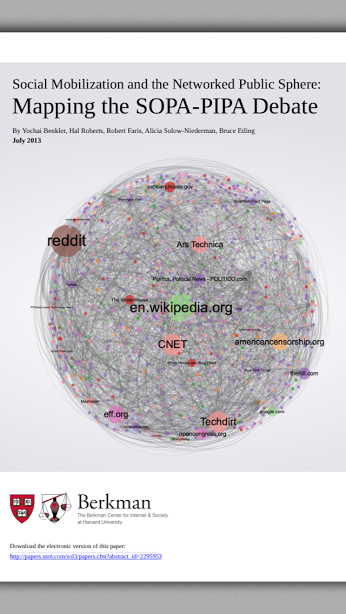
berkman-sopa-paper
A new paper from Yochai Benkler and co-authors at the Berkman Center maps how the networked public sphere led to the Stop Online Piracy Act and Protect IP Act being defeated in the U.S. Congress.

“Abstract: “This paper uses a new set of online research tools to develop a detailed study of the public debate over proposed legislation in the United States designed to give prosecutors and copyright holders new tools to pursue suspected online copyright violations.”

Key insight: “We find that the fourth estate function was fulfilled by a network of small-scale commercial tech media, standing non-media NGOs, and individuals, whose work was then amplified by traditional media. Mobilization was effective, and involved substantial experimentation and rapid development. We observe the rise to public awareness of an agenda originating in the networked public sphere and its framing in the teeth of substantial sums of money spent to shape the mass media narrative in favor of the legislation. Moreover, we witness what we call an attention backbone, in which more trafficked sites amplify less-visible individual voices on specific subjects. Some aspects of the events suggest that they may be particularly susceptible to these kinds of democratic features, and may not be generalizable. Nonetheless, the data suggest that, at least in this case, the networked public sphere enabled a dynamic public discourse that involved both individual and organizational participants and offered substantive discussion of complex issues contributing to affirmative political action.”

One data set, however, was missing from the paper: the role of social media, in particular Twitter, in reporting, amplifying and discussing the bills. The microblogging platform connected many information nodes mapped out by Berkman, from hearings to activism, and notably did not shut down when much of the Internet “blacked out” in protest.

The paper extends Benkler’s comments on a networked public commons from last year.

As I wrote then, we’re in unexplored territory. We may have seen the dawn of new era of networked activism and participatory democracy, borne upon the tidal wave of hundreds of millions of citizens connected by mobile technology, social media platforms and open data.

As I also observed, all too presciently, that era will also include pervasive electronic surveillance, whether you’re online and offline, with commensurate threats to privacy, security, human rights and civil liberties, and the use of these technologies by autocratic government to suppress dissent or track down dissidents.

Finding a way for forward will not be easy but it’s clearly necessary.