On September 22, the Republican candidates for president will be in Orlando, Florida for the next debate. Unlike the last debate, where moderators from NBC and Politico chose the questions, Google-Fox News debate will use Google Moderator and YouTube to bubble up questions from the Internet. Questions can be submitted as text or video through the Fox News YouTube channel. The deadline is September 21st. The video embedded below introduces the concept:
Fox News anchor Brett Baer explains the process below and encourages people to submit questions “creatively” — which means that former Massachusetts governor Mitt Romney could potentially be confronted by a YouTube snowman of the sort he didn’t care much for in 2007.
For good or ill, that kind of question in that kind of costume is likely to be part of the warp and weft of presidential politics in the 21st century. President Obama’s Twitter townhall” featured several questions from people with quirky account names or avatars. Bringing YouTube into the discussion will allow even more self expression and, while Fox News has the ability not to broadcast a video, millions of connected Americans can go watch the videos themselves if they choose. At the moment, the top-rated questions are substantive ones:
How do you intend to shift some of the power and influence of large corporations in Washington DC back to the average American and small business owner?
Would you support term limits for Congress?
As president, would you support the elimination of government agencies or departments as a means to reduce our government’s size and spending? If so, which agencies or departments would you eliminate or substantially downsize?
We’ll see if the question about marijuana legalization that has so frequently bubbled up to the top of Moderator instances for the president ends up in this one.
Designing digital democracy is hard. The structures and conventions that have evolved for deliberative democracy, as messy as it can be offline, don’t transfer perfectly into machine code. Many different companies, civic entrepreneurs, nonprofits and public servants are working to create better online forums for discussion that make better use of technology. Last week, ASU journalism professor and author Dan Gillmor commented in the Guardian that is was past time for “presidential primary debate 2.0, where the Internet would a much bigger role in the structure, format and substance of these events. As Gillmor observes, “truly using the web would mean creating a much more ambitious project.”
Imagine, for example, a debate that unfolds online over the course of days, or even weeks and months. While they’d include audio, video and other media, these debates would necessarily exist, for the most part, in the more traditional form of text, which is still by far the best for exploring serious issues in serious ways. Questions would be posed by candidates to each other, as well as by journalists and the public. But an answer would not be the end of that round; in fact, it would only be the beginning.
We’re not there yet. In less than two weeks, however, we’ll see if the hybrid Fox News-Google Moderator approach comes any closer to bringing the Internet into the debate in any sort of meaningful way than it has in the past.
With We the People,” the White House has added a new page to WhiteHouse.gov and has announced a potentially disruptive feature for an American public that increasingly turning online for government information and political action: online petitions.
“When I ran for this office, I pledged to make government more open and accountable to its citizens,” reads a statement by President Barack Obama at WhiteHouse.gov. “That’s what the new We the People feature on WhiteHouse.gov is all about – giving Americans a direct line to the White House on the issues and concerns that matter most to them.”
There’s a big idea embedded in this launch, going back to the original compact between the American people and its government. The First Amendment of United States Constitution gives citizens the right to petition their government. In the 21st century, the Internet provides a new means for such petitions to be made.
“With We the People, we’re offering a new way to submit an online petition on a range of issues — and get an official response,” writes Macon Phillips, White House director of digital in a WhiteHouse.gov blog post announcing We the People.
He explains more in the video embedded below and invites people to sign up for email updates when We The People goes live.
Citizens can create or sign e-petitions on a “range of issues” — it’s not clear yet whether citizens can define their own issues or will have to choose from a list.
If an e-petition gathers more than 5,000 signatures in 30 days, White House officials will review and answer it.
Initially, an e-petition will have a unique URL that only its creator knows. “It’s up to that person to share it in their network to gather an initial amount of signatures — initially 150 — before it is searchable on WhiteHouse.gov. ” It’s not clear what a “network” means but it likely refers to Twitter or Facebook, like the way act.ly works.
There are still many questions that remain in terms of how this is going to work or how it’s going to fit into a 21st century e-democracy. As Phillips recognized, the United States isn’t the first to try this: the United Kingdom offers e-petitions, and according to Phillips, “this work was very helpful as we developed our own.”
The sticky e-widget there is that the UK dropped e-petitions late last year as the new prime minister came into office, due to negative publicity and other issues. Reasonably, we can expect there to be similar challenges with the White House version. The UK has since relaunched its e-petitions site, as Phillips points out, and sharedplans to release the e-petitions code on Github.While it’s not clear yet who built the White House version, it’s possible that they used this code, given the support for open source that Philips has demonstrated over the past three years. The White House built the system in house, according to Phillips.
The initial response online ranges from celebration, including a “high five from PopVox,” to extreme skepticism.
Open government godfather Carl Malamud the long view: “Nice job on We The People,” he tweeted. “Treading in the footsteps of the Founders, petitions have a long and honorable history in our republic!”
“What difference do they make?” tweeted FutureGov Dominic Campbell. “None. Just a distraction technique to pacify the masses. Need new politics not gimmicks. Backbenchers are generally as influential over govt policy as my gran. And she’s dead. Petition / precise tech tool is irrelevant, it’s all about political culture. Petitions are lame. All power is in the hands of govt. Not game changing. More make u feel better/doing *something*.” While the UK petitions have come back, “You’d be hard pushed to find anyone in UK speak +vely of them. Waste of space… think they just reinforce status quo and reward loudest/best organised. Not democracy. ”
Former Sunlight Foundationer Jake Brewer dug into some of the structural issues that exist with this approach. The “only reason “We the People” would [be] useful vs other tools is if @WhiteHouse can convince all they are listening & meaningfully responding,” he tweeted.
“It strikes me though that “giving people a voice” is not at all the problem in gov. Many ways to talk AT gov. Few ways to do so usefully.We simply don’t need more ways to send petitions or gather ideas. We need better ways to listen & operationalize good ideas. What will be an agency’s incentive to take any action based on a petition? Will Whitehouse pressure? Petitions to Congress (theoretically) work because Reps want to be responsive/re-elected. Exec not the same, so how to handle? Guess I’m having a hard time seeing “We the People” as anything more than gov 2.0 theater, and I’d like to be wrong. We simply don’t need more ways to send petitions or gather ideas. We need better ways to listen and operationalize good ideas.”
Questions for We the People
The White House is taking questions on We the People using the feedback form at White House.gov and on Twitter, using the hashtag #WHWeb, where Phillips is listening as @macon44.
Why do petitions at all?“Online petitions are commonly understood, and petitions have been part of our democracy since the beginning,” he tweeted.
When asked by Nancy Scola whether the thinking with We the People is to “have @whitehouse act as [a] clearinghouse for petitions directed towards agencies,” Phillips replied: “People shouldn’t have to decipher how the executive branch is organized in order to speak out about an issue. Processing incoming petitions handled by WH, but relevant petitions will be coordinated w/others as needed, including Agencies.”
In response to a question by @abc4all, Phillips tweeted that “participation in We the People is open to the general public (13yrs+) & requires a valid email address.”
When Alex Rose asked if “WH have a profile of citizens based on petitions we support on We the People? Who can access aggregated data?,” Phillips replied that “only a small group of wh staff will have access to administrative data We the People will be subject to a public privacy policy.”
Here are the questions I’ve tweeted out and their answers:
Who built the e-petitions function? Is it the the same code as the UK tool?
Answer: “System design and development of We the People was developed in house,” tweeted Phillips.
How will identity be handled? How will the White House authenticate citizens to e-petitions government?
Answer: “Lightweight – participation will require an email verification step,” tweeted Phillips. “For now we are using first party WH accounts that verify an email address. Plan to incorporate NSTIC rec’s in future http://1.usa.gov/p7n8HR ”
Do you have to be a citizen?
Answer: “Right now the system only requires valid email and does not verify citizenship,” tweeted Phillips.
How will social media be integrated?
Answer: “when you create a petition you get a unique link. How you share that is up to you. Will have @facebook & @twitter share [buttons],” tweeted Phillips. yes, just like other content on wh.gov
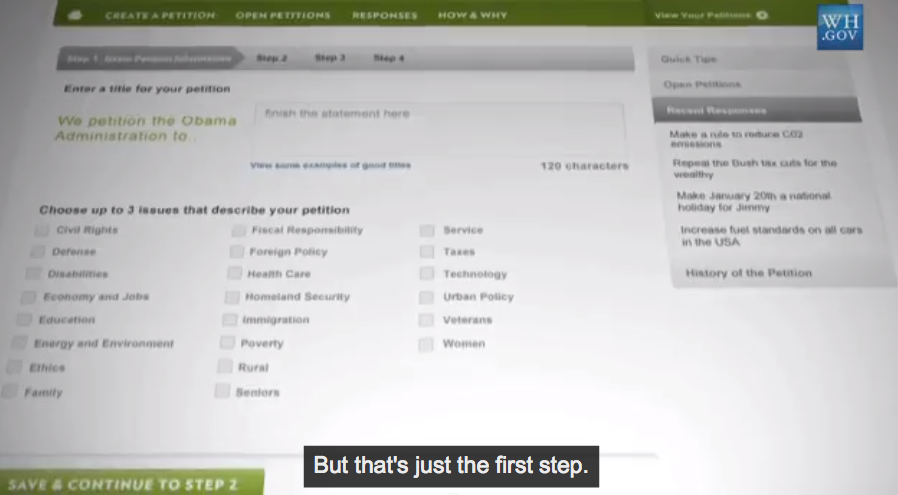
Can citizens ask questions using We The People on whatever topic they wish or will these be predefined? The screenshot below implies the latter categorization: taxonomy, not folksonomy.
Answer: “there will be a defined set of topic people can choose from but its a wide range, and there will also be ad hoc tags,” tweeted Phillips.
Will there be an API so that civic developers can visualize and analyze them to see if there are duplicates or emerging themes?
Answer: “Not now; API’s for analysis & extending petition functionality on a long list of features we we are considering for future. With [federal CIO] Steve upstairs now, thinking through how that can best work is both a priority & more informed.”
Why build this when services like PopVox, Votizen and Change exist to create social e-petitions?
Answer: “Developing We the People ourselves […] offers the flexibility to adapt to the public response to improve engagement,” tweeted Phillips. “It’s a false choice to say _either_ We the People _or_ others – there’s lots of collaboration ahead, this space is still young.”
There’s another key detail: these e-petitions would go to the executive branch, whereas Votizen and PopVox are targeted at Congress and constituent communications.
The creator of act.ly, Jim Gilliam, offered some of his own perspective and questions. “I built a petition/priority tool White House 2 back in 2008. I learned a lot, happy to share,” he tweeted to Phillips, linking to his post on White House 2.0. On this count, the White House was listening: Phillips asked Gilliam to “dm him his email address.” Here’s a look back at “imagining White House 2.0” from the 2009 Personal Democracy Forum:
“I figured out all the problems, except for one. getting the white house to pay attention. (or maybe it just took 3yrs),” tweeted Gilliam.
He highlighted two issues, one for advocates and one for White House technologists: “”How will the white house use all the email addresses it collects with new petition tool? Advocacy groups will have to decide whether to send their people to whitehouse.gov at the expense of their own list building,” he tweeted. “White house will need some serious anti-spam jujitsu to knock back the tools that scrape congressional forms.”
Perhaps most important, how will citizens know that they’re being heard by the White House, that these e-petitions matter, and that this will not be a public relations exercise that ends with a thank you letter from staff?
This goes to the issue of connecting e-petition action to results. “OpenGov has the equivalent of a “last mile” problem: a culture+digital-infrastructure gap at the workgroup level,” tweeted Dan Latorre, leader of Digital Placemaking and creator ofFixCity.org.
For instance, if enough people sign e-petitions on withdrawing from Afghanistan, supporting gay marriage, legalizing marijuana or opposing ICE takedowns of websites without judicial review, will the White House change its policy?
Stay tuned for answers [See above] and upon launch, outcomes.
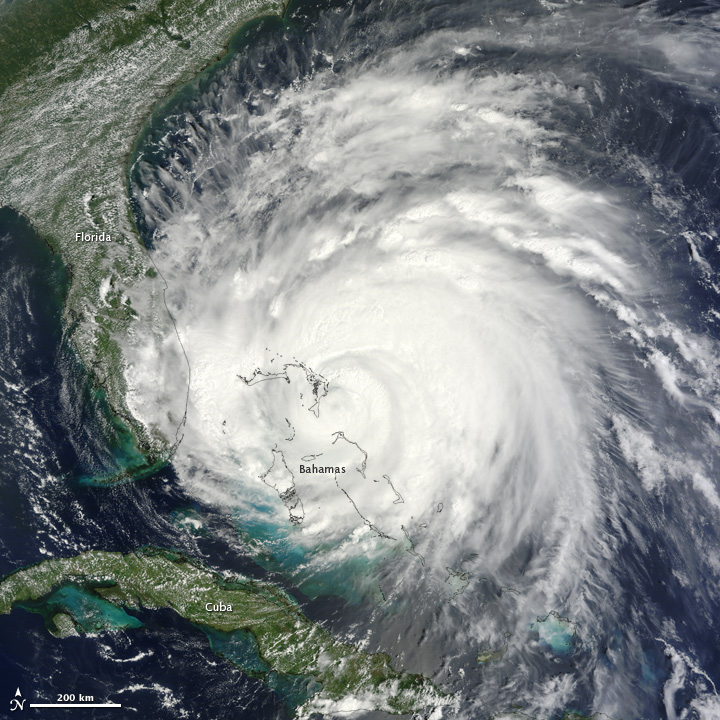
Tens of millions of citizens in the United States are watching as Hurricane Irene churns up the East Coast. If you’re in the path of the immense storm, today is a critical day to prepare. Visit Ready.gov for relevant resources. Unfortunately for citizens in my home state, New York City is right in the path of Hurricane Irene. As many New Yorkers look for information online, however, we’re watching NYC.gov is buckling under demand. For part of Friday morning, NYC.gov would not resolve. The outage is providing a real-time experiment in how a megalopolis with millions of citizens provides information during a natural disaster.
As the Village Voice reported, NYC is evacuating the most vulnerable and putting out advisories but city websites are down. As a result, we’re watching how city government is forced to pivot to the Internet and commercial websites, including social media, to get information out.
Dropbox is hosting a Hurricane #Irene Evacuation PDF (It’s not completely clear if city government uploaded the PDF or not, when this post was published). NYC chief digital officer Rachel Sterne and the official NYC.gov Twitter account have acknowledged and apologized for the outage and pointed citizens to docstoc.com for the official evacuation map:
What is clear, amidst growing concerns of a multi-billion dollar disaster, is that the New York City government’s website hosting strategy needs to be revisited. According to Provide Security, NYC servers are hosted in a data center in Brooklyn. Spikes in demand are precisely what cloud computing offers to the private sector and, increasingly, to federal government. As hurricane clouds gather, it’s probably past time for New York government to get familiar into cloudbursting or move quickly implementing internal architectures that include a private cloud, through Nebula or something similar, to handle the load. In the context of disasters, surge capacity for government websites is no longer a “nice-to-have” — it’s a must-have.
UPDATE: Civic technologist Philip Ashlock is mirroring NYC Irene data & links on Amazon Web Services (AWS). Even though NYC didn’t move critical resources to the cloud itself, a member of New York City’s technology community stepped up to help the city and citizens in a crisis. That’s Gov 2.0 in action:
The federal government is providing information on Hurricane Irene at Hurricanes.gov and sharing news and advisories in real-time on the radio, television, mobile devices and online using social media channels. A curated list from the Federal Emergency Management Agency (@FEMA) is embedded below:http://widgets.twimg.com/j/2/widget.js
//
If you use Twitter, a key follow this weekend is FEMA Administrator Craig Fugate, who tweets at @CraigAtFEMA. This morning, Fugate tweeted out a link to new digital tools, including a FEMA Android app and text shortcodes. If you’re at risk, this information is for you. Shayne Adamski, senior manager for digital engagement, blogged the details:
In the new FEMA App, you’ll be able to:
Check off the items you have in your family’s emergency kit,
Enter your family emergency meeting locations,
Review safety tips on what to do before, during and after a disaster,
View a map of shelters and disaster recovery centers across the U.S., and
Read our latest blog posts.
When we built the app, we kept the disaster survivor in mind, making sure much of the information would be available even if cell phone service isn’t, so you’ll be able to access the important information on how to safe after a disaster, as well as your family emergency meeting locations.
So as Administrator Fugate said, you can download our app today in the Android market, and look for FEMA App for Blackberry version 6 devices and iPhones in the coming weeks.
FEMA Text Messages
A new and separate service from the new app, our text message updates will allow cell phone users to receive text message updates from FEMA.
Text PREPARE to 43362 (4FEMA) to sign up to receive monthly disaster safety tips
Text SHELTER + your ZIP code to 43362 (4FEMA) to find the nearest shelter in your area (example: shelter 12345)
(For availability of shelters and services, contact your local emergency management agency.)
Text DRC + your ZIP code to 44362 (4FEMA) to find the nearest disaster recovery center in your area (for example, if you lived in Annandale, Virginia with a Zip Code of 22003, you’d text DRC 22003).
We’re excited to provide these two new ways you can access information on your mobile device, in addition to our already existing mobile site – m.fema.gov. Stay tuned to our blog, Facebook and Twitter channels as we roll out our app to the remaining smartphone operating systems and make enhancements to our text messages program.
So download the app or text PREPARE to 44362, and then leave us a comment and let us know what you think. We encourage you to tell a family member, friend, or neighbor as well, so they can have disaster safety information always at their fingertips.
File under “awesome” on a busy morning: receiving an email from the United States Army with a classification “UNCLASSIFIED” and caveats: NONE. Brittany Brown, social media manager for the U.S. Army Office of the Chief of Public Affairs, writes in to share the news that the @USArmy has released a revised social media handbook:
The new edition of the U.S. Army Social Media Handbook includes an expanded operations security (OPSEC) section, a section about blogging and Army Strong Stories and a section discussing how to manage fake Facebook pages and social media imposters. In addition to the new sections, we’ve also included a quick reference guide for both Facebook and Twitter and a 10-page social media glossary.
The Army’s handbook has much in common with the US Navy social media handbook, although there’s no handy tagline for me to add on like “loose tweets sink fleets.” Both guides offer common sense advice that’s clearly worth repeating: don’t post geolocated updates about your unit’s movements or other information that could be of use to enemy combatants or criminals.
What Brown highlights out regarding guidance on imposter accounts, however, is significant. According to the guide, “the practice of impersonating soldiers for financial gain is significant.” The same phishing activity that targets the rest of the users on social networks is a problem for the military as well. Beyond that, there’s every reason to believe that impersonations are also a vector for gathering information that can be used to spear phish more sensitive intelligence. Caveat tweeter.
A 3D map of the earthquake from DC-based DevelopmentSeed, embedded below, visualizes the intensity of the tremblor.
Thankfully, today’s earthquake does not appear to have caused any deaths nor collapsed buildings or bridges, although the National Cathedral sustained what officials call “substantial earthquake damage.” Longer term earthquake damage in DC will take time to assess. Eric Wemple has a comprehensive assessment of earthquake coverage that includes links to more logistical details and assessments, if you’re interested.
He also highlighted a critical resource for an increasingly mobile citizenry, m.fema.gov/earthquake, and hurricanes.gov, which will be an important source of information as Hurricane Irene moves up the coast.
While both DC residents and people across the United States took the opportunity to joke about the quake using Twitter, a more sobering reality emerged as residents found themselves unable to make phone calls over overloaded cellphone networks: social networks offered an important alternate channel to connect with friends, family and coworkers. In the context of overloaded networks, the Department of Homeland Security offered earthquake advice: don’t call. In fact, DHS urged urged citizens to use social media to contact one another. The White House amplified that message:
Citizens didn’t need much urging to turn to social networks after the quake. According to
Facebook hosts conversation with Red Cross on social media in emergencies
The day after the earthquake, in what turns out to be an unusually good scheduling choice, Facebook DC is hosting a conversation with the Red Cross on the use of social media in emergencies. As a new infographic from the Red Cross, embedded below, makes clear, the importance of emergency social data has grown over the past year.
The Obama Administration’s Open Government Directive required Federal Agencies to publish Open Government Plans describing how they would become more transparent, participatory, and collaborative. Before this research, the public participation elements of the plans had not been subject to an in-depth analysis. We reviewed the more than 1,000 pages contained in the plans of the 29 Agencies that were included in the White House Open Government Dashboard and compared them to the standards used often by practitioners in the field of public engagement that we believe are most important.
The report, embedded below, highlights best practices for public participation and suggests ways to enhance the role the public has in shaping federal policy, including implementing the ExpertNet open government platform.
Overall, the administration received mixed marks. While the AmericaSpeaks found that agencies “display an admirable willingness to experiment with new tools and techniques to involve citizens with their decision-making processes,” the “Open Government Initiative and most Federal Agency plans have failed to offer standards for what constitutes high-quality public participation.”
On the one hand, agencies are increasing the number of people devoted to public engagement and using a range of online and offline forums. On the other, “deliberative processes, in which citizens learn, express points of view, and have a chance to find common ground, are rarely incorporated.”
Separately, University of Pennsylvania professor Cary Coglianese prepared a report to the Administrative Conference of the United States on the use of electronic media in the rulemaking process. Here’s the short version: agencies should use social media more, involve the millions of non-English speaking members of the public and significantly upgrade, streamline and optimize agency websites. For the long way, read on:
Using hierarchical linear regression (N = 2,368) with gender, ethnicity, and parental education level as control variables, I found that time spent on Facebook was a significant positive predictor of time spent in campus activities.
Although time spent on Facebook was a significant positive predictor, it wasn’t the strongest predictor of time spent in campus activities. In fact, it was the weakest predictor. The strongest positive predictors, in order of strength (with strongest first), were:
1. Creating or RSVPing to events on Facebook
2. Commenting
3. Viewing Photos
4. Average time spent on Facebook per day
There were also negative predictors of time spent in campus activities. In order of strength, they were:
1. Posting photos
2. Checking up on friends (or what students call “stalking,” “creeping,” or “lurking”)
3. Playing games on Facebook
It’s an interesting data point, although it’s just part of a larger body of work that’s giving us insight into how our our offline lives are connected to our online lives. The new research does provide a specific example of how the social side of the Internet is increasing its importance in civil society.
Increased campus involvement in activities is not on the same order of civic engagement as toppling an autocratic government or exposing systemic corruption. That said, this research does give us more insight into how the role of the Internet as a platform for collective action could be extended to local government by citizens that are active on social networks, in terms of awareness of town halls, public hearings on notices or, this time of year, ice cream socials.
In 2011, it might feel a little late for federal agencies to be issuing social media policies. How governments use social media has shifted from a niche concern, debated by new media and policy wonks, to an issue that makes international headlines when global leaders alternately decry or celebrate the impact of connection technologies upon their countries.
Think again.
As anyone who has worked in a federal bureaucracy will tell you, squaring usage policies with rules, regulations and laws is a fundamental need if there’s going to be any progress towards 21st century governance.
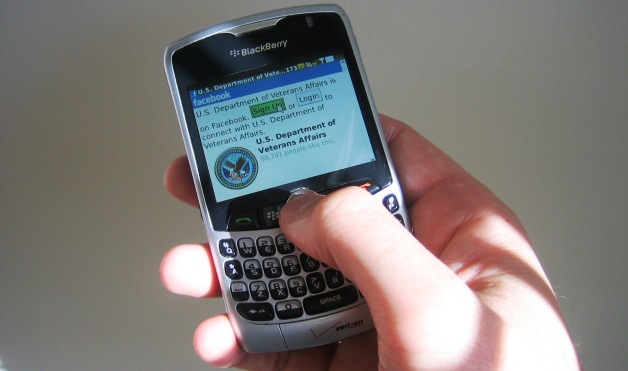
“One of the biggest, long-standing complaints about VA is how it’s an opaque, monolithic bureaucracy that doesn’t respond to the needs of vets,” writes Brandon Friedman (@BrandonF), director of online communications for the U.S. Department of Veterans Affairs, in an email today. “We’re finally putting a human face on it. Everything we post on our blog or our main Facebook page or Twitter feed has a name attached to it. This shows even the largest, slow-moving federal agencies can make progress in becoming more agile and responsive.”
There’s also a matter of default for usage of these tools: open, versus closed. Consider that the emphasis below is the VA’s:
The use of Web-based collaboration tools such as social media tools is highly encouraged. Web-based collaboration is intended for information sharing within and outside of VA. To increase accountability, promote informed participation by the public, and create economic opportunity, the presumption shall be in favor of openness (to the extent permitted by law and subject to the exclusions noted in this Directive or other policy)
The entire policy, which has to be considered progressive for an organization with military DNA, is embedded below or available as a PDF. Given the stance that other federal agencies have taken recently on social media usage, this policy is not a watershed but is extremely important to over 300,000 VA employees and the millions veterans they serve. If access to Internet-based capabilities is critical at the Department of Defense, similar access for veterans is important.
Today’s announcement also serves as a reminder that the VA has come a long way in a short time, particularly in the context of an enormous government institution. “Less than two years ago, VA’s primary method of engagement with the public consisted of telephone calls and the USPS,” wrote Friedman. “Today, hundreds of thousands of veterans can get help navigating the bureaucracy via social media. We can also make a direct difference in peoples’ lives. One example I use concerns suicidal ideation on Facebook and Twitter. We’ve actually intervened in at least half a dozen instances where veterans have talked about killing themselves. We’ve been able to jump in and link them up with assistance. As we always say here, it’s about leveraging new technology to get the right information to the right veteran at the right time. For so long, many veterans have lost out on the benefits to which they’re entitled because they weren’t even aware of them—or they didn’t want to deal with a complex bureaucracy. Social media allows us to get them the information and to help ease the transition from the military into the VA system.”
It’s an important shift. Next up? Work to leverage technology better to reduce the backlog in veterans’ benefit applications and help vets who have returned from service abroad get back to work in a down economy.
Getting social with security and privacy
Embedded in this policy is are security and privacy provisions that instruct to the deputy assistant secretary for information security to issue an information protection policy, do a risk assessment, provide patching, training and a “Trusted Internet Connection” for the desktop images of VA users.
There is also instruction for the director of the VA privacy service to address policy concerns and to public affairs, granting “the authority to disapprove any outward-facing content on official VA blogs and social media sites which do not meet accepted standards of quality,” along with audits to ensure same.
For a deeper dive into what social media means to the military, read this talk on connection technologies and global organizations. It’s by U.S. Navy Chief of Naval Operations Roughead, a title which effectively makes him the “CEO” of that global enterprise. He talked about “burning the boats” as the Navy enters this operational space — an extremely powerful metaphor, given his occupation — but perhaps a fitting one, given that achieving and maintaining situational awareness in a changing information environment has become a strategic capability.
As the VA looks to support the considerable needs of the men and women who have served their country, it looks like social media will be a part of the plumbing that connects them together.
The results of a new survey from the Pew Internet and Life Project will come as no surprise to most: Internet users: search and email top the list of the things people do online. These two activities have been the most popular since Pew first started tracking online behavior over the last decade. The advent of broadband, mobile devices and social media has not changed that dynamic, though it’s a safe bet that adults under 30 are sending quite a lot of Facemail, IMs and tweets these days too.
That said, Pew did identify a difference. “The most significant change over that time is that both activities have become more habitual,” writes Kristen Purcell. “Today, roughly six in ten online adults engage in each of these activities on a typical day; in 2002, 49% of online adults used email each day, while just 29% used a search engine daily.”
Search and email demographics
According to Pew’s numbers, search is most popular among adult internet users aged age 18-29, 96% of whom use search engines to find information online.
There’s also some evidence of a continuing digital divide based upon education and race. According to Pew, online adults, college-educated, and those in the highest income categories are more likely than others to use email.
“These demographic differences are considerably more pronounced when one looks at email use on a typical day,” writes Purcell. “Moreover, while overall email use is comparable across white, African-American and Hispanic online adults, internet use on any given day is not. White online adults are significantly more likely than both African-American and Hispanic online adults to be email users on a typical day (63% v. 48% v. 53%, respectively).”
These results also suggest that as exciting as the integration of social media into government may be, officials tasked with public engagement and consultation shouldn’t neglect using email to communicate with citizens, along with Facebook, Flickr, Twitter, YouTube and the other apps available to them. The difference in demographics usage of social media and email, however, does highlight that social media offers an important complementary channel to reach mobile citizens that access the Internet primarily through their mobile phones.
If most of former United States Speaker of the House @NewtGingrich‘s followers on Twitter are “fake” or inactive, they’re more likely to have primarily come through a gift from Twitter in 2009 than any clandestine campaign purchases. Remember when Anil Dash wrote that “Ryan Osborn does too, (@Rozzy) over at NBC News, who reminded me of Dash’s post today.
The issue of “fake followers” arose today after an incendiary post by John Cook over at Gawker sourced the comments of an anonymous former campaign staffer alleging that Gingrich paid “follow agencies” to create some 80% of his followers. Mashable has picked up the story, asking if the former United States Speaker of the House bought most of his Twitter followers.” The allegations surfaced today a few weeks after Politico published a glowing story about “Gingrich being miles ahead in the Twitter primary,” with “an impressive 1.3 million followers.”
Unfortunately, covering this election season as a “social media horse race,” with social media followers numbers as a 21st century success metric, holds some risks. (OhMyGov, to be fair, generally takes a much nuanced approach than most mainstream outlets.)
All three writers (and their editors) have apparently forgotten that Newt Gingrich was added to Twitter’s Suggested User List back in the fall of 2009, about three weeks after an AP story reported that Government” list. He has retained over a million followers since then in the way that Politico depicted — but he didn’t get there through deepy policy wonkery and quick wit alone.
On the one hand, if it’s confirmed that the campaign has been pumping Gingrich’s follower numbers through third parties, it will be yet another case study to add to the rapidly growing pile of political social media snafus and I’ll eat some crow about the origin of those hundreds of thousands of accounts. As Vanessa Fox tweeted, “both methods likely contributed. people/orgs fall back on fakes to drum up #s way too often, but suggested list def much of it.”
On the other hand, if it turns out that media outlets simply developed amnesia about Twitter’s early history, there might be enough crow around to bake a Blackbird Pie or two.
UPDATE: An analysis by social media analytics firm PeekYou supports the anonymous staffer’s accusation of “follower fraud:”
The Consumer Ratio measures the percentage of a Twitter audience that is identified as a “consumer” or “voter” in Newt’s case, vs business, private/anonymous and spam accounts. The average range sits anywhere between 30-60% human depending on this type of account. Newt’s was 8% — the lowest the team had ever seen by 5%.
“We have seen some pretty low ‘Consumer Ratios’ in our testing, but Newt Gingrich’s was the lowest we had ever seen. At first, we actually thought it might have been a bug on our side, but a quick manual look at the data showed our analysis was true,” said Michael Hussey, CEO and founder of PeekYou.
“Once the news broke yesterday the team went back to look at the report. The data supported that out of Newt’s 1.3 million followers only 8 percent (2 percent less than claimed in recent media reports), are identified by our algorithm as humans, meaning Newt’s follower count is really closer to 106,055,” continued Hussey.
When assessing those approximately 100,000 followers via PeekAnalytics, the company established that 67% are male, 41% are over 35 years old, and 61% have less than 100 online connections. Using normalized population data, the top 5 states for legitimate followers are Georgia, North Carolina, Pennsylvania, Texas, and Wisconsin. In addition, more than the majority write a blog (typically supporting press/blogger interest) and favor Facebook as their social network of choice.
UPDATE II: Indiana University has posted an analysis of the 2012 presidential candidates’ Twitter followers that offers some more insight. In the chart below, pulled from Indiana’s post and data, the data from a random sampling of 5000 accounts following the candidates is displayed. Smaller values correspond to bluer colors, larger values corresponding to redder colors. Draw your own conclusions.
*I was added to Twitter’s “Technology” recommendations in early 2010, after the SUL was scrapped for an algorithm that I suspect is at least partially based on Lists. My Twitter account @digiphile) now has nearly 90,000 followers, up from 7,500 or so. While I think most of you are real, I suspect some of those accounts are similarly inactive or (gasp) robots. I haven’t had the time to weed through tens of thousands of notifications to groom them out. If you’ve made it to the end of this post, know that I’m much more interested (and grateful) to see how many of you reply to me, read me or share my work than my follower count. It’s ok. Nobody really has 1,000,000 followers, after all, with the obvious exception of @JustinBieber, whose intensely loyal fans have been known to put an unexpected stress test on young photosharing startups.


 Favorite
 Retweet
 Reply
Reply


 E Pluribus Unum