Live from DC/Boston/Canada, it’s Episode 3 of Gov 2.0 TV

Two weeks ago, Gov 2.0 TV launched to cover what’s happening in open government. Today, we’ll be talking about some of the biggest stories of the past week. Tune in to FusedLogic.tv/live to catch today’s show.

http://bitcast-b.bitgravity.com/player/6/functions.js //

Here’s a quick rundown of a few stories we’ll be talking about:

White House turns to Twitter to discuss President Obama’s Middle East speech

The role of mobile phones, Facebook, YouTube and Twitter in the revolutions that have swept the Middle East in 2011’s historic “Arab Spring” has been the subject of much debate for months. While connection technologies helped to accelerate and amplify the news coming out of Egypt, Tunisia, Syria, Yemen, Libya, Bahrain and the rest of the region, it’s the incredible bravery of the young people who have stood up for their freedom in the streets that made change happen.

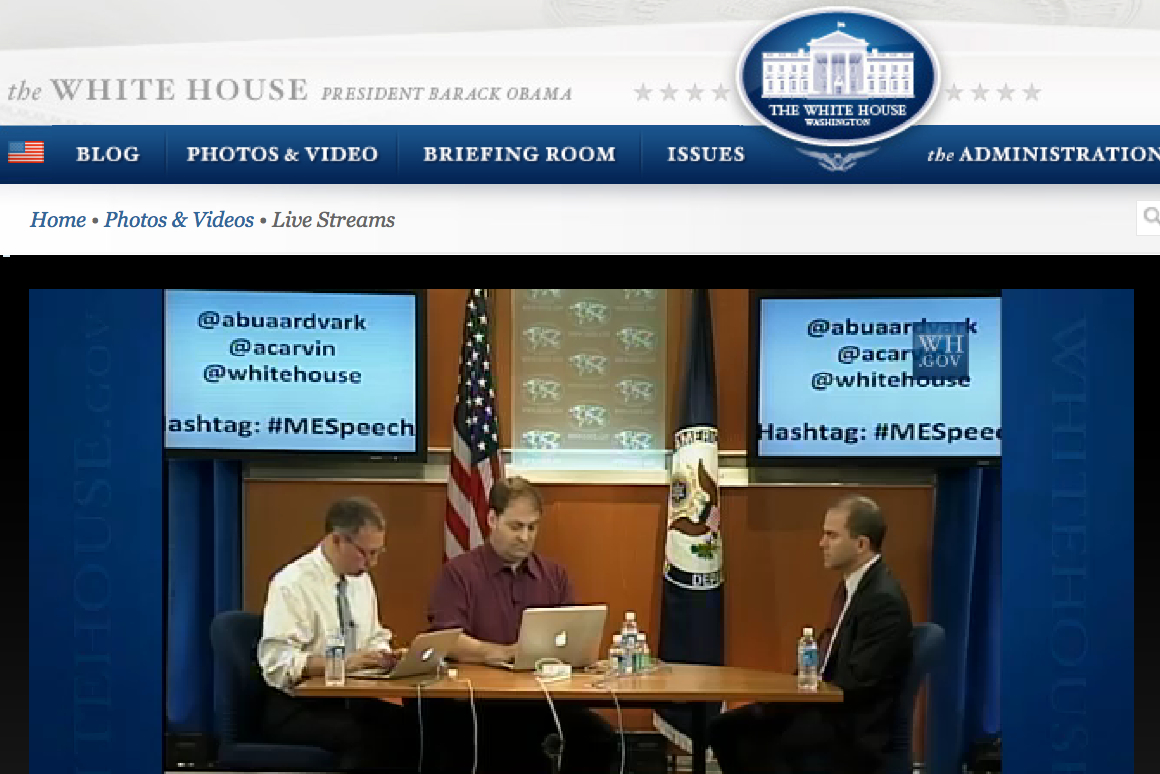
Tomorrow, President Obama will deliver a speech that many experts expect to reshape the Middle East policy debate. The speech will be live-streamed from the State Department and available to anyone online  at WhiteHouse.gov/live. In conjunction with the speech, the foremost curator of online media about the Arab Spring, Andy Carvin (@acarvin), will join with Foreign Policy’s Mark Lynch (@abuaardvark) in hosting a Twitter chat on the Middle East that will include an interview White House deputy national security advisor Ben Rhodes after the president concludes his remarks.

Earlier today, White House new media director Macon Phillips (@macon44) explained how the White House will continue the conversation on Twitter over at WhiteHouse.gov:

Immediately afterwards, the live-stream will switch to a follow-up Twitter chat with Deputy National Security Advisor Ben Rhodes, where anyone will be able to pose questions and reactions via Twitter.

NPR’s Andy Carvin (@acarvin) and Foreign Policy’s Marc Lynch (@abuaardvark), two experts who bring both a deep understanding of foreign policy and extensive online networks, will facilitate a world-wide conversation that will include participants from the Middle East and North Africa.  As Andy explains:

Rather than come up with all the questions ourselves, we’d like to invite you to help us craft the questions. If you’re on Twitter and want to submit a question, please post a tweet with your question and include the hashtag #MEspeech in the tweet. You can pose your question before or during the speech. We won’t be able to get to every question, of course, so we encourage everyone to follow the #MEspeech hashtag and join the broader conversation about the speech on Twitter.

Folks at the White House (@whitehouse) will be keeping an eye on the #MESpeech hashtag as well, so be sure to use that to share thoughts before, during and after the speech.

Keep an eye on that hashtag tomorrow: this will get interesting.

//

UPDATE: I’ve embedded the archive from today’s Twitter chat at the end of the post along with video from the White House. Quick thoughts on the outcome of today’s “Twitter chat.”

1) I thought Carvin and Lynch did a phenomenal job, and that this was well worth their considerable effort. Carvin described the experience of a Twitter interview as akin to “juggling and riding a unicycle simultaneously, all the while trying to interview a senior administration official.” The two men asked tough questions from a global audience, starting with fundamental issues of trust and policy towards Bahrain, shared the questions and answers as they went on Twitter, often including the @ handle of the person who asked them. The result was a fascinating window into one future of new media, geopolitics and journalism. The considerable trust that they were given to find and ask the best questions was, in my eyes, paid back with interest. Well done.

2) It was also hard not to see a marked contrast between the recent “Facebook townhall” where founder Mark Zuckerberg asked President Obama all of the questions and Andy Carvin bringing questions culled from a real time global conversation to Ben Rhodes.

3) On a week when the executive editor of the New York Times offered considerable skepticism about Twitter’s value, this event serves as a quiet, powerful reminder of the platform’s global reach in the hands of those willing to fully engage the public there.

4) Poynter has an excellent background post regarding why NPR’s Andy Carvin is moderating the White House Middle East speech Twitter chat. NPR’s managing editor for digital news explained:

“Andy has cultivated a unique audience and following around the world and is the right person to carry on a conversation and channel a wide range of questions from around the world. He’s been doing it for months.”

If the interview were being conducted another way, Stencel said, perhaps a program host or a beat reporter would’ve done it.

Carvin “has the talent in this format that our hosts have in commanding the air. Andy is in essence the Neal Conan [host of NPR’s “Talk of the Nation”] of social media. He understands the format and he can conduct the interview in a way that takes a combination of smarts and skills that’s rare in media.”

That’s about right. In May 2011, there is no one using Twitter in this way more effectively than Andy Carvin. He has been more actively and deeply engaged in finding, validating and distributing the digital documentary evidence emerging from the Middle East on social networks and video sharing sites over the past six months than anyone else on the planet. He’s been storytelling using what Zenyep Tufecki aptly called “Twitter’s oral history” in a way that brings the voices and vision of millions of people crying out for freedom to the rest of the world. Today, he brought their questions into the State Department and White House. Pairing him with a foreign policy expert in Lynch brought significant weight and contextual experience to interviewing Rhodes. Well done.

For more, Nancy Scola wrote up Carvin and Lynch’s ‘Twitter interview’ with Rhodes over at techPresident. As always, she’s worth reading on it.

Nigel Shadbolt on data.gov.uk: Open data is not a partisan issue

Catalyzing innovation and adding more transparency to government through the release of open data is an issue that should rise about partisan politics. At least, that was the message that Nigel Shadbolt, an advisor to the United Kingdom, delivered at a conference in Bilbao, Spain yesterday.

Opendata : les leçons à tirer de data.gov.uk, par Nigel Shadbolt from RSLNmag on Vimeo.

Shadbolt’s presentation on how they did data.gov.uk, the British open government data website will offer some fuel to the arguments of advocates in other countries or states working to justify standing up similar repositories – or defend one that are already online. In his presentation, below, Shadbolt offers up a range of arguments, including more accountability, citizen engagement, improvement to public services, government efficiency, benefits to economic and social value, and that “government as a platform” idea that continues to maintain traction around the globe.

Opendata – data.gov.uk : how did we do it?

It was only last month, after all, that the United States Congress weighed deep cuts to funding for federal open government data platforms, with the final budget slashing the White House Office of Management and Budget’s e-government fund by some 75%. As data.gov relaunches as a cloud-based platform, the arguments for open data that Shadbolt advances will need to be born out with favorable outcomes in at least a few areas over the coming year to shore up bipartisan its continued operations. The brightest hope for those outcomes is likely to come from health.data.gov, a subdomain of the main open government data repository, where the U.S. Department of Health and Services has been working to making health data as weather data.

For more on the United Kingdom’s open government initiative and the open data movement, watch Shadbolt’s talk from February 2011 of this year, embedded below:

[Hat tip to the Australia E-Government Research Center]

Data.gov relaunches as a cloud-based open data platform

There’s a new version of data.gov going online. For those keeping track, Data.gov is the open data website that the United States federal government launched two years ago. The most recent iteration integrates the services of Socrata, a Seattle-based startup that has quietly been helping cities and states around the country to get their data online. For more on the new version of Data.gov, check out explore.data.gov or watch Socrata’s introductory video about the changes.

One caveat: It was only a few weeks ago that Congress cut funding to open government data platforms by 75% – which includes data.gov. Federal CIO Vivek Kundra has not made any public statements about how the remaining $8 million dollars of the Office of Management and Budget’s e-government funds will be allocated, but given the ongoing revamp of data.gov, the smart money, so to speak, looks to be that the premier federal open government website will not only stay online but gain more functionality.

For a more personal look, here’s a video interview I recorded with Allen Vander Wallie, a program manager for Data.gov at the U.S. General Services Administration, where he talks about the potential for open data.

With a new road map, New York City aims to be the nation’s premier digital city

Today, New York City released its strategy to use technology to improve productivity, save money, attract startups and upgrade the services it provides to citizens. That’s a tall order, but then New Yorkers have rarely been know to think small or dream moderately.

“We want New York City to be the nation’s premier digital city – in how local government interacts with New Yorkers, in how New Yorkers have access to and capitalize on new technologies, and in how our tech and digital media sectors evolve, grow businesses and create jobs,” Mayor Michael Bloomberg said in a statement. His office released an official statement digital roadmap at MikeBloomberg.com. “NYC’s #digitalroadmap has 4 goals: access, open government, citizen engagement & expanding NYC’s digital job growth,” tweeted Bloomberg after the announcement.

Nick Judd secured an advance copy of NYC’s road map to the digital city over at techPresident, which I’ve embedded below, and has this analysis of some of the important bytes.

There are no explicit plans in the report for increasing the number of available datasets — such as more detailed city budget data — but do include an “apps wishlist” to streamline the process of requesting more data.

Implementing the recommendations in the report will in large part be the responsibility of city Department of Information Technology and Telecommunications Commissioner Carole Post, who is already in the process of pushing internally for updated city IT.

Archived video of today’s announcement by Mayor Bloomberg and NYC chief digital officer Rachel Sterne (which was, appropriately, livestreamed online) is embedded below.

Watch live streaming video from nycgov at livestream.com

While some media outlets will focus on NYC embracing Twitter, Facebook and Foursquare as digital partners, a notable aspect of today’s news that may fly under the radar may be that NYC.gov will be adding APIs for Open311, its open data mine and other Web efforts. Those are the open government pillars that will support New York City’s effort to architect a city as a platform. For more on how New York City is citizensourcing smarter government, head on over to Radar.

Social media will play a role in the months ahead. When Adam Sharp, Twitter’s government guy, tweeted out the Wall Street Journal above, he highlighted a feature that melds social media with old school mobile technology: the use of “Fast Follow,” a function that goes back to Twitter’s earliest days.

“New Yorkers who want to follow @nycgov by SMS can text “follow nycgov” to 40404. No @Twitter acct or computer needed,” tweeted Sharp.

That means that every resident with a phone call can receive updates from the city’s official account. It will be interesting to see if city government advertises that to its residents over the coming months, particularly in areas where Internet penetration rates are lower.

Anil Dash, native New Yorker, blogger and entrepreneur, highlighted something important in the plan that transcended any particular initiative, technology or policy: it captures New York City government thinking about the Web as a public space.

It’s an extraordinary document, and as someone who loves the web, civic engagement, public infrastructure and New York City, it feels like a momentous accomplishment, even though it marks the beginning of a years-long process, not just the end of a months-long one.

But the single biggest lesson I got from the 65-page, 11.8mb PDF is a simple one: The greatest city in the world can take shared public spaces online as seriously as it takes its public spaces in the physical world.

As you’d expect, there’s a press release about the Digital Road Map, but more reassuringly, the document demonstrates the idea of the web as public space throughout, making the idea explicit on page 43:

Maintaining digital ‘public spaces’ such as nyc.gov or 311 Online is equally important as maintaining physical public spaces like Prospect Park or the New York Public Library. Both digital and physical should be welcoming, accessible, cared for, and easy to navigate. Both must provide value to New Yorkers. And for both, regular stewardship and improvements are a necessity.

New York City’s road map for a digital city plan is embedded below. You also can download the digital city roadmap as a PDF.

NYC ODC 90day Report 5-15C(function() { var scribd = document.createElement(“script”); scribd.type = “text/javascript”; scribd.async = true; scribd.src = “http://www.scribd.com/javascripts/embed_code/inject.js”; var s = document.getElementsByTagName(“script”)[0]; s.parentNode.insertBefore(scribd, s); })();

UPDATE: There are some concerns about what happens next out there in the community. New York City resident and director of the CUNY Mapping Service at the Graduate Center of the City University of New York (CUNY) Steven Romalewski also listened in on the announcement and blogged his concerns about ‘open data fatigue“:

I always worry when I see the city touting its technology efforts without also including local Community Boards, neighborhood groups, business advocates, urban planners, other elected officials, etc. who rely on access to public data so they can hold government accountable and do their jobs better. In my view, these groups need the data moreso than app developers. That is why open data efforts and policies are so important.

But the city seems more focused on apps than on community. I understand the economic development appeal of fostering startups. But the open data movement long predated apps.  I highlighted this in my post last year (see the “Misplaced Priorities” section).

Apps are great (I use them constantly, and I’ve even developed one myself). And kudos to the city and its agencies for responding to app developers and making data more open so the developers can do great things with the data (things even the city might not do).

I just hope the latest announcements by the city will result in more real and lasting efforts to make data easier to access than the latest check-in craze. The Mayor already expressed some hesitation to making data accessible when a reporter asked him about CrashStat. CrashStat is a great example of my point — it wasn’t created to be an “app” per se; it’s an effort by a local nonprofit group to use public data to educate the public and hold government agencies more accountable about traffic injuries and fatalities. But the Mayor said he didn’t even know what CrashStat was, while making excuses about not making data available if it’s not in electronic format, or needs to be vetted, or is “sensitive”.  Blah blah blah – we’ve heard all that before and it undermines my confidence in the city’s pronouncements that more data will really be made open.

Model local open government initiative gains traction in Cook County. Who’s next?

The news that Cook County took the model open government directive drafted earlier this year into account in making their own open government policy was a real validation of the hard work of everyone involved at CityCamp Colorado and thereafter.

Belated congratulations to all involved. Like Nick Clark Judd, I think Cook County was the first municipality to adopt the framework.

Last night, it struck me that there’s quite a bit in common with the open government recommendations that councilman-at-large Bill Green recently advanced in Philadelphia.

It will be interesting to see if the model open government directive is adopted by newly elected South Orange Village mayor Alex Torpey, a new media consultant who ran on an open government and technology platform. Chicago mayor-elect Rahm Emanuel, by way of contrast, appears to have drafted an open government transition plan without any such directive, although it does include key principles of open data and transparency.

If anyone hears of other cities adopting the model local open government framework, please do share.

Architecting a city as a platform [VIDEO]

The 21st century metropolis can be a platform for citizens, government and business to build upon. The vision of New York City as a data platform has been getting some traction of late as the Big Apple’s first chief digital officer, Rachel Sterne, makes the rounds on the conference circuit. In the video below, Sterne gives a talk the recent PSFK Conference where she highlights various digital initiatives that NYC has rolled out.

PSFK CONFERENCE NYC 2011: Rachel Sterne from Piers Fawkes on Vimeo.

During her talk, Sterne talks about “The Daily Pothole,” how NYC is tumbling, QR code technology on building permits, a NYC 311 app and using Twitter, amongst other themes.

For more on how New York City is citizensourcing smarter government, head on over to Radar.

[Hat tip: PSFK]

Britain seeks alpha

In the United States, government agencies like the FCC have launched open government websites in beta. In the United Kingdom, the United Kingdom is rolling back one more version and seeking alpha.

Alpha.gov 404 error page

Alpha.gov.uk is an experimental prototype of a new, single website for government in the United Kingdom that the Government Digital Service developed over the course of three months, working from the recommendations of Martha Lane-Fox’s Review. That service is located within the UK Cabinet Office. As its designers emphasize, “the site is a demonstration, and whilst it’s public it’s not permanent and is not replacing any other website.” (The hilarious 404 graphic above was designed by Matt Blease.)

There are some interesting semantics to consider here. In software development, “alpha” refers to the initial release in a software development cycle. In machine learning, alpha is “the degree to which a learning agent takes into account new information.”

In either sense, a government seeking alpha in rebooting its online presence is both taking risks and revisiting what government websites should do in the 21st century. The trial of Alpha.gov.uk offers a toolkit of simple, reusable functions that are oriented around the most common needs that citizens go online to address, like lost passports.

To date, the British plan to reinvent websites has received good press, including an excellent post what Alpha.gov gets right. One notable choice in age of austere budgets: going with an open source platform and using next generation web development tools and languages, including a mix of Ruby and Python. Says Wired UK:

This isn’t the first time that the government has experimented with creating a single site for all departments. From URL directories to public service hubs, sites like direct.gov.uk have often tried to shove the whole shebang into one, hulking site with varying degrees of success.

But Alpha.gov.uk’s daring design, 21st century architecture and expansive ambitions (the content can be easily syndicated to new internet platforms, like apps or IPTV),  could be the way forward.

The Alpha.gov team continues to share more about how Alpha.gov was developed at the project blog, encouraging citizens to play with the prototype and send feedback to Get Satisfaction or to @AlphaGov on Twitter or Facebook.

[Image Credit for Alpha.gov Error Page designed by Matt Blease: Ben Terrett]

Opening Chicago: In Year One, Open311 and ‘Apps for Metro Chicago’ will launch

Mayor-elect Rahm Emanuel released his final 2011 transition plan for Chicago today. Emanuel encouraged his followers on Twitter to visit Chicago2011.org to read a copy of the report (embedded below or downloadable as a PDF) and “share your thoughts” on it.

Of note to open government advocates: Page 14

5. Set high standards for open, participatory government to involve all Chicagoans

Why do this? Without access toinformation, Chicagoans cannoteffectively find services, build businesses, or understand how well City government is performing and hold it accountable for results. How will we do this? The City will pos ton-line and in easy-to-use formats the information that Chicagoans need most. For example, complete budget documents – currently only retrievable as massive PDF documents –will be available in straightforward and searchable formats.

The City’s web site will allow anyone to track and find information on lobbyists and what they are lobbying for as well as which government officials they have lobbied.The City will out-perform the requirements of the Freedom of Information Act and publicly report delays and denials in providing access to public records.The City will also place on-line information about permitting, zoning,and business licenses, including status of applications and requests. And Chicagoans will be asked to participate in Open311, an easy and transparent means for all residents to submit and monitor service requests, such as potholes and broken street lights. Chicagoans will be invited to develop
their own “apps” to interpret and use City data in ways that most help the public.

What will be different?

100 Days: A searchable version of the City budget will be posted on-line, after a full review to ensure that its presentation is clear and easy to understand.

Year 1: Open311 and “Apps for Metro Chicago” will launch. Also a broad spectrum of new information will be made available to residents and business owners to enable them to track lobbying activity, as well as status of permits, licenses, and zoning change requests. Starting with the 2012budget, the budget document will be reformed, simplified, and tied to performance.

It should be an interesting first 100 days. The plan balanced good government, with transparency and accountability driven through technology, with an open innovation approach that embraces Open311 and a focus on open data.

Nick Clark Judd wrote up Mayor-elect Emanuel’s promises to open the #$%@ing government over at techPresident, observing that “Emanuel’s transition team also recommends consolidating city infrastructure — IT, vehicle fleets, et cetera — and collaborate with nonprofits and Cook County, the county that encompasses Chicago, to provide some services. This means the City of Chicago might stop providing some services, directing people to nonprofits or the county instead.”

Chicago 2011_Transition Plan(function() { var scribd = document.createElement(“script”); scribd.type = “text/javascript”; scribd.async = true; scribd.src = “http://www.scribd.com/javascripts/embed_code/inject.js”; var s = document.getElementsByTagName(“script”)[0]; s.parentNode.insertBefore(scribd, s); })();

Gov 2.0 gets applied in Oklahoma [#Gov20a]

In the Gov 2.0a conference going on today and tomorrow in Oklahoma, the “a” stands for “applied,” as in implementing technology, processes and people strategy to make government work better. There should be some video going up later, along with pictures from Adriel Hampton and a blog post or three from from the attendees. Until that goes online, the tweetstream has told the best tale of what’s been happening at the conference. I used Storify to chronicle the story online.

http://storify.com/digiphile/gov20a-gov-20-goes-to-oklahoma.js[View the story “Gov20a: Gov 2.0 Goes to Oklahoma” on Storify]