“Participation partition” the newest facet of the digital divide, warns Gruen

Disparities in access to the Internet have been persistent since the scratchy sounds of a modem were first heard in offices, basements and schools. In recent years, the digital divide has grown to encompass smartphones usage, differentiation of broadband Internet and open data’s role in empowering the empowered.

Dr. Nicholas Gruen, CEO of Lateral Economics and the former chair of the Government 2.0 Taskforce in Australia, warned the audience at the Smart Government 2010 conference in Melbourne of a new dimension to the digital divide: a “participation partition” that favors citizens who are more active engaging in online discourse.

“The world is leaning towards favouring those who participate,” said Gruen. “They have more fun and more influence. If you participate more in your local school and local democracy, you’re going to have more say and more power. I see these things as very healthy, but there isn’t an equality of outcomes for everyone.”

As Rob O’Brien reported in Government News, Australia’s Gov 2.0 Taskforce pushed government entities to participate more online themselves, including encouraging public sector officials and workers to use with social media tools.

“We’ve now got 20 government blogs, that’s a great start. What we don’t have is people participating on blogs,” Mr Gruen said. “I’m not suggesting they should be making controversial comments, but just be a member of a group of people talking about policy issues.”

Redefining Public/Private Partnerships

Dr. Gruen was a featured speaker at the Gov 2.0 Summit in Washington, where he explored public goods in the context of open government and digital citizenship. His talk is embedded below:

For more on what’s been happening in technology and government in Australia, see my report on Gov 2.0 Down Under: Australia and Open Government.

Apps for California Winners Feature Innnovative Mashups Of Open Government Data

Today, California announced the winners of its Apps for California challenge. As the summer comes to an end, there will indeed be an open government app for that in California. As I reported earlier this year at Radar, the app contest was targeted at catalyzing innovative uses of a refreshed Data.CA.gov, which included over 400 major data sources, including XLS, CSV and XML formats, and over 100 million records. The winners will be honored and given prizes at an awards gala hosted by Government Technology’s Best of the Web Competition on September 17, 2010.

Who are the Winners?

So who won and why? According to the Apps for California rules, each entry was judged according to the following criteria:

  1. Providing value to California’s residents and businesses;
  2. Demonstrating Innovation;
  3. Promoting Collaboration and Government Efficiency; and
  4. Ensuring Accessibility and Usability.

WIthout further ado, here are the five winners:


California Cage Fight
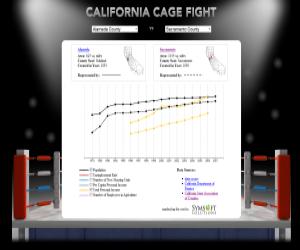
(info page) allows residents to compare their counties with other California counties and the state as a whole, including population growth, per capita income, unemployment, new houses and more.


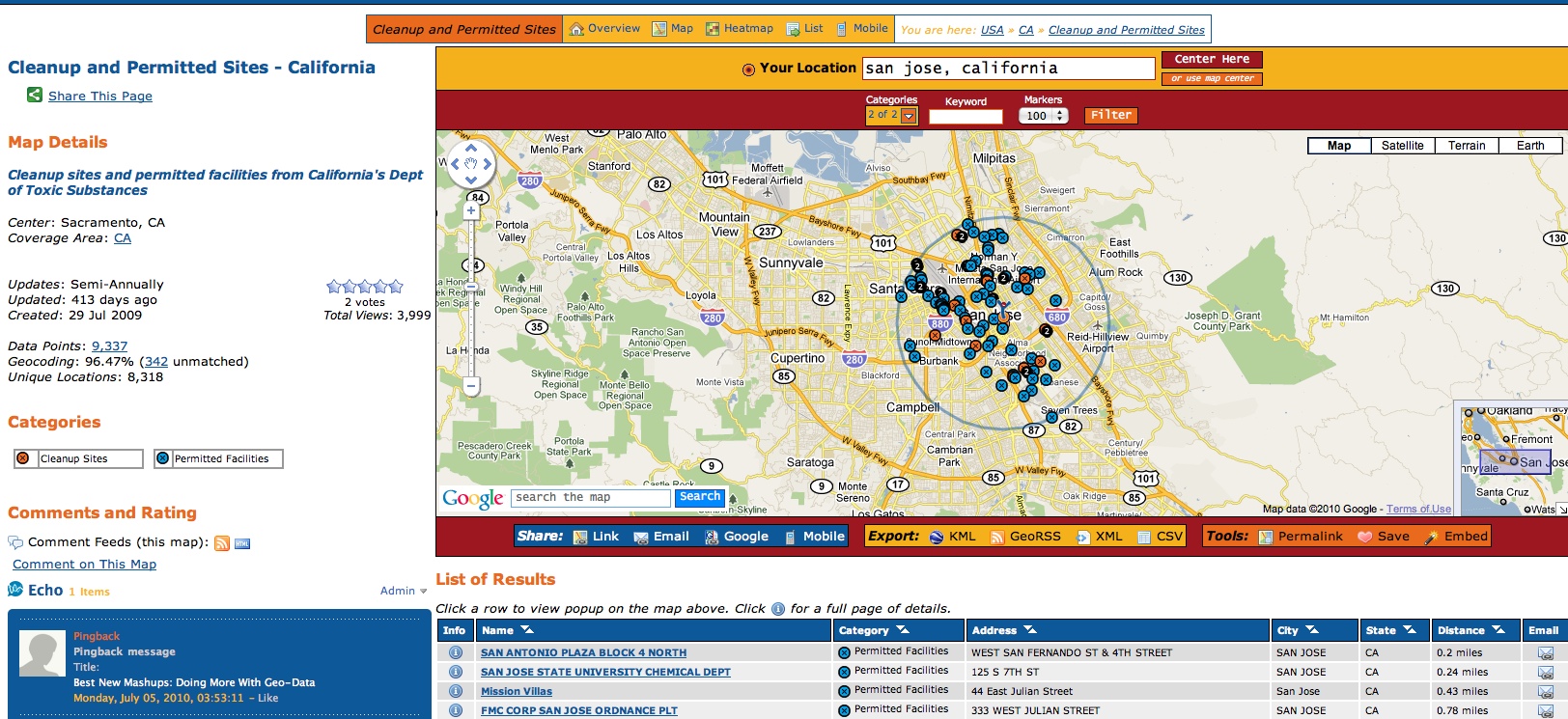
California Environment Report: Cleanup Sites and Permitted Facilities
(info page) provide residents with an interactive map that includes heatmaps, a mobile version with geolocation, data feeds, and detail pages for every cleanup site and permitted dacility from the CA Department of Toxic Substances Control Datasets.


California View
(info page) is a simple mapping tool that displays the locations of California state parks, fishing holes and boating facilities.


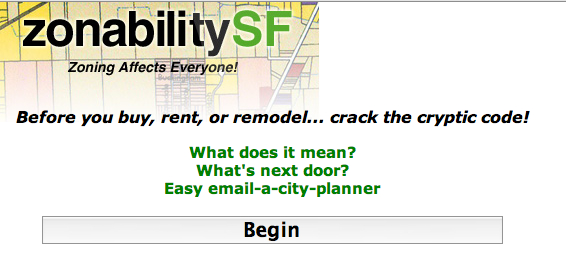
ZonabilitySF
(info page) provides mobile access to San Francisco zoning ordinance information. This app includes geolocation, interactive zoning maps, resources about code and a mechanism to ask a city planner questions.


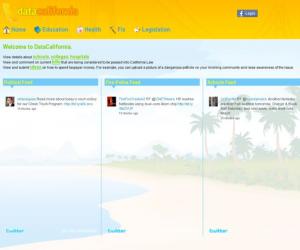
DataCalifornia
(info page) provides a browser for California education, health and current legislation. The mashup allows users to “submit ideas on how the government should spend taxpayer money. Notably, it also has a constant stream of updates from schools, first responders and local politics. The site features Facebook integration, and a “Fix” button  that should be familiar to SeeClickFix users.

People’s Choice Award


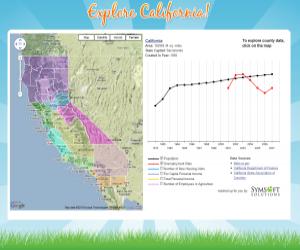
Explore California” (info page) and the California Cage Fight mashups won the People’s Choice Awards. Explore California is similar to Data California, providing users with an interactive map and visualizations population, income, unemployment, new housing units, and other trends over time. Visitors can “compare and contrast the patterns of growth and decline in various categories and the relationships between them.”

What’s do Apps for California mean for Gov 2.0?

At review time, the winners seems like it might have the most potential to enable better outcomes for citizens to engage with government, given the tool. The zoning app could potentially be quite useful to builders or homeowners. And if you’re also an angler, the easy lookup of potential hotspots could be of interest, though old salts might not want the increased competition. A complete list of Apps for California finalists is available at CA.gov.

The contest was conducted by the Center for Digital Government in collaboration with the state of California, the city of Los Angeles, the county of Los Angeles, the city and county of San Francisco, Google, Microsoft and ProgrammableWeb.com. That collaboration featured some of the nation’s biggest tech companies partnering with public institutions to create mashups that of open public data that would provide more value to citizens.

Overall, the state saw over a dozen applications developed over the summer that might have taken it much longer to build internally, and at substantially great cost. Beyond stimulating that activity, however, the success or failure of the contest will likely be judged not upon the prices awarded or the number of apps built but rather whether these applications make the lives of citizens easier or provide more frictionless access to information. That’s a judgement that will only be rendered with time.

New Data.WorldBank.org fuels storytelling with the power of open data

Earlier today, the new data.worldbank.org launched. As I reported for Radar this afternoon, added widgets, maps and an API make World Bank data sing.

The Bank is increasing the number of indicators available on the site from 339 to more than 1,200, and it has substantially improved its API. Four different languages are supported on the site, along with an improved data browser, feedback buttons, instant search, and embeddable widgets.

“The new site shows the art of the possibility,” said Eric Gundersen of Development Seed, the D.C.-based Drupal shop behind the World Bank’s data catalog. “This is really actionable information. So many more NGOs [non-governmental organizations] can now make data-informed decisions if they have access.”

Below, I’ve embedded a video on the power of geo-coding aid.

From the blog:

A team of researchers from Development Gateway and AidData have worked with the World Bank to add detailed subnational geographical information to all of the Bank’s active projects in the Africa and Latin America region. This isn’t just pins in a map showing the country where the money is spent: they have looked through the project documentation to find out as far as possible the geographic coordinates of the actual locations where aid the activities take place.

This video by AidData explains brilliantly what geocoding means, and why its important.

As I also reported at Radar, the World Bank wil be running an Apps for Development contest, launching on Oct. 7.  In addition to the contest, the World Bank will host an open forum on Oct. 7 that will feature experts from the open data movement via live webcasts and a 24-hour chatroom.

David Eaves on Gov 2.0, Open Government and Open Data in Canada

“If you read only one blog in the Gov 2.0 space, you should read eaves.ca” – Tim O’Reilly.

My interview with David Eaves on open government and open data at today’s Gov 2.0 Summit is a reminder why my publisher would offer that ringing endorsement. We talked about the risks and rewards of open data, the state of Gov 2.0 in Canada and the progress of “We government” up across the border. Eaves also revealed that Canadians love Facebook, though perhaps not as much as hockey.

How Socializing Data Built A Better Government Platform

Can social media, open government and an API lead to a better pill identification system? What about a collaborative effort between Big Pharma and the National Institutes of Health (NIH) that could result in pictures of medications on labels for the first time?

As David Hale’s interview in my most recent article at Mashable showed, the power of social media, open data and innovation led to a better healthcare platform at the National Library of Medicine:

Every year, poison control centers get more than one million calls for pill identification. Each one of those calls costs nearly $50. Social software is helping biomedical researchers collaborate on better ways of identifying drugs. “Pillbox is a digital platform for communities to solve challenges related to pharmaceutical identification and reference,” says David Hale, the program manager. The National Library of Medicine’s mission is to gather, curate and distribute the world’s biomedical information, said Hale.

Pillbox is an open government initiative from the National Library of Medicine (NLM) at the National Institutes of Health (NIH) and Food and Drug Administration that could transform how pharmaceuticals are labeled in the future. The interactive web application currently allows visitors to rapidly identify unknown solid medications, like tablets or capsules, based upon their shape, color and other markings. Pillbox remains a research and development project, so users should not be making clinical decisions just yet. Right now there are over 1,000 images of prescription drugs in the system, with many more to come in the next few months.

In the video below, Hale demonstrates the platform:

Hale will share more about new updates to Pillbox and how the healthcare community and developers partnering to restructure federal drug label data at the Gov 2.0 Summit next week in Washington on September 8th.

His last presentation, “Open Gov Ninja 101,” is embedded below:

Rebooting FCC.gov: An interview with FCC managing director Steven VanRoekel

Earlier today, my newest Radar post explained what to expect as FCC.gov is poised for an overdue overhaul featured FCC managing director Steven VanRoekel on participation and building platforms. For the full perspective on what’s next in “FCC 2.0,” check out Radar. Our video interview is embedded below.

FCC Chairman Julius Genachowski and Managing Director Steven VanRoekel will discuss their experiences turning FCC.gov into a 21st-century consumer resource at the Gov 2.0 Summit in Washington, D.C. (Sept. 7-8). Request an invitation.

Gov 2.0: Applying open data to open government

http://www.viddler.com/simple/dbed5110/

Earlier this summer, the Knight Foundation convened a panel of experts on open source and open government at the 2010 Future of News and Civic Media Conference at MIT to consider whether open data can be used to fuel positive social change. If you missed the event or video when it was first posted, it’s well worth your time.

From the Knight Blog:

Ellen Miller, executive director of the Sunlight Foundation, Laurel Ruma, editor at O’Reilly Media, and Nick Grossman, director of Civic Works at OpenPlans, each gave a brief speech and answered topical questions. Although each speaker expressed different ideas about how to foster civic engagement and social change, their strategies all revolved around a similar theme: transparency. The speakers agreed that social change can be fostered by increasing the amount of quality data available and correspondence between residents and their governments.

Miller will be presenting an Open Government Scorecard at the Gov 2.0 Summit next week. It’s a good bet that John Wonderlich’s post on the White House leading practice winners might serve as a preview of her comments.

Collaborative innovation in open government: Is there an app for that?

Could contests help us realize the vision of participatory democracy outlined by Thomas Jefferson, where citizens collaborate with government to solve the nation’s most difficult problems? The White House hopes so. As the Federal Times reported this morning, agencies are trying to crowdsource their way out of problems.

These efforts won’t always work out as proponents might hope. To date, crowdsourcing government reform has had mixed results. The new British government’s first crowdsourcing attempt fails to alter Whitehall line. And as Wired’s Jeff Home observed last year, crowdsourcing and the President were a “failed marriage” when the new administration tried its first online town hall.

That said, in April the White House Office of Science and Technology Policy (OSTP) began requesting public input on how to implement President Obama’s innovation strategy, which calls for new ways to foster economic growth and create high-quality jobs.

“Government does not have a monopoly on the best ideas,” as Vivek Kundra, the nation’s first federal chief information officer, has emphasized repeatedly. To deliver on the promise of innovation for “government as a platform,” as Tim O’Reilly has framed the concept of “government 2.0,” the White House will have to find ways to empower citizens to contribute to the formation and delivery of effective and efficient policy and services.

The idea of a contest to inspire technological innovation, however, is not a novel concept reliant on Web services, born from the fertile mind of a Silicon Valley entrepreneur. One of the most famous scientific achievements in nautical history was spurred by a grand challenge issued in the 18th Century. The issue of safe, long distance sea travel in the Age of Sail was of such great importance that the British government offered a cash award of £20,000 pounds to anyone who could invent a way of precisely determining a ship’s longitude. The Longitude Prize, enacted by the British Parliament in 1714, would be worth some £30 million pounds today, but even by that measure the value of the marine chronometer invented by British clockmaker John Harrison might be a deal.

What has inspired the use of the contests? “There are a number of sources,” said Thomas Kalil, deputy director for policy at OSTP. “The organization that gets the most credit for the renaissance in the use of prizes is the X Prize Foundation. The Ansari X Prize and its success was one of the things that got me excited about the potential of these challenges.” Kalil joined Tim O’Reilly and Lesa Mitchell from the Kauffman Foundation next week at the Gov 2.0 Summit to talk about turbocharging American innovation. Their conversation is embedded below:

The Applications of App Contests

“We created Apps for Democracy with Vivek Kundra and Office of the Chief Technology Officer back in 2008,” said Peter Corbett, CEO of Washington, D.C.-based iStrategy Labs. “[Kundra] said ‘Peter, we have all this open data–it’s probably the most comprehensive municipal open data catalog in the world–but it’s not really useful to anybody because it’s just raw data.”

What Corbett suggested to Kundra was to encourage citizen technologists to build Web applications and mobile services on top of that data. “Build on top of that catalog for fame — and a little bit of fortune.” Within two months, they had 47 Web, mobile and iPhone applications developed. Since then, that method and concept has spread throughout the world, said Corbett. The Department of Defense recently announced the winners of the Apps for Army contest, which could shape the future of defense acquisition.

Apps contests are not just a phenomenon in the United States, either: in Canada, an Apps for Climate Change contest just wrapped up. And in Africa, Apps for Africa is focused on leveraging the talent of local developers in Kenya, Uganda, Rwanda and Tanzania.

“There are ‘Apps for Democracy’ contests in Finland, in Australia and ones on the city level like Portland, New York and London,” said Corbett, highlighting the spread of the paradigm globally. Later this year, an Apps for Development contest will leverage an even bigger open data store soon too, explained Corbett, based upon the World Bank’s open data catalog.

While apps contests may be unlocking government innovation, more recently Corbett has focused his technical evangelism on moving beyond apps contests, to building communities of developers. That’s a focus that former Sunlight Labs director Clay Johnson would endorse, as evidenced by his post on building communities, not apps contests. One bellwether for the success of the method for unlocking innovation may be the results of the Health 2.0 Developer Challenge, which is focused upon engaging the development community to make community health data as useful as weather data through developing healthcare apps.

For more perspective, make sure to read Mark Headd here at Govfresh on his “glass half full” view of government app contests, and the thoughts from former DC CTO Bryan Sivak on government app contests moving from cool to useful.

Creating innovation contests with real results

A recent McKinsey article on the promise of innovation held by prize contests offered further instruction, noting that “most successful prize competitions place an equal emphasis on other elements, such as the broader change strategy, the competition itself, and post-award activities designed to enhance the impact of the prize.”

Kalil agreed with that assessment, observing that a strategy that specifies victory conditions is useful. “That’s why a clear goal, like ‘build a spaceship that can go up 200km, and then repeat that within two weeks,’ is helpful,” he said.

Will hardwiring prizes that leverage public sector investments provide a good return on the commitment of time, prize money and other resources?

“We’re finding that to be the case with the NASA Centennial Challenges Program,” said Kalil. “If NASA had had to pay for all of the capabilities created by the Lunar Lander Challenge, they would have had to put in far more money.”

Corbett said that for D.C., the city estimated the value of the first Apps for Democracy program was in excess of $2.3 million dollars, when compared to the traditional costs associated with procurement and development.

Other early results are also promising. “The government is still in early days with respect to its use of prizes,” said Kalil. “The agencies most involved have been NASA and its prizes. DARPA, particularly the DARPA Grand Challenge, have played an important role in advanced unmanned ground vehicles and robotics. The DARPA Network Challenge showed the power of social networks to gather information in a distributed way.”

Riley Crane, a MIT post-doctoral fellow, shares insights on crowdsourcing from his team’s success in the DARPA Network Challenge below. The interview came after his testimony at a recent Senate hearing on technological innovation and government.

http://www.ustream.tv/flash/video/8698606?v3=1

The success or failure of these challenges and contests may ultimately rest upon the ability of the White House to draw the attention of innovators to the questions posed. Should we expect a live American Idol panel to judge the potential of ideas?

Kalil laughed: “That will depend on the competition.”

There are already dozens of challenges online at the new Challenge.gov today. Below, Bev Godwin from the General Services Administration talks about the new site:

Crowdsourcing innovation through social media

Contests aren’t the only platform that government entities are looking to in order to spur collaborative innovation. Another platform for communication will come from Expert Labs, a non-profit independent lab that is affiliated with the American Association for the Advancement of Science. The open source ThinkUp App being developed by award-winning author Gina Trapani will be used by the White House as a crowdsourcing platform for collecting feedback on grand challenges that are submitted on Twitter.

“This first attempt is about whether we can get people to push the button,” said Anil Dash, director of Expert Labs. “The next attempt will be about seeing if we can get them to contribute to something larger, like a collaborative document.”

Dash said that to be successful, people developing these tools need know what they want to achieve at the outset. “You have to have a purpose-built tool,” he said. “You have to tap into as large of a network as possible, and you need to clearly define the outcome you want.”

Will it be possible to draw attention to huge, difficult problems using social media and the Internet? “Look at the number of people that have watched Bill Gates’ TED talk on zero carbon,” said Dash. “You don’t need to get everyone in the world to agree. It’s a matter of activating the people who want to contribute. It’s about getting the doers to do.”

In the video below, you can learn more about Think Up App from Dash and Trapani’s talk at the recent Supernova Hub conference.

http://www.ustream.tv/flash/video/8591838?v3=1

For more perspective, see Adriel Hampton’s recent interview on Gov 2.0 Radio, “Getting the BrightIdea: Crowdsourcing in government and enterprise.”

On Language: Putting Government 2.0 in Context

Does the public need to understand what the term Government 2.0 means? Many look to my publisher, Tim O’Reilly, to explain, given that he has written eloquently about the topic and worked with Dick O’Neill to convene the Gov 2.0 Summit last year. O’Reilly talked with CBS News this summer about what Gov 2.0 means to him. Others might ask the nation’s technology executives, US CIO Vivek Kundra and CTO Aneesh Chopra, both of whom participated in the Summit in Washington last summer and will join it again this year.

In 2009, the attendees of that summit explained “What Gov 2.0 means to you?” in an online contest, offering up a multitude of interpretations of the nebulous term. Here at Govfresh, Jake Brewer wrote that Gov 2.0 means accountability, better services and economic opportunity.

If you turned instead to Wikipedia for the crowd’s opinion, the entry for “Government 2.0” defines it as:

“a neologism for attempts to apply the social networking and integration advantages of Web 2.0 to the practice of governmentWilliam (Bill) Eggers claims to have coined the term in his 2005 book, Government 2.0: Using Technology to Improve Education, Cut Red Tape, Reduce Gridlock, and Enhance Democracy.[1] Government 2.0 is an attempt to provide more effective processes for government service delivery to individuals and businesses. Integration of tools such as wikis, development of government-specific social networking sites and the use of blogs, RSS feeds and Google Maps are all helping governments provide information to people in a manner that is more immediately useful to the people concerned.[2]

Well and good. The line I find most compelling in the above explanation for the term is the “attempt to provide more effective processes for government service delivery to individuals and businesses.”

If I had to explain the idea to my technophobic friends, that’s the tack I’d take. O’Reilly defined government 2.0 as a platform, which I also find to be a useful metaphor, if one that demands the explanation that O’Reilly himself provided at TechCrunch. More takes on what a definition might be can also be found at Govloop, the government social network, or elsewhere around the Web.

Getting technical with government

For those more technically inclined, it might be useful to talk about open data, mashups, Data.gov, the Open Government directive, XML, XBRL, virtualization, cloud computing, social media and a host of other terms that have meaning in context but without prior knowledge do little to inform the public about what, precisely, the “2.0” means.

Most people have some sense of what “government” is, though there’s no shortage of opinion about how it should be constituted, run, regulated, managed or funded. Those discussions go back to the earliest days of humanity, well before organizing principles or rules emerged from Hammurabi or were enshrined on the Magna Carta or constitutions.

In all of that time, the body politic and its regulatory and enforcement arms have been equipped with increasingly sophisticated tools. In 2010, agencies and public servants have unprecedented abilities because of the rapid growth of online tools to both engage and inform both their constituencies, relevant markets and others within government. The question that confronts both citizens and public servants around the globe is how to turn all of that innovation to useful change. Savvy political campaigns have already found ways to leverage the Internet as a platform for both organizing and fundraising. Few observers failed to see the way that the Obama campaign leveraged email, text messaging, online donations and social networking in 2008.

One area that will be of intense interest to political observers in 2010 will be whether that same online savvy can be harnessed in the Congressional mid-terms. Micah Sifry wrote about an “Obama Disconnect” at length; I leave it to him to explore that question.

What I find compelling is whether any of these technologies can be turned to making better policy or delivering improved services. In theory, good data can be aggregated to create information, which can then in turn be used to form knowledge. Whether the Open Government Directive dashboard at White House.gov reveals information or simply adherence to defined policy is on open question.

Where Web 2.0 matters to Government 2.0

So does the public need to know what Government 2.0 is, exactly? One might wonder if the public needed to know about what “Web 2.0” was? Judging by search traffic and years of Web 2.0 Conferences, my perception has been that there’s interest, if only to know what the next version of the World Wide Web might be, exactly. After all, the Web that Tim Berners-Lee’s fecund mind brought into being has been one of the most extraordinary innovations in humanity’s short history: what could be better? The short answer has often reflected the definition of Government 2.0 above: a combination of technologies that allows people to more easily publish information online, often with a social software or computing component that enables community between their online identities.

In 2010, the dominant platforms that represent Web 2.0 are well known: Blogger, Wikipedia, YouTube, Facebook, Twitter, MySpace, Flickr, Delicious, Digg, Ning, WordPress, StumbleUpon and a host of new mobile communities or platforms. In each case, the company is often defined by what it allows users to do: upload pictures or video, stay connected to friends, track and discover news, save bookmarks or create communities that do all of those things.

When it comes to government 2.0, I believe that’s precisely how any service be defined: by its utility to helping citizens or agencies solve problems, either for individuals or the commons. The “2.0” term provides an umbrellas term for the movement and the technologies. That greater point is precisely the one that Booz Allen’s social lead, Steve Radick, makes when he wrote that the public doesn’t need to know what Gov 2.0 is but they do need to experience it.

Why explaining Government 2.0 matters

As a thought experiment, I asked five different people in the hotel lobby in Los Angeles where I was writing if they knew what “government 2.0” was.

I asked the same question of “Web 2.0.” In every circumstance, no one could explain the term. And yet, in every circumstance, people knew what Facebook, Twitter or YouTube was, including the use of those technologies by government officials.

That’s one reason why Bill Grundfest’s talk at Government 2.0 Camp Los Angeles was a useful balance earlier this year, not least because as a Hollywood resident the creator of  “Mad About You” is thoroughly outside of the Beltway echo chamber. Christina Gagnier, an IP attorney located in LA, wrote about Grundfest’s approach at the Huffington Post in “Gov 2.0: A message from Hollywood to the Beltway.”

As she captured there, the focus of Grundfest’s frequently entertaining interview with Alan Silberberg was grounded in the entertainment business: communicate clearly, humanize what’s being offered and move away from jargon. G

Grundfest had listened to the morning’s unconference sessions and took copious notes, in a way that was novel to this author, capturing the themes, memes and jargon shared in the talks on coffee cups.

That message was delivered to a room, by and large, that knew and used the jargon often used around Gov 2.0. For that audience, getting advice from a true outsider held utility in both its clarity and lack of pretension. Grundfest may not have developed or managed government programs to deliver services but he has certainly learned how to tell stories.

And that’s the rub of it: Storytelling, as journalists and teachers know well, is one of the most powerful ways to share information. It’s an art form and human experience that goes back to our earliest days, as hunters and gatherers huddled around fires to share knowledge about the world, passing on the wisdom of generations.

The activity is scarcely limited to our species, as anyone who’s watched a honey bee shimmy and shake to pass on the details of a pollen gathering trip knows, but humanity’s language skills do tend to advance our ability to convey knowledge, along with the technologies we have at our disposal.

To get beyond the circle of people who are advocates for open government, transparency or innovative use of technology in government, the storytellers will have to get more involved.

That won’t be easy.

As the comments on ReadWriteWeb co-editor Marshall Kirkpatrick’s meditation on getting people excited about government data stories suggest, releasing bulk XML isn’t going to do draw more interest in an over-saturated media environment.

To help people understand what Gov 2.0 is, in other words, focusing on the contributions of people to platforms have to be balanced with explanations of the platforms themselves. Grundfest recommended the use of video, testimonials and other narrative forms to provide an entrance point into the what, how, where and, especially, why of new government technologies or platforms for engagement.

That impetus is why I wrote about a lesser known example of Gov 2.0: putting SEC data online in 1993 this month. Instead of dwelling any further on what Government 2.0 might be or couching discussion or branding in jargon, explain what the technology or platform will do — and what problem it will solve. And at the end of the day, remember that on language, usage drives meaning.

How can government adapt to exponential technological change?

Can the agile development cycle be applied to government? Cory Ondrejka, co-founder of Second Life, offered up a provocative paean earlier this year at the Gov 2.0 LA Camp for more flexible adaption to new online platforms for citizen engagement and empowerment.

“Who will know first if the rules have changed: customers, partners, clients?”

In his talk, Ondrejka drew a fascinating parallel between today’s open government movement and an open data case study from another age: the Era of Sail.

In the The Physical Geography of the Sea,” published in the mid-1800s, a disabled sailor who could no longer serve as crew found something to do from ashore: aggregate the logs of weather, winds and current.

As Matthew Fontaine Maury started aggregating that data, he found patterns. There are better ways to travel.

After he published the data, Maury then shipped to anyone who asked for it and asked for contributions.

That became a worldwide project that created value from information. Maury saw great value in publishing the data “in such a manner that each may have before him, at a glance, the experience of all.”

Notably, President John Quincy Adams agreed. Not long afterwards, the United States created standards for reporting meteorological data and endowed the U.S. Naval Observatory.

Ondrejka suggested that government agencies and those creating applications that use open data a“when possible, write less code, get more data.” When it comes to resources, he asked “who’s cheaper: a silicon or carbon employee?”

His observation that social computing platforms will “require different level of trust, support and information” is apt; citizens now have different expectations from a government that’s gone online than existed in an analog world. As Ondrejka put it, online users represent the “largest focus group in the world.” And in that content, he says, there is a role for government innovation, and it should be occupied by both leaders and citizens.

Ondrejka provided one more “analog” example of how government data was used in the 1800s. By studying harpoon designs,  Maury found that many whales in the Pacific has previously been harpooned in the Atlantic and vice versa. He used that as evidence of a Northwest Passage. While that didn’t go well for subsequent explorers who went north and ran up against a frozen ocean, the ’49ers were able to use the data to reduce the length of time it took to get around Cape Horn. In those days, it took more than 200 days to travel from New York City to San Francisco.

As the Gold Rush was on, time was at a premium, and for “extreme clipper ships” like Flying Cloud, any advantage that could be derived from patterns in the data had economic value. A similar parallel to innovation using government data can be seen today in the use of the global positioning system (GPS) that the U.S. funded.

With any of these technologies, however, there’s a long-standing pattern in technology adoption, the data around which follows a “fairly predictable” curve, said Ondrejka.  That “linear to exponential” is something that’s been true in multiple technologies, from email to the VCR to the DVD to social media platforms like Facebook.

In government, however, applying such technology has multiple considers, including regulations, transparency and cybersecurity.“When you’re driving institutional change, you’re requiring people to be fearless,” said Ondrejka. “Experimental culture doesn’t mean just go try stuff.” Measurement is key. “Stay out of the Church of Assumption.The plural of anecdote is not evidence.”

Concerns about data ownership are also central, as are questions about vendor lock-in or the use proprietary formats. “We need to be careful about not releasing the data that taxpayers pay for,” said Ondrejka.

Ondrejka’s presentation is embedded below. You can read more of his thoughts on government 2.0 at Ondrejka.net.

Cory Ondrejka Government 2.0 LA Opening Keynote http://d1.scribdassets.com/ScribdViewer.swf

The full hour of his talk is embedded below:

Cory Ondrejka Delivers Keynote Address to Gov20LA 2010 from Gov20LA on Vimeo.