Open data and maps tell the local story of unemployment and recovery spending

Washington-based DevelopmentSeed continues to tell dazzling data stories with open source mapping tools. This week, they’ve posted a map of the local impact of unemployment and recovery spending. The map visualizes unemployment rate changes at a county level and folds in total economic recovery spending by the government under the American Recovery and Reinvestment Act of 2009. In the map embedded below, red corresponds to an increased unemployment rate and green corresponds to a lower unemployment rate or job growth. Counties that received less than $10 million dollars in recovery spending have a white pattern.

David Cole explains more in a post at DevelopmentSeed.org:

Over the last year, we see that unemployment dropped in 58% of counties by an average of 0.25 percentage points. On average the Recovery Act funded 31 projects at a total of $24,131,582.47 per county. Nationally this works out to about $282.66 in recovery spending per person.

Overall, it’s impossible to tell for sure how much recovery spending improved the economic situation, because we just don’t know how bad things could have been. It may be the case that without spending, this map would have a lot more red. Or maybe not. What’s interesting here is the local impact and information we are able to see from processing a few sets of open data. Check out how your county is doing compared to its surroundings. How about compared to a more or less urban county nearby?


Strata Conference New York 2011, being held Sept. 22-23, covers the latest and best tools and technologies for data science — from gathering, cleaning, analyzing, and storing data to communicating data intelligence effectively. Save 20% on registration with the code STN11RAD

Presentation: Health Data Innovation at the Wolfram Data Summit

Earlier today, Peter Speyer gave a great talk about the Global Health Data Exchange and health data innovation at the Wolfram Data Summit in Washington, D.C.

For more context, read: about unlocking innovation through opening health data, better mobile healthcare decisions through open data and “Can Todd Park revolutionize the health care industry?

D.C. and Moscow to host bilateral open government codeathon

In less than two weeks, there will be an unprecedented bilateral codeathon between the United States and Russia held in both Washington, D.C. and Moscow, Russia.

The event will last between September 24 at 9AM until September 25 at 5:00 PM and will be held at American University in D.C. and in the offices of Yandex in Moscow.

More details coming soon.

For now, check out Code4Country.org and submit your ideas for civic applications that can help make Russian civil society stronger, solve problems for citizens and enable more government transparency,

Baltimore empowers citizens to act as sensors with new mobile apps, open 311

This past weekend, citizens acted as important sensors as Hurricane Irene washed up the East Coast of the United States, sharing crisis data as the storm moved through their communities and damage reports in its wake.

Baltimore has embraced the open 311 standard with a new 311 API and take a major step forward towards a collaborative approach to reporting issues with the launch of new mobile applications for the iPhone and Android  devices.

“The new 311 Mobile App allows citizens to have real-time collaboration with their government,” said Mayor Rawlings-Blake in a prepared statement. “If you see a pothole, graffiti, or a broken streetlight, you can see it, shoot it, and send it to us — we have an app for that!”

As Philip Ashlock highlighted at Civic Commons in a post on open 311 in Baltimore, the city has a long history with 311:

The City of Baltimore has a long history of leading the way with 311. In 1996, they were the first city to deploy the 311 short code and unified call center, and in 1999, the city launched CitiStat, pioneering the use of statistics based performance management. Now both of these innovations can be amplified by a much more open and collaborative relationship between Baltimoreans and their government through Open311.

Ashlock highlighted another key detail about the integration of the standard by Motorola, which was crucial in DC and San Francisco, the first cities in the U.S. to embrace the Open311 standard.

The launch of Baltimore’s Open311 apps and API was aided by the fact that they were able to leverage the Open311 compliant solutions provided by Motorola CSR and Connected Bits. Baltimore CIO Rico Singleton went as far as to say that their choice of software solutions was influenced by the interoperability provided by the standard.

There are a limited number of citizens who have the time, expertise, passion and education to go clean up public data. There are quite a few more who will report issues in the neighborhoods they live in or work near and share what they see. This kind of mobile networked accountability is going to be a big deal in Africa, Asia and South America very soon. We’ve been seeing early versions of it emerge already during disasters, man-made and otherwise.

With the launch of more mobile applications that connect citizens to existing systems for accountability, city governments are empowering citizens to act as sensors, connecting the real world to the Internet and creating positive feedback loops. That’s good news for Baltimore and beyond.

MySociety launches FixMyTransport to solve transit problems with microactivism

Over in the United Kingdom, MySociety had launched FixMyTransport, a Web application to help citizens solve persistent public transit issues.

According to Tom Steinberg, FixMyTransport is the biggest project for MySociety since they launched WhatDoTheyKnow in 2008.

“This is a huge accomplishment — a nationwide UK system for individuals to document and report problems with any kind of public transportation system,” wrote CivicCommons executive director Andrew McLaughlin this morning. “MySociety has figured out how to route every kind of report to the responsible agency (or even person) — “the service works everywhere in Great Britain, our database has over 300,000 stops and routes for train, tube, tram, bus, coach and ferry.” Great design and interface. Congratulations, +Tom Steinberg and team!”

“We’ve never before launched a site that took so much work to build, or that contained so much data,” writes Steinberg at the MySociety blog, where he explained more about what it’s for. (The emphasis below is mine.)

FixMyTransport has two goals – one in your face, and the other more subtle.

The first goal, as the site’s name suggests, is to help people get common public transport problems resolved. We’re talking broken ticket machines, gates that should be open and stations without stair-free access. We’ll help by dramatically lowering the barrier to working out who’s responsible, and getting a problem report sent to them – a task that would have been impossible without the help of volunteers who gathered a huge number of operator email addresses for us. Consequently the service works everywhere in Great Britain, our database has over 300,000 stops and routes for train, tube, tram, bus, coach and ferry.

The second goal – the subtle one – is to see if it is possible to use the internet to coax non-activist, non-political people into their first taste of micro-activism. Whilst the site intentionally doesn’t contain any language about campaigning or democracy, we encourage and provide tools to facilitate the gathering of supporters, the emailing of local media, the posting of photos of problems, and the general application of pressure where it is needed. We also make problem reports and correspondence between operators and users public, which we have frequently seen create positive pressure when used on sister sites FixMyStreet and WhatDoTheyKnow.

Steinburg goes much deeper into the thinking and process behind FixMyTransport over at Radar today, where he writes about how to create sustainable open data projects with purpose:

I’m not saying it is impossible to hack brilliant things without piles of VC gold. But if you are going to hack something really, genuinely valuable in just a couple of weeks, and you want it to thrive and survive in the real Internet, you need to have an idea that is as simple as it is brilliant. Matthew Somerville’s accessible Traintimes fits into this category, as does FlyOnTime.us, E.ggtimer.com and doodle.ch. But ideas like this are super rare — they’re so simple and powerful that really polished sites can be built and sustained on volunteer-level time contributions. I salute the geniuses who gave us the four sites I just mentioned. They make me feel small and stupid.

If your civic hack idea is more complicated than this, then you should really go hunting for funding before you set about coding. Because the Internet is a savagely competitive place, and if your site isn’t pretty spanking, nobody is going to come except the robots and spammers.

To be clear — FixMyTransport is not an example of a super-simple genius idea. I wish it were. Rather it’s our response to the questions “What’s missing in the civic web?” and “What’s still too hard to get done online?”

As we say here on the Internet, go read the whole thing. If you’re interested in working on stuff making stuff that matters to citizens and make the world a better place, instead of, say, getting them to click on ads, you’ll be glad you did.

New Orleans launches open government data site

Tonight, Denice W. Ross, director of applications for the city of New Orleans, tweeted the news that “NOLA” had soft launched an open data site. There’s not a lot of data there yet but it’s a great start. Data.NOLA.gov is beautifully designed and based upon the Socrata platform, which will give the embryonic site room to grow.

As Ross shared, New Orleans’ new open data site starts its life online with data on parcels, streets, building permits, council districts and census data. The site also has data on post-Hurricane damage assessment that some plucky civic developer or data journalist will likely mash up to good effect.

For those unfamiliar, open government data broadly refers to public sector records that have been made available to citizens. Putting up an open government data platform online is not in of itself a guarantor of more open government, responsive government or good government — but it can be a enabler for all those things, in partnership with public officials, nonprofits, developers, media and citizens.

For a canonical resource on what makes such releases truly “open,” consult the 8 principles of open government data.

I first encountered Ross last year, at the Gov 2.0 Expo in Washington. Ross, who was then affiliated with the Greater New Orleans Community Data Center, gave a terrific talk about “An App We Can Trust: Lessons Learned in Post-Katrina New Orleans.” I’ve embedded it below.

UPDATE: As Leando Oliva shared, today was also the release of the sixth New Orleans Index. According to the Brooking Institute, the Greater New Orleans Community Data Center took on the publication of this index as a solo effort:

Download the Full Report » (PDF)
Download the Executive Summary » (PDF)
Download the Data Tables » (XLS)

American University to host EPA Apps for the Environment hackathon

If you’d like to get your civic hacker on, American University is hosting a hackathon for the Apps for Environment on Saturday, September 3rd. Register to make green apps here.

The pitch for the hackathon includes a “green from the beginning” detail that may catch the eye of sustainable energy advocates:

The hack-a-thon will be located in the spacious new Graduate Research Center adjoining the School of International Service building, which is itself a certified LEED Gold marvel of green technology innovation. With a sustainable design and “cradle-to cradle” philosophy for recycling and reusing building materials, participants will even power their devices with solar and wind offset power so their Apps for the Environment will be green from the first idea until the last line of code.

Come one, come all

The hackathon’s organizers emphasize that this event isn’t just about the District’s local civic coders: “Whether you’re a student at any school in computer science, journalism, a professional in the field, or just have an idea to share (which you can post here http://blog.epa.gov/data/ideasforappscomments/) please join us at the hack-a-thonT”

American University journalism professor David Johnson left a comment on the event page that expands that idea:

…even if you can’t code, you can have ideas. even if you don’t have ideas, you can help spread the word. even if you can’t come to DC or AU, you can join us on twitter, ustream, IRC, GitHub, and other online hangouts… we’ll be all over it. everyone can be a part of this. spread the word to campuses and dev shops. come hack with us.

Open data webinar

Last week, I moderated an EPA webinar on open data and the Apps for the Environment challenge from the D.C. headquarters of the U.S. Environmental Protection Agency.

If you’d like to learn more about Apps for the Environment (and hear a robust conversation about open data and apps contests!) watch the webinar and presentation embedded below.

Apps for the Environment Developer Webinar(function() { var scribd = document.createElement(“script”); scribd.type = “text/javascript”; scribd.async = true; scribd.src = “http://www.scribd.com/javascripts/embed_code/inject.js”; var s = document.getElementsByTagName(“script”)[0]; s.parentNode.insertBefore(scribd, s); })();

Hackathon coordinates

If you would like to participate in the AU hackathon, you can put your civic surplus to work from 9 AM to 6 PM at the location below:

Head on over to the event page on Facebook for more details and register to make green apps at Eventbrite.

Carmi Levy: open government is about leveraging technology and citizens to do more with less

It looks like the dog days of August 2011 may be the month when the meme of a citizen-centric government gets some traction in the business world. Over on the finance section of Yahoo Canada, Carmi Levy writes that the future of government is citizen-focused.

Levy cites open government in British Columbia and initiatives in New Zealand, Toronto, and Lousiana as case studies for his thinking and then connects the dots with the big idea: that technology enables officials to empower citizens to work with government in new ways, driven by macrotrends towards open data, mobile connectivity, social media and austerity measures.

…governments are increasingly giving citizens free rein to do as they wish with previously inaccessible data. Costs are significantly reduced as big, conventional IT projects are replaced by more on-the-fly approaches to resource management. Timelines are also cut down to size thanks to the use of agile development methods and more collaborative models. Crowdsourcing also maximizes the use of newer technologies, thanks to home-based developers looking to market their prowess to a broader audience. This all translates into more bang for the public buck.

Proponents of open data initiatives claim they increase government efficiency and effectiveness by encouraging greater levels of citizen participation in the creation and delivery of public services. But in light of the just-completed U.S. deal to restructure its debt ceiling and begin trimming the federal budget, it’s difficult to ignore the cost side of the equation, as well.

As governments on both sides of the border find themselves increasingly pressured to deliver the same — or more — services for less, open data and so-called Government 2.0-based initiatives could hold the key to taxpayers having their cake and eating it, too. As government shrinks, citizens willingly take up the slack using rapidly evolving development and social media tools.

Open government isn’t just a philosophical concept designed to drive democracy.

It’s really about leveraging technology — and technologically enabled citizens — to do more with less. By throwing data out there and seeing what develops, governments can reduce spend and enable business in ways they simply wouldn’t be able to do if they functioned conventionally. They can leverage the motivations and skills of interested members of the public to create value that conventionally hired departmental resources have never been able to achieve; at least not at this level of efficiency.

Carmi Levy (@CarmiLevy)

It’s a bold vision, although perhaps a familiar one to those who have been following the narrative that runs through these open government stories. The notable connection is connecting this approach to the need that governments have now.

If open government is going to work better, however, citizens will have to become more civically engaged — and their governments will need to both listen to them and work with them.

Kundra: Closing the IT gap is the key to making government work better for the American people

Today, the first chief information officer of the United States, Vivek Kundra, shared his reflections on public service.

Kundra, whose last day of work at the White House Office of Management and Budget was last Friday, is now at the Harvard Kennedy School and Berkman Center.

I arrived at a White House that was, as the Washington Post put it, “stuck” in the “Dark Ages of technology.” In their words, “If the Obama campaign represented a sleek, new iPhone kind of future, the first day of the Obama administration looked more like the rotary-dial past.”

As my team congratulated me on the new job, they handed me a stack of documents with $27 billion worth of technology projects that were years behind schedule and millions of dollars over budget. At the time, those documents were what passed for real-time updates on the performance of IT projects. My neighbor’s ten year old could look up the latest stats of his favorite baseball player on his phone on the school bus, but I couldn’t get an update on how we were spending billions of taxpayer dollars while at my desk in the White House. And at the same time, the President of the United States had to fight tooth and nail to simply get a blackberry.

These were symptoms of a much larger problem.

The information technology gap between the public and private sectors makes the Federal Government less productive and less effective at providing basic services to its citizens. Closing this gap is the key to making government work better for the American people – the ultimate goal.

His complete thoughts are embedded below. If you’re interested in frank insight into why changing government through information technology isn’t easy, read on.

Vivek Kundra’s Reflections on Public Service 2011(function() { var scribd = document.createElement(“script”); scribd.type = “text/javascript”; scribd.async = true; scribd.src = “http://www.scribd.com/javascripts/embed_code/inject.js”; var s = document.getElementsByTagName(“script”)[0]; s.parentNode.insertBefore(scribd, s); })();

Notes from the third White House Open Government Partnership consultation

In July 2011, the State Department hosted an historic gathering in Washington to announce an Open Government Partnership with Brazil and six other nations. For background on the initiative, read this digest on Open Government Partnership analysis for context.

This new new open government partnership could drive U.S. commitments, according to OMB Watch.

What those commitments will be is still unclear. Given that they’re due by September’s Open Government Summit at the United Nations in New York City, the timeline for drafting them is quite limited.

Last week, when the White House asked for ideas on the National Plan for open government, the community learned a bit more about what’s on the table: improving public services and increasing public integrity.

Clay Johnson has since offered the White House a deep set of recommendations for open government in response to the three questions it posed, including better ways to use open data, social media, improving regulations, public comment, and the developer community better. If you’re interested in open government, it’s a must-read.

Those are not the limit of potential commitments on the table, at least as evidenced by what we know about the series of three consultations with open government stakeholders in Washington that the White House Office of Information and Regulatory Affairs held this July, on the 22nd, 25th and 29th. These consultations were not livestreamed or otherwise recorded, however, nor have OIRA’s notes been released to the public yet. That said, we have at least two accounts of what happened in July, from:

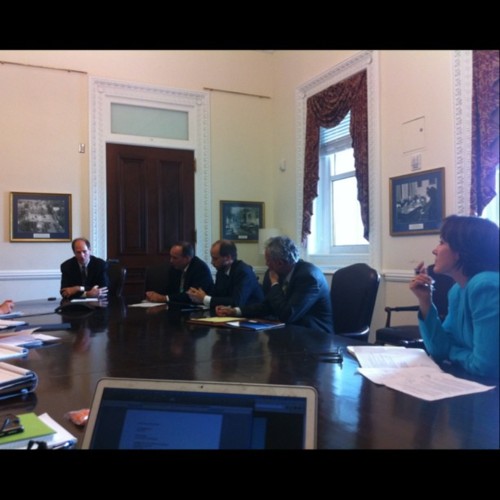
I attended the July 29th consultation and, while I did not record video or audio, can share the following written notes.

Attendees

As with the previous meetings, OIRA administrator Cass Sunstein led the discussion. White House OSTP deputy CTO for public sector innovation Chris Vein was also there, along with half a dozen OIRA staff and a representative of the National Security Archive.

Seated around the table were representatives from America Speaks, OMB Watch, the Center for Technology in Government at the University of Albany, Sunshine in Government. University of Pennsylvania professor Cary Coglionese and a board member from the International Association for Public Participation, Leanne Nurse, dialed into a conference speaker phone line.
Past meetings included representatives from the Revenue Watch Institute, Code for America, Harvard’s Kennedy School of Government, Open Plans, Civic Commons, the Sunlight Foundation, Citizens for Responsibility and Ethics in Washington and the Project for Government Oversight, in addition to Open the Government and NCDD.

Open Government Consultation

Sunstein started the meeting by offering high level context for the OGP and thanks to the organizations around the table.

When the OGP was devised, he said, it was done with background experience from the Open Government Directive that came President Barack Obama and the White House Office of Management and Budget.

Many of your organizations were “indispensable” during that process, Sunstein said, and even though what happened with the open government directive “wasn’t perfect,” there has been “tremendous progress.” He thought from the beginning, with regard to the OMB open government project, that it would be a work in progress, with plans scrutinized and improved over time.

Sunstein laid out the reason for the consultation: the White House has national action plan due in September, with an event at the UN as the president promised. The White House wants the national action plan to be as good as possible, “improving on what we’ve got so far as we can.” Reflecting his comments at the previous two consultations, Sunstein said that one way to think of the meeting is generating ideas through three stages, given the temporal and feasibility constraints posed by the short deadline for UN recommendations. He observed that where would be opportunities moving forward in the medium term, over a 3-5 month time period to do more.

Katherine McFate, the executive director of OMB Watch, asked a question about the parameters for the consultation, noting that if you go back and look at the open government partnership, there are five different challenges for countries. If you only have to pick one or two, she suggested, improving public services is one, and may be improving public integrity is another. Increasing accountability, likely to be three. (Given the recent White House blog post, OIRA may have taken that suggestion.)

In response, Sunstein replied that there are surely things that have budgetary repercussions, which you then have to answer for, although in open government, sometimes it’s possible to improve public services without stretching the budget.

Theresa Pardo, director of the CTG at Albany, after thanking OIRA for the opportunity to speak and to listen, focused on the some of the issues that have arisen during implementation of the open government directive, including the role of citizen engagement. One tension is how to think about citizen participation, versus accountability imperatives.

One of the things that we hear quite regularly when we talk to practitioners at federal, local, and state level, along with academics, is a lot of confusion about concepts underlying open government directive. There’s pressure towards clarity, and still a lot of ambiguity. One of the ways to push through in creating that clarity, she suggested, would be to focus a bit more on the conversation, on figuring out what the problems that citizens are seeking open government to solve. Pardo said that in their experience, in various jurisdictions in US and outside of the US, it’s a challenge to connect what’s happening in government agencies with what citizens are talking about in public. Over the long term, the opportunity for open government, she explained, is to move towards deeper engagement with citizens themselves about what problems are they experiencing.

Professor Coglianese, speaking over the phone, agreed with Pardo and McFate. He also suggested that the White House clearly take stock of where open government is currently. We’re seeing great things, in taking stock of regulations, he said. It would make sense to something similar with taking stock of public participation now, defining a better baseline of where to assess what kinds of reform are making changes.

The point, about defining a baseline for public participation, was taken up and emphasized by many of those invited to the July 29 consultation. One of our major tools is the public participation spectrum, said Douglas Sarno of IAP2 USA. No systematic approach to what we’re trying to do or what’s been achieved has been defined by the White House, he said, and no way of qualifying bonafide public participation versus hackneyed participation defined. There are good challenges in finding metrics.

Sunstein agreed that the regulatory process requires significant public participation. This week, the Regulations.gov team acknowledged the need to do more in that regard.

In response, Pardo cited a number of studies in which communications scholars and computer scientists are using machine language processing to analyze online rulemaking to see if it results in changing in deliberation or positive social interaction. Such studies can be expensive but useful. Part of the issue in integrated such work, however, is getting real movement in processes in partnership with academics, she said.

Pardo focused further upon the role of citizen engagement, both around rulemaking and the large context of open government. Nowhere, until just recently, she said, do we teach our public managers about how to look, engage, and use citizen participation tools. “There’s a capability gap at all levels of government. How do public managers in local governments and cities, think about their jobs in different ways?”

The National Association of State CIOs and others are looking at building capability to understand how to use data and engagement tools better, said Pardo, but across the board there’s lack of ability in these core competencies. Maybe building ability as with cybersecurity skills would make sense, she suggested, including professional standards for citizen participation.

Coglianese similary focused more on baseline assessments for public participation. There are some political scientists who have tried to assess the actual impact of public comment and proposed rulemaking, he said. In terms of what to look to as baseline, what is it you want to accomplish with this national action plan? Is the goal to increase public participation? What is the level right now? We don’t have a way of saying what the volume of interaction is across the federal government, he asserted.

We do know, however, that rulemaking tends to be more something that organizations participated in more than individual citizens, Coglionese said, citing a recent article on public participation that he’d authored law journal. “We need a baseline of who’s participating and at what level,” he said. “Is the goal of participation to increase the quality of public decision making? That’s hard to assess. To enhance public virtue? That’s much harder to assess. Until it’s clear exactly what it is you would want to do, you can’t answer these questions.”

David Stern, director on online engagement at America Speaks, validated Coglionese’s words, observing that his organization had recently looked at all open government plans by agencies and came to the same conclusion. There’s a lack of consistency in metrics used to evaluate projects, said Stern, and no standards about what defines good participation. Number of people, diversity, number of instances policy influenced? Standards and best practices, in this area, would be helpful coming from White House and OMB. Every open government project contains response to the most popular proposals, he said, which means that every public engagement initiative has a public engagement component.

Rick Blum of Sunshine in Government raised another issue: FOIA exemptions, including agencies proposing them independently. The Department of Defense is overclassifying, said Blum, and it’s very hard to track what’s happening. The Department of Justice has put up a FOIA dashboard but it’s “plagued with tech glitches and bad data,” he said. This has become a public debate about secrecy or disclosure, with some half a billion dollars being spent annually fulfilling FOIA requests, said Blum. There’s also concern about the impact of the recent Supreme Court decision in Milner vs the Navy.

On my part, I offered feedback that I’d collected from the broader open government community ahead of time and over the previous year.

First, the White House has not explicitly separated open government innovation, in terms of open data about the business of government, from “good government” initiatives that transparency advocates expect and demand, in terms of accountability to the people. Misset expectations around the goals the White House has set out have created widespread dissatisfaction and harsh criticisms of an administration that promised to be “most transparent ever.” The open government initiative in the province of British Columbia offers a potential model for the White House to consider, in terms of this separation.

Second, as the federal government moves forward with its ongoing review of .gov websites, there are opportunities to work with civil society and civic developers to co-create better e-services.

Third, opportunities exist for the White House to partner with entrepreneurs, media or nonprofits that are making government data open, useful and searchable. For instance, BrightScope has made financial advisor data from the SEC and FINRA available to the public. The work of Code for America and others on farmers market open data is another example.

Finally, there continue to be serious issues raised by developers about the quality of open government data on Data.gov. In general, public servants continue to release PDFs, as opposed to machine-readable structured data, and cite the language in the Open Government Directive for support. If government wishes developers and businesses to use its data for accountability, civic utility or economic value, then releasing data in the open formats that these communities find most useful makes logical sense.

Pardo took up the issues raised with good government versus open innovation, noting that the two aren’t necessarily against each other. The idea of high value data wasn’t well defined, she said. For instance, the calendars of public officials are nothing more than a dataset.

Sunstein asked after the data issues and the one of his deputies specifically asked about the language in the OGD. He brought up the work that the federal government has done on regulations.gov – which was a persistent focus from the OIRA administrator – and asked whether it was good enough, and over what time limit? And for whom?

The general answer there was clear enough: “we the people.”

Coglianese offered more feedback on regulations.gov: it’s not enough. There are data fields are not filled in, missing information, and things remain incomprehensible, he said. “Imagine how it is for many others coming for first time?” Coglianese endorsed the recommendations of ADA blue ribbon commission for a dedicated overseer of data quality, although such a role would require congressional authorization.

There are some really important opportunities to leverage data in regulations.gov, he emphasized. Leverage that data to extract it automatically, display the data on websites. For instance, many members of congress have a button on their websites forlegislation they’re sponsoring, which then takes visitors to data automatically etxtracted from Thomas.gov. Imagine a similar system for agencies and regulators, he suggested, or consider the EPA, which is trying to display every rule that the agency is working on., which is being developed in addition to regulations.gov.

Agencies right now are building websites around current uses, said Coglionese. That makes a lot of senses, and it’s what one would hope, but doesn’t go to the “separate question of who do they want their users to be.” He criticized the design of the new FCC.gov, although I pointed out that the process that preceded the FCC relaunch was focused on the most common purposes of the site’ visitors.

What was left unsaid in these open government partnership consultations? A great deal, due to the length of time allowed. The voices that were heard around this table were also those of advocates, policy, experts, academics, and technologists: not citizens, and by and large not those of the media, whose function in representative democracies been to hold government accountable on behalf of the public.

As the White House considers its commitments in advance of the September meeting at the United Nations, the people will have a window of opportunity to tell their elected officials what open government means to them and how they woud like their federal government to be more transparent, participatory or collaborative.

If you have feedback on any of those accounts, send it to opengov@omb.gov.