Roundup: who said what about the White House executive order on open data?

This morning, President Obama issued an historic executive order making open data the new default for releasing information in the federal government. The president announced the order on a trip to Austin, Texas, where he visited Manor New Tech High School, visited the Capital Factory incubator, where he saw a demonstration of StormPulse, a risk management startup that uses open data, and delivered remarks on open data at Applied Materials Inc.

Here’s what the tech media had to say about today’s news. (Got half an hour? Listen to the press briefing from today  at FierceGovernmentT or download this MP3 of the call that provides the source material for much of the following.)

Sean Gallagher and Nick Clark Judd both penned the most thoughtful, informed and well-reported pieces covering the news. Both are especially strong on covering what the order and associated initiatives actually mean.

At ArsTechnica, Gallagher highlights the challenges that implementing the policy will face: “Obama orders agencies to make data open, machine-readable by default.”

At techPresident, Judd parses out what’s new (Github!) and what actually relates to transparency in “Developers Are Already Submitting Patches to Obama’s New Open Data Policy.”

The Github angle was irresistable  to Wired reporter Bob McMillan (and pretty much anyone else interested in open source) who noted that “Now You Can Fork U.S. Government Policy … On GitHub.”

We’ll see if “the revolution will be forked,” as Githubber (and former White House staffer) Ben Balter put it.

The executive order was significant enough news to escape the tech orbit: The business and general press was also on the story, framing it in terms of jobs.

The Daily Caller earned the dubious distinction of writing the worst headline of the bunch, “Obama is going to tell people how the White House is organized.” (Not exactly.)

Out in the blogosphere and on Twitter, there’s a somewhat different flavor of reaction and commentary from reporters tasked to cover the news.

The Data.gov team is actively looking for feedback, as Data.gov evangelist Jeanne Holm made clear on Google+

Those of us at the Data.gov team are seeking your great ideas and constructive criticism as we move forward to the next phase of Data.gov. We want to scale up the quality and quantity of data, be more helpful to American businesses and entrepreneurs looking to use government data and research, more clearly support learning in classrooms, get government data in front of researchers and journalists, and bring the power of open data to American citizens.

It’s all about getting you to the data you need as quickly as possible in a variety of machine-readable formats with better search, more APIs, easier ways to share data, more data resources federated.  You can see an early view of our new CKAN-powered catalog http://geo.gov.ckan.org/dataset .

You’ve told us via forums, list serves, hack-a-thons, blogs, social media, and meetups around the country and the world that we need to have more and better capabilities for developers and innovators.  We are listening.Find out more details about the technical implementations underwayhttps://www.data.gov/blog/under-hood-open-data-engine and let us know what you think at Data.gov https://www.data.gov/developers/page/forum-topic/11?tid=28622 or via Twitter @usdatagov!

At the Sunlight Foundation, John Wonderlich says that the “open data executive order shows the way forward.”

Simon Rogers explored how the open data executive order compares to similar efforts in the United Kingdom.

Open government data advocate and Govpulse.us founder Josh Tauberer weighed in, regarding licensing: “New Open Data Memorandum almost defines open data, misses mark with open licenses.”

OpenTheGovernment.org praised aspects of the open data policy but expressed concern about exemptions, definitions for information systems and references to the mosaic effect.

Steven Aftergood questioned whether making government data open and machine-readable would have an effect on government secrecy, particularly in the intelligence world.

Jim Harper focused on a similar dynamic, praising President Obama’s new open data policy but questioning its relationship to government transparency.

Noel Dickover said the the new open data policy is terrific, but… notes that “creating and maintaining an enterprise data inventory is a massive undertaking.”

Clay Johnson also wondered about related costs  and found the part of the policy focused on grant and contract knowledge especially interesting.

Coming tomorrow: my interview with US CIO Steven VanRoekel and further analysis on why this matters.

President Obama issues historic executive order making open data the new default in federal government

This morning, the White House released a new executive order from President Barack Obama that makes “open and machine readable” the new default for the release of government information.

The White House also published a memorandum regarding the policy that goes with it and a new website on Github that offers more context and resources on Project Open Data.

Below, U.S. CTO Todd Park and U.S. CIO Steven VanRoekel talk about landmark steps to liberate more open data defined in the new order and what the new policy will mean:

One big question is whether data that is currently being bought by big business and startups — or obtained under FOIA — is now identified and released. Business interest in government data is longstanding, from Bloomberg to Reuters to Lexis-Nexis. New players exist now, particularly Google, and I expect them to consume data as it becomes available and make it usable, useful and economically significant.

At a broader level, the new policy defines machine-readable as the default and instructs agencies to do data inventories. That may sounds simple, to a layman, but it’s a big deal, if the administration can drive implementation and make this more than another compliance exercise.

We’ll see. John Wonderlich is right: this open data executive order is a step in the right direction and shows a path forward.

Later today, the President is going to talk about this order in Texas, elevating open data into the national discussion. I expect the conversation that results to be interesting. I’ll be speaking with the US CIO as well, so if you have questions, please let me know at @digiphile on Twitter or weigh in in the comments.

Will Maryland’s new open data initiative be a platform for a more open government?

Maryland joined 39 other states in the union when it officially launched its open data inititive on Wednesday.

Governor Martin O’Malley unveiled Data.Maryland.gov at a panel discussion in Annapolis on Wednesday, at a panel discussion hosted in conjunction with the Future of Information Alliance (FIA), an inter-disciplinary partnership between the University of Maryland, College Park and 10 founding partners.

“Big data is forever changing the way we manage, market, and move information, and in Maryland, it is also changing the way we govern with better choices and better results,” said Governor O’Malley. “Together, we set public goals, relentlessly measure government performance on a weekly basis, broadly share information, and put it on the internet for all to see. We publicly identify our problems and crowd source the solutions with open access to data. That’s why today we’re launching data.maryland.gov – a movement away from ideological, hierarchal, bureaucratic governing and toward information-age governing that is fundamentally entrepreneurial, collaborative, relentlessly interactive and performance driven.”

The path to standing up Maryland’s new open data platform extends back into the last decade when the O’Malley administration and the state’s legislature first started taking substantive steps towards putting more government data online.

These efforts were preceded by two important open government laws that laid a foundation for transparency in the 21st century:

1970: Maryland passes Public Information Act that established the public’s right to inspect public records, providing that “[a]ll persons are entitled to have access to information about the affairs of government and the official acts of public officials and employees.”

1977: Maryland passes an Open Meetings Act to “allow the general public to view the entire deliberative process.”

2008: Governor O’Malley launched StateStat, publishing performance and management statistics online. The governor subsequently touted the use of performance data a year later as a way to save taxpayer dollars. “RSS, XML, GIS, API: this is what smart, transparent governance will look like in the years ahead,” he said.

2010: Maryland webcasts more hearings and meetings online.

June 2011: Maryland General Assembly establishes a Joint Committee on Transparency and Open Government

April 2012: (Former) Maryland chief innovation officer Bryan Sivak hosts open data roundtable. [Baltimore Sun]

December 2012: Maryland Governor Martin O’Malley establishes an open data working group with an executive order. [Maryland.gov]

May 2013: Maryland launches data.maryland.gov using Socrata’s cloud-based open data platform.

Whither open government?

While the launch of an open data platform is an important digital milestone, it doesn’t in of itself address substantive concerns about Maryland’s open government challenges. TechPresident asked whether Maryland becoming the open government state in 2011, a question that came loaded with decades of context.

On the one hand, the new open data is a substantive step towards addressing the criticisms of open government advocates who noted that Maryland was lagging other states in the nation in its digital initiatives.

On the other, the 236 datasets on data.maryland.gov at launch do not include spending data. Many transparency advocates would like to see that change: Maryland received a low grade in PIRG’s annual report on government spending, as examined through the prism of  data delivering online.

According to PIRG, “Maryland’s transparency website, which garnered a ‘C’ grade, provides checkbook-level information on contracts and other expenditures. However, it lacks detailed information on economic development tax credits and the projected and achieved benefits of economic development subsidies.”

The state government’s compliance with Maryland’s Freedom of Information Act (PDF) is also unclear. While journalists, researchers and other freedom of information requestors now have a new way to ask for data (a nominate button on the new open data website) if they don’t receive an immediate reply, they’ll be hard-pressed to know who to turn to in individual agencies. There is, as of yet, no comprehensive list of Maryland FOIA officers online yet, nor independent institution, auditor or ombudsman with statutory authority to ensure that FOIA requests are complied with in a timely or effective manner.

It’s unclear whether any of this new open data will substantially mitigate Maryland’s record on transparency. According to report card by State Integrity, Maryland ranks 40th in the nation when assessed on 14 different categories</a.

While access to electronic information may improve, Maryland’s story includes a political history rife with corruption in the latter part of the 20th century and a present marked by murky procurement policies, oft-ignored auditors’ reports, spotty access to information and limitied executive and legislative branch accountability.

As Christian Borge detailed for Public Integrity in August of 2012, Maryland faces open government challenges around lobbying, contracting and political cronyism. Websites like StateStat, BayStat, and GreenPrint have featured data disclosures made at the discretion of the O’Malley administration, as is the case with this new open data platform. The state of play in Maryland is an excellent example of the ambiguity of open government and open data, where states release data relevant to services, performance or of economic value but not requests from the media for information related to the exercise (or abuse) of power, the existence of policial corruption or potentially embarrassing errors.

This state of affairs is what led to iSolon.org president Jim Snider to decry Maryland’s fake open government in 2010, much as open government advocates have criticized the Obama administration’s record on open data, open government and FOIA compliance. As Snider pointed out in March, Maryland’s Board of Elections also has serious open government issues.

Whether any of this figures into the 2014 election for governor remains to be seen. Maryland Attorney General Doug Gansler is a leading contender in the crowded field in the developing 2014 MD gubernatorial race. Whether the leading law enforcement official in Maryland chooses to make open data or open government part of the issues in his campaign is, like the political winds in Annapolis, not clear. To date, Gansler’s record on technology primarily has focused upon targeting sexual predators on social networking sites, not using digital technology to make Maryland government more open, transparent or accountable to its 5.8 million people.

None of this means that Maryland’s new open data initiative won’t matter for government transparency, improved civic services or economic activity in the private sector. This step forward does matter and adds what increasingly looks like a basic building block for governance to Maryland’s toolkit. It just means that the citizens of the Old Line State by the Bay need to keep asking for more than data from their elected officials.

Peixoto: Open government data’s impact depends on political agency and press freedom

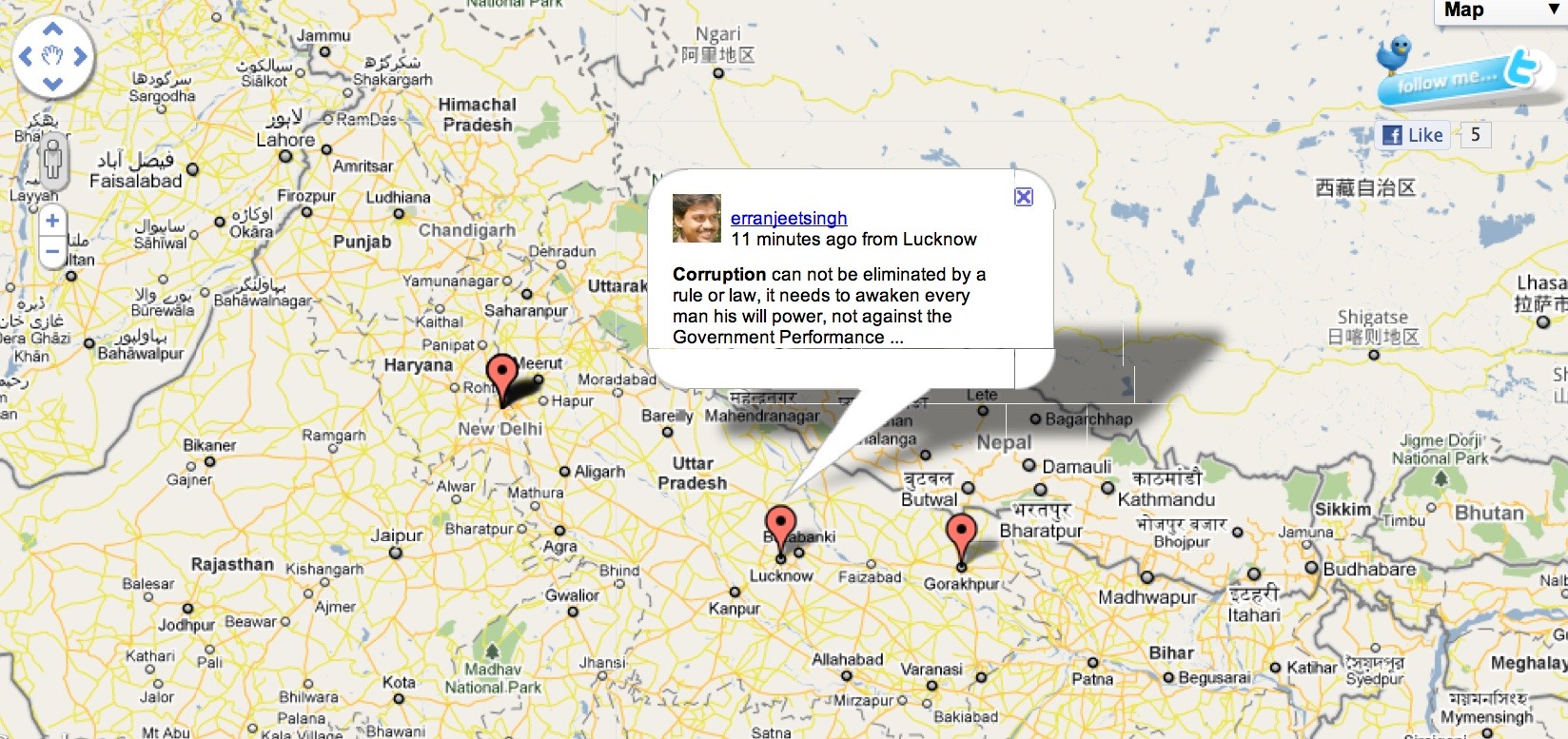
india-corruption-map

Tiago Peixoto has published a new law review article on the uncertain relationship between open data and accountability.

In it, he considers open government, transparency, accountability, press freedom and “open data” and comes to some interesting conclusions.

Peixoto suggests that for “adaptable data to engender accountability, it must fulfill at least two conditions: the publicity and political agency conditions.”

The former condition, although substantially enhanced by digital technologies and increased access to information, has traditionally been enabled by the media. The latter relies upon the basic conditions of democracy, from participatory institutions to free and fair elections.

If you’re interested in open government data, this is well worth the read.

Open government data shines a light on hospital billing and health care costs

If transparency is the best disinfectant, casting sunlight upon the cost of care in hospitals across the United States will make the health care system itself healthier.

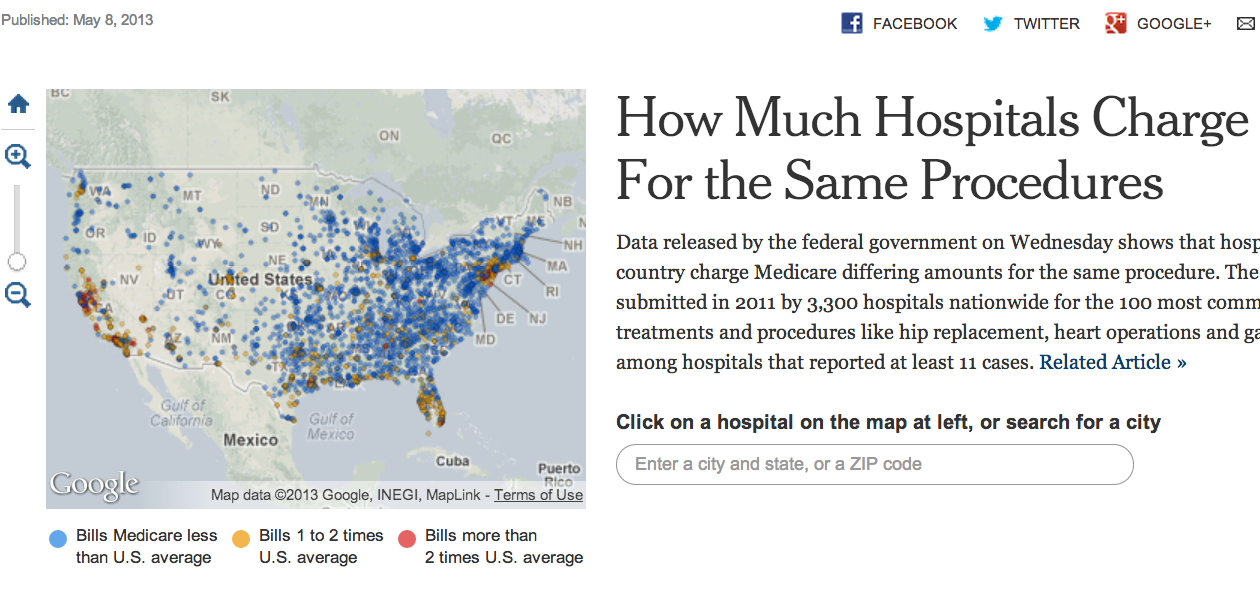
The Department of Health and Human Services has released open data that compares the billing for the 100 most common treatments and procedures performed at more than 3000 hospital in the U.S. The Medicare provider charge data shows significant variation within communies and across the country for the same procedures.

One hospital charged $8,000, another $38,000 — for the same condition. This data is enabling newspapers like the Washington Post to show people the actual costs of health care and create  interactive features that enable  people to search for individual hospitals and see how they compare. The New York Times explored the potential reasons behind wild disparities in billing at length today, from sicker patients to longer hospitalizations to higher labor costs.

hospital-costs


These graphics and features are only the tip of the iceberg for this health data to be baked into health applications and services. Given the spiraling costs of health care in the U.S., this kind of data has been sorely lacking. Health apps and services based upon this kind of data hold the potential to change how society accesses the quality and delivery of care, controls costs, connects patients to one another, creates jobs, empowers care givers and cuts fraud.

Progress on making health information as useful as weather data has been gradual over the past five years, pushed an Open Government Directive in 2009. The catalyst for change today, however, appears to be a member of the media.

According to Steven Brill, this end to hospital bill secrecy was prompted, at least in part, by his mammoth special report on healthcare pricing practices in the March 4 issue of TIME Magazine. If so, it’s one of the most important outcomes of a single feature of investigative journalism in this new century.

More, please.

Image Credit: Images of Money

New beginnings

lincoln-memorial

“One nation, undivided, with liberty and justice for all.”

I remember those words well from my days as a schoolboy, reciting the Pledge of Allegiance to the flag of the United States of America.

Decades later, after I’ve spent years living in the the District of Columbia and writing about governance and technology, those words are imbued with a special poignance and power for me.

We live in extraordinary times, yet access to opportunities, capital and the law is not equal.

We can hear the voices of people crying out for help and justice from around the world at an unprecedented scale and velocity, yet our leaders do not always listen.

We can separate fact from fiction and publish the data that underlies those arguments, yet our capacity to reason and compromise is not always augmented.

We, the People, can do better. Whenever I run down to see Mr. Lincoln and stare out at the Mall, imagining what he might think of our own historic moment, I can’t help but conclude that he would agree.

I intend to share the stories and voices of people who are doing better here, drawing from years of interviews, reporting and exploration. You’ll find analysis, original essays, pictures, videos and data, mixed together and presented in what I hope will be a compelling mix. I hope that you find it worthy of your time.

-Alexander B. Howard

Beware openwashing. Question secrecy. Acknowledge ideology.

You could spend a long day listing all of the organizations or individuals who are putting government data online, from Carl Malamud to open government activists in Brazil, Africa or Canada. As many conversations in the public domain over the past few years have demonstrated, there are many different perspectives on what purposes “open data” should serve, often informed by what advocates intend or related to an organization or institution’s goals. For those interested, I recommend the open data seminar and associated comments highly.

When and if such data includes ratings or malpractice information about hospitals or doctors, or fees for insurance companies, transparency and accountability is an important byproduct, which in turn does have political implications. (Watch the reaction of unions or doctors’ groups to performance or claims data going online for those conflicts.)

There are people who want to see legislatures open their data, to provide more insight into those processes, and others who want to to see transit data or health data become more open, in the service of more civic utility or patient empowerment.

Other people may support publishing more information about the business or performance of government because evidence of fraud, mismanagement or incompetence will support their arguments for shrinking the size of the state. A big tent for open government can mean that libertarians could end up supporting the same bills liberals do.

In the U.S., Govtrack.us has been making government legislative data open, despite the lack of bulk access to Thomas.gov, by “scraping.” There are many people who wish to see campaign finance data open, like the Sunlight Foundation, to show where influence and power lies in the political system. There are many members of civil society, media organizations and startups that are collecting, sharing or using open data, from OpenCorporates to OpenCongress, to Brightscope or ProPublica.

Whether anyone chooses to describe those activities as a movement is up to them — but it is indisputable that 3 years ago, a neutral observer would be hard-pressed to find an open government data platform. Now there are dozens at the national level. What matters more than their existence is what goes onto them, however, and there people have to be extremely careful about giving governments credit for just putting a “portal” online.

While the raw number of open government data platforms around the globe looks set to continue to increase in 2013 at every level of government, advocates should be wary of governments claiming “open government” victories as a result.

//platform.twitter.com/widgets.jsSince Morozov sent out that tweet, he’s published a book with a chapter that extends that critique, along with a series of New York Times op-eds, reviews, Slate debates, and a 16,000 word essay in The Baffler that explores the career and thinking of Tim O’Reilly (my publisher). Morozov’s essay catalyzed Annaleen Newitz to paraphrase and link to it at post at iO9, where Tim responded to in a comment.

While his style can distract and detract from his work — and his behavior on Twitter can be fairly characterized as contemptuous at times — the issues Morozov raises around technology and philosophy are important and deserve to be directly engaged by open government advocates, as John Wilbanks suggests.


That’s happening, slowly. Sunlight Foundation policy director John Wonderlich has also responded, quoting Morozov’s recommendations to reflect out how he might specific uses of technology that support open government. Wilbanks himself has written one of the most effective (short) responses to date:

One of the reasons I do “open” work is that I think, in the sciences, it’s a philosophical approach that is more likely to lead to that epistemic transformation. If we have more data available about a scientific problem like climate change, or cancer, then the odds of the algorithms figuring something out that is “true” but incomprehensible to us humans go up. Sam Arbesman has written about this nicely both in his book the Half Life of Facts and in another recent Slate article.

I work for “open” not because “open” solves a specific scientific problem, but because it increases the overall probability of success in sensorism-driven science. Even if the odds of success themselves don’t change, increasing the sample size of attempts will increase the net number of successes. I have philosophical reasons for liking open as well, and those clearly cause me cognitive bias on the topic, but I deeply believe that the greatest value in open science is precisely the increased sample size of those looking.

I also tend to think there’s a truly, deeply political element to enabling access to knowledge and science. I don’t think it’s openwashing (and you should read this paper recommended by Morozov on the topic) to say that letting individuals read science can have a real political impact.

Morozov’s critique of “openwashing” isn’t specious, though it’s fair to question his depiction of the history of open source and free software and an absence of balance in his consideration of various open government efforts. Civil society and media must be extremely careful about giving governments credit for just putting a “portal” online.

On that count, Wonderlich wrote about the “missing open data policy” that every government that has stood up or will stand up an open data platform could benefit from reading:

Most newly implemented open data policies, much like the Open Government Directive, are announced along alongside a package of newly released datasets, and often new data portals, like Data.gov. In a sense, these pieces have become the standard parts of the government data transparency structure.  There’s a policy that says data should generally be open and usefully released, a central site for accessing it, some set of new data, and perhaps a few apps that demonstrate the data’s value.

Unfortunately, this is not the anatomy of an open government.  Instead, this is the anatomy of the popular open government data initiatives that are currently in favor. Governments have learned to say that data will be open, provide a place to find it, release some selected datasets, and point to its reuse.

This goes to the concerns of traditional advocates working for good government, as explored in a excellent research paper by Yu and Robinson on the ambiguity of open government and open data, along with the broader discussion you’ll find in civil society in the lead up to the Open Government Partnership, where this dynamic was the subject of much concern — and not just in the Canadian or United Kingdom context. The work exploring this dynamic by Nathaniel Heller at Global Integrity is instructive.

As I’ve written before (unrepentant self-plagiarism alert), standing up open data platforms and publishing data sets regarding services is not a replacement for a Constitution that enforces a rule of law, free and fair elections, an effective judiciary, decent schools, basic regulatory bodies or civil society, particularly if the data does not relate to meaningful aspects of society.

Socrata, a venture-capital backed startup whose technology powers the open data platforms of several city, state and federal governments, including Kenya and the United States, is also part of this ecosystem and indisputably has “skin in the game.”

That said, the insights that Kevin Merritt, the founder of Socrata, shared in post on reinventing government are worth considering:

An open Government strategy needs to include Open Data as a component of enabling transparency and engaging citizens. However, Open Government is also about a commitment to open public meetings; releasing public information in all its forms, if not proactively at least in a timely fashion; engaging the public in decision making; and it is also a general mindset, backed up by clear policy, that citizens need to be empowered with information and a voice so they can hold their government accountable.

At the same time, a good Open Data strategy should support Open Government goals, by making structured data that relates to accountability and ethics like spending data, contracts, staff salaries, elections, political contributions, program effectiveness…etc. available in machine- and human-readable formats.

The open data strategy advanced by the White House and 10 Downing Street has not embraced releasing all of those data types, although the Obama administration did follow through on the President’s promise to launch Ethics.gov.

The Obama administration has come under heavy criticism for the quality of its transparency efforts from watchdogs, political opponents and media. It’s fair to say that this White House has advanced an unprecedented effort to open up government information while it has much more of mixed record on transparency and accountability, particularly with respect to national security and a culture of secrecy around the surveillance state.

Open government advocates assert that the transparency that President Obama promised has not been delivered, as Charles Ornstein, a senior reporter at ProPublica, and Hagit Limor, president of the Society of Professional Journalists, wrote in the Washington Post. In fact, the current administration’s open data initiatives are one of the bright spots its transparency record — and that’s in the context of real data quality and cultural issues that need to be addressed to match the rhetoric of the past four years.

“Government transparency is not the same as data that can be called via an API,” said Virginia Carlson, former president of the Metro Chicago Information Center. “I think the ‘New Tech’ world forgets that — open data is a political process first and foremost, and a technology problem second.”

If we look at what’s happening with open government in Chicago, a similar dynamic seems to have emerged, as the city methodically works to release high quality open data related to services, performance or lobbying but is more resistant to media organizations pushing for more access to data about the Mayor’s negotiations or electronic communications, the traditional targets of open government advocacy. This tension was explored quite well in an article by WBEZ on the people behind Chicago’s government 2.0 efforts.

In the United States, there is a sizable group of people that believe that data created using public funds should in turn be made available to the public — and that the Internet is a highly effective place to make such data available. Such thinking extends to open access to research or public sector code, too.

As those policy decisions are implemented, asking hard questions about data quality, use, licenses, outcomes and cost is both important and useful, particularly given that motivations and context will differ from country to country and from industry to civil society.

Who benefits and how? What existing entities are affected? Should all public data be subject to FOIA? If so, under what timelines and conditions? Should commercial entities that create or derive economic value from data pay for bulk access? What about licensing? If government goes digital, how can the poor, disabled or technically illiterate be given access and voice as well? (Answers to some of these questions are in the Sunlight Foundation’s principles of open government data, which were based on the recommendatations of an earlier working group.)

In the United Kingdom, there are also concerns that the current administrations “open data agenda” obscures a push towards privatization of public services should be more prominent in public debates, a dynamic that Morozov recently explored in the opinion pages of the New York Times. My colleague, Nat Torkington, highlighted the needs for a discussion about which services should be provided by government at Radar back in 2010:

Obama and his staff, coming from the investment mindset, are building a Gov 2.0 infrastructure that creates a space for economic opportunity, informed citizens, and wider involvement in decision making so the government better reflects the community’s will. Cameron and his staff, coming from a cost mindset, are building a Gov 2.0 infrastructure that suggests it will be more about turning government-provided services over to the private sector.

Whether one agrees with the side of the argument that supports investment or the other that is looking for cost-savings — or both — is something that people of democratic societies will need to debate and decide for themselves, along with the size and role of government. The politics can’t be abstracted away.

I don’t think that many open government advocates are blind to the ideologies involved, including the goals of libertarians, nor that the “open dystopia” that Newitz described at iO9 is a particularly likely outcome.

That said, given the stakes, these policies deserve to be the subject of debate in every nation whose leaders are putting them forward. We’ve never had better tools for debate, discussion and collective action. Let’s use them.
Cameras in the courtroom: Will SCOTUS ever go live online?

In an age where setting up a livestream to the Web and the rest of the networked world is as easy as holding up a smartphone and making a few taps, the United States Supreme Court appears more uniformly opposed to adding cameras in the courtroom than ever.
Continue reading