Election 2012: A #SocialElection Driven By The Data

Social media was a bigger part of the election season of 2012 than ever before, from the enormous volume of Facebook updates and tweets to memes during the Presidential debates to public awareness of what the campaigns were doing there in popular culture. Facebook may even have booted President Obama’s vote tally.

While it’s too early to say if any of the plethora of platforms played any sort of determinative role in 2012, strong interest in what social media meant in this election season led me to participate in two panels in the past two weeks: one during DC Week 2012 and another at the National Press Club, earlier today. Storifies of the online conversations during each one are embedded below.

http://storify.com/digiphile/social-media-and-election-2012-at-dc-week-2012.js[View the story “Social media and Election 2012 at DC Week 2012” on Storify]

http://storify.com/digiphile/election-2012-the-socialelection.js[View the story “Election 2012: The #SocialElection?” on Storify]

The big tech story of this campaign, however, was not social media. As Micah Sifry presciently observed last year, it wasn’t (just) about Facebook: “it’s the data, stupid.” And when it came to building for this re-election campaign like an Internet company, the digital infrastructure that the Obama campaign’s team of engineers built helped to deliver the 2012 election.

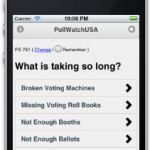
PollWatchUSA enables anyone with a smartphone to act as a poll monitor

Pollwatch, a mobile application that enabled crowdsourced poll monitoring, has launched a final version at pollwatch.us, just in time for Election Day 2012. The initial iteration of the app was conceived, developed and demonstrated at the hackathon at the 2012 Personal Democracy Forum in New York City. Continue reading

To use social media in a time of need, start building networks before disasters

As is the case in every major event in the U.S., social media was part of the fabric of communications during Hurricane Sandy. Twitter was a window into what was happening in real-time. Facebook gave families and friends a way to stay in touch about safety or power. And government officials and employees, from first responders mayors to governors to the President of the United States, put critical information into the hands of citizens that needed it.

While Hurricane Sandy cemented the utility of these networks, neither they nor their role are new. With all due respect to Gartner analyst Andrea Di Maio, his notion that people aren’t conveying “useful information” every day there — that it’s just ” chatting about sport results, or favorite actors, or how to bake” — is like some weird flashback to a 2007 blog post or ignorant cable news anchor.

Public sector, first responders and emergency management officials have recognized the utility of social media reports as a means for situational awareness before, during and after natural or man-made disasters for years now and have integrated tools into crisis response.

Officials at local, state and federal levels have confirmed to me again and again that it’s critical to build trusted networks *before* disaster strikes so that when crises occur, the quality of intelligence is improved and existing relationships with influence can amplify their messages.

Media and civil society serve as infomediaries and critical filters (aka, B.S. detectors) for vetting information, something that has proved crucial with fake reports and pictures popping up. Official government accounts play a critical role for putting trusted information into the networks to share, something we saw in real-time up and down the East Coast this week.

To be frank, Di Maio’s advice that authorities shouldn’t incorporate social media into their normal course of business is precisely the opposite of the experience on the ground of organizations like the Los Angeles Fire Department, Red Cross or FEMA. Here’s Brian Humphrey, public information officer of the LAFD, on best practices for social media:

If public safety officials come across Di Maio’s advice, I hope they’ll choose instead to listen to citizens every day and look to scale the best practices of their peers for using technology for emergency response, not start during a crisis.

TechCrunch’s “CrunchGov” grades Congress on tech, pilots legislative crowdsourcing platform

In general, connecting more citizens with their legislators and create more resources for Congress to understand where their constituents and tech community stands on proposed legislation is a good thing. Last year’s Congressional hearings on the Stop Online Piracy Act … Continue reading

A Twitter chat with @VotingInfo on voting, elections and tech

Today, I hosted a Twitter chat with the Voting Information Project. They partner with states to provide official election data that developers can use to create free, open source tools for voters.

I’ve embedded a storify of our conversation below, along with a video explaining more about what they do. Of special note: VIP is partnering with Mobile Commons to let registered voters know where to vote. Just txt “where” or “donde” to 877-877.

http://storify.com/digiphile/a-chat-with-votinginfo-on-voting-elections-and-tec.js[View the story “A chat with @VotingInfo on voting, elections and tech” on Storify]

San Francisco experiments with citizensourcing better ideas

As significant as the revisions to San Francisco’s open data policy may prove to be, city officials and civic startups alike emphasize that it’s people are fundamental to sustained improvements in governance and city life.

“Open data would not exist without our community,” said Jay Nath, the city’s first chief innovation officer, this Monday at the Hatchery.

San Francisco’s approach to open innovation in the public sector — what businesses might describe as crowdsourcing, you might think of as citizensourcing for cities — involves a digital mix of hackathons, public engagement and a renewed focus on the city’s dynamic tech community, including the San Francisco Citizens Initiative for Technology and Innovation, or SF.citi.

Cities have been asking their residents how government could work better for some time, of course — and residents have been telling city governments how they could work better for much longer than that. New technologies, however, have created new horizons for participatory platforms to engage citizens, including mobile apps and social media.

Open data and civic coders also represent a “new class of civic engagement focused on solving issues, not just sharing problems,” argues Nath. “We have dozens and dozens of apps in San Francisco. I think it’s such a rich community. We haven’t awarded prizes. It’s really about sustainability and creating community. We’ve six or seven events and more than 10,000 hours of civic engagement.”

San Francisco’s dedicated citizensourcing platform is called “ImproveSF.” The initiative had its genesis as an internal effort to allow employees to make government better, said Walton. The ideas that come out of both, he said, are typically about budget savings.

The explosion of social media in the past few years has created new challenges for San Francisco to take public comments digitally on Facebook or Twitter that officials haven’t fully surmounted yet.

“We don’t try to answer and have end-to-end dialog,” said Jon Walton, San Francisco’s CIO, in an interview earlier this year. Part of that choice is driven by the city’s staffing constraints.

“What’s important is that we store, archive and make comments available to policy makers so that they can see what the public input is,” he said.

Many priorities are generated by citizen ideas submitted digitally, emphasized Walton, which then can be put on a ballot that residents then vote on and become policy by public mandate.

“How do you get a more robust conversation going on with the public?” asked Walton. “In local government, what we’re trying to do is form better decisions on where we spend time and money. That means learning about other ideas and facilitating conversations.”

He pointed to the deployment of free public Wi-Fi this year as an example of how online public comments can help shape city decisions. “We had limited funds for the project,” he said. “Just $80,000. What can you do with that?”

Walton said that one of the first things they thought about doing was putting up a website to ask the public to suggest where the hotspots should be.

The city is taking that feedback into account as it plans future wifi deployments:

green dot Completed sites

blue dot Sites in progress

Walton said they’re working with the mayor’s office to make the next generation of ImproveSF more public-facing.

“How do we take the same idea and expose it to the public?” he asked. “Any new ‘town hall’ should really involve the public in asking what the business of government should be? Where should sacrifices and investments be made? There’s so much energy around the annual ballot process. People haven’t really talked about expanding that. The thing that we’re focusing on is to make decision-making more interactive.”

At least some of San Francisco’s focus has gone into mobile development.

“If you look at the new social media app, we’re answering the question of ‘how do we make public meetings available to people on handhelds and tablets’?” said Walton.

“The next generation will focus on how do they not just watch a meeting but see it live, text in questions and have a dialog with policy makers about priorities, live, instead of coming in in person.”

Rakesh Rajani: An Open Government Takes Humility

On the first anniversary of the Open Government Partnership (OGP), Rakesh Rajani, the head of Twaweza in Tanzania offered an eloquent perspective (PDF) regarding its progress and potential.

He was straightforward in his assessment: he said that there’s “at best a one in five chance” that the partnership will achieve its full potential. Rajani also offered a fundamental metric for assessing the success of OGP: “not how many countries sign on to the open government declaration, but how many commitments are delivered in countries, and how many citizens experience concrete improvements in their lives.”

In that vein, he highlighted two projects in Africa that haven’t delivered upon their promise:

Even where governments and civil society are willing, realizing the full promise of OGP commitments is not easy; executing meaningful programs is very difficult. In Kenya the Open Data portal makes an impressive level of data public for the first time, but few use it. In Tanzania, the project to enable citizens to report broken water points through their mobile phones, a project that was featured in the OGP launch film and that my organization supported, has largely failed, because people simply did not believe reporting data would make a difference. Overall, if we are honest, of the 300 or so commitments made in the OGP plans so far, the glass is more empty than full. These are still early days, but the window to learn lessons and get our act together is closing fast.

That said, Rajani remains fundamentally optimistic about the world’s movement towards open government:

“I believe that the idea of open government is as fundamental as some of our greatest achievements of the last century, such as that of the equality of men and women and equality of the races; indeed underlying them all is the deep human impulse for freedom and dignity. That is why, despite my concern about the prospects of the OGP, I am optimistic. Open government is so fundamental to being human that the arc of human history, driven by the everyday actions millions of people across the world, will inevitably bend towards openness. The challenge before us, and awesome privilege, is whether we muster the humility and good sense to be part of that movement.”

I interviewed Rajani earlier this year. If you’re interested in how civil society plays a central role in holding governments accountable, do watch:

Watch live streaming video from ogp2012 at livestream.com

POPVOX shares its Top 50 bills for the 112th Congress (#SOPA is #1)

Last week, the Library of Congress launched Congress.gov in beta, its vision of the next generation of THOMAS, the online repository of the nation’s legislative data. The site features a “most viewed bills” list that lets visitors to the site see at a glance what laws or proposals are gathering interest the site.

The most viewed bills there, however, may not match up to the most popular bills elsewhere online. POPVOX**, a civic startup that is trying to bring the voice of the People into Congress, has posted the top 50 bills on its site for the 112th Congress, in terms of activity.

That the top bill is the Stop Online Piracy Act — and that the PROTECT IP Act is also in the top 5 — is unlikely to be a surprise to observers. The other bills at the top of the list — HR3035 Mobile Informational Call Act, HR2306 Ending Federal Marijuana Prohibition Act and  S3240 Agriculture Reform, Food, and Jobs Act – may be more unfamiliar to many people. The complete list is in the infographic below, including whether POPVOX’s userbase supported or opposed them.

popvox infographic

Marci Harris, the co-founder and CEO of POPVOX, wrote in via email to note that, as the 112th Congress comes to a close, the sequestration issue is starting to pop.

**DISCLAIMER: Tim O’Reilly, my publisher, provided angel funding for POPVOX last year. He calls it “a kind of Google Analytics service for politics, bringing visibility and actionable insight to both Congressional staffers and advocacy organizations.”


Delivering Government 2.0 at GOV.UK

Mike Bracken, U.K. government’s executive director of digital, talks with the Wall Street Journal about how new technologies and approaches can reduce one of the biggest issues in government IT: expensive government IT projects that run long.

For more perspective on what Bracken is talking about, read about how GOV.UK is redefining the online government platform.

Beth Noveck: think about how to open up the API of government

Former White House deputy CTO for open government Beth Noveck recently gave a TED Talk on a “more open source government. For more perspective in the vein of “open,” read CNN’s TED summary, “What if you could make anything you … Continue reading