Data BBQ features District tech entrepreneurs, passion and tasty open data.

Get off your index and build your Rolodex,” read the invite to last night’s Data BBQ in Washington, D.C.

And last night, that’s exactly what over a hundred people from around D.C.’s growing tech scene did, spilling out of the revamped officers of Insomniac Design in Bladgen Alley, near Mount Vernon Square.

The crowd was leavened with many attendees from the ongoing mHealth Summit 2010, manyof DC’s open data geeks and supporters and. Expert Labs’ Gina Trapani and Waxy.org’s Andy Baio came by from the FCC’s Open Developer Day to mix and mingle too. The highlight of the Data BBQ was the lightning talks, where attendees pitched projects, ideas, jobs or even spare rooms to the crowd. The talks are embedded below:

Many of the mHealth conferees no doubt know about the Health 2.0 Developer Challenge from the Department of Health and Human Services, where health data is being mashed up into new applications.

And, judging by the show of hands, many of the Data BBQ’ers had also heard about the World Bank’s Global Apps for Development Competition, which is looking to the development and practitioner communities to create innovative apps using World Bank data.

What might have been new to a few, at least, was the upcoming Apps for Army competition for the public, where the successful apps competition that Peter Corbett and iStrategy Labs helped the Army run will be rebooted for wider participation.

FCC hosts developer day focused on open government innovation

Will a rebooted FCC.gov become a platform for an ecosystem of applications driven by open government data? If that vision is going to come to fruition, the nation’s pre-eminent communication regulator will have to do more than just publish open data sets in machine readable formats online: it will have to develop a community of software developers that benefits to creating such applications.

Monday’s FCC developer day is a first step towards that future. Whether it’s a successful one will be in part predicated upon whether the applications created by the “civic hackers” present help citizens, businesses or other organizations do something new or ease a given process.

UPDATE: One key member of the open government community is the founder of Development Seed, Eric Gunderson. Gunderson has been involved in some of the most innovative mapping projects in open government over the past few years, along with the development of the platform for the new data.worldbank.org. If you’re looking for an unvarnished assessment of the meaning of the FCC’s effort and developer outreach, look no further:

Does it make sense to experiment? “In an online world, the best ideas can and do come from anyone, anywhere,” said FCC chairman Genachowski in a prepared statement. “Tapping into the innovation happening at the edge and in the cloud is a no brainer. The FCC’s first-ever Open Developer Day imports a best practice from the tech industry to help improve accessibility. It is part of our ongoing effort to harness technology to transform the FCC into a model of excellence in government.”

As the statement hints, addressing the requirements of the 21st Century Communications and Video Accessibility Act that President Obama signed into law last month.

In order to meet that goal, the FCC is taking an open government tack, asking the civic development community to contribute to that effort. The agency’s first data officer, Greg Elin, explained more about the constituents for today’s dev day on the Blogband blog:

Programmers from the Yahoo! Developer Network will be on hand to demo their tools and provide guidance. They will give an overview of YQL, their query language which allows developers to “access and shape data across the Internet through one simple language, eliminating the need to learn how to call different APIs.” We will also see a demonstration of their YUI Library, a set of “utilities and controls … for building richly interactive web applications.”

An undertone, pervading a significant strand of the discussion, will be the 21st Century Communications and Video Accessibility Act. In signing the act last month, President Obama said the act “will make it easier for people who are deaf, blind or live with a visual impairment to do what many of us take for granted…  It sets new standards so that Americans with disabilities can take advantage of the technology our economy depends on.”

The full day event will start at 9:00am and take place in Washington, DC at FCC headquarters. All developers are welcome free of charge. Bring a laptop and RSVP soon. If you’re not in the DC area and are unable to make it down here, we will be live streaming portions of the day. You can also join the discussion on Twitter using the hashtag #fccdevday. To email questions write to livequestions [at] fcc [dot] gov. You can participate by visiting Accessible Event, and entering the event code 00520237

For more context on what the FCC is trying to accomplish with FCC.gov/developer, watch a speech from the chairman and managing director Steve Van Roeckel at the 2010 Gov 2.0 Summit, below:

Linking up WhiteHouse.gov and a new US-India Partnership on Open Government

After an election that saw open government make gains in statehouses across the United States, a new transcontinental partnership offers new opportunities for international collaboration. This afternoon, Samantha Power, special assistant to the President for multilateral affairs and human rights, blogged about a new US-India partnership on open government at WhiteHouse.gov. Her post describes President Obama’s visit to an “Expo on Democracy and Open Government” at St. Xavier’s College in Mumbai and the technologies and organizations he encountered there. According to Power:

“India’s dynamism in the technology sector is well known, as is Gandhi’s legacy in India of civic action and bottom-up change, but today’s expo highlighted something very fresh: Indian civil society’s harnessing of innovation and technology to strengthen India’s democracy — by fighting corruption, holding government officials accountable, and empowering citizens to be the change they seek.”

Power’s post is thorough, descriptive and contextualizes the president’s trip and the growing use of technology to fight corruption and improve accountability in India. It also contains only one link that’s relevant to the organizations that were at said “Expo on Democracy and Open Government.” Ipaidabribe.com was created by Janagraaha to enable “Indians upload videos of their experiences in paying a bribe, in refusing to pay a bribe, and in ‘not having to pay a bribe.'”

The expo itself does not appear to have a website, or at least one that could be discovered after a few minutes of searching online.

The closest thing to an online FAQ is the White House press release on “Indian Innovations in Expo for Democracy and Open Government posted at America.gov, where the participating organizations are listed and described. Neither the WhiteHouse.gov blog post nor the release contains that most elemental of online elements: hyperlinks to the relevant person, place or thing being described. For some readers, used to the limitations of print, that may not be a huge issue. For digital natives or immigrants, the absence of links is a big missed opportunity.

The reason that critique is particularly fresh this afternoon is that one of the archetypal bloggers on the Web, David Winer, made the argument at Scripting News today that WhiteHouse.gov should be a hyperlocal blog. Specifically:

The sitting President can’t run campaign ads as an aspiring President does. But he has the ability to communicate more effectively than anyone else on the planet, if that power is developed. If you send people away to places that involve them. The White House blog should be a daily link list of ideas and perspectives on what’s happening in the world.

For instance, Power could have linked to the press briefing at USAID.gov where she, Secretary of Agriculture Tom Vilsack, USAID Administrator Raj Shah and Chief Technology Officer Aneesh Chopra talk about yesterday’s agricultural exposition, including her comments on this open government partnership. For example:

one of the things that we’ve been doing is really learning as a government just how rich the innovations are in a lot of emerging democracies, and indeed, in a lot of new democracies and transitional democracies. No one country has a monopoly on innovation in this space. And it’s indeed quite inspiring to see how even with very few resources you can see how creative nongovernmental actors are, or indeed champions within government who are stepping forward and taking advantage of new technologies and so forth to try to enhance partnership or transparency.

So having said that, I still think India has a huge number of comparative advantages. I mean, for starters it has one of the most noble traditions in human history of bottom-up change and bottom-up activism. I mean, the whole history of modern India is rooted in what you might call the original “Yes, we can” with Mr. Gandhi and the movement that he created and the billions of people that he inspired around the world, one of whom, as the President said today, was Martin Luther King, without whom, arguably, we wouldn’t be where we are in my own country.

So this tradition of bottom-up change, of citizen demand the quality of demand that one encounters out in the most rural areas and some of the most impoverished areas here, even among people who haven’t yet acquired literacy in their communities.

For an administration that’s embraced the idea and practice of Gov 2.0 in many notable ways, failing to link in even a Web 1.0 way is surprising. And to be fair, this post was an exception. The White House blog has frequently made good use of links, video and images, as shown by this week’s WhiteHouse.gov weekly wrapup.

For the sake of the broader open government community who may be interested, here’s the list of participants in that Expo from the press release, this time with links to the relevant organizations or news coverage, where such websites are not available:

An Illustrative List of Exhibitors and Roundtable Participants:

· Mazdoor Kisan Shakti Sangathana (Workers and Peasants Strength Union – MKSS) is an organization that fights against government corruption and creates channels for citizens to oversee their local governments. Its leader, Aruna Roy, is best known as a prominent leader of the Right to Information movement in India which led to Parliament’s passage of the Right to Information Act in 2005, which has empowered millions of ordinary Indians.

· Satark Nagrik Sangathan (SNS) is a New Delhi based citizen’s group with a mandate to promote accountability and transparency in government functioning. SNS’s key activities have been to promote the use of the Right to Information Act (RTI) by training citizens, particularly women in slum areas, to use the RTI and on the functioning of the government in areas such as rations, civic works, education and social welfare schemes. More recently, SNS has used the RTI to collect information on the performance of elected representatives and develop report cards.

· Janaagraha is a Bangalore-based NGO that works with citizens and government to change the quality of life in India’s cities and towns, focusing on urban infrastructure and citizen engagement with public institutions, including volunteerism. They also recently launched an exciting initiative called IPAIDABRIBE.com, a web platform for where people who have been asked for or ever had to pay a bribe are encouraged to share their experiences (after only 2 months, it gets 30,000 hits per day).

· The Hunger Project (THP) is a global organization committed to ending hunger. In India, it is committed to ignite and sustain the leadership spirit of women elected to local village councils (panchayats). THP works in 13 states of India, including Maharashtra (where Mumbai is located). By partnering with more than 90 civil society organizations, THP has worked with and supported the leadership of more than 60,000 elected women representatives.

· ASER uses simple tools to empower people nationwide to test their children’s math and reading abilities, and then hold local government accountable to outcomes. With this data, ASER creates the Annual Status of Education Report, which surveys literacy in 570 districts and 700,000 children of India with citizen participation. Each year 25,000 volunteers donate 4 days of their time to gather the data for this report.

· PRS Legislative Research (PRS) works with Members of Parliament (MPs) across party lines to provide research support on legislative and policy issues. Its aim is to complement the base of knowledge and expertise that already exists in government, citizens groups, businesses, and other research institutions. PRS also enables citizens to track the progress of legislative and policy reforms through an on-line portal.

· The Association for Democratic Reforms (ADR) works on building fair and transparent electoral and political processes in India. ADR has organized Citizen Election Watch for all major elections and discloses candidate background information in a timely manner, including through SMS technology, to the media and the public, helping them to make informed voting choices.

The takeaway for government – or any organization, for that matter – is that blogs and the Web offer new opportunities to share information, create more surface area to expose ideas to citizens and create conversations. If official accounts of new partnerships or events consist of plaintext press releases, lack a website or a post on the most prominent government blog in the world fails to include images, video or relevant links, that opportunity is being neglected.
Google Maps Mashup: World Map of Open Government Data Initiatives

Pretty cool. According to the page, it’s from Semantic-Web.at. It’s a good bet that the growth of open data and open government initiatives around the world will be a topic of conversation for the community the International Data Summit this month in Washington, D.C.

Exploring Civil Society 2.0 at the State Department

The Tech@State conference on Civil Society 2.0 offered insight into the future of technology and civics around the world from digital diplomats, nonprofit leaders and technologists. Tim O’Reilly delivered one of the most thoughtful lectures I’ve seen to date, exploring the factors that led to the success of the Web, Google, Microsoft, Amazon and the platforms that undergird our digital world.

“As you think about civil society 2.0, think about open ended platforms that you can build on, not just applications,” he said.

While his comments and those of the other presenters deserve more analysis and reporting, the four excerpts from O’Reilly’s talk below offer immediate access to the insight he shared. I’ll write more at Radar soon.

For more perspective on what civil society might mean in 2010 – or 2050 – read Nancy Scola at techPresident.

http://www.ustream.tv/flash/video/10632532?v3=1

http://www.ustream.tv/flash/video/10632190?v3=1

http://www.ustream.tv/flash/video/10632341?v3=1

http://www.ustream.tv/flash/video/10632304?v3=1

Automotive X-Prize Winners: “Give us problems that mean something to us”

http://storify.com/dan_munz/jenn-gustetic-interviews-the-automotive-xprize-tea.js

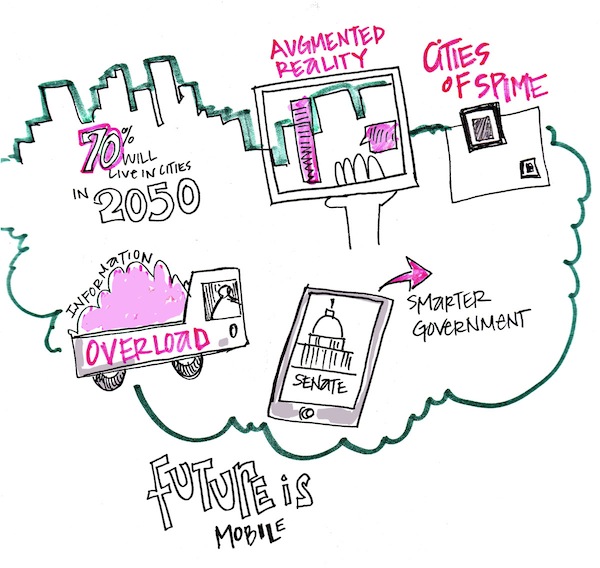
The Future is Mobile at Ignite NYC: Open Data, Open Government and Augmented Reality

“The future is already here – it’s just not evenly distributed.” —William Gibson.

http://blip.tv/play/AYKJtSgC

“An exploration of cyberpunk fiction, technology, where we’re headed, the challenges we face, and the solutions we need”-Ignite NYC. I gave a (very) similar talk called Pattern Recognition and Spimewatch at Ignite D.C. later that week. For whatever reason, this version seems to have come off much better. Rack it up to the first time on a big stage; there were close to a thousand people present in NYC.

The creative graphic recording at Ignite NYC at Web 2.0 Expo was created during the talk by Nora Herting of ImageThink.

For a great Ignite talk with a related theme, check out In Coders We Trust, by Laurel Ruma.

Dan Rather interviews Tim O’Reilly on Gov 2.0

How did Tim O’Reilly describe the potential of Gov 2.0 to Dan Rather?

“Government 2.0 is the attempt to harness the latest technology to make our government more effective, transparent and participatory,” he said.

What do the alpha geeks want to do, with respect to improving government? “They started saying, first of all, we want to open up government, we want more access to all this government data. We want to create new capabilities for citizen involvement.”

From HDNet YouTube Channel excerpt’s description:

Barack Obama’s presidential campaign was recognized for its innovative use of technology to rally voter support. But there are people out there who say that technology has the power to not only revolutionize campaigns, but the very way we view government. It’s a movement called Government 2.0 and Tim O’Reilly is one of its most vocal prophets. He has been called “the Oracle of Silicon Valley” because he saw the potential of the world wide web years before most of us had even heard of it. He’s a highly respected big thinker in the tech community. And he believes that we are at the vanguard of a radical re-think of how government works in the Internet age.

The full episode of Dan Rather Reports on “Tim O’Reilly and Government 2.0” is available as a direct download from iTunes.

IBM initiative adds Big Blue to government cloud computing market

What will a government cloud computing look like coming from “Big Blue?” Today, IBM announced a community cloud for federal government customers and a municipal cloud for state and local government agencies. With the move, IBM joins a marketplace for providing government cloud computing services that has quickly grown to include Google, Amazon, Salesforce.com and Microsoft.

[Image Credit: Envis-Precisely.com]

“We’re building our federal cloud offering out of intellectual bricks and mortar developed over decades,” said Dave McQueeney, IBM’s CTO of US Federal, in an interview. The value proposition for government cloud computing that IBM offers, he said, is founded in its integrated offering, long history of government work and experience with handling some of the largest transactional websites in the world.

The technology giant whose early success was predicated upon a government contract (providing Social Security records keeping systems in the 1920s) will be relying on that history to secure business. As McQueeney pointed out, IBM has been handling hosting for federal agencies for years and, unlike any other of the cloud computing players, has already secured FISMA High certification for that work. IBM will have to secure FISMA certification for its cloud computing, which McQueeney said is underway. “Our understanding is that you have to follow the FedRAMP process,” he said, referring to the the Federal Risk and Authorization Management Program (FedRAMP initiative that’s aimed at making such authorization easier for cloud providers. “We have made requests for an audit,” he said.

As the drive for governments to move to the cloud gathers steam, IBM appears to have made a move to remain relevant as a technology provider. There’s still plenty of room in the marketplace, after all, and a federal CIO in Vivek Kundra that has been emphasizing the potential of government cloud computing since he joined the Office of Management and Budget. Adopting government cloud computing services are not, however, an easy transition for federal or state CIOs, given complex security, privacy and other compliance issues. That’s one reason that IBM is pitching an integrated model that allows government entities to consumer cloud services to the degree to which CIOs are comfortable.

Or, to put it another way, software quality and assurance testing is the gateway drug to the cloud. That’s because putting certain kinds of workloads and public data in the cloud doesn’t pose the same headaches as others. That’s why the White House moved Recovery.gov to Amazon’s cloud, which CIO Kundra estimated will save some $750,000 to the operational budget to run the government spending tracking website. “We don’t have data that’s sensitive in nature or vital to national security here,” said Kundra in May.

“Cloud isn’t so much a thing as a place you are on a journey,” said McQueeney. “To begin, it’s about making basic basic information provisioning as easy and as flexible as possible. Then you start adding virtualization of storage, processing, networks, auto provisioning or self service for users. Those things tend to be the nexus of what’s available by subscription in a SaaS [Software-as-a-Service] model.”

The path most enterprises and government agencies are following is to start with private clouds, said McQueeney. In a phrase that might gain some traction in government cloud computing, he noted that “there’s an appliance for that,” a “cloud in a box” from IBM that they’re calling CloudBurst. From that perspective, enterprises have long since moved to a private cloud where poorly utilized machines are virtualized, realizing huge efficiencies for data center administrators.

“We think most will government agencies will continue to start with private cloud,” said McQueeney, which means CIOs “won’t have to answer hard questions about data flowing out of the enterprise.”

Agencies that need on demand resources for spikes in computing demands also stand to benefit from government cloud computing services: just ask NASA, which has already begun sending certain processing needs to Amazon’s cloud. IBM is making a play for that business, though it’s unclear yet how well it will compete. The federal community cloud that IBM is offering includes multiple levels of the software stacks including Infrastructure as a Service (IaaS) and Platform as a Service (PaaS), depending upon agency interest. At the state and local level, IBM is making a play to offer SaaS to those customers based upon its experience in the space.

We know from dealing with municipal governments that processes are very similar between cities and states,” said McQueeney. “There’s probably a great leverage to be gained economically for them to do municipal tasks using SaaS that don’t differ from one another.” For those watching the development of such municipal software, the Civic Commons code-sharing initiative is also bidding to reduce government IT costs by avoiding redundancies between open source applications.

The interesting question, as McQueeney posed it, is what are government cloud computing clients are really going to find when they start using cloud services. “Is the provider ready? Do they have capacity? Is reliability really there?” he asked. Offering a premium services model seems to be where IBM is placing its bet, given its history of government contracts. Whether that value proposition makes dollars (and sense) in the context of the other players remains to be sense, along with the potential growth of Open Stack, the open source cloud computing offering from Rackspace and other players.

Regardless of loud computing will be one more tool that enables government to deliver e-services to citizens in a way that was simply not possible before. If you measure Gov 2.0 by how technology is used to arrive at better outcomes, the cloud is part of the conversation.

Whether state and city governments move to open source applications or cloud computing – like Los Angeles, Minnesota or now New York City – will be one of the most important government IT stories to watch in the next year. Today, IBM has added itself to that conversation.

UPDATE: CNET posted additional coverage of IBM’s government cloud initiative, including the video from IBM Labs below: