Apps for California Winners Feature Innnovative Mashups Of Open Government Data

Today, California announced the winners of its Apps for California challenge. As the summer comes to an end, there will indeed be an open government app for that in California. As I reported earlier this year at Radar, the app contest was targeted at catalyzing innovative uses of a refreshed Data.CA.gov, which included over 400 major data sources, including XLS, CSV and XML formats, and over 100 million records. The winners will be honored and given prizes at an awards gala hosted by Government Technology’s Best of the Web Competition on September 17, 2010.

Who are the Winners?

So who won and why? According to the Apps for California rules, each entry was judged according to the following criteria:

  1. Providing value to California’s residents and businesses;
  2. Demonstrating Innovation;
  3. Promoting Collaboration and Government Efficiency; and
  4. Ensuring Accessibility and Usability.

WIthout further ado, here are the five winners:
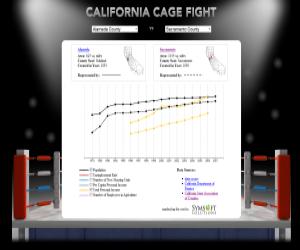


California Cage Fight
(info page) allows residents to compare their counties with other California counties and the state as a whole, including population growth, per capita income, unemployment, new houses and more.
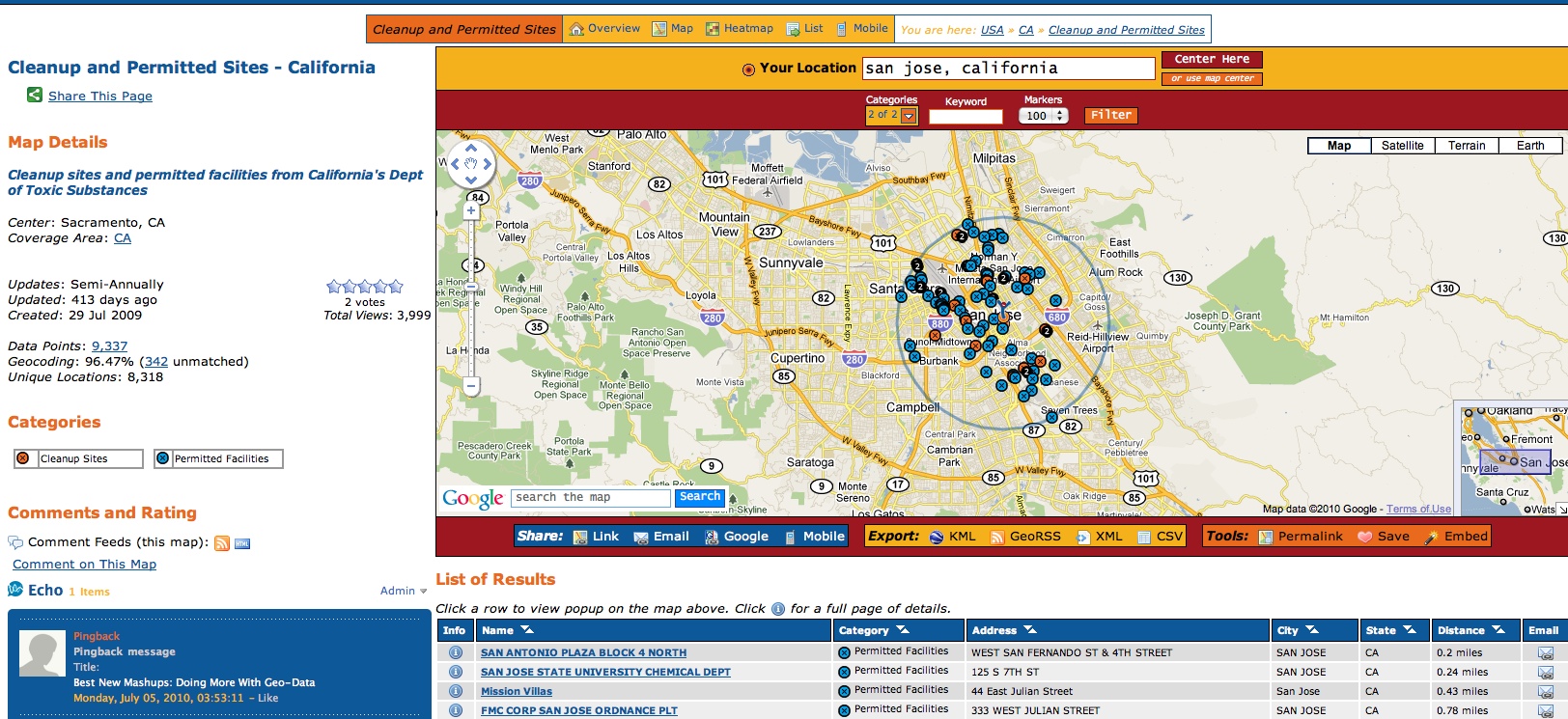


California Environment Report: Cleanup Sites and Permitted Facilities
(info page) provide residents with an interactive map that includes heatmaps, a mobile version with geolocation, data feeds, and detail pages for every cleanup site and permitted dacility from the CA Department of Toxic Substances Control Datasets.


California View
(info page) is a simple mapping tool that displays the locations of California state parks, fishing holes and boating facilities.



ZonabilitySF
(info page) provides mobile access to San Francisco zoning ordinance information. This app includes geolocation, interactive zoning maps, resources about code and a mechanism to ask a city planner questions.
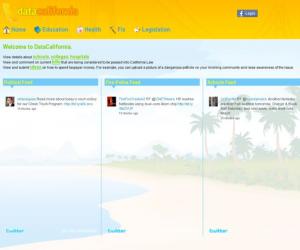


DataCalifornia
(info page) provides a browser for California education, health and current legislation. The mashup allows users to “submit ideas on how the government should spend taxpayer money. Notably, it also has a constant stream of updates from schools, first responders and local politics. The site features Facebook integration, and a “Fix” button  that should be familiar to SeeClickFix users.

People’s Choice Award
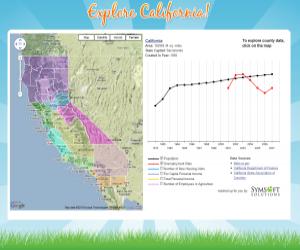


Explore California” (info page) and the California Cage Fight mashups won the People’s Choice Awards. Explore California is similar to Data California, providing users with an interactive map and visualizations population, income, unemployment, new housing units, and other trends over time. Visitors can “compare and contrast the patterns of growth and decline in various categories and the relationships between them.”

What’s do Apps for California mean for Gov 2.0?

At review time, the winners seems like it might have the most potential to enable better outcomes for citizens to engage with government, given the tool. The zoning app could potentially be quite useful to builders or homeowners. And if you’re also an angler, the easy lookup of potential hotspots could be of interest, though old salts might not want the increased competition. A complete list of Apps for California finalists is available at CA.gov.

The contest was conducted by the Center for Digital Government in collaboration with the state of California, the city of Los Angeles, the county of Los Angeles, the city and county of San Francisco, Google, Microsoft and ProgrammableWeb.com. That collaboration featured some of the nation’s biggest tech companies partnering with public institutions to create mashups that of open public data that would provide more value to citizens.

Overall, the state saw over a dozen applications developed over the summer that might have taken it much longer to build internally, and at substantially great cost. Beyond stimulating that activity, however, the success or failure of the contest will likely be judged not upon the prices awarded or the number of apps built but rather whether these applications make the lives of citizens easier or provide more frictionless access to information. That’s a judgement that will only be rendered with time.

New Data.WorldBank.org fuels storytelling with the power of open data

Earlier today, the new data.worldbank.org launched. As I reported for Radar this afternoon, added widgets, maps and an API make World Bank data sing.

The Bank is increasing the number of indicators available on the site from 339 to more than 1,200, and it has substantially improved its API. Four different languages are supported on the site, along with an improved data browser, feedback buttons, instant search, and embeddable widgets.

“The new site shows the art of the possibility,” said Eric Gundersen of Development Seed, the D.C.-based Drupal shop behind the World Bank’s data catalog. “This is really actionable information. So many more NGOs [non-governmental organizations] can now make data-informed decisions if they have access.”

Below, I’ve embedded a video on the power of geo-coding aid.

From the blog:

A team of researchers from Development Gateway and AidData have worked with the World Bank to add detailed subnational geographical information to all of the Bank’s active projects in the Africa and Latin America region. This isn’t just pins in a map showing the country where the money is spent: they have looked through the project documentation to find out as far as possible the geographic coordinates of the actual locations where aid the activities take place.

This video by AidData explains brilliantly what geocoding means, and why its important.

As I also reported at Radar, the World Bank wil be running an Apps for Development contest, launching on Oct. 7.  In addition to the contest, the World Bank will host an open forum on Oct. 7 that will feature experts from the open data movement via live webcasts and a 24-hour chatroom.

David Eaves on Gov 2.0, Open Government and Open Data in Canada

“If you read only one blog in the Gov 2.0 space, you should read eaves.ca” – Tim O’Reilly.

My interview with David Eaves on open government and open data at today’s Gov 2.0 Summit is a reminder why my publisher would offer that ringing endorsement. We talked about the risks and rewards of open data, the state of Gov 2.0 in Canada and the progress of “We government” up across the border. Eaves also revealed that Canadians love Facebook, though perhaps not as much as hockey.

Exploring the future of online privacy with Jules Polonetsky

How will regulations and laws that address the new challenges of online privacy evolve? What are the tradeoffs between societal benefit and individual rights? How should the opportunities inherent in data mining be balanced with harm-based standards? What are the responsibilities of governments, businesses and citizens to protect privacy?

Yesterday at the Gov 2.0 Summit in Washington, my interview with Jules Polonetsky covered all of those topics and more. Polonestsky is the Co-chair and Director of the Future of Privacy Forum, a think tank seeking to improve the state of online privacy by advancing responsible data practices. His writing and research can be found at Futureofprivacy.org.

Cisco CTO Padmasree Warrior on the power of video

Last month, I interviewed Cisco CTO Padmasree Warrior about technology, gov 2.0 and open government. In the excerpt below, we talk about some lessons for the public sector from her experience in the business of technology, particularly around distributed collaboration using video conferencing. “The power of video is that it really allows us to extend the abstract notions of text-based technology and replaces that with much more human way of communicating,” said Warrior. “It’s more natural.”

Warrior, who went to Russia this past winter on a State Department “TechDel,” leveraged telepresence to collaborate with her fellow travelers after they dispersed. She’ll be talking more about more about similar lessons from the private sector in her conversation with Tim O’Reilly at the Gov 2.0 Summit next week. I’ll be posting more excerpts from our interview at Radar on Monday.

Cisco CTO Padmasree Warrior on technology and business in Russia

Last month, I interviewed Cisco CTO Padmasree Warrior about technology, gov 2.0 and open government. In the excerpt below, we talk about technology and business in Russia. Warrior traveled to Russia this past winter on a TechDel with the State Department, looking for connections through digital diplomacy.

I’m very much looking forward to her conversation with Tim O’Reilly at the Gov 2.0 Summit on private sector lessons that translate to the public sector next week. I’ll be posting more excerpts from our interview at Radar on Monday.

Cisco CTO on telepresence and the use of tech in natural disasters

Last month, I interviewed Cisco CTO Padmasree Warrior about technology, gov 2.0 and open government. In the excerpt below, we talked about on the use of telepresence in government – over telepresence – and the opportunities around teleworking.

I’m very much looking forward to her conversation with Tim O’Reilly at the Gov 2.0 Summit on private sector lessons that translate to the public sector next week. I’ll be posting more excerpts from our interview on Monday.

We also talked about the role of technology in natural disasters. An excerpt from that conversation is embedded below:

CrisisCommons and floods in Pakistan

What Warrior and I didn’t discuss then, with respect to the floods in Pakistan, is the CrisisCommons Marathon Weekend that begins today. It’s an international effort that spans the globe, from Canada to London to Bangkok to Sydney, leveraging the distributed efforts of concerned citizens and technology to provide aid in the massive disaster. For more information – and to help – consult the links below:

We will be working to assist our friends and partner organizations: OpenStreetMapSahana and Crowdmap (Ushahidi). Each individual city may also be working on tasks listed on the CrisisCommons wiki for pkfloods.

We’ll be working in a number of countries and timezones with staggered over three days. CrisisCamps in Canada and CrisisCamp Virtual will start on the evening of Friday, September 3, 2010. This is the same start time for CrisisCamp Sydney where the time will be Saturday, September 4, 2010 : 08:00 AEST. As we collaborate work across North America, we will run overnight and link to the CrisisCamp London team. The Canadian and Uk teams finish on Saturday, September 4, 2010 while the Sydney team will continue throughout Sunday, September 5, 2010.

Register for the Sydney, Australia CrisisCamp: Saturday, September 4, 2010: 08:00 AEST

Join CrisisCamp Bangkok for Saturday, September 4, 2010

Register for the Toronto, Canada CrisisCamp: Friday, September 3, 2010: 18:00 ET

Join Silicon Valley on Friday, September 3, 2010 5-10pm Pacific Time at 650 Castro, Mountain View

Register for the London, UK CrisisCamp: Saturday, September 4,2010: 10am GMT

Join us virtually:

Register to be a Virtual Crisis Camper

State CIOs rank cloud computing, green IT and social media as top emerging tech

According to a March 2010 survey of state chief information officers by NASCIO , Grant Thornton and Tech America, public IT executives in the United States are looking seriously at investing in the cloud and green IT. 50% of the 40 CIOs, IT resource management officials and OMB representatives surveyed planned to invest in cloud computing. Additionally, some two thirds of those surveyed are using social media. The report is embedded below.

2010 Tech America Federal CIO Survey Final Reporthttp://static.slidesharecdn.com/swf/doc_player.swf?doc=2010techamericaciosurveyreportfinal-100330103736-phpapp01&stripped_title=2010-tech-america-federal-cio-survey-final-report

[Hat Tip: Governing People]

How Socializing Data Built A Better Government Platform

Can social media, open government and an API lead to a better pill identification system? What about a collaborative effort between Big Pharma and the National Institutes of Health (NIH) that could result in pictures of medications on labels for the first time?

As David Hale’s interview in my most recent article at Mashable showed, the power of social media, open data and innovation led to a better healthcare platform at the National Library of Medicine:

Every year, poison control centers get more than one million calls for pill identification. Each one of those calls costs nearly $50. Social software is helping biomedical researchers collaborate on better ways of identifying drugs. “Pillbox is a digital platform for communities to solve challenges related to pharmaceutical identification and reference,” says David Hale, the program manager. The National Library of Medicine’s mission is to gather, curate and distribute the world’s biomedical information, said Hale.

Pillbox is an open government initiative from the National Library of Medicine (NLM) at the National Institutes of Health (NIH) and Food and Drug Administration that could transform how pharmaceuticals are labeled in the future. The interactive web application currently allows visitors to rapidly identify unknown solid medications, like tablets or capsules, based upon their shape, color and other markings. Pillbox remains a research and development project, so users should not be making clinical decisions just yet. Right now there are over 1,000 images of prescription drugs in the system, with many more to come in the next few months.

In the video below, Hale demonstrates the platform:

Hale will share more about new updates to Pillbox and how the healthcare community and developers partnering to restructure federal drug label data at the Gov 2.0 Summit next week in Washington on September 8th.

His last presentation, “Open Gov Ninja 101,” is embedded below:

Rebooting FCC.gov: An interview with FCC managing director Steven VanRoekel

Earlier today, my newest Radar post explained what to expect as FCC.gov is poised for an overdue overhaul featured FCC managing director Steven VanRoekel on participation and building platforms. For the full perspective on what’s next in “FCC 2.0,” check out Radar. Our video interview is embedded below.

FCC Chairman Julius Genachowski and Managing Director Steven VanRoekel will discuss their experiences turning FCC.gov into a 21st-century consumer resource at the Gov 2.0 Summit in Washington, D.C. (Sept. 7-8). Request an invitation.