How should whistleblowing work in the age of transparency?

Transparency movements have gone global. Open government, however, depends in part upon the ability of public servants and corporate insiders to blow the whistle on fraud, corruption or other conduct that is not in the interest of citizens or stakeholders. In the context of Wikileaks, the role of whistleblowing has taken on new meaning and scope in this age of transparency. Despite President Obama’s open government commitments, his administration has aggressively pursued whistleblowers over the past two and a half years.

It is in that context that the Advisory Committee on Transparency for the Transparency Caucus in the U.S. Congress hosted a public discussion on July 29, 2011 on the challenges federal whistleblowers face. Video of the hearing, provided courtesy of the Sunlight Foundation, is embedded below.

The panelists included:

  • Angela Canterbury, Director of Public Policy, Project on Government Oversight
  • Carolyn Lerner, Special Counsel, U.S. Office of Special Counsel
  • Christian Sanchez, Border Patrol Agent, Customs & Border Protection, Department of Homeland Security
  • Daniel Schuman, Moderator, Policy Counsel, the Sunlight Foundation
  • Micah Sifry, Co-founder and editor of the Personal Democracy Forum; author of WikiLeaks and the Age of Transparency; Sunlight Foundation sr. technology advisor

People interested in government transparency will find it of considerable interest.

Even if the White House’s commitment to transparency is questioned, open government continues to grow globally, with new tools for transparency coming online every month.

Dyson at the eG8: You don’t need to be from the Internet to believe in liberty or free speech

At the eG8, 20th century ideas clashed with the 21st century economy. The inaugural eG8 forum, held in Paris before the G-8 summit of global leaders, showed that online innovation and freedom of expression still need strong defenders. As Nancy Scola reported at techPresident, at the at the eG8, civil society groups restaked their claim to the ‘Net.

Several attendees, many who had traveled from the United States, strongly questioned whether the Internet should be regulated in the ways that Sarkozy implied. The “value of internet is not just efficiency but also transparency,” tweeted Esther Dyson, “a much better regulator than government could ever be.”

I spoke further in with Dyson in an interview embedded below. What matters about the eG “is that you have a lot of people being exposed to one another and you have a lot of government people being exposed to people they don’t normally listen to,” said Dyson. “As usual, it’s not what happens up on stage, or what happens on the video: it’s what happens on the tweets, in the personal interactions, in the dinner afterwards, and in the back hall of the meeting. And that – that was positive. The world doesn’t change overnight, mostly. ”

She spoke to the concerns of civil society about eG8 recommendations: “It is sort of justified. Some of them were precanned. I actually sat down with my guy after doing my panel and changed them. I don’t think that happened with all of them. But again, the community is aroused: it’s going to make its points around this.”

Dyson also emphasized the universality of some of these concerns and what’s at stake. “You don’t need to be ‘from the Internet’ to believe in liberty or free speech.”

How are startups helping the global transparency movement? “They’re providing tools to make the data meaningful,” said Dyson. “They’re providing tools for people to share the information. They’re providing the communication tools, again, that allow from everything from Wikileaks to people communicating with reporters. Tools like your phone, connected to the Internet, so that you can record interviews not just with me but with all of the other people you talk to, upload them, people can share them, people can comment on them. That’s all technology.”

Dyson shared other thoughts on the eG8 and Internet freedom, including how entrepreneurs are changing the world through their work. Dyson also shared an insight that transcends technology:

“Even when you have a revolution, what makes the revolution works is what changes in people’s minds, and that’s what’s going on here,” said Dyson.

“The world is changing. People in government are not special. They should be as transparent as everybody else. People deserve privacy. Officials, governments, institutions, they all should be transparent. That’s new thinking, and it was being heard.”

Senator Carper fears e-gov budget cuts are “penny wise, pound foolish”

As Daniel Schuman wrote on the Sunlight Foundation’s blog today, Delaware Senator Tom Carper wrote yesterday to federal CIO Vivek Kundra about the effects of a 75% cut to e-government funding at the White House Office of Management and Budget (OMB), including questions about how the Obama administration intends to go forward. For those that have not been tracking the issue closely, Congress and the President collectively cut OMB’s Electronic Government Fund from $34m in FY2010 to $8m in FY2011.

Schuman and the Sunlight Foundation originally discovered proposed deep cuts to e-government funding during the budget crisis weeks ago and have been reporting on every new wrinkle in the story.

In the last few weeks there’s been a whirlwind of news and speculation about what will happen to the federal government’s online transparency efforts. From the first rumble of budget trouble to a frantic search for information on when the sites would go dark, and an extended legislative give-and-take over funding levels, the storm has cleared enough to know what’s left standing.

The way forward for these online open government platforms, as Schuman notes, isn’t immediately clear. Now, Senator Carper (D-DE) has become more directly involved:

I remain concerned with how the new lower funding level for the E-Gov Fund might not only impede the progress made thus far to make government open and transparent, but also harm efforts to cut wasteful and duplicative spending in the federal government.

The future of these programs have already earned bipartisan support, with Representative Darrell Issa (R-CA) making a personal pledge to use his reprogramming authority as Chairman of the House Committee on Oversight and Government Reform to keep many sites alive. “We’ll find a way to keep OpenGov sites open, but need to make data actually accessible/usable,” tweeted Issa this week, linking to a story on NextGov on softening the budget blow to transparency websites.

Improved accountability, efficiency and civic utility from open government data, in other words, are issues that both sides of the aisle appear to support, although it remains unclear why, if that is so, the original budget was cut by 94%.

Senator Carper’s letter is embedded below.

Letter From Senator Carper to Vivek Kundra about the E-Gov Fund(function() { var scribd = document.createElement(“script”); scribd.type = “text/javascript”; scribd.async = true; scribd.src = “http://www.scribd.com/javascripts/embed_code/inject.js”; var s = document.getElementsByTagName(“script”)[0]; s.parentNode.insertBefore(scribd, s); })();

Week in Review: Top Gov 2.0 and Open Government Stories

US Capitol Blooms

Open government made an appearance in popular culture, albeit not in an admiring sense. At the start of the week, Jon Stewart and the Daily Show mocked the Obama administration and the president for a perceived lack of transparency.

Stewart and many other commentators have understandably wondered why the president’s meeting with open government advocates to receive a transparency award wasn’t on the official schedule or covered by the media. A first hand account of the meeting from open government advocate Danielle Brian offered useful perspective on the issues that arose that go beyond a soundbite or one liner:

Gary, OMB Watch’s executive director, focused on the places where we have seen real change, including the Open Government Directive, the Executive Orders on Classified National Security and Controlled Unclassified Information, emphasis on affirmative disclosures of government information; and the President’s support of reporters’ privilege and shield law, as well as whistleblower protections.

Lucy, executive director for Reporters Committee for Freedom of the Press, pointed out that this was the first president in her 30 years of working in this field who had invited open government advocates into the Oval Office. She specifically thanked him for his strong support of a reporters’ shield law, which he affirmed he continues to support. Tom, executive director for the National Security Archive, emphasized that when it comes to FOIA reform and implementation we know it isn’t just a ship of state, but an entire flotilla including rowboats. And that while there has been notable improvement according to the National Security Archive’s survey of agencies, there continues to need be a need for leadership from the top to change cultures across the vast swath of government agencies. He also noted that we all believe the information we want to see is not simply that which is useful for consumers, but also that which holds the government accountable.

I knew my topic was likely to be sensitive. I began by thanking the President for his strong support of whistleblower protections, and noted that it was not for lack of effort on the part of the White House that the legislation didn’t pass at the end of the last Congress.

I noted, however, that the current aggressive prosecution of national security whistleblowers is undermining this legacy. That we need to create safe channels for disclosure of wrongdoing in national security agencies. That we need to work harder to shrink the amount of over-classified materials that unnecessarily prompt leak prosecutions.

The President shifted in his seat and leaned forward. He said he wanted to engage on this topic because this may be where we have some differences. He said he doesn’t want to protect the people who leak to the media war plans that could impact the troops. He differentiated these leaks from those whistleblowers exposing a contractor getting paid for work they are not performing. I was careful not to interrupt the President, but waited until he was done. I pointed out that few, if any, in our community would disagree with his distinction—but that in reality the current prosecutions are not of those high-level officials who regularly leak to the press to advance their policy agendas. Instead, the Department of Justice (DOJ) is prosecuting exactly the kind of whistleblower he described, for example one from the National Security Agency.

The President then did something that I think was remarkable. He said this is an incredibly difficult area and he wants to work through how to do a better job in handling it. He also agreed that too much information is classified, and asked us to work with his office on this. He wasn’t defensive nor was he dismissive. It was perhaps the dream moment for an advocate—hearing the most senior policymaker agree with you and offer to work together to tackle the problem.

Brian’s account is the most comprehensive account of the meeting on open government online. The irony that it was not recorded and released to the American people is, however, inescapable. For anyone tracking the progress of the Open Government Directive, the last six months have been an up and down experience. It was clear back in September that in the United States, open government remains in beta.

According to doctoral research by University of Texas academic, there are 358 open government projects in federal government. Former White House deputy chief technology officer Beth Noveck wrote about the semantics and the meaning of good government and open government mean in this context. One takeaway: don’t mistake open innovation policies for transparency guarantees.

The current White House deputy CTO for innovation, Chris Vein, wrote on the White House blog this week that the one year anniversary of open government plans were “a testament to hard work” at the agencies. As Vein acknowledged, “while there is always more to be done, we are proud of the important work that agencies have done and are doing to change the culture of government to one that encourages transparency and facilitates innovation.  We are committed to maintaining and building upon this momentum to make our Nation stronger and to make the lives of Americans better.”

Naturally, some projects are always going to be judged more as more or less effective in delivering on the mission of government than others. An open government approach to creating a Health Internet may be the most disruptive of them. For those that expected to see rapid, dynamic changes in Washington fueled by technology, however, the bloom has long since come off of the proverbial rose. Open government is looking a lot more like an ultramarathon than a 400 yard dash accomplished over a few years.

That said, something different is going on during what Micah Sifry has aptly called the age of transparency. We’re in new territory here, with respect to the disruption that new connection technologies represent to citizens, society and government. It’s worth taking stock of what’s happened recently. It’s been a while since I first posted a Gov 2.0 Week in Review at Radar, and three months since the 2010 Gov 2.0 year in review.

There’s a lot happening in this space. Following is a quick digest that might provide some perspective to those who might think that open government is a better punchline than policy.

1. The government stayed open. The budget crisis on Capitol Hill overshadowed every other issue this past week. It’s harder for a government to be open if it’s closed. The secrecy of the shutdown negotiations left folks over at the Sunlight Foundation wondering about how open government principles matched up to reality.

2. Proposed deep cuts to funding for open government data platforms like Data.gov or the IT Dashboard appear to be least partially restored in the new budget. That will likely salve (some of) the concerns of advocates like Harlan Yu, who wrote about what we would lose if we lost Data.gov. John Wonderlich’s questions on the budget deal, however, include one on exactly how much funding was restored.

3. FCC.gov relaunched as an open government platform. In any other week, this story would have led the list open government news. Having sat out the Aughts, FCC.gov stepped into the modern age FCC managing director Steve Van Roekel and his team worked hard to bring Web 2.0 principles into the FCC’s online operations. Those principles include elements of open data, platform thinking, collective intelligence, and lightweight social software. What remains to be seen in the years ahead is how much incorporating Web 2.0 into operations will change how the FCC operates as a regulator. The redesign was driven through an open government process that solicited broad comment from the various constituencies that visit FCC.gov. The beta.FCC.gov isn’t just a site anymore, however: it’s a Web service that taps into open source, the cloud, and collective intelligence. In the world of Gov 2.0, that’s a substantial reframing of what government can do online.

4. What happens to e-government in a shutdown? This near miss forced hundreds of thousands of people to consider how to make wired government go dark. That discussion should not end with this latest resolution.

5. The first NASA Open Source Summit explored why open source is a valuable tool for the space agency. Open source is a pillar of NASA’s open government plan.

6. The Russian blogosphere came under attack, quashing an online parliament initiative. Needless to say, it will be interesting to see if a Russian Gov 2.0 conference next week addresses the issue of press freedoms or open government transparency.

7. Simpl launched as platform to bridge the connection between social innovators and government.

8. National Builder launched as a new online activism platform.

9. Senator Jon Tester (D-MT) and Representative Steve Israel (D-NY) reintroduced the Public Online Information Act. With this transparency bill, the federal government would acknowledge the Internet, opined Mother Jones.

10. SeeClickFix launches its Facebook app.. “It looks like the entire SeeClickFix experience has been ported over to the Facebook environment,” writes Dan Kennedy. “Users can report problems and pinpoint them on a Google map, thus alerting government officials and the news media. I am far from being the world’s biggest Facebook fan, but it’s a smart move, given how much time people spend there.”

Editor’s Note This is by no means a definitive, comprehensive list. For instance, there’s plenty of open government news happening in countries around the world, from corruption mashups in India to the transparency challenges in various states. For a daily dose of transparency, make sure to read the Sunlight Foundation’s blog IBM’s Business of Government blog has also posted a weekly round up. If you have more stories that came across your desktop, inbox or television this week, please share them in the comments.

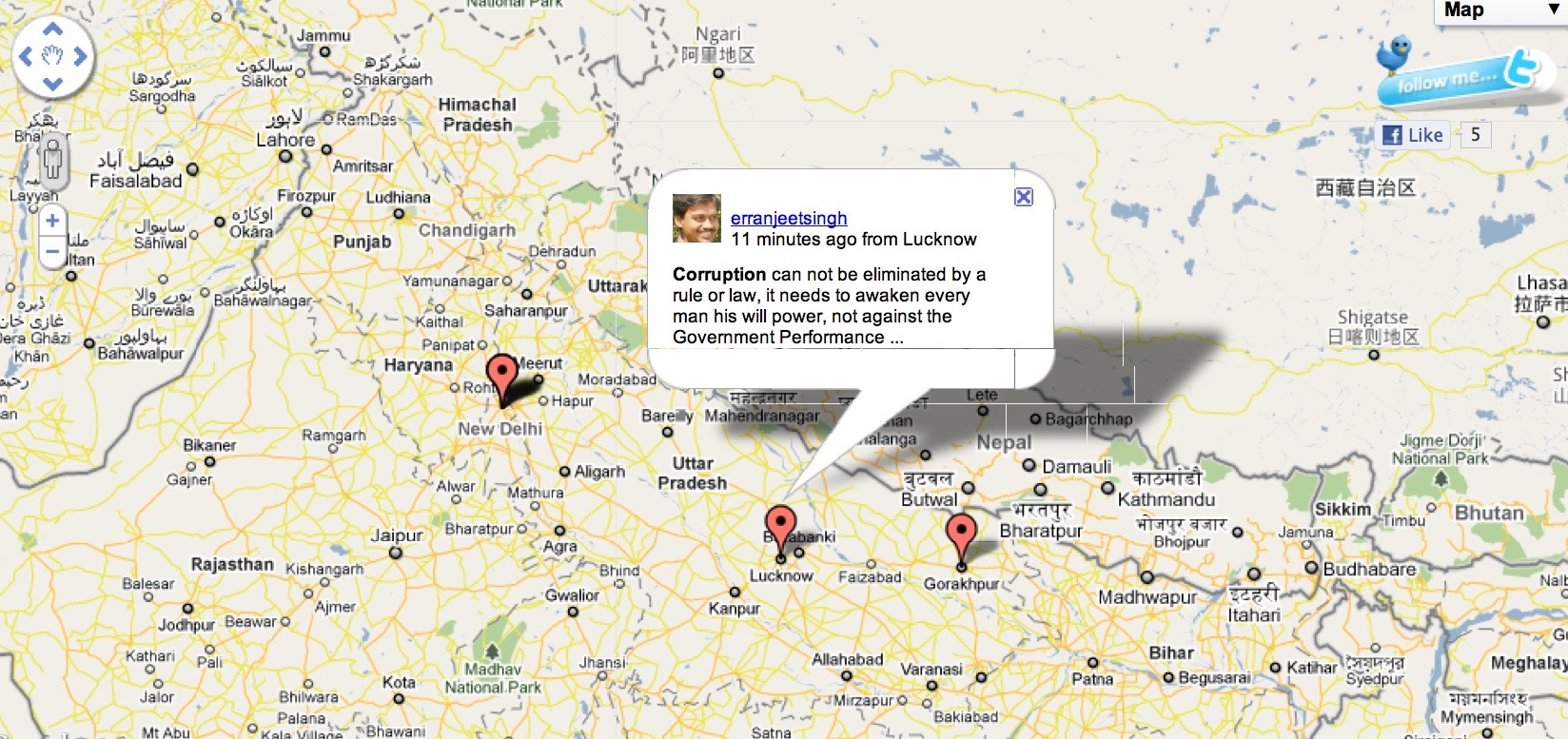
Mapping corruption tweets in real-time in India [MASHUP]

Transparency has gone global. Today, there’s a mashup of corruption-related tweets in India and Google Maps to explore.

Add an expanding number of data points in how Gov 2.0 and open government are taking root in India.

Hat tip to Andrew McLaughlin.

Samantha Power: Transparency has gone global

Innovations in democratic governance have been and likely always will be a global phenomenon. Samantha Power, senior director and special assistant for multilateral affairs and human rights at the White house, highlighted the ways in which platforms and initiatives for transparency in other countries are growing on the White House blog yesterday.

While “Sunshine Week” may be an American invention, the momentum for greater transparency and accountability in government is a global phenomenon. In countries around the world, governments and civil society groups are taking new and creative steps to ensure that government delivers for citizens and to strengthen democratic accountability.

From Kenya to Brazil to France to Australia, new laws and platforms are giving citizens new means to ask for, demand or simply create greater government transparency. As Power observed, open government is taking root in India, where the passage of India’s Right to Information Act and new digital platforms have the potential to change the dynamic between citizens and the immense bureaucracy.

Power listed a series of global transparency efforts, often empowered by technology, that serve as other useful examples of “innovations in democratic governance” on every continent

  • El Salvador and Liberia recently passed progressive freedom of information laws, joining more than 80 countries with legislation in place, up from only 13 in 1990;
  • A few weeks ago in Paris, six new countries from Europe, Africa, Central Asia, and the Middle East met the high standards of the Extractive Industries Transparency Initiative (EITI), empowering citizens with unprecedented information about payments made for the extraction of natural resources;
  • Brazil and South Africa are pioneering innovative tools to promote budget transparency and foster citizen engagement in budget decision-making, along with tens of other countries that are making budget proposals and processes open to public input and scrutiny;
  • Civil society groups are developing mechanisms to enable citizens to keep track of what happens in legislatures and parliaments, including impressive web portals such as votainteligente.cl in Chile and mzalendo.com in Kenya; and
  • Experiments in citizen engagement in Tanzania, Indonesia, and the Philippines, are demonstrating that citizen efforts to monitor the disbursement of government funds for education, health, and other basic services, actually decrease the likelihood of corruption and drive better performance in service delivery.

There’s a long road ahead for open government here in the United States. While improving collaboration and transparency through open government will continue to be difficult nuts to crack, it looks like “Uncle Sam” could stand to learn a thing or two from the efforts and successes of other countries on transparency. Addressing FOIA reform and better mobile access to information are two places to start.

For more on how open government can have a global impact, click on over to this exclusive interview with Samantha Power on national security, transparency and open government.

Knight Commission to release recommendations on open government and online hubs

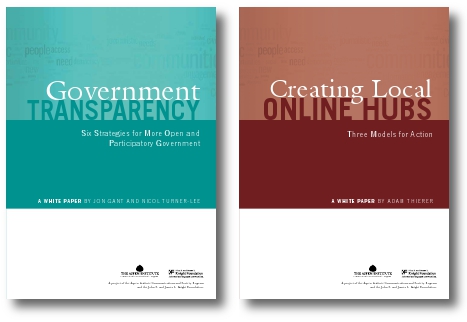
Tomorrow, the Aspen Institute Communications and Society Program and the John S. and James L. Knight Foundation will release two new white papers that focus on implementing the recommendations of the Knight Commission on the Information Needs of Communities in a Democracy.

The two new white papers—“Government Transparency: Six Strategies for More Open and Participatory Government” by Jon Gant and Nicol Turner-Lee, and “Creating Local Online Hubs: Three Models for Action” by Adam Thierer, recommend steps that government and community leaders should take to increase government transparency and put more information hubs online.

To Aspen Institute will convene a roundtable of public officials, advocates, and watchdogs from national, state and local levels of government (along with this correspondent) tomorrow morning from 9:00 a.m. to 12:00 p.m. EST. See the list of attendees below for specific details.

There will be a live webcast of the event. The Knight Commission is encouraging people to participate online at <a href="http://www.knightcomm.org and on Twitter using #knightcomm hashtag. According to the event organizers, a livestream will begin at 9:00 a.m. (EST) and will be archived. These white papers will be available to read and download Friday morning. Look for links here when they become available.

http://widgets.twimg.com/j/2/widget.js

new TWTR.Widget({
version: 2,
type: ‘search’,
search: ‘knightcomm’,
interval: 6000,
title: ‘New in Knight Commission papers on’,
subject: ‘Government Transparency and Online Hubs’,
width: ‘auto’,
height: 300,
theme: {
shell: {
background: ‘#00278a’,
color: ‘#ffffff’
},
tweets: {
background: ‘#ffffff’,
color: ‘#444444’,
links: ‘#1985b5’
}
},
features: {
scrollbar: false,
loop: true,
live: true,
hashtags: true,
timestamp: true,
avatars: true,
toptweets: true,
behavior: ‘default’
}
}).render().start();

Featured Roundtable Speakers

Dr. Jon Gant, Fellow, Joint Center for Political and Economic Studies, and Associate Professor, Graduate School of Library and Information Science, University of Illinois at Urbana-Champaign. He is a leading scholar in the field of information systems and public administration.

Dr. Nicol Turner-Lee, Vice President and Director of the Media and Technology Institute for the Joint Center for Political and Economic Studies. She has produced path breaking research on broadband adoption among minority and disadvantaged populations and engages city, state and federal legislators on issues in telecommunications, open government and the emerging technology innovation sectors.

Adam Thierer, Senior Research Fellow, Technology Policy Program, Mercatus Center at George Mason University, having previously served as President of the Progress & Freedom Foundation. His work spans technology, media, and Internet and free speech with a focus in online child safety and digital privacy policy issues.

Roundtable participants include:

Gary Bass, Executive Director, OMB Watch
Ben Berkowitz, Founder, SeeClickFix
John Bracken, Directory of Digital Media, John S. and James L. Knight Foundation
Jerry Brito, Senior Research Fellow, George Mason University
Kevin Curry, Co-Founder, CityCamp.com
Lucy Dalglish, Executive Director, Reporters Committee for Freedom of the Press
Charlie Firestone, Executive Director, Communications and Society Program, Aspen Institute
Feather Houstoun, President, William Penn Foundation
Alexander Howarder, Government 2.0 Washington Correspondent, O’Reilly Media
William Kellibrew, IV, Deputy Director, National Coalition on Black Civic Participation
Alex Kreilein, Legislative Assistant, Office of Congresswoman Jane Harman
Ngoan Le, Vice President of Programs, The Chicago Community Trust
Blair Levin, Communications and Society Fellow, Aspen Institute
Philip Neustrom, Founder, Davis Wiki
Steve Pearson, Publisher and Chief Technologist, Project Virginia
Lee Rainie, Director, PEW Internet and American Life Project
Rachel Sterne, Chief Digital Officer, Mayor’s Office of Media & Entertainment, New York City
Daniel Schuman, Policy Counsel, Sunlight Foundation
Nancy Tate, Executive Director, League of Women Voters
Tracy Viselli, Community Manager, ACTion Alexandria
Marijke Visser, Assistant Director, OITP, American Library Association
Eric Wenger, Policy Counsel, US-Legal-Government Affairs, Microsoft Corporation
Harry Wingo, Senior Policy Counsel, Google, Inc.

What the new FCC open Internet rules could mean for net neutrality

The Federal Communications Commission adopted new rules for regulating Internet access at a hearing today in Washington. After FCC commissioners Michael Copps and Mignon Clyburn said yesterday they will not stand in the way of Chairman Julius Genachowski’s modified order, it paved the way for a 3-2 vote to approve new rules of the road for the Internet. The tech policy reporters at Politico made the following assessment of the rules in their excellent Morning Tech newsletter this morning and got it about right.

1) Transparency for both wireline and wireless services, requiring disclosure to consumers, content and device providers,
2) Wireline providers are prohibited from blocking any lawful content, apps, services or devices; wireless providers, from blocking websites and competing telephony services, 3) Wireline providers are prohibited from unreasonably discriminating against any traffic (but no such rule for wireless). Paid prioritization is not explicitly banned, though any such regime would likely raise red flags for the commission under the “no unreasonable discrimination” test. That will be determined on a case-by-case basis.

Below are key excerpts from the report and order the FCC voted on yesterday. (The full order still hasn’t been released to the public; more on that later in this post.)

Rule 1: Transparency

A person engaged in the provision of broadband Internet access service shall publicly disclose accurate information regarding the network management practices, performance, and commercial terms of its broadband Internet access services sufficient for consumers to make informed choices regarding use of such services and for content, application, service, and device providers to develop, market, and maintain Internet offerings.

Rule 2: No Blocking

A person engaged in the provision of fixed broadband Internet access service, insofar as such person is so engaged, shall not block lawful content, applications, services, or non-harmful devices, subject to reasonable network management.

A person engaged in the provision of mobile broadband Internet access service, insofar as such person is so engaged, shall not block consumers from accessing lawful websites, subject to reasonable network management; nor shall such person block applications that compete with the provider’s voice or video telephony services, subject to reasonable network

Rule 3: No Unreasonable Discrimination

A person engaged in the provision of fixed broadband Internet access service, insofar as such person is so engaged, shall not unreasonably discriminate in transmitting lawful network traffic over a consumer’s broadband Internet access service.  Reasonable network management shall not constitute unreasonable discrimination.

Wired’s Sam Gustin may have the best one sentence summary of what the FCC compromise will mean:

The three new rules, which will go into effect early next year, force ISPs to be transparent about how they handle network congestion, prohibit them from blocking traffic such as Skype on wired networks, and outlaw “unreasonable” discrimination on those networks, meaning they can’t put a competing online video service in the slow lane to benefit their own video services.

As Politico reported, these are widely regarded as the first enforceable net neutrality rules. The compromise they have produced widespread reaction on both sides of the issue. As Brian Stelter reported for the New York Times, the new FCC net neutrality rules are going down well with anyone interested in the issue.

The debate over the rules, intended to preserve open access to the Internet, seems to have resulted in a classic Washington solution — the kind that pleases no one on either side of the issue. Verizon and other service providers would prefer no government involvement. Public interest advocates think the rules stop far short of ensuring free speech. Some Republicans believe the rules are another instance of government overreach.

Nancy Scola posted a typically thoughtful analysis of what the FCC did to net neutrality today. The whole thing is worth reading but there are two key grafs:

…for sure, some of the provisions in this proposal do seem designed to be responsive to industry worries that don’t seem to have actually been justified in the record. But looking at this whole debate, it starts to look much bigger than Genachowski, and much like we’ve reached the point to where any sort of meaningful incursion onto the corporate right to influence and even dominate the Internet would seem like a downright radical act of political bravery. That’s a reality of the U.S. communications landscape, circa 2010. That we’re debating just how powerful a say telecom company’s should have over how the Internet works is a sign of how the Internet has, as a medium, shifted since its earlier days.

Writing for Wired in 2005, Kevin Kelly recalled how one of the early debates in the Internet’s evolution was whether or not to allow any sort of commerce at all on the activity layer of the Internet. (That is, e-commerce websites and the like.) “It’s hard to believe now,” writes Kelly, “but until 1991, commercial enterprise on the Internet was strictly prohibited.” The idea that the Internet should be so pure probably seems laughable to many of us now. Watching the net neutrality process unfold at the FCC and on Capitol Hill over the last many months has made clear that the reality is that, very quickly, corporate interests have acquired such a level of influence over the evolution of the Internet where the debate can sometimes seem to be far more concerned with their interests than the public interest.

The Center for Democracy & Technology released the following statement in response to the Federal Communications Commission vote to approve a set of “rules of the road” for preserving the open nature of the Internet.

“The Commission took a vital first step today by voting to adopt rules designed to sustain the open nature of the Internet,” said CDT President Leslie Harris. “The Internet is and should remain a place where innovators and upstarts can experiment and thrive, without needing to seek permission or approval from established network operators,” she said. “Today, after a long debate, the FCC affirms that it can and will play a crucial role in protecting that open environment.”

“This is a big day, but the true test of these rules will depend on how they are implemented and interpreted over time,” said CDT Senior Policy Counsel David Sohn. “It appears the rules will leave a number of important open questions, including how the FCC will approach openness for wireless. Ultimately, the kind of Internet users get should not depend on whether they happen to access it via a wireline or wireless connection.”

“To be sure, there is more to be done,” Harris said. “But this is how we make progress on policy, one step at a time, each step building on the one before it. This isn’t the end of the Internet neutrality debate, it’s just the end of the beginning.”

The Washington Post’s Cecilia Kang, who reported live all day on the FCC’s new neutrality rules, went on the PBS News Hour to talk about the new rules tonight:
http://www.pbs.org/wgbh/pages/frontline/js/pap/embed.js?news01s466fq100b

The FCC’s press release follows. Look for the tech journalism community to be teasing more details from this over the coming days, including mentions of Android and how the FCC will handle the app stores

FCC Press Release 12-12-2010 Open Internet http://d1.scribdassets.com/ScribdViewer.swf

The meeting was livestreamed at FCC.gov/live. An archive of the liveblog on this post embedded below; the FCC itself liveblogged the meeting at Blog.OpenInternet.gov.

A note on transparency

Before the hearing, another writer approached me for my thoughts on how transparency played into today’s hearing. Amy Gahran considered why the FCC ‘net neutrality’ rule was still secret at CNN.com today. While she included most of my statement, here’s the full version:

Chairman Genachowski made a commitment to a more open, transparent and data-driven F.C.C. under President Obama’s Open Government Directive. In many respects, in its first year of open government, the agency made commendable progress, with strides towards taking public comment through e-rulemaking at OpenInternet.gov, Broadband.gov and Reboot.FCC.gov. The sites were deployed by an able new media team that has used online communications in unprecedented ways. The chairman and his managing director, Steven Van Roeckel, both deserve credit for their plans to reboot FCC.gov as a platform for government including the use of APIs and open source technologies like Drupal.

That said, when it comes to the question of whether the public has a right to see the net neutrality proposal before the commissioners vote upon it, however, the agency has fallen short of its transparency pledge. I have not found a legal precedent that explicitly gives the agency authority to keep the text of a proposed rule secret until it is voted upon by the Commission. While it is true that conversely the F.C.C. does not appear to be under no legal obligation to do so, given that the members of the commission presumably had to negotiate on the details of the final rules for vote, the decision not to share a version publicly may have made such discussion more flexible. That said, the choice not to post the proposed rules online before the vote is an example less government transparency in the creation of important regulation, not more.

UPDATE: Ryan Singel obtained and posted the following snippets of what looks like the new open Internet rules, below:
Net Neutrality Order Snippets http://d1.scribdassets.com/ScribdViewer.swf

UPDATE: The New York Times Brian Stelter obtained a copy of FCC Chairman Genachowski’s remarks. They are embedded below. His initial coverage of the FCC net neutrality rules remains some of the best online.
Net neutrality statement by Julius Genachowski, the FCC chair, on Dec. 21, 2010 http://d1.scribdassets.com/ScribdViewer.swf

UPDATE: Here are all five prepared statements from the FCC commissioners, as posted on FCC.gov as PDFs.

Copps Statement

Clyburn Statement

Genachowski Statement

McDowell Statement

Baker Statement

UPDATE: The FCC released the full version of the new open Internet rules online on the Friday before Christmas.

Adding social context to low public transparency ratings for federal government

What does open government need to break through the awareness barrier? A new study of federal government transparency efforts released by NextGov and ForeSeeResults gave all entities in the survey low marks in court of public opinion. Here’s the executive summary:

“Nearly two years after a memorandum to the federal government calling for ambitious and sweeping open government initiatives, many are wondering if the goals of openness, democratic participation, and collaboration have taken root and, if so, how successful the efforts have been.

ForeSee Results, in partnership with Nextgov, designed a comprehensive survey to assess how citizens grade four government entities (the government overall, the White House, Congress, and federal agencies and departments) in terms of Open Government Initiative (OGI) principles like transparency and trust. The goals of the research were:

• To get a baseline, quantifiable measurement of citizen trust and perceptions of transparency against which future measurements can be benchmarked

• To compare key citizen-facing government entities

There were four key findings in the study:

  1. All measured entities received low scores when it comes to transparency, citizen satisfaction, and trust.
  2. The White House received the highest score as the most transparent of the four measured entities.
  3. There is a clear and proven relationship between transparency, satisfaction and trust.
  4. Congress has the lowest score of any of the four entities.

To get a sense of what the online community thought about the study, I fired up Twitter and collected the feedback I received after asking a few questions using Storify, a social media curation tool.

http://storify.com/digiphile/public-transparency-ratings-for-the-federal-govern.js