Her perspective can’t be taken as the definitive version of what happened or why, but given that she participated from on the ground, as a witness to history she provided a valuable account of the role of technology. In Nour’s account, this Tunisian revolution was fundamentally powered by people and the conditions of their lives. Tunisia wasn’t a Twitter or Facebook or Wikileaks revolution, said Nour. It was Tunisians on the ground. Regional disparities, corruption, unemployment were primary drivers, she emphasized.
That said, the online and offline worlds appear to have interacted in unprecedented ways in Tunisia. (That insight reflects new Pew research on the role of the Internet as a platform for collective action in the United States, where many expert observers see the decline of the distinctions between “cyberspace” and the material world). The disruptive effect of cameraphones and other devices was particularly important in Tunisia, and, really, everwhere. As Bryce Roberts observed, “mobile devices are the Gutenberg presses of our generation.”
Nour said that Twitter played an important initial role in Tunisia for much of December. As the revolution gathered steam, the new minister of youth and sports, was an inspiration for bloggers in Tunisia, said Nour. @slim404, as he’s known in 140 characters or less, was been a constant source of insight into Tunisia’s inner workings on Twitter. After December 24th that soon Facebook became the main organizing tool for protests and sharing videos. That’s congruent with the statistics the DC Media Makers audience heard. According to Nour, there is about 85% cellphone penetration in Tunisia, with around 30% of Tunisian citizens are on the Internet. She said that there are 500 or so active Twitter accounts there, as compared to more than 2 million active Facebook users.
NPR senior strategist Andy Carvin, co-founder of DC Media Makers and an expert analyst regarding the role of online communications in uprising, observed that Facebook was the open platform for Tunisians to share videos. People in Europe would migrate those videos into Posterous, then upload to YouTube, and then share them using Twitter. Carvin pointed out the nawaat.org also aggregated Facebook videos almost as fast as they went up. All of the services worked together on top of platform that the Internet provides.
Nour highlighted four ways that social media played a role in the Tunisian revolution, all of which can be applied to other contexts.
Grassroots mobilization. Nour said that some of the organization of protests happened on Facebook, which effectively played the role of community organizing platform
Organize the rise of civil society and active citizenship. Citizens used social media to identify the positions of snipers, police and looters, and to alert one another to other violence, said Nour, who also noted that networks formed to clean streets, protect shops or organize bread lines.
Counter rumor or propaganda tool. When there were concerns about water being poisoned, people sharing information on Facebook helped to counter that falsehood, said Nour. When reports came in that there was massive shooting in a neighborhood, a few minutes later, a few dozen people said that was untrue.
Helped people analyze government statements. Nour said that when government went on TV, people went on online to analyze what president aid and to form a consensus on whether the positions met their requirements. Ultimately, they did not.
Would the revolution have happened without social media? Yes, asserted Nour, but “it wouldn’t have happened as fast.”
Now Tunisians face the next steps: what happens after this uprising. “In a revolution, as in a novel, the most difficult part to invent is the end,” observed Nour, quoting de Tocqueville.
In this historic moment, we’re all living stories. When combined into the narratives of entire countries, they make for fascinating, sometimes heartrending reading.
Designing digital democracy is hard. The structures and conventions that have evolved for deliberative democracy, as messy as it can be offline, don’t transfer perfectly into machine code. Many different companies, civic entrepreneurs, nonprofits and public servants are working to create better online forums for discussion that make better use of technology. This morning, New York City’s new chief digital officer, Rachel Sterne, asked how NYC could use technology to serve citizens. In 2011, the White House is using an unprecedented mix of Web 2.0 platforms at its new State of the Union page for tonight’s speech, integrating graphs and other elements to the WhiteHouse.gov livestream.
Tonight, a new alpha feature in Google Moderator is adding some social signals to help identify the questions that citizens want President Obama to answer in his YouTube interview on Thursday night. Every tweet with an #askObama hashtag will be added to the Google Moderator instance at YouTube.com/AskObama. And every retweet of an #AskObama tweet will count as vote in the Moderator instance. (For the uninitiated, a retweet on Twitter is when a user reshares another user’s tweet. To count as a vote on Moderator, the retweet has to be a “native RT,” not the older manual version where text is copied.)
It’s a simple tweak but it’s one that could make the tool more useful for people who wish to crowdsource questions. “There’s a lot of experimentation going on with Gov 2.0,” said Ginny Hunt, product manager for Google Moderator. “There’s a lot of people on all sides trying to figure out how to involve people in a more useful, participatory, exciting way.”
Hunt looks at Moderator as a way to aggregate and rank answers from many different places across the Web. “We don’t see Moderator as a Q&A platform in quite the same way that you might look at Yahoo Answers or Quora,” she said. “We see it as a way to have an ongoing conversation with constituents in a way that’s efficiently organized. That’s why it fits so naturally with YouTube, because there’s a very clear connection with engaging content.”
Hunt emphasized that what people will see on Moderator tonight “is really alpha” and isn’t available on the standard module on YouTube. “It’s a small step in the evolution of social engagement,” she said. “The more we can simplify the process for government and partners, the better. What you’ll see with Twitter tonight is just the first step. Tweets will get integrated into Moderator with your Twitter identity. It’s just a tiptoe into how we can aggregate ideas in a smarter way and is highly experimental, which is why it’s in Google Labs.”
Part of that process is in making the Google Moderator API available to developers. For instance, Google Moderator powers 10 Questions, which the Personal Democracy Forum relaunched in an effort to reboot citizen to candidate engagement.
“We’ve now used the API to kick of something called YouTube World View, which will be a monthly interview with a world leader,” said Hunt. “You can use the API to plug into anything you want to socialize to allow ranking. We made it open because we expect people to be more innovative than we can anticipate in terms of easily crowdsourcing within a community.”
The content from a Moderator series can also be exported as comma-separated values (CSV) files, which allows developers and designers to take the information and do analysis with the raw data.
There are many challenges in creating platforms for civic discourse, including building in incentives for participation, mitigating identity or privacy issues, addressing vocal minorities overwhelming the system, or ensuring systems scale under heavy traffic. (On that last count, Google’s servers have had little trouble keeping up the load: the Google Moderator instance for last year’s YouTube interview on the CitizenTube channel received over 11,600 questions and over 660,000 votes.)
Even as the role of the Internet as a platform for collective action is growing, however, the technical challenges of getting this right include numerous design, community and cultural challenges. The ways that connection technologies can be turned to governance, versus campaigning, will become increasingly critical as more people go online. Many of the social platforms that are in current use give their users substantial ability to personalize what information or conversations they receive.
Clay Shirky, speaking at this year’s State of the Internet Conference, said that government and technologists have systematically undersigned social spaces where hard choices are addressed. “We have, thanks to James Madison, lots of well designed systems to do that [offline]” he said. “We don’t have as many online. The tendency to rant or opt out prevents the kind of bargaining or horsetrading that’s important.”
The Google Moderator team has made an effort to address some of those issues. “We’ve tried to address that by giving everyone a way to let their voices be heard and to weigh in on the process. Ideally, a small, loud, organized group wouldn’t block the virtual room for others,” said Hunt. “The online systems haven’t caught up to the checks and balances that exist in an in-person town hall. Sometimes, they can be more disruptive. We’re still figuring that out. We do care that people have fair space to have their voice heard.”
Hunt posits that when you ask community about not just what they want to say but what they care about, you’ll get more useful results. “We’re not just inviting people here to post something. We’re asking them to contribute and then vote on something they care about. Freedom of speech in a representative democracy can be messy but that’s part of the process that makes it what it is. The challenge is getting closer to giving people who are busy, with a lot on their minds, a way to get involved.”
The real time Web needs to become the right time Web for most of those citizens to find it relevant in their everyday lives, as it did today when a new geolocation app launched that connected trained citizens with heart attack victims. People need actionable intelligence. Geeks hacking smarter government to make asking questions and gathering feedback simpler can and will make a difference. “If we can make it simpler for folks to plug in, that’s a good thing for everyone,” said Hunt. For those that want to #askObama a question about his plans for 2011, that Moderator instance closes at midnight on Wednesday.
The social web can be a powerful tool for communication, sharing and remembrance. The Internet would be a neutral tool that could be used for organizing, enlightenment and commerce, or repression, propaganda and crime. Which will it be? In 2011, the safest bet is both. Today, that truth was self-evident in the United States, as a nation remembered Dr. Martin Luther King Jr. online. Over the past week, however, the Internet and its social layer has been given a starring role in the recent events in Tunisia that may be overblown.
In a word, no. At least, not on those terms. “No one I spoke to in Tunis today mentioned twitter, facebook or wikileaks. It’s all about unemployment, corruption, oppression,” tweeted Ben Wedeman, reporting for CNN from on the ground in Tunisia. Dan Murphy minced no words in his piece in the Christian Science Monitor rebutting the Wikileaks revolution meme that Wikileaks itself spread. “The Jasmine Revolution in Tunisia is being driven by flesh and blood and conditions on the ground, not because WikiLeaks ‘revealed’ to Tunisians the real face of a government they’d lived with their whole lives,” wrotes Murphy.
“Any attempt to credit a massive political shift to a single factor — technological, economic, or otherwise — is simply untrue,” wrote Zuckerman in Foreign Policy. “Tunisians took to the streets due to decades of frustration, not in reaction to a WikiLeaks cable, a denial-of-service attack, or a Facebook update.”
On amplifying voices:
For users of social media, the protests in Iran were an inescapable, global story. Tunisia, by contrast, hasn’t seen nearly the attention or support from the online community.
The irony is that social media likely played a significant role in the events that have unfolded in the past month in Tunisia, and that the revolution appears far more likely to lead to lasting political change. Ben Ali’s government tightly controlled all forms of media, on and offline. Reporters were prevented from traveling to cover protests in Sidi Bouzid, and the reports from official media characterized events as either vandalism or terrorism. Tunisians got an alternative picture from Facebook, which remained uncensored through the protests, and they communicated events to the rest of the world by posting videos to YouTube and Dailymotion. As unrest spread from Sidi Bouzid to Sfax, from Hammamet and ultimately to Tunis, Tunisians documented events on Facebook. As others followed their updates, it’s likely that news of demonstrations in other parts of the country disseminated online helped others conclude that it was time to take to the streets. And the videos and accounts published to social media sites offered an ongoing picture of the protests to those around the world savvy enough to be paying attention. – Ethan Zuckerman, Foreign Policy
Here’s a reader that provides more perspectives on the Internet in the past week’s events in Africa.
Al Jazeera on the role of social media in the Tunisian uprising:
“In contemporary systems of political communication, citizens turn to the Internet as a source of news and information in times of political crisis. It is not only that online social networking services are influential as a communications media; rather, they are now also a fundamental infrastructure for social movements. And the Internet globalizes local struggles.
Information and communication technologies are the infrastructure for transposing democratic ideals from community to community. They support the process of learning new approaches to political representation, of testing new organizational strategies, and of cognitively extending the possibilities and prospects for political transformation from one context to another.
But it would be a mistake to tie any theory of social change to a particular piece of software.”-Philip Howard
Technology clearly played a role in amplifying the voices of Tunisian citizens. The question is how much of a role, given the reality. Using social networks, SMS and online video, they could be heard by on another and the rest of the world (along with, one can assume, government agents.)
Did Twitter matter?
The reality is that Twitter is an information-distribution network, not that different from the telephone or email or text messaging, except that it is real-time and massively distributed — in the sense that a message posted by a Tunisian blogger can be re-published thousands of times and transmitted halfway around the world in the blink of an eye. That is a very powerful thing, in part because the more rapidly the news is distributed, the more it can create a sense of momentum, helping a revolution to “go viral,” as marketing types like to say. Tufekci noted that Twitter can “strengthen communities prior to unrest by allowing a parallel public(ish) sphere that is harder to censor.”
So was what happened in Tunisia a Twitter revolution? Not any more than what happened in Poland in 1989 was a telephone revolution. But the reality of modern media is that Twitter and Facebook and other social-media tools can be incredibly useful for spreading the news about revolutions — because it gives everyone a voice, as founder Ev Williams has pointed out — and that can help them expand and ultimately achieve some kind of effect. Whether that means the world will see more revolutions, or simply revolutions that happen more quickly or are better reported, remains to be seen.”-Mathew Ingram, GigaOm
Tunisia’s Twitter revolution?
“Many have attributed the wave of protests to the rise of the internet and social media in a country notorious for its censorship but Foreign Policy blogger Marc Lynch says it’s not that simple. He says the internet, social media and satellite channels like Al Jazeera have collectively transformed the information landscape in the Arab world.”-On the Media
Car malgré l’immense respect que j’ai pour ce qu’a réussi à accomplir le peuple tunisien, et les twitterers qui ont rejoint leur cause, il convient de dire que l’engouement des twitterers pour la révolution Tunisienne est resté, somme toute, trés modeste.
Ainsi, au plus fort de la crise, le tryptique Tunisie+Tunisia+tunez n’a atteint que 100 tweets par minutes. On m’objectera que ce trypique ne permet pas de mesurer le nombre de tweets réels parlant des événements tunisiens. C’est tout à fait vrai, mais cela reste un indicateur, et en comparaison le dyptique (equateur + ecuador) dépassait lui les 400 tweets/minutes lors de la tentative de coup d’etat en Equateur du 30 septembre dernier… Qui s’en souvient?
Autre indicateur intéressant, le mot Tunisie (en français), est resté égal à Tunisia (en anglais) et superieur à Tunez (en espagnol) avec constance jusqu’aux 2 derniers jours, les courbes des différents mots clefs épousant par ailleurs exactement le même tracé. Ceci nous permet de conclure 2 choses:
Les twitterers impliqués appartenaient globalement aux mêmes fuseaux horaires. En réalité, la révolution tunisiennes a été essentiellement suivie, commentée et retweetée en Europe et au Moyen-orient.
Les événements ont sans doute fait le plein des voix francophones intéréssées par l’actualité internationale, celles-ci restant, n’en doutant pas, bien modestes à l’echelle de Twitter. Mais, les grandes communautés de Twitterers hispanophones et anglophones d’Amerique du Nord et du Sud, ainsi que celles des pays asiatiques anglophones sont elles, en proportion, restées trés en marge de l’actualité Tunisienne. (je ne possède pas de données concernant les autres communautés linguistiques notamment japonaise, russe, etc…)
Et à cela il y a me semble-t-il une explication qui va au delà des facteurs géographiques ou historiques: la trés faible et pour le moins tardive implication les medias US et UK qui, sur Twitter, sont eux, les véritables catalyseurs, et c’est un fait constant, des discussions touchant à l’actualité internationale.”-Quelle Twitter revolution en Tunisie?
Clay Shirky commented on the role of technology in Tunisia:
“…you quote Zeynep asking “was the French Revolution a printing press revolution?” To which the answer is _of course_ the French Revolution was a press revolution; it was unimaginable without the press.
“Prototypically, this type of press can be observed in times of revolution, when the journals of the tiniest political groupings and associations mushroom–in Paris in the year 1789 every marginally prominent politician formed his club, and every other founded his journal; between February and May alone 450 clubs and over 200 journals sprang up.” (Habermas, _Structural transformation of the public sphere_)
So Tunisia was no more a media revolution than the French Revolution was, but no less either. And though Twitter has become the short-hand for the changed media environment in Tunisia, my vote goes to mobile phones and Al Jazeera as the monikers for the media that made the most difference.
Weighting the variables, though, are details, in my view, compared to the much larger change in the conversation taking place.
No one believes social media _causes_ otherwise complacent citizens to become angry enough to take to the streets. It’s a convenient straw man for the skeptics, because, as an obviously ridiculous narrative, it’s easy to refute.
And the effect of a new medium on society is so full of feedback loops there is no way to prize apart those effects while they are happening, and prizing them apart afterwards takes decades and consumes academic careers.
The argument about the effect of social media centers on something much less causal and much more contributory: the idea that social media helps angry people achieve shared awareness about how many other people are angry, and helps those people take action. AJ contributed more to the first half of that equation, mobile phones to the second, FB more the first, Twitter more the second, and so on.
In Tunis, this effect clearly played a role. How and how much will be debated for years, but its importance seems obvious, just as the importance of newly cheap printing presses fueled political organization in France. But even the people pointing out that calling this a Twitter Revolution is simplistic and insulting are alway saying social media had an effect. Luke Allnut’s widely circulated piece, “Can We Please Stop Talking About Twitter Revolutions” says:
“First off, it looks like social media did have an important role to play here. An estimated 18 percent of Tunisia’s population is on Facebook and, left unblocked by the government, it was a place where many Tunisians shared updates pertaining to the protests. As Ethan Zuckerman has pointed out, the video-sharing sites Dailymotion and YouTube were also important. And with a paucity of on-the-ground media coverage, Twitter excelled as a medium in getting the message out, in driving mainstream media coverage, and in connecting activists on the ground with multipliers in the West.”
“Twitter Revolution” is a headline, a label that compresses and distorts wildly, but arguing over whether we should use or drop the phrase (I think its dreadful, and never use it) is a lot less important than the underlying clarity the events in Tunis provide: no one thinks social media is the source of the anger, some people think social media was one of the things that helped convert that anger to action (Allnutt, Zuckerman, me), some people think that social media has little or no effect (Morosov and Gladwell, most famously). And from my point of view, that latter belief has become harder to support.
“-Clay Shirky, commenting on GigaOm
Shirky posted a correction as well:
Evgeny has pointed out to me in mail that I have wrongly lumped his views in with Malcolm Gladwell’s, which I’d like to retract.
Malcolm seems to have taken a “Bah, humbug” approach to social media, stretching Tom Slee’s ‘slacktivism’ critique (Facebook shout-outs for overthrowing SLORC won’t free Burma) to encompass all uses of social media. Where I went wrong was in imputing Malcolm’s “social media is politically inert” view to Evgeny as well, when he believes something considerably more complex.
Here’s my precis of Evgeny’s thesis: although the internet and mobile phones _can_ lead to things like improved ability to mobilize, those improvements will not necessarily lead to a net increase in political freedom. The governments threatened by increasingly synchronized populations can still avail themselves of Evgeny’s troika of surveillance, propaganda, and censorship, thus retaining or even strengthening their hold on the populace. (Rebecca Mackinnon makes a similar argument in her work on networked authoritarianism.)
This a subtler view than the one I hastily attributed to Evgeny. He and I still disagree, but our disagreement is only slightly affected by the Jasmine Revolution, as it is only a data point for the larger question of the net effect on all the world’s countries.
Shirky wrote more about the political power of social media in Foreign Affairs (sub. required) written before Tunisia broke upon the wider wold consciousness.
More from a “technosociology” viewpoint:
I find it hard to believe that the ability to disseminate news, videos, tidbits, information, links, outside messages that easily, transparently and without censorship reached one in five persons (and thus their immediate social networks) within a country that otherwise suffered from heavy censorship was without a significant impact. (More background here on the particulars of the general political situation in Tunisia). To say that social-media was a key part of the revolution does not necessarily mean that people used GPS-enabled phones to coordinate demonstrations; that is simplistic and misses the point in which social media shapes the environment in general. What it means is that the people acted in a world where they had more means of expressing themselves to each other and the world, being more assured that their plight would not be buried by the deep pit of censorship, and a little more confidence that their extended families, their neighbors, their fellow citizens were similarly fed up, as poignantly expressed by the slogan taken up by the protestors: “Yezzi Fock! Enough!”-Zeynep Tufecki
On “rebooting” Tunisia:
What happened this week has nothing to do with previous Twitter-revolutions (sorry Iran), and is more about Facebook than Twitter anyway. Social media was not just a tool to communicate and coordinate action, it was a tool to create worldwide support in little time. From a retweet to an Anonymous LOIC attack, a blog post or a translation, millions have shown their support and took action.” –Fabrice Epelboin, ReadWriteWeb
Of “cyberactivists” and a dictator:
As during Iran’s Green Revolution, the primary function of social media has been to get around the government’s iron grip on information flows. International media can pull the information from sites like Àli’s, then broadcasts it back into Tunisia via satellite TV, a process in which Al Jazeera in particular has played a critical role. Social media, along with SMS and traditional word-of-mouth, has also been an important tool to coordinate the grassroots protests which don’t really have any leaders yet. There is no political party or unifying figure behind the demonstrations, which were going on for almost a month before people outside the country started to take note.-Mike Giglio, Newsweek
A view on the role of social media from within Tunisia:
Wikileaks played a major role in fueling the anger / determination of Tunisians. However, the Wikileaks reports only put further light on what we already knew. They confirmed our doubts and detailed the different events.
Twitter and Facebook played a very important role in our revolution, and I am confident that if we were not using social media we wouldn’t have accomplished our goals.
Social media empowered our communication infrastructure.
It countered the traditional media, the propaganda machine of our government. It allowed us to detect patterns that one would not notice if left alone, such as noticing that all the presidential police cars are rented (rented cars in tunisia have blue license plates). Social media fostered crowdwisdom, by sharing thoughts, feedbacks, and opinions. And finally on the battle field, we even used in the final hours of our government to share snipers’ positions.
Then, the final demonstration was an event on facebook that everybody shared.
And now we are using it to find the militias, and share their positions. There are volunteers working on developing web 2.0 applications to place events on maps. – Youssef Gaigi, Tunisian blogger
A “Human Revolution?”
But to call this a “Twitter revolution” or even a “WikiLeaks revolution” demonstrates that we haven’t learned anything from past experiences in Moldova and Iran. Evgeny Morozov’s question–”Would this revolution have happened if there were no Facebook and Twitter?”–says it all. And in this case, yes, I–like most Tunisians to whom I’ve posed this question–believe that this would have happened without the Internet.
The real question, then, is would the rest of us have heard about it without the Internet? Would the State Department have gotten involved early on (remember, their first public comment was in respect to Tunisian Net freedom)? Would Al Jazeera–without offices on the ground–have been able to report on the unfolding story as they did? Most importantly, would any of that have mattered?
Social media may have had some tangential effect on organization within Tunisia; I think it’s too soon to say. No doubt, SMS and e-mail (not to be mistaken with social media) helped Tunisians keep in touch during, before, and after protests, but no one’s hyping those–e-mails and texts simply aren’t as fascinating to the public as tweets. In fact, assuming SMS and e-mail did play a role in organizing (and again, I don’t doubt they did — Tunisian’s Internet penetration rate may be only 33%, but its mobile penetration rate is closer to 85%), then we ought to be asking what it is about social media that is unappealing for organization? Could it be the sheer publicness of it, the inherent risks of posting one’s location for the world to see? Given the mass phishing of Facebook accounts, it wouldn’t surprise me in the least if Facebook were seen as risky (Gmail accounts were also hacked, however, which undoubtedly led some to view digital communications in general as risky).”-Jillian C. York, Cantabridgian blogger
In my view, success in the 21st Century depends on effective governance. A free and vibrant press plays an important role around the world in the development of civil society and accountable governments. As a general rule, the freer the press, the more transparent and more democratic the government is likely to be. In the context of this seminar, Media and Politics, think of the places around the world recently where existing governments are clearly guilty of substantial election fraud, fraud that either skewed the results to a significant degree, or stole elections outright. This involves the election in Iran in June 2009, where the government harassed the traditional media as they covered the election and the fraud that was evident, as well as the opposition that very effectively used social media during the campaign, and has refused to be silenced to the present day.
Dictatorships understand the power of the media, where in Burma, the ruling junta held an election in November for which it refused to allow Aung San Suu Kyi to participate, nor allowed outside media to cover. The result was a kind of election laundering, where the existing military government attempted to use the election to transform itself into a civilian government. But it lacks the legitimacy that only civil society, backed by a vibrant press, can bestow. Unfortunately there is no shortage of present-day examples, from Cote d’Ivoire to Belarus, where the media continues to document the actions of repressive governments that in one case refuses to accept the results of an election that it did not expect to lose, and in the other has literally jailed every opposition figure that dared run against Europe’s last dictator.
The former Yugoslavia is my best example of a case where the investment in independent media helped to transform a country and we hope over time a region, contributing to the dynamic that led to the end of the rule of Slobodan Milosevic, and his transfer to The Hague where he died in prison while facing charges for crimes against humanity. We also know that the media can be used to incite ethnic violence, as we saw tragically in the 1990s in Rwanda. We continue to have concerns regarding state-controlled, particularly in the Middle East, that continue to foment religious tension across the region.
No one is a greater advocate for a vibrant independent and responsible press, committed to the promotion of freedom of expression and development of a true global civil society, than the United States. Every day, we express concern about the plight of journalists (or bloggers) around the world who are intimidated, jailed or even killed by governments that are afraid of their people, and afraid of the empowerment that comes with the free flow of information within a civil society.
Most recently, we did so in the context of Tunisia, which has hacked social media accounts while claiming to protect their citizens from the incitement of violence. But in doing so, we feel the government is unduly restricting the ability of its people to peacefully assemble and express their views in order to influence government policies. These are universal principles that we continue to support. And we practice what we preach. Just look at our own country and cable television. We don’t silence dissidents. We make them television news analysts. -P.J. Crowley, U.S. State Department
And thoughts from one of the toughest critics of State’s “Internet freedom” policy, Evgeny Morozov:
Anyone who has seen reports about Tunisia’s “WikiLeaks Revolution” would know that those accounts mostly focus on the role that the cable revelations about Tunisia played in enticing the protests (this is an account I don’t agree with, if it’s not yet obvious). To suggest that a term like a “WikiLeaks Revolution” does not also celebrate – perhaps, implicitly – the factors most commonly associated with the Internet (its resilience against censorship, its spirit of mutual collaboration, etc) would be extremely disingenuous. When people say that events in Tunisia were a “WikILeaks Revolution”, they are consciously or subconsciously cheering the fact that there is this former-hacker guy Assange who used the Internet to do the unthinkable. If this is not what is celebrated by the term “WikiLeaks Revolution”, then it doesn’t have any meaning at all.
WikiLeaks, alas, is not “social media” – so it doesn’t meet Clay’s rigid definition. But if you broaden the terms of the debate to the Internet proper – and those are the terms that are most interesting to me – you are bound to notice that there are plenty of pundits and analysts celebrating the power of the Internet to politicize future protesters – not only to help them organize. This, by the way, is the same argument that was used by plenty of neocons in the wake of the Soviet collapse: it was assumed that the Western radio informed Soviet citizens about the superior value of Western goods – and the Soviets eventually rebelled. Apologies for self-promotion, but anyone who thinks these are not real intellectual narratives being pimped in Washington DC should take a look at my book, where they are extensively documented (including in the 70-page bibliography!)” -Evgeny Morozov, The Net Effect, Foreign Affairs
(As it happens, this correspondent is reading it this month. He’s also headed to the State of the Net later this morning, where the events above were the subject of discussion.)
Q: Tunisians were using Twitter for logistics, from warning of sniper locations, to calling for blood donation at hospitals, to organizing protests. Does this mark a new era in Twitter use, where people use it to navigate danger and save lives under tumultuous circumstances?
ZT: Twitter is a very good tool for using in emergencies thanks to its short message format, multi-platform access, and the ability to use cell phones. This was also shown during the Haitian earthquake, Tuscon shootings, etc. So, yes, social media in general, and Twitter in particular, are now woven into the fabric of our responses to tumultuous circumstances.
NW: There was a report on a French TV station called TF1, where a Tunisian man said, ‘Twitter a sauve mon vie,’ which means, ‘Twitter saved my life.’ What happened was that at one point the presidential guard went on a rampage. The man said he was about to leave his house, but he saw masked, armed gunmen. He went online and tweeted, and asked for help. People saw this in Tunisia, and started calling the army’s emergency lines, reporting his exact location. The army showed up immediately and arrested these people. This is the power of social media.
JY: It does seem like a new thing, it’s not something that I had seen before. But I saw more [logistical information] being shared on facebook, behind closed doors using private messaging. I had one friend who sent a message to a group of people to stay away from a specific neighbourhood in Tunis because of snipers. Another person sent out a message saying, ‘I’m going to be [at a particular place] this afternoon, and I should be back online by 10:30 p.m..’ That way, if that person is not back online by 10:30 p.m., somebody is going to be concerned. I saw a lot of that happening.
“There’s no such thing as a Twitter revolution,” says Jared Cohen of Google Ideas, Google’s new think tank — and that’s coming from someone who once served as Secretary of State Hillary Rodham Clinton’s principal advisor on what the State Department calls its “Internet Freedom Agenda.” In 2009, Cohen telephoned the managers of Twitter and persuaded them to delay a maintenance break so Iranian protesters — who filled the streets of Tehran at the time — wouldn’t lose their access.
Cohen does think technology has a major impact on incipient revolutionary movements: “It’s an accelerant,” he said. Social media make it easier for grass-roots dissidents to find each other, identify potential leaders, share information and connect with the outside world. But in the end, he noted, “a successful revolution still requires people to go into the streets and risk their lives.”-Doyle McManus, L.A. Times
McManus shared a further, highly relevant observation in that column: “An old-fashioned lesson for revolutionaries: It’s nice to have Twitter, but it’s even nicer to have the army on your side.
“The first conflict with the old RCD-ists,” Mr. Amamou, 33, told his 10,000 Twitter followers from the closed-door cabinet meeting, along with the rest of the fly-on-the-wall details reported above. “I like the minister of Justice,” he wrote on Twitter a few days later. “I am going to wear a tie just to please him.”
In the week since Mr. Ben Ali’s flight, Mr. Amamou has become a symbol inside the cabinet of the revolution’s roots in the online world of Twitter and Facebook. Before the advent of such networks, local outbursts of unrest here were quickly crushed. This time, the revolt flashed across the country as protesters shared video of their own demonstrations. Grainy cellphone images of a clash with the police in one town egged on the next.
Now Mr. Amamou’s idiosyncratic commentary on Twitter is telling the still-evolving story of the revolution’s early days and providing an important source of information about the new administration’s plans.
His news bulletins have included advance word that the prime minister would resign from his party, and that the education minister planned to reopen the schools. After four new ministers resigned Tuesday in protest of the continued role of the R.C.D., the French initials for the Constitutional Democratic Rally, Mr. Amamou wrote that the government planned to seek their return instead of replacing them.
Crowley’s Saturday post about Tunisia was just the latest in a series aimed at encouraging calm and reform in the country. “The people of Tunisia have spoken,” he wrote on Thursday. “The interim government must create a genuine transition to democracy. The United States will help.”
Both Crowley and Ross dispute that the revolution in Tunisia was fomented by either WikiLeaks revelations of U.S. assessments of rampant corruption, which was already well known, or social media. But, they said Twitter, Facebook and other forms of social media played an important role in how the revolt played out.
“Dramatic change is happening in Tunisia,” Crowley told the AP. But “real social deprivations, including the lack of political and economic opportunity combined with obvious corruption, are the real underlying causes. . Social media served as an accelerant.”
“Connection technologies succeeded where mainstream media was blocked or slow to identify and report news,” said Ross. “Tools like Twitter can stand-in where traditional media is blocked by an authoritarian regime from reporting. At times like this, the ability of P.J. Crowley to communicate with people through Twitter is very important.”
“We are not utopian about technology,” he said. “We understand that it just a tool. However, if you want to be relevant in 2011, you need to understand how to harness the power of technology.” -Matthew Lee, Washington Post
If you have thoughts, comments or other data which would further inform readers, please leave them in the comments, drop me an email or find me on Twitter.
A new survey by the Pew Research Center’s Internet and Life Project sheds new light on the social side of the Internet.The results offer new insight into the differences between the connected and the disconnected. The survey found that: 75% … Continue reading →
Today, news that White House press secretary Robert Gibbs will be leaving to become an outside political adviser to the president and his re-election campaign. In the White House press briefing today, Gibbs reflected upon several ways that his role has changed as the speed of reporting has increased, particularly in the context of Twitter. Gibbs was the first White House press secretary to tweet, at @PressSec.
The two questions Gibbs answered today for #1Q centered on exactly the question: what’s next for Gibbs – and for his @PressSec account?
“None of these tools were developed for me,” said Gibbs. “They were developed for you.”
He implied that @PressSec will continue, though it’s not immediately clear whether he’ll transition the account. For more on his thinking on social networking, relevant excerpts from the transcript from the briefing follow.
Q: Thank you. Having been at this for two years, can you talk to us a bit about the value of the daily briefing? Do you think it’s helpful to the general public? Is it helpful to reporters? Is it helpful to the White House? Would you make any changes? Would you take it off camera? Do you like it being on camera?
MR. GIBBS: Look, we’ve experimented with a couple different things like — I do think there’s a great utility in doing some off-camera gaggles. We probably, truth be told, haven’t done enough of those. I think there’s an ability to talk about things slightly differently without all these fancy lights.
I think it’s important, though, as I said — I alluded to earlier, it’s important to, as a government, to come out here and talk about and answer the — talk about the policies and decisions that are being made and to answer the questions surrounding those.
Like I said, there are days in which — my guess is it will happen again this week — where you pick up that newspaper or you turn on your computer at 4:30 a.m. in the morning while your coffee is still brewing and you groan and, oh, God, what — you know, great, this is going — and then you get on your BlackBerry.
But I think there’s a usefulness to that. I think there’s a reason that this has been an enduring quality. I do think there is — look, I think there has to be — I think there should continue to be experimentation, again, with gaggles. We’ve tried more stuff on social networking that I think will continue long past my existence inside this building because that, too, is important.
You now have the ability to — look, I got on something like Twitter largely from watching you guys tweet while the President was standing right here. And it’s a fascinating concept. All this stuff moves much faster. I think that will endure. And I think the briefing will endure. And I think what gets added to and what complements the briefing in terms of breaking down any walls that exist between the people and their government will only accelerate.
Gibbs then took a question on his use of social media platforms, which, as the questioner pointed out, he used to call “the Twitter” and YouTube. Gibbs said that was “a joke.” Take a look at WhiteHouse.gov/1Q for an archive of his use of the two platforms.
Q: The use of these kind of platforms, to what degree can you gauge its effectiveness in terms of sort of bypassing us, who are filters —
MR. GIBBS: Well, here’s I think a great misnomer, because I think it’s important — social networking and the use of those type of tools I think — I don’t look at it as, boy, I can now talk to people and you guys — I’m going to go around you. I’ve neversaid that. Because, quite frankly, I subscribe to what you write; youguys subscribe to what I write. And I think what’s unique is we’ve done recently — and I’ve greatly enjoyed them, though I realize that — and I know you all agree — that very few of my answers conform to 140 characters. But I think it’s interesting that you can have a dialogue with people who are going about their daily lives, who have questions for the administration about what it’s doing, and you guys have written off of that.
And I think that’s — I just don’t think people should look at the increased transparency in their government, a greater explanation of the decisions that we’re making, as an effort to move around and go around you guys.
Food for thought. Hat tip to Nancy Scola at techPresident, who offers additional analysis. If you’re at all interested in what happens next to @PressSec, or how the new media aspects of today’s transition were handled, Scola’s post on the 112th Congress’ great Twitter handover is an absolute must-read.
If you missed the first two rounds of Gibbs taking extended questions from the public over Twitter, they’re captured here, along with analysis of what transparency really means in this context.
One of the risks and rewards for the use of Web 2.0 that came up in the July hearing on “government 2.0” technology in the House of Representatives had nothing to do with privacy, secrecy, security or embarrassment. Instead, it was a decidedly more prosaic concern, and one that is no surprise to anyone familiar with governmental institutions: record keeping. And no, this is not another story about how the Library of Congress is archiving the world’s tweets.
IBM’s Business of Government Center has released a new report on social media (PDF) records management, focusing on some best practices for harried federal employees faced with rapidly expanding troves of tweets, Facebook status updates, blog posts or wikis. For those keeping track, 22 of 24 agencies now, at the minimum, have a Facebook presence.
If you’re interested in the evolution of social media in government, a lot of what’s in here won’t be new to you. If not, the report provides a useful framework for why using social media presents headaches for federal records keeping and quite a few best practices and suggestions for mitigating them. As the preamble to the report allows, “this report does not solve the many challenges it identifies. However, it serves as a useful guide for federal managers attempting to use social media to engage citizens while meeting the statutory requirement to preserve historical records for future generations.”
If you’re still wondering what social media is at this point in 2010, Dr. Patricia Franks, the author of the report and a professor at San Jose State University in California, considers exactly that, with judicious references to experts. She offers a number of definitions and then provides her own summary: “‘social media’ encompasses a number of emerging technologies that facilitate interaction between individuals and groups both inside and outside an organization. The best return on an agency’s investment of resources in social media is realized when the goal of the social media initiative is clearly identified and clearly related to the agency’s core mission.”
And that last point is particularly interesting, and frames where much of the federal government stands at the end of 2010 well. The observation was preceded by an apt observation sourced by “insiders”: that the Obama administration’s Open Government Directive created a “Wild West” atmosphere around social media. In that content “eager individuals, embracing the freedom to innovate, moved quickly to use social media both within their departments and agencies and with the outside world. Early government enthusiasts of social media endeavored to establish a presence without first identifying a goal. Only recently have those responsible for social media initiatives begun to ask what needs to be accomplished before selecting the appropriate tool for the task.”
Some new media directors and communication staff have been aligning tools with mission for some time. Others have simply set up the accounts and then pushed updates to them. From what this correspondent hears around Washington, that “Wild West” is getting civilized, with this report representing the latest push to absorb social media into the business of government, replete with established policies, procedures and, yes, reporting standards.
“It’s not OK just to check a box and set up a Facebook page anymore,” said Cammie Croft, director of new media a the Department of Energy, last week at a forum on citizen engagement. “You have to have an idea for what you want to accomplish.” That reflects what Booz Allen social media strategist Steve Radick wrote last month, when he observed that the “new media director position is a means to an end.”
Speaking at the same event, Jack Holt, senior strategist for emerging media at the Department of Defense, reflected on how federal social media use has evolved from “no way, no how” to “accepted procedure” to “standard operating procedure.”
“These are not new tools we need to learn how to use,” he said. “It’s a new environment in which we need to live.”
As the year comes to an end, in other words, the federal government is learning how to live in the same new media world its citizens are grappling with comprehending, where “We the People” has newfound resonance. Yet again, we’re all in it together.
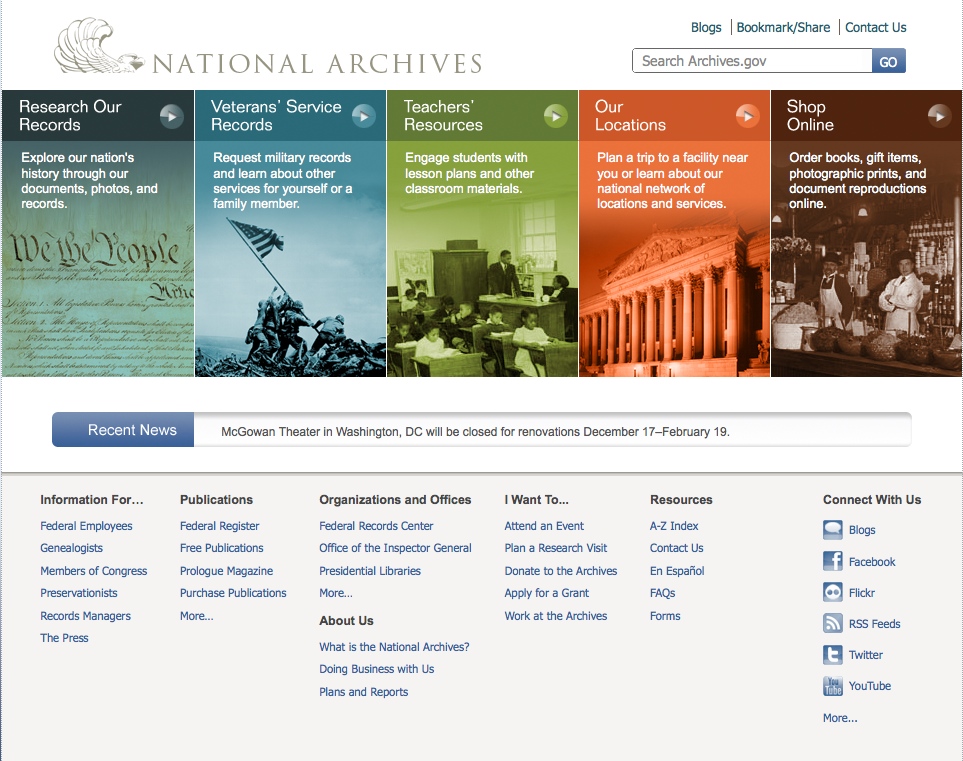
Today the National Archives launched its redesign of Archives.gov redesign.
“It’s essential for the National Archives to have a user-friendly online presence,” said Archivist of the United States David S. Ferriero in a prepared statement. Ferriero is the first Archivist to blog, tweet (@dferriero), and launch a Facebook page. “We hope to reach new audiences while still engaging our long-time users, researchers and visitors. This redesign – part of the National Archives flagship Open Government Initiative – reflects the ongoing effort to engage the public and make records of the National Archives easier to find and use.”
If you’re not following the work of the National Archivist, today is a good day to reflect on his progress and the importance of his work. Reflect on what he told the New York Times:
How many digitized records should be available online? “If I had my way,” he replied, “everything.”
The Obama administration has also given the National Archives responsibility for reviewing the declassification of 400 million pages of secret documents by the end of 2013.
Mr. Ferriero’s goal, he said, is “to ensure that we have the user at the center of our thinking — historians, genealogists, open government folks. What can we do to make their lives easier?”
Each of these flagship initiatives, many of which are listed at the WhiteHouse.gov open government innovations gallery, are supposed to deliver upon the signature elements of each agency’s mission. In terms of the National Archives, the redesign was “intended to encourage online user participation in the redesign of our website.” Does it deliver?
Here’s the old design of Archives.gov:
The research that preceded the redesign looked at what people do when they come to Archives.gov and what they do there.
Here are the results of the National Archives’ data analysis of Archives.gov “customers”:
How frequently do you visit this site?
69% First time
14% Every 6 months or less
9% About once a month
5% About once a week
In what role are you using the web site today?
30% Veteran or Veteran’s family
23% Genealogist or family historian
14% Educator or student
14% Researcher
What were you primarily looking for today?
28% Historical Documents
25% Veterans’ Service Records
19% Genealogy or family history information
9% Other
How would you most like to interact with this site?
41% Bookmark or tag pages
35% None
15% Receiving newsletters/email updates
8% Watching Vodcasts or video
The new Archives.gov was based in part on that feedback and user need:
On first glance, and after some time clicking around, the answer is a qualified “yes.” This version of the Archives.gov redesign came about through a vote on the homepage design using Ideascale and in-person events, receiving in total some 3,257 votes. The redesign includes streamlined access to historical documents and military service records, an important improvement, given the eye-opening statistic that 81 percent of Archives.gov visitors are looking for this information.
The new design is cleaner, features clearer organization of content and loaded more quickly on my mobile device. The search field, one of the critical features of any modern website, is larger and raised to greater prominence in the redesign. I don’t see a mobile version of the site yet, and there is as of yet “no app for that,” unlike, say, the Library of Congress. That may change.
With respect to another stated aim of the project, the redesign does prominently display the Archives.gov social media accounts, although in muted colors that, while fitting look and feel, don’t catch the eye. No social content is featured on the homepage or the dedicated section, though it’s not hard to find those accounts on the master list of social media. There are some real gems to be fond in there, particularly in the NARA Flickr feed.
There are a host of other accounts in there for regional archives, presidential libraries or specific topics. For more on the back story behind the design, read over the minutes from last month’s researcher meeting:
The website was last updated several years ago. This time, we are revising it to focus on tasks that people are trying to accomplish when they come to our website.
We collected information from researchers on what you wanted in a variety of ways over several months including asking staff, researchers, veterans, patrons in line at exhibits, etc. This is part of Open Government from December 2009. The Flagship initiative is to redesign by matching the needs of all users (researchers, educators, students, and those just browsing to see the founding documents).
We have the new website categorized into sections. There are five main sections: veterans, researchers, educators and students, locations, and our online store.
Other pages will focus on genealogy, Congress, records preservation, Federal records managers, publications, offices in NARA, and information about us in general. It also includes an agency index, FAQs, and social media (e.g., blogs like NARAtions and AOTUS).
The research section has basic information on how to do research at each of the facilities and links to specific topics like the Civil War.
The new website rolls out next month in December. This is the first phase of the redesign. The focus is on the home page, researchers, veterans, education, and will then move onto other areas.
The 1940s census will be available online in 2012 spring.
“Hire a Researcher” will still be available. All content will migrate over. You do not need to resubmit information. All current information will come over. If you need to resubmit information, we will let you know. We do an annual contact check to revise the list.
This is a significant improvement and one that the Archives staff should be commended upon. If you have feedback, they’ve made it clear that they’re listening: comment on the NARAtions Blog or write to webprogram@nara.gov.
This week, I was proud to be one of two speakers for a session on social media and government at the Council on Governmental Ethics Laws (COGEL) conference in Washington, D.C. I delivered an adapted version of the talk on social media and government I gave the Social Security Administration’s Open Government Awareness Day earlier this year, focusing on the elements that would be of greatest interest to a group of lawyers, regulators and academics. The presentation is embedded below:
The speaker that followed me, however, was able to share a fascinating view of what social media looks like from inside of government, specifically in the District of Columbia. Alysoun McLaughlin, the public affairs manager for the District of Columbia Board of Elections and Ethics. Here’s her bio, from the COGEL session description:
She joined the District last year, just in time to implement a long list of reforms for the 2010 election including new voting equipment, early voting and same-day registration. Prior to becoming an election official, she was a project manager for Election Initiatives at the Pew Center on the States. She previously spent a decade as a Washington lobbyist, focusing on election issues for the National Conference of State Legislatures and the National Association of Counties. She is here today to share her experience with social media during the 2010 election.
And share she did. Over the course of half an hour, she talked about Facebook, Twitter, local media, citizen engagement and much more. I captured most of her presentation on my iPhone (sorry about the unsteady hand) and have embedded her presentation, “To Tweet or not to Tweet: Engaging the Public through Social Media,” below.
If you want an excellent, practical perspective of the local government side of social media, these are worth watching. A couple of key takeaways from her presentation:
How can governments get insights from Twitter without using it? “Just type in the name of your agency and see what they’re saying.”
On D.C. elections: “We know there are going to be lines. Come to the website to see what they are.”
Don’t trust this to an intern. You “need someone skilled in crisis communications.”
“The days that I’m heavy on Twitter are the days my phone rings less.”
Viral tweets can raise awareness: “…and we just confirmed that a voter used a write-in stamp. on a touch screen.”
Part 1: Introductions
Part 2: Reflections on Twitter and Facebook
Part 3: Twitter and the 2010 DC Election
Part 4: Who follows @DCBOEE
Part 5: Listening and using social media in government
The explosion of social media use in the United States has been greeted with enthusiasm by digital evangelists who argue that online platforms will be an upgrade on the existing communications systems between citizens and Congress. After the 2008 and 2010 elections, it’s clear that while social media now plays a role, the voices of citizens aren’t necessarily being heard in Congress any more effectively. Where phone calls used to swamp Capitol Hill switchboards, now, email, tweets and Facebook comments can overwhelm Congressional staffers. That reality was articulated in a speech by Marci Harris at the Gov 2.0 Summit this year, embedded below:
Two months later, Harris’s new company, POPVOX*, has announced its public beta, aiming to “bridge the gap between the input the public wants to provide to Congress, and the information Members of Congress need to receive.”
“Constituent communications are overwhelming Congressional offices,” said POPVOX CEO Marci Harris in a prepared statement. Harris, who has worked as a Congressional staff member, understands this issue better than most. “Members of Congress really do want to hear what constituents have to say. Unfortunately, today’s communication tools dramatically increase the ability to generate messages going in to Congress without helping Congress handle the influx. The increasing emails, Tweets, Facebook comments, petitions, form letters, faxes, etc. are having the unintended effect of turning genuine citizen engagement into unintelligible noise.”
The approach that POPVOX takes to this information flood is to act as a platform for citizen-to-Congressional staff communication, identifying citizens as constituents to staffers, guiding visitors to pending legislation and publishing data-driven dashboards that show the organizations that are lining up on the issues. The customers for POPVOX are the advocacy organizations that want to get more awareness of their legislative lobbying and to partners with similar advocates.
“Many grassroots campaigns don’t take into account that Members of Congress have limited ability to respond to general expressions of outrage or support. They can introduce, co-sponsor, or vote yes or no on a bill. That’s about all they can realistically do,” said Harris in her statement. “By focusing the POPVOX platform on pending legislation and not general ‘issues,’ and making comments on POPVOX public, searchable and sortable by anyone, we are able to turn constituent voices into something that a legislator can actually use.”
POPVOX, a nonpartisan corporation, joins an increasingly hot space. TechCrunch covered Votizen in September, another startup which has received $1.5 million dollars to “make sure government representatives hear your voice.” Sound familiar?
As Jason Kincaid noted, “The startup sprung, in part, from the success of a Votizen-powered Twitter campaign earlier this year that was held in support of the Startup Visa. Thousands of people tweeted their support for the bill, and Votizen actually delivered their messages by hand to the appropriate people.” Another firm, Frogloop, coordinates social media campaigns in support of advocates’ issues. FireSide21 provides a suite of technology tools for constituent communications, including CRM, email marketing, telephone town halls and more.
The open question for POPVOX now will be whether their platform can reboot the relationship between citizens and legislators, and do so sustainably, effectively and profitably. Given the historic low ratings for Congress, there’s certainly plenty of room for improvement.
*DISCLAIMER: Tim O’Reilly, my publisher, provided angel funding for POPVOX. He calls it “a kind of Google Analytics service for politics, bringing visibility and actionable insight to both Congressional staffers and advocacy organizations.” My choice to cover the beta launch startup did not come as the result of his request nor that of Harris, who I met for a briefing on Capitol Hill earlier this year.
Ten years ago, staffers thought Al Gore was weird for texting Tipper. Fast forward a decade to late 2010, when any politician who doesn’t use check email on a smartphone or monitor what the media and voters are saying on social media platforms risks being judged out of step. As the midterm elections loom large next month, a large majority of the United States House and Senate are on Facebook. A smaller majority uses Twitter, YouTube and Flickr. While the effectiveness of that usage varies from candidate to candidate, the question of whether social media is a fad is largely settled.
One of the great unanswered questions of this election with respect to social media will be whether fan or follower numbers have any predictive value with respect to elections. Another will be whether more interactive candidates are more successful. What remains is to decide which strategies and tactics will make the difference in winning elections.
Earlier tonight, a panel of experts from media, campaigns and academia came together at George Washington University for “Going Viral: How Campaigns are Using Social Media,” an event jointly sponsored by Politico and Facebook. The panel featured:
What was the high level take away? You can judge yourself: Video of the panel on political campaigns and social media is available at CSPAN and embedded below:
Politico’s own Meredith Shiner reported that “social media still has much to prove.” As Shiner noted, Finn told the audience that “Despite the increased attention paid by the media to political Facebook and Twitter accounts, campaigns today still spend less than 5 percent of their media expenditures online.” Determining whether that spend is consistent across all campaigns would be useful. That said, part of the allure of social media is that it requires an investment in time and expertise, not classical media buys. Sarah Palin, Scott Brown and Barack Obama could use Twitter, Facebook and YouTube to achieve awareness of their messages without huge campaign war chests. For underfunded campaigns, using those tools isn’t a choice. It’s a necessity.
Drawing from those take aways, here are eight more lessons for social media and politics:
1) Politicians have to use social media themselves to realize its full potential. Most campaigns are on Facebook. As Facebook’s Adam Conner pointed out, however, what remains is for candidates to understand tech personally and use it. “When you put a communications manager or staffer in between 140 characters or a Facebook update,” he said, “it’s much less authentic.”
3) Very few Congressional candidates are doing a good job with these tools. At least, that was Professor Matthew Hindman’s take at the event. Judging from the feeds of many candidates, there’s clearly a learning curve with respect to style, conventions and technical acumen. Posting press releases to Twitter or Facebook does not realize their potential. Neither does treating the platforms the same way. For instance, Finn said that “tweeting from Facebook” is one of her pet peeves. Connor had seen enough “double third person posting” by staff to find it annoying. Voters are likely no different.
4) Social media enables candidates to build the intensity of support. While tweets and updates may not sway independents in of themselves, building strong online communities of supporters can translate into electoral success.
5) Friend power is important. Online, people are increasingly finding news stories from one other on Facebook, Twitter or other social networks, as opposed to through a search engine. That makes creating content with high “shareability” key, whether it’s embeddable videos, polling widgets or tweetable campaign slogans.
6. Leaving negative comments online builds trust, up to a point. In order for voters to see a page is a place for debate, you need to leave as many negative comments up as possible, said de Vellis, with the exception of abusive or pornographic content, which should be moderated. “Leave as much up as much as you can stomach,” said Finn. If the site is a place for supporters, “they’ll jump in and support you.” Conner suggested setting a policy up ahead of time, which a campaign can use to tramp down bad publicity. He said that it’s even more imporatnt to internal staff to have discussions ahead of time to get universal understanding of that policy.
7. This is the year of mobile. Again. As Pew Internet researcher Susannah Fox powerfully articulated in her presentation on the power of mobile this fall, 82 percent of American adults have a cell phone. Six in 10 American adults go online wirelessly with a laptop or mobile device. “Mobile was the final front in the access revolution,” she said. “It has erased the digital divide. A mobile device is the Internet for many people. Access isn’t the point anymore. It’s what people are doing with the access that matters.” As important as social media may become to the future of campaigns, reaching voters using email, text messages and calls to their cellphones – good old “Web 1.0” – is still paramount, along with a ground game to get them to the polls.
8. Candidates who use social media personally are more likely to use it on campaigns and ultimately in governance, says Adam Conner.
Once in office, the challenges of using technology for open government are even greater. Just ask the staffers at the Obama Administration and federal agencies, where open government initiatives in beta are moving from plans to implementation.
Telling the story of social media and politics
Befitting the occasion, below are selected tweets and images from the event, curated using Storify:





 E Pluribus Unum