Making sense of Gov 2.0, Open Government and We Government at Ogilvy

What is Gov 2.0?

How does making government smarter relate to open government, e-government or “We government?”

As Sifry put it in the Huffington Post this week ,

At Personal Democracy Forum, we prefer the term “We-government,” the co-creating of new forms of collaboration and service that use technology, public data and the social web to address vital issues and solve public problems, that enables us to do more with less. It’s neither Right nor Left, not small government or big government, but effective do-it-ourselves-government.

What are the early success stories and challenges for an open government in betaThis morning in Washington, I dodged rain drops on my way to a Gov 2.0 panel moderated by Ogilvy Digital’s Rohit Bhargava to talk about that very topic, joining Personal Democracy Forum co-founder Micah Sifry; Mark Murray, deputy political director for NBC News; Ari Melber, correspondent and blogger for the Nation magazine and Politico; and Gwynne Kostin, Director at the Center for New Media and Citizen Engagement at the GSA.

The panel was livestreamed at Livestream.com and integrated with the Ogilvy’s 360 Digital Influence Facebook page for an online audience. Fast forward to about 30 minutes into the archive for the beginning of the event.

http://cdn.livestream.com/grid/LSPlayer.swf?channel=ogilvy360didc&clip=pla_450cc7e2-ce2f-487e-82d0-f8db28753ff1&autoPlay=false

“We’re just beginning to see the government using the Web in a more porous, participatory way,” said Sifry, who saw no reason that government workers couldn’t get technology in the same way other citizens else can. “Really, government workers have mastered the telephone,” he said. “The can probably use Web 2.0 tools.”

Gov 2.0 Case Studies

While Sifry was critical of the White House’s embrace of Gov 2.0 and open government, he observed that at the agency level he’s seeing “a flowering of initiative.” That’s backed up by what I’ve seen on the ground and have reported on in numerous studies. For instance:

“There is a civic surplus waiting to be tapped of people who want the country to succeed,” said Sifry. And, in fact, I reported on Harnessing the Civic Surplus for Open Government,” when Noveck spoke in Manor, Texas about all of these initiatives.

I’m shortchanging the comments of Melber, Kostin and Murray due to time, unfortunately, but the #Ogilvy360di tweetstream and archived livestream offer additional perspective. Both of the reporters provided ample insight into the hyper-charged world of national correspondents in Washington, where news and issues move almost as quickly as the polls. More of Kostin’s thoughts may also be fond at her blog, OnDotGov.

http://cdn.livestream.com/grid/LSPlayer.swf?channel=ogilvy360didc&clip=pla_4d3b3b86-4458-40b4-92af-ed14a203397a&autoPlay=false

Selected reflections from the online audience:

@msspinach: “The hot question: what exactly is #gov20? Gwynne Kostin: ‘We’re still throwing spaghetti on the wall and seeing what sticks.'”

@voleynik:#Gov20 = government using the web to create better services for citizens. Creating smarter more effective government.”

@SaBean21: “Our bill of rights is being used in a digital form. Open platform is a tiny & fragile thing we have right now.

@dlblack: “@digiphile: the gov20 / #opengov conversation can’t just be about Washington, it has to be about data people can use”

@msspinach: “#gov20 means whoever is in power gives up some cntrl. If u want group prticipation, ppl need to feel they’re being listened to.”

@merici:”Ok, social media exists. We get it. Moving fwd, what are ex of gov using web to be smarter, more efficient?”

@dlblack: “not all #gov20 projects need to be about mass participation, they need to be about exchanging knowledge w/right audience”

Brad Feld on the gap between Washington, VCs, entrepreneurs and Silicon Valley

How important is the disconnect between the Silicon Valley and Washington, D.C.? As the United States transitions from an industrial economy into the Information Age, the importance of Washington securing legislation and regulations that promote security and innovation has perhaps never been greater. Small businesses are the source of many jobs, and yet the barriers that entrepreneurs face in getting startups off the ground are legion. Stimulating open government entrepreneurship is a key issue for the Gov 2.0 movement and yet the examples of successful startups are dwarfed by the pages of the regulations that govern them.

I spoke with Brad Feld about all of these issues at the Gov 2.0 Summit earlier this month. Feld has been an early stage investor and entrepreneur for over 20 years. Prior to co-founding Foundry Group, he co-founded Mobius Venture Capital and, prior to that, founded Intensity Ventures, a company that helped launch and operate software companies and later became a venture affiliate of the predecessor to Mobius Venture Capital. Our interview is embedded below:

Those concerns where voiced yesterday by LinkedIn founder Reid Hoffman this week, who told Hillicon Valley that entrepreneurs in Silicon Valley could benefit from a stronger lobbying presence in Washington D.C.:

“I realized one of the paradoxes of the entrepreneurship ecosystem that is so important to society is: We don’t have an entrepreneurship lobby,” he said, “because entrepreneurs are off doing it.”

Policymakers tend to ignore start-up concerns, according to Hoffman.

“The natural process of ‘oh, I’m responding to these lobbies, I’m responding to old political interests’ tends to always drown out the entrepreneurs,” he said.

It’s easy to ignore the concerns of newer companies, according to Hoffman, a partner at Greylock Partners, a venture capital firm in California.

“Some folks are trying to [help] but people are like, ‘OK, I can deal with that later; I don’t really care,'” he said.

Stimulus funding is a key example of startups getting government short shrift, according to Hoffman.

“The way this is described is ‘shovel-ready jobs,'” he said, arguing that kind of funding would not benefit new companies who are “key to our future.”

“It’s much easier when you’re embedded in the political infrastructure to respond to immediate things” such as the stimulus package, he said.

StartUP Visa

Another issue of critical importance to entrepreneurs is top technical talent. That’s why Feld and others have been advocating for a “startup visa.” In the video from Gov 2.0 Summit below, he talks about the startup visa legislation and why it matters to VCs and the innovation economy.

According to the website supporting the legislation in the Senate, S. 3029, the StartUP Visa Act alien entrepreneurs who have received significant capital from investors to establish a business in the United States. Specifically:

  • Have a required amount of financial backing from a qualified investor or venture capitalist
  • Have a commercial business that will generate a predetermined level of employment, revenue or capital investment
  • The goal of the StartUP Visa legislation is to create an alternate visa system to the H1B program, in which temporary visas are granted to immigrants working in specialized fields including the high-tech industry. Currently, there are 65,000 HIB visas awarded to immigrants and an additional 20,000 H1B visas awarded to individuals who hold an advanced degree. Additionally, this legislation would create a new set of visas that require immigrants to invest at least $1 million dollars in the US and employ at least 10 people.

    One hundred and sixty venture capitalists and angel investors support the bill. According to the National Venture Capital Association (NVCA), 25 percent of America’s venture-backed and publicly-traded businesses, including: Google, Yahoo!, eBay, Intel, Pfizer, DuPont and Procter & Gamble are examples of American success stories founded or co-founded by foreign born residents. Further, in 2005, these companies netted more than $52 billion in sales and employed 450,000 workers. In 2006, 24% of all filled patents had foreign residents listed as the inventor or co-inventor.

    To date, the StartUP Visa Act has not advanced beyond committee.

    Exploring the potential of First Responder Communities of Practice

    In this talk from the Gov 2.0 Expo, Jose Vazquez from the Department of Homeland Security talks about “First Responder Communities of Practice.” The community was discussed today at the Gov 2.0 conference in Manor, Texas.

    CiviGuard CMO Shawna Pandya talks about Gov 2.0 and emergency management

    How can government to citizen communications be improved during emergencies? Earlier this year at the Gov 2.0 Expo, I talked to the founders of Civiguard, a technology company that’s working on leveraging mobile tech, GIS and social media to create a platform to address the challenge.

    Embedded below is an interview with Shawna Pandya, CMO of CiviGuard, Inc.. Pandya’s background includes experience in both technological innovation and public service, with work on the neuroArm robotic arm for neurosurgery, a stint as the VP of Research for an inner-city free clinic for high-risk youth and published papers on telemedicine for the developing world.

    Canadian Apps for Climate Change Winners Announced

    Earlier this spring, the United States released community health information to provision healthcare apps and drive better policy.

    [Photo by Senior Airman Joshua Strang, U.S. Air Force, via Wikipedia]

    Now, scientists and policy makers will explore the potential for climate data services to inform citizens and government, enabling both to make better decisions for communities and businesses alike.

    Can open government lead to greater awareness or action around the existential issue climate change? Posting open data online in of itself is not enough, although there’s no question that publishing scientific data where it can be publicly accessed, validated or stored is a huge step forward with respect to transparency.

    Socializing open health data was necessary to build a better government platform at the National Institute of Medicine, where open data and innovation led to an innovative means to identity pills.

    Is collaborative innovation in open government possible in Canada? On the one hand, Canadian open data consultant David Eaves bluntly pointed out some of the challenges extant because of culture: Collaborate? ‘Governments don’t do that’.

    Collaborative innovation, however, may be another matter, as many governments, large and small, are experimenting with websites crowdsourcing citizen ideas.

    Enter the Apps for Climate Action Contest, which challenged Canadian software developers to raise awareness and inspire action by using open data in Web and mobile applications. The open data itself came from the government of British Columbia, which created a catalogue of climate and greenhouse gas emission data at Data.gov.bc.ca.

    So who won?

    Best Web AppVELO

    The app allows organizations to compare against peers internally and externally, enabling businesses to monitor and compare benchmarks for carbon emissions continually rather than annually.

    Best Mobile AppMathTappers: Carbon Choices

    The MathTappers: Carbon Choices App is designed to help students examine the effects of their personal choices on climate change. As students track their choices their impact is assessed in terms of annualized kg of CO2 equivalents generated.”

    Best of B.C.Waterly

    This app is designed to help people to use less water on their lawns.

    People’s ChoiceVanTrash

    “VanTrash scrapes pickup schedules from City of Vancouver websites and combines it with GIS data from data.vancouver.ca. In turn, VanTrash exposes this scraped data in a clean RESTful API for other citizens to build and innovate on.” The idea here is that the app will help residents to remember to take their recycling, organic waste and other garbage out.

    Will any of these apps make a difference in a global context? The jury is out on that count. Notably, several of the winners empower citizens with more lightweight access to information about local services or awareness of commodities usage. Canada may be one of the world leader’s in sheer volume of clean water but that doesn’t mean minimization of transport or use doesn’t make sense. I could certainly use a trash and recycling reminder here in Washington; maybe Octo Labs will work with a good developer if the data is available.

    A gallery of all the climate change apps is online.

    Climate Services and Open Data in the US

    In the United States, using data as a climate change agent is part of the big idea behind Climate.gov, where public climate data from NOAA and NASA could spur better decisions and a more informed society.

    Amidst varied hopes for open data and open government, enabling better data-driven decisions in both the private and public sector rank high. One of the existential challenges for humanity will be addressing climate change, particularly in countries where scientific resources are scant or even non-existent.

    In February, the Obama administration proposed a climate service that would provide projections on climate change in much the same way that the National Ocean and Atmospheric Association (NOAA) provides weather information. Earlier this summer, the Center for Strategic and International Studies (CSIS) published new research, “Earth Observation for Climate Change,” and hosted a forum on leveraging climate data services to manage climate change. The video from the forum is embedded below:

    http://blip.tv/play/hYpBgfCMMwI

    For more perspective on the role of Climate.gov and climate services, read the full post on Radar.

    Exploring Gov 2.0, open data and open government in Canada

    What’s going on with Gov 2.0 in Canada? I had the opportunity to interview David Eaves on Gov 2.0, open government and open data in Canada last week – and I took it. He shared even more perspective on the state of open government in Canada with my colleague Mac Slocum at Radar back in March. And if you’re not following his posts on government collaboration ( or the lack thereof), well, start. His talk about Gov 2.0 in Canada at the recent Gov 2.0 Summit is embedded below:

    Eaves posted a wealth of links on Gov 2.0 in Canada at his blog after the talk.

    For those interested in further perspective from north of the 49th parallel, flip through the presentation by Jury Konga, principal of the eGovFutures Group embedded below:

    What does Gov 2.0 have to do with cloud computing?

    Last week, Gartner analyst Andrea DiMaio rendered his opinion of what Gov 2.0 has to do with cloud computing. In his post, he writes that “ironically, the terms “cloud” and “open” do not even fit very well with each other,” with respect to auditability and compliance issues.

    I’m not convinced. Specifically, consider open source cloud computing at NASA Nebula and the OpenStack collaboration with Rackspace and other industry players, or Eucalyptus.For more, read my former colleague Carl Brooks at SearchCloudComputing for extensive reporting in those areas. Or watch NASA CTO for IT Chris Kemp below:

    Aside from the work that CloudAudit.org is doing to address cloud computing, after reading DiMaio’s post, I was a bit curious about how familiar he is with certain aspects of what the U.S. federal government is doing in this area. After all, Nebula is one of the pillars of NASA’s open government plan.

    Beyond that relationship, the assertion that responsibility for cloud computing deployment investment resides in the Office for Citizen Engagement might come as a surprise to the CIO of GSA. McClure certainly is more than conversant with the technology and its implications — but I have a feeling Casey Coleman holds the purse strings and accountability for implementation. Watch the GSA’s RFP for email in the cloud for the outcome there.

    To Adriel Hampton’s point on DiMaio’s post about cloud and Gov 2.0 having “nothing to do with one another,” I’d posit that that’s overly reductive. He’s right that cloud in of itself doesn’t equal Gov 2.0. It’s a tool that enables it.

    Moving Recovery.gov to Amazon’s cloud, for instance, is estimated to save the federal government some $750,000 over time and gives people the means to be “citizen inspector generals.” (Whether they use them is another matter.) Like other tools borne of the Web 2.0 revolution, cloud has the potential enable more agile, lean government that enables better outcomes for citizens, particularly with respect to cost savings, assuming those compliance concerns can be met.

    The latter point is why Google Apps receiving FISMA certification was significant, and why Microsoft has been steadily working towards it for its Azure platform. As many observers know, Salesforce.com has long since signed many federal customers, including the U.S. Census.

    DiMaio’s cynicism regarding last week’s Summit is interesting, although it’s not something I can spend a great deal of time in addressing. Would you tell the Gov 2.0 community to stop coming together at camps, forums, hearings, seminars, expos, summits, conferences or local government convocations because an analyst told you to? That’s not a position I’m coming around to any time soon, not least as I look forward to heading to Manor, Texas next week.

    In the end, cloud computing will be one more tool that enables government to deliver e-services to citizens in a way that was simply not possible before. If you measure Gov 2.0 by how technology is used to arrive at better outcomes, the cloud is part of the conversation.

    [*Note Gartner’s reply in the comments regarding the resolution of the magic quadrant suit. -Ed.]

    “Participation partition” the newest facet of the digital divide, warns Gruen

    Disparities in access to the Internet have been persistent since the scratchy sounds of a modem were first heard in offices, basements and schools. In recent years, the digital divide has grown to encompass smartphones usage, differentiation of broadband Internet and open data’s role in empowering the empowered.

    Dr. Nicholas Gruen, CEO of Lateral Economics and the former chair of the Government 2.0 Taskforce in Australia, warned the audience at the Smart Government 2010 conference in Melbourne of a new dimension to the digital divide: a “participation partition” that favors citizens who are more active engaging in online discourse.

    “The world is leaning towards favouring those who participate,” said Gruen. “They have more fun and more influence. If you participate more in your local school and local democracy, you’re going to have more say and more power. I see these things as very healthy, but there isn’t an equality of outcomes for everyone.”

    As Rob O’Brien reported in Government News, Australia’s Gov 2.0 Taskforce pushed government entities to participate more online themselves, including encouraging public sector officials and workers to use with social media tools.

    “We’ve now got 20 government blogs, that’s a great start. What we don’t have is people participating on blogs,” Mr Gruen said. “I’m not suggesting they should be making controversial comments, but just be a member of a group of people talking about policy issues.”

    Redefining Public/Private Partnerships

    Dr. Gruen was a featured speaker at the Gov 2.0 Summit in Washington, where he explored public goods in the context of open government and digital citizenship. His talk is embedded below:

    For more on what’s been happening in technology and government in Australia, see my report on Gov 2.0 Down Under: Australia and Open Government.

    Apps for California Winners Feature Innnovative Mashups Of Open Government Data

    Today, California announced the winners of its Apps for California challenge. As the summer comes to an end, there will indeed be an open government app for that in California. As I reported earlier this year at Radar, the app contest was targeted at catalyzing innovative uses of a refreshed Data.CA.gov, which included over 400 major data sources, including XLS, CSV and XML formats, and over 100 million records. The winners will be honored and given prizes at an awards gala hosted by Government Technology’s Best of the Web Competition on September 17, 2010.

    Who are the Winners?

    So who won and why? According to the Apps for California rules, each entry was judged according to the following criteria:

    1. Providing value to California’s residents and businesses;
    2. Demonstrating Innovation;
    3. Promoting Collaboration and Government Efficiency; and
    4. Ensuring Accessibility and Usability.

    WIthout further ado, here are the five winners:


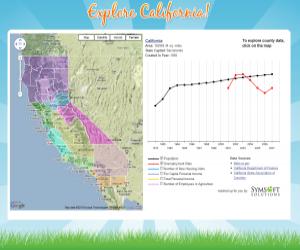
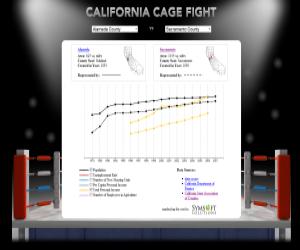
    California Cage Fight
    (info page) allows residents to compare their counties with other California counties and the state as a whole, including population growth, per capita income, unemployment, new houses and more.


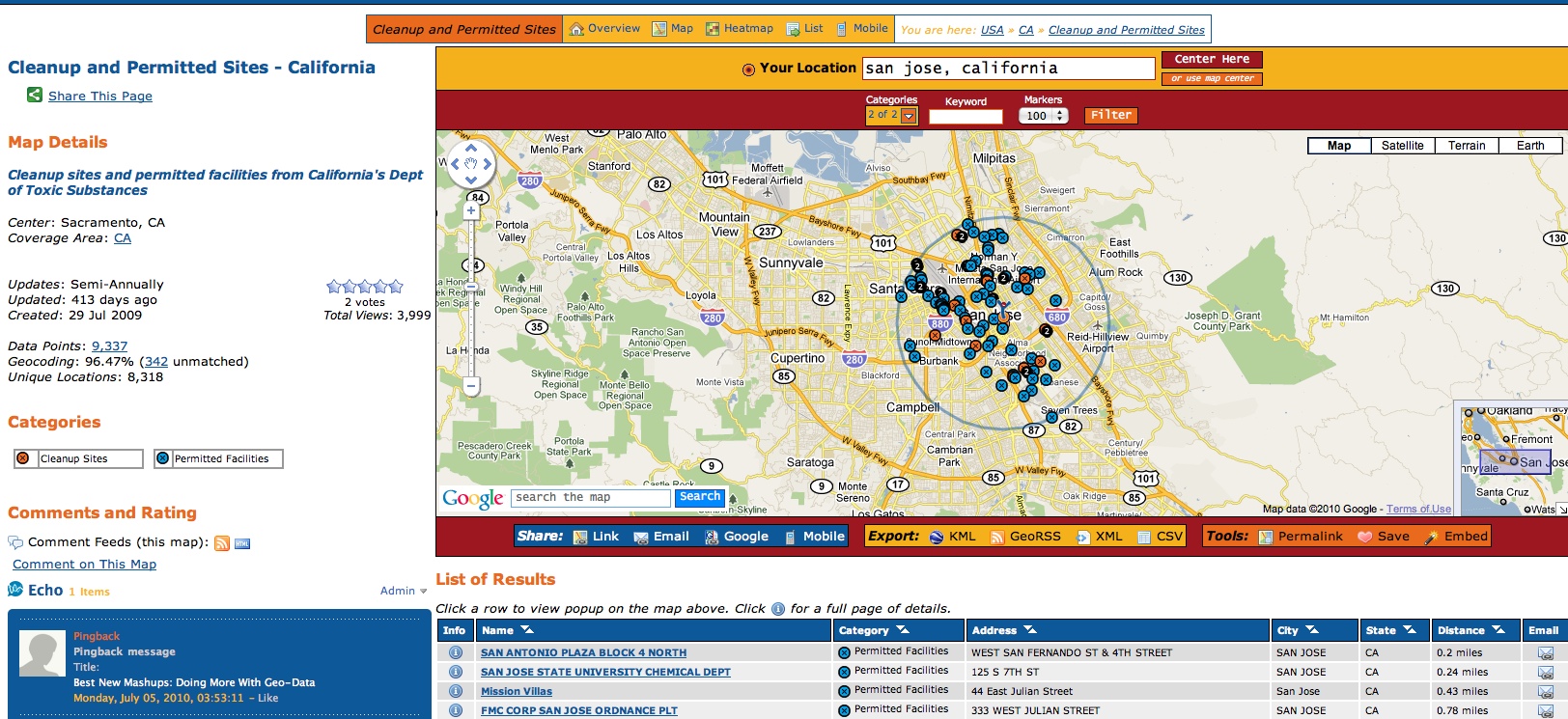
    California Environment Report: Cleanup Sites and Permitted Facilities
    (info page) provide residents with an interactive map that includes heatmaps, a mobile version with geolocation, data feeds, and detail pages for every cleanup site and permitted dacility from the CA Department of Toxic Substances Control Datasets.


    California View
    (info page) is a simple mapping tool that displays the locations of California state parks, fishing holes and boating facilities.


    ZonabilitySF
    (info page) provides mobile access to San Francisco zoning ordinance information. This app includes geolocation, interactive zoning maps, resources about code and a mechanism to ask a city planner questions.


    DataCalifornia
    (info page) provides a browser for California education, health and current legislation. The mashup allows users to “submit ideas on how the government should spend taxpayer money. Notably, it also has a constant stream of updates from schools, first responders and local politics. The site features Facebook integration, and a “Fix” button  that should be familiar to SeeClickFix users.

    People’s Choice Award


    Explore California” (info page) and the California Cage Fight mashups won the People’s Choice Awards. Explore California is similar to Data California, providing users with an interactive map and visualizations population, income, unemployment, new housing units, and other trends over time. Visitors can “compare and contrast the patterns of growth and decline in various categories and the relationships between them.”

    What’s do Apps for California mean for Gov 2.0?

    At review time, the winners seems like it might have the most potential to enable better outcomes for citizens to engage with government, given the tool. The zoning app could potentially be quite useful to builders or homeowners. And if you’re also an angler, the easy lookup of potential hotspots could be of interest, though old salts might not want the increased competition. A complete list of Apps for California finalists is available at CA.gov.

    The contest was conducted by the Center for Digital Government in collaboration with the state of California, the city of Los Angeles, the county of Los Angeles, the city and county of San Francisco, Google, Microsoft and ProgrammableWeb.com. That collaboration featured some of the nation’s biggest tech companies partnering with public institutions to create mashups that of open public data that would provide more value to citizens.

    Overall, the state saw over a dozen applications developed over the summer that might have taken it much longer to build internally, and at substantially great cost. Beyond stimulating that activity, however, the success or failure of the contest will likely be judged not upon the prices awarded or the number of apps built but rather whether these applications make the lives of citizens easier or provide more frictionless access to information. That’s a judgement that will only be rendered with time.

    New Data.WorldBank.org fuels storytelling with the power of open data

    Earlier today, the new data.worldbank.org launched. As I reported for Radar this afternoon, added widgets, maps and an API make World Bank data sing.

    The Bank is increasing the number of indicators available on the site from 339 to more than 1,200, and it has substantially improved its API. Four different languages are supported on the site, along with an improved data browser, feedback buttons, instant search, and embeddable widgets.

    “The new site shows the art of the possibility,” said Eric Gundersen of Development Seed, the D.C.-based Drupal shop behind the World Bank’s data catalog. “This is really actionable information. So many more NGOs [non-governmental organizations] can now make data-informed decisions if they have access.”

    Below, I’ve embedded a video on the power of geo-coding aid.

    From the blog:

    A team of researchers from Development Gateway and AidData have worked with the World Bank to add detailed subnational geographical information to all of the Bank’s active projects in the Africa and Latin America region. This isn’t just pins in a map showing the country where the money is spent: they have looked through the project documentation to find out as far as possible the geographic coordinates of the actual locations where aid the activities take place.

    This video by AidData explains brilliantly what geocoding means, and why its important.

    As I also reported at Radar, the World Bank wil be running an Apps for Development contest, launching on Oct. 7.  In addition to the contest, the World Bank will host an open forum on Oct. 7 that will feature experts from the open data movement via live webcasts and a 24-hour chatroom.