
UPDATE: This service was taken offline after IRS security was compromised.
UPDATE: Learn how to download your tax transcript from IRS.gov.

Earlier today, at the White House Education Datapalooza, an official from the United States Department of the Treasury informed a packed theater and livestream that students, parents and citizens would finally be able to do something simple and profoundly useful over the Internet: download a transcript of their tax return from the Internal Revenue Service.
“I am very excited to announce that the IRS has just launched, this week, a transcript application which will give taxpayers the ability to view, print, and download tax transcripts,” said Katherine Sydor, a policy advisor in the Office of Consumer Policy of the Treasury, “making it easier for student borrowers to access tax records he or she might need to submit loan applications or grant applications.” [VIDEO]
Previously, filers could request a copy of the transcript (not the full return) but would have to wait 5-10 business days to receive it in the mail. For people who needed more rapid access for applications, the delay could be critical. A White House fact sheet subsequently confirmed the news, under the rubric of “streamlining application paperwork,” and a quick follow up with an official secured the correct URL for the new IRS Web application to get a tax transcript.

I created an account, which involved jumping through the hoops familiar from establishing online access bank accounts — choosing pass phrase, pass image and security questions — and then answered a number of questions that made it pretty clear that the IRS knew exactly who I was and where I had lived. (It’s not clear whether they hold this information or used a credit bureau, from the consumer-side.)
When I tried to actually download the transcript, though, I ran into some issues: first, a browser error in Chrome — “This XML file does not appear to have any style information associated with it. The document tree is shown below.” Using Firefox, however, I was able to at least get the page where I could choose from various years of transcripts.
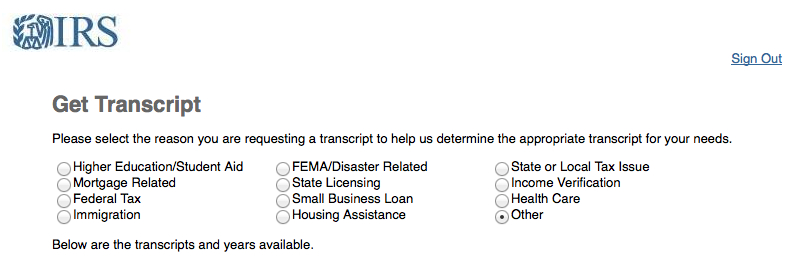
Unfortunately, clicking any of the links delivered a file that my Macbook was unable to parse. I was, however, able to log into IRS.gov and easily download last year’s tax return with one click to my iPhone. Success!
While the technical problems I ran into suggest that Apple computer users might run into some issues, I have a funny feeling that (the vast majority) of people who are running Internet Explorer on a Windows machine will fare better.
The fact that American citizens could not access their own tax returns online in 2014 might seem jarring but, until this week, that was the status quo. This advance represents the sort of somewhat mundane but important shift that the Obama administration’s approach to digital government have enabled over the past five years.
While the troubles behind the botched launch of Healthcare.gov have shaken the confidence of many citizens in the capacity of this administration to deliver effective digital services and months of headlines about digital surveillance by the National Security Agency have diminished trust in government overall, the ability of the “tech surge” to fix the site and the success of the technology team at the Consumer Financial Protection Bureau not only offers a guide for how to avoid similar issues but highlights a less salacious and boring reality that will generate no headlines nor heated rhetoric on cable news shows: most public officials and civil servants are quietly working to deliver better customer service for citizens.
Being able to download a tax transcript online is not, however, without risks. The Internal Revenue Service will need to continue to be vigilant about security. The new functionality will almost certainly inspire fraudsters to create mockups of the government website that look similar and then send phishing emails to consumers, urging them to “log in” to fake websites.
Perhaps most problematically, people will download tax transcripts to mobile devices and laptops and then not take steps to protect them with encryption. If you do download your transcripts or personal health information, make sure to also install full disk encryption on every machine you own. Leaving your files unprotected there is like leaving the door to your house unlocked with your tax returns and medical records on the kitchen table.
I have asked the IRS for comment on the new feature, browser and operating system and security guidance and will update this post if and when I receive any.
Update: comment from the IRS on follows.
How much time and technical resources did the IRS invest in deploying the feature? Has the IRS increased the capacity of the website for more demand?
From establishing the business case and receiving funding plus approval to start the work to implementation took approximately one year. Additional time was spent in ideation, innovation, and confirming requirements of the product prior to receiving approval.
I had trouble downloading my transcript on an Apple computer using Chrome and Firefox. (I was able to get it through my iPhone.) What browsers and operating systems does the new function officially support?
As a web application, Get Transcript is supported on most modern OS/browser combinations. While there may be intermittent issues due to certain end-user configurations, IRS has not implemented any restrictions against certain browsers or operating systems. We are continuing to work open issues as they are identified and validated.
A side note: For the best user experience, taxpayers may want to try up-to-date versions of internet explorer and a supported version of Microsoft windows; however, that is certainly not a requirement.)
Does the IRS have any guidance for ensuring that Americans connect securely to the website and then protect tax returns on their home computers once they have downloaded them?
The IRS has made good progress on oversight and enhanced security controls in the area of information technology. With state-of-the-art technology as the foundation for our portal (e.g. irs.gov), we continue to focus on protecting the PII of all taxpayers when communicating with the IRS.
However, security is a two-way street with both the IRS and users needing to take steps for a secure experience. On our end, our security is comparable to leaders in private industry.
Our IRS2GO app has successfully completed a security assessment and received approval to launch by our cybersecurity organization after being scanned for weaknesses and vulnerabilities.
Any personally identifiable information (PII) or sensitive information transmitted to the IRS through IRS2Go for refund status or tax record requests uses secure communication channels that meet or exceed federal requirements for encryption. No PII is passed back to the taxpayer through IRS2GO and no PII is stored on the smartphone by the application.
When using our popular Where’s My Refund? application, taxpayers may notice just a few of our security measures. The URL for Where’s My Refund? begins with https. Just like in private industry, the “s” is a key indicator that a web user should notice indicating you are in a “secure session.” Taxpayers may also notice our message that we recommend they close their browser when finished accessing your refund status.
As we become a more mobile society and able to link to the internet while we’re on the go, we remind taxpayers to take precautions to protect themselves from being victimized, including using secure networks, firewalls, virus protection and other safeguards.
We always recommend taxpayers check with the Federal Trade Commission for the latest on reporting incidents of identity theft. You can find more information on our website, including tips if you believe you have become the victim of identity theft.
Does the IRS have any plans to provide Americans with access or insight to estimated tax returns online in the future? Now that we have the ability to establish user accounts, would it ever be possible, for instance, for people with simple taxes (1040EZ, etc) to log in, review an estimated return, make any required edits, and then e-file it on IRS.gov?
IRS: The IRS is considering a number of new proposals that may become a part of the online services roadmap some time in the future. This may include a taxpayer account where up to date status could be securely reviewed by the account owner.
Note: This post has been updated throughout to make it clear that the IRS has provided online access to tax transcripts, not the entire return. You can read up on the difference between a tax transcript and tax return here.

 E Pluribus Unum