Vivek Kundra talks open government and data journalism at ONA 2011

Earlier today, Vivek Kundra, the first CIO of the United States, visited the Online News Association. Here’s a Storify of the tweetstream from his talk by Cristina F. Pereda.

http://storify.com/onewayoranother/vivek-kundra-ex-director-de-informacion-y-tecnolog.js[View the story “Vivek Kundra, ex director de Información y Tecnología” on Storify]

Open Government Week in Review: White House update, eGov setbacks and global OGP potential

Friday’s White House open government “status update” capped a historic week for open government in Washington. The Blue Button movement now has a website: BlueButtonData.org. Federal CTO Aneesh Chopra challenged the energy industry to collaborate in the design of a “green button” modeled after that Blue Button. White House director of digital Macon Phillips answered questions about “We the People” and the White House e-petitions. The Department of Transportation held a public consultation for the its Digital Transportation Exchange (DTE) open government initiative. President Obama signed the America Invents Act into law.

Progress and Setbacks

Quiet successes have been matched with setbacks to open government in Washington over the past three years, including two from this past week. Several journalism organizations have protested the U.S. federal government taking down doctor discipline and malpractice data from the Web. The Obama administration also faces an uncertain future for funding for its Office of Management and Budget’s open government initiatives after theU.S. Senate appropriations committee shortchanged the Electronic Government Fund by some $10 million dollars this week.

Global Open Government Partnership

While neither of those stories are good data points for the state of open government at the federal level, they are both part of a much larger narrative where some 40 countries (including the founding 8 members) have reportedly now submitted letters of intent to join this unprecedented international open government partnership.

Next Tuesday, I’ll be in New York on the same day that President Obama introduces the U.S. National Plan for open government as part of its commitment to the Open Government Partnership As John Wonderlich observed at the Sunlight Foundation on Friday, preparing for the U.S. National Plan and then delivering upon whatever is contains will be a “complex, ongoing effort that takes dedicated effort and attention,” adding to the progress towards a more transparent, participatory, collaborative or innovative government made to date.

In 2011, some of the most dynamic changes may be found the state and local level in the United States. After next week, the eyes of many more people will be open to the broader sweep of a global movement towards transparency. The world can watch the live streaming coverage of the “Power of Open” at Google’s YouTube channel from 9-10:30 AM and from 1:30-4:30 PM. Event details are available at OpenGovPartnership.org”>, including agenda, participants, presentations and other materials. I’m looking forward to telling that story using Twitter, Flickr, Tumblr and next Tuesday, where I’ll be liveblogging at the O’Reilly Radar all day. techPresident’s associate editor, Nick Judd, will be tweeting and liveblogging. Follow the #OGP hashtag for the real-time conversation about the Open Government Partnership:

http://widgets.twimg.com/j/2/widget.js

new TWTR.Widget({
version: 2,
type: ‘search’,
search: ‘#ogp’,
interval: 30000,
title: ‘What\’s happening with’,
subject: ‘The Open Government Partnership’,
width: ‘auto’,
height: 300,
theme: {
shell: {
background: ‘#085578’,
color: ‘#ffffff’
},
tweets: {
background: ‘#ffffff’,
color: ‘#444444’,
links: ‘#ab0916’
}
},
features: {
scrollbar: false,
loop: true,
live: true,
hashtags: true,
timestamp: true,
avatars: true,
toptweets: true,
behavior: ‘default’
}
}).render().start();

Obama administration releases open government status report

The Obama administration has released a status report on open government.

The report, which I’ve embedded below, was released through a blog post at Whitehouse.gov by Steven Croley, special assistant and senior counsel to the President:

President Obama has made open government a high priority. Greater openness renders our government more efficient and effective. It strengthens our democracy. It improves our citizens’ lives.

To these ends, the Administration has taken many substantial steps to promote increased participation and collaboration in government, and to make government more transparent. For example, federal agencies have increased transparency through redoubled efforts to disclose more information under the Freedom of Information Act. They have implemented ambitious Open Government Plans, and made voluminous data newly available to the public. The Administration has also made spending information more transparent, and taken steps to disclose previously sensitive government information.

Of course, creating a more open government requires sustained effort. How best to harness new technologies in the service of open government, to strike the proper balance between transparency and the protection of national security and personal privacy, to change agency culture so that openness becomes the new normal–such issues require long-term commitment.

But it is useful to take stock of the Administration’s accomplishments along the way. Accordingly, today the White House is releasing The Obama Administration’s Commitment to Open Government: A Status Report (pdf). This status report highlights the breadth of the Administration’s commitment to open government, documents the substantial progress made on many of the Administration’s open government initiatives, and anticipates continued progress. Although not an exhaustive compilation of our open government efforts, thi provides a compelling picture of how far the Administration has already come towards forging a more open government.

Open Government Status Report

View more documents from White House

As Nick Judd points out in his report at techPresident, the report comes a week before President Obama’s open government speech at the launch of the international Open Government Partnership in New York City.

The 34-page report is a highlight reel of everything the administration has accomplished on open government, claiming victories in increased agency responsiveness to Freedom of Information Act requests, the release of government data online, and better communication using web tools. It comes as the Obama administration prepares to make good on a challenge the president himself issued at last year’s convening of the U.N. General Assembly to return there this month with concrete steps to make governments more open, participatory and collaborative.

“We are pleased to see the Administration undertaking this kind of review because it gives us an all opportunity to reflect on what goals have been met and what challenges we agree remain,” wrote Patrice McDermott, director of Open the Government, in a post at OpenTheGovernment.org. “We hope our advocacy and the Administration’s actions will result in an even more impressive report in the future.”

OpenTheGovernment recently released its own “Progress Report on Openness and Secrecy in the Obama Administration” that was somewhat less glowing, balancing both promising and “troubling directions” for open government.

Stay tuned for more on what further commitments the White House will make in its upcoming U.S. National Plan and the commitments of other countries. For further context, read these notes from the White House open government partnership consultation and the links embedded in tracking the progress of the Open Government Directive.

http://www.whitehouse.gov/sites/all/modules/swftools/shared/flash_media_player/player5x2.swf

The Internet will ask (some of) the questions in the Fox News/Google Republican debate

On September 22, the Republican candidates for president will be in Orlando, Florida for the next debate. Unlike the last debate, where moderators from NBC and Politico chose the questions, Google-Fox News debate will use Google Moderator and YouTube to bubble up questions from the Internet. Questions can be submitted as text or video through the Fox News YouTube channel. The deadline is September 21st. The video embedded below introduces the concept:

Fox News anchor Brett Baer explains the process below and encourages people to submit questions “creatively” — which means that former Massachusetts governor Mitt Romney could potentially be confronted by a YouTube snowman of the sort he didn’t care much for in 2007.

For good or ill, that kind of question in that kind of costume is likely to be part of the warp and weft of presidential politics in the 21st century. President Obama’s Twitter townhall” featured several questions from people with quirky account names or avatars. Bringing YouTube into the discussion will allow even more self expression and, while Fox News has the ability not to broadcast a video, millions of connected Americans can go watch the videos themselves if they choose. At the moment, the top-rated questions are substantive ones:

Open Government Partnership expands to include at least 22 countries at launch

With two weeks left before a historic announcement in New York City at the United Nations, the international Open Government Partnership (OGP) has expanded to include fourteen more countries. The news of the expansion was first reported by FreedomInfo.org, which quoted an unnamed U.S. official.

The newly added countries include Kenya, Guatemala, Honduras, Albania, Macedonia, Malta, Georgia, Moldova, Slovakia, Bulgaria, Israel, Croatia, Mongolia and Lithuania. The original eight country members of the OGP are the United States and Brazil (co-chairs of OGP), South Africa, the United Kingdom, Norway, Mexico, Indonesia and the Philippines.

“These are governments from whom we’ve received formal letters of intent,” said Caroline Mauldin, special assistant to Under Secretary for Democracy and Global Affairs Maria Otero at U.S. Department of State. “We’re very energized by the number of countries who are ready to step up to the Open Government Partnership plate.” Mauldin tells me that more letters of intent are still coming in, which will add further to the participants.

Expanding the number of countries committing to more open government is not in principle a bad thing, although the devil is the details, as ever. Brazil and the Philippines, for instance, are still working on Freedom of Information laws. We’ll learn more over the next two weeks, until the official Heads of State launch on the margins of the opening of the United Nations General Assembly in New York City. I’ll be sharing news and information as I go during the next 14 days and from the Big Apple on September 20th.

“All of the new countries are committing to developing their own country action plans in consultation with civil society, which they will announce at an OGP meeting in March 2012,” said Mauldin. “The ‘consultative process’ is the part of OGP that guarantees an ongoing, iterative dialogue with civil society.”

These letters will commit participating countries to broad principles but leave many specifics to individual governments. “OGP is structured to foster accountability between a government and its people,” said Mauldin. “A country can design their own mechanisms, so they’ll likely vary from one place to the next; of course, one key reason why countries are joining is so they can learn from one another.” That flexibility could be important in many contexts, as Gartner analyst Andrea Di Maio observed in his post on the Open Government Partnership:

Open government can be used to fight corruption, to increase the trust in government, to counterbalance the effects of excessive churn in government, to reduce the cost of government, and so forth. But in order to deliver on these different objectives, it does require different approaches.

The risk – like similar initiatives on e-government led by the UN or the EU have clearly shown – is that leading countries tend to showcase their approaches, which are almost automatically taken as best practices. But what is a best practice for a federal agency in the US or a large city in the UK may be either irrelevant or even counterproductive in a place like Moldova or Albania, just to name two.

All that said, it bears noting that the OGP is substantially expanding and the news seems to have been leaked without attribution initially, as opposed to an official announcement by the White House, State Department or OGP or anyone else on the record. The open government community should expect ongoing announcement regarding new participants, the September 20th event, a declaration and all letters to go up on OpenGovPartnership.org — but it’s not there yet, and the @OpenGovPart Twitter account has gone silent. In the U.S., the recommendations that have been collected by the White House as part of its consultation for the U.S. National Plan are only public if the entities submitting them have published them, like the open government recommendations by Clay Johnson at Expert Labs.

For more context, Nick Judd has published a comprehensive report on the expansion of the OGP roster over at techPresident and my notes from the White House open government partnership consultation. FreedomInfo.org also collected more OGP news from South Africa, India and the new White House’s epetition initiative.

White House offers “We the People” online petitions at WhiteHouse.gov

With We the People,” the White House has added a new page to WhiteHouse.gov and has announced a potentially disruptive feature for an American public that increasingly turning online for government information and political action: online petitions.

“When I ran for this office, I pledged to make government more open and accountable to its citizens,” reads a statement by President Barack Obama at WhiteHouse.gov. “That’s what the new We the People feature on WhiteHouse.gov is all about – giving Americans a direct line to the White House on the issues and concerns that matter most to them.”

There’s a big idea embedded in this launch, going back to the original compact between the American people and its government. The First Amendment of United States Constitution gives citizens the right to petition their government. In the 21st century, the Internet provides a new means for such petitions to be made.

“With We the People, we’re offering a new way to submit an online petition on a range of issues — and get an official response,” writes Macon Phillips, White House director of digital in a WhiteHouse.gov blog post announcing We the People.

He explains more in the video embedded below and invites people to sign up for email updates when We The People goes live.

Phillips explained the basics of how the White House e-petitions will work on the White House blog. Here’s the key takeaways:

  • Citizens can create or sign e-petitions on a “range of issues” — it’s not clear yet whether citizens can define their own issues or will have to choose from a list.
  • If an e-petition gathers more than 5,000 signatures in 30 days, White House officials will review and answer it.
  • Initially, an e-petition will have a unique URL that only its creator knows. “It’s up to that person to share it in their network to gather an initial amount of signatures — initially 150 — before it is searchable on WhiteHouse.gov. ” It’s not clear what a “network” means but it likely refers to Twitter or Facebook, like the way act.ly works.

There are still many questions that remain in terms of how this is going to work or how it’s going to fit into a 21st century e-democracy. As Phillips recognized, the United States isn’t the first to try this: the United Kingdom offers e-petitions, and according to Phillips, “this work was very helpful as we developed our own.”

The sticky e-widget there is that the UK dropped e-petitions late last year as the new prime minister came into office, due to negative publicity and other issues. Reasonably, we can expect there to be similar challenges with the White House version. The UK has since relaunched its e-petitions site, as Phillips points out, and sharedplans to release the e-petitions code on Github.While it’s not clear yet who built the White House version, it’s possible that they used this code, given the support for open source that Philips has demonstrated over the past three years. The White House built the system in house, according to Phillips.

The initial response online ranges from celebration, including a “high five from PopVox,” to extreme skepticism.

Open government godfather Carl Malamud the long view: “Nice job on We The People,” he tweeted. “Treading in the footsteps of the Founders, petitions have a long and honorable history in our republic!”

“What difference do they make?” tweeted FutureGov Dominic Campbell. “None. Just a distraction technique to pacify the masses. Need new politics not gimmicks. Backbenchers are generally as influential over govt policy as my gran. And she’s dead. Petition / precise tech tool is irrelevant, it’s all about political culture. Petitions are lame. All power is in the hands of govt. Not game changing. More make u feel better/doing *something*.” While the UK petitions have come back, “You’d be hard pushed to find anyone in UK speak +vely of them. Waste of space… think they just reinforce status quo and reward loudest/best organised. Not democracy. ”

Former Sunlight Foundationer Jake Brewer dug into some of the structural issues that exist with this approach. The “only reason “We the People” would [be] useful vs other tools is if @WhiteHouse can convince all they are listening & meaningfully responding,” he tweeted.

“It strikes me though that “giving people a voice” is not at all the problem in gov. Many ways to talk AT gov. Few ways to do so usefully.We simply don’t need more ways to send petitions or gather ideas. We need better ways to listen & operationalize good ideas. What will be an agency’s incentive to take any action based on a petition? Will Whitehouse pressure? Petitions to Congress (theoretically) work because Reps want to be responsive/re-elected. Exec not the same, so how to handle? Guess I’m having a hard time seeing “We the People” as anything more than gov 2.0 theater, and I’d like to be wrong. We simply don’t need more ways to send petitions or gather ideas. We need better ways to listen and operationalize good ideas.”

Questions for We the People

The White House is taking questions on We the People using the feedback form at White House.gov and on Twitter, using the hashtag #WHWeb, where Phillips is listening as @macon44.

Why do petitions at all? “Online petitions are commonly understood, and petitions have been part of our democracy since the beginning,” he tweeted.

When asked by Nancy Scola whether the thinking with We the People is to “have @whitehouse act as [a] clearinghouse for petitions directed towards agencies,” Phillips replied: “People shouldn’t have to decipher how the executive branch is organized in order to speak out about an issue. Processing incoming petitions handled by WH, but relevant petitions will be coordinated w/others as needed, including Agencies.”

In response to a question by @abc4all, Phillips tweeted that “participation in We the People is open to the general public (13yrs+) & requires a valid email address.”

When Alex Rose asked if “WH have a profile of citizens based on petitions we support on We the People? Who can access aggregated data?,” Phillips replied that “only a small group of wh staff will have access to administrative data We the People will be subject to a public privacy policy.”

Here are the questions I’ve tweeted out and their answers:

Who built the e-petitions function? Is it the the same code as the UK tool?

Answer: “System design and development of We the People was developed in house,” tweeted Phillips.

How will identity be handled? How will the White House authenticate citizens to e-petitions government?

Answer: “Lightweight – participation will require an email verification step,” tweeted Phillips. “For now we are using first party WH accounts that verify an email address. Plan to incorporate NSTIC rec’s in future http://1.usa.gov/p7n8HR ”

Do you have to be a citizen?

Answer: “Right now the system only requires valid email and does not verify citizenship,” tweeted Phillips.

How will social media be integrated? 

Answer: “when you create a petition you get a unique link. How you share that is up to you. Will have @facebook & @twitter share [buttons],” tweeted Phillips. yes, just like other content on wh.gov

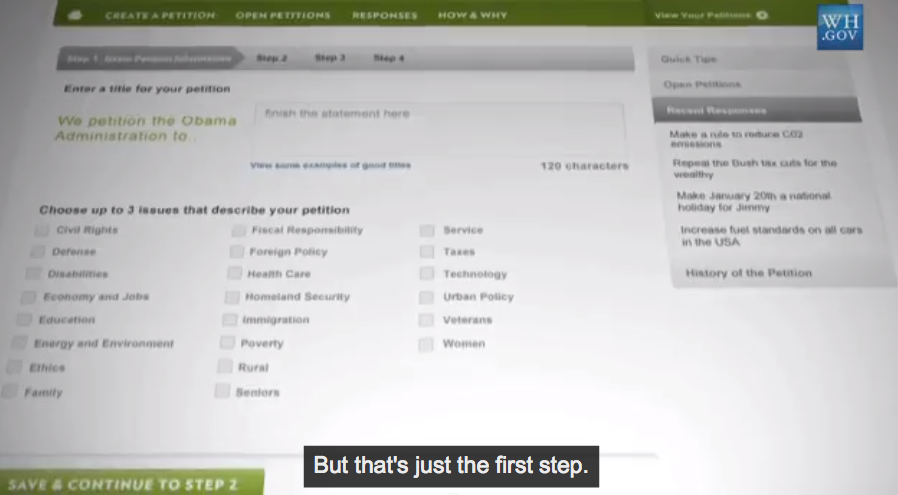
Can citizens ask questions using We The People on whatever topic they wish or will these be predefined? The screenshot below implies the latter categorization: taxonomy, not folksonomy.

Answer: “there will be a defined set of topic people can choose from but its a wide range, and there will also be ad hoc tags,” tweeted Phillips.

Will there be an API so that civic developers can visualize and analyze them to see if there are duplicates or emerging themes?

Answer: “Not now; API’s for analysis & extending petition functionality on a long list of features we we are considering for future. With [federal CIO] Steve upstairs now, thinking through how that can best work is both a priority & more informed.”

Why build this when services like PopVox, Votizen and Change exist to create social e-petitions?

Answer: “Developing We the People ourselves […] offers the flexibility to adapt to the public response to improve engagement,” tweeted Phillips. “It’s a false choice to say _either_ We the People _or_ others – there’s lots of collaboration ahead, this space is still young.”

There’s another key detail: these e-petitions would go to the executive branch, whereas Votizen and PopVox are targeted at Congress and constituent communications.

The creator of act.ly, Jim Gilliam, offered some of his own perspective and questions. “I built a petition/priority tool White House 2 back in 2008. I learned a lot, happy to share,” he tweeted to Phillips, linking to his post on White House 2.0. On this count, the White House was listening: Phillips asked Gilliam to “dm him his email address.” Here’s a look back at “imagining White House 2.0” from the 2009 Personal Democracy Forum:

“I figured out all the problems, except for one. getting the white house to pay attention. (or maybe it just took 3yrs),” tweeted Gilliam.

He highlighted two issues, one for advocates and one for White House technologists: “”How will the white house use all the email addresses it collects with new petition tool? Advocacy groups will have to decide whether to send their people to whitehouse.gov at the expense of their own list building,” he tweeted. “White house will need some serious anti-spam jujitsu to knock back the tools that scrape congressional forms.”

Perhaps most important, how will citizens know that they’re being heard by the White House, that these e-petitions matter, and that this will not be a public relations exercise that ends with a thank you letter from staff?

This goes to the issue of connecting e-petition action to results. “OpenGov has the equivalent of a “last mile” problem: a culture+digital-infrastructure gap at the workgroup level,” tweeted Dan Latorre, leader of Digital Placemaking and creator ofFixCity.org.

For instance, if enough people sign e-petitions on withdrawing from Afghanistan, supporting gay marriage, legalizing marijuana or opposing ICE takedowns of websites without judicial review, will the White House change its policy?

Stay tuned for answers [See above] and upon launch, outcomes.

East Coast earthquake cements role of social media in government crisis communications

At approximately 1:51:04 ET today, a magnitude 5.8 earthquake 3.7 miles below Virginia rattled the east coast of the United States from South Carolina to Maine.

A 3D map of the earthquake from DC-based DevelopmentSeed, embedded below, visualizes the intensity of the tremblor.

Thankfully, today’s earthquake does not appear to have caused any deaths nor collapsed buildings or bridges, although the National Cathedral sustained what officials call “substantial earthquake damage.” Longer term earthquake damage in DC will take time to assess. Eric Wemple has a comprehensive assessment of earthquake coverage that includes links to more logistical details and assessments, if you’re interested.

A reminder to prepare

FEMA Administrator Craig Fugate talked directly to the public over the Internet, using his Twitter account, emphasizing that this quake is a reminder to get prepared.

He also highlighted a critical resource for an increasingly mobile citizenry, m.fema.gov/earthquake, and hurricanes.gov, which will be an important source of information as Hurricane Irene moves up the coast.

Additionally, Govfresh founder Luke Fretwell compiled an excellent short federal government primer to earthquake preparedness that’s full of more resources, including what to do before, during and after an earthquake

Key earthquake information can be found at Ready.gov and the FEMA, USGS and Centers for Disease Control Websites. USGS also provides a seven-step Protecting Your Family From Earthquakes safety guide (embed below).

Remember, prepare, plan and stay informed.

Social media fills a fault

seismic waves by xkcd

While both DC residents and people across the United States took the opportunity to joke about the quake using Twitter, a more sobering reality emerged as residents found themselves unable to make phone calls over overloaded cellphone networks: social networks offered an important alternate channel to connect with friends, family and coworkers. In the context of overloaded networks, the Department of Homeland Security offered earthquake advice: don’t call. In fact, DHS urged urged citizens to use social media to contact one another. The White House amplified that message:

RT @DHSJournal: Quake: Tell friends/family you are OK via text, email and social media (@twitter & facebook.com). Avoid calls.less than a minute ago via Twitter for BlackBerry® Favorite Retweet Reply


Citizens didn’t need much urging to turn to social networks after the quake. According to

Facebook hosts conversation with Red Cross on social media in emergencies

The day after the earthquake, in what turns out to be an unusually good scheduling choice, Facebook DC is hosting a conversation with the Red Cross on the use of social media in emergencies. As a new infographic from the Red Cross, embedded below, makes clear, the importance of emergency social data has grown over the past year.

Social Media in Emergencies//

According to a new national survey:

  • The Internet is now the third most popular way for people to gather emergency information, after television and local radio
  • Nearly a fourth of the online population would use social media to let family and friends know they are safe.
  • 80% of the general public surveyed believe emergency response organizations should monitor social media.
  • About one third of those polled via telephone said they would expect help to arrive within an hour.

The event will be livestreamed on Facebook DC’s page at 3 PM EDT, if you’re online and free to tune in.

Watch live streaming video from facebookdclive at livestream.com

More Americans Using Social Media and Technology in Emergencies//

New reports on citizen participation and rulemaking offer open government guidance

Earlier today, AmericaSpeaks released a new report, “Assessing Public Participation in an Open Government Era: A Review of Federal Agency Plans.” This represents the most comprehensive review of the public participation aspects of the federal open government initiative to date.

The Obama Administration’s Open Government Directive required Federal Agencies to publish Open Government Plans describing how they would become more transparent, participatory, and collaborative. Before this research, the public participation elements of the plans had not been subject to an in-depth analysis.  We reviewed the more than 1,000 pages contained in the plans of the 29 Agencies that were included in the White House Open Government Dashboard and compared them to the standards used often by practitioners in the field of public engagement that we believe are most important.

The report, embedded below, highlights best practices for public participation and suggests ways to enhance the role the public has in shaping federal policy, including implementing the ExpertNet open government platform.

Overall, the administration received mixed marks. While the AmericaSpeaks found that agencies “display an admirable willingness to experiment with new tools and techniques to involve citizens with their decision-making processes,” the “Open Government Initiative and most Federal Agency plans have failed to offer standards for what constitutes high-quality public participation.”

On the one hand, agencies are increasing the number of people devoted to public engagement and using a range of online and offline forums. On the other, “deliberative processes, in which citizens learn, express points of view, and have a chance to find common ground, are rarely incorporated.”

New guidance on rulemaking

Separately, University of Pennsylvania professor Cary Coglianese prepared a report to the Administrative Conference of the United States on the use of electronic media in the rulemaking process. Here’s the short version: agencies should use social media more, involve the millions of non-English speaking members of the public and significantly upgrade, streamline and optimize agency websites. For the long way, read on:

Federal Agency Use of Electronic Media in the Rulemaking Process//

Kundra: Closing the IT gap is the key to making government work better for the American people

Today, the first chief information officer of the United States, Vivek Kundra, shared his reflections on public service.

Kundra, whose last day of work at the White House Office of Management and Budget was last Friday, is now at the Harvard Kennedy School and Berkman Center.

I arrived at a White House that was, as the Washington Post put it, “stuck” in the “Dark Ages of technology.” In their words, “If the Obama campaign represented a sleek, new iPhone kind of future, the first day of the Obama administration looked more like the rotary-dial past.”

As my team congratulated me on the new job, they handed me a stack of documents with $27 billion worth of technology projects that were years behind schedule and millions of dollars over budget. At the time, those documents were what passed for real-time updates on the performance of IT projects. My neighbor’s ten year old could look up the latest stats of his favorite baseball player on his phone on the school bus, but I couldn’t get an update on how we were spending billions of taxpayer dollars while at my desk in the White House. And at the same time, the President of the United States had to fight tooth and nail to simply get a blackberry.

These were symptoms of a much larger problem.

The information technology gap between the public and private sectors makes the Federal Government less productive and less effective at providing basic services to its citizens. Closing this gap is the key to making government work better for the American people – the ultimate goal.

His complete thoughts are embedded below. If you’re interested in frank insight into why changing government through information technology isn’t easy, read on.

Vivek Kundra’s Reflections on Public Service 2011(function() { var scribd = document.createElement(“script”); scribd.type = “text/javascript”; scribd.async = true; scribd.src = “http://www.scribd.com/javascripts/embed_code/inject.js”; var s = document.getElementsByTagName(“script”)[0]; s.parentNode.insertBefore(scribd, s); })();

Notes from the third White House Open Government Partnership consultation

In July 2011, the State Department hosted an historic gathering in Washington to announce an Open Government Partnership with Brazil and six other nations. For background on the initiative, read this digest on Open Government Partnership analysis for context.

This new new open government partnership could drive U.S. commitments, according to OMB Watch.

What those commitments will be is still unclear. Given that they’re due by September’s Open Government Summit at the United Nations in New York City, the timeline for drafting them is quite limited.

Last week, when the White House asked for ideas on the National Plan for open government, the community learned a bit more about what’s on the table: improving public services and increasing public integrity.

Clay Johnson has since offered the White House a deep set of recommendations for open government in response to the three questions it posed, including better ways to use open data, social media, improving regulations, public comment, and the developer community better. If you’re interested in open government, it’s a must-read.

Those are not the limit of potential commitments on the table, at least as evidenced by what we know about the series of three consultations with open government stakeholders in Washington that the White House Office of Information and Regulatory Affairs held this July, on the 22nd, 25th and 29th. These consultations were not livestreamed or otherwise recorded, however, nor have OIRA’s notes been released to the public yet. That said, we have at least two accounts of what happened in July, from:

I attended the July 29th consultation and, while I did not record video or audio, can share the following written notes.

Attendees

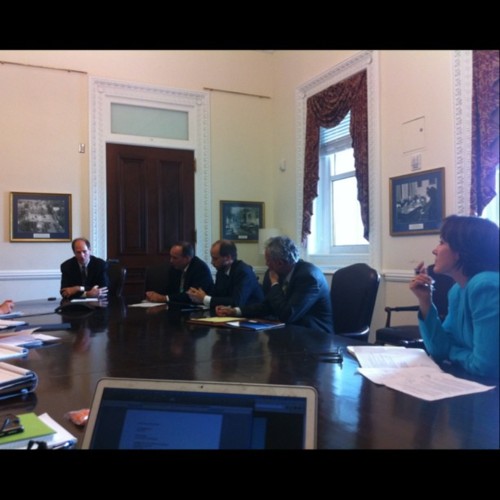
As with the previous meetings, OIRA administrator Cass Sunstein led the discussion. White House OSTP deputy CTO for public sector innovation Chris Vein was also there, along with half a dozen OIRA staff and a representative of the National Security Archive.

Seated around the table were representatives from America Speaks, OMB Watch, the Center for Technology in Government at the University of Albany, Sunshine in Government. University of Pennsylvania professor Cary Coglionese and a board member from the International Association for Public Participation, Leanne Nurse, dialed into a conference speaker phone line.
Past meetings included representatives from the Revenue Watch Institute, Code for America, Harvard’s Kennedy School of Government, Open Plans, Civic Commons, the Sunlight Foundation, Citizens for Responsibility and Ethics in Washington and the Project for Government Oversight, in addition to Open the Government and NCDD.

Open Government Consultation

Sunstein started the meeting by offering high level context for the OGP and thanks to the organizations around the table.

When the OGP was devised, he said, it was done with background experience from the Open Government Directive that came President Barack Obama and the White House Office of Management and Budget.

Many of your organizations were “indispensable” during that process, Sunstein said, and even though what happened with the open government directive “wasn’t perfect,” there has been “tremendous progress.” He thought from the beginning, with regard to the OMB open government project, that it would be a work in progress, with plans scrutinized and improved over time.

Sunstein laid out the reason for the consultation: the White House has national action plan due in September, with an event at the UN as the president promised. The White House wants the national action plan to be as good as possible, “improving on what we’ve got so far as we can.” Reflecting his comments at the previous two consultations, Sunstein said that one way to think of the meeting is generating ideas through three stages, given the temporal and feasibility constraints posed by the short deadline for UN recommendations. He observed that where would be opportunities moving forward in the medium term, over a 3-5 month time period to do more.

Katherine McFate, the executive director of OMB Watch, asked a question about the parameters for the consultation, noting that if you go back and look at the open government partnership, there are five different challenges for countries. If you only have to pick one or two, she suggested, improving public services is one, and may be improving public integrity is another. Increasing accountability, likely to be three. (Given the recent White House blog post, OIRA may have taken that suggestion.)

In response, Sunstein replied that there are surely things that have budgetary repercussions, which you then have to answer for, although in open government, sometimes it’s possible to improve public services without stretching the budget.

Theresa Pardo, director of the CTG at Albany, after thanking OIRA for the opportunity to speak and to listen, focused on the some of the issues that have arisen during implementation of the open government directive, including the role of citizen engagement. One tension is how to think about citizen participation, versus accountability imperatives.

One of the things that we hear quite regularly when we talk to practitioners at federal, local, and state level, along with academics, is a lot of confusion about concepts underlying open government directive. There’s pressure towards clarity, and still a lot of ambiguity. One of the ways to push through in creating that clarity, she suggested, would be to focus a bit more on the conversation, on figuring out what the problems that citizens are seeking open government to solve. Pardo said that in their experience, in various jurisdictions in US and outside of the US, it’s a challenge to connect what’s happening in government agencies with what citizens are talking about in public. Over the long term, the opportunity for open government, she explained, is to move towards deeper engagement with citizens themselves about what problems are they experiencing.

Professor Coglianese, speaking over the phone, agreed with Pardo and McFate. He also suggested that the White House clearly take stock of where open government is currently. We’re seeing great things, in taking stock of regulations, he said. It would make sense to something similar with taking stock of public participation now, defining a better baseline of where to assess what kinds of reform are making changes.

The point, about defining a baseline for public participation, was taken up and emphasized by many of those invited to the July 29 consultation. One of our major tools is the public participation spectrum, said Douglas Sarno of IAP2 USA. No systematic approach to what we’re trying to do or what’s been achieved has been defined by the White House, he said, and no way of qualifying bonafide public participation versus hackneyed participation defined. There are good challenges in finding metrics.

Sunstein agreed that the regulatory process requires significant public participation. This week, the Regulations.gov team acknowledged the need to do more in that regard.

In response, Pardo cited a number of studies in which communications scholars and computer scientists are using machine language processing to analyze online rulemaking to see if it results in changing in deliberation or positive social interaction. Such studies can be expensive but useful. Part of the issue in integrated such work, however, is getting real movement in processes in partnership with academics, she said.

Pardo focused further upon the role of citizen engagement, both around rulemaking and the large context of open government. Nowhere, until just recently, she said, do we teach our public managers about how to look, engage, and use citizen participation tools. “There’s a capability gap at all levels of government. How do public managers in local governments and cities, think about their jobs in different ways?”

The National Association of State CIOs and others are looking at building capability to understand how to use data and engagement tools better, said Pardo, but across the board there’s lack of ability in these core competencies. Maybe building ability as with cybersecurity skills would make sense, she suggested, including professional standards for citizen participation.

Coglianese similary focused more on baseline assessments for public participation. There are some political scientists who have tried to assess the actual impact of public comment and proposed rulemaking, he said. In terms of what to look to as baseline, what is it you want to accomplish with this national action plan? Is the goal to increase public participation? What is the level right now? We don’t have a way of saying what the volume of interaction is across the federal government, he asserted.

We do know, however, that rulemaking tends to be more something that organizations participated in more than individual citizens, Coglionese said, citing a recent article on public participation that he’d authored law journal. “We need a baseline of who’s participating and at what level,” he said. “Is the goal of participation to increase the quality of public decision making? That’s hard to assess. To enhance public virtue? That’s much harder to assess. Until it’s clear exactly what it is you would want to do, you can’t answer these questions.”

David Stern, director on online engagement at America Speaks, validated Coglionese’s words, observing that his organization had recently looked at all open government plans by agencies and came to the same conclusion. There’s a lack of consistency in metrics used to evaluate projects, said Stern, and no standards about what defines good participation. Number of people, diversity, number of instances policy influenced? Standards and best practices, in this area, would be helpful coming from White House and OMB. Every open government project contains response to the most popular proposals, he said, which means that every public engagement initiative has a public engagement component.

Rick Blum of Sunshine in Government raised another issue: FOIA exemptions, including agencies proposing them independently. The Department of Defense is overclassifying, said Blum, and it’s very hard to track what’s happening. The Department of Justice has put up a FOIA dashboard but it’s “plagued with tech glitches and bad data,” he said. This has become a public debate about secrecy or disclosure, with some half a billion dollars being spent annually fulfilling FOIA requests, said Blum. There’s also concern about the impact of the recent Supreme Court decision in Milner vs the Navy.

On my part, I offered feedback that I’d collected from the broader open government community ahead of time and over the previous year.

First, the White House has not explicitly separated open government innovation, in terms of open data about the business of government, from “good government” initiatives that transparency advocates expect and demand, in terms of accountability to the people. Misset expectations around the goals the White House has set out have created widespread dissatisfaction and harsh criticisms of an administration that promised to be “most transparent ever.” The open government initiative in the province of British Columbia offers a potential model for the White House to consider, in terms of this separation.

Second, as the federal government moves forward with its ongoing review of .gov websites, there are opportunities to work with civil society and civic developers to co-create better e-services.

Third, opportunities exist for the White House to partner with entrepreneurs, media or nonprofits that are making government data open, useful and searchable. For instance, BrightScope has made financial advisor data from the SEC and FINRA available to the public. The work of Code for America and others on farmers market open data is another example.

Finally, there continue to be serious issues raised by developers about the quality of open government data on Data.gov. In general, public servants continue to release PDFs, as opposed to machine-readable structured data, and cite the language in the Open Government Directive for support. If government wishes developers and businesses to use its data for accountability, civic utility or economic value, then releasing data in the open formats that these communities find most useful makes logical sense.

Pardo took up the issues raised with good government versus open innovation, noting that the two aren’t necessarily against each other. The idea of high value data wasn’t well defined, she said. For instance, the calendars of public officials are nothing more than a dataset.

Sunstein asked after the data issues and the one of his deputies specifically asked about the language in the OGD. He brought up the work that the federal government has done on regulations.gov – which was a persistent focus from the OIRA administrator – and asked whether it was good enough, and over what time limit? And for whom?

The general answer there was clear enough: “we the people.”

Coglianese offered more feedback on regulations.gov: it’s not enough. There are data fields are not filled in, missing information, and things remain incomprehensible, he said. “Imagine how it is for many others coming for first time?” Coglianese endorsed the recommendations of ADA blue ribbon commission for a dedicated overseer of data quality, although such a role would require congressional authorization.

There are some really important opportunities to leverage data in regulations.gov, he emphasized. Leverage that data to extract it automatically, display the data on websites. For instance, many members of congress have a button on their websites forlegislation they’re sponsoring, which then takes visitors to data automatically etxtracted from Thomas.gov. Imagine a similar system for agencies and regulators, he suggested, or consider the EPA, which is trying to display every rule that the agency is working on., which is being developed in addition to regulations.gov.

Agencies right now are building websites around current uses, said Coglionese. That makes a lot of senses, and it’s what one would hope, but doesn’t go to the “separate question of who do they want their users to be.” He criticized the design of the new FCC.gov, although I pointed out that the process that preceded the FCC relaunch was focused on the most common purposes of the site’ visitors.

What was left unsaid in these open government partnership consultations? A great deal, due to the length of time allowed. The voices that were heard around this table were also those of advocates, policy, experts, academics, and technologists: not citizens, and by and large not those of the media, whose function in representative democracies been to hold government accountable on behalf of the public.

As the White House considers its commitments in advance of the September meeting at the United Nations, the people will have a window of opportunity to tell their elected officials what open government means to them and how they woud like their federal government to be more transparent, participatory or collaborative.

If you have feedback on any of those accounts, send it to opengov@omb.gov.