
The NewsHour interviews Alec J. Ross on digital diplomacy and 21st Century Statecraft

What do State Department officials mean when they talk about ” 21st Century Statecraft?” The PBS Newshour’s digital correspondent, Hari Sreenivasan, sat down with Alec J. Ross, senior adviser for innovation at the State Department, to learn how technology is being leveraged to accomplish foreign policy goals. Sreenivasan subsequently published an excellent post on diplomacy and 21st Century statecraft at the Rundown, the Newshour blog, that includes the video below:

As Sreenivasan notes, the State Department has been rapidly moving forward in its use of technology, as reported in Radar on applying technology for Internet freedom. The question of whether the US should support Internet freedom through technology is a complex one, and deserves serious scrutiny as it moves forward, as evidenced by the Haystack fiasco.

What does 21st Century Statecraft mean? Sreenivasan takes a swing at reporting on Ross’s take:

In light of the seismic shifts taking place in how information and people interact and engage with one another, Ross says a broadening of the practice of statecraft is necessary. Going forward, that means using a balance of soft and hard power to enable and support relationships between non-state actors, and between representatives of governments.The prescription calls for far more than giving diplomats Twitter training, or simply using social media to push “the message” out. It is also about connecting people to resources efficiently and effectively, from NGOs to governments to people in need of aid.

In addition to spending money on new forms of digital diplomacy, the State Department has more often used its clout to convene bright minds from the private sector and the NGO world in a series of Tech@State conferences. They have included gatherings to share ideas on leveraging mobile technology, finding and empowering technology assistance in Haiti’s recovery and, more recently, rethinking Civil Society.

Sreenivasan included a host of excellent links to learn more about 21st Century statecraft, including:

  • An essay in Foreign Affairs entitled “America’s Edge” (requires one-time free registration) by Anne-Marie Slaughter. It was published around the same time that the former Dean of the Woodrow Wilson school at Princeton University was appointed as the new Director of Policy Planning at the State Department.
  • A essay by Eric Shmidt and Jared Cohen of Google titled The Digital Disruption, also in Foreign Affairs, which discusses the challenges facing diplomacy. As Sreenivasan notes, Cohen recently moved to Google from the State Department, where he had been working with Ross on 21st Century Statecraft. The New York Times Magazine covered their digital diplomacy efforts this this past summer.
  • Sam Dupont of NDN has gathered a list of 21st Century statecraft initiatives.

The Newshour has been extending its coverage into Gov 2.0 since Sreenivasan reported on the Gov 2.0 Expo and Summit earlier this year. For more of its past coverage, check out their conversation with Todd Park, the Chief Technology Officer of HHS, and excerpts from their conversation with White House Chief Technology Officer Aneesh Chopra and federak CIO Vivek Kundra. It’s a significant evolution to see Gov 2.0 be discussed on the Newshour, CBS or Dan Rather reports. Whether it’s enough to raise national awareness of open government challenges, success or failure is itself an open question.

Celebrating Veterans Day Online

“As we express our gratitude, we must never forget that the highest appreciation is not to utter words, but to live by them.”
-President John Fitzgerald Kennedy

All over the Internet today, politicians, businesses, media companies and, most of all, people express their thanks on Veterans Day.

Over on YouTube, PostSecret published a special video of soldiers’ stories. Powerful.

YouTube also shared the story of Justin Constantine, an veteran of the war in Iraq that was injured in the line of duty, on its Twitter feed today.

Dipity published a wonderful Veterans Day visualization:

On this day of reflection, make sure to read Susannah Fox on inspiration for Veterans Day and a great BBC article on how social media is helping today’s war veterans.

As a reminder to U.S. citizens, today is also known as “Remembrance Day” abroad, honoring the millions who died in World War I, as this excellent history of Veterans Day from the History Channel explains.

In the world of open government, it’s important to recognize the work of the Veterans Department. The Blue Button from the Veterans Administration and Department of Health and Human Services has now eclipsed 100,000 electronic health record downloads. The Blue Button corrects a national shame, with respect to disabled veterans’ difficulties with repetitively filling out paperwork, and it is a notable example of a public-private partnership.

Elsewhere on the Web, Alex Horton reminded readers of the VA’s new blog, VAntage Point, of the battle in their hearts that war veterans carry with them.

Mark Drapeau wrote a thoughtful post on Sector Public about how Microsoft is helping veterans integrate back into civilian life.

The Experience Project is collecting memories of veterans and heroes. (HT
Reg Sadler)

Along with historic Veterans Day quotes like President Kennedy’s words above, you can see sentiments expressed in real-time on Twitter and Facebook:

new TWTR.Widget({
version: 2,
type: ‘search’,
search: ‘veteransday’,
interval: 3000,
title: ‘Veterans Day Tweets’,
subject: ‘What does this day of remembrance mean to you?’,
width: 600,
height: 200,
theme: {
shell: {
background: ‘#066896’,
color: ‘#ffffff’
},
tweets: {
background: ‘#ffffff’,
color: ‘#444444’,
links: ‘#1985b5’
}
},
features: {
scrollbar: false,
loop: true,
live: true,
hashtags: true,
timestamp: true,
avatars: true,
toptweets: true,
behavior: ‘default’
}
}).render().start();

PBS has done a wonderful job pulling together online resources for Veterans Day, including their archives and more from elsewhere on the Web:

  • The photo-sharing website Flickr offers a roundup of community members’ Armistice Day photos (the national Armistice Day holiday declared at the end of World War I was the precursor to Veteran’s Day).
  • The Virginia state government’s education website offers “cool facts about veterans” geared toward children in kindergarten through fifth grade, while the Teachers Corner online features ready-made worksheets and puzzles to teach children about the importance of remembering America’s veterans.
  • Military.com provides extensive resources for Veterans Day celebrations, support services, and photographic story sharing.  The site provides a space for employers to seek veterans for hire and a buddy finder to reunite old co-workers and friends.

Great work by Lauren Saks.

To the more than 23.2 million veterans who have served the United States, thank you.

San Francisco passes municipal open data law

Yesterday, the San Francisco Board of Overseers voted unanimously to approve the first municipal an open data law* in the United States. November 9, 2010 is a milestone for open government.

That said, the moment comes with major caveats on open data appetite vs reality, as John Wonderlich points out at the Sunlight Foundation.

Here are the changes that came out of the committee, though:

AMENDED on Page 2, Lines 2-6 by adding ‘make reasonable efforts to’ after ‘shall’; deleting ‘all’ after ‘available’; adding ‘and with applicable law, including laws related to privacy’ after ‘(“COIT”)’; Page 3, Line 2 by deleting ‘all’ after ‘accounting of’; and on Page 3, Line 5 by replacing ‘would’ with ‘could’.
Those changes are comical. The ordinance now mandates that agencies have to try to follow the standards set by an IT oversight body, to release some information based on an audit of some subset of public data.

This is the language of the low-hanging fruit — the kind of aspirational mandate that isn’t really a mandate at all, but more of a statement of goals and principles, lofty rhetoric with a roadmap made up of other road maps, and plans for other plans.

Again, this declaration, and the others like it, aren’t inappropriate. Their effects probably vary based on the context, based on the actual commitment of everyone involved, from government officials to citizens.
If all these declarations do is to win some of the easy fights, then they’re well worth the effort, because those obvious decisions (like open local transit data) have been gotten wrong far too often in the past, and can have significant positive effects when they’re gotten right.
We need to avoid, however, thinking that these top-level political declarations are something they aren’t. Governments have a vast stores of information, and most of it won’t be reached by these pronouncements. There’s a whole world between the initial urge for government to “put all its data online” and the “please try to put some data online better when you remember to” that that urge decays into. At the first sign of trouble, “all” disappears, “must” becomes “should,” and a mandate becomes a suggestion. The San Francisco ordinance demonstrates just how far a vision for transparency can be from the kind of nuance and structure that makes it possible.

Wonderlich is onto something here. Read the whole thing.

*CORRECTION: As Philip Ashlock pointed out, “Portland’s open data & open source legislation passed a year ago in Oregon, though it wasn’t as explicit as San Francisco’s. See open data policy [at CivicCommons].” In his comment to FreeGovInfo’s story, he notes that Portland’s “law was largely influenced by the legislation passed in Vancouver about six months before that. The major difference (and a very important one) with San Francisco’s new legislation is that it is more explicit about using open licenses with the open data.”

I regret the error; the tweet from the White House @OpenGov account (“San Francisco passes first municipal open data law”) led me astray.

The text of the law is embedded below, courtesy of Chris Dorobek at Federal News Radio.

San Francisco open data law (11.09.2010) http://d1.scribdassets.com/ScribdViewer.swf

HHS CTO Todd Park on HealthData.gov, Text4Baby and open health data

The first chief technology officer of the Department of Health and Human Services (HHS), Todd Park, has been working hard to make community health data as useful as weather data. If that vision for open government at HHS matures, the innovation released in the private sector could meet or exceed the billions of dollars unlocked by GPS or NOAA data. To see the first steps in that direction, look no further than the healthcare apps that have already gone online, like the integration of community health data into Bing search results.

Park shared the next step in opening up health data last month out in California, when he announced HealthData.gov at the San Francisco Healthcamp. When interviewed yesterday at the mHealth Summit in Washington, Park shared more details about HealthData.gov, which he says will launch in December. He also shared a new goal for text4baby yesterday, which has now grown to be the biggest mobile health platform in the United States: 1 million moms by 2012.

HealthData.gov will be a new part of Data.gov with a health data catalog, including a roster of new public and private applications using the data, said Park. The site will launch with a new tool, a “Health Indicator Warehouse” with over 2000 metrics for United States, state and county health. HealthData.gov will also host an online community dedicated to health data, which should allow practitioners, technologists and entrepreneurs to learn from one another. The site is the next step in the framework HHS has created for government to act as a platform through the Community Health Data Initiative. The next question will be whether these applications lead to better outcomes for citizens and businesses that expand, bringing on new workers. Measuring that meaningful outcome will require more time.

Exploring Civil Society 2.0 at the State Department

The Tech@State conference on Civil Society 2.0 offered insight into the future of technology and civics around the world from digital diplomats, nonprofit leaders and technologists. Tim O’Reilly delivered one of the most thoughtful lectures I’ve seen to date, exploring the factors that led to the success of the Web, Google, Microsoft, Amazon and the platforms that undergird our digital world.

“As you think about civil society 2.0, think about open ended platforms that you can build on, not just applications,” he said.

While his comments and those of the other presenters deserve more analysis and reporting, the four excerpts from O’Reilly’s talk below offer immediate access to the insight he shared. I’ll write more at Radar soon.

For more perspective on what civil society might mean in 2010 – or 2050 – read Nancy Scola at techPresident.

http://www.ustream.tv/flash/video/10632532?v3=1

http://www.ustream.tv/flash/video/10632190?v3=1

http://www.ustream.tv/flash/video/10632341?v3=1

http://www.ustream.tv/flash/video/10632304?v3=1

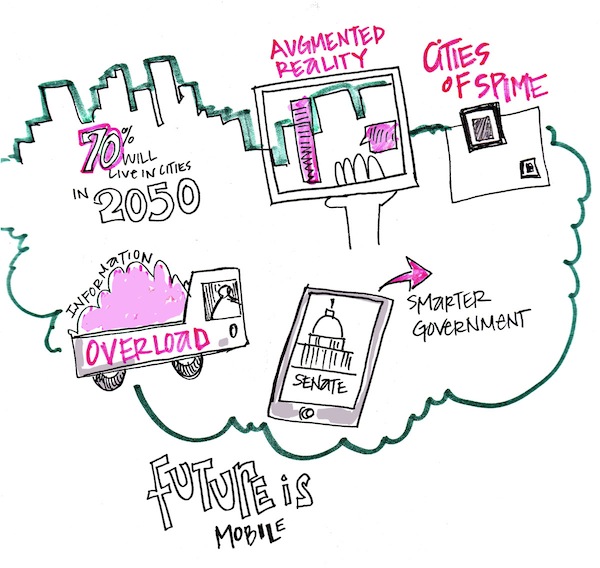
The Future is Mobile at Ignite NYC: Open Data, Open Government and Augmented Reality

“The future is already here – it’s just not evenly distributed.” —William Gibson.

http://blip.tv/play/AYKJtSgC

“An exploration of cyberpunk fiction, technology, where we’re headed, the challenges we face, and the solutions we need”-Ignite NYC. I gave a (very) similar talk called Pattern Recognition and Spimewatch at Ignite D.C. later that week. For whatever reason, this version seems to have come off much better. Rack it up to the first time on a big stage; there were close to a thousand people present in NYC.

The creative graphic recording at Ignite NYC at Web 2.0 Expo was created during the talk by Nora Herting of ImageThink.

For a great Ignite talk with a related theme, check out In Coders We Trust, by Laurel Ruma.

Dan Rather interviews Tim O’Reilly on Gov 2.0

How did Tim O’Reilly describe the potential of Gov 2.0 to Dan Rather?

“Government 2.0 is the attempt to harness the latest technology to make our government more effective, transparent and participatory,” he said.

What do the alpha geeks want to do, with respect to improving government? “They started saying, first of all, we want to open up government, we want more access to all this government data. We want to create new capabilities for citizen involvement.”

From HDNet YouTube Channel excerpt’s description:

Barack Obama’s presidential campaign was recognized for its innovative use of technology to rally voter support. But there are people out there who say that technology has the power to not only revolutionize campaigns, but the very way we view government. It’s a movement called Government 2.0 and Tim O’Reilly is one of its most vocal prophets. He has been called “the Oracle of Silicon Valley” because he saw the potential of the world wide web years before most of us had even heard of it. He’s a highly respected big thinker in the tech community. And he believes that we are at the vanguard of a radical re-think of how government works in the Internet age.

The full episode of Dan Rather Reports on “Tim O’Reilly and Government 2.0” is available as a direct download from iTunes.

Open Government and Civic Innovation on Display at Portland’s CivicApps Awards

What does the innovation on display at the Civic Apps contest by developers in Portland, Oregon mean to the city’s mayor?

“It’s bringing to the world knowledge of what exists in the real world but is so often unknown,” said Mayor Sam Adams in an interview at the awards ceremony for the winners of the contest.

“In Portland, like I think most cities, when people are armed with knowledge, they make wiser choices,” he said, pointing to applications like PDX Bus as examples of innovation that actually help citizens to navigate the city better.

Does open data lead to more economic value creation in the private sector and metropolitan areas alike?

“We are seeing folks that are sole proprietorships hire folks to help them build their business, their app business, their online business with our data sets.” he said. “For us, data has always been there, in some cases for decades. Putting it to use for the public and help people make money while they do it – we intend to be the open source capitol of the nation – and this is one contribution we can make, with our data sets.”

What’s next? “What CivicApps is about in part, providing the data, is sparking relationships, relationships which lead to economic opportunities,” he said. “Webtrends, Microsoft meets the local hacker or coder tonight at this event, who knows what will happen. Our job is to provide the data, provide the opportunity for relationships to occur, provide what in comparison is a tiny litte bit of money, a little incentive for people to keep going. And it’s also fun. It make the city more fun to live in, because you know what’s there.”

That incentive, incidentally, amounted to $1000 for each of the winners of the second round of Civic Apps awards, with another $3000 going to the Best of Show winner, Loqi.me. This afternoon, Skip Newberry, economic development policy advisor to Mayor Adams, congratulated the winners of CivicApps on Twitter.

.bbpBox29117818058 {background:url(http://a3.twimg.com/profile_background_images/26879991/Downtown_Portland_-_Twitter_image.png) #9AE4E8;padding:20px;} p.bbpTweet{background:#fff;padding:10px 12px 10px 12px;margin:0;min-height:48px;color:#000;font-size:18px !important;line-height:22px;-moz-border-radius:5px;-webkit-border-radius:5px} p.bbpTweet span.metadata{display:block;width:100%;clear:both;margin-top:8px;padding-top:12px;height:40px;border-top:1px solid #fff;border-top:1px solid #e6e6e6} p.bbpTweet span.metadata span.author{line-height:19px} p.bbpTweet span.metadata span.author img{float:left;margin:0 7px 0 0px;width:38px;height:38px} p.bbpTweet a:hover{text-decoration:underline}p.bbpTweet span.timestamp{font-size:12px;display:block}

Congrats to @caseorganic @elsewisemedia @pdxmele @maxogden & John Mosser for their award-winning @civicapps! #opensource #gov20 #teamadamsless than a minute ago via TweetDeck

Most Useful App and Best of Show

Amber Case for Loqi.me

As Mayor Adams mentioned later in the program, this Web app could be useful in a snowstorm in Oregon or, if adapted more broadly, for crisis response around the country or world.

App description: “This application is a resource for citizens, medical teams and governments before, during and after disasters. Loqi.me allows mobile users to send an emergency GPS beacon to a real-time map. Crises responders can view all of the help requests on the webpage, along with hospitals and fire stations, real-time 911 calls related to natural disasters. Ground teams can easily use Loqi.me on their mobile phones to send notices of supplies and terrain reports in real time. Remote helpers can easily see the whole picture on the website’s real-time map, handle help and information requests, and send messages to the network. Loqi.me supports subscription to group messages via SMS, AIM, Jabber and Twitter. No application installation is required. Location beacons can be sent simply by going to http://loqi.me on a mobile phone.”

Most Appealing

Matt Blair for PDX Trees.

App description: “PDX Trees is an app for iPhone and iPod Touch devices that makes it easy to find and and enjoy them. With this app, you can:

  • Search for nearby trees and see them on a map.
  • Tap a pin to see the name and view details for that particular tree.
  • Take and upload a photo of a Heritage Tree you’re visiting.
  • View photos of the tree taken by other tree enthusiasts.
  • Email a friend about the tree (includes tree name and location where available)
  • Read more about a type of tree from Wikipedia, without leaving the app.”

Most Original

Melelani Sax-Barnett for Portland Bike to Transit.

App Description: “This is a simple, handy web map that helps you figure out how to ride your bike to transit. It lets you choose from a variety of base layers, and toggle transit stops, routes, and current bike routes. You can also query transit stops and routes for basic information. I made this for a Web GIS class at PSU and I’m a total beginner (with some code thanks to Professor Percy and OpenLayers).”

Best Use of Data

Max Ogden for Civic Apps Data Previewer

“This helped make our data useful to a lot of other developers and the general public,” said Mayor Adams. “Why take it on?”

“I saw all of this great data at the core when civic apps launched,” said Ogden. “When you get data into the Web format, you get Web developers who are really used to making human interfaces for things make them.”

App Description: “A web application to preview any of the public geo data on CivicApps from your web browser. You can choose a dataset and view that data on a map. Individual objects are clickable and can provide details (metadata).”

Civic Choice

Joseph Mosser for PDXTrian

App Description: “Pdxtrian is a simple utility for riders of Portland’s excellent mass transit system, TriMet.

  • Uses GPS to find nearby transit stops
  • Displays a map of the stop location
  • Displays a list upcoming arrivals
  • Allows you to save stops and look them up anytime”

The livestream of the awards ceremony is embedded below:

http://www.ustream.tv/flash/video/10487185?v3=1

In Coders We Trust: Laurel Ruma breaks down Gov 2.0 at Ignite NYC

We’re moving from the Social Web to the Civic Web. IT and geeks matter. What we can do with open data and the internet is very important. If government is a platform, we need people to create apps and others to open up data sets.”-Laurel Ruma, Gov 2.0 Evangelist, O’Reilly Media

If you want a great introduction to what Gov 2.0 is and why it matters, look no further than her 5 minute talk from Ignite NYC is embedded below.

Reflections from Manor Govfresh: Voices of Open Government and Gov 2.0

If you’re looking for the faces of government 2.0, look no further. The video above, released today by Manor New Tech High‘s “Digital Dojo,” features more than a dozen voices (including this correspondent) talking about what Manor.Govfresh meant to them and what open government means to the country.

“I am very excited to be at Manor Govfresh because it’s the first time I’ve ever been to a conference that doesn’t just talk about change but actually does it,” said White House deputy CTO for open government Beth Noveck. “What’s exciting about Manor Govfresh is that it’s brought together so many people who are interested in municipal innovation and using technology to actually make a difference in local communities here in Manor, Texas, in Deleon, Texas, and across America, to actually make government work better.”

When you watch the video, of course, you’ll hear many more voices than Noveck’s, which is of course the point. The movement towards open government at the local level puts the growth of government 2.0 in context. As Stacy Viselli said this morning in a comment on Radar, “Communities and neighborhoods have been moving their organizations online for a while now and are looking for ways to do more. It creates an optimum environment for collaborative projects that include local governments, business, civic associations, nonprofits, and community foundations. Sometimes it’s not about the data so much as it is about providing a platform that empowers communities do what they are already doing–better.”

For more on how local governments are using technology to deliver smarter government, read about how Gov 2.0 is growing locally. And for more on Manor Govfresh, read about harnessing the civic surplus for open government.