This week, I was proud to be one of two speakers for a session on social media and government at the Council on Governmental Ethics Laws (COGEL) conference in Washington, D.C. I delivered an adapted version of the talk on social media and government I gave the Social Security Administration’s Open Government Awareness Day earlier this year, focusing on the elements that would be of greatest interest to a group of lawyers, regulators and academics. The presentation is embedded below:
The speaker that followed me, however, was able to share a fascinating view of what social media looks like from inside of government, specifically in the District of Columbia. Alysoun McLaughlin, the public affairs manager for the District of Columbia Board of Elections and Ethics. Here’s her bio, from the COGEL session description:
She joined the District last year, just in time to implement a long list of reforms for the 2010 election including new voting equipment, early voting and same-day registration. Prior to becoming an election official, she was a project manager for Election Initiatives at the Pew Center on the States. She previously spent a decade as a Washington lobbyist, focusing on election issues for the National Conference of State Legislatures and the National Association of Counties. She is here today to share her experience with social media during the 2010 election.
And share she did. Over the course of half an hour, she talked about Facebook, Twitter, local media, citizen engagement and much more. I captured most of her presentation on my iPhone (sorry about the unsteady hand) and have embedded her presentation, “To Tweet or not to Tweet: Engaging the Public through Social Media,” below.
If you want an excellent, practical perspective of the local government side of social media, these are worth watching. A couple of key takeaways from her presentation:
How can governments get insights from Twitter without using it? “Just type in the name of your agency and see what they’re saying.”
On D.C. elections: “We know there are going to be lines. Come to the website to see what they are.”
Don’t trust this to an intern. You “need someone skilled in crisis communications.”
“The days that I’m heavy on Twitter are the days my phone rings less.”
Viral tweets can raise awareness: “…and we just confirmed that a voter used a write-in stamp. on a touch screen.”
Part 1: Introductions
Part 2: Reflections on Twitter and Facebook
Part 3: Twitter and the 2010 DC Election
Part 4: Who follows @DCBOEE
Part 5: Listening and using social media in government
The digital divide in D.C. is an issue that has been receiving increased sunlight under the District’s chief technology officer, Bryan Sivak. As the Kojo Nnamdi Show episode on the D.C. digital divide reported, “a 2009 study by the OCTO found that the digital divide runs very deep in the city – 90% of residents in Northwest D.C. have high-speed internet access in their homes, but in Southeast, that figure falls to just 36% – 40%.”
Earlier this year, Washington became the recipient of stimulus funding for a digital divide initiative. This summer, the city turned on free wifi in many neighborhoods, which can be viewed at DC.wifi.gov. Today, Sivak announced D.C.’s first digital divide strategy:
.bbpBox12514372882534400 {background:url(http://s.twimg.com/a/1291760612/images/themes/theme1/bg.png) #C0DEED;padding:20px;} p.bbpTweet{background:#fff;padding:10px 12px 10px 12px;margin:0;min-height:48px;color:#000;font-size:18px !important;line-height:22px;-moz-border-radius:5px;-webkit-border-radius:5px} p.bbpTweet span.metadata{display:block;width:100%;clear:both;margin-top:8px;padding-top:12px;height:40px;border-top:1px solid #fff;border-top:1px solid #e6e6e6} p.bbpTweet span.metadata span.author{line-height:19px} p.bbpTweet span.metadata span.author img{float:left;margin:0 7px 0 0px;width:38px;height:38px} p.bbpTweet a:hover{text-decoration:underline}p.bbpTweet span.timestamp{font-size:12px;display:block}
It’s embedded below in the post. Interestingly, the digital divide strategy announcement at the Office of the Chief Technology Officer of D.C. indicated that it would be a “living document,” much like the Web itself:
OCTO is pleased to release a public draft of the District of Columbia’s first ever strategic plan to address the digital divide. This is intended to be a living document, updated quarterly or bi-annually as conditions warrant, and will reflect the current high-level vision of the District Government as it relates to tackling this important issue. Feedback is welcome so please feel free to share your thoughts and help us bridge this gap.
For a feel for the thinking of the DC CTO on this count, watch Sivak’s closing statement from the District of Columbia’s first-ever “Community Broadband Summit” (DC-CBS) is embedded below. The summit was a public forum designed to address the city’s digital divide.
It’s not clear whether Sivak will stay on under incoming Mayor-Elect Vincent Gray’s administration. If not, here’s hoping his replacement works with the D.C. tech community to connect more citizens to the Internet. Online access has become a vital link for information, services, access to jobs, education and communication with family, friends, teachers and coworkers in the 21st century. The District should be commended for continuing to working to bridge it.
What do you think of the strategy? Leave your thoughts in the comments.
Tomorrow, December 8, is the one year anniversary of the White House Open Government Directive, which which required federal agencies to take steps to achieve key milestones in transparency, participation, and collaboration. At 2:00 PM EST, the first United States chief technology officer, Aneesh Chopra, will join OMB chief information officer Vivek Kundra and Cass Sunstein, administrator of the Office of Information and Regulatory Affairs, in a live web chat at WhiteHouse.gov/live. Video of the webcast is embedded below:
The Sunlight Foundation released the following statement on the one year anniversary of the open government directive:
“In its first year, the Open Government Directive made government transparency a priority and encouraged federal agencies to put important information online. While more government information is now available online, the Directive’s limitations have also become clearer. Simply put, the president’s commitment to transparency is not yet living up to its full potential. The Open Government Directive is a great starting point, but the hard work that is needed to create a truly open government is still ahead of us.
“Agencies such as the Department of Labor, Health and Human Services and NASA have led the way in releasing data, and the working groups created among key staff have brought about real cultural change within agencies. But all of these initiatives need a steady hand and a clear commitment from the White House to mature into permanent, reliable, effective policies that result in meaningful data online.
“More concentrated work is needed to move beyond the easy wins. The administration has to give stronger direction and urge the agencies to move forward if the promise of an open government is to be realized.”
Last week I hooked a computer up to the Twitter data streaming API and, over the course of a day, grabbed every tweet that had geographic coordinates. I wrote a Python script to parse the 2GB of JSON files and used Matplotlib with the Basemap extension to animate 25 hours of data on a world map. The resulting animation plots almost 530,000 tweets — and remember these are just tweets with geo-coordinates enabled.
I recommend you full-screen this video, turn scaling off and high definition on.
The animation begins at 5am on November 18, Greenwich Mean Time (United Kingdom). This corresponds to midnight Eastern Standard Time, 9pm Pacific Time (Nov 17) and 6pm in New Zealand (Nov 18).
There are some interesting things to note:
– It is possible to infer the passage of the sun across the map as data begins to stream out of mobile phones and desktops and previously dark patches of the map begin to glow white.
– At 8:00, 9:00 and 10:00 GMT waves of tweets pass across the United States from East to West. This is an automated Twitter service that tweets local news for specific ZIP codes.
– Turn your attention to Indonesia. Jakarta glows as brightly as New York and San Francisco.
– Note the black spots. With the exception of a few cities, such as Lagos and Johannesburg, Africa remains the dark continent.
Food for thought and a feast for the eyes as the weekend draws near.
Bush missed few opportunities to plug his new book in the first half of the discussion or to poke some fun at Zuckerberg. Promoting for the book to be expected, given that Facebook’s headquarters were the major stop on the California leg of his “Decision Points” book tour. Less expected was the moment when the two men bumped fists over Zuckerberg’s success without graduating from college.
Bush and Zuckerberg also talked about how he’s adopted technology since leading the Oval Office. After he left D.C., “I became a BlackBerry person,” said Bush. “Now I’m an iPad person. And I use the Facebook.” (According to CNN, Bush’s favorite iPad app is Scrabble.)
Like Zadie Smith, who wrote about her Facebook experience in “Generation Why,” Bush doesn’t use Facebook in the same way as the average citizen. He’s a public figure, and when he says he has “over 600,000 friends on my Facebook page,” it means that many accounts have “Liked” his account, not that he’s radically exceeded the limits of the social networking giant’s social graph. Likes and friends are not at all the same thing. For the sake of reference, President Barack Obama has some 16,891,000 “Likes” on Facebook, very few of whom are likely his “friends” in any real sense.
Bush and Zuckerberg reflected upon a more serious use of social networking and online platforms as well. “One way we’re trying to advance freedom is by using the Internet,” said Bush, citing the work of Oscar Morales and his One Million Voices against FARC.
In a rare moment of praise for the Obama administration, Bush also said that “I think they’ve handled Afghanistan well.”
He reflected on the dynamics within China, the rising power in the East, connecting its voracious consumption of natural resources, connecting it to keeping internal order. “To create 25 million new jobs a year, you have to have a lot of natural resources,” he said.
Zuckerberg asked the question of the moment near the end of the hour-long interview: What is the impact of Wikileaks?
“I think it’s going to be hard, in some cases, to earn the trust of foreign leaders,” said Bush.
Today at George Washington University, GW Office of Entrepreneurship & iStrategyLabs is hosting a “Gov 2.0 Startup Lab” to highlight the opportunities around civic entrepreneurship. According to the event organizers, the event “will stimulate new ideas and bring together collaborators for the 2011 GW Business Plan Competition with $50,000 in prizes, and further establish GW as a hotspot for innovation and entrepreneurship.” The livestream is embedded below:
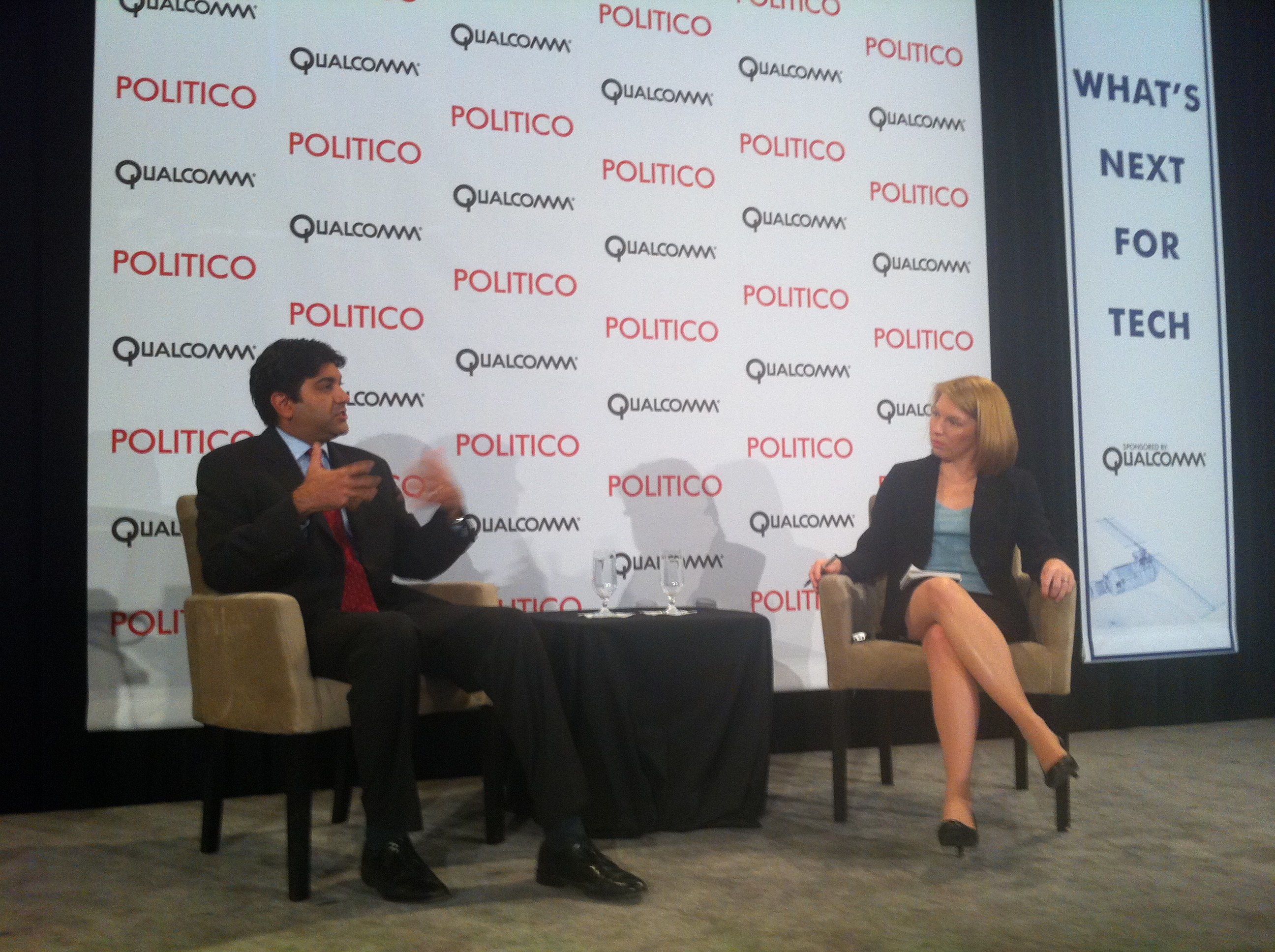
“The single best thing we could do in open government is to get the American people engaged in the question of what high value data is,” said Aneesh Chopra, the first United States chief technology officer, speaking at this morning’s Politico “What’s Next in Tech” forum in Union Station. Video is below:
In an interview with Politico’s technology editor, Kim Hart, Chopra looked back at the lessons learned from his first two years on the job and ahead, appropriately, to what to expect in tech policy from the Obama administration. They covered a lot of ground, from open government successes to what’s next in Congress (hint: watch the push to open up spectrum for first responders) to supporting entrepreneurial growth.
Lessons learned
What were Chopra’s lessons learned? He offered up three examples.
First, with support from the President, Chopra said that they’ve been able to open up discussion and build trusted relationships across the federal government, which has been “critical” to improving the way technology could be used and the long term policy posture.
Second, with that support, he’s been surprised on seeing the pace of response become fast. There’s a “lesson on balance of getting long term balance, versus getting results in 90 days,” he said, referring to the turnaround on projects like HealthCare.gov.
Third, Chopra emphasized the role of “government as a convener,” where the administration can use its influence to bring people together to accomplish goals with technology without new regulations or legislation.
Working tech policy levers
What are the levers that the first US CTO has worked to try to galvanize action on the administration’s priorities?
First, a commitment to openness. From Manor, Texas, to inner cities, “people have found ways to tap into info in ways that helps them do something different,” said Chopra, speaking to the phenomenon of Gov 2.0 going local. “85 to 90% of that activity is happening in places we wouldn’t have imagined,” not gathering in Washington.
Second, Chopra cited the White House’s work towards “voluntary, consensus-driven standards,” noting that he was ” very proud of the work on NHIN Direct.”
Finally, Chopra noted that there’s some $150 billion spent on research and development every year, which offers a number of ways to push forward with innovation in priorities like healthcare IT, energy, smart grid or communications.
Making meaningful use modular
Given the new Congress coming in to Washington, Chopra’s description on the bipartisan agreement on tech policy from his time in Virginia under Republican leadership has to be more than a little strategic. He talked about “getting to the right answer,” referring back to an former manager, David Bradley, and his management strategy of “True North.”
That approach will be rested in the next Congress, on rulemaking. and in moving forward with the tech policy decisions. Outside of the healthcare bill that President Obama signed into law, which continues to meet with significant opposition in Congress, Chopra noted that “healthcare is signature part of President’s agenda,” specifically advanced by more than 20 billion dollars in Recovery Act spending on healthcare IT.
Chopra looked back at two decisions related to approaching technology policy a bit differently. “Rather than walking into Best Buy and buying software, we created more flexible standards for meaningful use,” he said. As a result, “entrepreneurs that never thought of themselves as EMR companies are entering the market.”
The decision to make meaningful use more modular was also significant, asserted Chopra. “We opened up the regulatory regime so you could certify each and every regulatory module.”
In aggregate, Chopra associated that R&D investment, work to convene conversations, open up data and create more flexible regulatory regimes with a better outcomes: venture capital investment in HIT going up by 39%, citing a statistic from the National Venture Capital Association.
How did Chopra respond? He asked for more criticism, responding that you “must listen to people who are frustrated” and consider that much of the tech platform is in the space “where the plane is yet to land.” If you go through campaign promises, and look at executive ability to move the needle on different areas, Chopra asserted that the
biggest part of that – open government – has gone ahead. “It’s not ‘mom and apple pie perfect’,” he said, but they’re proud of delivering on 90 day deliverables like standards, or websites.
Part of the challenge of delivering on campaign promises is that budgetary or legislative action requires different stakeholders, observed Chopra, a reality that will become even more sharply defined in the next Congress. “The Recovery Act is a unique moment in time,” which, as he argued is “overwhelmingly the vehicle for campaign promises” in health IT and clean tech.
What’s next in United States technology policy?
First, it’s clear that Chopra and the Obama administration is thinking about online privacy, with the recently announced Internet privacy committee. There are open questions about how much portfolio, budget, subpoena power or other authority any new position would hold, but it’s an area to watch. Chopra said that he had met with Representative Bob Goodlatte (R-VA) and had found him supportive of privacy policy.
Chopra also met with Representative Darrell Issa (R-CA), who is very supportive of increased government transparency through technology. Issa, a successful technology entrepreneur, is one of the most knowledgeable members of Congress when it comes to technology. Whatever comes out of his his legislative staff, or the new House Oversight committee, which he will chair, could represent a step forward for open government after the 2010 election.
Chopra also emphasized “modest but significant actions” that could improve the conditions for tech entrepreneurs in the United Stats, from open government data to regulatory action to smart grid or support for new learning technologies. On that count, Chopra offered up a “scoop” to Kim Hart, observing that the next area where he will focus on driving innovation will be into learning technologies, with more news coming at a Brookings Institute event in December.
The top opportunities that Chopra sees for entrepreneurs are in healthcare and energy, the former of which is already becoming hot with more healthcare apps provisioned with open healthcare data
“One policy lever is the role of public-private partnerships,” observed Chopra, highlighting the growth in STEM education, with over half a billion dollars in investment. “It’s not the money, it’s the platforms,” he said.
Chopra fielded a question Congressman Wu (D-OR), the current chairman of the House technology and innovation committee. After a discursion into what went wrong for the Democratic Party in the midterm, Wu asked what the next priority will be for Congress and Chopra to work together upon. His answer was simple: spectrum policy, emphasizing voluntary processes for formulating solution. The priority, he said, was to get a broadband network for public safety that’s interoperable for first responders.
Finally, Chopra talked about the story of the Alfred brothers, who founded Brightscope in California in 2008. The story of Brightscope is important: data driving the innovation economy. They knew about key data on 401(k) plan fees at the Department of Labor, worked hard to liberate it and now have a successful, growing startup as a result.
As Anil Dash blogged earlier today, Andy Baio has joined Expert Labs as a project director for ThinkUp App. According to Dash, Baio will be working as a “Director of Hacks,” focusing on making better use of the data collected by apps like ThinkUp.
Andy’s new role marks the beginning of a whole new phase for Expert Labs; We’re now very tightly focused on working with agencies that want to get crowdsourced feedback, and the biggest request those agencies make is to better understand the ideas that people submit. We’re answering those requests with smart tools for presenting, visualizing, sorting and filtering ideas and suggestions that come in through Facebook and Twitter.
In short, we’ve already got the ability to collect responses to policy questions through a social network, and now we’ll be able to turn those responses into real insights.
In his own blog post about on joining Expert Labs, Baio elaborated further on the mission he’s taking on:
Our goal’s to help government make better decisions about policy by listening to citizens in the places they already are: social networks like Twitter and Facebook.
Our first project is ThinkUp, an open-source tool for archiving and visualizing conversations on social networks. It started with Gina scratching a personal itch, a way to parse and filter @replies. But it’s grown to be something more: a tool for policy makers to harness the collective intelligence of experts.
There’s tons to do, but I’m particularly excited to tackle ThinkUp’s ability to separate signal from noise, making it easier to derive meaning from hundreds or thousands of responses, using visualization, clustering, sentiment analysis, and robotic hamsters. I’m planning on building some fun hacks on top of ThinkUp, as well as keeping an eye open for other vectors to tackle our core mission.
And his motivations for going to work in open government:
So, why would I go to a Gov 2.0 non-profit? For three main reasons:
It’s important. To tackle our most serious national issues, we need better communication between government and citizens. I want my son to grow up in a world where he doesn’t feel disconnected and disillusioned by government, and I want government to meet the needs of the people, rather than favoring those with the most money or the loudest voices.
It’s exciting. Technology is quite possibly our best hope of breaking down that divide, using social tools to disrupt the way that governments are run and policy is made. I love designing and building tools that use social connections to tackle difficult problems, and it feels like government is an area ripe for disruption.
I love the team. I’ve known Anil and Gina for years and have long admired their work. They’re both extraordinarily talented and creative people, and I feel lucky to call them both friends. The opportunity to work with them was too hard to pass up.
Welcome to the Gov 2.0 community, Andy. I saw him hard at work at the first FCC Open Developer Day in Washington this week, where we talked more about what it means to have members of the technology community work on technology to make government function more effectively.
When high profile members of the Web 2.0 community pitch in, their networks will learn more about what’s going on. Call it “digital diffusion.” That attention, scrutiny and tinkering is likely to be a good outcome for everyone.
For more on that count, I interviewed Expert Labs’ Gina Trapani at the FCC about ThinkUp app, the apps that came out of the developer day and this issue: what does it mean when geeks try to help government work better. It was a great conversation and I encourage readers of this blog to embed it elsewhere.



 E Pluribus Unum

