New iPhone app connects trained citizens to others in cardiac distress

In 2011, there needs to be a better way to empower citizens trained in CPR to receive alerts about nearby cardiac arrest victims with geolocated maps and the location of electronic defribrillators to help them.

Now, there’s an app for that too: firedepartment.mobi. The new new geolocation app connects citizen first responders to heart attack victims in San Ramon. FireDepartment can be downloaded directly from iTunes.

Today the San Ramon Valley Fire Protection District (SRVFPD) in California launched a iPhone app that will dispatch trained citizens to help others in cardiac emergencies. This new application is the latest evolution of the role of citizens as sensors, where resources and information are connected to those who need it most in the moment. This FireDepartment app is also an important example of Gov 2.0, where a forward looking organization created a platform for citizens to help each another in crises and planned to make the underlying code available for civic developers to improve on. Given context and information, trained citizens in San Ramone will now be able to do more than alert authorities and share information: they can act to save lives. Here’s a demo of the app:

iPhone Demo from Fire Department on Vimeo.

Adriel Hampton called FireDepartment the perfect blend of technology, government and volunteers. Can an everyday citizen become a hero? As Joe Hackman observed, “Today it just got a lot easier.”

http://widgets.twimg.com/j/2/widget.js

new TWTR.Widget({
version: 2,
type: ‘search’,
search: ‘beahero’,
interval: 6000,
title: ‘Cardiac arrest near you?’,
subject: ‘Be a hero.’,
width: ‘auto’,
height: 300,
theme: {
shell: {
background: ‘#054766’,
color: ‘#ffffff’
},
tweets: {
background: ‘#ffffff’,
color: ‘#444444’,
links: ‘#1985b5’
}
},
features: {
scrollbar: false,
loop: true,
live: true,
hashtags: true,
timestamp: true,
avatars: true,
toptweets: true,
behavior: ‘default’
}
}).render().start();

Debating the meaning of WikiLeaks, the Internet and Democracy

On January 21st, a panel at the Churchill Club in San Jose, California debated the meaning of WikiLeaks and its broader impact to the Internet and democracy.

The issue of how Wikileaks relates to open government, Internet freedom, free speech and the use of technology in government is going to continue to be hotly debated in 2011. This conversation lays out some of the core issues, from the perspective of media analysts, the academy, technologists and, crucially, a man who was at the heart of the release of one of the most important releases of classified government information in the history of the United States.

It’s worth a watch.

The panel was moderated by Paul Jay, CEO and Senior Editor, The Real News Network, and included the following speakers:

  • Daniel Ellsberg, Former State and Defense Dept. Official prosecuted for releasing the Pentagon Papers
  • Clay Shirky, Independent Internet Professional; Adjunct Professor, Interactive Telecommunications Program, New York University
  • Neville Roy Singham, Founder and Chairman, ThoughtWorks
  • Peter Thiel, Technology entrepreneur, investor, and philanthropist
  • Jonathan Zittrain, Professor of Law and Professor of Computer Science, Harvard University; Co-founder, Berkman Center for Internet & Society

President Obama to take questions on YouTube after State of the Union

Next Tuesday January 25 at 9 p.m. EST, President Obama will deliver his 2011 State of the Union Address, which will be streamed live at WhiteHouse.gov and on the major television networks. Today, Steve Grove announced a YouTube interview with President Obama next Thursday, January 27, with questions coming from the online audience. The deadline for questions is Wednesday, January 25 at midnight EST.

Once again, YouTube is taking questions using Google Moderator, which allows people to vote questions up and down. Before anyone jumps and calls this “Obama 2.0,” the president sat down for a similar live interview with Grove in the White House last year, and used a similar mechanism for an online town hall in 2009. The Google Moderator instance for last year’s YouTube interview on the CitizenTube channel received over 11,600 questions and over 660,000 votes. While the number of questions submitted the last time around suggest the odds aren’t terrific for the average citizen to see a question asked, it’s worth noting that a good pertinent question about the economy, energy, healthcare or foreign policy could be voted up for the president’s consideration (along with the persistent questions about legalizing marijuana.)

For a look back at last year’s YouTube interview, including a sense of how Grove pulls from the public’s questions. watch the video below.

House 2.0: Livestreams of special session on Tucson Shooting on Facebook, CSPAN.org

Today, C-SPAN’s Facebook page will host streaming video coverage of Wednesday’s special U.S. House session on the Tucson shootings. The livestream will start at 10 AM ET, when the House will consider a resolution on the shootings. The session is also … Continue reading

Extended thoughts on Twitter and the White House from the first @PressSec

Today, news that White House press secretary Robert Gibbs will be leaving to become an outside political adviser to the president and his re-election campaign. In the White House press briefing today, Gibbs reflected upon several ways that his role has changed as the speed of reporting has increased, particularly in the context of Twitter. Gibbs was the first White House press secretary to tweet, at @PressSec.

The two questions Gibbs answered today for #1Q centered on exactly the question: what’s next for Gibbs – and for his @PressSec account?

“None of these tools were developed for me,” said Gibbs. “They were developed for you.”

He implied that @PressSec will continue, though it’s not immediately clear whether he’ll transition the account. For more on his thinking on social networking, relevant excerpts from the transcript from the briefing follow.

Q: Thank you. Having been at this for two years, can you talk to us a bit about the value of the daily briefing? Do you think it’s helpful to the general public? Is it helpful to reporters? Is it helpful to the White House? Would you make any changes? Would you take it off camera? Do you like it being on camera?

MR. GIBBS: Look, we’ve experimented with a couple different things like — I do think there’s a great utility in doing some off-camera gaggles. We probably, truth be told, haven’t done enough of those. I think there’s an ability to talk about things slightly differently without all these fancy lights.

I think it’s important, though, as I said — I alluded to earlier, it’s important to, as a government, to come out here and talk about and answer the — talk about the policies and decisions that are being made and to answer the questions surrounding those.

Like I said, there are days in which — my guess is it will happen again this week — where you pick up that newspaper or you turn on your computer at 4:30 a.m. in the morning while your coffee is still brewing and you groan and, oh, God, what — you know, great, this is going — and then you get on your BlackBerry.

But I think there’s a usefulness to that. I think there’s a reason that this has been an enduring quality. I do think there is — look, I think there has to be — I think there should continue to be experimentation, again, with gaggles. We’ve tried more stuff on social networking that I think will continue long past my existence inside this building because that, too, is important.

You now have the ability to — look, I got on something like Twitter largely from watching you guys tweet while the President was standing right here. And it’s a fascinating concept. All this stuff moves much faster. I think that will endure. And I think the briefing will endure. And I think what gets added to and what complements the briefing in terms of breaking down any walls that exist between the people and their government will only accelerate.

Gibbs then took a question on his use of social media platforms, which, as the questioner pointed out, he used to call “the Twitter” and YouTube. Gibbs said that was “a joke.” Take a look at WhiteHouse.gov/1Q for an archive of his use of the two platforms.

Q: The use of these kind of platforms, to what degree can you gauge its effectiveness in terms of sort of bypassing us, who are filters —

MR. GIBBS: Well, here’s I think a great misnomer, because I think it’s important — social networking and the use of those type of tools I think — I don’t look at it as, boy, I can now talk to people and you guys — I’m going to go around you. I’ve neversaid that. Because, quite frankly, I subscribe to what you write; youguys subscribe to what I write. And I think what’s unique is we’ve done recently — and I’ve greatly enjoyed them, though I realize that — and I know you all agree — that very few of my answers conform to 140 characters. But I think it’s interesting that you can have a dialogue with people who are going about their daily lives, who have questions for the administration about what it’s doing, and you guys have written off of that.

And I think that’s — I just don’t think people should look at the increased transparency in their government, a greater explanation of the decisions that we’re making, as an effort to move around and go around you guys.

Food for thought. Hat tip to Nancy Scola at techPresident, who offers additional analysis. If you’re at all interested in what happens next to @PressSec, or how the new media aspects of today’s transition were handled, Scola’s post on the 112th Congress’ great Twitter handover is an absolute must-read.

If you missed the first two rounds of Gibbs taking extended questions from the public over Twitter, they’re captured here, along with analysis of what transparency really means in this context.

House 2.0: A Congressional transition is livestreamed, tweeted and Facebooked

From my National Journal article today on the GOP transition in the House:

Today is the first day of the 112th Congress of the United States of America. One way that the incoming Republican majority will embrace innovation and transparency in the legislative process will be increased use of video and new media. As Marshall Kirkpatrick wrote at ReadWriteWeb, commenting on CNN’s report yesterday, Facebook will livestream the opening day of Congress.

In a post on Speaker.gov, the incoming speaker invited people to visit the “Pledge to America” Facebook page to view the transition to a GOP-controlled House and comment on the feed.

Key detail: you don’t have to be on Facebook to watch. You can see it right here. As Nick Schaper, the speaker’s director of new media, explained, the speaker’s staff is using the LiveStream.com plugin, available on Facebook, with the standard House of Representatives floor feed available on Capitol Hill to put the feed online. Notably, that also means that citizens and other interested parties don’t have to join Facebook, log in or “Like” the page to watch the transition. The feed at Livestream.com/SpeakerBoehner is available on the open Web and can be embedded on any blog or article.

Livestream.com and Facebook won’t be the only options used by the new speaker’s office either, according to Schaper. When asked whether the speaker would use Current.tv or UStream or YouTube, Schaper said that “we’ve never limited ourselves or worked exclusively with any technology partners on efforts such as this. We’ve used all of the above and I look forward to finding more new tools that can help our members more efficiently connect with those they represent.”

UPDATE: Notably, the new speaker’s remarks were livetweeted in sync with his speech by the new @SpeakerBoehner account on Twitter. It’s safe to say that, at least at this moment, Boehner was not tweeting himself.

new TWTR.Widget({
version: 2,
type: ‘profile’,
rpp: 5,
interval: 6000,
width: 600,
height: 300,
theme: {
shell: {
background: ‘#1d0087’,
color: ‘#ff0a0a’
},
tweets: {
background: ‘#fcfcff’,
color: ‘#a60c13’,
links: ‘#303df0’
}
},
features: {
scrollbar: false,
loop: false,
live: false,
hashtags: true,
timestamp: true,
avatars: false,
behavior: ‘all’
}
}).render().setUser(‘speakerboehner’).start();

For more on social media, transparency and the 112 Congress, click on over the full article at National Journal.

Kevin Rose interviews @Jack Dorsey on Twitter, @Square and entrepreneurship

From the show notes:

In this series premiere of Foundation, Kevin Rose interviews Jack Dorsey, the creator, co-founder and chairman of Twitter and the CEO of Square. The conversation talks of entrepreneurship, decision making, trial and error, and the path Jack took that lead to the creation of Twitter and Square.

TechCrunch covered the launch of Foundat.io/n, the Digg founder’s new venture, earlier this week. It’s a private email newsletter with a 20-30 minute interview like the one above. Some of these will be of more interest to the Gov 2.0 community than others but this one is worth watching.

As NYU professor Jay Rosen pointed out this morning on Twitter (how meta), “Jack Dorsey listened to the radio calls from emergency vehicles when he was a kid. The idea for Twitter was born there.” In 2011, Twitter is now a home to emergency social data, including earthquake warning systems, crowdsourced weather alerts and other disaster-related information. That’s why social media and FEMA now mix, among other reasons.

It’s a great first interview from Rose. Enjoy.

#1Q grows to many: The @WhiteHouse @PressSec takes questions live on Twitter, makes @AP news

http://storify.com/digiphile/live-twitter-qa-with-the-us-press-secretary.js

National Archives launches redesigned Archives.gov under open government plan

Today the National Archives launched its redesign of Archives.gov redesign.

“It’s essential for the National Archives to have a user-friendly online presence,” said Archivist of the United States David S. Ferriero in a prepared statement. Ferriero is the first Archivist to blog, tweet (@dferriero), and launch a Facebook page. “We hope to reach new audiences while still engaging our long-time users, researchers and visitors. This redesign – part of the National Archives flagship Open Government Initiative – reflects the ongoing effort to engage the public and make records of the National Archives easier to find and use.”

If you’re not following the work of the National Archivist, today is a good day to reflect on his progress and the importance of his work. Reflect on what he told the New York Times:

How many digitized records should be available online? “If I had my way,” he replied, “everything.”

The Obama administration has also given the National Archives responsibility for reviewing the declassification of 400 million pages of secret documents by the end of 2013.

Mr. Ferriero’s goal, he said, is “to ensure that we have the user at the center of our thinking — historians, genealogists, open government folks. What can we do to make their lives easier?”

Each of these flagship initiatives, many of which are listed at the WhiteHouse.gov open government innovations gallery, are supposed to deliver upon the signature elements of each agency’s mission. In terms of the National Archives, the redesign was “intended to encourage online user participation in the redesign of our website.” Does it deliver?

Here’s the old design of Archives.gov:
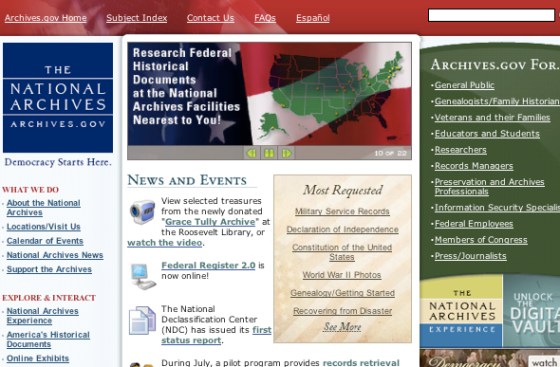
The research that preceded the redesign looked at what people do when they come to Archives.gov and what they do there.

Here are the results of the National Archives’ data analysis of Archives.gov “customers”:

How frequently do you visit this site?
69% First time
14% Every 6 months or less
9% About once a month
5% About once a week

In what role are you using the web site today?
30% Veteran or Veteran’s family
23% Genealogist or family historian
14% Educator or student
14% Researcher

What were you primarily looking for today?
28% Historical Documents
25% Veterans’ Service Records
19% Genealogy or family history information
9% Other

How would you most like to interact with this site?
41% Bookmark or tag pages
35% None
15% Receiving newsletters/email updates
8% Watching Vodcasts or video

The new Archives.gov was based in part on that feedback and user need:
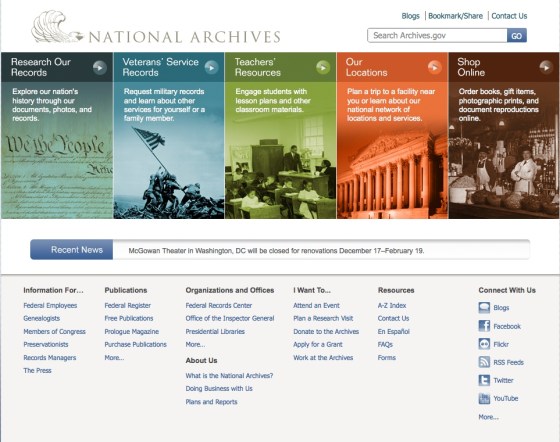
On first glance, and after some time clicking around, the answer is a qualified “yes.” This version of the Archives.gov redesign came about through a vote on the homepage design using Ideascale and in-person events, receiving in total some 3,257 votes. The redesign includes streamlined access to historical documents and military service records, an important improvement, given the eye-opening statistic that 81 percent of Archives.gov visitors are looking for this information.

The new design is cleaner, features clearer organization of content and loaded more quickly on my mobile device. The search field, one of the critical features of any modern website, is larger and raised to greater prominence in the redesign. I don’t see a mobile version of the site yet, and there is as of yet “no app for that,” unlike, say, the Library of Congress. That may change.

With respect to another stated aim of the project, the redesign does prominently display the Archives.gov social media accounts, although in muted colors that, while fitting look and feel, don’t catch the eye. No social content is featured on the homepage or the dedicated section, though it’s not hard to find those accounts on the master list of social media. There are some real gems to be fond in there, particularly in the NARA Flickr feed.

Archives Wiki: Our Archives Wiki
Blog – NARAtions, the U.S. National Archives: Blog - NARAtions, the U.S. National Archives
Facebook – US National Archives: Facebook - US National Archives
Flickr – US National Archives Photostream: Flickr - US National Archives Photostream
RSS Feed – News from the U.S. National Archives: RSS Feed - News from the U.S. National Archives
Twitter – @ArchivesNews: Twitter - @archivesnews
YouTube – US National Archives Channel: YouTube - US National Archives Channel

There are a host of other accounts in there for regional archives, presidential libraries or specific topics. For more on the back story behind the design, read over the minutes from last month’s researcher meeting:

The website was last updated several years ago. This time, we are revising it to focus on tasks that people are trying to accomplish when they come to our website.

We collected information from researchers on what you wanted in a variety of ways over several months including asking staff, researchers, veterans, patrons in line at exhibits, etc. This is part of Open Government from December 2009. The Flagship initiative is to redesign by matching the needs of all users (researchers, educators, students, and those just browsing to see the founding documents).

We have the new website categorized into sections. There are five main sections: veterans, researchers, educators and students, locations, and our online store.

Other pages will focus on genealogy, Congress, records preservation, Federal records managers, publications, offices in NARA, and information about us in general. It also includes an agency index, FAQs, and social media (e.g., blogs like NARAtions and AOTUS).

The research section has basic information on how to do research at each of the facilities and links to specific topics like the Civil War.

The new website rolls out next month in December. This is the first phase of the redesign. The focus is on the home page, researchers, veterans, education, and will then move onto other areas.

The 1940s census will be available online in 2012 spring.

“Hire a Researcher” will still be available. All content will migrate over. You do not need to resubmit information. All current information will come over. If you need to resubmit information, we will let you know. We do an annual contact check to revise the list.

This is a significant improvement and one that the Archives staff should be commended upon. If you have feedback, they’ve made it clear that they’re listening: comment on the NARAtions Blog or write to webprogram@nara.gov.