This (Social Network) We’ll Defend: US Army releases new social media handbook

File under “awesome” on a busy morning: receiving an email from the United States Army with a classification “UNCLASSIFIED” and caveats: NONE. Brittany Brown, social media manager for the U.S. Army Office of the Chief of Public Affairs, writes in to share the news that the @USArmy has released a revised social media handbook:

As a follow up to your Jan. 20 article entitled “Department of Defense: access to Internet-based capabilities is critical, despite risks,”, I am happy to announce that we just released a second edition of the U.S. Army Handbook.

The new edition of the U.S. Army Social Media Handbook includes an expanded operations security (OPSEC) section, a section about blogging and Army Strong Stories and a section discussing how to manage fake Facebook pages and social media imposters. In addition to the new sections, we’ve also included a quick reference guide for both Facebook and Twitter and a 10-page social media glossary.

Social Media Handbook 2011

View more documents from U.S. Army

The Army’s handbook has much in common with the US Navy social media handbook, although there’s no handy tagline for me to add on like “loose tweets sink fleets.” Both guides offer common sense advice that’s clearly worth repeating: don’t post geolocated updates about your unit’s movements or other information that could be of use to enemy combatants or criminals.

What Brown highlights out regarding guidance on imposter accounts, however, is significant. According to the guide, “the practice of impersonating soldiers for financial gain is significant.” The same phishing activity that targets the rest of the users on social networks is a problem for the military as well. Beyond that, there’s every reason to believe that impersonations are also a vector for gathering information that can be used to spear phish more sensitive intelligence. Caveat tweeter.

East Coast earthquake cements role of social media in government crisis communications

At approximately 1:51:04 ET today, a magnitude 5.8 earthquake 3.7 miles below Virginia rattled the east coast of the United States from South Carolina to Maine.

A 3D map of the earthquake from DC-based DevelopmentSeed, embedded below, visualizes the intensity of the tremblor.

Thankfully, today’s earthquake does not appear to have caused any deaths nor collapsed buildings or bridges, although the National Cathedral sustained what officials call “substantial earthquake damage.” Longer term earthquake damage in DC will take time to assess. Eric Wemple has a comprehensive assessment of earthquake coverage that includes links to more logistical details and assessments, if you’re interested.

A reminder to prepare

FEMA Administrator Craig Fugate talked directly to the public over the Internet, using his Twitter account, emphasizing that this quake is a reminder to get prepared.

He also highlighted a critical resource for an increasingly mobile citizenry, m.fema.gov/earthquake, and hurricanes.gov, which will be an important source of information as Hurricane Irene moves up the coast.

Additionally, Govfresh founder Luke Fretwell compiled an excellent short federal government primer to earthquake preparedness that’s full of more resources, including what to do before, during and after an earthquake

Key earthquake information can be found at Ready.gov and the FEMA, USGS and Centers for Disease Control Websites. USGS also provides a seven-step Protecting Your Family From Earthquakes safety guide (embed below).

Remember, prepare, plan and stay informed.

Social media fills a fault

seismic waves by xkcd

While both DC residents and people across the United States took the opportunity to joke about the quake using Twitter, a more sobering reality emerged as residents found themselves unable to make phone calls over overloaded cellphone networks: social networks offered an important alternate channel to connect with friends, family and coworkers. In the context of overloaded networks, the Department of Homeland Security offered earthquake advice: don’t call. In fact, DHS urged urged citizens to use social media to contact one another. The White House amplified that message:

RT @DHSJournal: Quake: Tell friends/family you are OK via text, email and social media (@twitter & facebook.com). Avoid calls.less than a minute ago via Twitter for BlackBerry® Favorite Retweet Reply


Citizens didn’t need much urging to turn to social networks after the quake. According to

Facebook hosts conversation with Red Cross on social media in emergencies

The day after the earthquake, in what turns out to be an unusually good scheduling choice, Facebook DC is hosting a conversation with the Red Cross on the use of social media in emergencies. As a new infographic from the Red Cross, embedded below, makes clear, the importance of emergency social data has grown over the past year.

Social Media in Emergencies//

According to a new national survey:

  • The Internet is now the third most popular way for people to gather emergency information, after television and local radio
  • Nearly a fourth of the online population would use social media to let family and friends know they are safe.
  • 80% of the general public surveyed believe emergency response organizations should monitor social media.
  • About one third of those polled via telephone said they would expect help to arrive within an hour.

The event will be livestreamed on Facebook DC’s page at 3 PM EDT, if you’re online and free to tune in.

Watch live streaming video from facebookdclive at livestream.com

More Americans Using Social Media and Technology in Emergencies//

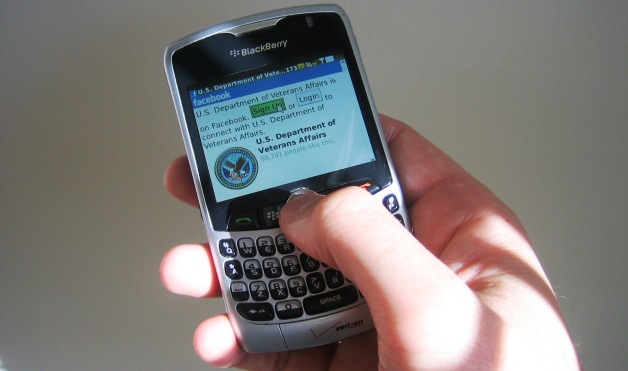
Department of Veterans Affairs releases progressive, structured social media policy

In 2011, it might feel a little late for federal agencies to be issuing social media policies. How governments use social media has shifted from a niche concern, debated by new media and policy wonks, to an issue that makes international headlines when global leaders alternately decry or celebrate the impact of connection technologies upon their countries.

Think again.

As anyone who has worked in a federal bureaucracy will tell you, squaring usage policies with rules, regulations and laws is a fundamental need if there’s going to be any progress towards 21st century governance.

“One of the biggest, long-standing complaints about VA is how it’s an opaque, monolithic bureaucracy that doesn’t respond to the needs of vets,” writes Brandon Friedman (@BrandonF), director of online communications for the U.S. Department of Veterans Affairs, in an email today. “We’re finally putting a human face on it. Everything we post on our blog or our main Facebook page or Twitter feed has a name attached to it. This shows even the largest, slow-moving federal agencies can make progress in becoming more agile and responsive.”

There’s also a matter of default for usage of these tools: open, versus closed. Consider that the emphasis below is the VA’s:

The use of Web-based collaboration tools such as social media tools is highly encouraged. Web-based collaboration is intended for information sharing within and outside of VA. To increase accountability, promote informed participation by the public, and create economic opportunity, the presumption shall be in favor of openness (to the extent permitted by law and subject to the exclusions noted in this Directive or other policy)

The entire policy, which has to be considered progressive for an organization with military DNA, is embedded below or available as a PDF. Given the stance that other federal agencies have taken recently on social media usage, this policy is not a watershed but is extremely important to over 300,000 VA employees and the millions veterans they serve. If access to Internet-based capabilities is critical at the Department of Defense, similar access for veterans is important.

Today’s announcement also serves as a reminder that the VA has come a long way in a short time, particularly in the context of an enormous government institution. “Less than two years ago, VA’s primary method of engagement with the public consisted of telephone calls and the USPS,” wrote Friedman. “Today, hundreds of thousands of veterans can get help navigating the bureaucracy via social media. We can also make a direct difference in peoples’ lives. One example I use concerns suicidal ideation on Facebook and Twitter. We’ve actually intervened in at least half a dozen instances where veterans have talked about killing themselves. We’ve been able to jump in and link them up with assistance. As we always say here, it’s about leveraging new technology to get the right information to the right veteran at the right time. For so long, many veterans have lost out on the benefits to which they’re entitled because they weren’t even aware of them—or they didn’t want to deal with a complex bureaucracy. Social media allows us to get them the information and to help ease the transition from the military into the VA system.”

It’s an important shift. Next up? Work to leverage technology better to reduce the backlog in veterans’ benefit applications and help vets who have returned from service abroad get back to work in a down economy.

Getting social with security and privacy

Embedded in this policy is are security and privacy provisions that instruct to the deputy assistant secretary for information security to issue an information protection policy, do a risk assessment, provide patching, training and a “Trusted Internet Connection” for the desktop images of VA users.

There is also instruction for the director of the VA privacy service to address policy concerns and to public affairs, granting “the authority to disapprove any outward-facing content on official VA blogs and social media sites which do not meet accepted standards of quality,” along with audits to ensure same.

For a deeper dive into what social media means to the military, read this talk on connection technologies and global organizations. It’s by U.S. Navy Chief of Naval Operations Roughead, a title which effectively makes him the “CEO” of that global enterprise. He talked about “burning the boats” as the Navy enters this operational space — an extremely powerful metaphor, given his occupation — but perhaps a fitting one, given that achieving and maintaining situational awareness in a changing information environment has become a strategic capability.

As the VA looks to support the considerable needs of the men and women who have served their country, it looks like social media will be a part of the plumbing that connects them together.

Department of Veterans Affairs Social Media Policy//

Pew: Search and email are nearly universal among adult Internet users

The results of a new survey from the Pew Internet and Life Project will come as no surprise to most: Internet users: search and email top the list of the things people do online. These two activities have been the most popular since Pew first started tracking online behavior over the last decade. The advent of broadband, mobile devices and social media has not changed that dynamic, though it’s a safe bet that adults under 30 are sending quite a lot of Facemail, IMs and tweets these days too.

That said, Pew did identify a difference. “The most significant change over that time is that both activities have become more habitual,” writes Kristen Purcell. “Today, roughly six in ten online adults engage in each of these activities on a typical day; in 2002, 49% of online adults used email each day, while just 29% used a search engine daily.”

Search and email demographics

According to Pew’s numbers, search is most popular among adult internet users aged age 18-29, 96% of whom use search engines to find information online.

There’s also some evidence of a continuing digital divide based upon education and race. According to Pew, online adults, college-educated, and those in the highest income categories are more likely than others to use email.

“These demographic differences are considerably more pronounced when one looks at email use on a typical day,” writes Purcell. “Moreover, while overall email use is comparable across white, African-American and Hispanic online adults, internet use on any given day is not. White online adults are significantly more likely than both African-American and Hispanic online adults to be email users on a typical day (63% v. 48% v. 53%, respectively).”

This new survey and its findings should be read in the context of last year’s report that citizens are turning to Internet for government data, policy and services and considering in the context of the ongoing federal .gov website review.

If open government is to be citizen-centric, it will clearly need to be search-centric. That means ensuring that government websites are available in search and evaluating how search-centric redesigns at Utah.gov perform over time.

These results also suggest that as exciting as the integration of social media into government may be, officials tasked with public engagement and consultation shouldn’t neglect using email to communicate with citizens, along with Facebook, Flickr, Twitter, YouTube and the other apps available to them. The difference in demographics usage of social media and email, however, does highlight that social media offers an important complementary channel to reach mobile citizens that access the Internet primarily through their mobile phones.

Untangling fake followers, Newt Gingrich and Twitter’s Suggested User’s List

If most of former United States Speaker of the House @NewtGingrich‘s followers on Twitter are “fake” or inactive, they’re more likely to have primarily come through a gift from Twitter in 2009 than any clandestine campaign purchases. Remember when Anil Dash wrote that “Ryan Osborn does too, (@Rozzy) over at NBC News, who reminded me of Dash’s post today.

The issue of “fake followers” arose today after an incendiary post by John Cook over at Gawker sourced the comments of an anonymous former campaign staffer alleging that Gingrich paid “follow agencies” to create some 80% of his followers. Mashable has picked up the story, asking if the former United States Speaker of the House bought most of his Twitter followers.” The allegations surfaced today a few weeks after Politico published a glowing story about “Gingrich being miles ahead in the Twitter primary,” with “an impressive 1.3 million followers.”

Unfortunately, covering this election season as a “social media horse race,” with social media followers numbers as a 21st century success metric, holds some risks. (OhMyGov, to be fair, generally takes a much nuanced approach than most mainstream outlets.)

All three writers (and their editors) have apparently forgotten that Newt Gingrich was added to Twitter’s Suggested User List back in the fall of 2009, about three weeks after an AP story reported that Government” list. He has retained over a million followers since then in the way that Politico depicted — but he didn’t get there through deepy policy wonkery and quick wit alone.

On the one hand, if it’s confirmed that the campaign has been pumping Gingrich’s follower numbers through third parties, it will be yet another case study to add to the rapidly growing pile of political social media snafus and I’ll eat some crow about the origin of those hundreds of thousands of accounts. As Vanessa Fox tweeted, “both methods likely contributed. people/orgs fall back on fakes to drum up #s way too often, but suggested list def much of it.”

On the other hand, if it turns out that media outlets simply developed amnesia about Twitter’s early history, there might be enough crow around to bake a Blackbird Pie or two.

UPDATE: An analysis by social media analytics firm PeekYou supports the anonymous staffer’s accusation of “follower fraud:”

The Consumer Ratio measures the percentage of a Twitter audience that is identified as a “consumer” or “voter” in Newt’s case, vs business, private/anonymous and spam accounts. The average range sits anywhere between 30-60% human depending on this type of account. Newt’s was 8% — the lowest the team had ever seen by 5%.

“We have seen some pretty low ‘Consumer Ratios’ in our testing, but Newt Gingrich’s was the lowest we had ever seen. At first, we actually thought it might have been a bug on our side, but a quick manual look at the data showed our analysis was true,” said Michael Hussey, CEO and founder of PeekYou.

“Once the news broke yesterday the team went back to look at the report. The data supported that out of Newt’s 1.3 million followers only 8 percent (2 percent less than claimed in recent media reports), are identified by our algorithm as humans, meaning Newt’s follower count is really closer to 106,055,” continued Hussey.

When assessing those approximately 100,000 followers via PeekAnalytics, the company established that 67% are male, 41% are over 35 years old, and 61% have less than 100 online connections. Using normalized population data, the top 5 states for legitimate followers are Georgia, North Carolina, Pennsylvania, Texas, and Wisconsin. In addition, more than the majority write a blog (typically supporting press/blogger interest) and favor Facebook as their social network of choice.

UPDATE II: Indiana University has posted an analysis of the 2012 presidential candidates’ Twitter followers that offers some more insight. In the chart below, pulled from Indiana’s post and data, the data from a random sampling of 5000 accounts following the candidates is displayed. Smaller values correspond to bluer colors, larger values corresponding to redder colors. Draw your own conclusions.


*I was added to Twitter’s “Technology” recommendations in early 2010, after the SUL was scrapped for an algorithm that I suspect is at least partially based on Lists. My Twitter account @digiphile) now has nearly 90,000 followers, up from 7,500 or so. While I think most of you are real, I suspect some of those accounts are similarly inactive or (gasp) robots. I haven’t had the time to weed through tens of thousands of notifications to groom them out. If you’ve made it to the end of this post, know that I’m much more interested (and grateful) to see how many of you reply to me, read me or share my work than my follower count. It’s ok. Nobody really has 1,000,000 followers, after all, with the obvious exception of @JustinBieber, whose intensely loyal fans have been known to put an unexpected stress test on young photosharing startups.

[Photo Credit: Gage Skidmore]

Social Media and Gov 2.0: Can Fish and Wildlife Agencies Catch Up?

As social media becomes more integrated into the world’s political, educational and economic fabric, more and more organizations have moved from asking “what it is” to “how to do we use it?”

Today in Big Sky, Montana, the Western Association of Fish and Wildlife Agencies hosted a summer meeting with a plenary session on Gov 2.0 that included:

Happy July 4th! (There’s a patriotic app for that, too.)

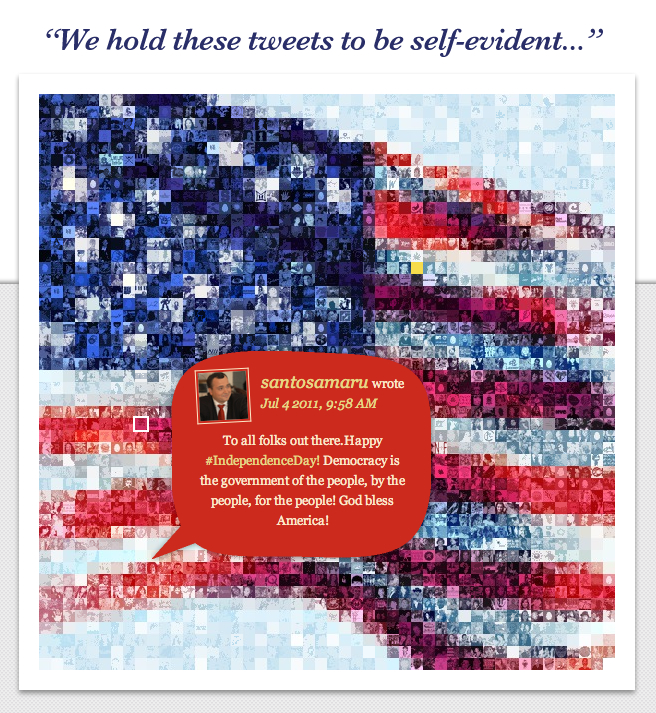
Civic developers at Code at America created a Web application in honor of this year’s Independence Day that features a number of patriotic values around: creativity, technical expertise and interest in the public discourse of their fellow citizens. Flag.CodeForAmerica.org aggregates Twitter avatars from users who tweet using the hashtag #July4th and mashes them up into a mosaic representing the Stars and Stripes. The first flag of the United States of America had a star and a stripe for each state. This flag has a tile for each human’s account.

“I have had the idea to do this for a while,” writes in Abhi Nemani, director of strategy and communication at Code for America, “soon after last year’s binary art campaign, but had to wait until we got the code infrastructure in place to be able to execute it at scale.”

Fortunately, Nemani said, the Mozilla Foundation worked with a development shop, Quodies, to create a similar mosaic when they launched Firefox 4 – check out their Firefox Tweet Machine.

“Given that it’s Mozilla, the code was open source of course,” said Nemani.”We rewired it some to get it working for us and added in some documentation so it should be easier for the next deployment,” said Nemani. Tyler Stadler was the development lead and Karla Macedo the designer.

If you want to check out the code for Twitter Collage, you can find it at Github. There’s no cap on #July4th responses, so tweet away.

The avatar mosaic is a 21st century update that captures some of the diversity and unity of that first flag by featuring some of the many voices that now can be heard on the public square of our time, the Internet. Not all of the tweets captured are positive. Some include strident political messages, divisive rhetoric or commercial promotions. It’s the public, in all of its uncensored, unvarnished, raw glory. The republic that the founding fathers fought and died for included the freedom of speech for its citizens. Over two centuries later, we’re seeing it today, coalesced around a national holiday.

“We hold these tweets to be self evident, that all humans are created equal…”

@Jack to moderate questions for President Obama in @Twitter @Townhall with @WhiteHouse [#AskObama]

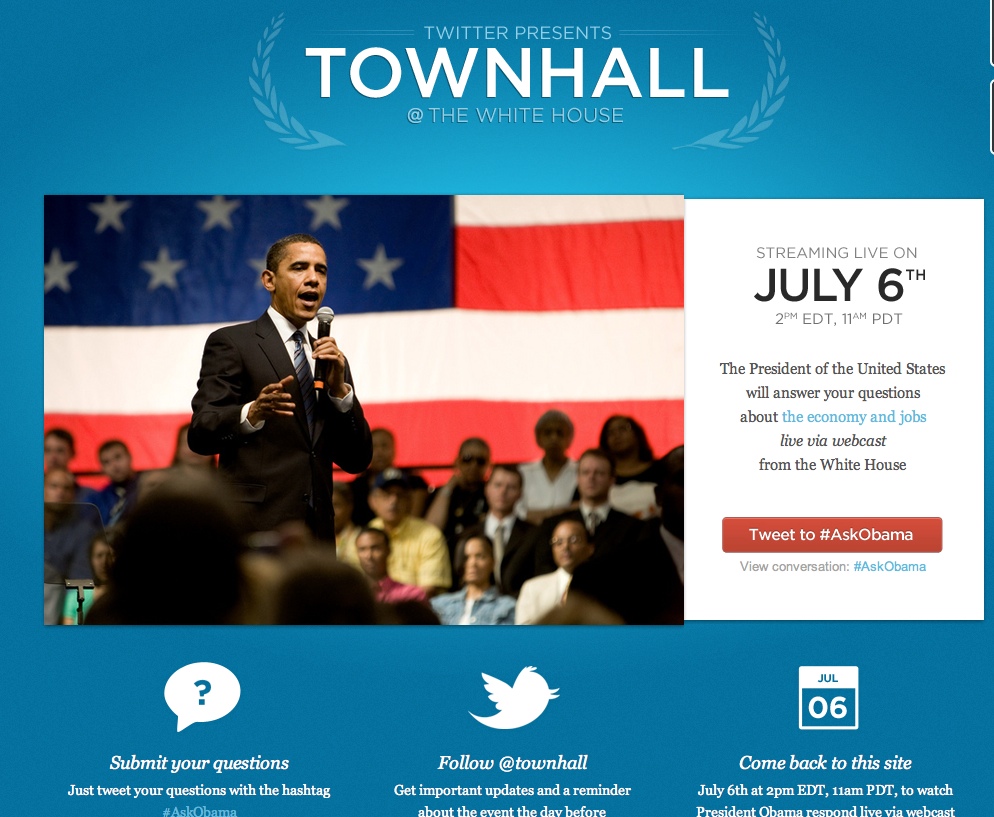
In coordinated tweets with Twitter, the White House announced that it will be holding a town hall on Twitter on July 6th, 2011 at 2 ET. Twitter launched a new @TownHall account for the event and a subdomain, AskObama.Twitter.com to host the live webcast.
According to Macon Phillips, director of digital for the White House, and Sean Garrett, Twitter’s vice president of communications, the digital town hall will be hosted by Twitter co-founder Jack Dorsey, who will provide the questions.

Phillips tweeted that “@Twitter has a cool approach to surfacing questions,” clarifying that “choosing the Q’s will be done by @twitter. Garrett tweeted that “there will be a fairly involved process by which they are selected” and more details and background on said process is on the way. UPDATE: Garrett emailed me “the basics”

“There will be multiple ways that questions will get to the President,” he wrote. “Twitter users will begin asking questions via the #AskObama hashtag today. To identify popular and relevant questions, Twitter is engaging with a third-party Twitter measurement company called Mass Relevance to provide a view on the most frequent topics and their geographical distribution. Additionally, Twitter will invite a group of highly active and engaged Twitter users (called “curators”) to help choose questions and comments both prior to and during the event. Twitter will collect questions in the days leading up to the Town Hall and in real-time during the event.”

Garrett also added some information regarding how Twitter will select this team of “question curators”:

“These curators will be a diverse group from around the country that are also active and engaged on Twitter,” he wrote. “These curators will ask those in their particular communities to also highlight what they think are the most important questions for the President. Curators will retweet questions and pose their own.”

The Twitter TownHall follows a Facebook TownHall earlier this year, in which Facebook founder Mark Zuckerberg posed live questions to President Obama. Nancy Scola wondered how much of a “TownHall” the event actually offered. With this Twitter version, the interesting detail will be in how much transparency goes into question selection, particularly with respect to how exact or tough they are. When the White House turned to Twitter to discuss President Obama’s Middle East speech, they included NPR’s Andy Carvin and Foreign Policy’s Mark Lynch as trusted interlocutors. It’s less clear how Dorsey will moderate, given his considerable different style of tweeting, but on one count there is no doubt: this will be interesting.

UPDATE: In his post on President Obama taking questions on Twitter, Nick Clark Judd raises similar questions over at techPresident on moderation. (And no, he didn’t call the event a “TownHall.”)

UPDATE II: The New York Times published more details on the “Twitter Town Hall,” including the news that there will be a “White House Tweetup,” the first of its kind. In terms of process, here’s what Twitter told the Times. (Spoiler: it’s quite similar to what Garrett told me, above).

Twitter will select the questions, using curation tools and a group of Twitter users to help identify the most popular questions raised both before and during the event. Twitter will be relying on its own search and curation features as well as a company called Mass Relevance to help find questions and topics that are most frequently mentioned.

… Adam Sharp, Twitter’s manager of government and political partnerships, said that the curators chosen by Twitter to help select the questions would be a politically and geographically diverse group. He said the curators would ask the people in their communities to highlight what they think are the most important questions for the president to address.

Curators will also be retweeting questions and posting their own.

“We will have highly-engaged Twitter users from around the country to provide that geographic diversity to help identify good questions, “ he said. “This helps us make sure that we are addressing the concerns that the Twitter universe cares about. “

Less clear whether the President of the United States will actually be doing any of the tweeting himself, as opposed to dictating a reply, which means we may not get to see any real-time presidential typos. According to reports by Paul Boutin, President Obama started tweeting for himself at @BarackObama over the Father’s Day Weekend, signing the tweet “-BO.”

CBS News White House correspondent and keeper of presidential lore Mark Knoller cautioned, however, that “Obama won’t be typing his responses.” Looking back at that Father’s Day tweet, Knoller tweeted that “a tweet was sent in his name by his campaign. He was not at a computer typing a tweet.”

We’ll see if the President decides to get more personally involved or not in the technology. Given that the presidential iPad appears to travel with him these days, it could happen.

[Photo Credit: President Barack Obama sits alone on the patio outside the Oval Office, following a meeting with his senior advisors, April 4, 2011. (Official White House Photo by Pete Souza)]

UPDATE III: Politico White House correspondent Mike Allen led his Tuesday’s Playbook with more details about Wednesday’s Twitter event:

The audience for tomorrow’s hour-long TWITTER TOWN HALL in the East Room (2 p.m. ET) will consist of 140 characters — er, people – in a nod to the maximum length of a tweet. President Obama, however, will face no such limit: He’ll answer questions for the audience, and @TownHall will carry summaries of what he says. Twitter co-founder and Executive Chairman Jack Dorsey will ask the questions. Three screens will be behind Obama and Dorsey: one with the current question; another will have a heat map of the U.S., showing where the town-hall tweets are concentrated; and the third will show the volume of tweets, by topic (jobs, taxes, spending, health care, etc.) Mass Relevance, a company that has worked with the broadcast networks on real-time Twitter data, will supply the analytics. Later, Radian6 will study the demographics of participants.

Representative questions will be chosen partly on how often they’re retweeted. The White House has also reached out to about 10 Twitter leaders in different parts of the country to help surface questions by curating themes and topics that are big among their followers and in their communities. So Dorsey may say: “We’re hearing a lot about the extension of unemployment benefits, especially from the upper Midwest, and here’s a question from Bob in Chicago.” The audience will include 20 people from around the country chosen through the White House Tweetups page, and they’ll also get to meet with Dorsey and with U.S. Chief Technology Officer Aneesh Chopra and perhaps other policy officials.

UPDATE IV: Twitter has blogged about the “Twitter Town Hall,” including a link to the 7 “curators” on Twitter who are selecting questions and a new study from Radian6 that found that “financial security is one of the most frequent topics of political conversation on Twitter.”

Tomorrow’s Town Hall is an invitation from the White House for anyone on Twitter to participate in an open exchange about the national and global economic issues facing the United States.

Questions addressed during the Town Hall will be selected both in advance and in real-time during the event. To narrow down the list of popular, relevant questions to ask on behalf of Twitter users, we’re doing the following:

• We’ve partnered with the visualization experts at Mass Relevance to identify the themes and regions driving the conversation.
• Algorithms behind Twitter search will identify the Tweets that are most engaged with via Retweets, Favorites and Replies.
• A team of seasoned Twitter users with experience discussing the economy will help flag questions from their communities through retweets.
Dyson at the eG8: You don’t need to be from the Internet to believe in liberty or free speech

At the eG8, 20th century ideas clashed with the 21st century economy. The inaugural eG8 forum, held in Paris before the G-8 summit of global leaders, showed that online innovation and freedom of expression still need strong defenders. As Nancy Scola reported at techPresident, at the at the eG8, civil society groups restaked their claim to the ‘Net.

Several attendees, many who had traveled from the United States, strongly questioned whether the Internet should be regulated in the ways that Sarkozy implied. The “value of internet is not just efficiency but also transparency,” tweeted Esther Dyson, “a much better regulator than government could ever be.”

I spoke further in with Dyson in an interview embedded below. What matters about the eG “is that you have a lot of people being exposed to one another and you have a lot of government people being exposed to people they don’t normally listen to,” said Dyson. “As usual, it’s not what happens up on stage, or what happens on the video: it’s what happens on the tweets, in the personal interactions, in the dinner afterwards, and in the back hall of the meeting. And that – that was positive. The world doesn’t change overnight, mostly. ”

She spoke to the concerns of civil society about eG8 recommendations: “It is sort of justified. Some of them were precanned. I actually sat down with my guy after doing my panel and changed them. I don’t think that happened with all of them. But again, the community is aroused: it’s going to make its points around this.”

Dyson also emphasized the universality of some of these concerns and what’s at stake. “You don’t need to be ‘from the Internet’ to believe in liberty or free speech.”

How are startups helping the global transparency movement? “They’re providing tools to make the data meaningful,” said Dyson. “They’re providing tools for people to share the information. They’re providing the communication tools, again, that allow from everything from Wikileaks to people communicating with reporters. Tools like your phone, connected to the Internet, so that you can record interviews not just with me but with all of the other people you talk to, upload them, people can share them, people can comment on them. That’s all technology.”

Dyson shared other thoughts on the eG8 and Internet freedom, including how entrepreneurs are changing the world through their work. Dyson also shared an insight that transcends technology:

“Even when you have a revolution, what makes the revolution works is what changes in people’s minds, and that’s what’s going on here,” said Dyson.

“The world is changing. People in government are not special. They should be as transparent as everybody else. People deserve privacy. Officials, governments, institutions, they all should be transparent. That’s new thinking, and it was being heard.”

Live from DC/Boston/Canada, it’s Episode 3 of Gov 2.0 TV

Two weeks ago, Gov 2.0 TV launched to cover what’s happening in open government. Today, we’ll be talking about some of the biggest stories of the past week. Tune in to FusedLogic.tv/live to catch today’s show.

http://bitcast-b.bitgravity.com/player/6/functions.js //

Here’s a quick rundown of a few stories we’ll be talking about: