White House issues guidance on “technology neutral” IT acquisition

Victoria Espinel, the White House intellectual property enforcement coordinator, wrote a blog post providing guidance to federal agencies on making technology neutral IT procurement decisions.

Each year, the U.S. Government spends almost $80 billion dollars buying information technology (IT); the software, computer equipment and network devices that help the Government run efficiently. It is important that those purchases be fair, neutral and based on an objective assessment of relevant criteria. To ensure that the agencies and the public are aware of our policy, today U.S. Chief Information Officer Vivek Kundra, Administrator for Federal Procurement Policy Dan Gordon and I issued a statement to Senior Procurement Executives and Chief Information Officers reminding them to select IT based on appropriate criteria while analyzing available alternatives including proprietary, open source and mixed source technologies.

Aliya Sernstein, over at NextGov, extracted an interested headline from the guidance: “Kundra encourages open source.” Getting to that conclusion from the memo in question, embedded below, might be a stretch, though it is notable that a document signed by the United States chief information officer specifically said that agencies should “analyze alternatives” that include open source.

One key phrase in the memo gives a bit more insight here, in terms of the acquisition process: should “selecting suitable IT on a case-by-case basis to meet the particular operational needs of the agency by considering factors such as performance, cost, security, interoperability, ability to share or re-use, and availability of quality support.”

Open source software has both competitive advantages and disadvantages in those areas.

Here’s the memo from CIO.gov:

Technology Neutrality http://d1.scribdassets.com/ScribdViewer.swf

Possibly related: “Google wins: Interior forbidden to award noncompetitive contract to Microsoft” [Federal Computer Week]

And no, this isn’t the only outlet to wonder about that link: read Nancy Scola over at techPresident on the White House reminder to be technology neutral:

(So why the memo, and why today? It’s not entirely clear yet, but a smart source points out a related news item in the space: yesterday Google won a preliminary injunction in a case where it had argued that the U.S. Department of the Interior had inappropriately geared a nearly $60 million contract for cloud-based email and collaboration software tools to fit only Microsoft’s proprietary products. Again, though, we’re indulging in a bit of speculation here, and it’s worth pointing out that Google’s revelant products aren’t themselves open-source.)

By the way, if you’d like to stay instantly up on such developments, you might try following Kundra’s new Twitter feed. He’s only tweeted three times thus far, but once was an indeed a pointer to this memo. “Open source vs proprietary?,” he posted. Follow @VivekKundra here.

Defining Gov 2.0 and Open Government

Fireworks begin as the Killers perform on the South Lawn of the White House, July 4, 2010, during the Fourth of July celebration. (Official White House Photo by Pete Souza)

Fireworks begin as the Killers perform on the South Lawn of the White House, July 4, 2010, during the Fourth of July celebration. (Official White House Photo by Pete Souza)

Exploring what this year will hold for the intersection of government, technology, citizens and business is a fascinating – and immense – challenge.

That is, however, precisely what I plan on doing,  here, at the Gov 2.0 section of O’Reilly RadarThe Huffington PostReadWriteWeb, National Journal, Mashable, Forbes and other outlets.

Yesterday, I participated in a discussion on Twitter that touched upon “Gov 2.0,” open government and social media. I include explanations for those terms below. Dozens of people participatedusing the #SMfastfwd hashtag on Twitter or at the #SMFastFWD room at TweetChat.com.

Be forewarned: there’s some jargon below, but then the organizer of the chat specifically asked for explanations. My answers and key considerations raised by several participants for the year ahead follow.

How do you define Gov 2.0? What about open government? What’s the difference? How do these relate to transparency?

What is government 2.0? Government social software expert Maxine Teller described the concept succinctly: Gov 2.0 equals “leveraging emerging tools, techs & collaboration PRINCIPLES to improve efficiency & effectiveness,” she tweeted. “Today’s tools & tech enable us to return to founding principles: government for, by & of the people.”

That’s useful, since many days it can seem like there are as many definitions for Gov 2.0 as there are people. That’s what happens when a term edges towards becoming a buzzword, particularly anything with a “2.0” added on.

Tim O’Reilly, my publisher, has explained how Gov 2.0 is all about the platform. In many ways, Gov 2.0 could be simply described as putting government in your hands.

As I’ve previously observed in writing about language, government 2.0, jargon and technology, I believe the term should be defined primarily by its utility to helping citizens or agencies solve problems, either for individuals or the commons. Defining it in gauzy paeans evangelizing world-shaking paradigm shifts from the embrace of social media by politicians isn’t helpful on that level.

That’s particularly true when politicians are using platforms to broadcast, in the model of 20th Century, not having iterative conversations that result in more agile government or participatory democracy.

Craigslist founder Craig Newmark put it another way yesterday: “Open government includes much greater gov’t transparency, that is, tell citizens what’s going on,” he tweeted. “Gov 2.0 includes gov’t and citizens working together for better customer service, more accountability.”

That melds well with O’Reilly’s perspective, where government 2.0 is the “idea of the government as platform: how can government design programs to be generative, […] building frameworks that enable people to build new services of their own.”

In a Forbes column in 2009, he’d framed this as “the opportunities inherent in harnessing a highly motivated and diverse population not just to help [politicians] get elected, but to help them do a better job.”

“Citizens are connected like never before and have the skill sets and passion to solve problems affecting them locally as well as nationally. Government information and services can be provided to citizens where and when they need it. Citizens are empowered to spark the innovation that will result in an improved approach to governance.

In this model, government is a convener and an enabler–ultimately, it is a vehicle for coordinating the collective action of citizens.

This is the right way to frame the question of “Government 2.0.” How does government itself become an open platform that allows people inside and outside government to innovate? How do you design a system in which all of the outcomes aren’t specified beforehand, but instead evolve through interactions between the technology provider and its user community?

Open government relates to that but isn’t necessarily grounded in technology, although certain aspects of it under the Obama administration absolutely have been.

As Chris Kemp, NASA’s chief technology officer for IT, put it last year, “The future of open government is allowing seamless conversations to occur between thousands of employees and people … You can’t divorce open government from technology. Technology enables the conversation and supports the conversation. We’re finding that if we don’t stand in the way of that conversation, incredible things can happen.”

If you’ve been tracking the progress of the Open Government Directive since 2009, you know that it required federal agencies to take steps to achieve key milestones in transparency, participation, and collaboration. As 2011 begins, more of those plans are still, for the most part, evolving towards implementation.

The progress of open government in the United States has beeen slowed by bureaucracy, culture, and the context of a White House balancing wars abroad and immense macroeconomic pressures, a populace deeply distrustful of many institutions,  and, at the end of 2010, the emergence and disruption presented by the more “radical openness” of Wikileaks.

It was clear back in September that in the United States, open government is still very much in its beta period. It was in that context, that, in December, the White House made a new, ambitious request of the American people: help them to design digital democracy by creating a platform for expert consultation on policy.

In doing so, the architects of initiative embraced the notion government acting as a convener or collaborator, trying to co-create better policy or outcomes. By its nature, such open government platforms are expressed as top down, where officials work to create more participatory, collaborative model of governance.

Gov 2.0, by contrast, is more often conceived as expressly technology driven, founded in the platform principles of Web 2.0, and buoyed by the efforts of citizens and civic entrepreneurs to build “do-it-ourselves” government. Both Gov 2.0 and open government can and do increase transparency.

Consider this detail from a webcast, “What is Gov 2.0?,” which combines open government and Gov 2.0 in action:

“The first person who really put Gov 2.0 on my radar was Carl Malamud. Carl is really the father of this movement in so many ways. Back in 1993, that’s pretty darn early in the history of the World Wide Web, he put the SEC online.He got a small planning grant from the  National Science Foundation, which he used to actually license the data, which at that point the SEC was licensing to big companies.

He got some servers from Eric Schmidt, who was the chief technology at Sun. And he basically put all this data he’d gotten from the SEC online, and he operated that for something like two years, and then he donated it to the federal government. Carl’s idea was that it really mattered for the public to have access to SEC data.”

In that moment, citizens in the private sector helped government do something it had trouble accomplishing. That’s still happening today, as evidenced by Malamud’s work on Law.gov and House.Resources.org.

What is the relationship between Gov 2.0, open government, and social media? How do tools go beyond Twitter, Facebook, etc.?

Ben Berkowitz, the founder of SeeClickFix, put it this way yesterday in a tweet: “Don’t just use social web platforms to communicate, restructure government to operate like a social platform.”

To extend that, and reiterate elements of the earlier answer, Gov 2.0 is a frame to rethink how citizens to participate in government using technology. Open government has been around for decades as both a philosophy and a practice.

Awareness of the concept was rebooted under the White House Open Government Initiative and new Gov 2.0 technologies and events, including numerous camps and the O’Reilly conferences in Washington.

Open government also relates to Federal Register 2.0, rules, passage of new legislation, and culture, a key aspect that requires change management that extends far beyond technology:

Social media is a key element of many emerging citizen engagement platforms. These platforms give citizens new voices and provides new channels for government workers and elected officials to to talk with them. Aides for the new Speaker of the House, John Boehner, say that he reads Facebook and constituents, as do many of his colleagues in Congress. While Facebook is an imperfect platform for government engagement, with respect to privacy or identity issues, given the hundreds of millions of users and global reach, elected officials have effectively been forced to at least pay attention to what is being said about them there. Some politicians, like former Alaska governor Sarah Palin, are shaping the national media conversation through Facebook and other media channels.

Social media, however, goes far beyond giving politicians or workers new platforms to broadcast, though that has been the approach for many first use cases. In 2011, for instance, Twitter is now home to emergency social data, including earthquake warning systems, crowdsourced weather alerts and other disaster-related information.

That’s why social media and FEMA now mix, among other reasons. Deciding to use these platforms creates complex decisions around terms of service and commercial speech, however, since civic discourse is being hosted by a third party. Those issues won’t go away in 2011.

Enterprise versions of these tools also provide the means for government to government communications, just as they do in businesses. That includes blogs, wikis, social networks, video or new forms of social media. For instance, ediplomacy at the State Department is doing behind firewall is in many ways at least as interesting as external social media use.

What should the goals of Gov 2.0 and open government be? How are you working toward those ends?

Smarter, leaner, more transparent, accountable, efficient and agile government, with data-driven policy. I’m sharing the stories of innovators.

What changes will 2011 bring in the Gov 2.0 or open government arena?

Open government will move more from theory to practice in 2011.

Certain policies, like net neutrality, will test open government goals in 2011.

In 2011, the growth of edemocracy platforms *abroad* will be fascinating.

The themes that made 2010 a huge year for Gov 2.0 will continue to matter:

Wikileaks will impact open government in the United States in 2011, as t affects “need to know” vs. “need to share.”

There will be both positive and negative outcomes from that emergence.

What are the obstacles and challenges to success with Gov 2.0 and open government?

Gov 2.0 advocate and San Francisco public servant Adriel Hampton identified a key issue here: “Education. Negative perception of gov still huge, citizens unaware of gov 2. efforts, excited when informed,” he tweeted.

Privacy and identity will be a huge issue for Gov 2.0 and open government in 2011. Follow the FTC Do No Track debate for more there.

There will be significant challenges around open government data, given the role controlling costs will play in 2011.

Another point made about accepting failures came from Newmark: “lots of Gov 2.0 open gov challenges, including normal big organizational inertia. Also, failure is stigmatized.” A more agile government would require tolerating mistakes and iterating faster based upon the lessons learned.

Government social media consultant Maxine Teller raised another angle: “Challenge is: what incentive do existing gov leaders have to embrace collaborative principles. Current system=self-perpetuating,” she tweeted. “Too much focus has been on citizen engagement. Need more on enterprise 2.0 — INSIDE government.” That goes back to the work at the State Department referenced earlier.For context on that challenge, read MIT professor Andrew Mcafee‘s piece on Gov 2.0 vs the beast of bureaucracy.

A final consideration is an open question: will open government be able to tap into the “civic surplus” to solve big problems. That’s Clay Shirky‘s “cognitive surplus,” applied to citizens and government. For open government to succeed, conveners need to get citizens to participate.  That won’t be easy, with historic frustration and lack of trust in institutions in many parts of the country.

What seem to be the biggest misperceptions in the public re: Gov 2.0 or open government? What should the public know?

For me, that’s easy: That Gov2.0 equals = social media. Many members of the media, marketers or consultants have further entrenched that perception, which is not true for Web 2.0 either.

There’s also a misperception that Gov 2.0 is all about D.C., or the White House. The state and local stories of Gov 2.0 are absolutely fascinating, as are international stories.

The public should know about Challenge.gov and the potential for everyone to work on huge issues using crowdsourcing and open government.

What takeaways do you have from the 01.05 edition of #SMfastfwd on Gov 2.0, open government and social media?

The conversation pulled in many informed voices but clearly showed the need to extend much further to resonate with the public. We “need to mainstream the discussion by focusing on impact of Gov 2.0 concepts on agency, community missions,” tweeted Teller.

Covering Open Government in 2011

The “sweeping Gov 2.0 concept isn’t newsworthy,” tweeted Teller. We “need to show RESULTS and impact of Gov 2.0 principles on gov MISSIONS.”

It’s substantially hard to argue with that assessment, although some tech news outlets have covered it. That’s why the Veterans Administration’s Blue Button is a genuinely big deal. Newsworthy, real impact.

So here’s my goal for 2011: explain what Gov 2.0 means for citizens, how it’s impacting agencies, communities, relates to mission and outcomes, and do so in outlets that extend awareness beyond Twitter or blogs. The good news is that other outlets are waking up, as legislation and initiatives move through Congress and pilots: the Washington Post covered the COMPETES Act and Challenge.gov recently.

Code for America: Inspiring a new generation of civic coders

What will the new Code for America Fellows be doing, now that the inaugural class has been chosen? Code for America’s CTO, Dan Melton, offered more insight into the forthcoming projects at the International Open Government Data Conference (IOGDC) today in Washington, D.C., where he talked about school ID cards in Boston, civic leader networks in Philadelphia and Seattle, and CivicCommons in the District of Columbia.

Audio of Melton’s talk is available on uStream. Melton and hundreds of attendees will be on the Code for America webinar today at 4 PM EST.

His presentation from IOGDC on “CRUD-ing the government,” which I was unable to record or attend due to my involvement in a parallel panel, is embedded below:

What’s the value proposition for open government data?

This weekend, I asked the Govloop community to tell me about the value proposition of open government data. Today at the International Open Government Data Conference in Washington, I’ll deliver a presentation that incorporates much of that feedback. I’ve embedded it below:

The audio livestream for my presentation and those of my fellow panelists will be available below:

http://www.ustream.tv/flash/live/1/18959?v3=1

The active backchannel on Twitter is embeddded below:

http://widgets.twimg.com/j/2/widget.js

new TWTR.Widget({
version: 2,
type: ‘search’,
search: ‘#IOGDC’,
interval: 6000,
title: ‘#IOGDC in Twitter’,
subject: ‘International Open Government Data Conference’,
width: ‘auto’,
height: 300,
theme: {
shell: {
background: ‘#004d70’,
color: ‘#ffffff’
},
tweets: {
background: ‘#ffffff’,
color: ‘#444444’,
links: ‘#1985b5’
}
},
features: {
scrollbar: false,
loop: true,
live: true,
hashtags: true,
timestamp: true,
avatars: true,
toptweets: true,
behavior: ‘default’
}
}).render().start();

Geeks hacking smarter government: Kickstarter’s Andy Baio joins Expert Labs

As Anil Dash blogged earlier today, Andy Baio has joined Expert Labs as a project director for ThinkUp App. According to Dash, Baio will be working as a “Director of Hacks,” focusing on making better use of the data collected by apps like ThinkUp.

Andy’s new role marks the beginning of a whole new phase for Expert Labs; We’re now very tightly focused on working with agencies that want to get crowdsourced feedback, and the biggest request those agencies make is to better understand the ideas that people submit. We’re answering those requests with smart tools for presenting, visualizing, sorting and filtering ideas and suggestions that come in through Facebook and Twitter.

In short, we’ve already got the ability to collect responses to policy questions through a social network, and now we’ll be able to turn those responses into real insights.

In his own blog post about on joining Expert Labs, Baio elaborated further on the mission he’s taking on:

Our goal’s to help government make better decisions about policy by listening to citizens in the places they already are: social networks like Twitter and Facebook.

Our first project is ThinkUp, an open-source tool for archiving and visualizing conversations on social networks. It started with Gina scratching a personal itch, a way to parse and filter @replies. But it’s grown to be something more: a tool for policy makers to harness the collective intelligence of experts.

There’s tons to do, but I’m particularly excited to tackle ThinkUp’s ability to separate signal from noise, making it easier to derive meaning from hundreds or thousands of responses, using visualization, clustering, sentiment analysis, and robotic hamsters. I’m planning on building some fun hacks on top of ThinkUp, as well as keeping an eye open for other vectors to tackle our core mission.

And his motivations for going to work in open government:

So, why would I go to a Gov 2.0 non-profit? For three main reasons:

It’s important. To tackle our most serious national issues, we need better communication between government and citizens. I want my son to grow up in a world where he doesn’t feel disconnected and disillusioned by government, and I want government to meet the needs of the people, rather than favoring those with the most money or the loudest voices.

It’s exciting. Technology is quite possibly our best hope of breaking down that divide, using social tools to disrupt the way that governments are run and policy is made. I love designing and building tools that use social connections to tackle difficult problems, and it feels like government is an area ripe for disruption.

I love the team. I’ve known Anil and Gina for years and have long admired their work. They’re both extraordinarily talented and creative people, and I feel lucky to call them both friends. The opportunity to work with them was too hard to pass up.

Welcome to the Gov 2.0 community, Andy. I saw him hard at work at the first FCC Open Developer Day in Washington this week, where we talked more about what it means to have members of the technology community work on technology to make government function more effectively.

When high profile members of the Web 2.0 community pitch in, their networks will learn more about what’s going on. Call it “digital diffusion.” That attention, scrutiny and tinkering is likely to be a good outcome for everyone.

For more on that count, I interviewed Expert Labs’ Gina Trapani at the FCC about ThinkUp app, the apps that came out of the developer day and this issue: what does it mean when geeks try to help government work better. It was a great conversation and I encourage readers of this blog to embed it elsewhere.

Data BBQ features District tech entrepreneurs, passion and tasty open data.

Get off your index and build your Rolodex,” read the invite to last night’s Data BBQ in Washington, D.C.

And last night, that’s exactly what over a hundred people from around D.C.’s growing tech scene did, spilling out of the revamped officers of Insomniac Design in Bladgen Alley, near Mount Vernon Square.

The crowd was leavened with many attendees from the ongoing mHealth Summit 2010, manyof DC’s open data geeks and supporters and. Expert Labs’ Gina Trapani and Waxy.org’s Andy Baio came by from the FCC’s Open Developer Day to mix and mingle too. The highlight of the Data BBQ was the lightning talks, where attendees pitched projects, ideas, jobs or even spare rooms to the crowd. The talks are embedded below:

Many of the mHealth conferees no doubt know about the Health 2.0 Developer Challenge from the Department of Health and Human Services, where health data is being mashed up into new applications.

And, judging by the show of hands, many of the Data BBQ’ers had also heard about the World Bank’s Global Apps for Development Competition, which is looking to the development and practitioner communities to create innovative apps using World Bank data.

What might have been new to a few, at least, was the upcoming Apps for Army competition for the public, where the successful apps competition that Peter Corbett and iStrategy Labs helped the Army run will be rebooted for wider participation.

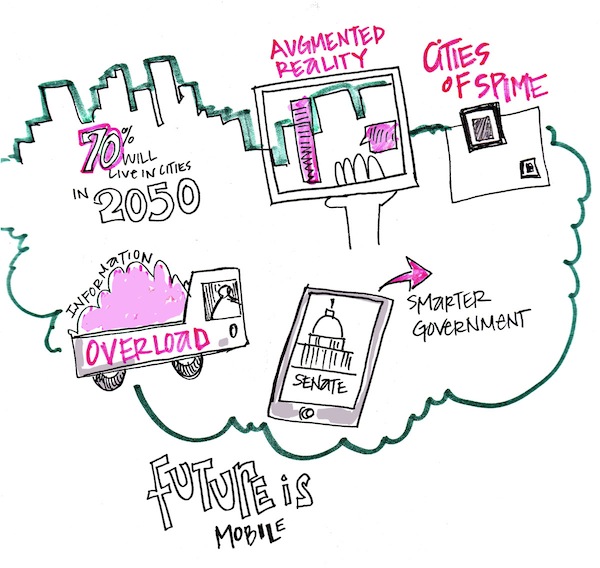
The Future is Mobile at Ignite NYC: Open Data, Open Government and Augmented Reality

“The future is already here – it’s just not evenly distributed.” —William Gibson.

http://blip.tv/play/AYKJtSgC

“An exploration of cyberpunk fiction, technology, where we’re headed, the challenges we face, and the solutions we need”-Ignite NYC. I gave a (very) similar talk called Pattern Recognition and Spimewatch at Ignite D.C. later that week. For whatever reason, this version seems to have come off much better. Rack it up to the first time on a big stage; there were close to a thousand people present in NYC.

The creative graphic recording at Ignite NYC at Web 2.0 Expo was created during the talk by Nora Herting of ImageThink.

For a great Ignite talk with a related theme, check out In Coders We Trust, by Laurel Ruma.

Open Government and Civic Innovation on Display at Portland’s CivicApps Awards

What does the innovation on display at the Civic Apps contest by developers in Portland, Oregon mean to the city’s mayor?

“It’s bringing to the world knowledge of what exists in the real world but is so often unknown,” said Mayor Sam Adams in an interview at the awards ceremony for the winners of the contest.

“In Portland, like I think most cities, when people are armed with knowledge, they make wiser choices,” he said, pointing to applications like PDX Bus as examples of innovation that actually help citizens to navigate the city better.

Does open data lead to more economic value creation in the private sector and metropolitan areas alike?

“We are seeing folks that are sole proprietorships hire folks to help them build their business, their app business, their online business with our data sets.” he said. “For us, data has always been there, in some cases for decades. Putting it to use for the public and help people make money while they do it – we intend to be the open source capitol of the nation – and this is one contribution we can make, with our data sets.”

What’s next? “What CivicApps is about in part, providing the data, is sparking relationships, relationships which lead to economic opportunities,” he said. “Webtrends, Microsoft meets the local hacker or coder tonight at this event, who knows what will happen. Our job is to provide the data, provide the opportunity for relationships to occur, provide what in comparison is a tiny litte bit of money, a little incentive for people to keep going. And it’s also fun. It make the city more fun to live in, because you know what’s there.”

That incentive, incidentally, amounted to $1000 for each of the winners of the second round of Civic Apps awards, with another $3000 going to the Best of Show winner, Loqi.me. This afternoon, Skip Newberry, economic development policy advisor to Mayor Adams, congratulated the winners of CivicApps on Twitter.

.bbpBox29117818058 {background:url(http://a3.twimg.com/profile_background_images/26879991/Downtown_Portland_-_Twitter_image.png) #9AE4E8;padding:20px;} p.bbpTweet{background:#fff;padding:10px 12px 10px 12px;margin:0;min-height:48px;color:#000;font-size:18px !important;line-height:22px;-moz-border-radius:5px;-webkit-border-radius:5px} p.bbpTweet span.metadata{display:block;width:100%;clear:both;margin-top:8px;padding-top:12px;height:40px;border-top:1px solid #fff;border-top:1px solid #e6e6e6} p.bbpTweet span.metadata span.author{line-height:19px} p.bbpTweet span.metadata span.author img{float:left;margin:0 7px 0 0px;width:38px;height:38px} p.bbpTweet a:hover{text-decoration:underline}p.bbpTweet span.timestamp{font-size:12px;display:block}

Congrats to @caseorganic @elsewisemedia @pdxmele @maxogden & John Mosser for their award-winning @civicapps! #opensource #gov20 #teamadamsless than a minute ago via TweetDeck

Most Useful App and Best of Show

Amber Case for Loqi.me

As Mayor Adams mentioned later in the program, this Web app could be useful in a snowstorm in Oregon or, if adapted more broadly, for crisis response around the country or world.

App description: “This application is a resource for citizens, medical teams and governments before, during and after disasters. Loqi.me allows mobile users to send an emergency GPS beacon to a real-time map. Crises responders can view all of the help requests on the webpage, along with hospitals and fire stations, real-time 911 calls related to natural disasters. Ground teams can easily use Loqi.me on their mobile phones to send notices of supplies and terrain reports in real time. Remote helpers can easily see the whole picture on the website’s real-time map, handle help and information requests, and send messages to the network. Loqi.me supports subscription to group messages via SMS, AIM, Jabber and Twitter. No application installation is required. Location beacons can be sent simply by going to http://loqi.me on a mobile phone.”

Most Appealing

Matt Blair for PDX Trees.

App description: “PDX Trees is an app for iPhone and iPod Touch devices that makes it easy to find and and enjoy them. With this app, you can:

  • Search for nearby trees and see them on a map.
  • Tap a pin to see the name and view details for that particular tree.
  • Take and upload a photo of a Heritage Tree you’re visiting.
  • View photos of the tree taken by other tree enthusiasts.
  • Email a friend about the tree (includes tree name and location where available)
  • Read more about a type of tree from Wikipedia, without leaving the app.”

Most Original

Melelani Sax-Barnett for Portland Bike to Transit.

App Description: “This is a simple, handy web map that helps you figure out how to ride your bike to transit. It lets you choose from a variety of base layers, and toggle transit stops, routes, and current bike routes. You can also query transit stops and routes for basic information. I made this for a Web GIS class at PSU and I’m a total beginner (with some code thanks to Professor Percy and OpenLayers).”

Best Use of Data

Max Ogden for Civic Apps Data Previewer

“This helped make our data useful to a lot of other developers and the general public,” said Mayor Adams. “Why take it on?”

“I saw all of this great data at the core when civic apps launched,” said Ogden. “When you get data into the Web format, you get Web developers who are really used to making human interfaces for things make them.”

App Description: “A web application to preview any of the public geo data on CivicApps from your web browser. You can choose a dataset and view that data on a map. Individual objects are clickable and can provide details (metadata).”

Civic Choice

Joseph Mosser for PDXTrian

App Description: “Pdxtrian is a simple utility for riders of Portland’s excellent mass transit system, TriMet.

  • Uses GPS to find nearby transit stops
  • Displays a map of the stop location
  • Displays a list upcoming arrivals
  • Allows you to save stops and look them up anytime”

The livestream of the awards ceremony is embedded below:

http://www.ustream.tv/flash/video/10487185?v3=1

Open source and open government community talks innovation at first IgniteGov

http://storify.com/digiphile/tracking-the-tweets-about-the-first-ignitegov-at-g.js

In Coders We Trust: Laurel Ruma breaks down Gov 2.0 at Ignite NYC

We’re moving from the Social Web to the Civic Web. IT and geeks matter. What we can do with open data and the internet is very important. If government is a platform, we need people to create apps and others to open up data sets.”-Laurel Ruma, Gov 2.0 Evangelist, O’Reilly Media

If you want a great introduction to what Gov 2.0 is and why it matters, look no further than her 5 minute talk from Ignite NYC is embedded below.