Pew: Disability or illness hinders many Americans from using the Internet

President Barack Obama talks with, from left, Rep. Steny Hoyer, D-Md., James Sensenbrenner, R-Wisc., Cheryl Sensenbrenner, James Langevin, D-R.I., and Sen. Tom Harkin, D-Iowa, in the Oval Office, July 26, 2010, prior to an event on the South Lawn commemorating the 20th anniversary of the Americans with Disabilities Act. (Official White House Photo by Pete Souza)

President Barack Obama talks with, from left, Rep. Steny Hoyer, D-Md., James Sensenbrenner, R-Wisc., Cheryl Sensenbrenner, James Langevin, D-R.I., and Sen. Tom Harkin, D-Iowa, in the Oval Office, July 26, 2010, prior to an event on the South Lawn commemorating the 20th anniversary of the Americans with Disabilities Act. (Official White House Photo by Pete Souza)

A new report from the Pew Internet and American Life Project includes the sobering figure that potentially hundreds of thousands of Americans live with disabilities or illness that makes it harder or impossible for them to use the Internet. According to Pew, some two percent of American adults are unable to fully make use of one of the greatest platforms for collective action in history. ‘

The survey was based on a national survey of 3,001 U.S. adults in September 2010. Here are three other data points to consider:

  • 27% of American adults live with a disability that interferes with activities of daily living.
  • 54% of adults living with a disability use the internet, compared with 81% of adults who report none of the disabilities listed in the survey.
  • 41% of adults living with a disability have broadband at home, compared with 69% of those without a disability.

“This is a correlation that we observed, not causation,” said Susannah Fox (@SusannahFox), associate director at the Pew Internet & American Life Project. “We don’t know that it’s the disability that’s causing that difference, but we do know that it’s not just lower levels of education or income, or age, all of which tend to depress Internet access rates. It’s something else.”

This research should be considered in the context of an ongoing matter before the Department of Justice (DoJ): the modernization of the Americans with Disabilities Act. When the Act was first passed, the DoJ stated in the preamble to the original 1991 ADA regulations that those regulations should be interpreted to keep pace with developing technologies. (28 CFR part 36, app. B.)

Needless to say, the Internet has come a long way since 1991. The power of technology and equality came into sharp focus this year on the 20th anniversary of the ADA. Iif the United States government intends to go forward with creating online open government platforms for all the people, accessibility and access issues are part of that picture. The country will need ability maps and to consider how to balance the accessibility needs of all Americans as more civic engagement goes digital. Disability advocates agree that transparency without accessibility would be a poor version of Gov 2.0.

“The reality is that so much of what’s happening today in the world is online,” said Fox. “There’s a real difference between a someone in their 70s who doesn’t want to add the Internet to their life and someone in their 20s who can’t go online because of a disability.”

When the ADA was passed, Congress contemplated that the Department of Justice would apply the statute in a manner that evolved over time, and delegated authority to the Attorney General  of the United States to put forward regulations to carry out the Act´s broad mandate. How the Department of Justice does so is still a matter for debate.  The DoJ is considering extending the enforcement of the ADA to include websites operated by more entities, including the following list of 12 categories of “places of public accommodation” covered by the ADA from ADA.gov.

(1) An inn, hotel, motel, or other place of lodging, except for an establishment located within a building that contains not more than five rooms for rent or hire and that is actually occupied by the proprietor of the establishment as the residence of the proprietor;
(2) A restaurant, bar, or other establishment serving food or drink;
(3) A motion picture house, theater, concert hall, stadium, or other place of exhibition or entertainment;
(4) An auditorium, convention center, lecture hall, or other place of public gathering;
(5) A bakery, grocery store, clothing store, hardware store, shopping center, or other sales or rental establishment;
(6) A laundromat, dry-cleaner, bank, barber shop, beauty shop, travel service, shoe repair service, funeral parlor, gas station, office of an accountant or lawyer, pharmacy, insurance office, professional office of a health care provider, hospital, or other service establishment;
(7) A terminal, depot, or other station used for specified public transportation;
(8) A museum, library, gallery, or other place of public display or collection;
(9) A park, zoo, amusement park, or other place of recreation;
(10) A nursery, elementary, secondary, undergraduate, or postgraduate private school, or other place of education;
(11) A day care center, senior citizen center, homeless shelter, food bank, adoption agency, or other social service center establishment; and
(12) A gymnasium, health spa, bowling alley, golf course, or other place of exercise or recreation.

The public comment period for the Department of Justice’s notice of rulemaking regarding this extension will end on Monday, January 24th. The questions being contemplated by the DoJ are straightforward and yet potentially significant, with respect to their effects upon businesses: Do they operate a website? If so, does that website also have to be accessible?

The considerations and trade offs involved in answering those questions are complex but important. For people for whom accessibility is more than a “nice to have” feature, however, those answers will be meaningful.

“It’s not just the group today that’s having trouble going online,” said Fox, ” it’s about how the conversation today contributes towards building towards the future.”

POSTSCRIPT: Audrey Watters, a staff writer at ReadWriteWeb, referenced this article in her post, “Pew Internet Study Points to Challenges Americans with Disabilities Have with Internet Access.” One of her readers, John Mill, replied to Watters on Twitter: “Thanks for posting that. This inspires me as I’m applying for an internship and need to talk about greatest challenge faced by students with disabilities and how I might do something about it.”

Mill said that “many things have actually gone backward” with regards to Web accessibility. “Facebook, for one. Probs with Captcha for another.” When reached for further comment, he tweeted more about the challenge of navigating the social Web as a blind man:

I’d say the single biggest issue is the rate of change on websites and in software apps. Our screen-readers are constantly playing catch-up, and soon as they do another update is released that breaks things! With regards to social networking, FB is difficult also, as they change regularly. New Twitter is all but [unusable], but enterprising blind devs have created a software program called Qwitter client, found at www.qwitter-client.net. Those are a few of my thoughts. Apparently I could write a book!

According to Mill, the new version of Twitter, set to be rolled out to all users this year, “causes screen-readers to become sluggish and unresponsive. Also hard to find where to write the new tweets.” With respect to Facebook, “I can’t really access the main site, largely because I’m not sure where anything is!” tweeted Mills. “The mobile site works well enough, for the most part. All those games and such are out, but I mostly use it to update statuses and message friends and family.”

ExpertNet: What is the future of the open government platform?

The President has lunch with Sen. Bob Casey at the Famous 4th Street Deli in Philadelphia

The President has lunch with Sen. Bob Casey at the Famous 4th Street Deli in Philadelphia. (Official White House Photo by Pete Souza)

Citizen engagement platforms grew in 2010. There will be more such platforms coming from top, through open government, and from the bottom, as civic developers create, host and use their own communities. The opportunity for citizens to participate in the co-creation of the most high profile open government platforms for citizen consultation, ExpertNet, will close on January 23rd, when the White House’s Request for Information will end.

The White House has been taking public feedback on designing democracy with this citizen consultation platform for weeks. In a number of respects, the discussion on ExpertNet.wikispaces.com has resembled an unconference, where the participants themselves drive the process.

So what’s interesting here? “It is the idea that the public will be (directly) shaping policy that is intriguing, and is a critical component to bridging the gap, both the economic gap as well as the digital gap, as the average citizen is the real stakeholder, and before now has had no forum for influencing change so directly,” said Megan Eskey, OpenGov Lead at the NASA Ames Research Center.

Or put it another way, as Anil Dash did earlier today: how should a White House Quora work?

The White House is looking to build a web community to get its questions answered, sort of their own Quora, and they’re trying to do it the right way. They’re asking those who would participate to help shape how the community itself works. They’re not trying to create a network from scratch, but instead trying to connect to networks that already exist. And they’re not just making a community for the hell of it — they’re trying to build one with purpose.

But they’ve asked for our help, from those of us who build, and know, and love web communities. We’re being asked to share our expertise in what does, and doesn’t work on successful web communities. Our deadline for participating is on Monday. Giving them insights into our hard-earned lessons will only take 15 minutes of your time this weekend, and will keep us from having to wonder, “Why wasn’t I consulted?

Many lively discussion threads have emerged, including suggestion for moderation, voting, ownership of intellectual property and more, including:

“It’s not so much the idea of a wiki or whatever platform ExpertNet rolls out, but rather the format they are looking at of matching experts with those seeking to solve immense problems,” said Eskey. “Whether it is a wiki or a social site or some other crowdsourcing tool like delib’s dialogue app, that feedback loop is critical, especially if the digital divide is to be bridged via new bills that are introduced into Congress, although at this time the project is envisioned for executive agencies and departments only,” she said. Eskey noted that any ideas for using ExpertNet within the legislative branch should be directed to elected representative(s) in Congress.

For those interested in the future of open government and citizen consultation, there’s no time like the present to weigh in. Tim Bonnemann of Intellitics has also posed six questions for ExpertNet for further consideration.

President Obama to take questions on YouTube after State of the Union

Next Tuesday January 25 at 9 p.m. EST, President Obama will deliver his 2011 State of the Union Address, which will be streamed live at WhiteHouse.gov and on the major television networks. Today, Steve Grove announced a YouTube interview with President Obama next Thursday, January 27, with questions coming from the online audience. The deadline for questions is Wednesday, January 25 at midnight EST.

Once again, YouTube is taking questions using Google Moderator, which allows people to vote questions up and down. Before anyone jumps and calls this “Obama 2.0,” the president sat down for a similar live interview with Grove in the White House last year, and used a similar mechanism for an online town hall in 2009. The Google Moderator instance for last year’s YouTube interview on the CitizenTube channel received over 11,600 questions and over 660,000 votes. While the number of questions submitted the last time around suggest the odds aren’t terrific for the average citizen to see a question asked, it’s worth noting that a good pertinent question about the economy, energy, healthcare or foreign policy could be voted up for the president’s consideration (along with the persistent questions about legalizing marijuana.)

For a look back at last year’s YouTube interview, including a sense of how Grove pulls from the public’s questions. watch the video below.

Exploring Gov 2.0 in Madison, Wisconsin

Erik Paulson published an excellent new series on Gov 2.0 in Madison, Wisconsin today:

The citizens of Madison are a fairly tech-savvy bunch, but when it comes to technology in the civic space, we’re not as far out it the lead as we should be. I’d like us to change that, and join the list of cities developing applications as part of a Gov 2.0 movement.  This is a brief introduction, and what follows below is a three-part set of posts.

Part I focuses on some of what Gov 2.0 is, and uses Madison Metro as an example. Part II looks at how Madison is doing with Gov 2.0, and what we can be doing better. Part III looks at some specific Gov 2.0 systems that we could be building.

All three articles are excellent, and include several kind nods towards this blog and to Code for America and Civic Commons, two of the civic innovations organizations to watch in 2011.You’ll find thoughts on citizens as sensors, urban data, civic development, government as a platform, a “neighborhood API,”improving libraries, adding fibre, legislation tracking and more. Highly recommended.

Paulson also suggests excellent further reading in The Economist’s Special Report on Smart Cities and  Time Magazine’s article “Want to Improve Your City? There’s an App for That” for more background on Gov 2.o in cities.

White House: Regulations shall be adopted through a process that involves public participation

President Barack Obama signs H.R. 2751, the “FDA Food Safety Modernization Act,” in the Oval Office, Jan. 4, 2011. (Official White House Photo by Pete Souza)

President Barack Obama in the Oval Office, Jan. 4, 2011. (Official White House Photo by Pete Souza)

President Barack Obama issued an executive order today focused on reforming regulation regulatory review.

There are a number of details in this order that deserve further consideration and analysis from the open government community. One element is notable: public participation in the regulatory process.

Sec. 2. Public Participation. (a) Regulations shall be adopted through a process that involves public participation. To that end, regulations shall be based, to the extent feasible and consistent with law, on the open exchange of information and perspectives among State, local, and tribal officials, experts in relevant disciplines, affected stakeholders in the private sector, and the public as a whole.

(b) To promote that open exchange, each agency, consistent with Executive Order 12866 and other applicable legal requirements, shall endeavor to provide the public with an opportunity to participate in the regulatory process. To the extent feasible and permitted by law, each agency shall afford the public a meaningful opportunity to comment through the Internet on any proposed regulation, with a comment period that should generally be at least 60 days. To the extent feasible and permitted by law, each agency shall also provide, for both proposed and final rules, timely online access to the rulemaking docket on regulations.gov, including relevant scientific and technical findings, in an open format that can be easily searched and downloaded. For proposed rules, such access shall include, to the extent feasible and permitted by law, an opportunity for public comment on all pertinent parts of the rulemaking docket, including relevant scientific and technical findings.

(c) Before issuing a notice of proposed rulemaking, each agency, where feasible and appropriate, shall seek the views of those who are likely to be affected, including those who are likely to benefit from and those who are potentially subject to such rulemaking.

This order is part of a larger effort towards e-rulemaking by the administration and, as the Wall Street Journal reports, the regulatory review is a nod to concerns in the business community about excessive regulation hampering investment and job creation as citizens struggle to recover from the effects of the Great Recession. In that context, The president penned an op-ed in the Wall Street Journal about moving towards a 21st century regulatory system:

…creating a 21st-century regulatory system is about more than which rules to add and which rules to subtract. As the executive order I am signing makes clear, we are seeking more affordable, less intrusive means to achieve the same ends—giving careful consideration to benefits and costs. This means writing rules with more input from experts, businesses and ordinary citizens. It means using disclosure as a tool to inform consumers of their choices, rather than restricting those choices. And it means making sure the government does more of its work online, just like companies are doing.

We’re also getting rid of absurd and unnecessary paperwork requirements that waste time and money. We’re looking at the system as a whole to make sure we avoid excessive, inconsistent and redundant regulation. And finally, today I am directing federal agencies to do more to account for—and reduce—the burdens regulations may place on small businesses. Small firms drive growth and create most new jobs in this country. We need to make sure nothing stands in their way.

The order can also be considered in the context of FCC open Internet rules and net neutrality, where OpenInternet.gov was used to collect public feedback for proposed rules. The full version of the final rules, however, were not shared with the public until days after they were voted upon.

As always, determining what “public participation” in regulatory review and the process of regulation created will be the nut of the issue. The question of whether Congress codifies such an executive order with legislation is also a consideration, given that another administration could roll back the order. That said, this order does appear to be a step forward for more open government in a dry but important area.

UPDATE: The University of Pennsylvania law school’s regulatory blog has weighed in on the executive order promoting public participation:

The order reaffirms many core principles of regulatory policymaking reflected in prior executive orders dating back to the Reagan Administration. It also keeps in place the existing structure of White House review of new regulations that had been established by President Clinton.

But consistent with the Obama Administration’s emphasis on open government, today’s order also makes some significant new strides toward improving the role the public plays in the regulatory process. Section 2 states that new “regulations shall be adopted through a process that involves public participation.” By itself, this command is not remarkable, as agencies are already required by law to give the public an opportunity to comment on proposed rules.

Yet, requiring that the public have an opportunity to comment does not mean that this opportunity is always meaningful, especially when it is hard for members of the public to review the data and documents underlying agencies’ regulatory proposals. As noted in 2008 by a nonpartisan presidential transition task force chaired by Penn Law Professor Cary Coglianese, for some agencies

“important data might not be included in a rulemaking docket until late in the comment process, or the data might be buried in voluminous records that are not available electronically. The lack of meaningful access to important information detracts from the public’s ability to contribute to the formulation of better rules.”

That same task force report recommended steps to improve the timely, online availability of information underlying new regulatory proposals.

In today’s executive order, President Obama announced a significant new effort to improve the public’s access to government information about agency proposals. The executive order calls for agencies to make their regulatory dockets available online in a “timely” manner so that the public can comment on “all pertinent parts of the rulemaking docket, including relevant scientific and technical findings.”

Although many federal agencies do provide such information online, far too many still do not provide this information in a timely and complete manner, even in today’s digital era. If President Obama’s order is implemented faithfully and consistently across all federal agencies, it will go a long way toward advancing the goal of a more open federal government.

As usual, when it comes to compliance with open government mandates, that’s a big “if.”

UPDATE: Nancy Scola has more on a move towards 21st century bureaucracy at techPresident:

The notion of right-sizing government has, of course, been with us for years. (Though there has historically been a dearth of people who have come out in favor of government too big, or too small.) And New York Governor Andrew Cuomo went back to that well during his new year’s day inaugural address. But there are sections of Obama’s op-ed that seem like they could have easily been written by Darrell Issa, the new Republican chair of the House Oversight and Government Reform Committee. “If regulators imposed consistent data formats for regulatory information,” wrote Issa in the Washington Examiner back in October, for example, “then watchdogs, bloggers, and the public could perform their own oversight, illuminating which regulatory systems are well-designed and which are too complex.”

Obama and Issa seem of one mind on a technologist’s technocratic twist on right-sizing government: the thinking that standardized government rules and the publically parsable datasets they produce is one path to a bureaucracy of just the perfect bulk. The idea seems to, in practice, require a great deal of the American public at the granular level of bureaucratic practice. But in rough form at least the notion seems to be particularly “of the moment” at the moment in Washington.

UPDATE: Anthony D. Williams makes a case for why regulatory innovation is the next frontier for open government:

The promise of increased stakeholder participation is that more transparent and participatory forms of regulation will help deliver concrete social outcomes without imposing disproportionate costs on either industry or taxpayers. Systems of regulation will become for fluid and timely, responding both to the evolving needs of societies and the capacity for improvement in industry. Citizens will be more informed to make smart choices and more empowered to protect their family, friends, and communities from harm.

Of course, there are risks too. Governments could cede control of the policy agenda to unelected interest groups or fail to adequately scrutinize the effectiveness of these alternative regulatory frameworks, leaving them vulnerable to gaming or insufficient enforcement.

But the greatest risk is that insufficient innovation in regulatory strategies will undermine the legitimacy and effectiveness of policy and undermine economic performance. Worse, systemic regulatory and market failures (comparable in impact to the financial crisis) could unleash detrimental changes in social, economic and political order that will further erode global stability. Harnessing expertise and resources from emerging networks in the private sector and civil society will be an essential part of developing effective and forward-looking policy responses.

House 2.0: Building out the House.gov platform with Drupal and social media

As I reported for the O’Reilly Radar yesterday, when the House chose Drupal as the preferred web content management system for House.gov, it made the “People’s House” one of the largest government institutions to move to the open source web content management platform.

The House.gov platform is moving to Drupal but House.gov itself is not on Drupal quite yet. That will probably happen in the next several months, according to Dan Weiser, communications director of the Office of the Chief Administrative Officer in the United States House of Representatives.

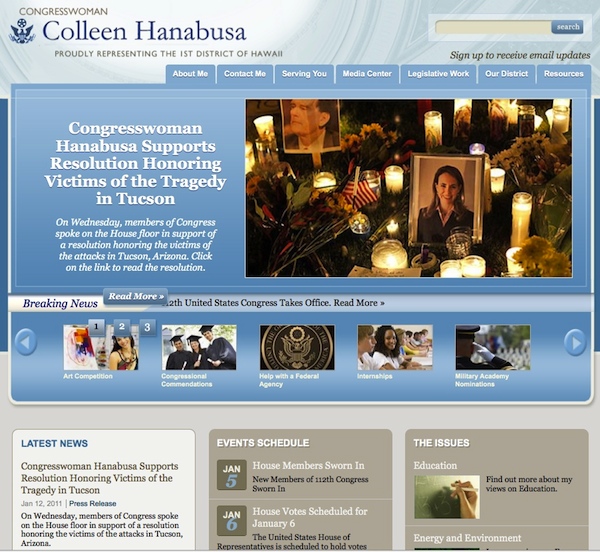
In the meantime, the incoming Congressmen and Congresswomen do appear to have adopted Drupal as the platform for their official websites. For instance, Congresswoman Colleen Hanabusa‘s site, below, uses one of several templates on the Drupal platform. Notably, each of the new sites includes default modules for the leaders in the respective verticals in the social media world: Flickr, YouTube, Twitter and Facebook.

Some questions remain about the cost and choices that representatives have as they choose their online Web presences. As NextGov reported today, while House websites can move to the open source platform – they don’t have to do so.

Given the context of citizens turning to the Internet for government information, data and services in increasing numbers, however, a well-designed Congressional website with clear connections to the various digital outposts has moved from a “nice to have” to a “must have” in the eyes of the digitally connected. (For citizens on the other side of the digital divide, the House switchboards are still available via phone call at (202) 224-3121 or TTY: (202) 225-1904).

If that’s a given, then the question is then why Drupal is now the preferred web hosting environment for the House. On that count, “Drupal was chosen because it is open source and widely accepted, therefore allows Members to leverage a large community of programmers which gives them more choices and innovation,” wrote Weiser in an email. “It should also be noted that Members still will have the option to use other platforms.”

Weiser told NextGov that, because, Drupal developers are in every member’s district, “that hopefully means expanded choice and more innovation for our members.”

The current content management system limits the choice of site programmer as well as innovation, said Dan Weiser, communications director for the chief administrative officer, in an e-mail. Drupal, which uses a common framework and code that can be customized, will allow members to leverage a large community of programmers, providing more opportunities for innovation, he added.

The House expects to save some money with the transition to Drupal, since the chief administrative officer will manage the infrastructure and members pay vendors only for development time, Weiser said.

The inclusion of social media is also no longer a novelty in the beginning of 2011. “We expected there would be interest by the incoming freshmen to have social media on their sites; it just seemed natural to offer the option,” wrote Weiser.

[Disclosure: One of the vendors involved in the House’s Drupal effort is Acquia. O’Reilly AlphaTech Ventures is an investor in Acquia.]

Clay Johnson on key trends for Gov 2.0 and open government in 2011

As dozens of freshmen Representatives move into their second week of work as legislators here in the District of Columbia, they’re going to come up against a key truth that White House officials have long since discovered since the heady … Continue reading

House 2.0: Livestreams of special session on Tucson Shooting on Facebook, CSPAN.org

Today, C-SPAN’s Facebook page will host streaming video coverage of Wednesday’s special U.S. House session on the Tucson shootings. The livestream will start at 10 AM ET, when the House will consider a resolution on the shootings. The session is also … Continue reading

The 411 on Digital Capitol Week on 1.1.11: 11.4.11 through 11.11.2011

Digital Capital Week is coming back to the United States Capital on November 4th, 2011. In a livestream today, the organizers of the inaugural 2010 event announced the data and opened the gates for DC Week registration and ideas for … Continue reading

Tim O’Reilly talks to Code for America about the power of platforms

Today, Tim O’Reilly spoke about the power of platforms to the inaugural class of Code for America fellows.

What’s happening today is an “open data” movement, said O’Reilly. “That’s what’s going to build the next platform.” As he’s said before, he thinks we’re now in an interesting platform stage where “the Internet is the operating system.” As early adopters of the new Google Chrome netbooks, a material metaphor for that notion is now online.

You can listen to the audio of Tim O’Reilly (my publisher) or download the MP3. Video may be available. later. Editor’s Note: O’Reilly Media is a supporter of Code for America and its founder, Tim O’Reilly, sits on its board.

The notion of “government as a platform,” which Tim has been speaking about for years now, is founded in his understanding of how technology companies have historically grown and flourished. Many of the anecdotes and historical underpinning of Gov 2.0 are in the webcast, “What is Gov 2.0?” in the side bar of this blog.

Here are a couple of key points from today:

Lesson 1: Platforms spread when they are ubiquitous and barriers to entry are low
Lesson 2: Create an architecture of participation, like Unix.
Lesson 3: Small pieces, loosely joined, which drove the growth of the World Wide Web.
Lesson 4: Don’t (just) build websites, build Web services.

There’s a lot more in there that builds upon Tim’s platform paradigm for government. Give it a listen and, if you find some other insights that particularly strike you or apply to how you think about how government can leverage the power of platforms, please share it in the comments.

If the notion that data and simplicity can build the government platform sound familiar, it should: Tim talked with the first United States chief technology officer, Aneesh Chopra, about how these ideas apply to government last year:

Building on that, if you have a moment, head on over to the White HouseExpertNet” wiki and share your thoughts on how the federal government should be designing democracy, specifically with respect to creating an open governnemt platform for citizen consultation.