United States releases second Open Government National Action Plan

This morning, the White House released its second action plan (PDF) for improving the state of open government in the United States. The action plan is required for U.S. participation in the Open Government Partnership, an international, multilateral initiative that seeks to push nations to make and keep commitments to open government.

“This second National Action Plan is another opportunity to set concrete and measurable goals for achieving a more transparent, participatory, and collaborative government,” wrote Nick Sinai, United States deputy chief technology officer and Gayle Smith, special assistant to the president and senior director for development and democracy, at the White House blog. “We look forward to working alongside civil society to carry out these commitments and continue identifying new ways to open our government in the future.”
open gov nap 2.0

As I previously reported, the action plan commits to modernizing the Freedom of Information Act, open more government data, improve the management of natural resources and engage citizens in innovation. Additionally, the final plan (a draft was released earlier this fall) includes commitments to join the Global Initiative on Fiscal Transparency  (GIFT), promote participatory budgeting, increase the transparency of spending and foreign assistance, improve the participation of the public in rulemaking and a number of other measures that expand existing commitments.

Initial reactions from open government advocates — many of whom, it must be said, worked to shape the contents of the plan — are strongly positive.

“The United States helped found the Open Government Partnership to challenge other countries to make concrete commitments to make themselves more transparent and accountable to the people,” said Patrice McDermott, executive director of OpenTheGovernment.org, in a statement.

“This plan shows that the US is also serious about challenging itself. While we have been critical of some of this Administration’s decisions, particularly its continued insistence on walling off all information related to national security, this plan begins to break down that wall and advance open government.”

Sean Moulton, director of open government policy at the Center for Effective Government, was similarly positive about the plan:

We are impressed by the scope and detail of the plan, as well as the administration’s commitment to continue to engage and refine those commitments for which detailed goals are not yet available. This broad and ambitious plan tackles important open government issues that we have long been advocating, including: 1) strengthening the Freedom of Information Act (FOIA), 2) improving information about government spending, and 3) continuing to open government data to the public. Properly implemented, these commitments can make government openness work for the public and change how government operates. The Center for Effective Government looks forward to working with the administration to ensure the outlined goals are executed over the next two years.

Sunlight Foundation policy director John Wonderlich balanced good with the bad in the plan:

There are some new and meaningful commitments. The proposed FOIA advisory board and committee could be transformative, and commitments to greater transparency in the extractives industry extend the significant new commitments that began in the US’s last plan.

More disappointing are the commitments around spending transparency, which would build on existing efforts to improve federal spending transparency in Congress and the federal government, but but offer only vague commitments. The National Action Plan also outlines a process to ensure federal agencies treat their data as an asset that should be open to the public, (long a Sunlight priority), but without adding much new detail to a process that is already well along its path.

And money in politics, like in the first National Action Plan, is missing entirely.

The measures that are likely to draw the most attention are those that relate to electronic surveillance and national security, and to whistleblower protections.

On that count, the second U.S. national action plan for open government includes measures to increase the transparency of foreign intelligence surveillance activities (largely mirroring the measures President Obama has already introduced this fall and repackaging the commitments made by the intelligence community) and to “strengthen and expand whistleblower protections for government personnel.” I include both below:

6. Increase Transparency of Foreign Intelligence Surveillance Activities
In June 2013, the President directed the U.S. Intelligence Community to declassify and make public as much information as possible about certain sensitive intelligence collection programs undertaken under the authority of the Foreign Intelligence Surveillance Act (FISA), while being mindful of the need to protect national security. Nearly two thousand pages of documents have since been released, including materials that were provided to Congress in conjunction with its oversight and reauthorization of these authorities. As information is declassified, the U.S. Intelligence Community is posting online materials and other information relevant to FISA, the FISA Court, and oversight and compliance efforts. The Administration has further committed to:

• Share Data on the Use of National Security Legal Authorities. The Administration will release annual public reports on the U.S. Government’s use of certain national security authorities. These reports will include the total number of orders issued during the prior twelve-month period and the number of targets affected by them.

• Review and Declassify Information Regarding Foreign Intelligence Surveillance Programs. The Director of National Intelligence will continue to review and, where appropriate, declassify information related to foreign intelligence surveillance programs.

• Consult with Stakeholders. The Administration will continue to engage with a broad group of stakeholders and seek input from the Privacy and Civil Liberties Oversight Board to ensure the Government appropriately protects privacy and civil liberties while simultaneously safeguarding
national security.

9. Strengthen and Expand Whistleblower Protections for Government Personnel
Employees with the courage to report wrongdoing through appropriate, legally authorized channels are a government’s best defense against waste, fraud, and abuse. Federal law prohibits retaliation against most government employees and contractors who act as whistleblowers, and those protections were strengthened by recent legislation and Executive action. However, some who work for the Government still have diminished statutory protections. The Government must also ensure that Federal employees know their rights. Therefore, the Administration will:

• Mandate Participation in the Office of Special Counsel Whistleblower Certification Program. To ensure that Federal employees understand their whistleblower rights and how to make protected disclosures, the Administration will require covered agencies to complete the U.S. Office of Special Counsel’s program to certify compliance with the Whistleblower Protection Act’s notification requirements.

• Implement the Presidential Directive on Protecting Whistleblowers. The U.S. Government will continue to work to implement the President’s October 2012 Policy Directive on Protecting Whistleblowers with Access to Classified Information (PPD-19), including by ensuring strong, independent due process procedures; awareness of protections; and agency understanding of the protections available to government contractors under the directive.

• Advocate for Legislation to Expand Whistleblower Protections. With the Administration’s support, Congress recently enacted legislation to strengthen whistleblower protections for most Federal Government employees and contractors, but there are still gaps in statutory protections available to certain government employees and contractors. The Administration will continue to work with Congress to enact appropriate legislation to protect these individuals.

• Explore Executive Authority to Expand Whistleblower Protections if Congress Does Not Act. While statutory protections are preferable, the Administration will explore additional options for utilizing Executive authority to further strengthen and expand whistleblower protections if Congress fails to act further.

“This is big news in my mind,” writes Nathaniel Heller, executive director of Global Integrity. “Yes, the commitments to greater disclosure around surveillance activities are largely retread and don’t go nearly far enough. But for these issues to have made their way into a US National Action Plan is an important first step towards broadening the open government agenda to include “new frontiers” or “thorny” issues. That’s a big deal and a win.”

As with so many aspects of government announcements regarding measures to hold themselves more accountable or become more transparent, the most important part of this plan will be not be the words themselves but in how they are interpreted and implemented by this administration and those to follow. To date, after bold rhetoric in 2009, the Obama administration’s record on open government is mixed, with ongoing challenges regarding transparency on Healthcare.gov’s performance. There’s also precious little acknowledgment of concerns about press freedoms in the plan. Heller would also have liked to have seen something on corporate ownership:

The administration remains silent on public registries of beneficial owners of companies,” he writes. “Sigh. David Cameron and the UK government made a pioneering commitment to public registries of who really owns UK companies at the OGP summit in London. The US is now in the awkward position of having to defend keeping this valuable data private to only government regulators and investigators. That’s an increasingly thin reed. There’s certainly opposition to public registries in Congress, but the White House could have at least committed to publicly pushing for public registries. Instead, mum’s the word.

Steven Aftergood expressed some concerns about the administration’s new goals on open government, focusing on his wheelhouse, overclassification and pervasive secrecy. As he noted, the plan also includes a measure to improve declassication:

…a new interagency Classification Review Committee is being established with White House leadership to evaluate proposals for classification reform, and to coordinate their implementation throughout the executive branch.  The creation of such a body was the primary recommendation of the Public Interest Declassification Board last year, and it was strongly endorsed by public interest groups.

Both because of its interagency character and especially due to its White House leadership, the new Committee has the potential to overcome the autonomous classification practices of individual agencies that have contributed to the explosive growth in secrecy.

Positive results are naturally not guaranteed.  The Administration has not embraced an explicit theory of how overclassification occurs, or even how overclassification is to be defined, and therefore it is not yet well-equipped to address the problem.

The new Plan notes that in June of this year President Obama directed the Intelligence Community to declassify and make public “as much information as possible” about intelligence surveillance programs. But in an optimally functioning classification system, the President’s directive would have been redundant and unnecessary; the system would already be declassifying as much information as possible.

Of course, the existing classification system is not functioning optimally. That is the problem.  So either the President needs to issue individualized directives to all agencies on every conceivable classified topic to “declassify as much as possible,” or else the new White House interagency Committee needs to find alternate means to effectively communicate the same imperative.

Wonderlich also expressed a deeper concern about the plan: its lack of ambition, focus upon political power and personal investment or commitment of political capital from President Obama.

Unfortunately, if we imagine what a National Action Plan could be with a committed, engaged President, and senior political staff at the White House who discuss and engage with integrity issues, rather than treating them as political liabilities, we imagine a wholly different world. Incremental working groups and vaguely redundant reporting procedures would be replaced by bold proposals that affect political and state power, and we’d see a White House that talks more about the transparency we’re building than the transparency they use as a shield against critics. That’s clearly not the National Action Plan the White House released today.

All that being said, the fact that these measures are in the plan shows that the Obama administration has heard the criticism of civil society regarding secret surveillance laws, overclassification, and prosecuting whistleblowers and included elements addressing them.

That’s better. Let’s see what they do next.

This post has been updated with reactions from  open government advocates over time.

Public Interest Declassification Board asked for public comment on prioritization

Top-Secret-stamp

David Ferriero, the Archivist of the United States, published a new blog post this week regarding prioritizing the declassification of government secrets.

“The Public Interest Declassification Board (PIDB) recently hosted an open meeting to discuss its recommendations to the President on Transforming the Security Classification System, focusing on declassification prioritization,” he said.

The task before the National Declassification Center is massive, with an estimated backlog of 354 million pages awaiting final declassification review.

The nation’s archivist has asked the public for input on the approach it should take. Should the National Archives “make declassification decisions because of their topicality or ‘gradually declassify everything in an orderly and systematic way’?” he asked. “Or do some of both? Your thoughts?”

For more on this, read Steven Aftergood’s post on declassification prioritization and then weigh in transforming classification, if you’re so inclined.

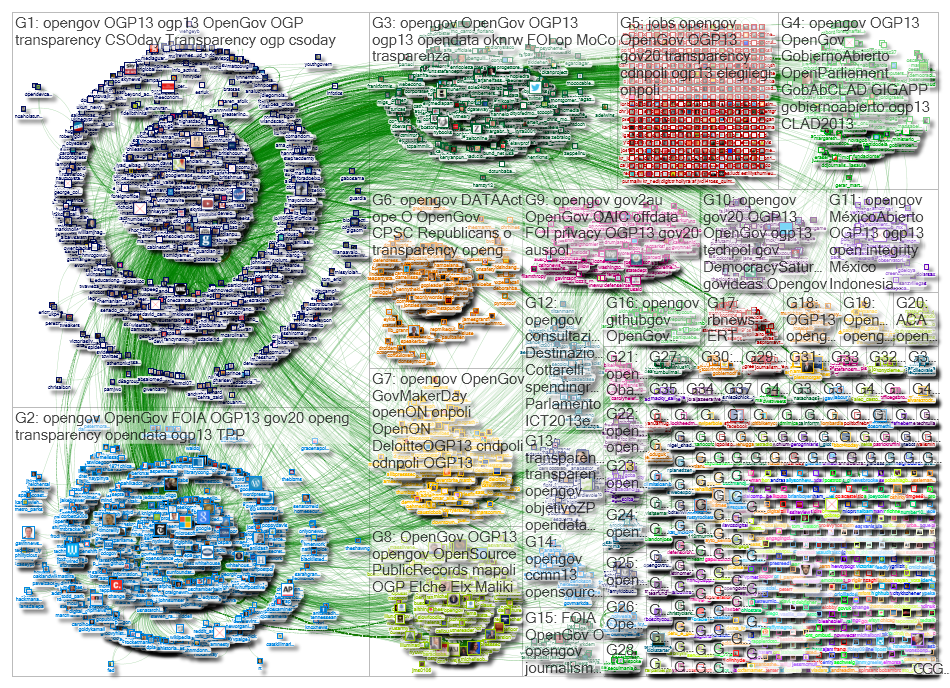
Map of open government communities generated by social network analysis of Twitter

Graph-12287

The map above was created on November 20 by researcher Marc Smith using a dataset of tweets that contained “opengov” over the past month. You can explore an interactive version of it here.

The social network analysis is, by its nature, a representation of only the data used to create it. It’s not a complete picture of open government communities offline, or even the totality of the communities online: it’s just the people who tweeted about open gov.

That said, there are some interesting insights to be gleaned.

1) The biggest network is the one for the Open Government Partnership (OGP), on the upper left (G1), which had its annual summit during the time period in question. That likely affected the data set.

2) I’m at the center of the U.S. open government community on the bottom left (G2) (I’m doing something right!) and am connected throughout these communities, though I need to work on my Spanish. This quadrant is strongly interconnected and includes many nodes linked up to OGP and around the world. (Those are represented by the green lines.)

3) Other communities include regional networks, like Spain (G4) and Spanish-speaking (G11) open government organizations, Germany (G3), Italy (G12), Canada (G7), Greece (G5) and Australia (G9), and ideological networks, like the White House @OpenGov initiative (G8) and U.S. House Majority Leader (G6). These networks have many links to one another, although Mexico looks relatively isolated. Given that Indonesia has a relatively high Twitter penetration, its relative absence from the map likely reflects users there not tweeting with “opengov.”

4) The relative sparseness of connections between the Republican open government network and other open government communities strongly suggests that, despite the overwhelming bipartisan support for the DATA Act in the House, the GOP isn’t engaging and linked up to the broader global conversation yet, an absence that should both concern its leaders and advocates in the United States that would like to see effective government rise above partisan politics. This community is also only tweeting links to its own (laudable) open government initiatives and bills in the House, as opposed to what’s happening outside of DC.

5) You can gain some insight into the events and issues that matter in these communities by looking at the top links shared. Below, I’ve shared the top links from Smith’s NodeXL analysis:
Top URLs in Tweet in Entire Graph:

https://healthcare.gov/
http://www.opengovguide.com/
https://www.gov.uk/government/topical-events/open-government-partnership-summit-2013
http://www.opengovpartnership.org/get-involved/london-summit-2013
https://govmakerday.eventbrite.com/
http://blogs.worldbank.org/youthink/can-young-people-make-your-government-more-accountable
http://www.opengovpartnership.org/london-summit-2013
http://paper.li/DGateway/1350366870
https://www.thunderclap.it/projects/5907-more-open-government-ogp13
http://www.youtube.com/playlist?feature=edit_ok&list=PLMDgGB-pYxdFNupM0kiHFPjwv8by2alxY

Top URLs in Tweet in G1 (Open Government Partnership):

https://www.gov.uk/government/topical-events/open-government-partnership-summit-2013
https://www.thunderclap.it/projects/5907-more-open-government-ogp13
http://www.opengovpartnership.org/london-summit-2013
http://www.thunderclap.it/tipped/5907/twitter
http://www.opengovpartnership.org/get-involved/london-summit-2013
http://www.youtube.com/playlist?feature=edit_ok&list=PLMDgGB-pYxdFNupM0kiHFPjwv8by2alxY
https://www.thunderclap.it/projects/5907-more-open-government-ogp13?locale=en
http://www.opengovguide.com/
https://www.gov.uk/government/consultations/open-government-partnership-uk-national-action-plan-2013
http://www.opengovpartnership.org/open-government-awards-launched-reward-transparent-accountable-and-effective-public-programs#sthash.xl5Bwn5D.dpuf

Top URLs in Tweet in G2 (US OpenGov Community):

http://www.usgovernmentmanual.gov/
http://www.huffingtonpost.com/danielle-brian/in-wake-of-snowden-us-mus_b_4192804.html?utm_hp_ref=tw
http://e-pluribusunum.com/2013/11/05/farm-bill-foia-open-government-epa/
http://www.knightfoundation.org/blogs/knightblog/2013/10/28/new-project-aims-connect-dots-open-data/
http://www.whitehouse.gov/lWV7k
http://sunlightfoundation.com/blog/2013/11/15/opengov-voices-pdf-liberation-hackathon-at-sunlight-in-dc-and-around-the-world-january-17-19-2014/
http://sunlightfoundation.com/blog/2013/11/14/recent-developments-show-desire-for-trade-talk-transparency/
http://sunlightfoundation.com/blog/2013/10/22/how-much-did-healthcare-gov-actually-cost/
http://www.consumerfinance.gov/blog/making-regulations-easier-to-use/
http://sunlightfoundation.com/blog/2013/11/19/house-keeps-data-act-momentum-moving/

Top URLs in Tweet in G3 (Germany):

http://paper.li/DGateway/1350366870
http://oknrw.de/
http://www.opengovpartnership.org/blog/christian-heise/2013/11/18/german-grand-coalition-might-agree-joining-ogp
http://dati.comune.bologna.it/node/962
http://www.globalhealthhub.org/thehive/
https://www.facebook.com/events/1431657647046016
http://aiddata.org/blog/this-week-open-data-for-open-hearts-and-open-minds
http://www.opengovpartnership.org/get-involved/london-summit-2013
http://www.freiburg.de/pb/,Lde/541381.html
http://digitaliser.dk/resource/2534864

Top URLs in Tweet in G4 (Spain):

http://www.opengovguide.com/
http://www.cepal.org/cgi-bin/getprod.asp?xml=/ilpes/capacitacion/0/50840/P50840.xml&xsl=/ilpes/tpl/p15f.xsl&base=/ilpes/tpl/top-bottom.xsl
https://vine.co/v/hpZErXPd6rq
http://thepowerofopengov.tumblr.com/
http://es.scribd.com/collections/4376877/Case-Studies
https://vine.co/v/hpZiw7TXanI
https://vine.co/v/hpZIV002zar
http://aga.org.mx/SitePages/DefinicionGob.aspx
http://www.opengovpartnership.org
http://inicio.ifai.org.mx/Publicaciones/La%20promesa%20del%20Gobierno%20Abierto.pdf

Top URLs in Tweet in G5 (Greece):

https://healthcare.gov/
http://venturebeat.com/2013/10/23/so-much-for-opengov-quantcast-traffic-on-healthcare-gov-hidden-by-the-owner/
http://elegilegi.org/
http://opengov.seoul.go.kr/
http://venturebeat.com/2013/10/23/so-much-for-opengov-quantcast-traffic-on-healthcare-gov-hidden-by-the-owner/?utm_source=twitterfeed&utm_medium=twitter
http://www.aspeninstitute.org/about/blog/biases-open-government-blind-us?utm_source=as.pn&utm_medium=urlshortener
http://www.opengov.gr/consultations/?p=1744
http://www.aspeninstitute.org/about/blog/biases-open-government-blind-us
http://www.opengov.gr/minfin/?p=4076
http://OpenGov.com

Top URLs in Tweet in G6 (GOP):

http://houselive.gov/
https://www.cosponsor.gov/details/hr2061
http://oversight.house.gov/release/oversight-leaders-introduce-bipartisan-data-act/
http://instagram.com/p/g3uvs_sYYr/
http://cpsc.gov/live
https://cosponsor.gov/details/hr2061-113
http://www.youtube.com/watch?v=Bnn3IsOhulE&feature=youtu.be
http://www.cpsc.gov/en/Regulations-Laws–Standards/Rulemaking/Final-and-Proposed-Rules/Hand-Held-Infant-Carriers/
http://www.speaker.gov/press-release/opengov-house-representatives-makes-us-code-available-bulk-xml
http://docs.house.gov/billsthisweek/20131118/BILLS-113hr2061XML.xml

Top URLs in Tweet in G7 (Canada):

https://govmakerday.eventbrite.com/
http://www.ontario.ca/government/open-government-initial-survey
http://govmakerday.eventbrite.com
http://www.thestar.com/opinion/commentary/2013/10/29/the_promise_and_challenges_of_open_government.html
http://www.marsdd.com/2013/10/31/open-government-three-stages-for-codeveloping-solutions/
http://www.thestar.com/opinion/commentary/2013/11/09/rob_ford_and_the_emerging_crisis_of_legitimacy.html
https://www.ontario.ca/government/open-government-initial-survey
http://govmakerday-estw.eventbrite.com
http://www.ontario.ca/open
http://gov20radio.com/2013/10/gtec2013/

Top URLs in Tweet in G8 (@OpenGov):

https://healthcare.gov/
http://www.whitehouse.gov/lWV7k
http://www.consumerfinance.gov/blog/making-regulations-easier-to-use/
http://aseyeseesit.blogspot.com/2012/01/economy-hasnt-stalled-for-members-of.html
http://www.commonblog.com/2013/10/23/eagle-tribune-editorial-public-records-need-to-be-available-to-its-citizenry/
http://mobile.twitter.com/OpenGov
http://blogs.state.gov/stories/2013/10/31/making-governments-more-open-effective-and-accountable
http://open.dc.gov/
http://www.sielocal.com/SieLocal/informe/1025/Ingresos-por-el-concepto-de-multas
http://mei-ks.net/?page=1,5,787

Top URLs in Tweet in G9 (Australia):

http://paper.li/cortado/1291646564
http://icma.org/en/icma/knowledge_network/documents/kn/Document/305680/Transparency_20_The_Fundamentals_of_Online_Open_Government
http://www.oaic.gov.au/about-us/corporate-information/annual-reports/oaic-annual-report-201213/
https://controllerdata.lacity.org/
http://cogovsnapshot.cofluence.co/
https://info.granicus.com/Online-Open-Gov-October-29-2013.html?page=Home-Page
http://www.oaic.gov.au/news-and-events/subscribe
https://oaic.govspace.gov.au/2013/10/30/community-attitudes-to-privacy-survey-results/
http://www.cebit.com.au/cebit-news/2013/towards-open-government-esnapshot-australia-2013
http://journalistsresource.org/studies/politics/digital-democracy/government-transparency-conflicts-public-trust-privacy-recent-research-ideas

Top URLs in Tweet in G10:

http://on.undp.org/pUdJj
http://europeandcis.undp.org/blog/2013/10/17/a-template-for-developing-a-gov20-opengov-project/?utm_source=%40OurTweets
http://www.govloop.com/profiles/blogs/12-favorite-quotes-from-code-for-america-summit
http://www.accessinitiative.org/blog/2013/10/east-kalimantan-community%E2%80%99s-struggles-underscore-need-proactive-transparency-indonesia
http://www.scribd.com/doc/178983441/Montenegro-Inspiring-Story-open-government
http://www.scribd.com/doc/178988676/Indonesia-case-study-open-government
http://www.setimes.com/cocoon/setimes/xhtml/en_GB/features/setimes/features/2013/10/18/feature-01?utm_source=%40OurTweets
http://www.opengovpartnership.org/summary-london-summit-commitments
http://feedly.com/k/1arGpdC
http://slid.es/kendall/open-records

ODNI declassifies more intelligence documents after White House order, ACLU, EFF suits

I’m still digesting the additional documents the U.S. director of national intelligence released last night. The New York Times’ coverage of the latest documents released notes that they include a 2006 “ruling in which the Foreign Intelligence Surveillance Court first approved a program to systematically track Americans’ emails during the Bush administration.”

The opinion, signed by Judge Colleen Kollar-Kotelly, permitted the NSA to gather email addresses and other forms of Internet communication in bulk  — but not the content of those communications. Law professor Orin Kerr has “major problems” with the FISC opinion:

“By imagining that the statute provides more protection than it does, and by then construing the ambiguity in the statute in the government’s favor, the FISC’s opinion ends up approving a program that Congress did not contemplate using privacy protections Congress did not contemplate either,” he wrote, at his blog. “The resulting opinion endorses a program that appears to be pretty far from the text of the statute.”

Taken in sum, the Guardian holds that these FISA court opinions show that the NSA demonstrated disregard for the privacy protections that are constitutionally afforded to American citizens under the Fourth Amendment.

Transparency, at last?

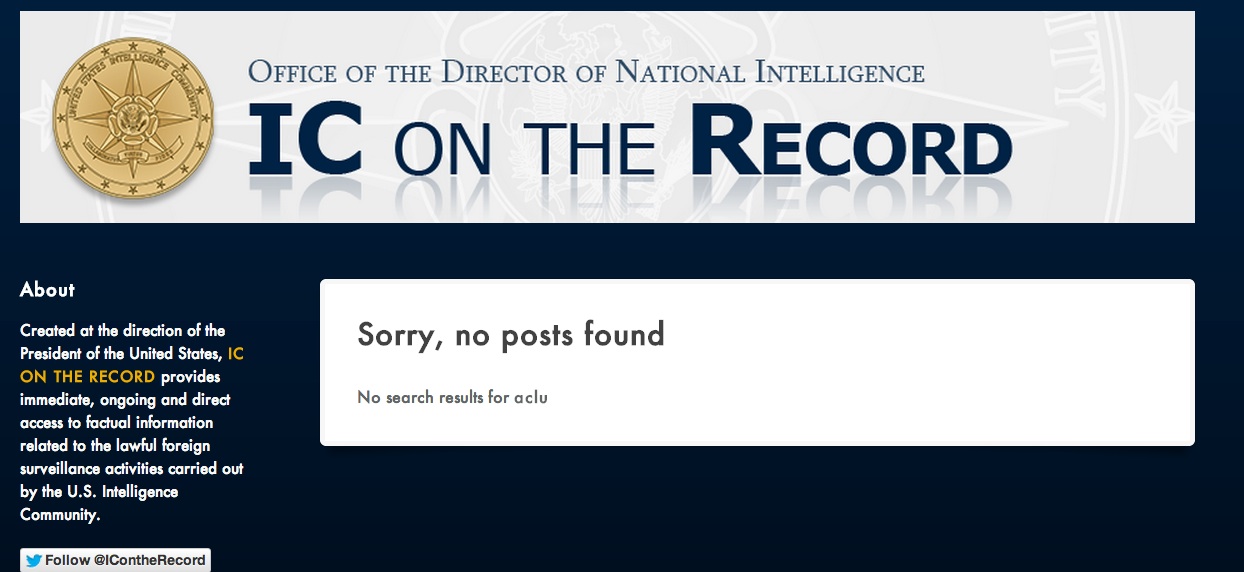
On the one hand, the intelligence community’s Tumblr blog and Twitter account have been an effective means of distributing and publicizing the document releases it is publishing on odni.gov, its website. That’s a measure of transparency, although the redacted, scanned documents are not “opening the kimono” all the way.

On the other hand, if you only read the ODNI’s press release and posts at that tumblr (which are quite similar,) you wouldn’t know that the documents released are not only pursuant to President Barack Obama directive to DNI Clapper to declassify information relevant to NSA bulk data collection.

aclu icontherecord

As Cyrus Farivar reported for Ars Technica, “the documents, which include annual reports from the Attorney General to Congress, memos, presentations, and training documents, were released in relation to an Electronic Frontier Foundation and American Civil Liberties Union [Freedom of Information Act] lawsuit.”

The overarching context for the release of nearly 2000 documents are the leaks of former NSA contractor Edward Snowden, whose disclosures to The Guardian and Washington Post prompted President Barack Obama’s directive to ODNI.<

So, this is what "open government" looks like in 2013: networked, nuanced and opaque. Official documents are released in response to the reports of whistleblowers,  and then distributed through the government's official channels online and reported, factchecked and through the 4th and 5th Estates.

This dynamic only bound to get more interesting from here on out.

Farewell, Thomas.gov. Hello, Congress.gov.

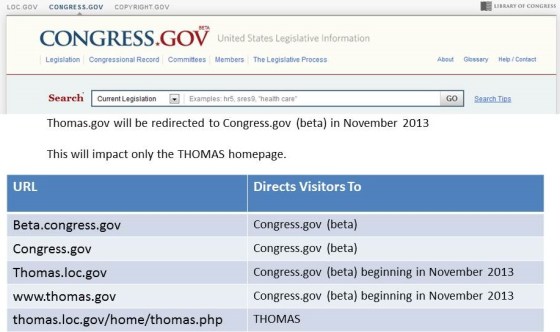
THOMAS-redirecting-to-Congress.gov_

On November 19th, Thomas.gov, the venerable website of the United States Congress, will begin to redirect visitors to Congress.gov. The new site, which launched in beta in September 2012, will become the primary governmental resource for the text of legislation, past, present and future, along with reports from committees, speeches from the floor of Congress and cost estimates from the Congressional Budget Office.

While the official announcement was made today by the Library of Congress, Thomas.gov’s custodian, leading headlines about Congress trading in the new Congress.gov and a note in Roll Call, the transition from THOMAS.gov to Congress.gov has been going on all fall, including updates to the new site and launching the Constitution Annotated and associated app.

THOMAS is centuries old, at least as measured in terms of Internet time. Launched in January of 1995, Thomas.gov was one of the first 23,000 websites to go online. When it went live the Internet had a worldwide user base of less than 40 million people, the majority of whom surfed the young World Wide Web using Mosaic and Netscape, checked their email on Eudora and dialed in on America Online. Watch the video below to get a sense of what life was like online nearly two decades ago.

Today, Thomas.gov receives, on average, 10 million visits every year, although I suspect many of those visits come from wonky repeat customers in or around the District of Columbia. I have no servers logs to prove that one way or another, but THOMAS has long been alternately beloved of or bemoaned by Congressional staffers and correspondents, all of whom have had to rely upon its increasingly creaky infrastructure for nearly two decades as the national repository of legislation and reports. So, too, have millions of Americans around the rest of the country who want to read proposed bills.

While incremental improvements to search and sharing in recent years have improved the site, for a decade people interested in tracking Congress have increasingly turned to sites like Govtrack or the New York Times for data created by scraping THOMAS. What does that mean, in practice? While Congress.gov will be official source of information, until its operators move to act as a platform for legislative data instead of a portal for legislative information. Open government advocates have been calling for the release of bulk legislative data for many years, culminating in frustration this September when a Library of Congress cost estimate acknowledged that Congress.gov “was not designed specifically to facilitate the extraction of the data as XML documents for bulk download.”

Putting the issue of bulk data aside, the new Congress.gov is an immense improvement on THOMAS in every way, as I reported last year:

Tapping into a growing trend in government new media, the new Congress.gov features responsive design, adapting to desktop, tablet or smartphone screens. It’s also search-centric, with Boolean search and, in an acknowledgement that most of its visitors show up looking for information, puts a search field front and center in the interface. The site includes member profiles for U.S. Senators and Representatives, with associated legislative work. In a nod to a mainstay of social media and media websites, the new Congress.gov also has a “most viewed bills” list that lets visitors see at a glance what laws or proposals are gathering interest online.

Since September 2012 digital staff at the Law Library of Congress have been busy since the Congress.gov launched in beta, adding new features and context at a steady pace, including adding the Congressional Recordcommittee reports, standing committee pages, and the ability to “Search within results.

On November 19th, when THOMAS is retired, the social media outposts of the site will also transition. @THOMASDotGov will transition its more than 15,500 followers to a new identity.

In a press release, the Library of Congress indicated that the old site will remain accessible from the Congress.gov homepage through late 2014. After that, historians may have to hope that the National Archives adopts whatever code or data retains historical interest into its servers, lest it moulder and succumb to bitrot — unfortunately, the configuration of the robots.txt file for Thomas.gov appears to have prevented the Internet Archive from preserving its iterations over the years.

If you’re interested in learning how to use the new Congress.gov, you can register at beta.congress.gov/help for training sessions scheduled for November 14, January 16, March 11 and March 16.

When digital government supports open government

photo (17)

As I looked back at the annual Open Government Partnership Summit in London, I was struck by how much technology continues to dominate discussion, particularly when many of the issues that confront people and governments around the world are political or systemic, and thus resistant to simply “fixes.”

Given that so many of the new country commitments for the partnership either involve improving the use of technology or are enabled by technology, it’s tempting to frame the release of government data and other digital efforts as efforts that will primarily serve elites, not the poor, and to warn of the encroachment of commercial interests in that delivery.

The years ahead will be messy, full of anger, violence, ignorance and the worst of human nature, expressed in political conflicts and entrenched institutions and industries fighting against a rising tide of populism and industrial disruption fueled by an explosion of connection technologies.

Near the end of 2013, the majority of humanity is living through the consequences of wars, natural disasters, disease, food shortages or inequality in access to resources. On many days, access to healthy food, electricity and clean water are critical needs. Access to information, however, has rapidly become critical in this new millennium.

That such information will be delivered through the Internet and mobile devices is clearly one of the megatrends of this decade. Similarly, access to one another through those same devices, mediated by social media and video, is shifting how we all can understand, document and experience the world.

While 56% of American adults now own a smartphone, the rest of the world hasn’t hasn’t caught up yet. That’s changing quickly, however, as the cost of mobile hardware continues to drop. There have now been over 1 billion Android activations worldwide. As cheaper smartphones and tablets become available, and more wireless Internet access rolls out through ISPs, mesh networks and perhaps even Google blimps, the pressure to provide digital services will only increase.

Why all the hullabaloo? Isn’t this just “e-government redux,” with phones? It would also be a gross mistake to view digital government as simply rebranding or scaling the existing approaches to buying, building and maintaining government IT.

Unfortunately, the bad news here is that government technology around the world is dominated by regulations, tangled hiring practices and procurement policies that get in the way of building important software, along with politics and poor management. The good news is that the example of the United Kingdom’s new Government Digital Services team shows a potential way forward for building a digital core for 21st century government online.

Adopting a digital government strategy is not the same as moving to a system of government more open and accountable to the people, as a comparison of the democratic accountability in countries as diverse as Singapore, Denmark, Iran and Brazil demonstrate.

Given that technology can and will underpin many efforts to reduce corruption, improve accountability and empower citizen activism and public engagement, dismissing the importance of public-private partnerships or digital government initiatives as inherently “ephemeral” would be a mistake in this young century.

As the DATA Act goes up for markup in Senate, will its Recovery.gov model survive?

rotunda-dome-capital (1)

There will be a markup for the DATA Act (S.994) in U.S. Senate today. The bill, which passed the House, would standardize federal spending and publish it in a similar way as the Recovery Act, which proved to be a successful test case for open data. A proposed amendment to the DATA Act, however, is facing opposition from the same good government groups that supported its passage in the House of Representatives.

Update: The DATA Act passed markup with the amendment.

The amendment, which removes the “accountability platform” from the legislation, faced criticism from the author of the original bill, Hudson Hollister. Hollister emailed the following comment to Federal News Radio:

“Without the accountability platform, there will be no mechanism for inspectors general to use the newly-standardized federal spending data, combined with public and private data sources, to suss out waste and fraud. If the final version of the bill fails to expand the Recovery Operations Center to cover all federal spending, taxpayers’ interests will be hurt in two ways. First, waste and fraud that could have been illuminated and eliminated will go undetected. Second — and perhaps more important — without any internal government effort to use the newly-standardized spending data for any purpose, there will be no internal pressure to improve the quality of data published on USASpending.gov. We recognize that the accountability platform was removed in order to reduce the bill’s Congressional Budget Office score. We hope that an offset large enough to restore those provisions can be included in the bill at a later stage.”

A coalition of good government groups are calling for the the DATA Act to be passed as introduced, not “as amended,” submitting a letter to the Senate Homeland Security and Government Affairs Committee to that effect. (Below.)

DATA Act – Letter of Support to Homeland Security and Government Affairs Committee – 11-05-2013

Prospects for the DATA Act’s passage in the Senate do appear improved over last year, where it foundered in committee, but the form it will emerge from today’s markup in is unclear.

Hollister is warning that the removal of the requirement for a data analytics platform from the bill, modeled on Recovery.gov, would be a mistake and lead to same kinds of data quality issues that exist at the SEC.

Citing a study from Columbia Business School which evaluates the state and future of interactive data at the SEC, Hollister says the platform is a key tool for government inspectors general to examine spending data, which then creates an internal incentive to correct errors. Given the reality that “armchair auditors” have yet to emerge in the United Kingdom to look at similar data, improving the capacity of the IGs to find fraud, waste and abuse is critical.

In advocating for retention of the platform (the “accountability hub”), Hollister suggested that its estimated $20 million dollar cost will be more than balanced by the amount of fraud detected.

“Open data is no good unless it’s accurate,” writes Hollister. “The SEC’s experience shows that the only way to generate internal pressure for accurate spending data will be if the federal government is actively using that data.”

Congressional bills could cripple FOIA requests for feedlot data from the EPA

UPDATE: The final version of the Farm Bill that passed both houses of Congress did not contain this amendment.

On the one hand, the White House is committing (again) to modernizing the administration of the Freedom of Information Act  and touting a new effort to open up agricultural data:

On the other, there are now multiple efforts to bar access to agricultural information sprouting on Capitol Hill. Open government advocates successfully stalled an amendment on farm bill secrecy this spring. The amendment is back, in multiple places.

The Farm Bill poses a great threat to the public’s right to know about agricultural and livestock operations.

farm-bill-foia-575

OpentheGovernment.org is warning that multiple bills could limit the EPA from releasing data relevant to the public interest:

The Senators who proposed the Farm Bill amendment, Senators Grassley and Donnelly, recently introduced an identical bill, and similar language appears in the House-passed version of the Farm Bill (Sec. 450) and the House Appropriations Committee’s version of the 2014 Interior spending bill (Sec. 11325). The sponsors say the language is intended to address the EPA’s release of information related to Concentrated Animal Feeding Operations (CAFOs) to environmental groups earlier this year. After hearing concerns about the amount of private information included in the release, EPA requested the groups return the original information (which the groups did) and committed to redacting all private information from similar releases in the future.

The language some Members of Congress are trying to make a part of the law goes well beyond the stated objectives. Rather than appropriately protecting private information, the language cuts off all public access to any information the EPA has collected on any owner, operator, or employee of a livestock operation (the language in the House-passed farm bill is even broader — barring the release of information on agricultural operations as well as livestock operations). In other words, the language would not just prevent the EPA from releasing private information about a local farmer with a few pigs or heads of cattle, it would broadly shield the information of corporate operations. The language also ignores the possible public interest in release of the information. If passed, the language would completely cut off access to information that is especially critical for people who live near or share waterways with CAFOs.

To be clear, these are not minor exceptions.

The authors of the Senate bill are “trying to create a huge hole in the FOIA by blocking the EPA from releasing any information it has collected on any owner, operator, or employee of a livestock operation,” writes Scott A. Hodes at the FOIA Blog.

“The language in the House-passed farm bill is even broader, barring the release of information on agricultural operations as well as livestock operations. …There may be a valid reason to not release information about small family farms, but the language in some of these proposals go way past that point and would create a huge Exemption 3 statute that blocks information that the public deserves to be known from being released via the FOIA.

According to OpenSecrets.org, the campaign committees and leadership PACs of the sponsors of the bill, Senator Charles Grassley and Senator Joe Donnelly, have received $458,750 and $104, 891 from agribusiness, respectively.

To date, S.1343 hasn’t garnered much attention in the press or online at POPVOX and OpenCongress. That’s unfortunate. While the repeated release of personally identifiable information in FOIA documents by the Environmental Protection Agency clearly merits Congressional attention and oversight, these amendments are a gross overreaction to the disclosures and stand to damage the public interest.

Given the importance of public access to information about agriculture, particularly the large feedlots that provide the majority of the beef Americans consume and attendant food safety issues, limiting broad disclosure from the EPA would be a huge step backwards for open government in the United States.

Update: More than 40 organizations have joined OpenTheGovernment.org to urge Congress not to include language that cuts off public access to this information, sending a letter (embedded below) to the committee.

As the letter points out, people who live near agricultural and livestock operations – particularly people who live near concentrated animal feeding operations (CAFOs) – need access to information about these operations in order to ensure their health and safety. The law already requires federal agencies, when responding to a Freedom of Information Act (FOIA) request for information about these operations, to protect personal privacy, including email addresses, phone numbers, and other similar information of non-government individuals. Indeed, after determining that it improperly released personal information related to CAFOs earlier this year, the Environmental Protection Agency (EPA) asked requesters who had received the information to return it to the agency. The requesters complied.

Beyond being unnecessary to protect personal privacy, language included in the House-passed version of the Farm Bill is exceedingly broad and vague. Because it does not define the terms “owners” or “operators,” it would extend FOIA’s personal privacy protections to corporate farms. In FEC vs. ATT, the Supreme Court found that Congress never intended to extend the FOIA’s personal privacy protections to corporations, and Congress must not do so now.

[Image Credit: POGO]

Coalition presses White House to make secret surveillance laws open to the public

A coalition of organizations that support open government, press freedom and civil liberties have sent a letter to President Barack Obama urging him to make the laws that govern surveillance by the National Security Agency public. The letter, which I’ve published in full below, asks the constitutional law professor living at 1600 Pennsylvania Avenue to support a core principle of democratic governance that hails back (at least as far as) the 12 Tables posted in the Roman Forum: the people should be able to read the laws under which they are governed. The letter was sent to the White House on the eve of the second annual conference of the Open Government Partnership.

October 21, 2013
President Barack Obama
The White House
1600 Pennsylvania Avenue, N.W. Washington, DC 20500
Dear President Obama:
On behalf of citizens who support an open and accountable government, we are writing to urge you to pledge as part of the US’s new round of Open Government Partnership commitments to curb the secret law that enabled the National Security Agency’s surveillance programs to become much broader and more invasive than it was believed the law allowed.
Secret legal interpretations by the Justice Department’s Office of Legal Counsel (OLC) and the Foreign Intelligence Surveillance Court allowed the NSA’s surveillance programs to grow in ways that raise serious concerns about what the government is doing in our name and the extent of violations of American’s privacy and civil liberties. Documents released to the media about the NSA’s programs further raise critical questions about the scope of the US’s activities abroad, leading the President of Brazil and others to question whether the US’s programs breach international law.
This is not the first time that abuses of power have occurred when a government program operates in a bubble of secrecy with only limited oversight: similarly, Americans were outraged to learn that memos authored by the OLC during the Bush Administration approved interrogation methods that many equate to torture. Your release of these memos demonstrated a respect for the public’s right to know how the government interprets the law. Making a concrete commitment to the public’s right to legal interpretations on issues including the intelligence community’s surveillance programs and other controversial policies like targeted killing through the use of drones or other means would make this respect part of the administration’s legacy. While the government has an obligation to protect properly and appropriately classified information, democracy does not thrive when our national security programs and the intelligence community’s actions are shrouded in secrecy. The public must, at the very least, have a shared understanding of the bounds and limits of the laws of our land and be able to have an informed debate about our policies.
During the meeting of the Open Government Partnership in London, you have a unique opportunity to address this issue head-on on an international stage. By committing to give the public access to documents that significantly interpret laws, including – but not limited to—the Department of Justice’s legal interpretations and opinions by the Foreign Intelligence Surveillance Court (FISC), you can both address domestic concerns about our surveillance programs, and begin to rebuild trust with our international partners.
Thank you in advance for your attention to this issue of critical importance to transparent and accountable government. To discuss these issues in greater detail, please contact Patrice McDermott, Executive Director of OpenTheGovernment.org, at pmcdermott@openthegovernment.org or 202-332- 6736.
Sincerely,
American Booksellers Foundation for Free Expression American Civil Liberties Union
American Library Association
American Society of News Editors
Arab American Institute
ARTICLE 19
Bill of Rights Defense Committee
Brechner Center for Freedom of Information
Californians Aware
Center for Democracy and Technology
Center for Effective Government
Center for Media and Democracy
Citizens for Responsibility and Ethics in Washington – CREW The Constitution Project
Council on American-Islamic Relations – CAIR
Electronic Frontier Foundation
Electronic Privacy Information Center – EPIC
Essential Information
Federation of American Scientists
First Amendment Foundation
Government Accountability Project – GAP
Human Right Watch

iSolon.org
James Madison Project
Just Foreign Policy
Liberty Coalition
National Coalition Against Censorship
National Freedom of Information Coalition National Security Archive
No More Guantanamos
OpenTheGovernment.org
PolitiHacks
Project On Government Oversight – POGO
Public Citizen
Public Knowledge
Reporters Committee for Freedom of the Press Reporters Without Borders
Society of Professional Journalists
Sunlight Foundation
Tully Center for Free Speech at Syracuse University Understanding Government
Vermont Coalition for Open Government
Vermont Press Association
Washington Civil Rights Council
Win Without War

2013 Code for America Summit convenes civic innovators in San Francisco [LIVEBLOG]

cfa-2013-theater
Hello from San Francisco! I’ll be liveblogging from the 2013 Code for America Summit for the next 2 days. You can tune in here.

Readers should also be aware of an important disclosure: Code for America paid for the costs of my travel to and from San Francisco and has further engaged me to produce paid analysis of the themes extant at the event. Part of our agreement, however, was that the organization would have no editorial control or discretion with respect to what I write about the event, organization, partners or constituents.