@Jack to moderate questions for President Obama in @Twitter @Townhall with @WhiteHouse [#AskObama]

In coordinated tweets with Twitter, the White House announced that it will be holding a town hall on Twitter on July 6th, 2011 at 2 ET. Twitter launched a new @TownHall account for the event and a subdomain, AskObama.Twitter.com to host the live webcast.
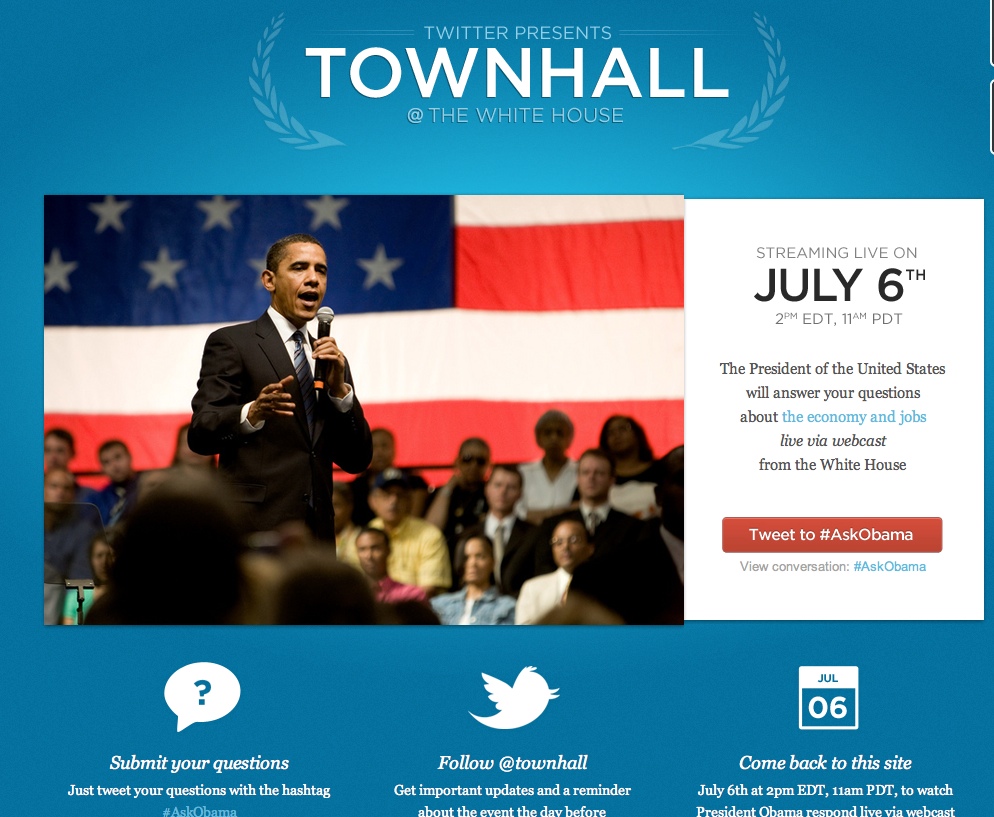
According to Macon Phillips, director of digital for the White House, and Sean Garrett, Twitter’s vice president of communications, the digital town hall will be hosted by Twitter co-founder Jack Dorsey, who will provide the questions.

Phillips tweeted that “@Twitter has a cool approach to surfacing questions,” clarifying that “choosing the Q’s will be done by @twitter. Garrett tweeted that “there will be a fairly involved process by which they are selected” and more details and background on said process is on the way. UPDATE: Garrett emailed me “the basics”

“There will be multiple ways that questions will get to the President,” he wrote. “Twitter users will begin asking questions via the #AskObama hashtag today. To identify popular and relevant questions, Twitter is engaging with a third-party Twitter measurement company called Mass Relevance to provide a view on the most frequent topics and their geographical distribution. Additionally, Twitter will invite a group of highly active and engaged Twitter users (called “curators”) to help choose questions and comments both prior to and during the event. Twitter will collect questions in the days leading up to the Town Hall and in real-time during the event.”

Garrett also added some information regarding how Twitter will select this team of “question curators”:

“These curators will be a diverse group from around the country that are also active and engaged on Twitter,” he wrote. “These curators will ask those in their particular communities to also highlight what they think are the most important questions for the President. Curators will retweet questions and pose their own.”

The Twitter TownHall follows a Facebook TownHall earlier this year, in which Facebook founder Mark Zuckerberg posed live questions to President Obama. Nancy Scola wondered how much of a “TownHall” the event actually offered. With this Twitter version, the interesting detail will be in how much transparency goes into question selection, particularly with respect to how exact or tough they are. When the White House turned to Twitter to discuss President Obama’s Middle East speech, they included NPR’s Andy Carvin and Foreign Policy’s Mark Lynch as trusted interlocutors. It’s less clear how Dorsey will moderate, given his considerable different style of tweeting, but on one count there is no doubt: this will be interesting.

UPDATE: In his post on President Obama taking questions on Twitter, Nick Clark Judd raises similar questions over at techPresident on moderation. (And no, he didn’t call the event a “TownHall.”)

UPDATE II: The New York Times published more details on the “Twitter Town Hall,” including the news that there will be a “White House Tweetup,” the first of its kind. In terms of process, here’s what Twitter told the Times. (Spoiler: it’s quite similar to what Garrett told me, above).

Twitter will select the questions, using curation tools and a group of Twitter users to help identify the most popular questions raised both before and during the event. Twitter will be relying on its own search and curation features as well as a company called Mass Relevance to help find questions and topics that are most frequently mentioned.

… Adam Sharp, Twitter’s manager of government and political partnerships, said that the curators chosen by Twitter to help select the questions would be a politically and geographically diverse group. He said the curators would ask the people in their communities to highlight what they think are the most important questions for the president to address.

Curators will also be retweeting questions and posting their own.

“We will have highly-engaged Twitter users from around the country to provide that geographic diversity to help identify good questions, “ he said. “This helps us make sure that we are addressing the concerns that the Twitter universe cares about. “

Less clear whether the President of the United States will actually be doing any of the tweeting himself, as opposed to dictating a reply, which means we may not get to see any real-time presidential typos. According to reports by Paul Boutin, President Obama started tweeting for himself at @BarackObama over the Father’s Day Weekend, signing the tweet “-BO.”

CBS News White House correspondent and keeper of presidential lore Mark Knoller cautioned, however, that “Obama won’t be typing his responses.” Looking back at that Father’s Day tweet, Knoller tweeted that “a tweet was sent in his name by his campaign. He was not at a computer typing a tweet.”

We’ll see if the President decides to get more personally involved or not in the technology. Given that the presidential iPad appears to travel with him these days, it could happen.

[Photo Credit: President Barack Obama sits alone on the patio outside the Oval Office, following a meeting with his senior advisors, April 4, 2011. (Official White House Photo by Pete Souza)]

UPDATE III: Politico White House correspondent Mike Allen led his Tuesday’s Playbook with more details about Wednesday’s Twitter event:

The audience for tomorrow’s hour-long TWITTER TOWN HALL in the East Room (2 p.m. ET) will consist of 140 characters — er, people – in a nod to the maximum length of a tweet. President Obama, however, will face no such limit: He’ll answer questions for the audience, and @TownHall will carry summaries of what he says. Twitter co-founder and Executive Chairman Jack Dorsey will ask the questions. Three screens will be behind Obama and Dorsey: one with the current question; another will have a heat map of the U.S., showing where the town-hall tweets are concentrated; and the third will show the volume of tweets, by topic (jobs, taxes, spending, health care, etc.) Mass Relevance, a company that has worked with the broadcast networks on real-time Twitter data, will supply the analytics. Later, Radian6 will study the demographics of participants.

Representative questions will be chosen partly on how often they’re retweeted. The White House has also reached out to about 10 Twitter leaders in different parts of the country to help surface questions by curating themes and topics that are big among their followers and in their communities. So Dorsey may say: “We’re hearing a lot about the extension of unemployment benefits, especially from the upper Midwest, and here’s a question from Bob in Chicago.” The audience will include 20 people from around the country chosen through the White House Tweetups page, and they’ll also get to meet with Dorsey and with U.S. Chief Technology Officer Aneesh Chopra and perhaps other policy officials.

UPDATE IV: Twitter has blogged about the “Twitter Town Hall,” including a link to the 7 “curators” on Twitter who are selecting questions and a new study from Radian6 that found that “financial security is one of the most frequent topics of political conversation on Twitter.”

Tomorrow’s Town Hall is an invitation from the White House for anyone on Twitter to participate in an open exchange about the national and global economic issues facing the United States.

Questions addressed during the Town Hall will be selected both in advance and in real-time during the event. To narrow down the list of popular, relevant questions to ask on behalf of Twitter users, we’re doing the following:

• We’ve partnered with the visualization experts at Mass Relevance to identify the themes and regions driving the conversation.
• Algorithms behind Twitter search will identify the Tweets that are most engaged with via Retweets, Favorites and Replies.
• A team of seasoned Twitter users with experience discussing the economy will help flag questions from their communities through retweets.

Tim O’Reilly on the power of platforms – from Web 2.0 to Gov 2.0 [VIDEO]

Earlier this spring, Tim O’Reilly gave a talk about how Web 2.0 relates to Gov 2.0 to an ESRI conference. He explores how the idea of the Internet as an operating system and the role of data in future of society.

http://video.esri.com/embed/236/000000/width/600

O’Reilly ended with an encouragement to the conference of mapping professionals and developers there and at large: “We really need to focus on what matters.”

Crawford: The open Internet is the basis for democracy flourishing around the world

“Access to the Internet is fundamental,” said Susan Crawford, an American law professor and former White House official, speaking at the The inaugural eG8 forum, held in Paris. These are the most important policies that government should be embracing. We want to make sure that other voices are heard.”

At the eG8, 20th century ideas clashed with the 21st century economy. The forum, held before the G-8 summit of global leaders, showed that online innovation and freedom of expression still need strong defenders.

As Nancy Scola reported at techPresident, at the at the eG8, civil society groups restaked their claim to the ‘Net. I spoke with Crawford about what’s at stake following an impromptu press conference held to highlight their concerns. Our interview is below:

“What’s at risk is the future of the Internet,” she said. It’s “whether it continues to be a distributed, open, platform for innovation, economic growth, democratic discourse, participation by all peoples of the world or whether it becomes a balkanized, taxed, blocked, controlled broadcast medium, which is what many incumbents would like to see.”

How close are we to that happening? “Luckily, we have a long way to go,” said Crawford, “because the people who use the Internet will continue to fight back with everything they’ve got.”

Watch the whole thing to hear what her take on why this matters to citizens, educators, children, and entrepreneurs.

Nigel Shadbolt on data.gov.uk: Open data is not a partisan issue

Catalyzing innovation and adding more transparency to government through the release of open data is an issue that should rise about partisan politics. At least, that was the message that Nigel Shadbolt, an advisor to the United Kingdom, delivered at a conference in Bilbao, Spain yesterday.

Opendata : les leçons à tirer de data.gov.uk, par Nigel Shadbolt from RSLNmag on Vimeo.

Shadbolt’s presentation on how they did data.gov.uk, the British open government data website will offer some fuel to the arguments of advocates in other countries or states working to justify standing up similar repositories – or defend one that are already online. In his presentation, below, Shadbolt offers up a range of arguments, including more accountability, citizen engagement, improvement to public services, government efficiency, benefits to economic and social value, and that “government as a platform” idea that continues to maintain traction around the globe.

Opendata – data.gov.uk : how did we do it?

It was only last month, after all, that the United States Congress weighed deep cuts to funding for federal open government data platforms, with the final budget slashing the White House Office of Management and Budget’s e-government fund by some 75%. As data.gov relaunches as a cloud-based platform, the arguments for open data that Shadbolt advances will need to be born out with favorable outcomes in at least a few areas over the coming year to shore up bipartisan its continued operations. The brightest hope for those outcomes is likely to come from health.data.gov, a subdomain of the main open government data repository, where the U.S. Department of Health and Services has been working to making health data as weather data.

For more on the United Kingdom’s open government initiative and the open data movement, watch Shadbolt’s talk from February 2011 of this year, embedded below:

[Hat tip to the Australia E-Government Research Center]

With a new road map, New York City aims to be the nation’s premier digital city

Today, New York City released its strategy to use technology to improve productivity, save money, attract startups and upgrade the services it provides to citizens. That’s a tall order, but then New Yorkers have rarely been know to think small or dream moderately.

“We want New York City to be the nation’s premier digital city – in how local government interacts with New Yorkers, in how New Yorkers have access to and capitalize on new technologies, and in how our tech and digital media sectors evolve, grow businesses and create jobs,” Mayor Michael Bloomberg said in a statement. His office released an official statement digital roadmap at MikeBloomberg.com. “NYC’s #digitalroadmap has 4 goals: access, open government, citizen engagement & expanding NYC’s digital job growth,” tweeted Bloomberg after the announcement.

Nick Judd secured an advance copy of NYC’s road map to the digital city over at techPresident, which I’ve embedded below, and has this analysis of some of the important bytes.

There are no explicit plans in the report for increasing the number of available datasets — such as more detailed city budget data — but do include an “apps wishlist” to streamline the process of requesting more data.

Implementing the recommendations in the report will in large part be the responsibility of city Department of Information Technology and Telecommunications Commissioner Carole Post, who is already in the process of pushing internally for updated city IT.

Archived video of today’s announcement by Mayor Bloomberg and NYC chief digital officer Rachel Sterne (which was, appropriately, livestreamed online) is embedded below.

Watch live streaming video from nycgov at livestream.com

While some media outlets will focus on NYC embracing Twitter, Facebook and Foursquare as digital partners, a notable aspect of today’s news that may fly under the radar may be that NYC.gov will be adding APIs for Open311, its open data mine and other Web efforts. Those are the open government pillars that will support New York City’s effort to architect a city as a platform. For more on how New York City is citizensourcing smarter government, head on over to Radar.

Social media will play a role in the months ahead. When Adam Sharp, Twitter’s government guy, tweeted out the Wall Street Journal above, he highlighted a feature that melds social media with old school mobile technology: the use of “Fast Follow,” a function that goes back to Twitter’s earliest days.

“New Yorkers who want to follow @nycgov by SMS can text “follow nycgov” to 40404. No @Twitter acct or computer needed,” tweeted Sharp.

That means that every resident with a phone call can receive updates from the city’s official account. It will be interesting to see if city government advertises that to its residents over the coming months, particularly in areas where Internet penetration rates are lower.

Anil Dash, native New Yorker, blogger and entrepreneur, highlighted something important in the plan that transcended any particular initiative, technology or policy: it captures New York City government thinking about the Web as a public space.

It’s an extraordinary document, and as someone who loves the web, civic engagement, public infrastructure and New York City, it feels like a momentous accomplishment, even though it marks the beginning of a years-long process, not just the end of a months-long one.

But the single biggest lesson I got from the 65-page, 11.8mb PDF is a simple one: The greatest city in the world can take shared public spaces online as seriously as it takes its public spaces in the physical world.

As you’d expect, there’s a press release about the Digital Road Map, but more reassuringly, the document demonstrates the idea of the web as public space throughout, making the idea explicit on page 43:

Maintaining digital ‘public spaces’ such as nyc.gov or 311 Online is equally important as maintaining physical public spaces like Prospect Park or the New York Public Library. Both digital and physical should be welcoming, accessible, cared for, and easy to navigate. Both must provide value to New Yorkers. And for both, regular stewardship and improvements are a necessity.

New York City’s road map for a digital city plan is embedded below. You also can download the digital city roadmap as a PDF.

NYC ODC 90day Report 5-15C(function() { var scribd = document.createElement(“script”); scribd.type = “text/javascript”; scribd.async = true; scribd.src = “http://www.scribd.com/javascripts/embed_code/inject.js”; var s = document.getElementsByTagName(“script”)[0]; s.parentNode.insertBefore(scribd, s); })();

UPDATE: There are some concerns about what happens next out there in the community. New York City resident and director of the CUNY Mapping Service at the Graduate Center of the City University of New York (CUNY) Steven Romalewski also listened in on the announcement and blogged his concerns about ‘open data fatigue“:

I always worry when I see the city touting its technology efforts without also including local Community Boards, neighborhood groups, business advocates, urban planners, other elected officials, etc. who rely on access to public data so they can hold government accountable and do their jobs better. In my view, these groups need the data moreso than app developers. That is why open data efforts and policies are so important.

But the city seems more focused on apps than on community. I understand the economic development appeal of fostering startups. But the open data movement long predated apps.  I highlighted this in my post last year (see the “Misplaced Priorities” section).

Apps are great (I use them constantly, and I’ve even developed one myself). And kudos to the city and its agencies for responding to app developers and making data more open so the developers can do great things with the data (things even the city might not do).

I just hope the latest announcements by the city will result in more real and lasting efforts to make data easier to access than the latest check-in craze. The Mayor already expressed some hesitation to making data accessible when a reporter asked him about CrashStat. CrashStat is a great example of my point — it wasn’t created to be an “app” per se; it’s an effort by a local nonprofit group to use public data to educate the public and hold government agencies more accountable about traffic injuries and fatalities. But the Mayor said he didn’t even know what CrashStat was, while making excuses about not making data available if it’s not in electronic format, or needs to be vetted, or is “sensitive”.  Blah blah blah – we’ve heard all that before and it undermines my confidence in the city’s pronouncements that more data will really be made open.

The consequences of connectivity in an information age

win 7 devicesLast night, author Sean Power (@seanpower) was able to recover his lost laptop and belongings using the tracking software (@preyproject), Twitter and some brave, helpful human beings. It’s a fascinating outcome. As Power tweeted afterwards, this is “a great story, and brings up many implications re: vigilantism, crime in the era of realtime, and findability.”

In many ways, this story of loss and recovery serves as a fascinating insight into the century ahead in an increasingly networked society. There’s Orwell’s Big Brother, created by a growing number of cameras, satellite photos, wiretaps and intercepts, and there’s Little Brother, made up of citizens toting mobile phones. When the TSA patted down a baby this week at an airport, a pastor (@JacobJester) in line saw it, snapped a picture and tweeted it.

This is, to be fair, a leading edge case. Power is more connected online than many of his fellow citizens, technically proficient enough to install open source tracking software and sufficiently deft to leverage his distributed network of friends in real-time.

That said, it’s a reasonable expectation that we’ll be seeing variants of these kinds of stories in the years ahead. They’ll often end with the same moral: <a href="don’t steal computers from people who know how to use computers. Freelance journalist Branden Ballenger (@btballenger) used Storify to document Power’s story, which I’ve embedded below.

http://storify.com/btballenger/man-tracks-stolen-laptop-thousands-of-miles-away.js[View the story “Man tracks stolen laptop hundreds of miles away, calls thief” on Storify]

Architecting a city as a platform [VIDEO]

The 21st century metropolis can be a platform for citizens, government and business to build upon. The vision of New York City as a data platform has been getting some traction of late as the Big Apple’s first chief digital officer, Rachel Sterne, makes the rounds on the conference circuit. In the video below, Sterne gives a talk the recent PSFK Conference where she highlights various digital initiatives that NYC has rolled out.

PSFK CONFERENCE NYC 2011: Rachel Sterne from Piers Fawkes on Vimeo.

During her talk, Sterne talks about “The Daily Pothole,” how NYC is tumbling, QR code technology on building permits, a NYC 311 app and using Twitter, amongst other themes.

For more on how New York City is citizensourcing smarter government, head on over to Radar.

[Hat tip: PSFK]

Gov 2.0 gets applied in Oklahoma [#Gov20a]

In the Gov 2.0a conference going on today and tomorrow in Oklahoma, the “a” stands for “applied,” as in implementing technology, processes and people strategy to make government work better. There should be some video going up later, along with pictures from Adriel Hampton and a blog post or three from from the attendees. Until that goes online, the tweetstream has told the best tale of what’s been happening at the conference. I used Storify to chronicle the story online.

http://storify.com/digiphile/gov20a-gov-20-goes-to-oklahoma.js[View the story “Gov20a: Gov 2.0 Goes to Oklahoma” on Storify]

Open Government Camp: Sunlight’s tools for transparency

So this one time, at Transparency Camp

I’m still thinking through all of the things I learned at the Sunlight Foundation’s annual unconference last weekend. My top level takeaway was the large number of international campers solidified that transparency has gone global. At an operational level, I thought that the Sunlight Foundation used the combination of Internet and mobile technology to organize better than any of the previous unconferences I’ve attended. They raised the bar for interactivity with a new mobile app, integrated displays and livestreaming.

Putting the tools together to bring off a big camp is a lot harder than listing them, but by sharing the tools for transparency that the organizers used, Scott Stadum did the open government community a mitzvah. While that mobile app required development time and expertise, the vast majority of these tools are free on the Web.

Here’s a quick rundown of the tools that were used during Transparency Camp 2011:

Great stuff.

Stadum did forget one tool, even as he used it: the Sunlight Foundation’s blog.

From where I sit, a well designed and maintained blog continues to be extremely useful as the hub for organizing, particularly in a Web application ecosystem that supports the kind of diversity in platforms listed above. Sunlight does a great job with that, and in using it as a platform to track news that matter, like open government data.

Thanks again to the organizers, sponsors, hosts and, most of all, the attendees of Transparency Camp, who taught me a lot about open government over the course of two days.

Taking stock of global freedom of expression on World Press Freedom Day

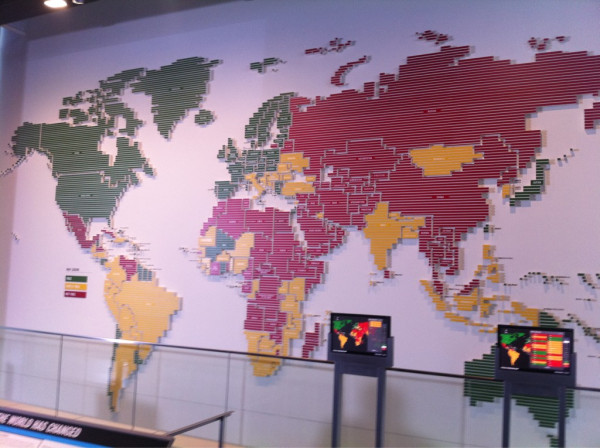
In 2010, only 1 in 6 people lives in countries with a free press, according to a new report on press freedom from Freedom House. There is a long road ahead to establishing and protecting freedom of expression for humanity.

This week, defenders of free expression are celebrating the progress of press freedom and recognizing the challenges that persist globally on World Press Freedom Day 2011. This is the 20th anniversary of the Windhoek Declaration that helped to establish UNESCO’s World Press Freedom Day. The United States is hosting this year’s World Press Freedom Day in Washington, D.C. at the Newseum. You can watch the livestream below and follow the conversation on Twitter on the #wpfd hashtag, both of which are embedded below.

wpfd2011 on livestream.com. Broadcast Live Free

new TWTR.Widget({
version: 2,
type: ‘search’,
search: ‘#wpfd OR #pressfreedom’,
interval: 6000,
title: ‘What\’s happening on’,
subject: ‘World Press Freedom Day’,
width: ‘auto’,
height: 500,
theme: {
shell: {
background: ‘#004382’,
color: ‘#ffffff’
},
tweets: {
background: ‘#ffffff’,
color: ‘#444444’,
links: ‘#1985b5’
}
},
features: {
scrollbar: false,
loop: true,
live: true,
hashtags: true,
timestamp: true,
avatars: true,
toptweets: true,
behavior: ‘default’
}
}).render().start();

To learn more about global freedom of expression and and the organizations that protect journalists and support the collection and dissemination of news about our world, visit: