What will the new Code for America Fellows be doing, now that the inaugural class has been chosen? Code for America’s CTO, Dan Melton, offered more insight into the forthcoming projects at the International Open Government Data Conference (IOGDC) today in Washington, D.C., where he talked about school ID cards in Boston, civic leader networks in Philadelphia and Seattle, and CivicCommons in the District of Columbia.
His presentation from IOGDC on “CRUD-ing the government,” which I was unable to record or attend due to my involvement in a parallel panel, is embedded below:
“An exploration of cyberpunk fiction, technology, where we’re headed, the challenges we face, and the solutions we need”-Ignite NYC. I gave a (very) similar talk called Pattern Recognition and Spimewatch at Ignite D.C. later that week. For whatever reason, this version seems to have come off much better. Rack it up to the first time on a big stage; there were close to a thousand people present in NYC.
What does the innovation on display at the Civic Apps contest by developers in Portland, Oregon mean to the city’s mayor?
“It’s bringing to the world knowledge of what exists in the real world but is so often unknown,” said Mayor Sam Adams in an interview at the awards ceremony for the winners of the contest.
“In Portland, like I think most cities, when people are armed with knowledge, they make wiser choices,” he said, pointing to applications like PDX Bus as examples of innovation that actually help citizens to navigate the city better.
Does open data lead to more economic value creation in the private sector and metropolitan areas alike?
“We are seeing folks that are sole proprietorships hire folks to help them build their business, their app business, their online business with our data sets.” he said. “For us, data has always been there, in some cases for decades. Putting it to use for the public and help people make money while they do it – we intend to be the open source capitol of the nation – and this is one contribution we can make, with our data sets.”
What’s next? “What CivicApps is about in part, providing the data, is sparking relationships, relationships which lead to economic opportunities,” he said. “Webtrends, Microsoft meets the local hacker or coder tonight at this event, who knows what will happen. Our job is to provide the data, provide the opportunity for relationships to occur, provide what in comparison is a tiny litte bit of money, a little incentive for people to keep going. And it’s also fun. It make the city more fun to live in, because you know what’s there.”
That incentive, incidentally, amounted to $1000 for each of the winners of the second round of Civic Apps awards, with another $3000 going to the Best of Show winner, Loqi.me. This afternoon, Skip Newberry, economic development policy advisor to Mayor Adams, congratulated the winners of CivicApps on Twitter.
As Mayor Adams mentioned later in the program, this Web app could be useful in a snowstorm in Oregon or, if adapted more broadly, for crisis response around the country or world.
App description: “This application is a resource for citizens, medical teams and governments before, during and after disasters. Loqi.me allows mobile users to send an emergency GPS beacon to a real-time map. Crises responders can view all of the help requests on the webpage, along with hospitals and fire stations, real-time 911 calls related to natural disasters. Ground teams can easily use Loqi.me on their mobile phones to send notices of supplies and terrain reports in real time. Remote helpers can easily see the whole picture on the website’s real-time map, handle help and information requests, and send messages to the network. Loqi.me supports subscription to group messages via SMS, AIM, Jabber and Twitter. No application installation is required. Location beacons can be sent simply by going to http://loqi.me on a mobile phone.”
App Description: “This is a simple, handy web map that helps you figure out how to ride your bike to transit. It lets you choose from a variety of base layers, and toggle transit stops, routes, and current bike routes. You can also query transit stops and routes for basic information. I made this for a Web GIS class at PSU and I’m a total beginner (with some code thanks to Professor Percy and OpenLayers).”
“This helped make our data useful to a lot of other developers and the general public,” said Mayor Adams. “Why take it on?”
“I saw all of this great data at the core when civic apps launched,” said Ogden. “When you get data into the Web format, you get Web developers who are really used to making human interfaces for things make them.”
App Description: “A web application to preview any of the public geo data on CivicApps from your web browser. You can choose a dataset and view that data on a map. Individual objects are clickable and can provide details (metadata).”
“We’re moving from the Social Web to the Civic Web. IT and geeks matter. What we can do with open data and the internet is very important. If government is a platform, we need people to create apps and others to open up data sets.”-Laurel Ruma, Gov 2.0 Evangelist, O’Reilly Media
If you want a great introduction to what Gov 2.0 is and why it matters, look no further than her 5 minute talk from Ignite NYC is embedded below.
If you’re looking for the faces of government 2.0, look no further. The video above, released today by Manor New Tech High‘s “Digital Dojo,” features more than a dozen voices (including this correspondent) talking about what Manor.Govfresh meant to them and what open government means to the country.
“I am very excited to be at Manor Govfresh because it’s the first time I’ve ever been to a conference that doesn’t just talk about change but actually does it,” said White House deputy CTO for open government Beth Noveck. “What’s exciting about Manor Govfresh is that it’s brought together so many people who are interested in municipal innovation and using technology to actually make a difference in local communities here in Manor, Texas, in Deleon, Texas, and across America, to actually make government work better.”
When you watch the video, of course, you’ll hear many more voices than Noveck’s, which is of course the point. The movement towards open government at the local level puts the growth of government 2.0 in context. As Stacy Viselli said this morning in a comment on Radar, “Communities and neighborhoods have been moving their organizations online for a while now and are looking for ways to do more. It creates an optimum environment for collaborative projects that include local governments, business, civic associations, nonprofits, and community foundations. Sometimes it’s not about the data so much as it is about providing a platform that empowers communities do what they are already doing–better.”
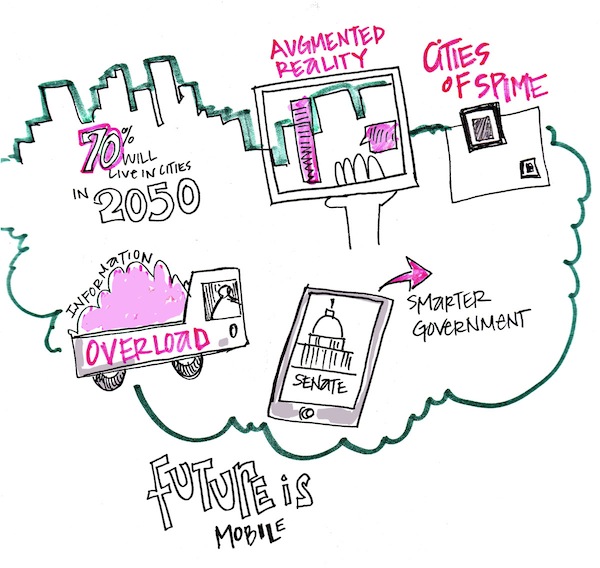
If you had five minutes to talk about the future, what would you say?
Last month, I had the privilege of presenting at two Ignite sessions, Ignite NYC at the Web 2.0 Expo and Ignite D.C. later in the week. If you’re not familiar, Ignites are 5 minute-long talks where presenters share subject they’re passionate about, using 20 slides that auto-advance every 15 seconds. If you’re not used to that rhythm, it can be tricky.
The video of my talk at Ignite D.C. is embedded below:
The presentation and associated links is embedded below:
Curious about the title for my talks? As fellow science fiction fans know, the title for these Ignite talks is an homage to two author: William Gibson, and Bruce Sterling. Gibson, sometimes called the “noir prophet” of cyberpunk, coined the term cyberspace and wrote “Pattern Recognition,” an enjoyable yarn about the future-present. Sterling, also an notable cyberpunk author, maintains the excellent Wired blog “Beyond the Beyond,” which has an entire category called “Spimewatch.”
How does making government smarter relate to open government, e-government or “We government?”
As Sifry put it in the Huffington Post this week ,
At Personal Democracy Forum, we prefer the term “We-government,” the co-creating of new forms of collaboration and service that use technology, public data and the social web to address vital issues and solve public problems, that enables us to do more with less. It’s neither Right nor Left, not small government or big government, but effective do-it-ourselves-government.
What are the early success stories and challenges for an open government in beta? This morning in Washington, I dodged rain drops on my way to a Gov 2.0 panel moderated by Ogilvy Digital’s Rohit Bhargava to talk about that very topic, joining Personal Democracy Forum co-founder Micah Sifry; Mark Murray, deputy political director for NBC News; Ari Melber, correspondent and blogger for the Nation magazine and Politico; and Gwynne Kostin, Director at the Center for New Media and Citizen Engagement at the GSA.
The panel was livestreamed at Livestream.com and integrated with the Ogilvy’s 360 Digital Influence Facebook page for an online audience. Fast forward to about 30 minutes into the archive for the beginning of the event.
“We’re just beginning to see the government using the Web in a more porous, participatory way,” said Sifry, who saw no reason that government workers couldn’t get technology in the same way other citizens else can. “Really, government workers have mastered the telephone,” he said. “The can probably use Web 2.0 tools.”
Gov 2.0 Case Studies
While Sifry was critical of the White House’s embrace of Gov 2.0 and open government, he observed that at the agency level he’s seeing “a flowering of initiative.” That’s backed up by what I’ve seen on the ground and have reported on in numerous studies. For instance:
“There’s a movement to make sure that cities all put their data out in the same way,” said Sifry, as evidenced by the Open 311 initiative
Sifry also referenced the targeted crowdsourcing example of Peer-to-Patent, an open government innovation pioneered by White House deputy CTO Beth Noveck
The reboot of FCC.gov and rollout of APIs and developer engagement holds some promise.
“There is a civic surplus waiting to be tapped of people who want the country to succeed,” said Sifry. And, in fact, I reported on Harnessing the Civic Surplus for Open Government,” when Noveck spoke in Manor, Texas about all of these initiatives.
I’m shortchanging the comments of Melber, Kostin and Murray due to time, unfortunately, but the #Ogilvy360di tweetstream and archived livestream offer additional perspective. Both of the reporters provided ample insight into the hyper-charged world of national correspondents in Washington, where news and issues move almost as quickly as the polls. More of Kostin’s thoughts may also be fond at her blog, OnDotGov.
How can government to citizen communications be improved during emergencies? Earlier this year at the Gov 2.0 Expo, I talked to the founders of Civiguard, a technology company that’s working on leveraging mobile tech, GIS and social media to create a platform to address the challenge.
Embedded below is an interview with Shawna Pandya, CMO of CiviGuard, Inc.. Pandya’s background includes experience in both technological innovation and public service, with work on the neuroArm robotic arm for neurosurgery, a stint as the VP of Research for an inner-city free clinic for high-risk youth and published papers on telemedicine for the developing world.


 E Pluribus Unum
