Jérémie Zimmermann on the Internet and civil society in France [VIDEO]

When it comes to the Internet, France has followed its own path in making policies, particularly with respect to intellectual property. Those choice were highlighted at the eG8 forum, where 20th century ideas clashed with the 21st century economy. The forum, held before the G-8 summit of global leaders, showed that online innovation and freedom of expression still need strong defenders.

As Nancy Scola reported at techPresident, at the eG8, civil society groups restaked their claim to the ‘Net. Looking for more answers, I spoke with Jérémie Zimmermann, co-founder and spokesperson for citizen advocacy group LaQuadrature du Net, about the Internet in France. For American Internet users, this interview should be by turns illuminating, provocative and a reminder of the freedoms we enjoy here.

Crawford: The open Internet is the basis for democracy flourishing around the world

“Access to the Internet is fundamental,” said Susan Crawford, an American law professor and former White House official, speaking at the The inaugural eG8 forum, held in Paris. These are the most important policies that government should be embracing. We want to make sure that other voices are heard.”

At the eG8, 20th century ideas clashed with the 21st century economy. The forum, held before the G-8 summit of global leaders, showed that online innovation and freedom of expression still need strong defenders.

As Nancy Scola reported at techPresident, at the at the eG8, civil society groups restaked their claim to the ‘Net. I spoke with Crawford about what’s at stake following an impromptu press conference held to highlight their concerns. Our interview is below:

“What’s at risk is the future of the Internet,” she said. It’s “whether it continues to be a distributed, open, platform for innovation, economic growth, democratic discourse, participation by all peoples of the world or whether it becomes a balkanized, taxed, blocked, controlled broadcast medium, which is what many incumbents would like to see.”

How close are we to that happening? “Luckily, we have a long way to go,” said Crawford, “because the people who use the Internet will continue to fight back with everything they’ve got.”

Watch the whole thing to hear what her take on why this matters to citizens, educators, children, and entrepreneurs.

Dyson at the eG8: You don’t need to be from the Internet to believe in liberty or free speech

At the eG8, 20th century ideas clashed with the 21st century economy. The inaugural eG8 forum, held in Paris before the G-8 summit of global leaders, showed that online innovation and freedom of expression still need strong defenders. As Nancy Scola reported at techPresident, at the at the eG8, civil society groups restaked their claim to the ‘Net.

Several attendees, many who had traveled from the United States, strongly questioned whether the Internet should be regulated in the ways that Sarkozy implied. The “value of internet is not just efficiency but also transparency,” tweeted Esther Dyson, “a much better regulator than government could ever be.”

I spoke further in with Dyson in an interview embedded below. What matters about the eG “is that you have a lot of people being exposed to one another and you have a lot of government people being exposed to people they don’t normally listen to,” said Dyson. “As usual, it’s not what happens up on stage, or what happens on the video: it’s what happens on the tweets, in the personal interactions, in the dinner afterwards, and in the back hall of the meeting. And that – that was positive. The world doesn’t change overnight, mostly. ”

She spoke to the concerns of civil society about eG8 recommendations: “It is sort of justified. Some of them were precanned. I actually sat down with my guy after doing my panel and changed them. I don’t think that happened with all of them. But again, the community is aroused: it’s going to make its points around this.”

Dyson also emphasized the universality of some of these concerns and what’s at stake. “You don’t need to be ‘from the Internet’ to believe in liberty or free speech.”

How are startups helping the global transparency movement? “They’re providing tools to make the data meaningful,” said Dyson. “They’re providing tools for people to share the information. They’re providing the communication tools, again, that allow from everything from Wikileaks to people communicating with reporters. Tools like your phone, connected to the Internet, so that you can record interviews not just with me but with all of the other people you talk to, upload them, people can share them, people can comment on them. That’s all technology.”

Dyson shared other thoughts on the eG8 and Internet freedom, including how entrepreneurs are changing the world through their work. Dyson also shared an insight that transcends technology:

“Even when you have a revolution, what makes the revolution works is what changes in people’s minds, and that’s what’s going on here,” said Dyson.

“The world is changing. People in government are not special. They should be as transparent as everybody else. People deserve privacy. Officials, governments, institutions, they all should be transparent. That’s new thinking, and it was being heard.”

Episode 4 of Gov 2.0 TV: Open Government News and the eG8

At At the eG8, 20th century ideas clashed with the 21st century economy. The inaugural eG8 forum, held in Paris before the G-8 summit of global leaders, showed that online innovation and freedom of expression still need strong defenders. As Nancy Scola reported at techPresident, at the at the eG8, civil society groups restaked their claim to the ‘Net.

I talked with Walter Schwabe of FusedLogic.tv about the eG8 in this week’s episode of Gov 2.0 TV, along with the news of cuts to U.S. federal open government websites. Federal CIO Vivek Kundra will shutter FedSpace and keep Data.gov up.

President Sarkozy at the eG8 Summit [VIDEO]

Today, the eG8 is considering the future of the Internet and society in Paris, in advance of the G-8 Summit. President Nicolas Sarkozy opened the summit after an introduction by Maurice Lévy, Chairman & CEO, Publicis Groupe, holding up the power of the Internet but emphasizing the role of the state in providing security, privacy and protection for intellectual property. Video is embedded below:

The moment that many may remember from the question and answer period that followed was when professor Jeff Jarvis asked President Sarkozy whether he’d take a “Hippocratic oath” to “first, do no harm” when making policy choices that affect the Internet.

Related coverage at the Guardian: Sarkozy opens eG8 Summit

White House turns to Twitter to discuss President Obama’s Middle East speech

The role of mobile phones, Facebook, YouTube and Twitter in the revolutions that have swept the Middle East in 2011’s historic “Arab Spring” has been the subject of much debate for months. While connection technologies helped to accelerate and amplify the news coming out of Egypt, Tunisia, Syria, Yemen, Libya, Bahrain and the rest of the region, it’s the incredible bravery of the young people who have stood up for their freedom in the streets that made change happen.

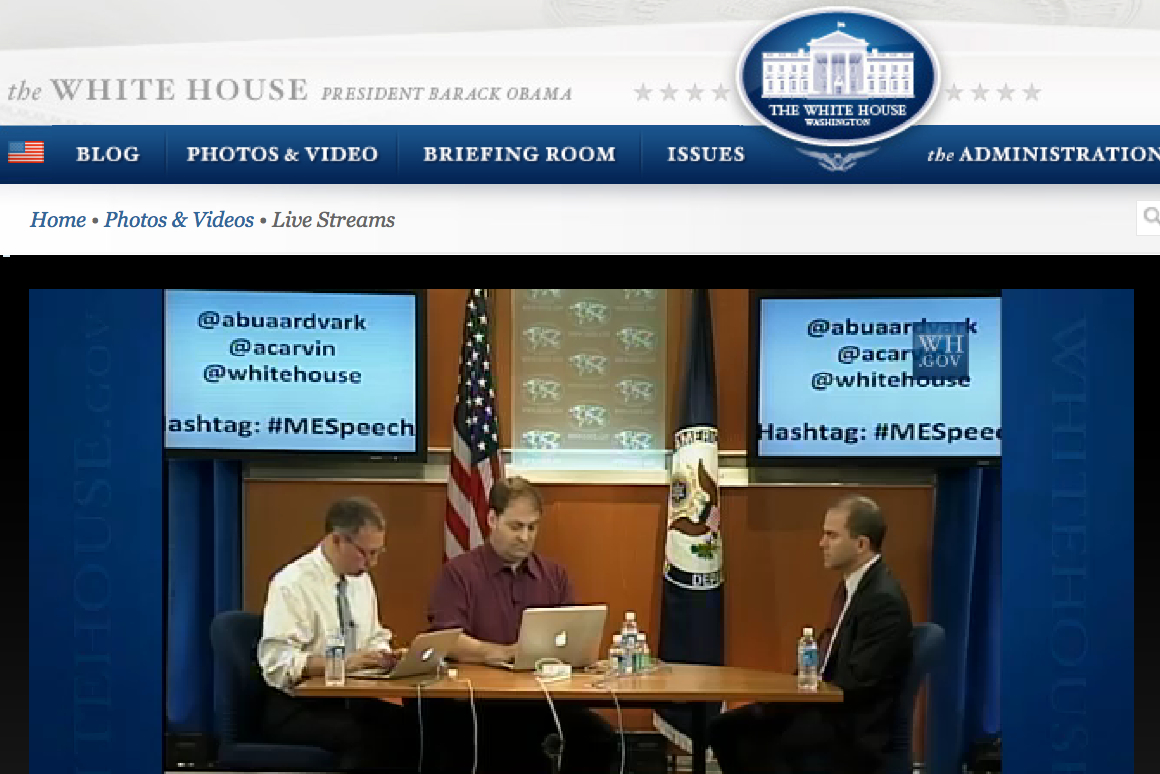
Tomorrow, President Obama will deliver a speech that many experts expect to reshape the Middle East policy debate. The speech will be live-streamed from the State Department and available to anyone online  at WhiteHouse.gov/live. In conjunction with the speech, the foremost curator of online media about the Arab Spring, Andy Carvin (@acarvin), will join with Foreign Policy’s Mark Lynch (@abuaardvark) in hosting a Twitter chat on the Middle East that will include an interview White House deputy national security advisor Ben Rhodes after the president concludes his remarks.

Earlier today, White House new media director Macon Phillips (@macon44) explained how the White House will continue the conversation on Twitter over at WhiteHouse.gov:

Immediately afterwards, the live-stream will switch to a follow-up Twitter chat with Deputy National Security Advisor Ben Rhodes, where anyone will be able to pose questions and reactions via Twitter.

NPR’s Andy Carvin (@acarvin) and Foreign Policy’s Marc Lynch (@abuaardvark), two experts who bring both a deep understanding of foreign policy and extensive online networks, will facilitate a world-wide conversation that will include participants from the Middle East and North Africa.  As Andy explains:

Rather than come up with all the questions ourselves, we’d like to invite you to help us craft the questions. If you’re on Twitter and want to submit a question, please post a tweet with your question and include the hashtag #MEspeech in the tweet. You can pose your question before or during the speech. We won’t be able to get to every question, of course, so we encourage everyone to follow the #MEspeech hashtag and join the broader conversation about the speech on Twitter.

Folks at the White House (@whitehouse) will be keeping an eye on the #MESpeech hashtag as well, so be sure to use that to share thoughts before, during and after the speech.

Keep an eye on that hashtag tomorrow: this will get interesting.

//

UPDATE: I’ve embedded the archive from today’s Twitter chat at the end of the post along with video from the White House. Quick thoughts on the outcome of today’s “Twitter chat.”

1) I thought Carvin and Lynch did a phenomenal job, and that this was well worth their considerable effort. Carvin described the experience of a Twitter interview as akin to “juggling and riding a unicycle simultaneously, all the while trying to interview a senior administration official.” The two men asked tough questions from a global audience, starting with fundamental issues of trust and policy towards Bahrain, shared the questions and answers as they went on Twitter, often including the @ handle of the person who asked them. The result was a fascinating window into one future of new media, geopolitics and journalism. The considerable trust that they were given to find and ask the best questions was, in my eyes, paid back with interest. Well done.

2) It was also hard not to see a marked contrast between the recent “Facebook townhall” where founder Mark Zuckerberg asked President Obama all of the questions and Andy Carvin bringing questions culled from a real time global conversation to Ben Rhodes.

3) On a week when the executive editor of the New York Times offered considerable skepticism about Twitter’s value, this event serves as a quiet, powerful reminder of the platform’s global reach in the hands of those willing to fully engage the public there.

4) Poynter has an excellent background post regarding why NPR’s Andy Carvin is moderating the White House Middle East speech Twitter chat. NPR’s managing editor for digital news explained:

“Andy has cultivated a unique audience and following around the world and is the right person to carry on a conversation and channel a wide range of questions from around the world. He’s been doing it for months.”

If the interview were being conducted another way, Stencel said, perhaps a program host or a beat reporter would’ve done it.

Carvin “has the talent in this format that our hosts have in commanding the air. Andy is in essence the Neal Conan [host of NPR’s “Talk of the Nation”] of social media. He understands the format and he can conduct the interview in a way that takes a combination of smarts and skills that’s rare in media.”

That’s about right. In May 2011, there is no one using Twitter in this way more effectively than Andy Carvin. He has been more actively and deeply engaged in finding, validating and distributing the digital documentary evidence emerging from the Middle East on social networks and video sharing sites over the past six months than anyone else on the planet. He’s been storytelling using what Zenyep Tufecki aptly called “Twitter’s oral history” in a way that brings the voices and vision of millions of people crying out for freedom to the rest of the world. Today, he brought their questions into the State Department and White House. Pairing him with a foreign policy expert in Lynch brought significant weight and contextual experience to interviewing Rhodes. Well done.

For more, Nancy Scola wrote up Carvin and Lynch’s ‘Twitter interview’ with Rhodes over at techPresident. As always, she’s worth reading on it.

Nigel Shadbolt on data.gov.uk: Open data is not a partisan issue

Catalyzing innovation and adding more transparency to government through the release of open data is an issue that should rise about partisan politics. At least, that was the message that Nigel Shadbolt, an advisor to the United Kingdom, delivered at a conference in Bilbao, Spain yesterday.

Opendata : les leçons à tirer de data.gov.uk, par Nigel Shadbolt from RSLNmag on Vimeo.

Shadbolt’s presentation on how they did data.gov.uk, the British open government data website will offer some fuel to the arguments of advocates in other countries or states working to justify standing up similar repositories – or defend one that are already online. In his presentation, below, Shadbolt offers up a range of arguments, including more accountability, citizen engagement, improvement to public services, government efficiency, benefits to economic and social value, and that “government as a platform” idea that continues to maintain traction around the globe.

Opendata – data.gov.uk : how did we do it?

It was only last month, after all, that the United States Congress weighed deep cuts to funding for federal open government data platforms, with the final budget slashing the White House Office of Management and Budget’s e-government fund by some 75%. As data.gov relaunches as a cloud-based platform, the arguments for open data that Shadbolt advances will need to be born out with favorable outcomes in at least a few areas over the coming year to shore up bipartisan its continued operations. The brightest hope for those outcomes is likely to come from health.data.gov, a subdomain of the main open government data repository, where the U.S. Department of Health and Services has been working to making health data as weather data.

For more on the United Kingdom’s open government initiative and the open data movement, watch Shadbolt’s talk from February 2011 of this year, embedded below:

[Hat tip to the Australia E-Government Research Center]

Britain seeks alpha

In the United States, government agencies like the FCC have launched open government websites in beta. In the United Kingdom, the United Kingdom is rolling back one more version and seeking alpha.

Alpha.gov 404 error page

Alpha.gov.uk is an experimental prototype of a new, single website for government in the United Kingdom that the Government Digital Service developed over the course of three months, working from the recommendations of Martha Lane-Fox’s Review. That service is located within the UK Cabinet Office. As its designers emphasize, “the site is a demonstration, and whilst it’s public it’s not permanent and is not replacing any other website.” (The hilarious 404 graphic above was designed by Matt Blease.)

There are some interesting semantics to consider here. In software development, “alpha” refers to the initial release in a software development cycle. In machine learning, alpha is “the degree to which a learning agent takes into account new information.”

In either sense, a government seeking alpha in rebooting its online presence is both taking risks and revisiting what government websites should do in the 21st century. The trial of Alpha.gov.uk offers a toolkit of simple, reusable functions that are oriented around the most common needs that citizens go online to address, like lost passports.

To date, the British plan to reinvent websites has received good press, including an excellent post what Alpha.gov gets right. One notable choice in age of austere budgets: going with an open source platform and using next generation web development tools and languages, including a mix of Ruby and Python. Says Wired UK:

This isn’t the first time that the government has experimented with creating a single site for all departments. From URL directories to public service hubs, sites like direct.gov.uk have often tried to shove the whole shebang into one, hulking site with varying degrees of success.

But Alpha.gov.uk’s daring design, 21st century architecture and expansive ambitions (the content can be easily syndicated to new internet platforms, like apps or IPTV),  could be the way forward.

The Alpha.gov team continues to share more about how Alpha.gov was developed at the project blog, encouraging citizens to play with the prototype and send feedback to Get Satisfaction or to @AlphaGov on Twitter or Facebook.

[Image Credit for Alpha.gov Error Page designed by Matt Blease: Ben Terrett]

Taking stock of global freedom of expression on World Press Freedom Day

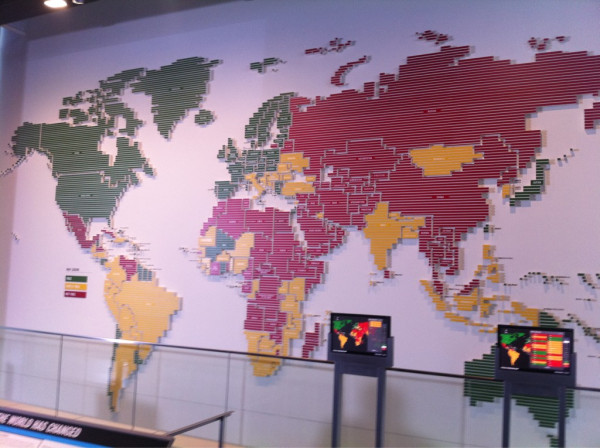
In 2010, only 1 in 6 people lives in countries with a free press, according to a new report on press freedom from Freedom House. There is a long road ahead to establishing and protecting freedom of expression for humanity.

This week, defenders of free expression are celebrating the progress of press freedom and recognizing the challenges that persist globally on World Press Freedom Day 2011. This is the 20th anniversary of the Windhoek Declaration that helped to establish UNESCO’s World Press Freedom Day. The United States is hosting this year’s World Press Freedom Day in Washington, D.C. at the Newseum. You can watch the livestream below and follow the conversation on Twitter on the #wpfd hashtag, both of which are embedded below.

wpfd2011 on livestream.com. Broadcast Live Free

new TWTR.Widget({
version: 2,
type: ‘search’,
search: ‘#wpfd OR #pressfreedom’,
interval: 6000,
title: ‘What\’s happening on’,
subject: ‘World Press Freedom Day’,
width: ‘auto’,
height: 500,
theme: {
shell: {
background: ‘#004382’,
color: ‘#ffffff’
},
tweets: {
background: ‘#ffffff’,
color: ‘#444444’,
links: ‘#1985b5’
}
},
features: {
scrollbar: false,
loop: true,
live: true,
hashtags: true,
timestamp: true,
avatars: true,
toptweets: true,
behavior: ‘default’
}
}).render().start();

To learn more about global freedom of expression and and the organizations that protect journalists and support the collection and dissemination of news about our world, visit:

eG8 to consider the future of the Internet and connected society

Cheers to Nova Spivack for unveiling the e-G8 agenda and his thoughts on the upcoming e-G8 Forum in Paris, France.

UPDATE: I will be attending the eG8, assuming that a volcanic eruption in Iceland doesn’t bollux up my air travel. Fingers crossed, and analysis below.

As Spivack noted in his post, there had been very little press coverage of the event when it was annoucned. His thoughts on the future of the Internet, government and society are well worth reading, particularly with respect to the major issues of the day. I post an excerpt from his post below:

Social networks are the cultural nervous systems of our new 21st century civilization. The problem is, they are being created and governed by commercial interests, not by their constituents.

If commercial social networks truly do become the fabric of our new societies, what happens to our civilization? It becomes privatized and controlled by commercial interests, not elected governments. Is that a world you want to live in?

The Internet is a new global resource, which, like the oceans, the atmosphere and the rainforests, must be protected in order to be of greatest benefit. It is something which every human should be able to share in, equally, and in fact, equal access to the Internet may soon become necessary in order to participate equally in any society or government.

Head on over to read the whole thing. If you have thoughts on the forum or know who else is going, share it on Twitter at #eg8 or in the comments.

As I said, I’ll be going and plan to share as much of what I see and hear as is reasonably possible. There are many people on both sides of the Atlantic who are asking whether the eG8 will create solutions – or more cynicism.

The New York Times presented the eG8 as an event where the “chaos of the Internet will meet a French sense of order. The crux of the matter is that France has pursued legislation and policies that revoke online access to citizens who share intellectual property, in a so-called “three strikes law,” and pursue technical blocks rather than going through courts.

Within Europe, there are also issues that divide, with Mr. Sarkozy pursuing a more active digital agenda than leaders of many other countries. His program has included a new law allowing the authorities to suspend Internet access to Internet users who ignore repeated warnings to stop sharing unlicensed music, movies or other copyrighted works online. Another new law permits the government to block access to Web sites that disseminate child pornography, rather than requiring law enforcement officials to pursue offenders through the courts.

While Britain has passed a law authorizing a similar crackdown on digital piracy, other E.U. members have been more circumspect. On the filtering of illegal content, German officials have expressed reservations about the French approach.

The New York Times acknowledges some of the disparities and congruences here, along with the reality of a fast-changing world where Europe it but one of the global hubs of influence. For instance, India, China and Indonesia, with hundreds of millions of online citizens, don’t have a clear seat at the eG8 table, so to speak. All of them have a stake in subsequent policy choices.

Many organizations concerned with human rights, liberties and civil society online have released a statement to the eG8 and G8 that advocates “expanding internet access for all, combating
digital censorship and surveillance, limiting online intermediary liability, and upholding
principles of net neutrality.”

In particular, a coalition of organizations – which includes the Electronic Frontier Foundation and Reporters without Borders – has highlighted concerns about a trend towards increasing “intermediary liability” and defending freedom of speech online. Part of France’s HADOPI law was declared unconstitutional in 2009 but a “3 strikes and you’re off the Net” reality still persists. In other words, while you’re in France, watch what you download.

For those unfamiliar with the issue, intermediary liability refers to holding Internet service providers or online media platforms liable for their users posting copyrighted or defamatory content. The ACTA treaty appears to increase such liability. United States Internet policies in this area over the past two decades have enabled many new businesses and services to flourish, as venture capitalist Fred Wilson articulated this week.

The coalition of civil society organizations urged eG8 participants “to follow the example of the Brazilian government’s Principles for the Governance and Use of the Internet, specifically #7 which reads: ‘All action taken against illicit activity on the network must be aimed at those directly responsible for such activities, and not at the means of access and transport, always upholding the fundamental principles of freedom, privacy and the respect for human rights.'”

Such measures and the issues that they are taken to address are not at all foreign to the halls of Washington and related Internet policy discussions, or the actions of the American federal government in recent months. That said, the United States federal government is not monolithic in its policies. It will be quite interesting, for instance, to see how the White House’sInternet freedom policy is defended by the State Department, particularly if compared or contrasted with, say, the actions of the Department of Homeland security or the Justice Department by other members of the G8.

Recent website takedowns by ICE, in concert with the White House IP and copyright office, highlight that governments on both sides of the Atlantic. are taking action to address the concerns of industry. The re-introduction of a new, tweaked “Protect IP” bill that would force search engines to remove sites that list infringing context from their indices is a legislative aspect of that common thread.

The White House has outlined an “international strategy for cyberspace” offers some insight into where American officials may stand in some respects, along with associated issues of identity, privacy and security.

As the eG8 forum looms, it’s unclear how much of the event will be an opportunity for president Sarkozy to stake out France’s position on Internet policy, how much of the programme will offer a forum for information exchange, or how much weight will be given to any resulting recommendation by policy makers. The Reuters analysis of this Web economy forum highlights these complexities. Realistically, two days and 800-odd participants may not drive much more than conversation. That said, in a time and place when the Internet – and being connected to it – are an increasingly important factor in the lives of billions of citizens, how it is architected, governed and extended matters.