

Linking up WhiteHouse.gov and a new US-India Partnership on Open Government

After an election that saw open government make gains in statehouses across the United States, a new transcontinental partnership offers new opportunities for international collaboration. This afternoon, Samantha Power, special assistant to the President for multilateral affairs and human rights, blogged about a new US-India partnership on open government at WhiteHouse.gov. Her post describes President Obama’s visit to an “Expo on Democracy and Open Government” at St. Xavier’s College in Mumbai and the technologies and organizations he encountered there. According to Power:

“India’s dynamism in the technology sector is well known, as is Gandhi’s legacy in India of civic action and bottom-up change, but today’s expo highlighted something very fresh: Indian civil society’s harnessing of innovation and technology to strengthen India’s democracy — by fighting corruption, holding government officials accountable, and empowering citizens to be the change they seek.”

Power’s post is thorough, descriptive and contextualizes the president’s trip and the growing use of technology to fight corruption and improve accountability in India. It also contains only one link that’s relevant to the organizations that were at said “Expo on Democracy and Open Government.” Ipaidabribe.com was created by Janagraaha to enable “Indians upload videos of their experiences in paying a bribe, in refusing to pay a bribe, and in ‘not having to pay a bribe.'”

The expo itself does not appear to have a website, or at least one that could be discovered after a few minutes of searching online.

The closest thing to an online FAQ is the White House press release on “Indian Innovations in Expo for Democracy and Open Government posted at America.gov, where the participating organizations are listed and described. Neither the WhiteHouse.gov blog post nor the release contains that most elemental of online elements: hyperlinks to the relevant person, place or thing being described. For some readers, used to the limitations of print, that may not be a huge issue. For digital natives or immigrants, the absence of links is a big missed opportunity.

The reason that critique is particularly fresh this afternoon is that one of the archetypal bloggers on the Web, David Winer, made the argument at Scripting News today that WhiteHouse.gov should be a hyperlocal blog. Specifically:

The sitting President can’t run campaign ads as an aspiring President does. But he has the ability to communicate more effectively than anyone else on the planet, if that power is developed. If you send people away to places that involve them. The White House blog should be a daily link list of ideas and perspectives on what’s happening in the world.

For instance, Power could have linked to the press briefing at USAID.gov where she, Secretary of Agriculture Tom Vilsack, USAID Administrator Raj Shah and Chief Technology Officer Aneesh Chopra talk about yesterday’s agricultural exposition, including her comments on this open government partnership. For example:

one of the things that we’ve been doing is really learning as a government just how rich the innovations are in a lot of emerging democracies, and indeed, in a lot of new democracies and transitional democracies. No one country has a monopoly on innovation in this space. And it’s indeed quite inspiring to see how even with very few resources you can see how creative nongovernmental actors are, or indeed champions within government who are stepping forward and taking advantage of new technologies and so forth to try to enhance partnership or transparency.

So having said that, I still think India has a huge number of comparative advantages. I mean, for starters it has one of the most noble traditions in human history of bottom-up change and bottom-up activism. I mean, the whole history of modern India is rooted in what you might call the original “Yes, we can” with Mr. Gandhi and the movement that he created and the billions of people that he inspired around the world, one of whom, as the President said today, was Martin Luther King, without whom, arguably, we wouldn’t be where we are in my own country.

So this tradition of bottom-up change, of citizen demand the quality of demand that one encounters out in the most rural areas and some of the most impoverished areas here, even among people who haven’t yet acquired literacy in their communities.

For an administration that’s embraced the idea and practice of Gov 2.0 in many notable ways, failing to link in even a Web 1.0 way is surprising. And to be fair, this post was an exception. The White House blog has frequently made good use of links, video and images, as shown by this week’s WhiteHouse.gov weekly wrapup.

For the sake of the broader open government community who may be interested, here’s the list of participants in that Expo from the press release, this time with links to the relevant organizations or news coverage, where such websites are not available:

An Illustrative List of Exhibitors and Roundtable Participants:

· Mazdoor Kisan Shakti Sangathana (Workers and Peasants Strength Union – MKSS) is an organization that fights against government corruption and creates channels for citizens to oversee their local governments. Its leader, Aruna Roy, is best known as a prominent leader of the Right to Information movement in India which led to Parliament’s passage of the Right to Information Act in 2005, which has empowered millions of ordinary Indians.

· Satark Nagrik Sangathan (SNS) is a New Delhi based citizen’s group with a mandate to promote accountability and transparency in government functioning. SNS’s key activities have been to promote the use of the Right to Information Act (RTI) by training citizens, particularly women in slum areas, to use the RTI and on the functioning of the government in areas such as rations, civic works, education and social welfare schemes. More recently, SNS has used the RTI to collect information on the performance of elected representatives and develop report cards.

· Janaagraha is a Bangalore-based NGO that works with citizens and government to change the quality of life in India’s cities and towns, focusing on urban infrastructure and citizen engagement with public institutions, including volunteerism. They also recently launched an exciting initiative called IPAIDABRIBE.com, a web platform for where people who have been asked for or ever had to pay a bribe are encouraged to share their experiences (after only 2 months, it gets 30,000 hits per day).

· The Hunger Project (THP) is a global organization committed to ending hunger. In India, it is committed to ignite and sustain the leadership spirit of women elected to local village councils (panchayats). THP works in 13 states of India, including Maharashtra (where Mumbai is located). By partnering with more than 90 civil society organizations, THP has worked with and supported the leadership of more than 60,000 elected women representatives.

· ASER uses simple tools to empower people nationwide to test their children’s math and reading abilities, and then hold local government accountable to outcomes. With this data, ASER creates the Annual Status of Education Report, which surveys literacy in 570 districts and 700,000 children of India with citizen participation. Each year 25,000 volunteers donate 4 days of their time to gather the data for this report.

· PRS Legislative Research (PRS) works with Members of Parliament (MPs) across party lines to provide research support on legislative and policy issues. Its aim is to complement the base of knowledge and expertise that already exists in government, citizens groups, businesses, and other research institutions. PRS also enables citizens to track the progress of legislative and policy reforms through an on-line portal.

· The Association for Democratic Reforms (ADR) works on building fair and transparent electoral and political processes in India. ADR has organized Citizen Election Watch for all major elections and discloses candidate background information in a timely manner, including through SMS technology, to the media and the public, helping them to make informed voting choices.

The takeaway for government – or any organization, for that matter – is that blogs and the Web offer new opportunities to share information, create more surface area to expose ideas to citizens and create conversations. If official accounts of new partnerships or events consist of plaintext press releases, lack a website or a post on the most prominent government blog in the world fails to include images, video or relevant links, that opportunity is being neglected.
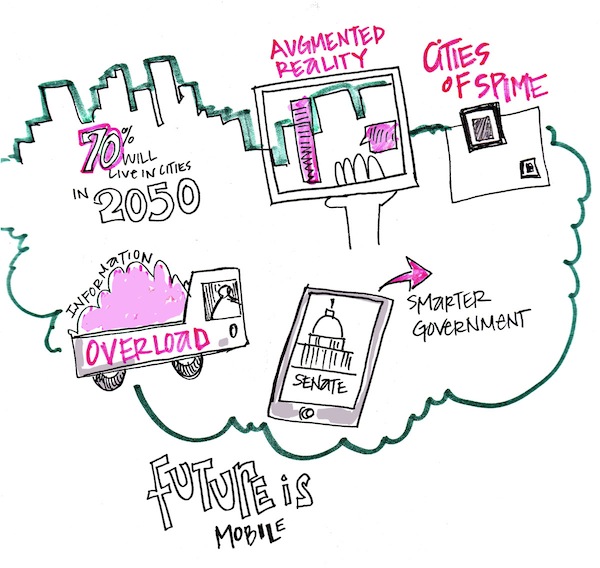
The Future is Mobile at Ignite NYC: Open Data, Open Government and Augmented Reality

“The future is already here – it’s just not evenly distributed.” —William Gibson.

http://blip.tv/play/AYKJtSgC

“An exploration of cyberpunk fiction, technology, where we’re headed, the challenges we face, and the solutions we need”-Ignite NYC. I gave a (very) similar talk called Pattern Recognition and Spimewatch at Ignite D.C. later that week. For whatever reason, this version seems to have come off much better. Rack it up to the first time on a big stage; there were close to a thousand people present in NYC.

The creative graphic recording at Ignite NYC at Web 2.0 Expo was created during the talk by Nora Herting of ImageThink.

For a great Ignite talk with a related theme, check out In Coders We Trust, by Laurel Ruma.

Making sense of Gov 2.0, Open Government and We Government at Ogilvy

What is Gov 2.0?

How does making government smarter relate to open government, e-government or “We government?”

As Sifry put it in the Huffington Post this week ,

At Personal Democracy Forum, we prefer the term “We-government,” the co-creating of new forms of collaboration and service that use technology, public data and the social web to address vital issues and solve public problems, that enables us to do more with less. It’s neither Right nor Left, not small government or big government, but effective do-it-ourselves-government.

What are the early success stories and challenges for an open government in betaThis morning in Washington, I dodged rain drops on my way to a Gov 2.0 panel moderated by Ogilvy Digital’s Rohit Bhargava to talk about that very topic, joining Personal Democracy Forum co-founder Micah Sifry; Mark Murray, deputy political director for NBC News; Ari Melber, correspondent and blogger for the Nation magazine and Politico; and Gwynne Kostin, Director at the Center for New Media and Citizen Engagement at the GSA.

The panel was livestreamed at Livestream.com and integrated with the Ogilvy’s 360 Digital Influence Facebook page for an online audience. Fast forward to about 30 minutes into the archive for the beginning of the event.

http://cdn.livestream.com/grid/LSPlayer.swf?channel=ogilvy360didc&clip=pla_450cc7e2-ce2f-487e-82d0-f8db28753ff1&autoPlay=false

“We’re just beginning to see the government using the Web in a more porous, participatory way,” said Sifry, who saw no reason that government workers couldn’t get technology in the same way other citizens else can. “Really, government workers have mastered the telephone,” he said. “The can probably use Web 2.0 tools.”

Gov 2.0 Case Studies

While Sifry was critical of the White House’s embrace of Gov 2.0 and open government, he observed that at the agency level he’s seeing “a flowering of initiative.” That’s backed up by what I’ve seen on the ground and have reported on in numerous studies. For instance:

“There is a civic surplus waiting to be tapped of people who want the country to succeed,” said Sifry. And, in fact, I reported on Harnessing the Civic Surplus for Open Government,” when Noveck spoke in Manor, Texas about all of these initiatives.

I’m shortchanging the comments of Melber, Kostin and Murray due to time, unfortunately, but the #Ogilvy360di tweetstream and archived livestream offer additional perspective. Both of the reporters provided ample insight into the hyper-charged world of national correspondents in Washington, where news and issues move almost as quickly as the polls. More of Kostin’s thoughts may also be fond at her blog, OnDotGov.

http://cdn.livestream.com/grid/LSPlayer.swf?channel=ogilvy360didc&clip=pla_4d3b3b86-4458-40b4-92af-ed14a203397a&autoPlay=false

Selected reflections from the online audience:

@msspinach: “The hot question: what exactly is #gov20? Gwynne Kostin: ‘We’re still throwing spaghetti on the wall and seeing what sticks.'”

@voleynik:#Gov20 = government using the web to create better services for citizens. Creating smarter more effective government.”

@SaBean21: “Our bill of rights is being used in a digital form. Open platform is a tiny & fragile thing we have right now.

@dlblack: “@digiphile: the gov20 / #opengov conversation can’t just be about Washington, it has to be about data people can use”

@msspinach: “#gov20 means whoever is in power gives up some cntrl. If u want group prticipation, ppl need to feel they’re being listened to.”

@merici:”Ok, social media exists. We get it. Moving fwd, what are ex of gov using web to be smarter, more efficient?”

@dlblack: “not all #gov20 projects need to be about mass participation, they need to be about exchanging knowledge w/right audience”

Canadian Apps for Climate Change Winners Announced

Earlier this spring, the United States released community health information to provision healthcare apps and drive better policy.

[Photo by Senior Airman Joshua Strang, U.S. Air Force, via Wikipedia]

Now, scientists and policy makers will explore the potential for climate data services to inform citizens and government, enabling both to make better decisions for communities and businesses alike.

Can open government lead to greater awareness or action around the existential issue climate change? Posting open data online in of itself is not enough, although there’s no question that publishing scientific data where it can be publicly accessed, validated or stored is a huge step forward with respect to transparency.

Socializing open health data was necessary to build a better government platform at the National Institute of Medicine, where open data and innovation led to an innovative means to identity pills.

Is collaborative innovation in open government possible in Canada? On the one hand, Canadian open data consultant David Eaves bluntly pointed out some of the challenges extant because of culture: Collaborate? ‘Governments don’t do that’.

Collaborative innovation, however, may be another matter, as many governments, large and small, are experimenting with websites crowdsourcing citizen ideas.

Enter the Apps for Climate Action Contest, which challenged Canadian software developers to raise awareness and inspire action by using open data in Web and mobile applications. The open data itself came from the government of British Columbia, which created a catalogue of climate and greenhouse gas emission data at Data.gov.bc.ca.

So who won?

Best Web AppVELO

The app allows organizations to compare against peers internally and externally, enabling businesses to monitor and compare benchmarks for carbon emissions continually rather than annually.

Best Mobile AppMathTappers: Carbon Choices

The MathTappers: Carbon Choices App is designed to help students examine the effects of their personal choices on climate change. As students track their choices their impact is assessed in terms of annualized kg of CO2 equivalents generated.”

Best of B.C.Waterly

This app is designed to help people to use less water on their lawns.

People’s ChoiceVanTrash

“VanTrash scrapes pickup schedules from City of Vancouver websites and combines it with GIS data from data.vancouver.ca. In turn, VanTrash exposes this scraped data in a clean RESTful API for other citizens to build and innovate on.” The idea here is that the app will help residents to remember to take their recycling, organic waste and other garbage out.

Will any of these apps make a difference in a global context? The jury is out on that count. Notably, several of the winners empower citizens with more lightweight access to information about local services or awareness of commodities usage. Canada may be one of the world leader’s in sheer volume of clean water but that doesn’t mean minimization of transport or use doesn’t make sense. I could certainly use a trash and recycling reminder here in Washington; maybe Octo Labs will work with a good developer if the data is available.

A gallery of all the climate change apps is online.

Climate Services and Open Data in the US

In the United States, using data as a climate change agent is part of the big idea behind Climate.gov, where public climate data from NOAA and NASA could spur better decisions and a more informed society.

Amidst varied hopes for open data and open government, enabling better data-driven decisions in both the private and public sector rank high. One of the existential challenges for humanity will be addressing climate change, particularly in countries where scientific resources are scant or even non-existent.

In February, the Obama administration proposed a climate service that would provide projections on climate change in much the same way that the National Ocean and Atmospheric Association (NOAA) provides weather information. Earlier this summer, the Center for Strategic and International Studies (CSIS) published new research, “Earth Observation for Climate Change,” and hosted a forum on leveraging climate data services to manage climate change. The video from the forum is embedded below:

http://blip.tv/play/hYpBgfCMMwI

For more perspective on the role of Climate.gov and climate services, read the full post on Radar.

Exploring Gov 2.0, open data and open government in Canada

What’s going on with Gov 2.0 in Canada? I had the opportunity to interview David Eaves on Gov 2.0, open government and open data in Canada last week – and I took it. He shared even more perspective on the state of open government in Canada with my colleague Mac Slocum at Radar back in March. And if you’re not following his posts on government collaboration ( or the lack thereof), well, start. His talk about Gov 2.0 in Canada at the recent Gov 2.0 Summit is embedded below:

Eaves posted a wealth of links on Gov 2.0 in Canada at his blog after the talk.

For those interested in further perspective from north of the 49th parallel, flip through the presentation by Jury Konga, principal of the eGovFutures Group embedded below:

“Participation partition” the newest facet of the digital divide, warns Gruen

Disparities in access to the Internet have been persistent since the scratchy sounds of a modem were first heard in offices, basements and schools. In recent years, the digital divide has grown to encompass smartphones usage, differentiation of broadband Internet and open data’s role in empowering the empowered.

Dr. Nicholas Gruen, CEO of Lateral Economics and the former chair of the Government 2.0 Taskforce in Australia, warned the audience at the Smart Government 2010 conference in Melbourne of a new dimension to the digital divide: a “participation partition” that favors citizens who are more active engaging in online discourse.

“The world is leaning towards favouring those who participate,” said Gruen. “They have more fun and more influence. If you participate more in your local school and local democracy, you’re going to have more say and more power. I see these things as very healthy, but there isn’t an equality of outcomes for everyone.”

As Rob O’Brien reported in Government News, Australia’s Gov 2.0 Taskforce pushed government entities to participate more online themselves, including encouraging public sector officials and workers to use with social media tools.

“We’ve now got 20 government blogs, that’s a great start. What we don’t have is people participating on blogs,” Mr Gruen said. “I’m not suggesting they should be making controversial comments, but just be a member of a group of people talking about policy issues.”

Redefining Public/Private Partnerships

Dr. Gruen was a featured speaker at the Gov 2.0 Summit in Washington, where he explored public goods in the context of open government and digital citizenship. His talk is embedded below:

For more on what’s been happening in technology and government in Australia, see my report on Gov 2.0 Down Under: Australia and Open Government.

New Data.WorldBank.org fuels storytelling with the power of open data

Earlier today, the new data.worldbank.org launched. As I reported for Radar this afternoon, added widgets, maps and an API make World Bank data sing.

The Bank is increasing the number of indicators available on the site from 339 to more than 1,200, and it has substantially improved its API. Four different languages are supported on the site, along with an improved data browser, feedback buttons, instant search, and embeddable widgets.

“The new site shows the art of the possibility,” said Eric Gundersen of Development Seed, the D.C.-based Drupal shop behind the World Bank’s data catalog. “This is really actionable information. So many more NGOs [non-governmental organizations] can now make data-informed decisions if they have access.”

Below, I’ve embedded a video on the power of geo-coding aid.

From the blog:

A team of researchers from Development Gateway and AidData have worked with the World Bank to add detailed subnational geographical information to all of the Bank’s active projects in the Africa and Latin America region. This isn’t just pins in a map showing the country where the money is spent: they have looked through the project documentation to find out as far as possible the geographic coordinates of the actual locations where aid the activities take place.

This video by AidData explains brilliantly what geocoding means, and why its important.

As I also reported at Radar, the World Bank wil be running an Apps for Development contest, launching on Oct. 7.  In addition to the contest, the World Bank will host an open forum on Oct. 7 that will feature experts from the open data movement via live webcasts and a 24-hour chatroom.

David Eaves on Gov 2.0, Open Government and Open Data in Canada

“If you read only one blog in the Gov 2.0 space, you should read eaves.ca” – Tim O’Reilly.

My interview with David Eaves on open government and open data at today’s Gov 2.0 Summit is a reminder why my publisher would offer that ringing endorsement. We talked about the risks and rewards of open data, the state of Gov 2.0 in Canada and the progress of “We government” up across the border. Eaves also revealed that Canadians love Facebook, though perhaps not as much as hockey.

Exploring the future of online privacy with Jules Polonetsky

How will regulations and laws that address the new challenges of online privacy evolve? What are the tradeoffs between societal benefit and individual rights? How should the opportunities inherent in data mining be balanced with harm-based standards? What are the responsibilities of governments, businesses and citizens to protect privacy?

Yesterday at the Gov 2.0 Summit in Washington, my interview with Jules Polonetsky covered all of those topics and more. Polonestsky is the Co-chair and Director of the Future of Privacy Forum, a think tank seeking to improve the state of online privacy by advancing responsible data practices. His writing and research can be found at Futureofprivacy.org.

Cisco CTO Padmasree Warrior on the power of video

Last month, I interviewed Cisco CTO Padmasree Warrior about technology, gov 2.0 and open government. In the excerpt below, we talk about some lessons for the public sector from her experience in the business of technology, particularly around distributed collaboration using video conferencing. “The power of video is that it really allows us to extend the abstract notions of text-based technology and replaces that with much more human way of communicating,” said Warrior. “It’s more natural.”

Warrior, who went to Russia this past winter on a State Department “TechDel,” leveraged telepresence to collaborate with her fellow travelers after they dispersed. She’ll be talking more about more about similar lessons from the private sector in her conversation with Tim O’Reilly at the Gov 2.0 Summit next week. I’ll be posting more excerpts from our interview at Radar on Monday.