President Barack Obama talks with Facebook founder and CEO Mark Zuckerberg before a dinner with Technology Business Leaders in Woodside, California, Feb. 17, 2011. Also pictured, left to right, are Carol Bartz, Yahoo! President and CEO; Art Levinson, Genentech Chairman and former CEO; Steve Westly, Founder and Managing Partner, The Westly Group; and Eric Schmidt, Executive Chairman and CEO of Google. (Official White House Photo by Pete Souza)
Amazingly, the White House Flickr feed hasn’t turned into a caption contest for this picture. In the absence of press coverage, Marshall Kirkpatrick had some fun speculating about the topic of conversation at Obama’s meeting with other Silicon Valley leaders over at ReadWriteWeb.
No word on whether the president talked with Zuckerberg about what it was like to act as POTUS on Facebook using the upgraded Pages feature. (As of this morning, President Barack Obama’s Facebook page has 18,368,666 likes. The WhiteHouse has 903,252. )
The event’s digital component includes a livestream and a new instance of Microsoft’s Town Hall platform for collecting feedback from the online audience. There is also an active backchannel on Twitter aggregated at the #USFutureEconomy hashtag:
“I began the Gov 2.0 taskforce thinking that open government was a kind of civil rights agenda, even if it has economic costs,” said Nicholas Gruen last week in Santa Clara at the Strata Conference. Gruen headed Australia’s Gov 2.0 taskforce. “At the end of it, I realized that open government was actually a really powerful economic driver.”
Why? Gruen pointed to the efficiencies presented inside of government by improved communication and the opportunities to ask citizens for ideas and solutions to problems. “Even if our team said we couldn’t do it technically, I just said we’ll tell everyone that we need help and approach it that way.” Asking questions was, he said, an effective means of accomplishing many tasks much faster than they would have been otherwise.
In a video interview, embedded below, Gruen talked more about the state of Gov 2.0 in Australia and some of his thoughts of the economics involved His comments on cultural change will be of particular interest those focused on technology as a panacea to inefficiency or engagement.
The recent historic flooding in Australia created an urgent use case for improved communications between the public and government. “When you look at the Queensland floods, the Facebook of the police department use blew people away,” said Gruen. “Their links got many comments and compliments.”
For more about how social media combine with geospatial mapping in crisis response, read about a new online application from geospatial mapping giant ESRI that applies trend analysis to help responders to Australia’s recent floods create relevance and context from citizen-generated reports.
Achieving better outcomes through technology isn’t just about setting up a Facebook page or Twitter account, emphasized Gruen. Public servants have to be willing to share information that matters to citizens and in turn listen to feedback from the public to create better feedback loops.
“This is a cultural transformation,” said Gruen. “You can’t impose that. You can’t dictate it.”
Her perspective can’t be taken as the definitive version of what happened or why, but given that she participated from on the ground, as a witness to history she provided a valuable account of the role of technology. In Nour’s account, this Tunisian revolution was fundamentally powered by people and the conditions of their lives. Tunisia wasn’t a Twitter or Facebook or Wikileaks revolution, said Nour. It was Tunisians on the ground. Regional disparities, corruption, unemployment were primary drivers, she emphasized.
That said, the online and offline worlds appear to have interacted in unprecedented ways in Tunisia. (That insight reflects new Pew research on the role of the Internet as a platform for collective action in the United States, where many expert observers see the decline of the distinctions between “cyberspace” and the material world). The disruptive effect of cameraphones and other devices was particularly important in Tunisia, and, really, everwhere. As Bryce Roberts observed, “mobile devices are the Gutenberg presses of our generation.”
Nour said that Twitter played an important initial role in Tunisia for much of December. As the revolution gathered steam, the new minister of youth and sports, was an inspiration for bloggers in Tunisia, said Nour. @slim404, as he’s known in 140 characters or less, was been a constant source of insight into Tunisia’s inner workings on Twitter. After December 24th that soon Facebook became the main organizing tool for protests and sharing videos. That’s congruent with the statistics the DC Media Makers audience heard. According to Nour, there is about 85% cellphone penetration in Tunisia, with around 30% of Tunisian citizens are on the Internet. She said that there are 500 or so active Twitter accounts there, as compared to more than 2 million active Facebook users.
NPR senior strategist Andy Carvin, co-founder of DC Media Makers and an expert analyst regarding the role of online communications in uprising, observed that Facebook was the open platform for Tunisians to share videos. People in Europe would migrate those videos into Posterous, then upload to YouTube, and then share them using Twitter. Carvin pointed out the nawaat.org also aggregated Facebook videos almost as fast as they went up. All of the services worked together on top of platform that the Internet provides.
Nour highlighted four ways that social media played a role in the Tunisian revolution, all of which can be applied to other contexts.
Grassroots mobilization. Nour said that some of the organization of protests happened on Facebook, which effectively played the role of community organizing platform
Organize the rise of civil society and active citizenship. Citizens used social media to identify the positions of snipers, police and looters, and to alert one another to other violence, said Nour, who also noted that networks formed to clean streets, protect shops or organize bread lines.
Counter rumor or propaganda tool. When there were concerns about water being poisoned, people sharing information on Facebook helped to counter that falsehood, said Nour. When reports came in that there was massive shooting in a neighborhood, a few minutes later, a few dozen people said that was untrue.
Helped people analyze government statements. Nour said that when government went on TV, people went on online to analyze what president aid and to form a consensus on whether the positions met their requirements. Ultimately, they did not.
Would the revolution have happened without social media? Yes, asserted Nour, but “it wouldn’t have happened as fast.”
Now Tunisians face the next steps: what happens after this uprising. “In a revolution, as in a novel, the most difficult part to invent is the end,” observed Nour, quoting de Tocqueville.
In this historic moment, we’re all living stories. When combined into the narratives of entire countries, they make for fascinating, sometimes heartrending reading.
The social web can be a powerful tool for communication, sharing and remembrance. The Internet would be a neutral tool that could be used for organizing, enlightenment and commerce, or repression, propaganda and crime. Which will it be? In 2011, the safest bet is both. Today, that truth was self-evident in the United States, as a nation remembered Dr. Martin Luther King Jr. online. Over the past week, however, the Internet and its social layer has been given a starring role in the recent events in Tunisia that may be overblown.
In a word, no. At least, not on those terms. “No one I spoke to in Tunis today mentioned twitter, facebook or wikileaks. It’s all about unemployment, corruption, oppression,” tweeted Ben Wedeman, reporting for CNN from on the ground in Tunisia. Dan Murphy minced no words in his piece in the Christian Science Monitor rebutting the Wikileaks revolution meme that Wikileaks itself spread. “The Jasmine Revolution in Tunisia is being driven by flesh and blood and conditions on the ground, not because WikiLeaks ‘revealed’ to Tunisians the real face of a government they’d lived with their whole lives,” wrotes Murphy.
“Any attempt to credit a massive political shift to a single factor — technological, economic, or otherwise — is simply untrue,” wrote Zuckerman in Foreign Policy. “Tunisians took to the streets due to decades of frustration, not in reaction to a WikiLeaks cable, a denial-of-service attack, or a Facebook update.”
On amplifying voices:
For users of social media, the protests in Iran were an inescapable, global story. Tunisia, by contrast, hasn’t seen nearly the attention or support from the online community.
The irony is that social media likely played a significant role in the events that have unfolded in the past month in Tunisia, and that the revolution appears far more likely to lead to lasting political change. Ben Ali’s government tightly controlled all forms of media, on and offline. Reporters were prevented from traveling to cover protests in Sidi Bouzid, and the reports from official media characterized events as either vandalism or terrorism. Tunisians got an alternative picture from Facebook, which remained uncensored through the protests, and they communicated events to the rest of the world by posting videos to YouTube and Dailymotion. As unrest spread from Sidi Bouzid to Sfax, from Hammamet and ultimately to Tunis, Tunisians documented events on Facebook. As others followed their updates, it’s likely that news of demonstrations in other parts of the country disseminated online helped others conclude that it was time to take to the streets. And the videos and accounts published to social media sites offered an ongoing picture of the protests to those around the world savvy enough to be paying attention. – Ethan Zuckerman, Foreign Policy
Here’s a reader that provides more perspectives on the Internet in the past week’s events in Africa.
Al Jazeera on the role of social media in the Tunisian uprising:
“In contemporary systems of political communication, citizens turn to the Internet as a source of news and information in times of political crisis. It is not only that online social networking services are influential as a communications media; rather, they are now also a fundamental infrastructure for social movements. And the Internet globalizes local struggles.
Information and communication technologies are the infrastructure for transposing democratic ideals from community to community. They support the process of learning new approaches to political representation, of testing new organizational strategies, and of cognitively extending the possibilities and prospects for political transformation from one context to another.
But it would be a mistake to tie any theory of social change to a particular piece of software.”-Philip Howard
Technology clearly played a role in amplifying the voices of Tunisian citizens. The question is how much of a role, given the reality. Using social networks, SMS and online video, they could be heard by on another and the rest of the world (along with, one can assume, government agents.)
Did Twitter matter?
The reality is that Twitter is an information-distribution network, not that different from the telephone or email or text messaging, except that it is real-time and massively distributed — in the sense that a message posted by a Tunisian blogger can be re-published thousands of times and transmitted halfway around the world in the blink of an eye. That is a very powerful thing, in part because the more rapidly the news is distributed, the more it can create a sense of momentum, helping a revolution to “go viral,” as marketing types like to say. Tufekci noted that Twitter can “strengthen communities prior to unrest by allowing a parallel public(ish) sphere that is harder to censor.”
So was what happened in Tunisia a Twitter revolution? Not any more than what happened in Poland in 1989 was a telephone revolution. But the reality of modern media is that Twitter and Facebook and other social-media tools can be incredibly useful for spreading the news about revolutions — because it gives everyone a voice, as founder Ev Williams has pointed out — and that can help them expand and ultimately achieve some kind of effect. Whether that means the world will see more revolutions, or simply revolutions that happen more quickly or are better reported, remains to be seen.”-Mathew Ingram, GigaOm
Tunisia’s Twitter revolution?
“Many have attributed the wave of protests to the rise of the internet and social media in a country notorious for its censorship but Foreign Policy blogger Marc Lynch says it’s not that simple. He says the internet, social media and satellite channels like Al Jazeera have collectively transformed the information landscape in the Arab world.”-On the Media
Car malgré l’immense respect que j’ai pour ce qu’a réussi à accomplir le peuple tunisien, et les twitterers qui ont rejoint leur cause, il convient de dire que l’engouement des twitterers pour la révolution Tunisienne est resté, somme toute, trés modeste.
Ainsi, au plus fort de la crise, le tryptique Tunisie+Tunisia+tunez n’a atteint que 100 tweets par minutes. On m’objectera que ce trypique ne permet pas de mesurer le nombre de tweets réels parlant des événements tunisiens. C’est tout à fait vrai, mais cela reste un indicateur, et en comparaison le dyptique (equateur + ecuador) dépassait lui les 400 tweets/minutes lors de la tentative de coup d’etat en Equateur du 30 septembre dernier… Qui s’en souvient?
Autre indicateur intéressant, le mot Tunisie (en français), est resté égal à Tunisia (en anglais) et superieur à Tunez (en espagnol) avec constance jusqu’aux 2 derniers jours, les courbes des différents mots clefs épousant par ailleurs exactement le même tracé. Ceci nous permet de conclure 2 choses:
Les twitterers impliqués appartenaient globalement aux mêmes fuseaux horaires. En réalité, la révolution tunisiennes a été essentiellement suivie, commentée et retweetée en Europe et au Moyen-orient.
Les événements ont sans doute fait le plein des voix francophones intéréssées par l’actualité internationale, celles-ci restant, n’en doutant pas, bien modestes à l’echelle de Twitter. Mais, les grandes communautés de Twitterers hispanophones et anglophones d’Amerique du Nord et du Sud, ainsi que celles des pays asiatiques anglophones sont elles, en proportion, restées trés en marge de l’actualité Tunisienne. (je ne possède pas de données concernant les autres communautés linguistiques notamment japonaise, russe, etc…)
Et à cela il y a me semble-t-il une explication qui va au delà des facteurs géographiques ou historiques: la trés faible et pour le moins tardive implication les medias US et UK qui, sur Twitter, sont eux, les véritables catalyseurs, et c’est un fait constant, des discussions touchant à l’actualité internationale.”-Quelle Twitter revolution en Tunisie?
Clay Shirky commented on the role of technology in Tunisia:
“…you quote Zeynep asking “was the French Revolution a printing press revolution?” To which the answer is _of course_ the French Revolution was a press revolution; it was unimaginable without the press.
“Prototypically, this type of press can be observed in times of revolution, when the journals of the tiniest political groupings and associations mushroom–in Paris in the year 1789 every marginally prominent politician formed his club, and every other founded his journal; between February and May alone 450 clubs and over 200 journals sprang up.” (Habermas, _Structural transformation of the public sphere_)
So Tunisia was no more a media revolution than the French Revolution was, but no less either. And though Twitter has become the short-hand for the changed media environment in Tunisia, my vote goes to mobile phones and Al Jazeera as the monikers for the media that made the most difference.
Weighting the variables, though, are details, in my view, compared to the much larger change in the conversation taking place.
No one believes social media _causes_ otherwise complacent citizens to become angry enough to take to the streets. It’s a convenient straw man for the skeptics, because, as an obviously ridiculous narrative, it’s easy to refute.
And the effect of a new medium on society is so full of feedback loops there is no way to prize apart those effects while they are happening, and prizing them apart afterwards takes decades and consumes academic careers.
The argument about the effect of social media centers on something much less causal and much more contributory: the idea that social media helps angry people achieve shared awareness about how many other people are angry, and helps those people take action. AJ contributed more to the first half of that equation, mobile phones to the second, FB more the first, Twitter more the second, and so on.
In Tunis, this effect clearly played a role. How and how much will be debated for years, but its importance seems obvious, just as the importance of newly cheap printing presses fueled political organization in France. But even the people pointing out that calling this a Twitter Revolution is simplistic and insulting are alway saying social media had an effect. Luke Allnut’s widely circulated piece, “Can We Please Stop Talking About Twitter Revolutions” says:
“First off, it looks like social media did have an important role to play here. An estimated 18 percent of Tunisia’s population is on Facebook and, left unblocked by the government, it was a place where many Tunisians shared updates pertaining to the protests. As Ethan Zuckerman has pointed out, the video-sharing sites Dailymotion and YouTube were also important. And with a paucity of on-the-ground media coverage, Twitter excelled as a medium in getting the message out, in driving mainstream media coverage, and in connecting activists on the ground with multipliers in the West.”
“Twitter Revolution” is a headline, a label that compresses and distorts wildly, but arguing over whether we should use or drop the phrase (I think its dreadful, and never use it) is a lot less important than the underlying clarity the events in Tunis provide: no one thinks social media is the source of the anger, some people think social media was one of the things that helped convert that anger to action (Allnutt, Zuckerman, me), some people think that social media has little or no effect (Morosov and Gladwell, most famously). And from my point of view, that latter belief has become harder to support.
“-Clay Shirky, commenting on GigaOm
Shirky posted a correction as well:
Evgeny has pointed out to me in mail that I have wrongly lumped his views in with Malcolm Gladwell’s, which I’d like to retract.
Malcolm seems to have taken a “Bah, humbug” approach to social media, stretching Tom Slee’s ‘slacktivism’ critique (Facebook shout-outs for overthrowing SLORC won’t free Burma) to encompass all uses of social media. Where I went wrong was in imputing Malcolm’s “social media is politically inert” view to Evgeny as well, when he believes something considerably more complex.
Here’s my precis of Evgeny’s thesis: although the internet and mobile phones _can_ lead to things like improved ability to mobilize, those improvements will not necessarily lead to a net increase in political freedom. The governments threatened by increasingly synchronized populations can still avail themselves of Evgeny’s troika of surveillance, propaganda, and censorship, thus retaining or even strengthening their hold on the populace. (Rebecca Mackinnon makes a similar argument in her work on networked authoritarianism.)
This a subtler view than the one I hastily attributed to Evgeny. He and I still disagree, but our disagreement is only slightly affected by the Jasmine Revolution, as it is only a data point for the larger question of the net effect on all the world’s countries.
Shirky wrote more about the political power of social media in Foreign Affairs (sub. required) written before Tunisia broke upon the wider wold consciousness.
More from a “technosociology” viewpoint:
I find it hard to believe that the ability to disseminate news, videos, tidbits, information, links, outside messages that easily, transparently and without censorship reached one in five persons (and thus their immediate social networks) within a country that otherwise suffered from heavy censorship was without a significant impact. (More background here on the particulars of the general political situation in Tunisia). To say that social-media was a key part of the revolution does not necessarily mean that people used GPS-enabled phones to coordinate demonstrations; that is simplistic and misses the point in which social media shapes the environment in general. What it means is that the people acted in a world where they had more means of expressing themselves to each other and the world, being more assured that their plight would not be buried by the deep pit of censorship, and a little more confidence that their extended families, their neighbors, their fellow citizens were similarly fed up, as poignantly expressed by the slogan taken up by the protestors: “Yezzi Fock! Enough!”-Zeynep Tufecki
On “rebooting” Tunisia:
What happened this week has nothing to do with previous Twitter-revolutions (sorry Iran), and is more about Facebook than Twitter anyway. Social media was not just a tool to communicate and coordinate action, it was a tool to create worldwide support in little time. From a retweet to an Anonymous LOIC attack, a blog post or a translation, millions have shown their support and took action.” –Fabrice Epelboin, ReadWriteWeb
Of “cyberactivists” and a dictator:
As during Iran’s Green Revolution, the primary function of social media has been to get around the government’s iron grip on information flows. International media can pull the information from sites like Àli’s, then broadcasts it back into Tunisia via satellite TV, a process in which Al Jazeera in particular has played a critical role. Social media, along with SMS and traditional word-of-mouth, has also been an important tool to coordinate the grassroots protests which don’t really have any leaders yet. There is no political party or unifying figure behind the demonstrations, which were going on for almost a month before people outside the country started to take note.-Mike Giglio, Newsweek
A view on the role of social media from within Tunisia:
Wikileaks played a major role in fueling the anger / determination of Tunisians. However, the Wikileaks reports only put further light on what we already knew. They confirmed our doubts and detailed the different events.
Twitter and Facebook played a very important role in our revolution, and I am confident that if we were not using social media we wouldn’t have accomplished our goals.
Social media empowered our communication infrastructure.
It countered the traditional media, the propaganda machine of our government. It allowed us to detect patterns that one would not notice if left alone, such as noticing that all the presidential police cars are rented (rented cars in tunisia have blue license plates). Social media fostered crowdwisdom, by sharing thoughts, feedbacks, and opinions. And finally on the battle field, we even used in the final hours of our government to share snipers’ positions.
Then, the final demonstration was an event on facebook that everybody shared.
And now we are using it to find the militias, and share their positions. There are volunteers working on developing web 2.0 applications to place events on maps. – Youssef Gaigi, Tunisian blogger
A “Human Revolution?”
But to call this a “Twitter revolution” or even a “WikiLeaks revolution” demonstrates that we haven’t learned anything from past experiences in Moldova and Iran. Evgeny Morozov’s question–”Would this revolution have happened if there were no Facebook and Twitter?”–says it all. And in this case, yes, I–like most Tunisians to whom I’ve posed this question–believe that this would have happened without the Internet.
The real question, then, is would the rest of us have heard about it without the Internet? Would the State Department have gotten involved early on (remember, their first public comment was in respect to Tunisian Net freedom)? Would Al Jazeera–without offices on the ground–have been able to report on the unfolding story as they did? Most importantly, would any of that have mattered?
Social media may have had some tangential effect on organization within Tunisia; I think it’s too soon to say. No doubt, SMS and e-mail (not to be mistaken with social media) helped Tunisians keep in touch during, before, and after protests, but no one’s hyping those–e-mails and texts simply aren’t as fascinating to the public as tweets. In fact, assuming SMS and e-mail did play a role in organizing (and again, I don’t doubt they did — Tunisian’s Internet penetration rate may be only 33%, but its mobile penetration rate is closer to 85%), then we ought to be asking what it is about social media that is unappealing for organization? Could it be the sheer publicness of it, the inherent risks of posting one’s location for the world to see? Given the mass phishing of Facebook accounts, it wouldn’t surprise me in the least if Facebook were seen as risky (Gmail accounts were also hacked, however, which undoubtedly led some to view digital communications in general as risky).”-Jillian C. York, Cantabridgian blogger
In my view, success in the 21st Century depends on effective governance. A free and vibrant press plays an important role around the world in the development of civil society and accountable governments. As a general rule, the freer the press, the more transparent and more democratic the government is likely to be. In the context of this seminar, Media and Politics, think of the places around the world recently where existing governments are clearly guilty of substantial election fraud, fraud that either skewed the results to a significant degree, or stole elections outright. This involves the election in Iran in June 2009, where the government harassed the traditional media as they covered the election and the fraud that was evident, as well as the opposition that very effectively used social media during the campaign, and has refused to be silenced to the present day.
Dictatorships understand the power of the media, where in Burma, the ruling junta held an election in November for which it refused to allow Aung San Suu Kyi to participate, nor allowed outside media to cover. The result was a kind of election laundering, where the existing military government attempted to use the election to transform itself into a civilian government. But it lacks the legitimacy that only civil society, backed by a vibrant press, can bestow. Unfortunately there is no shortage of present-day examples, from Cote d’Ivoire to Belarus, where the media continues to document the actions of repressive governments that in one case refuses to accept the results of an election that it did not expect to lose, and in the other has literally jailed every opposition figure that dared run against Europe’s last dictator.
The former Yugoslavia is my best example of a case where the investment in independent media helped to transform a country and we hope over time a region, contributing to the dynamic that led to the end of the rule of Slobodan Milosevic, and his transfer to The Hague where he died in prison while facing charges for crimes against humanity. We also know that the media can be used to incite ethnic violence, as we saw tragically in the 1990s in Rwanda. We continue to have concerns regarding state-controlled, particularly in the Middle East, that continue to foment religious tension across the region.
No one is a greater advocate for a vibrant independent and responsible press, committed to the promotion of freedom of expression and development of a true global civil society, than the United States. Every day, we express concern about the plight of journalists (or bloggers) around the world who are intimidated, jailed or even killed by governments that are afraid of their people, and afraid of the empowerment that comes with the free flow of information within a civil society.
Most recently, we did so in the context of Tunisia, which has hacked social media accounts while claiming to protect their citizens from the incitement of violence. But in doing so, we feel the government is unduly restricting the ability of its people to peacefully assemble and express their views in order to influence government policies. These are universal principles that we continue to support. And we practice what we preach. Just look at our own country and cable television. We don’t silence dissidents. We make them television news analysts. -P.J. Crowley, U.S. State Department
And thoughts from one of the toughest critics of State’s “Internet freedom” policy, Evgeny Morozov:
Anyone who has seen reports about Tunisia’s “WikiLeaks Revolution” would know that those accounts mostly focus on the role that the cable revelations about Tunisia played in enticing the protests (this is an account I don’t agree with, if it’s not yet obvious). To suggest that a term like a “WikiLeaks Revolution” does not also celebrate – perhaps, implicitly – the factors most commonly associated with the Internet (its resilience against censorship, its spirit of mutual collaboration, etc) would be extremely disingenuous. When people say that events in Tunisia were a “WikILeaks Revolution”, they are consciously or subconsciously cheering the fact that there is this former-hacker guy Assange who used the Internet to do the unthinkable. If this is not what is celebrated by the term “WikiLeaks Revolution”, then it doesn’t have any meaning at all.
WikiLeaks, alas, is not “social media” – so it doesn’t meet Clay’s rigid definition. But if you broaden the terms of the debate to the Internet proper – and those are the terms that are most interesting to me – you are bound to notice that there are plenty of pundits and analysts celebrating the power of the Internet to politicize future protesters – not only to help them organize. This, by the way, is the same argument that was used by plenty of neocons in the wake of the Soviet collapse: it was assumed that the Western radio informed Soviet citizens about the superior value of Western goods – and the Soviets eventually rebelled. Apologies for self-promotion, but anyone who thinks these are not real intellectual narratives being pimped in Washington DC should take a look at my book, where they are extensively documented (including in the 70-page bibliography!)” -Evgeny Morozov, The Net Effect, Foreign Affairs
(As it happens, this correspondent is reading it this month. He’s also headed to the State of the Net later this morning, where the events above were the subject of discussion.)
Q: Tunisians were using Twitter for logistics, from warning of sniper locations, to calling for blood donation at hospitals, to organizing protests. Does this mark a new era in Twitter use, where people use it to navigate danger and save lives under tumultuous circumstances?
ZT: Twitter is a very good tool for using in emergencies thanks to its short message format, multi-platform access, and the ability to use cell phones. This was also shown during the Haitian earthquake, Tuscon shootings, etc. So, yes, social media in general, and Twitter in particular, are now woven into the fabric of our responses to tumultuous circumstances.
NW: There was a report on a French TV station called TF1, where a Tunisian man said, ‘Twitter a sauve mon vie,’ which means, ‘Twitter saved my life.’ What happened was that at one point the presidential guard went on a rampage. The man said he was about to leave his house, but he saw masked, armed gunmen. He went online and tweeted, and asked for help. People saw this in Tunisia, and started calling the army’s emergency lines, reporting his exact location. The army showed up immediately and arrested these people. This is the power of social media.
JY: It does seem like a new thing, it’s not something that I had seen before. But I saw more [logistical information] being shared on facebook, behind closed doors using private messaging. I had one friend who sent a message to a group of people to stay away from a specific neighbourhood in Tunis because of snipers. Another person sent out a message saying, ‘I’m going to be [at a particular place] this afternoon, and I should be back online by 10:30 p.m..’ That way, if that person is not back online by 10:30 p.m., somebody is going to be concerned. I saw a lot of that happening.
“There’s no such thing as a Twitter revolution,” says Jared Cohen of Google Ideas, Google’s new think tank — and that’s coming from someone who once served as Secretary of State Hillary Rodham Clinton’s principal advisor on what the State Department calls its “Internet Freedom Agenda.” In 2009, Cohen telephoned the managers of Twitter and persuaded them to delay a maintenance break so Iranian protesters — who filled the streets of Tehran at the time — wouldn’t lose their access.
Cohen does think technology has a major impact on incipient revolutionary movements: “It’s an accelerant,” he said. Social media make it easier for grass-roots dissidents to find each other, identify potential leaders, share information and connect with the outside world. But in the end, he noted, “a successful revolution still requires people to go into the streets and risk their lives.”-Doyle McManus, L.A. Times
McManus shared a further, highly relevant observation in that column: “An old-fashioned lesson for revolutionaries: It’s nice to have Twitter, but it’s even nicer to have the army on your side.
“The first conflict with the old RCD-ists,” Mr. Amamou, 33, told his 10,000 Twitter followers from the closed-door cabinet meeting, along with the rest of the fly-on-the-wall details reported above. “I like the minister of Justice,” he wrote on Twitter a few days later. “I am going to wear a tie just to please him.”
In the week since Mr. Ben Ali’s flight, Mr. Amamou has become a symbol inside the cabinet of the revolution’s roots in the online world of Twitter and Facebook. Before the advent of such networks, local outbursts of unrest here were quickly crushed. This time, the revolt flashed across the country as protesters shared video of their own demonstrations. Grainy cellphone images of a clash with the police in one town egged on the next.
Now Mr. Amamou’s idiosyncratic commentary on Twitter is telling the still-evolving story of the revolution’s early days and providing an important source of information about the new administration’s plans.
His news bulletins have included advance word that the prime minister would resign from his party, and that the education minister planned to reopen the schools. After four new ministers resigned Tuesday in protest of the continued role of the R.C.D., the French initials for the Constitutional Democratic Rally, Mr. Amamou wrote that the government planned to seek their return instead of replacing them.
Crowley’s Saturday post about Tunisia was just the latest in a series aimed at encouraging calm and reform in the country. “The people of Tunisia have spoken,” he wrote on Thursday. “The interim government must create a genuine transition to democracy. The United States will help.”
Both Crowley and Ross dispute that the revolution in Tunisia was fomented by either WikiLeaks revelations of U.S. assessments of rampant corruption, which was already well known, or social media. But, they said Twitter, Facebook and other forms of social media played an important role in how the revolt played out.
“Dramatic change is happening in Tunisia,” Crowley told the AP. But “real social deprivations, including the lack of political and economic opportunity combined with obvious corruption, are the real underlying causes. . Social media served as an accelerant.”
“Connection technologies succeeded where mainstream media was blocked or slow to identify and report news,” said Ross. “Tools like Twitter can stand-in where traditional media is blocked by an authoritarian regime from reporting. At times like this, the ability of P.J. Crowley to communicate with people through Twitter is very important.”
“We are not utopian about technology,” he said. “We understand that it just a tool. However, if you want to be relevant in 2011, you need to understand how to harness the power of technology.” -Matthew Lee, Washington Post
If you have thoughts, comments or other data which would further inform readers, please leave them in the comments, drop me an email or find me on Twitter.
A new survey by the Pew Research Center’s Internet and Life Project sheds new light on the social side of the Internet.The results offer new insight into the differences between the connected and the disconnected. The survey found that: 75% … Continue reading →
As I reported for the O’Reilly Radar yesterday, when the House chose Drupal as the preferred web content management system for House.gov, it made the “People’s House” one of the largest government institutions to move to the open source web content management platform.
The House.gov platform is moving to Drupal but House.gov itself is not on Drupal quite yet. That will probably happen in the next several months, according to Dan Weiser, communications director of the Office of the Chief Administrative Officer in the United States House of Representatives.
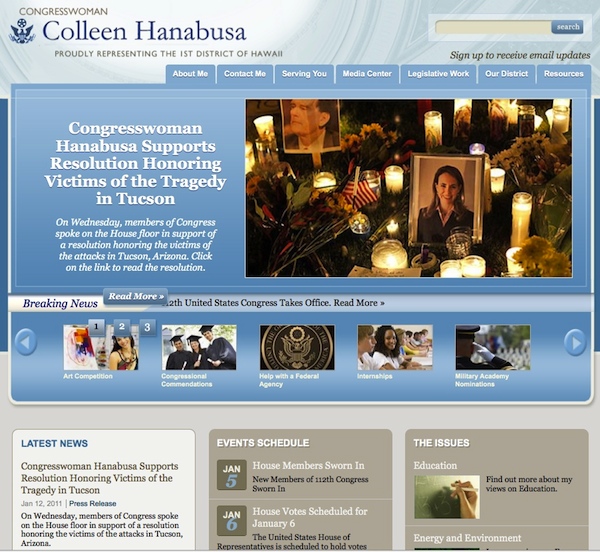
In the meantime, the incoming Congressmen and Congresswomen do appear to have adopted Drupal as the platform for their official websites. For instance, Congresswoman Colleen Hanabusa‘s site, below, uses one of several templates on the Drupal platform. Notably, each of the new sites includes default modules for the leaders in the respective verticals in the social media world: Flickr, YouTube, Twitter and Facebook.
Some questions remain about the cost and choices that representatives have as they choose their online Web presences. As NextGov reported today, while House websites can move to the open source platform – they don’t have to do so.
Given the context of citizens turning to the Internet for government information, data and services in increasing numbers, however, a well-designed Congressional website with clear connections to the various digital outposts has moved from a “nice to have” to a “must have” in the eyes of the digitally connected. (For citizens on the other side of the digital divide, the House switchboards are still available via phone call at (202) 224-3121 or TTY: (202) 225-1904).
If that’s a given, then the question is then why Drupal is now the preferred web hosting environment for the House. On that count, “Drupal was chosen because it is open source and widely accepted, therefore allows Members to leverage a large community of programmers which gives them more choices and innovation,” wrote Weiser in an email. “It should also be noted that Members still will have the option to use other platforms.”
Weiser told NextGov that, because, Drupal developers are in every member’s district, “that hopefully means expanded choice and more innovation for our members.”
The current content management system limits the choice of site programmer as well as innovation, said Dan Weiser, communications director for the chief administrative officer, in an e-mail. Drupal, which uses a common framework and code that can be customized, will allow members to leverage a large community of programmers, providing more opportunities for innovation, he added.
The House expects to save some money with the transition to Drupal, since the chief administrative officer will manage the infrastructure and members pay vendors only for development time, Weiser said.
The inclusion of social media is also no longer a novelty in the beginning of 2011. “We expected there would be interest by the incoming freshmen to have social media on their sites; it just seemed natural to offer the option,” wrote Weiser.
[Disclosure: One of the vendors involved in the House’s Drupal effort is Acquia. O’Reilly AlphaTech Ventures is an investor in Acquia.]
Facebook users are now able to receive social AMBER Alerts based in their state or region. The AMBER Alert program is a voluntary partnership between law enforcement, media, transportation companies and other entities that shares information relevant to child abduction … Continue reading →
Today, C-SPAN’s Facebook page will host streaming video coverage of Wednesday’s special U.S. House session on the Tucson shootings. The livestream will start at 10 AM ET, when the House will consider a resolution on the shootings. The session is also … Continue reading →
Fireworks begin as the Killers perform on the South Lawn of the White House, July 4, 2010, during the Fourth of July celebration. (Official White House Photo by Pete Souza)
Exploring what this year will hold for the intersection of government, technology, citizens and business is a fascinating – and immense – challenge.
Yesterday, I participated in a discussion on Twitter that touched upon “Gov 2.0,” open government and social media. I include explanations for those terms below. Dozens of people participatedusing the #SMfastfwd hashtag on Twitter or at the #SMFastFWD room at TweetChat.com.
Be forewarned: there’s some jargon below, but then the organizer of the chat specifically asked for explanations. My answers and key considerations raised by several participants for the year ahead follow.
How do you define Gov 2.0? What about open government? What’s the difference? How do these relate to transparency?
What is government 2.0? Government social software expert Maxine Teller described the concept succinctly: Gov 2.0 equals “leveraging emerging tools, techs & collaboration PRINCIPLES to improve efficiency & effectiveness,” she tweeted. “Today’s tools & tech enable us to return to founding principles: government for, by & of the people.”
That’s useful, since many days it can seem like there are as many definitions for Gov 2.0 as there are people. That’s what happens when a term edges towards becoming a buzzword, particularly anything with a “2.0” added on.
As I’ve previously observed in writing about language, government 2.0, jargon and technology, I believe the term should be defined primarily by its utility to helping citizens or agencies solve problems, either for individuals or the commons. Defining it in gauzy paeans evangelizing world-shaking paradigm shifts from the embrace of social media by politicians isn’t helpful on that level.
That’s particularly true when politicians are using platforms to broadcast, in the model of 20th Century, not having iterative conversations that result in more agile government or participatory democracy.
Craigslist founder Craig Newmark put it another way yesterday: “Open government includes much greater gov’t transparency, that is, tell citizens what’s going on,” he tweeted. “Gov 2.0 includes gov’t and citizens working together for better customer service, more accountability.”
That melds well with O’Reilly’s perspective, where government 2.0 is the “idea of the government as platform: how can government design programs to be generative, […] building frameworks that enable people to build new services of their own.”
In a Forbes column in 2009, he’d framed this as “the opportunities inherent in harnessing a highly motivated and diverse population not just to help [politicians] get elected, but to help them do a better job.”
“Citizens are connected like never before and have the skill sets and passion to solve problems affecting them locally as well as nationally. Government information and services can be provided to citizens where and when they need it. Citizens are empowered to spark the innovation that will result in an improved approach to governance.
In this model, government is a convener and an enabler–ultimately, it is a vehicle for coordinating the collective action of citizens.
This is the right way to frame the question of “Government 2.0.” How does government itself become an open platform that allows people inside and outside government to innovate? How do you design a system in which all of the outcomes aren’t specified beforehand, but instead evolve through interactions between the technology provider and its user community?
Open government relates to that but isn’t necessarily grounded in technology, although certain aspects of it under the Obama administration absolutely have been.
As Chris Kemp, NASA’s chief technology officer for IT, put it last year, “The future of open government is allowing seamless conversations to occur between thousands of employees and people … You can’t divorce open government from technology. Technology enables the conversation and supports the conversation. We’re finding that if we don’t stand in the way of that conversation, incredible things can happen.”
If you’ve been tracking the progress of the Open Government Directive since 2009, you know that it required federal agencies to take steps to achieve key milestones in transparency, participation, and collaboration. As 2011 begins, more of those plans are still, for the most part, evolving towards implementation.
The progress of open government in the United States has beeen slowed by bureaucracy, culture, and the context of a White House balancing wars abroad and immense macroeconomic pressures, a populace deeply distrustful of many institutions, and, at the end of 2010, the emergence and disruption presented by the more “radical openness” of Wikileaks.
It was clear back in September that in the United States, open government is still very much in its beta period. It was in that context, that, in December, the White House made a new, ambitious request of the American people: help them to design digital democracy by creating a platform for expert consultation on policy.
In doing so, the architects of initiative embraced the notion government acting as a convener or collaborator, trying to co-create better policy or outcomes. By its nature, such open government platforms are expressed as top down, where officials work to create more participatory, collaborative model of governance.
Gov 2.0, by contrast, is more often conceived as expressly technology driven, founded in the platform principles of Web 2.0, and buoyed by the efforts of citizens and civic entrepreneurs to build “do-it-ourselves” government. Both Gov 2.0 and open government can and do increase transparency.
Consider this detail from a webcast, “What is Gov 2.0?,” which combines open government and Gov 2.0 in action:
“The first person who really put Gov 2.0 on my radar was Carl Malamud. Carl is really the father of this movement in so many ways. Back in 1993, that’s pretty darn early in the history of the World Wide Web, he put the SEC online.He got a small planning grant from the National Science Foundation, which he used to actually license the data, which at that point the SEC was licensing to big companies.
He got some servers from Eric Schmidt, who was the chief technology at Sun. And he basically put all this data he’d gotten from the SEC online, and he operated that for something like two years, and then he donated it to the federal government. Carl’s idea was that it really mattered for the public to have access to SEC data.”
In that moment, citizens in the private sector helped government do something it had trouble accomplishing. That’s still happening today, as evidenced by Malamud’s work on Law.gov and House.Resources.org.
What is the relationship between Gov 2.0, open government, and social media? How do tools go beyond Twitter, Facebook, etc.?
Ben Berkowitz, the founder of SeeClickFix, put it this way yesterday in a tweet: “Don’t just use social web platforms to communicate, restructure government to operate like a social platform.”
To extend that, and reiterate elements of the earlier answer, Gov 2.0 is a frame to rethink how citizens to participate in government using technology. Open government has been around for decades as both a philosophy and a practice.
Awareness of the concept was rebooted under the White HouseOpen Government Initiative and new Gov 2.0 technologies and events, including numerous camps and the O’Reilly conferences in Washington.
Open government also relates to Federal Register 2.0, rules, passage of new legislation, and culture, a key aspect that requires change management that extends far beyond technology:
Social media is a key element of many emerging citizen engagement platforms. These platforms give citizens new voices and provides new channels for government workers and elected officials to to talk with them. Aides for the new Speaker of the House, John Boehner, say that he reads Facebook and constituents, as do many of his colleagues in Congress. While Facebook is an imperfect platform for government engagement, with respect to privacy or identity issues, given the hundreds of millions of users and global reach, elected officials have effectively been forced to at least pay attention to what is being said about them there. Some politicians, like former Alaska governor Sarah Palin, are shaping the national media conversation through Facebook and other media channels.
Social media, however, goes far beyond giving politicians or workers new platforms to broadcast, though that has been the approach for many first use cases. In 2011, for instance, Twitter is now home to emergency social data, including earthquake warning systems, crowdsourced weather alerts and other disaster-related information.
That’s why social media and FEMA now mix, among other reasons. Deciding to use these platforms creates complex decisions around terms of service and commercial speech, however, since civic discourse is being hosted by a third party. Those issues won’t go away in 2011.
Enterprise versions of these tools also provide the means for government to government communications, just as they do in businesses. That includes blogs, wikis, social networks, video or new forms of social media. For instance, ediplomacy at the State Department is doing behind firewall is in many ways at least as interesting as external social media use.
What should the goals of Gov 2.0 and open government be? How are you working toward those ends?
Smarter, leaner, more transparent, accountable, efficient and agile government, with data-driven policy. I’m sharing the stories of innovators.
What changes will 2011 bring in the Gov 2.0 or open government arena?
There will be both positive and negative outcomes from that emergence.
What are the obstacles and challenges to success with Gov 2.0 and open government?
Gov 2.0 advocate and San Francisco public servant Adriel Hampton identified a key issue here: “Education. Negative perception of gov still huge, citizens unaware of gov 2. efforts, excited when informed,” he tweeted.
Privacy and identity will be a huge issue for Gov 2.0 and open government in 2011. Follow the FTC Do No Track debate for more there.
There will be significant challenges around open government data, given the role controlling costs will play in 2011.
Another point made about accepting failures came from Newmark: “lots of Gov 2.0 open gov challenges, including normal big organizational inertia. Also, failure is stigmatized.” A more agile government would require tolerating mistakes and iterating faster based upon the lessons learned.
Government social media consultant Maxine Teller raised another angle: “Challenge is: what incentive do existing gov leaders have to embrace collaborative principles. Current system=self-perpetuating,” she tweeted. “Too much focus has been on citizen engagement. Need more on enterprise 2.0 — INSIDE government.” That goes back to the work at the State Department referenced earlier.For context on that challenge, read MIT professor Andrew Mcafee‘s piece on Gov 2.0 vs the beast of bureaucracy.
A final consideration is an open question: will open government be able to tap into the “civic surplus” to solve big problems. That’s Clay Shirky‘s “cognitive surplus,” applied to citizens and government. For open government to succeed, conveners need to get citizens to participate. That won’t be easy, with historic frustration and lack of trust in institutions in many parts of the country.
What seem to be the biggest misperceptions in the public re: Gov 2.0 or open government? What should the public know?
For me, that’s easy: That Gov2.0 equals = social media. Many members of the media, marketers or consultants have further entrenched that perception, which is not true for Web 2.0 either.
There’s also a misperception that Gov 2.0 is all about D.C., or the White House. The state and local stories of Gov 2.0 are absolutely fascinating, as are international stories.
What takeaways do you have from the 01.05 edition of #SMfastfwd on Gov 2.0, open government and social media?
The conversation pulled in many informed voices but clearly showed the need to extend much further to resonate with the public. We “need to mainstream the discussion by focusing on impact of Gov 2.0 concepts on agency, community missions,” tweeted Teller.
Covering Open Government in 2011
The “sweeping Gov 2.0 concept isn’t newsworthy,” tweeted Teller. We “need to show RESULTS and impact of Gov 2.0 principles on gov MISSIONS.”
It’s substantially hard to argue with that assessment, although some tech news outlets have covered it. That’s why the Veterans Administration’s Blue Button is a genuinely big deal. Newsworthy, real impact.
So here’s my goal for 2011: explain what Gov 2.0 means for citizens, how it’s impacting agencies, communities, relates to mission and outcomes, and do so in outlets that extend awareness beyond Twitter or blogs. The good news is that other outlets are waking up, as legislation and initiatives move through Congress and pilots: the Washington Post covered the COMPETES Act and Challenge.gov recently.






 E Pluribus Unum