UN: Disconnecting Internet users is a breach of human rights [REPORT]

As the role of the Internet as a platform for collective actions grows, access to the rest of wired humanity becomes more important. Today, United Nations special rapporteur Frank La Rue released a report on freedom of expression and the Internet that described cutting off Internet access as a breach of human rights. The report, which was presented to the Human Rights Council in Geneva, is an important data point as governments around the globe decide how to legislate, regulate or moderate the disruptive impact of the Internet.

The UN report comes at an important time. As Mathew Ingram wrote at GigaOm, reporting on the recently released UNESCO report on freedom of expression online, governments are still trying to kill, replace or undo the Internet.

“The report provides initial guidance for countries that are grappling with how to address complex Internet policy challenges while upholding their obligations to human rights,” said Leslie Harris, president and CEO of the Center for Democracy and Technology, in a statement released to the media.

“As Rapporteur La Rue affirms, the Internet’s unique ability to provide ample space for individual free expression can lead to the strengthening of other human rights, including political, economic and social rights,” said Cynthia Wong, director of the Center for Democracy and Technology’s Project on Global Internet Freedom. “In order for these rights to be realized, governments, civil society and industry must all continue to build on the work begun by the Special Rapporteur.”

Both reports and the recent eg8 Summit shows online innovation and freedom of expression still need strong defenders. “The primary reason we need to support the Net is because it is a foundational part of how we have our democracy,” said Yochai Benkler, co-director of the Berkman Center for Internet and Society, speaking in Paris.

What’s at stake today has been what’s at stake for more than 15 years, said Benkler: The possibility that a coalition of forces who are afraid of the internet will shut it down.”There is still a very powerful counter argument, one that says both for innovation and for freedom, we need an open Net.”

If an open Internet is the basis for democracy flourishing around the world, billions of people will be counting upon our leaders to keep it open and accessible.

Report of the Special Rapporteur on the promotion and protection of the right to freedom of opinion and exp…

[Hat Tip: TorrentFreak and Mathew Ingram]

G8: the Internet has become the public arena for our time

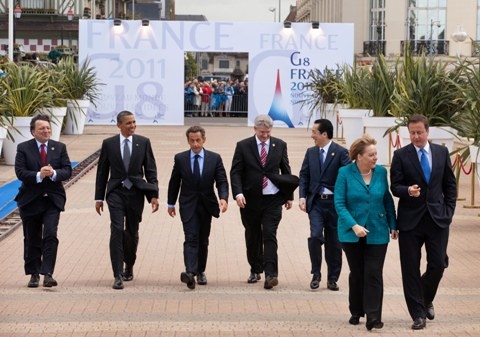
President Barack Obama and other world leaders walk to the first working session at the G8 summit in Deauville, France, May 26, 2011. Pictured, from left are: European Commission President Jose Manuel Barroso; President Obama; French President Nicolas Sarkozy; Canadian Prime Minister Stephen Harper; Japanese Prime Minister Naoto Kan; German Chancellor Angela Merkel; and British Prime Minister David Cameron. May 26, 2011. (Official White House Photo by Official White House Photo by Lawrence Jackson)

President Barack Obama and other world leaders walk to the first working session at the G8 summit in Deauville, France, May 26, 2011. Pictured, from left are: European Commission President Jose Manuel Barroso; President Obama; French President Nicolas Sarkozy; Canadian Prime Minister Stephen Harper; Japanese Prime Minister Naoto Kan; German Chancellor Angela Merkel; and British Prime Minister David Cameron. May 26, 2011. (Official White House Photo by Official White House Photo by Lawrence Jackson)

At this year’s meeting of the “Group of 8” (G8) nations in France, a declaration about the Arab Spring included a “Deauville Partnership” with the people of the Middle East to support the growth of “democratic, open societies and inclusive economic modernisation.”

For the first time, the 2011 G-8 Summit included discussion of the Internet as a top-level issue, alongside the ongoing conflict in Libya, economic growth, nuclear safety, climate change, foreign aid and national security.

The G8 released an official communique that pledging renewed commitment for freedom and democracy that included a substantial section on the Internet. The communique included this summary of the principles discussed:

We discussed new issues such as the Internet which are essential to our societies, economies and growth. For citizens, the Internet is a unique information and education tool, and thus helps to promote freedom, democracy and human rights. The Internet facilitates new forms of business and promotes efficiency, competitiveness, and economic growth. Governments, the private sector, users, and other stakeholders all have a role to play in creating an environment in which the Internet can flourish in a balanced manner. In Deauville in 2011, for the first time at Leaders’ level, we agreed, in the presence of some leaders of the Internet economy, on a number of key principles, including freedom, respect for privacy and intellectual property, multi-stakeholder governance, cyber-security, and protection from crime, that underpin a strong and flourishing Internet. The “e-G8” event held in Paris on 24 and 25 May was a useful contribution to these debates.

That eG8 showed that online innovation and freedom of expression still need strong defenders. Some of the concerns will be assuaged in this communique.

While the body of the communique is comprised of high level principles and does not contain specific prescriptions, it does not specifically reference to international human rights laws or a “freedom to connect,” an exception that supporters of free expression like Article 19 have criticized as unsufficient. In addition, paragraph 15, below, renews a “commitment to ensuring effective action against violations of intellectual property rights in the digital arena, including action that addresses present and future infringements” that may obliquely refer to the Anti-Counterfeiting Trade Agreement, or “ACTA,” that the Electronic Frontier Foundation and others have expressed concerns about as it has moved through drafting stages.

That said, there is much in the official communique about the Internet that celebrates its power and choices that have driven its growth, including:

  • “The openness, transparency and freedom of the Internet have been key to its development and success. These principles, together with those of non-discrimination and fair competition, must continue to be an essential force behind its development.”
  • “The Internet has become the public arena for our time, a lever of economic development and an instrument for political liberty and emancipation. Freedom of opinion, expression, information, assembly and association must be safeguarded on the Internet as elsewhere. Arbitrary or indiscriminate censorship or restrictions on access to the Internet are inconsistent with States’ international obligations and are clearly unacceptable. Furthermore, they impede economic and social growth.

Coming on a week when Iran vowed to unplug the Internet, disconnecting Iranian citizens from the rest of the world, holding up those principles is both timely and notable. The full section of the communique regarding the Internet follows.

II. INTERNET

4. All over the world, the Internet has become essential to our societies, economies and their growth.

5. For citizens, the Internet is a unique information and education resource and thus can be a helpful tool to promote freedom, democracy and human rights.

6. For business, the Internet has become an essential and irreplaceable tool for the conduct of commerce and development of relations with consumers. The Internet is a driver of innovation, improves efficiency, and thus contributes to growth and employment.

7. For governments, the Internet is a tool for a more efficient administration, for the provision of services to the public and businesses, and for enhancing their relations with citizens and ensuring respect for and promotion of human rights.

8. The Internet has become a major driver for the global economy, its growth and innovation.

9. The openness, transparency and freedom of the Internet have been key to its development and success. These principles, together with those of non-discrimination and fair competition, must continue to be an essential force behind its development.

10. Their implementation must be included in a broader framework: that of respect for the rule of law, human rights and fundamental freedoms, the protection of intellectual property rights, which inspire life in every democratic society for the benefit of all citizens. We strongly believe that freedom and security, transparency and respect for confidentiality, as well as the exercise of individual rights and responsibility have to be achieved simultaneously. Both the framework and principles must receive the same protection, with the same guarantees, on the Internet as everywhere else.

11. The Internet has become the public arena for our time, a lever of economic development and an instrument for political liberty and emancipation. Freedom of opinion, expression, information, assembly and association must be safeguarded on the Internet as elsewhere. Arbitrary or indiscriminate censorship or restrictions on access to the Internet are inconsistent with States’ international obligations and are clearly unacceptable. Furthermore, they impede economic and social growth.

12. The Internet and its future development, fostered by private sector initiatives and investments, require a favourable, transparent, stable and predictable environment, based on the framework and principles referred to above. In this respect, action from all governments is needed through national policies, but also through the promotion of international cooperation.

13. We commit to encourage the use of the Internet as a tool to advance human rights and democratic participation throughout the world.

14. The global digital economy has served as a powerful economic driver and engine of growth and innovation. Broadband Internet access is an essential infrastructure for participation in today’s economy. In order for our countries to benefit fully from the digital economy, we need to seize emerging opportunities, such as cloud computing, social networking and citizen publications, which are driving innovation and enabling growth in our societies. As we adopt more innovative Internet-based services, we face challenges in promoting interoperability and convergence among our public policies on issues such as the protection of personal data, net neutrality, transborder data flow, ICT security, and intellectual property.

15. With regard to the protection of intellectual property, in particular copyright, trademarks, trade secrets and patents, we recognize the need to have national laws and frameworks for improved enforcement. We are thus renewing our commitment to ensuring effective action against violations of intellectual property rights in the digital arena, including action that addresses present and future infringements. We recognize that the effective implementation of intellectual property rules requires suitable international cooperation of relevant stakeholders, including with the private sector. We are committed to identifying ways of facilitating greater access and openness to knowledge, education and culture, including by encouraging continued innovation in legal on line trade in goods and content, that are respectful of intellectual property rights.

16. The effective protection of personal data and individual privacy on the Internet is essential to earn users’ trust. It is a matter for all stakeholders: the users who need to be better aware of their responsibility when placing personal data on the Internet, the service providers who store and process this data, and governments and regulators who must ensure the effectiveness of this protection. We encourage the development of common approaches taking into account national legal frameworks, based on fundamental rights and that protect personal data, whilst allowing the legal transfer of data.

17. The security of networks and services on the Internet is a multi-stakeholder issue. It requires coordination between governments, regional and international organizations, the private sector, civil society and the G8’s own work in the Roma-Lyon group, to prevent, deter and punish the use of ICTs for terrorist and criminal purposes. Special attention must be paid to all forms of attacks against the integrity of infrastructure, networks and services, including attacks caused by the proliferation of malware and the activities of botnets through the Internet. In this regard, we recognize that promoting users’ awareness is of crucial importance and that enhanced international cooperation is needed in order to protect critical resources, ICTs and other related infrastructure. The fact that the Internet can potentially be used for purposes that are inconsistent with the objectives of peace and security, and may adversely affect the integrity of critical systems, remains a matter of concern. Governments have a role to play, informed by a full range of stakeholders, in helping to develop norms of behaviour and common approaches in the use of cyberspace. On all these issues, we are determined to provide the appropriate follow-up in all relevant fora.

18. We call upon all stakeholders to combat the use of Internet for trafficking in children and for their sexual exploitation. We will also work towards developing an environment in which children can safely use the Internet by improving children’s Internet literacy including risk awareness, and encouraging adequate parental controls consistent with the freedom of expression.

19. We recognize the importance of enhanced access to the Internet for developing countries. Important progress has been achieved since the Okinawa Summit and we pay tribute to the efforts made by developing countries in this regard as well as the various stakeholders, governments, the private sector and NGOs, which provide resources, expertise and innovation. We encourage initiatives, in partnership with the private sector, on the use of the Internet with a development purpose, particularly for education and healthcare.

20. As we support the multi-stakeholder model of Internet governance, we call upon all stakeholders to contribute to enhanced cooperation within and between all international fora dealing with the governance of the Internet. In this regard, flexibility and transparency have to be maintained in order to adapt to the fast pace of technological and business developments and uses. Governments have a key role to play in this model.

21. We welcome the meeting of the e-G8 Forum which took place in Paris on 24 and 25 May, on the eve of our Summit and reaffirm our commitment to the kinds of multi-stakeholder efforts that have been essential to the evolution of the Internet economy to date. The innovative format of the e-G8 Forum allowed participation of a number of stakeholders of the Internet in a discussion on fundamental goals and issues for citizens, business, and governments. Its free and fruitful debate is a contribution for all relevant fora on current and future challenges.

22. We look forward to the forthcoming opportunities to strengthen international cooperation in all these areas, including the Internet Governance Forum scheduled next September in Nairobi and other relevant UN events, the OECD High Level Meeting on “The Internet Economy: Generating Innovation and Growth” scheduled next June in Paris, the London International Cyber Conference scheduled next November, and the Avignon Conference on Copyright scheduled next November, as positive steps in taking this important issue forward.

Jérémie Zimmermann on the Internet and civil society in France [VIDEO]

When it comes to the Internet, France has followed its own path in making policies, particularly with respect to intellectual property. Those choice were highlighted at the eG8 forum, where 20th century ideas clashed with the 21st century economy. The forum, held before the G-8 summit of global leaders, showed that online innovation and freedom of expression still need strong defenders.

As Nancy Scola reported at techPresident, at the eG8, civil society groups restaked their claim to the ‘Net. Looking for more answers, I spoke with Jérémie Zimmermann, co-founder and spokesperson for citizen advocacy group LaQuadrature du Net, about the Internet in France. For American Internet users, this interview should be by turns illuminating, provocative and a reminder of the freedoms we enjoy here.

Crawford: The open Internet is the basis for democracy flourishing around the world

“Access to the Internet is fundamental,” said Susan Crawford, an American law professor and former White House official, speaking at the The inaugural eG8 forum, held in Paris. These are the most important policies that government should be embracing. We want to make sure that other voices are heard.”

At the eG8, 20th century ideas clashed with the 21st century economy. The forum, held before the G-8 summit of global leaders, showed that online innovation and freedom of expression still need strong defenders.

As Nancy Scola reported at techPresident, at the at the eG8, civil society groups restaked their claim to the ‘Net. I spoke with Crawford about what’s at stake following an impromptu press conference held to highlight their concerns. Our interview is below:

“What’s at risk is the future of the Internet,” she said. It’s “whether it continues to be a distributed, open, platform for innovation, economic growth, democratic discourse, participation by all peoples of the world or whether it becomes a balkanized, taxed, blocked, controlled broadcast medium, which is what many incumbents would like to see.”

How close are we to that happening? “Luckily, we have a long way to go,” said Crawford, “because the people who use the Internet will continue to fight back with everything they’ve got.”

Watch the whole thing to hear what her take on why this matters to citizens, educators, children, and entrepreneurs.

Dyson at the eG8: You don’t need to be from the Internet to believe in liberty or free speech

At the eG8, 20th century ideas clashed with the 21st century economy. The inaugural eG8 forum, held in Paris before the G-8 summit of global leaders, showed that online innovation and freedom of expression still need strong defenders. As Nancy Scola reported at techPresident, at the at the eG8, civil society groups restaked their claim to the ‘Net.

Several attendees, many who had traveled from the United States, strongly questioned whether the Internet should be regulated in the ways that Sarkozy implied. The “value of internet is not just efficiency but also transparency,” tweeted Esther Dyson, “a much better regulator than government could ever be.”

I spoke further in with Dyson in an interview embedded below. What matters about the eG “is that you have a lot of people being exposed to one another and you have a lot of government people being exposed to people they don’t normally listen to,” said Dyson. “As usual, it’s not what happens up on stage, or what happens on the video: it’s what happens on the tweets, in the personal interactions, in the dinner afterwards, and in the back hall of the meeting. And that – that was positive. The world doesn’t change overnight, mostly. ”

She spoke to the concerns of civil society about eG8 recommendations: “It is sort of justified. Some of them were precanned. I actually sat down with my guy after doing my panel and changed them. I don’t think that happened with all of them. But again, the community is aroused: it’s going to make its points around this.”

Dyson also emphasized the universality of some of these concerns and what’s at stake. “You don’t need to be ‘from the Internet’ to believe in liberty or free speech.”

How are startups helping the global transparency movement? “They’re providing tools to make the data meaningful,” said Dyson. “They’re providing tools for people to share the information. They’re providing the communication tools, again, that allow from everything from Wikileaks to people communicating with reporters. Tools like your phone, connected to the Internet, so that you can record interviews not just with me but with all of the other people you talk to, upload them, people can share them, people can comment on them. That’s all technology.”

Dyson shared other thoughts on the eG8 and Internet freedom, including how entrepreneurs are changing the world through their work. Dyson also shared an insight that transcends technology:

“Even when you have a revolution, what makes the revolution works is what changes in people’s minds, and that’s what’s going on here,” said Dyson.

“The world is changing. People in government are not special. They should be as transparent as everybody else. People deserve privacy. Officials, governments, institutions, they all should be transparent. That’s new thinking, and it was being heard.”

Episode 4 of Gov 2.0 TV: Open Government News and the eG8

At At the eG8, 20th century ideas clashed with the 21st century economy. The inaugural eG8 forum, held in Paris before the G-8 summit of global leaders, showed that online innovation and freedom of expression still need strong defenders. As Nancy Scola reported at techPresident, at the at the eG8, civil society groups restaked their claim to the ‘Net.

I talked with Walter Schwabe of FusedLogic.tv about the eG8 in this week’s episode of Gov 2.0 TV, along with the news of cuts to U.S. federal open government websites. Federal CIO Vivek Kundra will shutter FedSpace and keep Data.gov up.

President Sarkozy at the eG8 Summit [VIDEO]

Today, the eG8 is considering the future of the Internet and society in Paris, in advance of the G-8 Summit. President Nicolas Sarkozy opened the summit after an introduction by Maurice Lévy, Chairman & CEO, Publicis Groupe, holding up the power of the Internet but emphasizing the role of the state in providing security, privacy and protection for intellectual property. Video is embedded below:

The moment that many may remember from the question and answer period that followed was when professor Jeff Jarvis asked President Sarkozy whether he’d take a “Hippocratic oath” to “first, do no harm” when making policy choices that affect the Internet.

Related coverage at the Guardian: Sarkozy opens eG8 Summit

Opening Chicago: In Year One, Open311 and ‘Apps for Metro Chicago’ will launch

Mayor-elect Rahm Emanuel released his final 2011 transition plan for Chicago today. Emanuel encouraged his followers on Twitter to visit Chicago2011.org to read a copy of the report (embedded below or downloadable as a PDF) and “share your thoughts” on it.

Of note to open government advocates: Page 14

5. Set high standards for open, participatory government to involve all Chicagoans

Why do this? Without access toinformation, Chicagoans cannoteffectively find services, build businesses, or understand how well City government is performing and hold it accountable for results. How will we do this? The City will pos ton-line and in easy-to-use formats the information that Chicagoans need most. For example, complete budget documents – currently only retrievable as massive PDF documents –will be available in straightforward and searchable formats.

The City’s web site will allow anyone to track and find information on lobbyists and what they are lobbying for as well as which government officials they have lobbied.The City will out-perform the requirements of the Freedom of Information Act and publicly report delays and denials in providing access to public records.The City will also place on-line information about permitting, zoning,and business licenses, including status of applications and requests. And Chicagoans will be asked to participate in Open311, an easy and transparent means for all residents to submit and monitor service requests, such as potholes and broken street lights. Chicagoans will be invited to develop
their own “apps” to interpret and use City data in ways that most help the public.

What will be different?

100 Days: A searchable version of the City budget will be posted on-line, after a full review to ensure that its presentation is clear and easy to understand.

Year 1: Open311 and “Apps for Metro Chicago” will launch. Also a broad spectrum of new information will be made available to residents and business owners to enable them to track lobbying activity, as well as status of permits, licenses, and zoning change requests. Starting with the 2012budget, the budget document will be reformed, simplified, and tied to performance.

It should be an interesting first 100 days. The plan balanced good government, with transparency and accountability driven through technology, with an open innovation approach that embraces Open311 and a focus on open data.

Nick Clark Judd wrote up Mayor-elect Emanuel’s promises to open the #$%@ing government over at techPresident, observing that “Emanuel’s transition team also recommends consolidating city infrastructure — IT, vehicle fleets, et cetera — and collaborate with nonprofits and Cook County, the county that encompasses Chicago, to provide some services. This means the City of Chicago might stop providing some services, directing people to nonprofits or the county instead.”

Chicago 2011_Transition Plan(function() { var scribd = document.createElement(“script”); scribd.type = “text/javascript”; scribd.async = true; scribd.src = “http://www.scribd.com/javascripts/embed_code/inject.js”; var s = document.getElementsByTagName(“script”)[0]; s.parentNode.insertBefore(scribd, s); })();

Taking stock of global freedom of expression on World Press Freedom Day

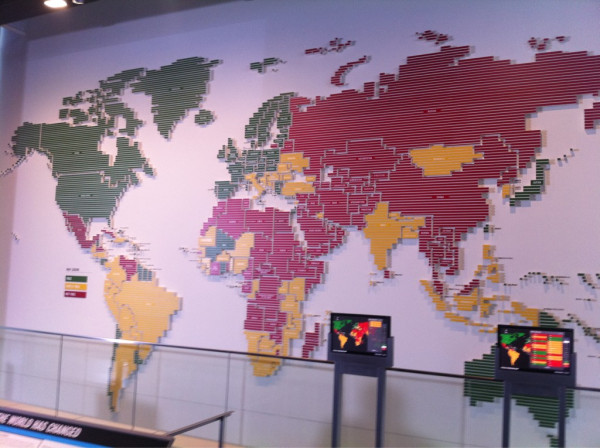
In 2010, only 1 in 6 people lives in countries with a free press, according to a new report on press freedom from Freedom House. There is a long road ahead to establishing and protecting freedom of expression for humanity.

This week, defenders of free expression are celebrating the progress of press freedom and recognizing the challenges that persist globally on World Press Freedom Day 2011. This is the 20th anniversary of the Windhoek Declaration that helped to establish UNESCO’s World Press Freedom Day. The United States is hosting this year’s World Press Freedom Day in Washington, D.C. at the Newseum. You can watch the livestream below and follow the conversation on Twitter on the #wpfd hashtag, both of which are embedded below.

wpfd2011 on livestream.com. Broadcast Live Free

new TWTR.Widget({
version: 2,
type: ‘search’,
search: ‘#wpfd OR #pressfreedom’,
interval: 6000,
title: ‘What\’s happening on’,
subject: ‘World Press Freedom Day’,
width: ‘auto’,
height: 500,
theme: {
shell: {
background: ‘#004382’,
color: ‘#ffffff’
},
tweets: {
background: ‘#ffffff’,
color: ‘#444444’,
links: ‘#1985b5’
}
},
features: {
scrollbar: false,
loop: true,
live: true,
hashtags: true,
timestamp: true,
avatars: true,
toptweets: true,
behavior: ‘default’
}
}).render().start();

To learn more about global freedom of expression and and the organizations that protect journalists and support the collection and dissemination of news about our world, visit:

Week in Review: Top Gov 2.0 and Open Government Stories

US Capitol Blooms

Open government made an appearance in popular culture, albeit not in an admiring sense. At the start of the week, Jon Stewart and the Daily Show mocked the Obama administration and the president for a perceived lack of transparency.

Stewart and many other commentators have understandably wondered why the president’s meeting with open government advocates to receive a transparency award wasn’t on the official schedule or covered by the media. A first hand account of the meeting from open government advocate Danielle Brian offered useful perspective on the issues that arose that go beyond a soundbite or one liner:

Gary, OMB Watch’s executive director, focused on the places where we have seen real change, including the Open Government Directive, the Executive Orders on Classified National Security and Controlled Unclassified Information, emphasis on affirmative disclosures of government information; and the President’s support of reporters’ privilege and shield law, as well as whistleblower protections.

Lucy, executive director for Reporters Committee for Freedom of the Press, pointed out that this was the first president in her 30 years of working in this field who had invited open government advocates into the Oval Office. She specifically thanked him for his strong support of a reporters’ shield law, which he affirmed he continues to support. Tom, executive director for the National Security Archive, emphasized that when it comes to FOIA reform and implementation we know it isn’t just a ship of state, but an entire flotilla including rowboats. And that while there has been notable improvement according to the National Security Archive’s survey of agencies, there continues to need be a need for leadership from the top to change cultures across the vast swath of government agencies. He also noted that we all believe the information we want to see is not simply that which is useful for consumers, but also that which holds the government accountable.

I knew my topic was likely to be sensitive. I began by thanking the President for his strong support of whistleblower protections, and noted that it was not for lack of effort on the part of the White House that the legislation didn’t pass at the end of the last Congress.

I noted, however, that the current aggressive prosecution of national security whistleblowers is undermining this legacy. That we need to create safe channels for disclosure of wrongdoing in national security agencies. That we need to work harder to shrink the amount of over-classified materials that unnecessarily prompt leak prosecutions.

The President shifted in his seat and leaned forward. He said he wanted to engage on this topic because this may be where we have some differences. He said he doesn’t want to protect the people who leak to the media war plans that could impact the troops. He differentiated these leaks from those whistleblowers exposing a contractor getting paid for work they are not performing. I was careful not to interrupt the President, but waited until he was done. I pointed out that few, if any, in our community would disagree with his distinction—but that in reality the current prosecutions are not of those high-level officials who regularly leak to the press to advance their policy agendas. Instead, the Department of Justice (DOJ) is prosecuting exactly the kind of whistleblower he described, for example one from the National Security Agency.

The President then did something that I think was remarkable. He said this is an incredibly difficult area and he wants to work through how to do a better job in handling it. He also agreed that too much information is classified, and asked us to work with his office on this. He wasn’t defensive nor was he dismissive. It was perhaps the dream moment for an advocate—hearing the most senior policymaker agree with you and offer to work together to tackle the problem.

Brian’s account is the most comprehensive account of the meeting on open government online. The irony that it was not recorded and released to the American people is, however, inescapable. For anyone tracking the progress of the Open Government Directive, the last six months have been an up and down experience. It was clear back in September that in the United States, open government remains in beta.

According to doctoral research by University of Texas academic, there are 358 open government projects in federal government. Former White House deputy chief technology officer Beth Noveck wrote about the semantics and the meaning of good government and open government mean in this context. One takeaway: don’t mistake open innovation policies for transparency guarantees.

The current White House deputy CTO for innovation, Chris Vein, wrote on the White House blog this week that the one year anniversary of open government plans were “a testament to hard work” at the agencies. As Vein acknowledged, “while there is always more to be done, we are proud of the important work that agencies have done and are doing to change the culture of government to one that encourages transparency and facilitates innovation.  We are committed to maintaining and building upon this momentum to make our Nation stronger and to make the lives of Americans better.”

Naturally, some projects are always going to be judged more as more or less effective in delivering on the mission of government than others. An open government approach to creating a Health Internet may be the most disruptive of them. For those that expected to see rapid, dynamic changes in Washington fueled by technology, however, the bloom has long since come off of the proverbial rose. Open government is looking a lot more like an ultramarathon than a 400 yard dash accomplished over a few years.

That said, something different is going on during what Micah Sifry has aptly called the age of transparency. We’re in new territory here, with respect to the disruption that new connection technologies represent to citizens, society and government. It’s worth taking stock of what’s happened recently. It’s been a while since I first posted a Gov 2.0 Week in Review at Radar, and three months since the 2010 Gov 2.0 year in review.

There’s a lot happening in this space. Following is a quick digest that might provide some perspective to those who might think that open government is a better punchline than policy.

1. The government stayed open. The budget crisis on Capitol Hill overshadowed every other issue this past week. It’s harder for a government to be open if it’s closed. The secrecy of the shutdown negotiations left folks over at the Sunlight Foundation wondering about how open government principles matched up to reality.

2. Proposed deep cuts to funding for open government data platforms like Data.gov or the IT Dashboard appear to be least partially restored in the new budget. That will likely salve (some of) the concerns of advocates like Harlan Yu, who wrote about what we would lose if we lost Data.gov. John Wonderlich’s questions on the budget deal, however, include one on exactly how much funding was restored.

3. FCC.gov relaunched as an open government platform. In any other week, this story would have led the list open government news. Having sat out the Aughts, FCC.gov stepped into the modern age FCC managing director Steve Van Roekel and his team worked hard to bring Web 2.0 principles into the FCC’s online operations. Those principles include elements of open data, platform thinking, collective intelligence, and lightweight social software. What remains to be seen in the years ahead is how much incorporating Web 2.0 into operations will change how the FCC operates as a regulator. The redesign was driven through an open government process that solicited broad comment from the various constituencies that visit FCC.gov. The beta.FCC.gov isn’t just a site anymore, however: it’s a Web service that taps into open source, the cloud, and collective intelligence. In the world of Gov 2.0, that’s a substantial reframing of what government can do online.

4. What happens to e-government in a shutdown? This near miss forced hundreds of thousands of people to consider how to make wired government go dark. That discussion should not end with this latest resolution.

5. The first NASA Open Source Summit explored why open source is a valuable tool for the space agency. Open source is a pillar of NASA’s open government plan.

6. The Russian blogosphere came under attack, quashing an online parliament initiative. Needless to say, it will be interesting to see if a Russian Gov 2.0 conference next week addresses the issue of press freedoms or open government transparency.

7. Simpl launched as platform to bridge the connection between social innovators and government.

8. National Builder launched as a new online activism platform.

9. Senator Jon Tester (D-MT) and Representative Steve Israel (D-NY) reintroduced the Public Online Information Act. With this transparency bill, the federal government would acknowledge the Internet, opined Mother Jones.

10. SeeClickFix launches its Facebook app.. “It looks like the entire SeeClickFix experience has been ported over to the Facebook environment,” writes Dan Kennedy. “Users can report problems and pinpoint them on a Google map, thus alerting government officials and the news media. I am far from being the world’s biggest Facebook fan, but it’s a smart move, given how much time people spend there.”

Editor’s Note This is by no means a definitive, comprehensive list. For instance, there’s plenty of open government news happening in countries around the world, from corruption mashups in India to the transparency challenges in various states. For a daily dose of transparency, make sure to read the Sunlight Foundation’s blog IBM’s Business of Government blog has also posted a weekly round up. If you have more stories that came across your desktop, inbox or television this week, please share them in the comments.