New partnership with Microsoft and Bing lets citizens Skype the White House

ask-whitehouse-skype

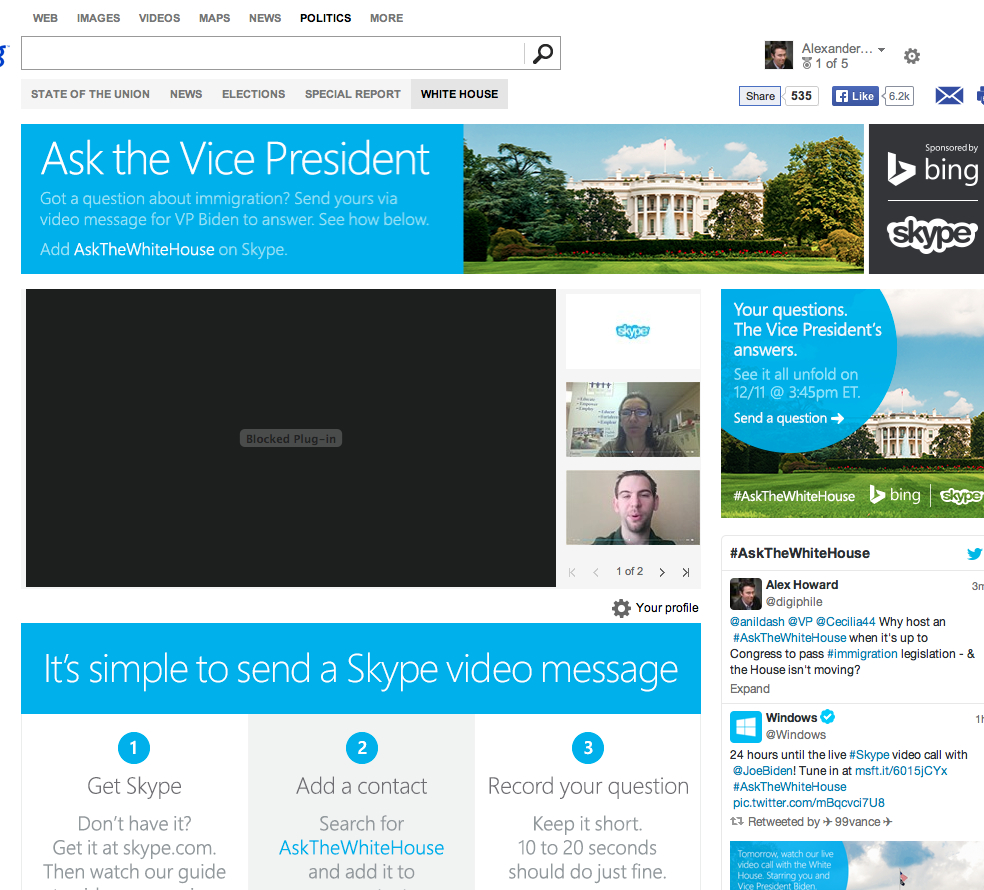
For almost five years now, the Obama administration has encouraged the American people to ask or answer questions over the Internet. On Wednesday, December 11th, we’ll see a new wrinkle: the White House is using a collaboration between Microsoft’s search engine, Bing, and Skype to enable people to ask questions from their house.

The occasion is a conversation on immigration reform with Vice President Joe Biden and the Director of the Domestic Policy Council, Cecilia Muñoz. In addition to questions posed on Twitter at #AskTheWhiteHouse (virtually old hat in 2013), people will be able to use Skype to record short messages, as campaign manager Lucy Woolfenden explained at Skype’s blog. According to Woolfenden, “a select group of questioners” will also connect to the White House via live Skype Video Calls. (The criteria for their selection was not disclosed.)

That the use of real-time online video links between elected officials and Americans isn’t exactly a groundbreaking of technology in government in late 2013, which says something about the world we live in. It’s hard to believe that almost two years ago, President Obama joined a Google+ Hangout in January 2012, followed by many more Hangouts from the White House by members of his administration.

Even with the rampant cynicism and historic lows in public trust in government, however, there’s reason to hope for something interesting to come out of the event. The first Hangout with the president featured real, tough questions from citizens that made news on the use of drones. Earlier this year, an unexpected question on “patent trolls” posed to Mr. Obama by Adafruit founder Limor Fried led to a series a series of executive actions in June.

That isn’t to say that recorded questions or the live Skype conversation tomorrow will lead to executive action on an immigration issue, like deportation policy, or even make news. It does mean the livestream at Bing.com/whitehouse and wh.gov/live tomorrow may be a bit more interesting.

While this is a novel use of Skype, the context for it is much the same as past efforts, where the Obama administration is trying to use its bully pulpit and social media prowess to engage the public to put more pressure on Congress on a given policy agenda. (In this case, it’s trying to move stalled immigration reform legislation forward. It’s not at all clear whether the effort will change any votes in the Republican-controlled House of Representatives.)

There’s one other new media angle teased by Crittenden last week to watch: “for greater interactivity, live polls will map public engagement with the conversation in real time.”

We’ll see how that goes, but the fact that Bing is being used to host the conversation and analyze engagement is something of a coup for Microsoft’s public sector team, which has not been a major part of the mix of this administration’s digital public engagement strategies, as the White House has tumbled further into social media over the years.

Why HealthSherpa.com is not a replacement for Healthcare.gov [UPDATED]

UPDATE: In June 2014, Ning Liang, one of the founders of HealthSherpa, wrote in about updates to the site. Ling said that they can now enroll people in ACA marketplace plans, including subsidies. According to Liang, “we are the only place besides Healthcare.gov where this is possible. We have signed an agreement with CMS as a web based entity to do this. We are directly integrated with the federal data hub, so going through us is identical to going through Healthcare.gov.”

Earlier tonight, Levick director of digital content Simon Owens discovered HealthSherpa.com, thought it was cool, and read a Daily Dot post about it that framed it as 3 20-something San Francisco Bay-area resident coding up an alternative to Healthcare.gov.

Could it be that easy, wondered Owens? Could these young coders have created a simpler, better way to shop for health insurance than the troubled Healthcare.gov?

healthsherpa

Well, yes and no. As is so often the case, it’s not quite that simple, for several reasons.

1) As always, note the disclaimer at the bottom of HealthSherpa.com: “The information provided here is for research purposes. Make sure to verify premiums and subsidies on your state exchange or healthcare.gov, or directly with the insurance company or an agent.”

Why? The site is based upon the publicly available data published by the Department for Health and Human Services, individual state exchanges and Healthcare.gov for premium costs, like this dataset of premiums by county at data.healthcare.gov.

Unfortunately, there appear to be data quality issues, as CBS News reported, that may be an issue on both sites.

When I compared searches for the same zipcode in Florida for a 35 year old, single non-smoking male, I found the same 106 plans but was quoted different premiums: $128.85 on HC.gov vs $150.24 on HealthSherpa. Hmm.

That could be user error, but… it looks like Healthcare.gov continues to underestimate costs.

Healthsherpa may actually be doing better, here. Good job, guys.

2) Regardless, this is not a replacement for everything Healthcare.gov is supposed to do.

The federal and state exchanges aren’t just about browsing plans and comparing premiums for options in a given zipcode in the “marketplace.” After a user knows decides which plan he or she want, the software is supposed to:

1) Register them as a user (registration was up front initially, which was a controversial, important choice, relevant to the site crashing at launch)
2) Authenticate them against government data bases
3) Verify income against government data bases
4) Calculate relevant subsidies, based upon income
5) Guide them through the application process
6) Send that form data on to insurance companies for enrollment.

The tech that underpins the test and graphics website on the front end of those process continues to hold up well.

The rest of the software that is supposed to enable visitors to go through steps 1-6 software, not so much. 16 state exchanges and DC are having varying degrees of success, with HHS Secretary Kathleen Sebelius acknowledging issues with data quality in Step 6 in her testimony to Congress.

3) While it has a subsidy calculator, otherwise Healthsherpa doesn’t replace Healthcare.gov.

Healthsherpa enables you to find a relevant plan and then gives you contact info for the relevant insurer.

For instance:

“Call Humana Medical Plan, Inc. at (800) 448-6262.
Use their menu or ask the operator to speak to someone about purchasing coverage.
Tell them you would like to purchase health exchange coverage, specifically the Humana Connect Basic 6350/6350 Plan for Hillsborough County, FL.
Follow their instructions to complete the application process.”

It does not place calls to the data hub to calculate steps 1-6.

That limited functionality, however, has been good enough for U.S. Senator Angus King to recommend HealthSherpa as a temporary alternative to Healthcare.gov.

“HealthSherpa offers a user-friendly platform to quickly browse through available health insurance plan options, including monthly premium costs, coverage plans, and possible premium subsidies,” Senator King said. “I recommend that Mainers who are having trouble with Healthcare.gov use HealthSherpa as a temporary alternative until the federal website functions properly.”

4) There are OTHER private healthcare insurance brokers that could be doing this.

Back in May 2013, the Center for Medicare and Medicaid Services issued official guidance for private sector brokers in online health insurance marketplaces. (PDF)

Former U.S. chief technology officer Aneesh Chopra said that these “Web-based entities” will be online this fall, operated by entities like eHealthInsurance.com and GetInsured.

For some reason, however, private sector insurance brokers have been stymied by the federal government from selling ACA insurance policies.

That’s unfortunate, given that the Obama administration could use a Plan B, just in case the progress on Healthcare.gov doesn’t lead to a functional federal health insurance exchange twenty days from now.

Update: Jonathan Cohn, writing for the New Republic, looked into Healthcare.gov’s backup plan and comes up with an interesting detail: issues with the so-called data hub could be holding back deployment of private online health insurance brokers.

…administration officials have been huddling with insurers about how to make more use of direct enrollment. Step one is to make sure that “side door” enrollment works smoothly. It doesn’t function well right now, because—you guessed it—it relies on the same information technology system that powers healthcare.gov. Fixing that portal, which techies tell me is called an “application programming interface,” is high on the administration’s to-do list. But it’s not clear (to me) whether improving the portal might require design modifications—or to what extent its success depends upon other, ongoing repairs to the federal website.

So, here’s some speculation: While it’s hard to know for sure, but it’s quite likely that that “portal” is the data hub that’s behind Healthcare.gov, and that it may not be up to additional volume from private sector demand.

The federal exchange and state exchanges both rely upon it, and, while federal officials have said that it’s working, a report by the New York Times yesterday that some state health insurance exchange are continuing to battle tech problems indicated that it’s not holding up under demand:

Even states whose websites are working well say they are hampered by a common problem: the federal website, particularly the data hub that checks every applicant’s identity and eligibility. That hub has stopped working on several occasions, preventing applications in the states from being completed.

If that’s happening now, concerns about the ability of the hub to hold up under the pressure of private sector online insurance brokers could well be justified. If I learn anything more definitive, I’ll share it.

Farewell, Thomas.gov. Hello, Congress.gov.

THOMAS-redirecting-to-Congress.gov_

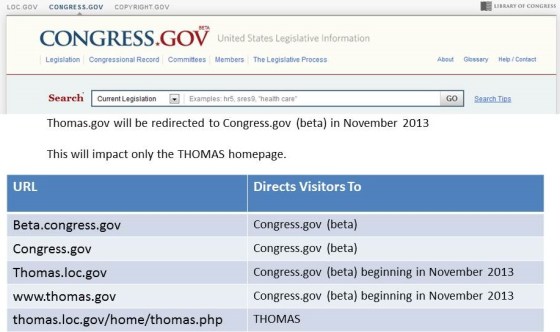
On November 19th, Thomas.gov, the venerable website of the United States Congress, will begin to redirect visitors to Congress.gov. The new site, which launched in beta in September 2012, will become the primary governmental resource for the text of legislation, past, present and future, along with reports from committees, speeches from the floor of Congress and cost estimates from the Congressional Budget Office.

While the official announcement was made today by the Library of Congress, Thomas.gov’s custodian, leading headlines about Congress trading in the new Congress.gov and a note in Roll Call, the transition from THOMAS.gov to Congress.gov has been going on all fall, including updates to the new site and launching the Constitution Annotated and associated app.

THOMAS is centuries old, at least as measured in terms of Internet time. Launched in January of 1995, Thomas.gov was one of the first 23,000 websites to go online. When it went live the Internet had a worldwide user base of less than 40 million people, the majority of whom surfed the young World Wide Web using Mosaic and Netscape, checked their email on Eudora and dialed in on America Online. Watch the video below to get a sense of what life was like online nearly two decades ago.

Today, Thomas.gov receives, on average, 10 million visits every year, although I suspect many of those visits come from wonky repeat customers in or around the District of Columbia. I have no servers logs to prove that one way or another, but THOMAS has long been alternately beloved of or bemoaned by Congressional staffers and correspondents, all of whom have had to rely upon its increasingly creaky infrastructure for nearly two decades as the national repository of legislation and reports. So, too, have millions of Americans around the rest of the country who want to read proposed bills.

While incremental improvements to search and sharing in recent years have improved the site, for a decade people interested in tracking Congress have increasingly turned to sites like Govtrack or the New York Times for data created by scraping THOMAS. What does that mean, in practice? While Congress.gov will be official source of information, until its operators move to act as a platform for legislative data instead of a portal for legislative information. Open government advocates have been calling for the release of bulk legislative data for many years, culminating in frustration this September when a Library of Congress cost estimate acknowledged that Congress.gov “was not designed specifically to facilitate the extraction of the data as XML documents for bulk download.”

Putting the issue of bulk data aside, the new Congress.gov is an immense improvement on THOMAS in every way, as I reported last year:

Tapping into a growing trend in government new media, the new Congress.gov features responsive design, adapting to desktop, tablet or smartphone screens. It’s also search-centric, with Boolean search and, in an acknowledgement that most of its visitors show up looking for information, puts a search field front and center in the interface. The site includes member profiles for U.S. Senators and Representatives, with associated legislative work. In a nod to a mainstay of social media and media websites, the new Congress.gov also has a “most viewed bills” list that lets visitors see at a glance what laws or proposals are gathering interest online.

Since September 2012 digital staff at the Law Library of Congress have been busy since the Congress.gov launched in beta, adding new features and context at a steady pace, including adding the Congressional Recordcommittee reports, standing committee pages, and the ability to “Search within results.

On November 19th, when THOMAS is retired, the social media outposts of the site will also transition. @THOMASDotGov will transition its more than 15,500 followers to a new identity.

In a press release, the Library of Congress indicated that the old site will remain accessible from the Congress.gov homepage through late 2014. After that, historians may have to hope that the National Archives adopts whatever code or data retains historical interest into its servers, lest it moulder and succumb to bitrot — unfortunately, the configuration of the robots.txt file for Thomas.gov appears to have prevented the Internet Archive from preserving its iterations over the years.

If you’re interested in learning how to use the new Congress.gov, you can register at beta.congress.gov/help for training sessions scheduled for November 14, January 16, March 11 and March 16.

When digital government supports open government

photo (17)

As I looked back at the annual Open Government Partnership Summit in London, I was struck by how much technology continues to dominate discussion, particularly when many of the issues that confront people and governments around the world are political or systemic, and thus resistant to simply “fixes.”

Given that so many of the new country commitments for the partnership either involve improving the use of technology or are enabled by technology, it’s tempting to frame the release of government data and other digital efforts as efforts that will primarily serve elites, not the poor, and to warn of the encroachment of commercial interests in that delivery.

The years ahead will be messy, full of anger, violence, ignorance and the worst of human nature, expressed in political conflicts and entrenched institutions and industries fighting against a rising tide of populism and industrial disruption fueled by an explosion of connection technologies.

Near the end of 2013, the majority of humanity is living through the consequences of wars, natural disasters, disease, food shortages or inequality in access to resources. On many days, access to healthy food, electricity and clean water are critical needs. Access to information, however, has rapidly become critical in this new millennium.

That such information will be delivered through the Internet and mobile devices is clearly one of the megatrends of this decade. Similarly, access to one another through those same devices, mediated by social media and video, is shifting how we all can understand, document and experience the world.

While 56% of American adults now own a smartphone, the rest of the world hasn’t hasn’t caught up yet. That’s changing quickly, however, as the cost of mobile hardware continues to drop. There have now been over 1 billion Android activations worldwide. As cheaper smartphones and tablets become available, and more wireless Internet access rolls out through ISPs, mesh networks and perhaps even Google blimps, the pressure to provide digital services will only increase.

Why all the hullabaloo? Isn’t this just “e-government redux,” with phones? It would also be a gross mistake to view digital government as simply rebranding or scaling the existing approaches to buying, building and maintaining government IT.

Unfortunately, the bad news here is that government technology around the world is dominated by regulations, tangled hiring practices and procurement policies that get in the way of building important software, along with politics and poor management. The good news is that the example of the United Kingdom’s new Government Digital Services team shows a potential way forward for building a digital core for 21st century government online.

Adopting a digital government strategy is not the same as moving to a system of government more open and accountable to the people, as a comparison of the democratic accountability in countries as diverse as Singapore, Denmark, Iran and Brazil demonstrate.

Given that technology can and will underpin many efforts to reduce corruption, improve accountability and empower citizen activism and public engagement, dismissing the importance of public-private partnerships or digital government initiatives as inherently “ephemeral” would be a mistake in this young century.