If Twitter is against SOPA and PIPA, should it ‘blackout’ like Wikipedia?

As Wikipedia prepares to go dark in protest, prospects for controversial online anti-piracy laws have dimmed in Congress. Now that Wikipedia has committed to such a bold move, will other tech, blogs or media companies follow? In some cases, the answers is clearly yes: Reddit and BoingBoing, for instance, have both said that they’ll be doing a ‘blackout.”

Online pressure to rethink anti-piracy bills that threaten the Internet industries, security and online free speech continues to build, although, as the New York Times reported, many still expect these online piracy bills invite a protracted battle. There are, as it turns out, quite a few people willing to stand up to these bills.

As I wrote in December, one of the big unanswered questions about the Stop Online Piracy Act and its companion bill in the Senate, the PROTECT IP Act, is whether Internet companies would directly engage hundreds of millions of users to advocate against the bill for them in Washington, in the way that Tumblr did last November. To date, Facebook and Google have not committed to doing so.

Today, Twitter CEO Dick Costolo indicated to me that the California-based social media company that he leads will not being ‘shutting down’ on Wednesday — but that it would also continue to be ‘very active.’ The Guardian has picked up on our exchange, publishing a story that focused upon mischaracterized Costolo’s response to a question about Twitter shutting down as him calling Wikipedia’s SOPA protest as ‘silly.’ What Costolo made clear later when Wales asked him about the story, however, is that he was referring to Twitter making such a choice, not Wikipedia.

Following is a storify of the relevant tweets, along with some context for them.

http://storify.com/digiphile/if-twitter-is-against-sopa-should-it-blackout-in-p.js

[View the story “If Twitter is against SOPA, should it blackout in protest?” on Storify]

My sense is that, of all of the major social media players — which in 2012 now include Google, Facebook, LinkedIn, Yahoo, Tumblr and MySpace, amongst others — Twitter has been one of the leaders in the technology community for sticking up for its users where it can, particularly with respect to the matter of fighting to make Twitter subpoena from the U.S. Justice Department regarding user data public.

Whether or not Twitter ultimately decides to “shut down” or “black out,” Twitter’s general counsel, Alex Macgillivray deserves all due credit for that decision and others, along with the lucid blog post that explained how SOPA would affect ordinary, non-infringing users.

For a fuller explanation of why these issues stuff matters, I highly recommend reading “Consent of the Networked,” a new must-read book on Internet freedom by former CNN journalist and co-founder of Global Voices Rebecca MacKinnon. These sorts of decisions and precedents are deeply important in the 21st century, when much of what people think of as speech in the new public square is hosted upon the servers of private services like Twitter, Facebook and Google.

This post has been updated to clarify Costolo’s position, with respect to how the Guardian framed his initial response.

#AskState: U.S. State Department to take questions from Twitter at the podium

Under Secretary McHale Participates in the State Department's First Global "Twitter Q&A"

Under Secretary of State for Public Diplomacy and Public Affairs Judith Mchale, center, participates in the State Department's first global Twitter Q & A, at the U.S. Department of State in Washington, D.C., on June 29, 2011.

As part of what it is calling “21st Century Statecraft Month,” State Department spokesperson Victoria Nuland will be taking questions from Twitter from up at the podium during the Daily Press Briefing each Friday afternoon during the month of January. Questions can be submitted using the #AskState hashtag.

The questions will be selected from the Department’s 10 official Twitter feeds, which now include tweets in Arabic, Chinese, English, Farsi, French, Hindi, Portuguese, Russian, Spanish, Urdu:

Whether this is a public relations exercise or another step towards the next generation of digital public diplomacy will depend upon whether State is willing to directly take on its fiercest critics, a constituency that will likely be active on the #askstate hashtag.

While this is an interesting experiment, it’s important to note that the State Department will still be choosing which questions to answer. In a press briefing, Nuland can choose the questioner but not the question. If Nuland would commit to taking the 3 most retweeted questions, say, that would be one thing. Here, they can be selective. For instance, if asked about the Wikileaks saga, sales of American surveillance gear to foreign governments or past State Department involvement in South America, will they take the questions?

There’s also the quiet reality that P.J. Crowley, the former state department spokesman, was (and is) quite active on Twitter as @PJCrowley during his tenure. As far as I know, Nuland doesn’t have an account, which effectively means they’re doing less of that particular brand of 21st century digital diplomacy, not more. @JaredCohen, who has moved on to Google, is similarly no longer a voice for ‘digital diplomacy’ on Twitter, leaving the mantle of being State’s primary “face” on social media on the shoulders of @AlecJRoss, although, to be fair, dozens of other staffers, embassies and officials are on Twitter now as well, from @USMariaOtero to UN @AmbassadorRice.

I’ve posed a question about the State Department’s official stance on the Stop Online Piracy Act, since its passage would seem very likely to directly impact its Internet freedom policy and funding for circumvention technologies. If State takes the question, they’d post it on their YouTube channel.

Below, I’ve embedded a Storify that includes a sample of many other questions that have been asked to date:

http://storify.com/digiphile/askstate-questions-from-twitter-for-the-at-stated.js

[View the story “#AskState: Questions from Twitter for the @StateDept” on Storify]

How should Regulations.gov be using social media?

The Internet offers new opportunities to involve the public in regulatory rulemaking, including industry, media, nonprofits and citizens. A new social layer for the Web has shifted what’s possible in open government forward again, both hosting and enabling conversations. Below, one of those conversations is captured using the social media curation tool, Storify.

http://storify.com/digiphile/how-should-regulationsgov-be-using-social-media.js[View the story “How should Regulations.gov be using social media?” on Storify]

Vivek Kundra talks open government and data journalism at ONA 2011

Earlier today, Vivek Kundra, the first CIO of the United States, visited the Online News Association. Here’s a Storify of the tweetstream from his talk by Cristina F. Pereda.

http://storify.com/onewayoranother/vivek-kundra-ex-director-de-informacion-y-tecnolog.js[View the story “Vivek Kundra, ex director de Información y Tecnología” on Storify]

This (Social Network) We’ll Defend: US Army releases new social media handbook

File under “awesome” on a busy morning: receiving an email from the United States Army with a classification “UNCLASSIFIED” and caveats: NONE. Brittany Brown, social media manager for the U.S. Army Office of the Chief of Public Affairs, writes in to share the news that the @USArmy has released a revised social media handbook:

As a follow up to your Jan. 20 article entitled “Department of Defense: access to Internet-based capabilities is critical, despite risks,”, I am happy to announce that we just released a second edition of the U.S. Army Handbook.

The new edition of the U.S. Army Social Media Handbook includes an expanded operations security (OPSEC) section, a section about blogging and Army Strong Stories and a section discussing how to manage fake Facebook pages and social media imposters. In addition to the new sections, we’ve also included a quick reference guide for both Facebook and Twitter and a 10-page social media glossary.

Social Media Handbook 2011

View more documents from U.S. Army

The Army’s handbook has much in common with the US Navy social media handbook, although there’s no handy tagline for me to add on like “loose tweets sink fleets.” Both guides offer common sense advice that’s clearly worth repeating: don’t post geolocated updates about your unit’s movements or other information that could be of use to enemy combatants or criminals.

What Brown highlights out regarding guidance on imposter accounts, however, is significant. According to the guide, “the practice of impersonating soldiers for financial gain is significant.” The same phishing activity that targets the rest of the users on social networks is a problem for the military as well. Beyond that, there’s every reason to believe that impersonations are also a vector for gathering information that can be used to spear phish more sensitive intelligence. Caveat tweeter.

East Coast earthquake cements role of social media in government crisis communications

At approximately 1:51:04 ET today, a magnitude 5.8 earthquake 3.7 miles below Virginia rattled the east coast of the United States from South Carolina to Maine.

A 3D map of the earthquake from DC-based DevelopmentSeed, embedded below, visualizes the intensity of the tremblor.

Thankfully, today’s earthquake does not appear to have caused any deaths nor collapsed buildings or bridges, although the National Cathedral sustained what officials call “substantial earthquake damage.” Longer term earthquake damage in DC will take time to assess. Eric Wemple has a comprehensive assessment of earthquake coverage that includes links to more logistical details and assessments, if you’re interested.

A reminder to prepare

FEMA Administrator Craig Fugate talked directly to the public over the Internet, using his Twitter account, emphasizing that this quake is a reminder to get prepared.

He also highlighted a critical resource for an increasingly mobile citizenry, m.fema.gov/earthquake, and hurricanes.gov, which will be an important source of information as Hurricane Irene moves up the coast.

Additionally, Govfresh founder Luke Fretwell compiled an excellent short federal government primer to earthquake preparedness that’s full of more resources, including what to do before, during and after an earthquake

Key earthquake information can be found at Ready.gov and the FEMA, USGS and Centers for Disease Control Websites. USGS also provides a seven-step Protecting Your Family From Earthquakes safety guide (embed below).

Remember, prepare, plan and stay informed.

Social media fills a fault

seismic waves by xkcd

While both DC residents and people across the United States took the opportunity to joke about the quake using Twitter, a more sobering reality emerged as residents found themselves unable to make phone calls over overloaded cellphone networks: social networks offered an important alternate channel to connect with friends, family and coworkers. In the context of overloaded networks, the Department of Homeland Security offered earthquake advice: don’t call. In fact, DHS urged urged citizens to use social media to contact one another. The White House amplified that message:

RT @DHSJournal: Quake: Tell friends/family you are OK via text, email and social media (@twitter & facebook.com). Avoid calls.less than a minute ago via Twitter for BlackBerry® Favorite Retweet Reply


Citizens didn’t need much urging to turn to social networks after the quake. According to

Facebook hosts conversation with Red Cross on social media in emergencies

The day after the earthquake, in what turns out to be an unusually good scheduling choice, Facebook DC is hosting a conversation with the Red Cross on the use of social media in emergencies. As a new infographic from the Red Cross, embedded below, makes clear, the importance of emergency social data has grown over the past year.

Social Media in Emergencies//

According to a new national survey:

  • The Internet is now the third most popular way for people to gather emergency information, after television and local radio
  • Nearly a fourth of the online population would use social media to let family and friends know they are safe.
  • 80% of the general public surveyed believe emergency response organizations should monitor social media.
  • About one third of those polled via telephone said they would expect help to arrive within an hour.

The event will be livestreamed on Facebook DC’s page at 3 PM EDT, if you’re online and free to tune in.

Watch live streaming video from facebookdclive at livestream.com

More Americans Using Social Media and Technology in Emergencies//

@Jack to moderate questions for President Obama in @Twitter @Townhall with @WhiteHouse [#AskObama]

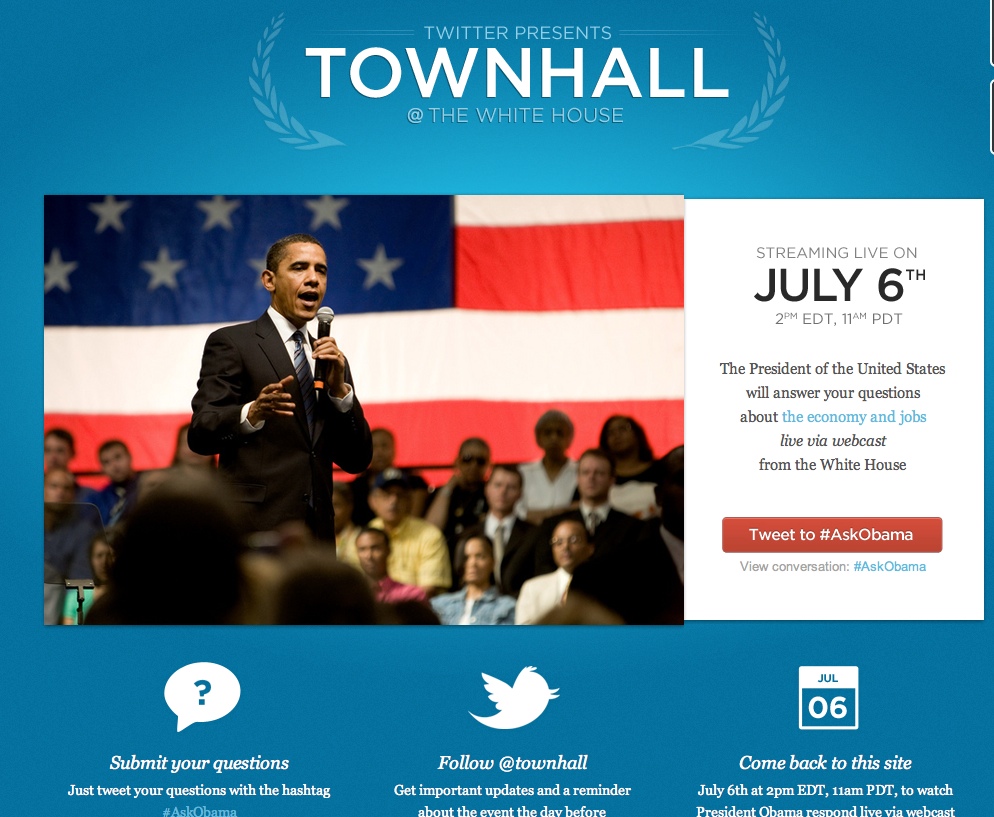
In coordinated tweets with Twitter, the White House announced that it will be holding a town hall on Twitter on July 6th, 2011 at 2 ET. Twitter launched a new @TownHall account for the event and a subdomain, AskObama.Twitter.com to host the live webcast.
According to Macon Phillips, director of digital for the White House, and Sean Garrett, Twitter’s vice president of communications, the digital town hall will be hosted by Twitter co-founder Jack Dorsey, who will provide the questions.

Phillips tweeted that “@Twitter has a cool approach to surfacing questions,” clarifying that “choosing the Q’s will be done by @twitter. Garrett tweeted that “there will be a fairly involved process by which they are selected” and more details and background on said process is on the way. UPDATE: Garrett emailed me “the basics”

“There will be multiple ways that questions will get to the President,” he wrote. “Twitter users will begin asking questions via the #AskObama hashtag today. To identify popular and relevant questions, Twitter is engaging with a third-party Twitter measurement company called Mass Relevance to provide a view on the most frequent topics and their geographical distribution. Additionally, Twitter will invite a group of highly active and engaged Twitter users (called “curators”) to help choose questions and comments both prior to and during the event. Twitter will collect questions in the days leading up to the Town Hall and in real-time during the event.”

Garrett also added some information regarding how Twitter will select this team of “question curators”:

“These curators will be a diverse group from around the country that are also active and engaged on Twitter,” he wrote. “These curators will ask those in their particular communities to also highlight what they think are the most important questions for the President. Curators will retweet questions and pose their own.”

The Twitter TownHall follows a Facebook TownHall earlier this year, in which Facebook founder Mark Zuckerberg posed live questions to President Obama. Nancy Scola wondered how much of a “TownHall” the event actually offered. With this Twitter version, the interesting detail will be in how much transparency goes into question selection, particularly with respect to how exact or tough they are. When the White House turned to Twitter to discuss President Obama’s Middle East speech, they included NPR’s Andy Carvin and Foreign Policy’s Mark Lynch as trusted interlocutors. It’s less clear how Dorsey will moderate, given his considerable different style of tweeting, but on one count there is no doubt: this will be interesting.

UPDATE: In his post on President Obama taking questions on Twitter, Nick Clark Judd raises similar questions over at techPresident on moderation. (And no, he didn’t call the event a “TownHall.”)

UPDATE II: The New York Times published more details on the “Twitter Town Hall,” including the news that there will be a “White House Tweetup,” the first of its kind. In terms of process, here’s what Twitter told the Times. (Spoiler: it’s quite similar to what Garrett told me, above).

Twitter will select the questions, using curation tools and a group of Twitter users to help identify the most popular questions raised both before and during the event. Twitter will be relying on its own search and curation features as well as a company called Mass Relevance to help find questions and topics that are most frequently mentioned.

… Adam Sharp, Twitter’s manager of government and political partnerships, said that the curators chosen by Twitter to help select the questions would be a politically and geographically diverse group. He said the curators would ask the people in their communities to highlight what they think are the most important questions for the president to address.

Curators will also be retweeting questions and posting their own.

“We will have highly-engaged Twitter users from around the country to provide that geographic diversity to help identify good questions, “ he said. “This helps us make sure that we are addressing the concerns that the Twitter universe cares about. “

Less clear whether the President of the United States will actually be doing any of the tweeting himself, as opposed to dictating a reply, which means we may not get to see any real-time presidential typos. According to reports by Paul Boutin, President Obama started tweeting for himself at @BarackObama over the Father’s Day Weekend, signing the tweet “-BO.”

CBS News White House correspondent and keeper of presidential lore Mark Knoller cautioned, however, that “Obama won’t be typing his responses.” Looking back at that Father’s Day tweet, Knoller tweeted that “a tweet was sent in his name by his campaign. He was not at a computer typing a tweet.”

We’ll see if the President decides to get more personally involved or not in the technology. Given that the presidential iPad appears to travel with him these days, it could happen.

[Photo Credit: President Barack Obama sits alone on the patio outside the Oval Office, following a meeting with his senior advisors, April 4, 2011. (Official White House Photo by Pete Souza)]

UPDATE III: Politico White House correspondent Mike Allen led his Tuesday’s Playbook with more details about Wednesday’s Twitter event:

The audience for tomorrow’s hour-long TWITTER TOWN HALL in the East Room (2 p.m. ET) will consist of 140 characters — er, people – in a nod to the maximum length of a tweet. President Obama, however, will face no such limit: He’ll answer questions for the audience, and @TownHall will carry summaries of what he says. Twitter co-founder and Executive Chairman Jack Dorsey will ask the questions. Three screens will be behind Obama and Dorsey: one with the current question; another will have a heat map of the U.S., showing where the town-hall tweets are concentrated; and the third will show the volume of tweets, by topic (jobs, taxes, spending, health care, etc.) Mass Relevance, a company that has worked with the broadcast networks on real-time Twitter data, will supply the analytics. Later, Radian6 will study the demographics of participants.

Representative questions will be chosen partly on how often they’re retweeted. The White House has also reached out to about 10 Twitter leaders in different parts of the country to help surface questions by curating themes and topics that are big among their followers and in their communities. So Dorsey may say: “We’re hearing a lot about the extension of unemployment benefits, especially from the upper Midwest, and here’s a question from Bob in Chicago.” The audience will include 20 people from around the country chosen through the White House Tweetups page, and they’ll also get to meet with Dorsey and with U.S. Chief Technology Officer Aneesh Chopra and perhaps other policy officials.

UPDATE IV: Twitter has blogged about the “Twitter Town Hall,” including a link to the 7 “curators” on Twitter who are selecting questions and a new study from Radian6 that found that “financial security is one of the most frequent topics of political conversation on Twitter.”

Tomorrow’s Town Hall is an invitation from the White House for anyone on Twitter to participate in an open exchange about the national and global economic issues facing the United States.

Questions addressed during the Town Hall will be selected both in advance and in real-time during the event. To narrow down the list of popular, relevant questions to ask on behalf of Twitter users, we’re doing the following:

• We’ve partnered with the visualization experts at Mass Relevance to identify the themes and regions driving the conversation.
• Algorithms behind Twitter search will identify the Tweets that are most engaged with via Retweets, Favorites and Replies.
• A team of seasoned Twitter users with experience discussing the economy will help flag questions from their communities through retweets.

White House turns to Twitter to discuss President Obama’s Middle East speech

The role of mobile phones, Facebook, YouTube and Twitter in the revolutions that have swept the Middle East in 2011’s historic “Arab Spring” has been the subject of much debate for months. While connection technologies helped to accelerate and amplify the news coming out of Egypt, Tunisia, Syria, Yemen, Libya, Bahrain and the rest of the region, it’s the incredible bravery of the young people who have stood up for their freedom in the streets that made change happen.

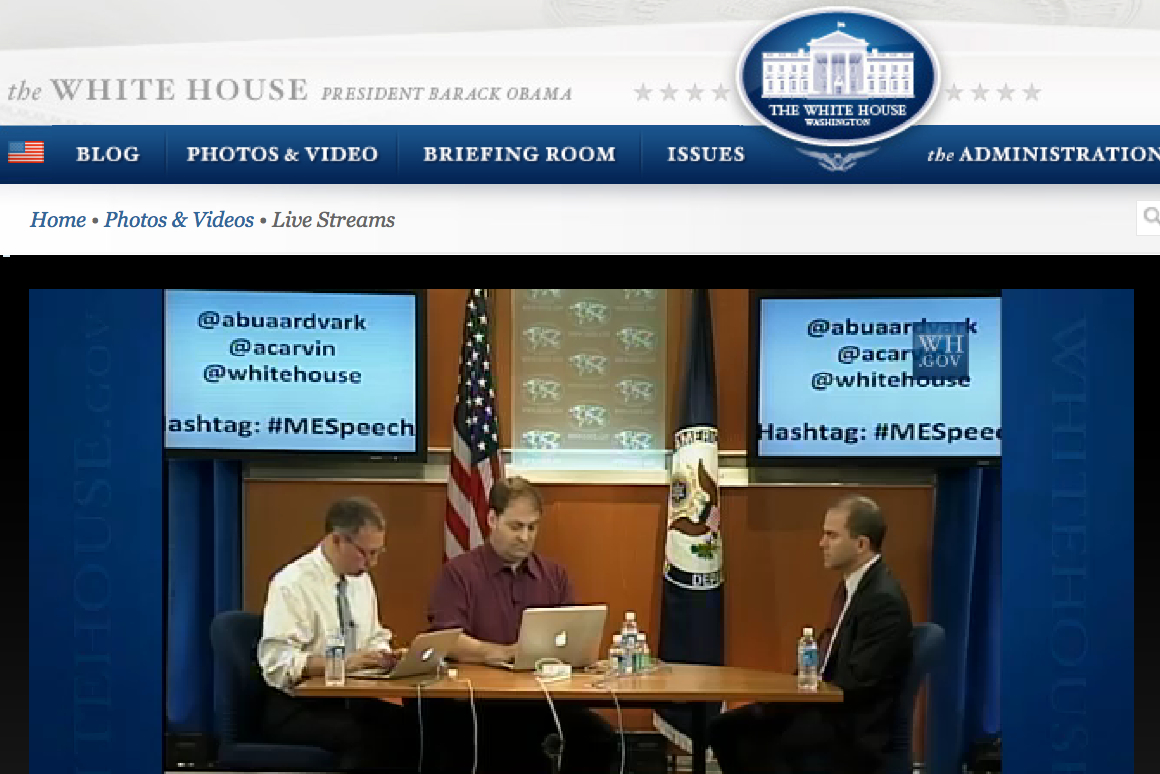
Tomorrow, President Obama will deliver a speech that many experts expect to reshape the Middle East policy debate. The speech will be live-streamed from the State Department and available to anyone online  at WhiteHouse.gov/live. In conjunction with the speech, the foremost curator of online media about the Arab Spring, Andy Carvin (@acarvin), will join with Foreign Policy’s Mark Lynch (@abuaardvark) in hosting a Twitter chat on the Middle East that will include an interview White House deputy national security advisor Ben Rhodes after the president concludes his remarks.

Earlier today, White House new media director Macon Phillips (@macon44) explained how the White House will continue the conversation on Twitter over at WhiteHouse.gov:

Immediately afterwards, the live-stream will switch to a follow-up Twitter chat with Deputy National Security Advisor Ben Rhodes, where anyone will be able to pose questions and reactions via Twitter.

NPR’s Andy Carvin (@acarvin) and Foreign Policy’s Marc Lynch (@abuaardvark), two experts who bring both a deep understanding of foreign policy and extensive online networks, will facilitate a world-wide conversation that will include participants from the Middle East and North Africa.  As Andy explains:

Rather than come up with all the questions ourselves, we’d like to invite you to help us craft the questions. If you’re on Twitter and want to submit a question, please post a tweet with your question and include the hashtag #MEspeech in the tweet. You can pose your question before or during the speech. We won’t be able to get to every question, of course, so we encourage everyone to follow the #MEspeech hashtag and join the broader conversation about the speech on Twitter.

Folks at the White House (@whitehouse) will be keeping an eye on the #MESpeech hashtag as well, so be sure to use that to share thoughts before, during and after the speech.

Keep an eye on that hashtag tomorrow: this will get interesting.

//

UPDATE: I’ve embedded the archive from today’s Twitter chat at the end of the post along with video from the White House. Quick thoughts on the outcome of today’s “Twitter chat.”

1) I thought Carvin and Lynch did a phenomenal job, and that this was well worth their considerable effort. Carvin described the experience of a Twitter interview as akin to “juggling and riding a unicycle simultaneously, all the while trying to interview a senior administration official.” The two men asked tough questions from a global audience, starting with fundamental issues of trust and policy towards Bahrain, shared the questions and answers as they went on Twitter, often including the @ handle of the person who asked them. The result was a fascinating window into one future of new media, geopolitics and journalism. The considerable trust that they were given to find and ask the best questions was, in my eyes, paid back with interest. Well done.

2) It was also hard not to see a marked contrast between the recent “Facebook townhall” where founder Mark Zuckerberg asked President Obama all of the questions and Andy Carvin bringing questions culled from a real time global conversation to Ben Rhodes.

3) On a week when the executive editor of the New York Times offered considerable skepticism about Twitter’s value, this event serves as a quiet, powerful reminder of the platform’s global reach in the hands of those willing to fully engage the public there.

4) Poynter has an excellent background post regarding why NPR’s Andy Carvin is moderating the White House Middle East speech Twitter chat. NPR’s managing editor for digital news explained:

“Andy has cultivated a unique audience and following around the world and is the right person to carry on a conversation and channel a wide range of questions from around the world. He’s been doing it for months.”

If the interview were being conducted another way, Stencel said, perhaps a program host or a beat reporter would’ve done it.

Carvin “has the talent in this format that our hosts have in commanding the air. Andy is in essence the Neal Conan [host of NPR’s “Talk of the Nation”] of social media. He understands the format and he can conduct the interview in a way that takes a combination of smarts and skills that’s rare in media.”

That’s about right. In May 2011, there is no one using Twitter in this way more effectively than Andy Carvin. He has been more actively and deeply engaged in finding, validating and distributing the digital documentary evidence emerging from the Middle East on social networks and video sharing sites over the past six months than anyone else on the planet. He’s been storytelling using what Zenyep Tufecki aptly called “Twitter’s oral history” in a way that brings the voices and vision of millions of people crying out for freedom to the rest of the world. Today, he brought their questions into the State Department and White House. Pairing him with a foreign policy expert in Lynch brought significant weight and contextual experience to interviewing Rhodes. Well done.

For more, Nancy Scola wrote up Carvin and Lynch’s ‘Twitter interview’ with Rhodes over at techPresident. As always, she’s worth reading on it.

The consequences of connectivity in an information age

win 7 devicesLast night, author Sean Power (@seanpower) was able to recover his lost laptop and belongings using the tracking software (@preyproject), Twitter and some brave, helpful human beings. It’s a fascinating outcome. As Power tweeted afterwards, this is “a great story, and brings up many implications re: vigilantism, crime in the era of realtime, and findability.”

In many ways, this story of loss and recovery serves as a fascinating insight into the century ahead in an increasingly networked society. There’s Orwell’s Big Brother, created by a growing number of cameras, satellite photos, wiretaps and intercepts, and there’s Little Brother, made up of citizens toting mobile phones. When the TSA patted down a baby this week at an airport, a pastor (@JacobJester) in line saw it, snapped a picture and tweeted it.

This is, to be fair, a leading edge case. Power is more connected online than many of his fellow citizens, technically proficient enough to install open source tracking software and sufficiently deft to leverage his distributed network of friends in real-time.

That said, it’s a reasonable expectation that we’ll be seeing variants of these kinds of stories in the years ahead. They’ll often end with the same moral: <a href="don’t steal computers from people who know how to use computers. Freelance journalist Branden Ballenger (@btballenger) used Storify to document Power’s story, which I’ve embedded below.

http://storify.com/btballenger/man-tracks-stolen-laptop-thousands-of-miles-away.js[View the story “Man tracks stolen laptop hundreds of miles away, calls thief” on Storify]

Gov 2.0 gets applied in Oklahoma [#Gov20a]

In the Gov 2.0a conference going on today and tomorrow in Oklahoma, the “a” stands for “applied,” as in implementing technology, processes and people strategy to make government work better. There should be some video going up later, along with pictures from Adriel Hampton and a blog post or three from from the attendees. Until that goes online, the tweetstream has told the best tale of what’s been happening at the conference. I used Storify to chronicle the story online.

http://storify.com/digiphile/gov20a-gov-20-goes-to-oklahoma.js[View the story “Gov20a: Gov 2.0 Goes to Oklahoma” on Storify]