Exploring Gov 2.0 in Madison, Wisconsin

Erik Paulson published an excellent new series on Gov 2.0 in Madison, Wisconsin today:

The citizens of Madison are a fairly tech-savvy bunch, but when it comes to technology in the civic space, we’re not as far out it the lead as we should be. I’d like us to change that, and join the list of cities developing applications as part of a Gov 2.0 movement.  This is a brief introduction, and what follows below is a three-part set of posts.

Part I focuses on some of what Gov 2.0 is, and uses Madison Metro as an example. Part II looks at how Madison is doing with Gov 2.0, and what we can be doing better. Part III looks at some specific Gov 2.0 systems that we could be building.

All three articles are excellent, and include several kind nods towards this blog and to Code for America and Civic Commons, two of the civic innovations organizations to watch in 2011.You’ll find thoughts on citizens as sensors, urban data, civic development, government as a platform, a “neighborhood API,”improving libraries, adding fibre, legislation tracking and more. Highly recommended.

Paulson also suggests excellent further reading in The Economist’s Special Report on Smart Cities and  Time Magazine’s article “Want to Improve Your City? There’s an App for That” for more background on Gov 2.o in cities.

White House: Regulations shall be adopted through a process that involves public participation

President Barack Obama signs H.R. 2751, the “FDA Food Safety Modernization Act,” in the Oval Office, Jan. 4, 2011. (Official White House Photo by Pete Souza)

President Barack Obama in the Oval Office, Jan. 4, 2011. (Official White House Photo by Pete Souza)

President Barack Obama issued an executive order today focused on reforming regulation regulatory review.

There are a number of details in this order that deserve further consideration and analysis from the open government community. One element is notable: public participation in the regulatory process.

Sec. 2. Public Participation. (a) Regulations shall be adopted through a process that involves public participation. To that end, regulations shall be based, to the extent feasible and consistent with law, on the open exchange of information and perspectives among State, local, and tribal officials, experts in relevant disciplines, affected stakeholders in the private sector, and the public as a whole.

(b) To promote that open exchange, each agency, consistent with Executive Order 12866 and other applicable legal requirements, shall endeavor to provide the public with an opportunity to participate in the regulatory process. To the extent feasible and permitted by law, each agency shall afford the public a meaningful opportunity to comment through the Internet on any proposed regulation, with a comment period that should generally be at least 60 days. To the extent feasible and permitted by law, each agency shall also provide, for both proposed and final rules, timely online access to the rulemaking docket on regulations.gov, including relevant scientific and technical findings, in an open format that can be easily searched and downloaded. For proposed rules, such access shall include, to the extent feasible and permitted by law, an opportunity for public comment on all pertinent parts of the rulemaking docket, including relevant scientific and technical findings.

(c) Before issuing a notice of proposed rulemaking, each agency, where feasible and appropriate, shall seek the views of those who are likely to be affected, including those who are likely to benefit from and those who are potentially subject to such rulemaking.

This order is part of a larger effort towards e-rulemaking by the administration and, as the Wall Street Journal reports, the regulatory review is a nod to concerns in the business community about excessive regulation hampering investment and job creation as citizens struggle to recover from the effects of the Great Recession. In that context, The president penned an op-ed in the Wall Street Journal about moving towards a 21st century regulatory system:

…creating a 21st-century regulatory system is about more than which rules to add and which rules to subtract. As the executive order I am signing makes clear, we are seeking more affordable, less intrusive means to achieve the same ends—giving careful consideration to benefits and costs. This means writing rules with more input from experts, businesses and ordinary citizens. It means using disclosure as a tool to inform consumers of their choices, rather than restricting those choices. And it means making sure the government does more of its work online, just like companies are doing.

We’re also getting rid of absurd and unnecessary paperwork requirements that waste time and money. We’re looking at the system as a whole to make sure we avoid excessive, inconsistent and redundant regulation. And finally, today I am directing federal agencies to do more to account for—and reduce—the burdens regulations may place on small businesses. Small firms drive growth and create most new jobs in this country. We need to make sure nothing stands in their way.

The order can also be considered in the context of FCC open Internet rules and net neutrality, where OpenInternet.gov was used to collect public feedback for proposed rules. The full version of the final rules, however, were not shared with the public until days after they were voted upon.

As always, determining what “public participation” in regulatory review and the process of regulation created will be the nut of the issue. The question of whether Congress codifies such an executive order with legislation is also a consideration, given that another administration could roll back the order. That said, this order does appear to be a step forward for more open government in a dry but important area.

UPDATE: The University of Pennsylvania law school’s regulatory blog has weighed in on the executive order promoting public participation:

The order reaffirms many core principles of regulatory policymaking reflected in prior executive orders dating back to the Reagan Administration. It also keeps in place the existing structure of White House review of new regulations that had been established by President Clinton.

But consistent with the Obama Administration’s emphasis on open government, today’s order also makes some significant new strides toward improving the role the public plays in the regulatory process. Section 2 states that new “regulations shall be adopted through a process that involves public participation.” By itself, this command is not remarkable, as agencies are already required by law to give the public an opportunity to comment on proposed rules.

Yet, requiring that the public have an opportunity to comment does not mean that this opportunity is always meaningful, especially when it is hard for members of the public to review the data and documents underlying agencies’ regulatory proposals. As noted in 2008 by a nonpartisan presidential transition task force chaired by Penn Law Professor Cary Coglianese, for some agencies

“important data might not be included in a rulemaking docket until late in the comment process, or the data might be buried in voluminous records that are not available electronically. The lack of meaningful access to important information detracts from the public’s ability to contribute to the formulation of better rules.”

That same task force report recommended steps to improve the timely, online availability of information underlying new regulatory proposals.

In today’s executive order, President Obama announced a significant new effort to improve the public’s access to government information about agency proposals. The executive order calls for agencies to make their regulatory dockets available online in a “timely” manner so that the public can comment on “all pertinent parts of the rulemaking docket, including relevant scientific and technical findings.”

Although many federal agencies do provide such information online, far too many still do not provide this information in a timely and complete manner, even in today’s digital era. If President Obama’s order is implemented faithfully and consistently across all federal agencies, it will go a long way toward advancing the goal of a more open federal government.

As usual, when it comes to compliance with open government mandates, that’s a big “if.”

UPDATE: Nancy Scola has more on a move towards 21st century bureaucracy at techPresident:

The notion of right-sizing government has, of course, been with us for years. (Though there has historically been a dearth of people who have come out in favor of government too big, or too small.) And New York Governor Andrew Cuomo went back to that well during his new year’s day inaugural address. But there are sections of Obama’s op-ed that seem like they could have easily been written by Darrell Issa, the new Republican chair of the House Oversight and Government Reform Committee. “If regulators imposed consistent data formats for regulatory information,” wrote Issa in the Washington Examiner back in October, for example, “then watchdogs, bloggers, and the public could perform their own oversight, illuminating which regulatory systems are well-designed and which are too complex.”

Obama and Issa seem of one mind on a technologist’s technocratic twist on right-sizing government: the thinking that standardized government rules and the publically parsable datasets they produce is one path to a bureaucracy of just the perfect bulk. The idea seems to, in practice, require a great deal of the American public at the granular level of bureaucratic practice. But in rough form at least the notion seems to be particularly “of the moment” at the moment in Washington.

UPDATE: Anthony D. Williams makes a case for why regulatory innovation is the next frontier for open government:

The promise of increased stakeholder participation is that more transparent and participatory forms of regulation will help deliver concrete social outcomes without imposing disproportionate costs on either industry or taxpayers. Systems of regulation will become for fluid and timely, responding both to the evolving needs of societies and the capacity for improvement in industry. Citizens will be more informed to make smart choices and more empowered to protect their family, friends, and communities from harm.

Of course, there are risks too. Governments could cede control of the policy agenda to unelected interest groups or fail to adequately scrutinize the effectiveness of these alternative regulatory frameworks, leaving them vulnerable to gaming or insufficient enforcement.

But the greatest risk is that insufficient innovation in regulatory strategies will undermine the legitimacy and effectiveness of policy and undermine economic performance. Worse, systemic regulatory and market failures (comparable in impact to the financial crisis) could unleash detrimental changes in social, economic and political order that will further erode global stability. Harnessing expertise and resources from emerging networks in the private sector and civil society will be an essential part of developing effective and forward-looking policy responses.

House 2.0: Livestreams of special session on Tucson Shooting on Facebook, CSPAN.org

Today, C-SPAN’s Facebook page will host streaming video coverage of Wednesday’s special U.S. House session on the Tucson shootings. The livestream will start at 10 AM ET, when the House will consider a resolution on the shootings. The session is also … Continue reading

Tim O’Reilly talks to Code for America about the power of platforms

Today, Tim O’Reilly spoke about the power of platforms to the inaugural class of Code for America fellows.

What’s happening today is an “open data” movement, said O’Reilly. “That’s what’s going to build the next platform.” As he’s said before, he thinks we’re now in an interesting platform stage where “the Internet is the operating system.” As early adopters of the new Google Chrome netbooks, a material metaphor for that notion is now online.

You can listen to the audio of Tim O’Reilly (my publisher) or download the MP3. Video may be available. later. Editor’s Note: O’Reilly Media is a supporter of Code for America and its founder, Tim O’Reilly, sits on its board.

The notion of “government as a platform,” which Tim has been speaking about for years now, is founded in his understanding of how technology companies have historically grown and flourished. Many of the anecdotes and historical underpinning of Gov 2.0 are in the webcast, “What is Gov 2.0?” in the side bar of this blog.

Here are a couple of key points from today:

Lesson 1: Platforms spread when they are ubiquitous and barriers to entry are low
Lesson 2: Create an architecture of participation, like Unix.
Lesson 3: Small pieces, loosely joined, which drove the growth of the World Wide Web.
Lesson 4: Don’t (just) build websites, build Web services.

There’s a lot more in there that builds upon Tim’s platform paradigm for government. Give it a listen and, if you find some other insights that particularly strike you or apply to how you think about how government can leverage the power of platforms, please share it in the comments.

If the notion that data and simplicity can build the government platform sound familiar, it should: Tim talked with the first United States chief technology officer, Aneesh Chopra, about how these ideas apply to government last year:

Building on that, if you have a moment, head on over to the White HouseExpertNet” wiki and share your thoughts on how the federal government should be designing democracy, specifically with respect to creating an open governnemt platform for citizen consultation.

White House deputy CTO for open government Beth Noveck returns to teaching

Beth Simone Noveck, director of the White House Open Government Initiative, and U.S. deputy chief technology officer, will return to academia as a professor of law at New York Law School on January 15th 2010.

Noveck is the author of “Wiki Government,” where she wrote about using social networking technology to connect people to policymakers.

People in the open government community began to thank her for her service today. “We’re lucky to have brilliant & dedicated leaders (& working moms!) like Beth Noveck serving our country. Thx, Beth & good luck!” tweeted Twitter’s Katie Stanton, a former colleague at the White House.

“Thanking Beth Noveck for 2 years of @OpenGov public service,” tweeted open government godfatherCarl Malamud. “Good luck on next gig, great job.”

More details will emerge on who will take on Noveck’s role at the White House in the coming weeks. For more on Noveck’s open government legacy, look back at her work on leveraging on the civic surplus, next steps for open government, the relaunch of the Federal Register and designing democracy with “ExpertNet,” a proposed a citizen consultation platform.

Also see coverage of Noveck’s resignation in NextGov, InformationWeek and FederalNewRadio.

UPDATEOn January 11, the John D. and Catherine T. MacArthur Foundation awarded Noveck a grant “to apply her expertise to developing a multi-year interdisciplinary research agenda to gauge the impact of digital networks on institutions,” including how society can use technology to strengthen democratic culture.

“The Foundation’s interest in public sector innovation as a potential longer term area for focused investment is testament to Beth’s success—through her research, writing, and public service—at putting the topic of 21st century democracy on the national agenda,” said Dean and President Richard A. Matasar. “We are delighted to have her back.”

According to the MacArthur Foundation, Noveck is now working with colleagues both inside and outside of government on the design for “IOPedia,” a platform for mashing up and visualizing public corporate accountability data and tracking the evolution of organizations.

“I am proud to have helped fulfill the president’s historic commitment to promoting an open and innovative government—one that uses openness and collaboration as core elements of governance and policy making,” Noveck said in a statemnt. “I look forward to working with students and the wider open government community to continue my research and advocacy to promote the adoption of public sector innovations.”

2011 Trends: National Strategy for Trusted Identities in Cyberspace highlights key online privacy, security challenges

Blackberrys, cell phones and communications devices are tagged with post-its during a briefing on Afghanistan and Pakistan in the Cabinet Room of the White House, March 26, 2009. (Official White House Photo by Pete Souza)

Blackberrys, cell phones and communications devices are tagged with post-its during a briefing on Afghanistan and Pakistan in the Cabinet Room of the White House, March 26, 2009. (Official White House Photo by Pete Souza)

The upcoming release of the final version of the White House “National Strategy for Trusted Identities in Cyberspace” highlights three key trends that face the world in 2011: online identity, privacy and security. Governments need ways to empower citizens to identify themselves online to realize both aspirational goals for citizen-to-government interaction and secure basic interactions for commercial purposes.

Earlier today, Stanford hosted an event today where U.S. Commerce Secretary Gary Locke and White House cybersecurity coordinator Howard Schmidt talked about the Obama administration’s efforts to improve online security and privacy at the Stanford Institute for Economic Policy Research (SIEPR). Here’s the NSTIC fact sheet the administration posted last year.

“As we look at the innovation engine that drives many of the things we’re doing, what does it mean to sit there as we’ve come together today,” asked Schmidt, “bringing these things together to overcome some of these risks associated with the technology we’ve deployed over the past 20 some odd years?”

The administration took public feedback on the document at NSTIC IdeaScale, which is now closed. (For a screenshot, see the story on IdeaScale on MSNBC.com.) “Every day at the end of the day. I would go back and read some of those comments,” said Schmidt today. “Some of them quite honestly were pretty silly. Other of them were very insight full and gave us some good thoughts about how can we do this right? How can we create a document that really does those things the secretary mentioned such as privacy enhancing but also giving us better trust?”

Schmidt took to the White House blog again today to announce a “National Program Office for Enhancing Online Trust and Privacy.”

Today, at Stanford University, Commerce Secretary Gary Locke and I were pleased to announce that the Commerce Department will host a National Program Office (NPO) in support of the National Strategy for Trusted Identities in Cyberspace (NSTIC).  As I’ve written previously, the NSTIC fulfills one of the action items in theCyberspace Policy Review (pdf) and is a key building block in our efforts to secure cyberspace.

This holiday season, consumers spent a record $30.81 billion in online retail spending, an increase of 13 percent over the same period the previous year.  This striking growth outshines even the notable 3.3-5.5 percent overall increase in holiday spending this past year.  While clearly a positive sign for our economy, losses from online fraud and identity theft eat away at these gains, not to mention the harm that identity crime causes directly to millions of victims.  We have a major problem in cyberspace, because when we are online we do not really know if people, businesses, and organizations are who they say they are. Moreover, we now have to remember dozens of user names and passwords. This multiplicity is so inconvenient that most people re-use their passwords for different accounts, which gives the criminal who compromises their password the “keys to the kingdom.”

We need a cyber world that enables people to validate their identities securely, but with minimal disclosure of information when they’re doing sensitive transactions (like banking) – and lets them stay anonymous when they’re not (like blogging). We need a vibrant marketplace that provides people with choices among multiple accredited identity providers – both private and public – and choices among multiple credentials. For example, imagine that a student could get a digital credential from her cell phone provider and another one from her university and use either of them to log-in to her bank, her e-mail, her social networking site, and so on, all without having to remember dozens of passwords. Such a marketplace will ensure that no single credential or centralized database can emerge. In this world, we can cut losses from fraud and identity theft, as well as cut costs for businesses and government by reducing inefficient identification procedures. We can put in-person services online without security trade-offs, thereby providing greater convenience for everyone.

This is the world envisioned in the NSTIC.  We call it the Identity Ecosystem.  We will be working to finalize the NSTIC in the coming months, but that is only the beginning of the process. I’m excited to be working with Secretary Locke. The Commerce Department is perfectly suited to work with the private sector to implement the NSTIC. In addition, there are other departments and agencies with strategic roles to play as well. Above all though, we look to the leadership of the private sector. Therein lies the key to success. Now is the time to move forward with our shared vision of a better, more secure cyberspace.

Why NSTIC Matters

The policy that the United States government makes towards the Internet has the potential to affect every person online in 2011, as advocates know, so how this is carried out bears close watching. The Center for Democracy and Technology filed key comments on NSTIC last year, including a key issue: “We alerted the Commerce Department to our concern about NSTIC’s current focus on the use of government credentials for private transactions: A pervasive government-run online authentication scheme is incompatible with fundamental American values,” wrote Heather West regarding the cybersecurity policy proposal.

The issue is at once simple and enormously complex, as Jim Dempsey from the Center for Democracy and Technology highlighted today. Government needs a better online identity infrastructure to improve IT security, online privacy, and support ecommerce but can’t create it itself, said Dempsey, outlining the key tension present. Dempsey advocated for a solution for online identity that lies within a broader trust framework and that is codified within a baseline federal consumer privacy law.

Some of the answers to the immense challenge of securing online privacy and identity won’t be technical or legislative at all. They lie in improving the digital literacy of for online citizens. That very human reality was highlighted after the massive Gawker database breach last year, when the number of weak passwords used online became clear. Schmidt highlighted the root caused of passwords today:

The reason most people do that is because we have to worry about remembering so many different passwords and then there’s so many layers of complexity and, complexity that we have to worry about, we have different time frame. We replace them every 30-day, 60 days, 90 days and it becomes really cumbersome. And recent survey found that 46% of the people surveyed never ever have changed their passwords and 71% use the same password with over and over and over again. From reading an on-line blog to doing sensitive financial transactions.

Others answers may be founded in creating online trust frameworks, which were a key initiative in 2010 for the federal government. Multifactor authentication, where more than one forms of identity are used in transactions, will be part of that vision. Schmidt described, loosely, what that might look like.

I go to a store. I go to a grocery store in some cases. I do some level of proofing, whatever I want to wind up doing, whether it’s the lowest level or the highest level to get an online identity stored on a token. A digital identity. Whether it’s on a USB drive or whether it’s on a smart card, I have the ability to do something beyond what I’m doing now. I go to log-in to these accounts. I use the USB device, I use a smart card. I use a one time password on my mobile device that no longer puts me in a position where I’ve been in the past where I can wind up making one small mistake and paying for it for years. But then I also get the log-in to my web mail account. That credential is passed on as well. So I have the ability to do these things seamlessly without all the baggage and overhead that goes with it. But then here comes the true test – this web mail – this phishing e-mail – comes in, and working together between the token and my digital identity and the browser, it stops me from doing things that are going to be harmful. And I had the ability to control that. I have the ability to set this up. And then it keeps me from becoming a victim of fraud.

That combination of physical tokens that interface with commercial and communications infrastructure to authenticate a consumer or online user are one vision of an identity ecosystem. Given the commercial needs of the moment, it should not be a surprise that the Department of Commerce is a key player. Secretary Locke offered perspective on the challenges that face the nation in 2011. [Full unedited transcript]

Let’s flash forward to today to 2011. Nowadays the world does an estimated $10 trillion of business online. Nearly every transaction you can think of is being done over the Internet. Consumers paying their utility bills, even from smartphones. People downloading music, movies and books online. Companies from the smallest local store to bed and breakfasts, to multinational corporations, ordering goods, paying vendors, selling to customers, all around the world. All over the Internet. E-commerce sales for the third quarter of 2010 were estimated at over $41 billion, up almost 14% over last year. And early reports indicate that the recent holiday buying season saw similar growth with year over year sales up by over 13%.

But despite these ongoing successes, the reality that the Internet still faces something of a trust issue. And it will not retch its full potential until users and consumers feel more secure than they do today when they go on-line. The threats on the Internet seem to be proliferating just as fast as the opportunities. Data breaches, malware, ID theft and spam are just some of the most commonly known invasions of a user’s privacy and security. And people are worried about their personal information going out and parents, like me, are worried about unwarranted sexually explicit material coming in before their children. And the landscape is getting more complex as dedicated hackers undertake persistent targeted attacks and develop ever more sophisticated frauds.

The approach that Locke outlined will apparently be housed within the Department of Commerce, a choice that is likely relevant to the scale and growth of e-commerce online:

The end game of course, is to create an identity ecosystem where individuals and organizations can complete online transactions with greater confidence, putting greater trust in the online identities of each other, and greater trust in the infrastructure that the transactions run over. Let’s be clear, we’re not talking about a national ID card. We’re talking about a government controlled system. But what we are talking about is enhancing online security and privacy, and reducing, and perhaps even eliminating, the need to memorize a dozen password through the creation and use of more trusted digital identities. To accomplish this, we’re going to need your help. And we need the private sector’s expertise and involvement in designing, building and implementing this identity ecosystem. To succeed we’ll also need a national program office at the Department of Commerce focused on implementing our trusted identities strategy.

For more context, look back to Schmidt’s introduction of the NSTIC at the WhiteHouse.gov blog last year:

Cyberspace has become an indispensable component of everyday life for all Americans. We have all witnessed how the application and use of this technology has increased exponentially over the years. Cyberspace includes the networks in our homes, businesses, schools, and our Nation’s critical infrastructure. It is where we exchange information, buy and sell products and services, and enable many other types of transactions across a wide range of sectors. But not all components of this technology have kept up with the pace of growth. Privacy and security require greater emphasis moving forward; and because of this, the technology that has brought many benefits to our society and has empowered us to do so much — has also empowered those who are driven to cause harm.

Today, I am pleased to announce the latest step in moving our Nation forward in securing our cyberspace with the release of the draft National Strategy for Trusted Identities in Cyberspace (NSTIC). This first draft of NSTIC was developed in collaboration with key government agencies, business leaders and privacy advocates. What has emerged is a blueprint to reduce cybersecurity vulnerabilities and improve online privacy protections through the use of trusted digital identities.

The NSTIC, which is in response to one of the near term action items in the President’s Cyberspace Policy Review, calls for the creation of an online environment, or an Identity Ecosystem as we refer to it in the strategy, where individuals and organizations can complete online transactions with confidence, trusting the identities of each other and the identities of the infrastructure that the transaction runs on. For example, no longer should individuals have to remember an ever-expanding and potentially insecure list of usernames and passwords to login into various online services. Through the strategy we seek to enable a future where individuals can voluntarily choose to obtain a secure, interoperable, and privacy-enhancing credential (e.g., a smart identity card, a digital certificate on their cell phone, etc) from a variety of service providers – both public and private – to authenticate themselves online for different types of transactions (e.g., online banking, accessing electronic health records, sending email, etc.). Another key concept in the strategy is that the Identity Ecosystem is user-centric – that means you, as a user, will be able to have more control of the private information you use to authenticate yourself on-line, and generally will not have to reveal more than is necessary to do so.

This is all wonky stuff that may seem a bit dry to some readers, but it’s important. The intertwined issues of identify, security and online privacy are increasingly relevant to every citizens as more commerce, education, communication and elements of everyday life move onto the Internet and mobile infrastructure. This strategy is central to how the United States government will work with industry, nonprofits, citizens and other states to improve the status quo. On that count, Bob Gourley, CTO of Crucial Point, commented extensively on the NSTIC at CTOVision.

It won’t be easy. Supporting the creation of identity infrastructure and improvements to online privacy in the private sector has the potential to make the Internet more secure and convenient for users and consumers but could have unintended consequences if not carefully pursued. There’s a lot at stake. As the Stanford event organizers highlighted, “e-commerce worldwide is estimated at $10 trillion of business online annually.”

Wired’s Ryan Singel highlighted a key issue for the White House plan for online identity, perhaps even the fundamental one in today’s online identity landscape: Facebook.

Philip Kaplan, the outspoken founder of Blippy, AdBrite and Fucked Company, added a Silicon Valley developer voice to event’s panel, arguing that any system has to be simple to implement, so that developers working in their living room making a website can concentrate on building new features, not worrying about security.

The closest thing to that currently is Facebook Connect, which lets you use your Facebook credentials to login you in around the net and on mobile apps..

“I can put in one line of JavaScript and I have a login system,” Kaplan said. “But that doesn’t I’m not going to pay my taxes using Facebook Connect.”

Which is another way of it might be as dangerous for a single company to be the world’s online ID vault as it would for the government to handle that task.

And right now, with Facebook at 600 million users and $50 billion in valuation, that future seems much more likely than a standards-based, interoperative system built by geeks at the behest of the feds.

Whether an online trust framework can be a viable alternative to Facebook’s play to be the identity provider online is a first-order question, and one that deserved examination. Kudos to Singel for putting the event in that context.

Weekend Reading: The most recent version of the NSTIC follows. Look for more reporting, both here or at another outlet, once the final version is released.

National Strategy for Trusted Identities in Cyberspace http://d1.scribdassets.com/ScribdViewer.swf
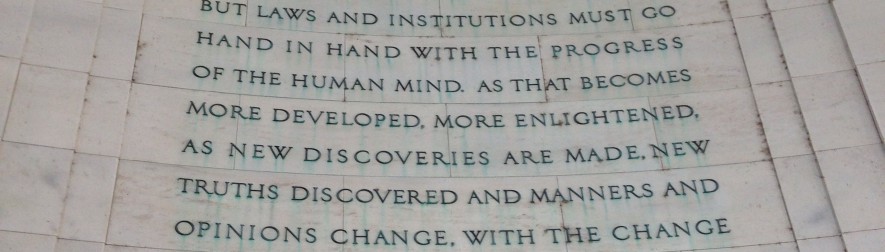
FT: “Open government never meant the real-time disclosure of all state activity”

The Financial Times opinion page weighed in on the state of open government in the United States and the United Kingdom today. The gist of the comment is that President Obama’s open data agenda has slightly stalled. A key excerpt, below, focused on potential sources of delay.

Barack Obama, the US president, and David Cameron, the UK premier, took power with a more mundane vision of transparency than that of Julian Assange – that governments should keep as many secrets only as truly necessary. Both were excited by the dry business of putting public data online. But they were right to be: signs that Mr Obama, in particular, has seen his efforts stall are a shame.

WikiLeaks releases highly sensitive diplomatic material. But governments collect reams of less delicate data, from exam results and hospital inspections to maps and weather reports. This can often be reused on the web, creating profitable businesses, helpful advice to citizens or tools that hold leaders to account. Not all such data are useful, just as not all scientific discoveries lead to new drugs. And not all should be published, if they break data protection rules. But more should be than at present.

It would be irresponsible to deny a state’s right to protect its interests, and those of its citizens, by keeping some secrets. Open government never meant the real-time disclosure of all state activity. But the reasons for hiding public information too often stem from fear of embarrassment, force of habit or politicians going cold on previous ideals – not the public interest.

Here Mr Obama began strongly, speedily unveiling schemes to unlock new data. Yet his progress has slowed as departments delay and fudge and the White House’s attention is diverted elsewhere. Mr Cameron has done better, in part by being more focused — and thus picking fewer fights with often recalcitrant civil servants.

The full Financial Times op-ed is online here, behind a registration wall: “Open up, before it becomes too late.”

For a look back at the progress of the Open Government Directive in its first year, click over to the Huffington Post.

FCC launches open Internet developer challenge for apps for network QoS testing

While the technology and political establishment is reeling off reactions to the Federal Communication’s net neutrality vote to approve the first federal rules on Internet traffic will mean for net neutrality, one thing at least is clear: the FCC has launched an Open Internet Apps Challenge on Challenge.gov.

The contest is reasonably straightforward, at least as a proposal; challenge developers to create applications that test networks that inform consumers about broadband Internet connections. Specifically:

The Open Internet Challenge is designed to encourage the development of creative, innovative and functional Internet software tools for fixed or mobile broadband that provide users with real-time data about their Internet connection and, when aggregated, can show Internet-wide patterns and trends.

Apps that can detect, aggregate and analyze such information might be of use to both the agency and consumers alike, in terms of making policy or consumption decisions:

The Open Internet Challenge seeks to encourage the development of creative, innovative and functional applications that provide users with information about the extent to which their fixed or mobile broadband Internet services are consistent with open Internet principles. These software tools could, for example, detect whether a broadband provider is interfering with DNS responses, application packet headers, or content.
These applications should also collect anonoymized data that is useful for network research and analysis that enables the discovery of patterns and trends in Internet openness.
One popular platform for Internet software tools is Measurement Lab (M-Lab), which “is an open, distributed server platform for researchers to deploy Internet measurement tools.” Those interested in running their software tools on the M-Lab platform should contact the M-Lab steering committee, which coordinates research on the M-Lab platform.

The commission is also soliciting research as part of the challenge:

In addition to measurement tools, this challenge also seeks research papers that analyze relevant Internet openness measurement techniques, approaches, and data. The Challenge is designed to encourage and reward the creation of novel, innovative and useful research. The research must be new or recent and directly involve open Internet principles. For example such research may illuminate how widely fixed and mobile networks observe the FCC’s open Internet principles or how advanced network services can be provided in a way that adheres to the spirit of the open Internet. Such research papers need to have been peer-reviewed by a recognized scientific conference or journal and must have been published since January 2007. (Dissertations, white papers and technical reports are not acceptable, but may be referenced for further details within the paper.) Research on Internet openness can improve policy making and advance Internet transparency, which helps to sustain a healthy Internet.

Will it take off? Another challenge, so to speak, might be the incentives. The winners will earn a free (up $500/person in travel expenses) trip to FCC headquarters in Washington, DC, where they’ll go to an FCC Chairman’s reception, present their work to the Commission, receive plaque and “have their apps and research featured on the FCC’s website and social media outlets.”

It’s also not clear how the development community will feel about the FCC after today’s hearing on somewhat controversial net neutrality rules, for which a public document still hasn’t been published online. Geeks and government have converged at the FCC before. If this challenge is going to take off, they’ll need to do a lot of outreach to encourage the development community to participate, which in turn will likely also mean exactly what the new open Internet principles will mean in practice. Stay tuned.

National Archives launches redesigned Archives.gov under open government plan

Today the National Archives launched its redesign of Archives.gov redesign.

“It’s essential for the National Archives to have a user-friendly online presence,” said Archivist of the United States David S. Ferriero in a prepared statement. Ferriero is the first Archivist to blog, tweet (@dferriero), and launch a Facebook page. “We hope to reach new audiences while still engaging our long-time users, researchers and visitors. This redesign – part of the National Archives flagship Open Government Initiative – reflects the ongoing effort to engage the public and make records of the National Archives easier to find and use.”

If you’re not following the work of the National Archivist, today is a good day to reflect on his progress and the importance of his work. Reflect on what he told the New York Times:

How many digitized records should be available online? “If I had my way,” he replied, “everything.”

The Obama administration has also given the National Archives responsibility for reviewing the declassification of 400 million pages of secret documents by the end of 2013.

Mr. Ferriero’s goal, he said, is “to ensure that we have the user at the center of our thinking — historians, genealogists, open government folks. What can we do to make their lives easier?”

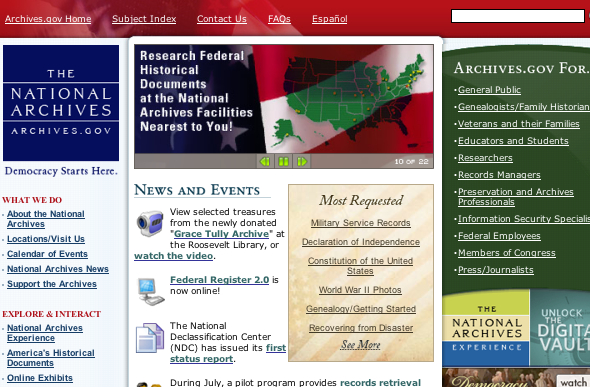
Each of these flagship initiatives, many of which are listed at the WhiteHouse.gov open government innovations gallery, are supposed to deliver upon the signature elements of each agency’s mission. In terms of the National Archives, the redesign was “intended to encourage online user participation in the redesign of our website.” Does it deliver?

Here’s the old design of Archives.gov:

The research that preceded the redesign looked at what people do when they come to Archives.gov and what they do there.

Here are the results of the National Archives’ data analysis of Archives.gov “customers”:

How frequently do you visit this site?
69% First time
14% Every 6 months or less
9% About once a month
5% About once a week

In what role are you using the web site today?
30% Veteran or Veteran’s family
23% Genealogist or family historian
14% Educator or student
14% Researcher

What were you primarily looking for today?
28% Historical Documents
25% Veterans’ Service Records
19% Genealogy or family history information
9% Other

How would you most like to interact with this site?
41% Bookmark or tag pages
35% None
15% Receiving newsletters/email updates
8% Watching Vodcasts or video

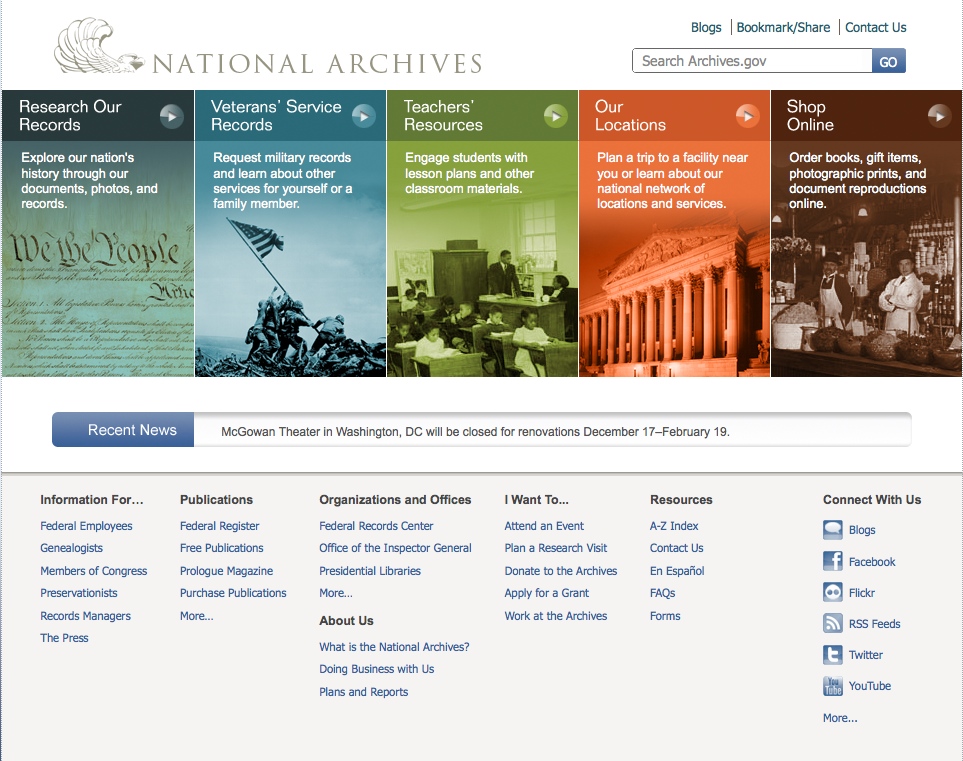
The new Archives.gov was based in part on that feedback and user need:

On first glance, and after some time clicking around, the answer is a qualified “yes.” This version of the Archives.gov redesign came about through a vote on the homepage design using Ideascale and in-person events, receiving in total some 3,257 votes. The redesign includes streamlined access to historical documents and military service records, an important improvement, given the eye-opening statistic that 81 percent of Archives.gov visitors are looking for this information.

The new design is cleaner, features clearer organization of content and loaded more quickly on my mobile device. The search field, one of the critical features of any modern website, is larger and raised to greater prominence in the redesign. I don’t see a mobile version of the site yet, and there is as of yet “no app for that,” unlike, say, the Library of Congress. That may change.

With respect to another stated aim of the project, the redesign does prominently display the Archives.gov social media accounts, although in muted colors that, while fitting look and feel, don’t catch the eye. No social content is featured on the homepage or the dedicated section, though it’s not hard to find those accounts on the master list of social media. There are some real gems to be fond in there, particularly in the NARA Flickr feed.

Archives Wiki: Our Archives Wiki
Blog – NARAtions, the U.S. National Archives: Blog - NARAtions, the U.S. National Archives
Facebook – US National Archives: Facebook - US National Archives
Flickr – US National Archives Photostream: Flickr - US National Archives Photostream
RSS Feed – News from the U.S. National Archives: RSS Feed - News from the U.S. National Archives
Twitter – @ArchivesNews: Twitter - @archivesnews
YouTube – US National Archives Channel: YouTube - US National Archives Channel

There are a host of other accounts in there for regional archives, presidential libraries or specific topics. For more on the back story behind the design, read over the minutes from last month’s researcher meeting:

The website was last updated several years ago. This time, we are revising it to focus on tasks that people are trying to accomplish when they come to our website.

We collected information from researchers on what you wanted in a variety of ways over several months including asking staff, researchers, veterans, patrons in line at exhibits, etc. This is part of Open Government from December 2009. The Flagship initiative is to redesign by matching the needs of all users (researchers, educators, students, and those just browsing to see the founding documents).

We have the new website categorized into sections. There are five main sections: veterans, researchers, educators and students, locations, and our online store.

Other pages will focus on genealogy, Congress, records preservation, Federal records managers, publications, offices in NARA, and information about us in general. It also includes an agency index, FAQs, and social media (e.g., blogs like NARAtions and AOTUS).

The research section has basic information on how to do research at each of the facilities and links to specific topics like the Civil War.

The new website rolls out next month in December. This is the first phase of the redesign. The focus is on the home page, researchers, veterans, education, and will then move onto other areas.

The 1940s census will be available online in 2012 spring.

“Hire a Researcher” will still be available. All content will migrate over. You do not need to resubmit information. All current information will come over. If you need to resubmit information, we will let you know. We do an annual contact check to revise the list.

This is a significant improvement and one that the Archives staff should be commended upon. If you have feedback, they’ve made it clear that they’re listening: comment on the NARAtions Blog or write to webprogram@nara.gov.

Social media, local government and elections: reflections on COGEL and @DCBOEE

This week, I was proud to be one of two speakers for a session on social media and government at the Council on Governmental Ethics Laws (COGEL) conference in Washington, D.C. I delivered an adapted version of the talk on social media and government I gave the Social Security Administration’s Open Government Awareness Day earlier this year, focusing on the elements that would be of greatest interest to a group of lawyers, regulators and academics. The presentation is embedded below:

The speaker that followed me, however, was able to share a fascinating view of what social media looks like from inside of government, specifically in the District of Columbia. Alysoun McLaughlin, the public affairs manager for the District of Columbia Board of Elections and Ethics. Here’s her bio, from the COGEL session description:

She joined the District last year, just in time to implement a long list of reforms for the 2010 election including new voting equipment, early voting and same-day registration. Prior to becoming an election official, she was a project manager for Election Initiatives at the Pew Center on the States. She previously spent a decade as a Washington lobbyist, focusing on election issues for the National Conference of State Legislatures and the National Association of Counties. She is here today to share her experience with social media during the 2010 election.

And share she did. Over the course of half an hour, she talked about Facebook, Twitter, local media, citizen engagement and much more. I captured most of her presentation on my iPhone (sorry about the unsteady hand) and have embedded her presentation, “To Tweet or not to Tweet: Engaging the Public through Social Media,” below.

If you want an excellent, practical perspective of the local government side of social media, these are worth watching. A couple of key takeaways from her presentation:

  • How can governments get insights from Twitter without using it? “Just type in the name of your agency and see what they’re saying.”
  • On D.C. elections: “We know there are going to be lines. Come to the website to see what they are.”
  • Don’t trust this to an intern. You “need someone skilled in crisis communications.”
  • “The days that I’m heavy on Twitter are the days my phone rings less.”
  • Viral tweets can raise awareness: “…and we just confirmed that a voter used a write-in stamp. on a touch screen.”

Part 1: Introductions

Part 2: Reflections on Twitter and Facebook

Part 3: Twitter and the 2010 DC Election

Part 4: Who follows @DCBOEE

Part 5: Listening and using social media in government