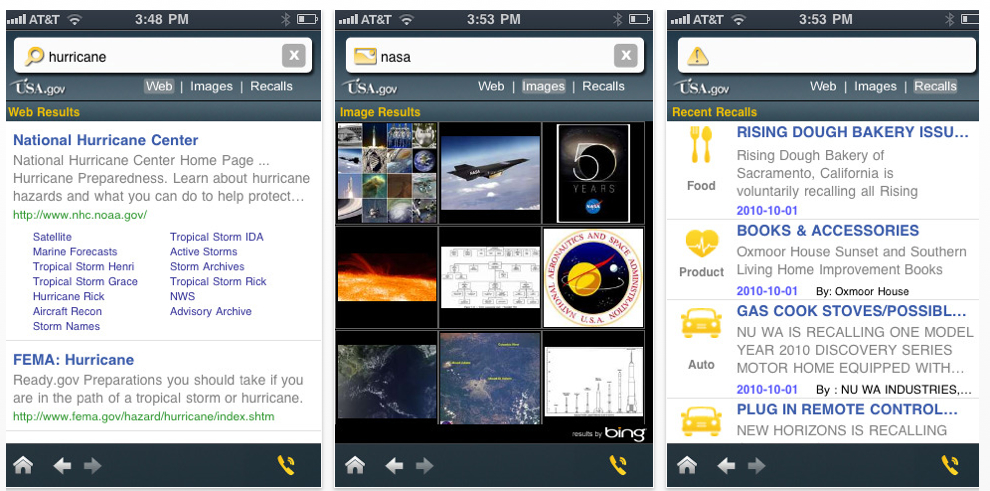
This October marks the 10th anniversary of USA.gov, the nation’s search engine for government. And, as it turns out, now there’s an app for that. Nope, it’s not Apps.gov of even Apps.USA.gov. The General Services Administration quietly added a new USA.gov iPhone app to iTunes a few days ago. Why is it important? When American look for government information, they use search engines. While most of them go to Google and Bing, now they have another option when they fire up a smartphone.
The new app integrates access to a useful government dataset for citizens: a product recall database. The same access is available through a Product Recall app online, for Android or on mobile devices at Recalls.gov. That also means that citizens don’t have to have a smartphone to access public data, a issue for accessibility and the digital divide. For those inclined, the app also provides mobile search for local, state and federal websites, including predictive search.
The new USA.gov app is beautifully designed, lightweight and didn’t crash on me after ten minutes of searching and browsing. The integration of a “tap to call” feature with the iPhone on the home screen also preserves a handy “Gov 1.0” feature as well: 1 800 FED INFO.
As the app description in iTunes notes, the app makes public data like birth, marriage and death records freely available to all citizens (provided that they have an iOS device with an Internet connection). Search.USA.gov provides similar access on both mobile and desktop users, for folks who prefer a Web browser to an app. Information about schools, passport and visas, tax codes, government jobs and Social Security benefits is also available.
The addition of the USA.gov to iTunes ends a quiet but important lag in getting a free government app onto the world’s largest mobile application platform. When Apps.USA.gov launched, Apple apps were conspicuously absent. Months later, the legal difficulties between the feds and Cupertino appear to resolved.
As a result, parents can search the FDA database to see which toys have been recalled. While it’s true that analysts can (and no doubt will) point to the USA.gov app as the latest example of “shiny app syndrome,” making a better interface for open data is a win for everyone.
The slideshow above is a selection of pictures from today’s Fedtalks in Washington. (Look for more high quality photography soon from the event organizers). If you can’t see the Flash slideshow, you can view my full Fedtalks 2010 set on Flickr.
Will a platform for citizen engagement help federal government employees reach their open government goals?
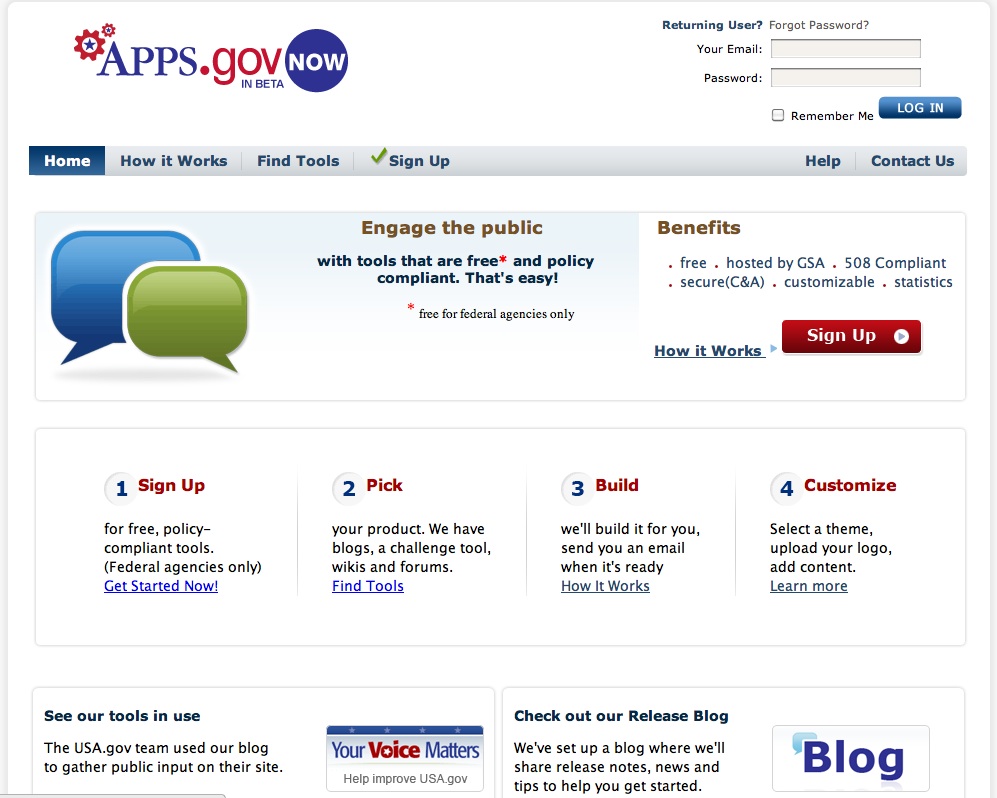
Today at Fedtalks in Washington, the General Services Administration’s director of citizen engagement, Gwynne Kostin, talked about its new open government platform, Apps.gov NOW. Apps.gov NOW launched in August but the Gov 2.0 community hasn’t heard much about it until this morning.
The new platform, available at citizen.apps.gov, allows federal employees to choose from technologies that enables them to create blogs, challenge tools, wikis or forums. Kostin talked about how employees can then upload a banner, add plug-ins or traffic reporting, and import data feeds. It’s essentially turnkey technology, with the regulatory compliance backhaul simplified for usage. 508 compliance for disability is particularly relevant to many feds.
“We cleared away a lot of the issues with policy,” said Kostin. “We expect this tool to be especially important to small agencies or for projects that need to get market fast.”
If you had five minutes to talk about the future, what would you say?
Last month, I had the privilege of presenting at two Ignite sessions, Ignite NYC at the Web 2.0 Expo and Ignite D.C. later in the week. If you’re not familiar, Ignites are 5 minute-long talks where presenters share subject they’re passionate about, using 20 slides that auto-advance every 15 seconds. If you’re not used to that rhythm, it can be tricky.
The video of my talk at Ignite D.C. is embedded below:
The presentation and associated links is embedded below:
Curious about the title for my talks? As fellow science fiction fans know, the title for these Ignite talks is an homage to two author: William Gibson, and Bruce Sterling. Gibson, sometimes called the “noir prophet” of cyberpunk, coined the term cyberspace and wrote “Pattern Recognition,” an enjoyable yarn about the future-present. Sterling, also an notable cyberpunk author, maintains the excellent Wired blog “Beyond the Beyond,” which has an entire category called “Spimewatch.”
What is the federal chief technology officer up to out in Silicon Valley? From afar, however, it’s looks like federal CTO Aneesh Chopra is stirring up awareness about open government and entrepreneurship in the venture capital community in California. He’s also traveling with Department of Health and Human Services (HHS) CTO Todd Park to add his compatriot’s considerable enthusiasm for innovation in healthcare information technology (HIT). Chopra’s slides follow:
During the event, I picked up some tweets coming out of a “D.C.-to-Silicon Valley” event and curated them using the Storify tool. It proved to be a bit unstable – apps in beta are fun! – but you’ll find a “living version” of the story embedded in the post below.
Have you met Todd Park? He’s the first CTO of Health and Human Services Department of the United States. Earlier this week, he announced the upcoming launch of HealthData.gov, a new website that will publish open government health data. If you’re unfamiliar with Park, I interviewed him at this year’s Gov 2.0 Expo:
Park and I talked about his open government work at the Department of Health and Human Services, where he’s been trying to make community health information as useful as weather data. We also spoke about the Health 2.0 Developer Challenge, a series of code-a-thons and team competitions to build apps based upon community health data. “Games are a non-trivial information dissemination approach” that can drive actionable behavior, said Park at HealthCamp, referring to many of the entries that use game mechanics to socialize the data. The developer challenge culminated this week during the fourth annual Health 2.0 Conference in San Francisco.
The nation now can see more about what the tech community has come up since this spring, when the question of whether there’s a healthcare app for that was answered the first time. “Social value and economic value can go hand in hand,” he said to a health IT summit in San Francisco. Below, Park talks about the Veterans Administration’s new “Blue Button,” which provides access to downloadable personal health data.
Veterans who log onto My HealtheVet at http://www.myhealth.va.gov and click the Blue Button can save or print information from their own health records. Using a similar Blue Button, Medicare beneficiaries who are registered users of http://www.mymedicare.gov can log onto a secure site where they can save or print their Medicare claims and self-entered personal information. Data from of each site can be used to create portable medical histories that will facilitate dialog with Veterans’ and beneficiaries’ health care providers, caregivers, and other trusted individuals or entities.
This new option will help Veterans and Medicare beneficiaries save their information on individual computers and portable storage devices or print that information in hard copy. Having ready access to personal health information from Medicare claims can help beneficiaries understand their medical history and partner more effectively with providers. With the advent of the Blue Button feature, Medicare beneficiaries will be able to view their claims and self-entered information—and be able to export that data onto their own computer. The information is downloaded as an “ASCII text file,” the easiest and simplest electronic text format. This file is also easy to read by the individual; it looks like an organized report.
More than 60,000 people have already downloaded their PHRs. As those technically savvy writers emphasize, however, this will create thousands of opportunities to have that sensitive data leak. They stressed the importance of using encryption and password protection to protect the records. For those watching the development of health IT, the future that the 3 CTOs hint about near the end of the post will be of particular interest:
Soon, Blue Button users may be able to augment the downloaded information that is housed on their computers—or that they transferred to a commercial personal health record or other health application—through automated connections to, and downloads from, major pharmacies including Walgreens and CVS; lab systems such as Quest and LabCorp; and an increasing number of inpatient and outpatient electronic medical records systems.
How does making government smarter relate to open government, e-government or “We government?”
As Sifry put it in the Huffington Post this week ,
At Personal Democracy Forum, we prefer the term “We-government,” the co-creating of new forms of collaboration and service that use technology, public data and the social web to address vital issues and solve public problems, that enables us to do more with less. It’s neither Right nor Left, not small government or big government, but effective do-it-ourselves-government.
What are the early success stories and challenges for an open government in beta? This morning in Washington, I dodged rain drops on my way to a Gov 2.0 panel moderated by Ogilvy Digital’s Rohit Bhargava to talk about that very topic, joining Personal Democracy Forum co-founder Micah Sifry; Mark Murray, deputy political director for NBC News; Ari Melber, correspondent and blogger for the Nation magazine and Politico; and Gwynne Kostin, Director at the Center for New Media and Citizen Engagement at the GSA.
The panel was livestreamed at Livestream.com and integrated with the Ogilvy’s 360 Digital Influence Facebook page for an online audience. Fast forward to about 30 minutes into the archive for the beginning of the event.
“We’re just beginning to see the government using the Web in a more porous, participatory way,” said Sifry, who saw no reason that government workers couldn’t get technology in the same way other citizens else can. “Really, government workers have mastered the telephone,” he said. “The can probably use Web 2.0 tools.”
Gov 2.0 Case Studies
While Sifry was critical of the White House’s embrace of Gov 2.0 and open government, he observed that at the agency level he’s seeing “a flowering of initiative.” That’s backed up by what I’ve seen on the ground and have reported on in numerous studies. For instance:
“There’s a movement to make sure that cities all put their data out in the same way,” said Sifry, as evidenced by the Open 311 initiative
Sifry also referenced the targeted crowdsourcing example of Peer-to-Patent, an open government innovation pioneered by White House deputy CTO Beth Noveck
The reboot of FCC.gov and rollout of APIs and developer engagement holds some promise.
“There is a civic surplus waiting to be tapped of people who want the country to succeed,” said Sifry. And, in fact, I reported on Harnessing the Civic Surplus for Open Government,” when Noveck spoke in Manor, Texas about all of these initiatives.
I’m shortchanging the comments of Melber, Kostin and Murray due to time, unfortunately, but the #Ogilvy360di tweetstream and archived livestream offer additional perspective. Both of the reporters provided ample insight into the hyper-charged world of national correspondents in Washington, where news and issues move almost as quickly as the polls. More of Kostin’s thoughts may also be fond at her blog, OnDotGov.
This morning, the state of Minnesota announced that it would use Microsoft’s private cloud computing technology as a platform for its collaboration software. Microsoft’s blog post reasonably Minnesota’s move to the cloud as an “historic first.” Given that the state’s press release, embedded below, describes it the same way, that’s not unfair. Details have yet to emerge on the security or privacy requirements that the Redmond-based software giants signed to gain the customer but, as the release notes, “the move makes Minnesota the first U.S. state to move to a large collaboration and communication suite in a private cloud environment.”
While federal, state and local government entities have used Amazon, Google Apps or Salesforce.com, today’s news at least adds Microsoft’s offerings into the conversation. The implementation will likely deploy the Windows Azure platform to deliver Microsoft’s Business Productivity Online Suite (BPOS).
“As states battle growing deficits, they are continually being asked to do more with less,” said Gopal Khanna, Minnesota’s State Chief Information Officer in a prepared statement. “Rethinking the way we manage our digital infrastructure centrally, to save locally across all units of government, is a crucial part of the solution. The private sector has utilized technological advancements like cloud computing to realize operational efficiencies for some time now. Government must follow suit.”
Not all reactions are quite as optimistic, however, particularly with respect to reduced costs. “I forsee short term gain,” tweeted researcher Simon Wardley, “large future exit costs, increased consumption, no long term reduction in IT expenditure.”
Why no long term reductions in state IT expenditures by going to Microsoft’s private cloud?
“See Jevons’ paradox,” Wardley replied. “Causes are co-evolution, long tail of demand, componentisation and increased innovation. In other words, you’ll just end up doing more. Countries & States are in competition with each other … not just firms. It’s not MSFT specific, it’s general to all clouds. The ‘cloud will save you money’argument forgets consumption effects. You might as well argue that Moore’s law should have reduced IT expenditure. [Cloud will] reduce your costs if your workload stays the same but alas it won’t, it’ll increase for the reasons previously listed.”
How important is the disconnect between the Silicon Valley and Washington, D.C.? As the United States transitions from an industrial economy into the Information Age, the importance of Washington securing legislation and regulations that promote security and innovation has perhaps never been greater. Small businesses are the source of many jobs, and yet the barriers that entrepreneurs face in getting startups off the ground are legion. Stimulating open government entrepreneurship is a key issue for the Gov 2.0 movement and yet the examples of successful startups are dwarfed by the pages of the regulations that govern them.
I spoke with Brad Feld about all of these issues at the Gov 2.0 Summit earlier this month. Feld has been an early stage investor and entrepreneur for over 20 years. Prior to co-founding Foundry Group, he co-founded Mobius Venture Capital and, prior to that, founded Intensity Ventures, a company that helped launch and operate software companies and later became a venture affiliate of the predecessor to Mobius Venture Capital. Our interview is embedded below:
“I realized one of the paradoxes of the entrepreneurship ecosystem that is so important to society is: We don’t have an entrepreneurship lobby,” he said, “because entrepreneurs are off doing it.”
Policymakers tend to ignore start-up concerns, according to Hoffman.
“The natural process of ‘oh, I’m responding to these lobbies, I’m responding to old political interests’ tends to always drown out the entrepreneurs,” he said.
It’s easy to ignore the concerns of newer companies, according to Hoffman, a partner at Greylock Partners, a venture capital firm in California.
“Some folks are trying to [help] but people are like, ‘OK, I can deal with that later; I don’t really care,'” he said.
Stimulus funding is a key example of startups getting government short shrift, according to Hoffman.
“The way this is described is ‘shovel-ready jobs,'” he said, arguing that kind of funding would not benefit new companies who are “key to our future.”
“It’s much easier when you’re embedded in the political infrastructure to respond to immediate things” such as the stimulus package, he said.
StartUP Visa
Another issue of critical importance to entrepreneurs is top technical talent. That’s why Feld and others have been advocating for a “startup visa.” In the video from Gov 2.0 Summit below, he talks about the startup visa legislation and why it matters to VCs and the innovation economy.
According to the website supporting the legislation in the Senate, S. 3029, the StartUP Visa Act alien entrepreneurs who have received significant capital from investors to establish a business in the United States. Specifically:
Have a required amount of financial backing from a qualified investor or venture capitalist
Have a commercial business that will generate a predetermined level of employment, revenue or capital investment
The goal of the StartUP Visa legislation is to create an alternate visa system to the H1B program, in which temporary visas are granted to immigrants working in specialized fields including the high-tech industry. Currently, there are 65,000 HIB visas awarded to immigrants and an additional 20,000 H1B visas awarded to individuals who hold an advanced degree. Additionally, this legislation would create a new set of visas that require immigrants to invest at least $1 million dollars in the US and employ at least 10 people.
One hundred and sixty venture capitalists and angel investors support the bill. According to the National Venture Capital Association (NVCA), 25 percent of America’s venture-backed and publicly-traded businesses, including: Google, Yahoo!, eBay, Intel, Pfizer, DuPont and Procter & Gamble are examples of American success stories founded or co-founded by foreign born residents. Further, in 2005, these companies netted more than $52 billion in sales and employed 450,000 workers. In 2006, 24% of all filled patents had foreign residents listed as the inventor or co-inventor.
To date, the StartUP Visa Act has not advanced beyond committee.
The statements of the witnesses before the Senate from the Commerce Department, Justice Department and witnesses are embedded in ths post. Below, find an exclusive interview with digital privacy and security researcher Chris Soghoian, who until recently was the resident geek at the Federal Trade Commission, and some context on “Digital Due Process,” the coalition of industry and privacy advocates advocating for an ECPA update.
“From the perspective of industry and definitely the public interest groups, people shouldn’t have to consider government access as one of the issues when they embrace cloud computing,” said Soghoian. “It should be about cost, about efficiency, about green energy, about reliability, about backups, but government access shouldn’t be an issue.”
While the tech blogosphere may be focused on Twitter, Facebook and inside baseball among the venture capitalists of Silicon Valley’s today, the matter before Congress should be earning more attention from citizens, media and technologists alike. Over at Forbes, Kashmir Hill made the case that industry will benefit from a clearer Electronic Communications Privacy Law. Take it one step further: updates to the ECPA have the potential to improve the privacy protections for every connected citizen, cloud computing provider or government employee. As she pointed out there:
One of the most egregious ECPA issues is how it treats the protection of email. “Why should email in someone’s inbox be treated different from something in someone’s sent folder?” asked Smith [Microsoft’s general counsel]. “Why is something unread in my junk folder subjected to greater privacy than something read in my inbox? Why does an email I sent in April have fewer privacy protections than one I sent in September?”
It’s important to be clear: Congress is unlikely to move on updating ECPA before the mid-term elections or in the lame duck session. That said, the hearing in the Senate today and the hearing on ECPA reform and the revolution in cloud computing in the House of Representatives tomorrow will inform any legislative action in the next Congress.
When Congress enacted ECPA in 1986, we wanted to ensure that all Americans would enjoy the same privacy protections in their online communications as they did in the offline world, while ensuring that law enforcement had access to information needed to combat crime. The result was a careful, bipartisan law designed in part to protect electronic communications from real-time monitoring or interception by the Government, as emails were being delivered and from searches when these communications were stored electronically. At the time, ECPA was a cutting-edge piece of legislation. But, the many advances in communication technologies since have outpaced the privacy protections that Congress put in place.
Today, ECPA is a law that is often hampered by conflicting privacy standards that create uncertainty and confusion for law enforcement, the business community and American consumers.
For example, the content of a single e-mail could be subject to as many as four different levels of privacy protections under ECPA, depending on where it is stored, and when it is sent. There are also no clear standards under that law for how and under what circumstances the Government can access cell phone, or other mobile location information when investigating crime or national security matters. In addition, the growing popularity of social networking sites, such as Facebook and MySpace, present new privacy challenges that were not envisioned when ECPA was passed.
Simply put, the times have changed, and so ECPA must be updated to keep up with the times. Today’s hearing is an opportunity for this Committee to begin to examine this important issue.
“There does seem to be wide agreement that current ECPA standards are a muddled mess,” said Julian Sanchez, a research fellow at the libertarian Cato Institute, and contributing editor for Reason Magazine. “The fear about “uncertainty” expressed by Baker is ridiculous when you consider the scholarly consensus and the evident confusion in the courts trying to apply it. In reality, DOJ finds the ambiguity convenient, since they can jurisidiction-shop for magistrates whose interpretations they find congenial.”
Justice Brandeis famously called privacy “the most comprehensive of rights, and the right most valued by a free people.” The Fourth Amendment embodies this right, requiring a judicial warrant for most searches or seizures, and Congress has enacted numerous laws affording privacy protections going beyond those mandated by the Constitution.
In setting rules for electronic surveillance, the courts and Congress have sought to balance two critical interests: the individual’s right to privacy and the government’s need to obtain evidence to prevent and investigate crimes, respond to emergency circumstances and protect the public. More recently, as technological developments have opened vast new opportunities for communication and commerce, Congress has added a third goal: providing a sound trust framework for communications technology and affording companies the clarity and certainty they need to invest in the development of innovative new services.
Today, it is clear that the balance among these three interests – the individual’s right to privacy, the government’s need for tools to conduct investigations, and the interest of service providers in clarity and customer trust – has been lost as powerful new technologies create and store more and more information about our daily lives. The protections provided by judicial precedent and statute have failed to keep pace, and important information is falling outside the traditional warrant standard.
The personal and economic benefits of technological development should not come at the price of privacy. In the absence of judicial protections, it is time for Congress to respond, as it has in the past, to afford adequate privacy protections, while preserving law enforcement tools and providing clarity to service providers.
The American Civil Liberties Union also had specific recommendations for Congress on ECPA reform. “The Electronic Communications Privacy Act was written in 1986 before the Web was even invented and is in desperate need of an upgrade,” said Laura W. Murphy, Director of the ACLU Washington Legislative Office. “While Americans have embraced technology as an essential part of everyday life, they have not surrendered their fundamental right to privacy. Congress must ensure that our privacy laws reflect the technology Americans use every day.”
The testimony of the ACLU on ECPA reform is embedded below:
Earlier this year, I reported on the launch of DigitalDueProcess.org, a coalition pushing for an ECPA update for online privacy in cloud computing age. A powerful collection of organizations has been pushing for an update to ECPA. Members of the coalition include Google, Microsoft, AT&T, AOL, Intel, the ACLU and the Electronic Frontier Foundation. The guidance from the coalition would enshrine principles for “digital due process,” online privacy and data protection in the age of cloud computing within an updated ECPA.
The coalition set up a website, DigitalDueProcess.org, containing its proposals for updating ECPA in the face of new cloud computing security and online privacy challenges. Google Public Policy released a video, embedded below, describing the concept of “digital due process,”


 E Pluribus Unum