Britain seeks alpha

In the United States, government agencies like the FCC have launched open government websites in beta. In the United Kingdom, the United Kingdom is rolling back one more version and seeking alpha.

Alpha.gov 404 error page

Alpha.gov.uk is an experimental prototype of a new, single website for government in the United Kingdom that the Government Digital Service developed over the course of three months, working from the recommendations of Martha Lane-Fox’s Review. That service is located within the UK Cabinet Office. As its designers emphasize, “the site is a demonstration, and whilst it’s public it’s not permanent and is not replacing any other website.” (The hilarious 404 graphic above was designed by Matt Blease.)

There are some interesting semantics to consider here. In software development, “alpha” refers to the initial release in a software development cycle. In machine learning, alpha is “the degree to which a learning agent takes into account new information.”

In either sense, a government seeking alpha in rebooting its online presence is both taking risks and revisiting what government websites should do in the 21st century. The trial of Alpha.gov.uk offers a toolkit of simple, reusable functions that are oriented around the most common needs that citizens go online to address, like lost passports.

To date, the British plan to reinvent websites has received good press, including an excellent post what Alpha.gov gets right. One notable choice in age of austere budgets: going with an open source platform and using next generation web development tools and languages, including a mix of Ruby and Python. Says Wired UK:

This isn’t the first time that the government has experimented with creating a single site for all departments. From URL directories to public service hubs, sites like direct.gov.uk have often tried to shove the whole shebang into one, hulking site with varying degrees of success.

But Alpha.gov.uk’s daring design, 21st century architecture and expansive ambitions (the content can be easily syndicated to new internet platforms, like apps or IPTV),  could be the way forward.

The Alpha.gov team continues to share more about how Alpha.gov was developed at the project blog, encouraging citizens to play with the prototype and send feedback to Get Satisfaction or to @AlphaGov on Twitter or Facebook.

[Image Credit for Alpha.gov Error Page designed by Matt Blease: Ben Terrett]

Opening Chicago: In Year One, Open311 and ‘Apps for Metro Chicago’ will launch

Mayor-elect Rahm Emanuel released his final 2011 transition plan for Chicago today. Emanuel encouraged his followers on Twitter to visit Chicago2011.org to read a copy of the report (embedded below or downloadable as a PDF) and “share your thoughts” on it.

Of note to open government advocates: Page 14

5. Set high standards for open, participatory government to involve all Chicagoans

Why do this? Without access toinformation, Chicagoans cannoteffectively find services, build businesses, or understand how well City government is performing and hold it accountable for results. How will we do this? The City will pos ton-line and in easy-to-use formats the information that Chicagoans need most. For example, complete budget documents – currently only retrievable as massive PDF documents –will be available in straightforward and searchable formats.

The City’s web site will allow anyone to track and find information on lobbyists and what they are lobbying for as well as which government officials they have lobbied.The City will out-perform the requirements of the Freedom of Information Act and publicly report delays and denials in providing access to public records.The City will also place on-line information about permitting, zoning,and business licenses, including status of applications and requests. And Chicagoans will be asked to participate in Open311, an easy and transparent means for all residents to submit and monitor service requests, such as potholes and broken street lights. Chicagoans will be invited to develop
their own “apps” to interpret and use City data in ways that most help the public.

What will be different?

100 Days: A searchable version of the City budget will be posted on-line, after a full review to ensure that its presentation is clear and easy to understand.

Year 1: Open311 and “Apps for Metro Chicago” will launch. Also a broad spectrum of new information will be made available to residents and business owners to enable them to track lobbying activity, as well as status of permits, licenses, and zoning change requests. Starting with the 2012budget, the budget document will be reformed, simplified, and tied to performance.

It should be an interesting first 100 days. The plan balanced good government, with transparency and accountability driven through technology, with an open innovation approach that embraces Open311 and a focus on open data.

Nick Clark Judd wrote up Mayor-elect Emanuel’s promises to open the #$%@ing government over at techPresident, observing that “Emanuel’s transition team also recommends consolidating city infrastructure — IT, vehicle fleets, et cetera — and collaborate with nonprofits and Cook County, the county that encompasses Chicago, to provide some services. This means the City of Chicago might stop providing some services, directing people to nonprofits or the county instead.”

Chicago 2011_Transition Plan(function() { var scribd = document.createElement(“script”); scribd.type = “text/javascript”; scribd.async = true; scribd.src = “http://www.scribd.com/javascripts/embed_code/inject.js”; var s = document.getElementsByTagName(“script”)[0]; s.parentNode.insertBefore(scribd, s); })();

Gov 2.0 gets applied in Oklahoma [#Gov20a]

In the Gov 2.0a conference going on today and tomorrow in Oklahoma, the “a” stands for “applied,” as in implementing technology, processes and people strategy to make government work better. There should be some video going up later, along with pictures from Adriel Hampton and a blog post or three from from the attendees. Until that goes online, the tweetstream has told the best tale of what’s been happening at the conference. I used Storify to chronicle the story online.

http://storify.com/digiphile/gov20a-gov-20-goes-to-oklahoma.js[View the story “Gov20a: Gov 2.0 Goes to Oklahoma” on Storify]

Todd Park and Tim O’Reilly on collaboration and healthcare [VIDEO]

What if open health data were to be harnessed to spur better healthcare decisions and catalyze the extension or creation of new businesses? That potential future exists now, in the present.

Todd Park, chief technology officer of the Department of Heath and Human Services, has been working to unlock innovation through open health data for over a year now. On many levels, the effort is the best story in federal open data. In the video below, he talks with my publisher, Tim O’Reilly, about collaboration and innovation in the healthcare system.

PHARM FRESH: Todd Park and Tim O’Reilly Discuss How Collaboration Leads To Healthcare Innovation from Zemoga on Vimeo.

The next big event in this space on June 9 at the NIH. If you’re interested in what’s next for open health data, track this event closely.

[Hat tip: PharmFresh]

WhiteHouse.gov puts data to use in its new federal property map.

As I reported at the O’Reilly Radar, The White House used interactive mapping and open data illustrate excess federal property around the United States. Check out the White House excess property map to see what that means in practice. I’ve embedded a similar map from MapBox below.

Selling excess federal property will be challenging. In contrast, open source mapping tools are making storytelling with data easier – and cheaper.

Open Government Camp: Sunlight’s tools for transparency

So this one time, at Transparency Camp

I’m still thinking through all of the things I learned at the Sunlight Foundation’s annual unconference last weekend. My top level takeaway was the large number of international campers solidified that transparency has gone global. At an operational level, I thought that the Sunlight Foundation used the combination of Internet and mobile technology to organize better than any of the previous unconferences I’ve attended. They raised the bar for interactivity with a new mobile app, integrated displays and livestreaming.

Putting the tools together to bring off a big camp is a lot harder than listing them, but by sharing the tools for transparency that the organizers used, Scott Stadum did the open government community a mitzvah. While that mobile app required development time and expertise, the vast majority of these tools are free on the Web.

Here’s a quick rundown of the tools that were used during Transparency Camp 2011:

Great stuff.

Stadum did forget one tool, even as he used it: the Sunlight Foundation’s blog.

From where I sit, a well designed and maintained blog continues to be extremely useful as the hub for organizing, particularly in a Web application ecosystem that supports the kind of diversity in platforms listed above. Sunlight does a great job with that, and in using it as a platform to track news that matter, like open government data.

Thanks again to the organizers, sponsors, hosts and, most of all, the attendees of Transparency Camp, who taught me a lot about open government over the course of two days.

US Senate hears testimony on the role of social media in crisis response

If you watched today’s hearing in the United States Senate on the role of social media in emergency management, “you witnessed a turning point in Gov 2.0,” says Brian Humphrey of the Los Angeles Fire Department. It’s certainly an important moment for the global community that has used these channels to communicate, coordinate and response to both recognize and share. CPAN’s video of the event is embedded below:


http://www.c-spanvideo.org/videoLibrary/assets/swf/CSPANPlayer.swf?pid=299342-1 

The Social Media for Emergency Management (SM4EM) blog has a great summary of SMEM on Capitol Hill, including a link to Crisis Commons co-founder Heather Blanchard’s written testimony.

The excellent speakers provided key examples of use and statistics on the use of social media during crisis situations. Some of these incredible examples included:

  • Direct communication between an eyewitness & Director Fugate during an emergency
  • Pace of fundraising that the Red Cross has experienced through their text campaign
  • The use of iPhone applications to share information about shelters
  • Google’s Person Finder application supporting recent disasters which was active 90 minutes after Japan’s earthquake
  • Skype use between communication between disaster victims and their families at home
  • Use of Google Maps by soldiers for planning

Here’s a few other insights that stuck me, along with related coverage:

  • “it’s not the technology tool, it’s the data behind it, and the people able to coordinate info”-Heather Blanchard (@poplifegirl)http://j.mp/fHhN2R
  • “The best thing would be no “social media” people but that it’s an integral part of every position”- Wendy Harman (@wharmanhttp://oreil.ly/gsocRc
  • “geotagged social media and data can provide real-time, on the ground situational information”-Heather Blanchard, http://oreil.ly/9VRguV
  • “When we talk about information overload, what we’re really talking about is a lack of filters”-Heather Blanchard http://oreil.ly/gsocRc
  • FEMA Administrator Craig Fugate (@CraigatFEMA) said under oath that he tweets himself. http://bit.ly/muJd9O
  • Fugate also said that some of his peers now rate social media and mobile as important a revolution as radio

Read more:

A little sweat never hurt nobody

The White House partnered with superstar musician Beyoncé Knowles and the National Association of Broadcasters on a “flash workout” that’s actually fun. First Lady Michelle Obama is using it as part of her Lets Move! campaign against child obesity.

The official dance video with Beyoncé and wide selection of teens is, in this thirtysomething correspondent’s opinion, both fun and well edited.

It says something about 2011 that the First Lady of the United States went out and danced around a bit herself.

My favorite video, by far, however, is when Beyoncé showed up and surprised students at PS/MS 161 Don Pedro Albizu Campus in New York City.

I can’t help but wish more celebrities donated their time, passion and interest to inspiring kids to get up and move more. Well played.

Taking stock of global freedom of expression on World Press Freedom Day

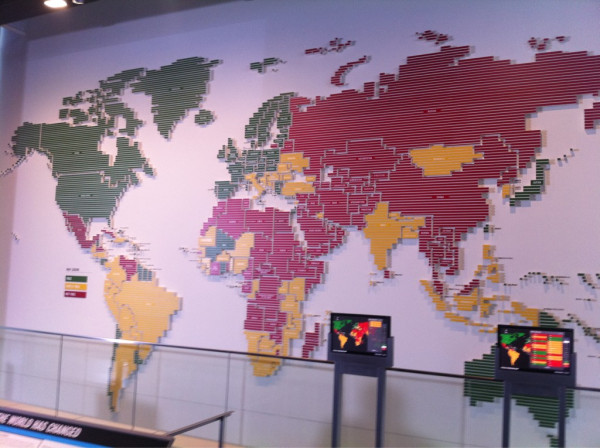
In 2010, only 1 in 6 people lives in countries with a free press, according to a new report on press freedom from Freedom House. There is a long road ahead to establishing and protecting freedom of expression for humanity.

This week, defenders of free expression are celebrating the progress of press freedom and recognizing the challenges that persist globally on World Press Freedom Day 2011. This is the 20th anniversary of the Windhoek Declaration that helped to establish UNESCO’s World Press Freedom Day. The United States is hosting this year’s World Press Freedom Day in Washington, D.C. at the Newseum. You can watch the livestream below and follow the conversation on Twitter on the #wpfd hashtag, both of which are embedded below.

wpfd2011 on livestream.com. Broadcast Live Free

new TWTR.Widget({
version: 2,
type: ‘search’,
search: ‘#wpfd OR #pressfreedom’,
interval: 6000,
title: ‘What\’s happening on’,
subject: ‘World Press Freedom Day’,
width: ‘auto’,
height: 500,
theme: {
shell: {
background: ‘#004382’,
color: ‘#ffffff’
},
tweets: {
background: ‘#ffffff’,
color: ‘#444444’,
links: ‘#1985b5’
}
},
features: {
scrollbar: false,
loop: true,
live: true,
hashtags: true,
timestamp: true,
avatars: true,
toptweets: true,
behavior: ‘default’
}
}).render().start();

To learn more about global freedom of expression and and the organizations that protect journalists and support the collection and dissemination of news about our world, visit:

Kicking off Transparency Camp 2011 with 3 words [#tcamp11]

Today in Washington, Transparency Camp is back in session. As with every unconference, each attendee introduced him or herself with three words that describes what they do, what they care about or what they work on. The frequency of those words is shown in the Transparency Camp 2011 wordle below.

Transparency Camp 2011 Wordle

Transparency Camp 2011 Wordle

You can follow the conversation on Twitter on the #tcamp11 hashtag:

http://widgets.twimg.com/j/2/widget.js

new TWTR.Widget({
version: 2,
type: ‘search’,
search: ‘#tcamp11’,
interval: 6000,
title: ‘What\’s happening at’,
subject: ‘Transparency Camp 2011’,
width: ‘auto’,
height: 400,
theme: {
shell: {
background: ‘#000675’,
color: ‘#ffffff’
},
tweets: {
background: ‘#ffffff’,
color: ‘#444444’,
links: ‘#1985b5’
}
},
features: {
scrollbar: false,
loop: true,
live: true,
hashtags: true,
timestamp: true,
avatars: true,
toptweets: true,
behavior: ‘default’
}
}).render().start();

Some sessions will be livestreamed at TransparencyCamp.com. Sessions will be updated on a new mobile website at m.tcamp.us. Check back for a report from Transparency Camp 2011 tomorrow.