ExpertLabs: The future of open government is citizen-focused

On Monday, the White House asked for ideas on the National Plan for open government in the Open Government Partnership. (For background on the initiative, read this digest on Open Government Partnership analysis for context.) Specifically, the White House asked for feedback on ideas related to two of the key challenges from the OGP: improving public services and increasing public integrity.

  • How can regulations.gov, one of the primary mechanisms for government transparency and public participation, be made more useful to the public rulemaking process?
  • OMB is beginning the process of reviewing and potentially updating its Federal Web Policy. What policy updates should be included in this revision to make Federal websites more user-friendly and pertinent to the needs of the public?
  • How can we build on the success of Data.Gov and encourage the use of democratized data to build new consumer-oriented products and services?

Today, Clay Johnson offered the White House a deep set of recommendations for open government in response to the three questions it posed, including better ways to use open data, social media, improving regulations, public comment, and the developer community better. If you’re interested in open government, it’s a must-read.

We believe the future of open government is citizen focused — to be open to engagement on the terms that citizens are used to in the venues they’re accustomed to.

The growth of social media since the delivery of the initial open government directive, and its adoption by agencies’ communications departments requires the next step: for social media to also be used in giving citizens a voice in regulatory decisions. We believe the future of open government is about discoverability. Moving data or regulations from print publications to the online world results in a net loss if there are less people viewing them. Government should work hard to make sure that all publicly available information is discoverable by search engines, and via social media.

We believe that the future of open government is through the engagement of open source communities, and that agencies should begin to open up to their participation. Government treats lawyers as experts in the field of law, why not treat developers as experts in the field of processing data? Take the next step and participate with them directly, rather than through independent vessels.

– Clay Johnson (@cjoh), Recommendations for Open Government

For more on the decision to use email in the consultation, read Tiago Peixoto’s post on Google Plus.

How should whistleblowing work in the age of transparency?

Transparency movements have gone global. Open government, however, depends in part upon the ability of public servants and corporate insiders to blow the whistle on fraud, corruption or other conduct that is not in the interest of citizens or stakeholders. In the context of Wikileaks, the role of whistleblowing has taken on new meaning and scope in this age of transparency. Despite President Obama’s open government commitments, his administration has aggressively pursued whistleblowers over the past two and a half years.

It is in that context that the Advisory Committee on Transparency for the Transparency Caucus in the U.S. Congress hosted a public discussion on July 29, 2011 on the challenges federal whistleblowers face. Video of the hearing, provided courtesy of the Sunlight Foundation, is embedded below.

The panelists included:

  • Angela Canterbury, Director of Public Policy, Project on Government Oversight
  • Carolyn Lerner, Special Counsel, U.S. Office of Special Counsel
  • Christian Sanchez, Border Patrol Agent, Customs & Border Protection, Department of Homeland Security
  • Daniel Schuman, Moderator, Policy Counsel, the Sunlight Foundation
  • Micah Sifry, Co-founder and editor of the Personal Democracy Forum; author of WikiLeaks and the Age of Transparency; Sunlight Foundation sr. technology advisor

People interested in government transparency will find it of considerable interest.

Even if the White House’s commitment to transparency is questioned, open government continues to grow globally, with new tools for transparency coming online every month.

Obama: “I am absolutely convinced that your generation will help us solve these problems”

Last Friday, President Obama hosted a townhall at the University of Maryland in College Park. At the end of his time on stage, he offered words addressed to the young students gathered in Ritchie Coliseum and those listening around the country:

…we’ve got a lot of young people here, I know that sometimes things feel discouraging. We’ve gone through two wars. We’ve gone through the worst financial crisis in any of our memories. We’ve got challenges environmentally. We’ve got conflicts around the world that seem intractable. We’ve got politicians who only seem to argue. And so I know that there must be times where you kind of say to yourself, golly, can’t anybody get their act together around here? And what’s the world that I’m starting off in, and how do I get my career on a sound foundation? And you got debts you’ve got to worry about.

I just want all of you to remember, America has gone through tougher times before, and we have always come through. We’ve always emerged on the other side stronger, more unified. The trajectory of America has been to become more inclusive, more generous, more tolerant.

And so I want all of you to recognize that when I look out at each and every one of you, this diverse crowd that we have, you give me incredible hope. You inspire me. I am absolutely convinced that your generation will help us solve these problems.

Unfortunately, one of my tweets on Friday reporting out the president’s words was missing two important words: “help us.” And, as it happened, that was the one that the White House chose to retweet to its more than two million followers. I corrected the quote and deeply regret the error, given the amplification and entrance into the public record. The omission changed the message in the president’s words from one of collective responsibility to shifted responsibility.

During the 2008 election, then Senator Barack Obama said that “the challenges we face today — from saving our planet to ending poverty — are simply too big for government to solve alone. We need all hands on deck.”

As president, finding solutions to grand challenges means that Obama is looking again to the larger community for answers. Whether he finds them will be a defining element in judging whether a young Senator from Illinois that leveraged Web 2.0 to become president can tap into that collective intelligence to govern in the Oval Office.

In 2011, there are more ways for the citizens of the United States to provide feedback to their federal government than perhaps there ever have been in its history. The open question is whether “We the people” will use these new participatory platforms to help government work better.

The evolution of these kinds of platforms isn’t U.S.-centric, either, nor limited to tech-savvy college students. Citizen engagement matters more now in every sense: crowdfunding, crowdsourcing, crowdmapping, collective intelligence, group translation, and human sensor networks. There’s a growth in “do it ourselves (DIO) government,” or as the folks at techPresident like to say, “We government.”

As institutions shift from eGov to WeGov, their leaders — including the incumbent of the White House — will be looking to students and all of us to help them in the transition.

As White House tech talent comes and goes, open government continues to grow globally

Kim Hart and Michelle Quinn published a new trends piece in Politico this morning, covering the exit of technology innovators from the White House. They tap into something important here that her sources, including Ellen Miller of the Sunlight Foundation and Micah Sifry of techPresident, validate: some of the primary drivers of the technology initiatives that marked the Obama administration’s first two years in office have departed. Vivek Kundra, the nation’s first CIO, Andrew McLaughlin, Beth Noveck, Jim Kohlenberger, Scott Deutchman and Phil Weiser have all decided to move on. If you follow Govfresh and the O’Reilly Radar, you know we’ve been tracking many of those stories and people.

For instance, we were the first to report that in January, then White House deputy CTO for open government Noveck returned to teaching – and then to a new role advising the British government on open data. Former deputy CTO McLaughlin also left in January, transitioning to Stanford and the executive directorship of Civic Commons.

What’s the driver of these changes?

One is the normal transition between presidential terms. It’s unusual for senior staff White House to remain for all four years, due to the exhausting, round-the-clock schedule. Another is certainly the culture of the startup meeting the realities of government, as many publications and participants recognize. “I think tech entrepreneurs in government service is a bit of an oxymoron,” Miller said to Politico’s MorningTech. “Someone who is an entrepreneur is able to execute and test and fail. … I can imagine there’s a mismatch in DNA in terms of being able to control and execute as quickly as they can in the private sector.”

If you followed the path of Katie Stanton from Google to the White House to the State Department to Twitter, you’d find a case study in that reality. When Stanton reflected on Washington, explaining to Nancy Scola that “being used to a fast-paced environment that isn’t afraid to fail, where risk-takers are rewarded, government is just a very different environment.” If you pick up Steven Levy’s excellent book on Google, In the Plex, you’ll read a longer discussion of what happened when Googlers go to Washington and come up against the different culture inside the Beltway.

As MIT research professor Andrew McAfee aptly observed, this is Gov 2.0 vs the Beast of Bureaucracy, and it’s not a conflict that is going to be solved in a few years or in any single administration. The bloom is off the rose, in terms of the hopes in 2009 that the adoption of Web 2.0 technologies, cloud computing and strategies from the private sector would radically change the federal government. The issues that plague government IT or Washington in general are a tough nut to crack, even for the brain trust in Silicon Valley. It’s even harder to attract and retain those minds to serve in government, as this Politico article narrates. If the country is going to solve the immense challenges that confront it in the 21st century, attracting and retaining geeks in government should be a national priority. The gap between Washington, VCs, entrepreneurs and Silicon Valley culture will have to narrow, whether through smarter immigration policies or innovation centers far outside of the Beltway.

When Quinn and Hart wrote that tech experts exit the White House, however, they for some reason failed to report that others have stepped up to take their place. I leave it to others to speculate about why that might be. For the moment, let the record show that there will be other techies serving in the White House.

For instance, Daniel Weitzner is the new White House deputy CTO for Internet policy, replacing McLaughlin.

Chris Vein is the new White House deputy CTO for open innovation, replacing Noveck.

And one of the biggest guessing games in government technology right now is who will fill Kundra’s shoes as the nation’s second CIO – a story which Politico itself has covered.

For many open government advocates, the shoes left unfilled that may cause the great consternation are those of Norm Eisen, the White House “ethics czar” that President Obama appointed to be ambassador of the Republic of Czech.)

There will be more tech talent that steps up to help the White House, but it’s safe to say they’ll be realistic about what can be accomplished in an election season where any decision will have political consequences.

Wither open government?

The departure of Kundra has caused a great deal of consternation in the open government community, particularly after a sensationalist op-ed on a Washington Post
by Vivek Wadhwa proclaimed the “coming death” of the movement. While Luke Fretwell forcefully rebutted Wadhwa here at Govfresh, essentially calling him wrong about open government, the lingering impression remains in the community that open government is in trouble. That feeling is part of longer continuum of criticism that reaches back into 2010, when it was already clear that open government was in beta and would continue to be, regardless of new open government platforms coming online or open data success at HHS. Advances and setbacks in open government will continue in Washington.

There will be new tech advisors that come into and leave the Obama administration (Harper Reed, for instance, has joined the campaign side as a CTO) but the future of open government won’t be borne solely upon their ability to innovate inside of government. Ultimately, in a new era of technology-fueled transparency, innovation and open government dawns around the world, it won’t depend on any single CIO or federal program. It will be driven by a distributed community of media, nonprofits, academics and civic advocates focused on better outcomes, more informed communities and the new news, whatever form it is delivered in. Advocates, watchdogs and government officials will have new tools for data journalism and, over time, open government. Globally, transparency movement is growing. Look to the launch of an Kenya’s open government data platform today and the lifted hopes of Kenya’s people for example, or new transparency initiatives in Britain for inspiration.

The growth of citizen science and open data hint at our collective future. Open government is about all of us, whether the White House steps up to the plate to reinvigorate its open government directive or not.

@Jack to moderate questions for President Obama in @Twitter @Townhall with @WhiteHouse [#AskObama]

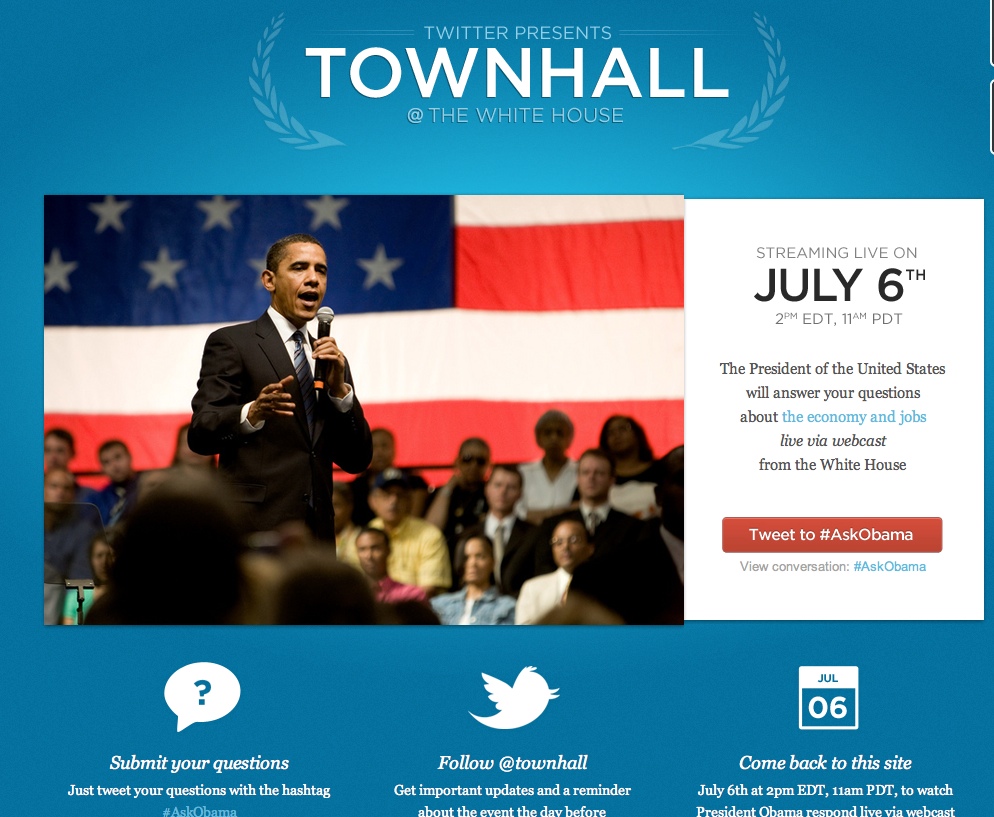
In coordinated tweets with Twitter, the White House announced that it will be holding a town hall on Twitter on July 6th, 2011 at 2 ET. Twitter launched a new @TownHall account for the event and a subdomain, AskObama.Twitter.com to host the live webcast.
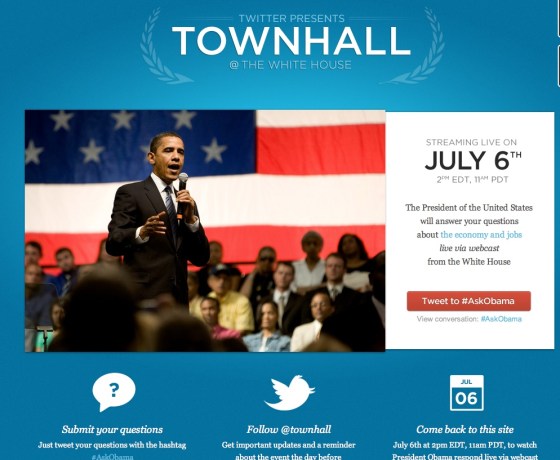
According to Macon Phillips, director of digital for the White House, and Sean Garrett, Twitter’s vice president of communications, the digital town hall will be hosted by Twitter co-founder Jack Dorsey, who will provide the questions.

Phillips tweeted that “@Twitter has a cool approach to surfacing questions,” clarifying that “choosing the Q’s will be done by @twitter. Garrett tweeted that “there will be a fairly involved process by which they are selected” and more details and background on said process is on the way. UPDATE: Garrett emailed me “the basics”

“There will be multiple ways that questions will get to the President,” he wrote. “Twitter users will begin asking questions via the #AskObama hashtag today. To identify popular and relevant questions, Twitter is engaging with a third-party Twitter measurement company called Mass Relevance to provide a view on the most frequent topics and their geographical distribution. Additionally, Twitter will invite a group of highly active and engaged Twitter users (called “curators”) to help choose questions and comments both prior to and during the event. Twitter will collect questions in the days leading up to the Town Hall and in real-time during the event.”

Garrett also added some information regarding how Twitter will select this team of “question curators”:

“These curators will be a diverse group from around the country that are also active and engaged on Twitter,” he wrote. “These curators will ask those in their particular communities to also highlight what they think are the most important questions for the President. Curators will retweet questions and pose their own.”

The Twitter TownHall follows a Facebook TownHall earlier this year, in which Facebook founder Mark Zuckerberg posed live questions to President Obama. Nancy Scola wondered how much of a “TownHall” the event actually offered. With this Twitter version, the interesting detail will be in how much transparency goes into question selection, particularly with respect to how exact or tough they are. When the White House turned to Twitter to discuss President Obama’s Middle East speech, they included NPR’s Andy Carvin and Foreign Policy’s Mark Lynch as trusted interlocutors. It’s less clear how Dorsey will moderate, given his considerable different style of tweeting, but on one count there is no doubt: this will be interesting.

UPDATE: In his post on President Obama taking questions on Twitter, Nick Clark Judd raises similar questions over at techPresident on moderation. (And no, he didn’t call the event a “TownHall.”)

UPDATE II: The New York Times published more details on the “Twitter Town Hall,” including the news that there will be a “White House Tweetup,” the first of its kind. In terms of process, here’s what Twitter told the Times. (Spoiler: it’s quite similar to what Garrett told me, above).

Twitter will select the questions, using curation tools and a group of Twitter users to help identify the most popular questions raised both before and during the event. Twitter will be relying on its own search and curation features as well as a company called Mass Relevance to help find questions and topics that are most frequently mentioned.

… Adam Sharp, Twitter’s manager of government and political partnerships, said that the curators chosen by Twitter to help select the questions would be a politically and geographically diverse group. He said the curators would ask the people in their communities to highlight what they think are the most important questions for the president to address.

Curators will also be retweeting questions and posting their own.

“We will have highly-engaged Twitter users from around the country to provide that geographic diversity to help identify good questions, “ he said. “This helps us make sure that we are addressing the concerns that the Twitter universe cares about. “

Less clear whether the President of the United States will actually be doing any of the tweeting himself, as opposed to dictating a reply, which means we may not get to see any real-time presidential typos. According to reports by Paul Boutin, President Obama started tweeting for himself at @BarackObama over the Father’s Day Weekend, signing the tweet “-BO.”

CBS News White House correspondent and keeper of presidential lore Mark Knoller cautioned, however, that “Obama won’t be typing his responses.” Looking back at that Father’s Day tweet, Knoller tweeted that “a tweet was sent in his name by his campaign. He was not at a computer typing a tweet.”

We’ll see if the President decides to get more personally involved or not in the technology. Given that the presidential iPad appears to travel with him these days, it could happen.

[Photo Credit: President Barack Obama sits alone on the patio outside the Oval Office, following a meeting with his senior advisors, April 4, 2011. (Official White House Photo by Pete Souza)]

UPDATE III: Politico White House correspondent Mike Allen led his Tuesday’s Playbook with more details about Wednesday’s Twitter event:

The audience for tomorrow’s hour-long TWITTER TOWN HALL in the East Room (2 p.m. ET) will consist of 140 characters — er, people – in a nod to the maximum length of a tweet. President Obama, however, will face no such limit: He’ll answer questions for the audience, and @TownHall will carry summaries of what he says. Twitter co-founder and Executive Chairman Jack Dorsey will ask the questions. Three screens will be behind Obama and Dorsey: one with the current question; another will have a heat map of the U.S., showing where the town-hall tweets are concentrated; and the third will show the volume of tweets, by topic (jobs, taxes, spending, health care, etc.) Mass Relevance, a company that has worked with the broadcast networks on real-time Twitter data, will supply the analytics. Later, Radian6 will study the demographics of participants.

Representative questions will be chosen partly on how often they’re retweeted. The White House has also reached out to about 10 Twitter leaders in different parts of the country to help surface questions by curating themes and topics that are big among their followers and in their communities. So Dorsey may say: “We’re hearing a lot about the extension of unemployment benefits, especially from the upper Midwest, and here’s a question from Bob in Chicago.” The audience will include 20 people from around the country chosen through the White House Tweetups page, and they’ll also get to meet with Dorsey and with U.S. Chief Technology Officer Aneesh Chopra and perhaps other policy officials.

UPDATE IV: Twitter has blogged about the “Twitter Town Hall,” including a link to the 7 “curators” on Twitter who are selecting questions and a new study from Radian6 that found that “financial security is one of the most frequent topics of political conversation on Twitter.”

Tomorrow’s Town Hall is an invitation from the White House for anyone on Twitter to participate in an open exchange about the national and global economic issues facing the United States.

Questions addressed during the Town Hall will be selected both in advance and in real-time during the event. To narrow down the list of popular, relevant questions to ask on behalf of Twitter users, we’re doing the following:

• We’ve partnered with the visualization experts at Mass Relevance to identify the themes and regions driving the conversation.
• Algorithms behind Twitter search will identify the Tweets that are most engaged with via Retweets, Favorites and Replies.
• A team of seasoned Twitter users with experience discussing the economy will help flag questions from their communities through retweets.


White House turns to Twitter to discuss President Obama’s Middle East speech

The role of mobile phones, Facebook, YouTube and Twitter in the revolutions that have swept the Middle East in 2011’s historic “Arab Spring” has been the subject of much debate for months. While connection technologies helped to accelerate and amplify the news coming out of Egypt, Tunisia, Syria, Yemen, Libya, Bahrain and the rest of the region, it’s the incredible bravery of the young people who have stood up for their freedom in the streets that made change happen.

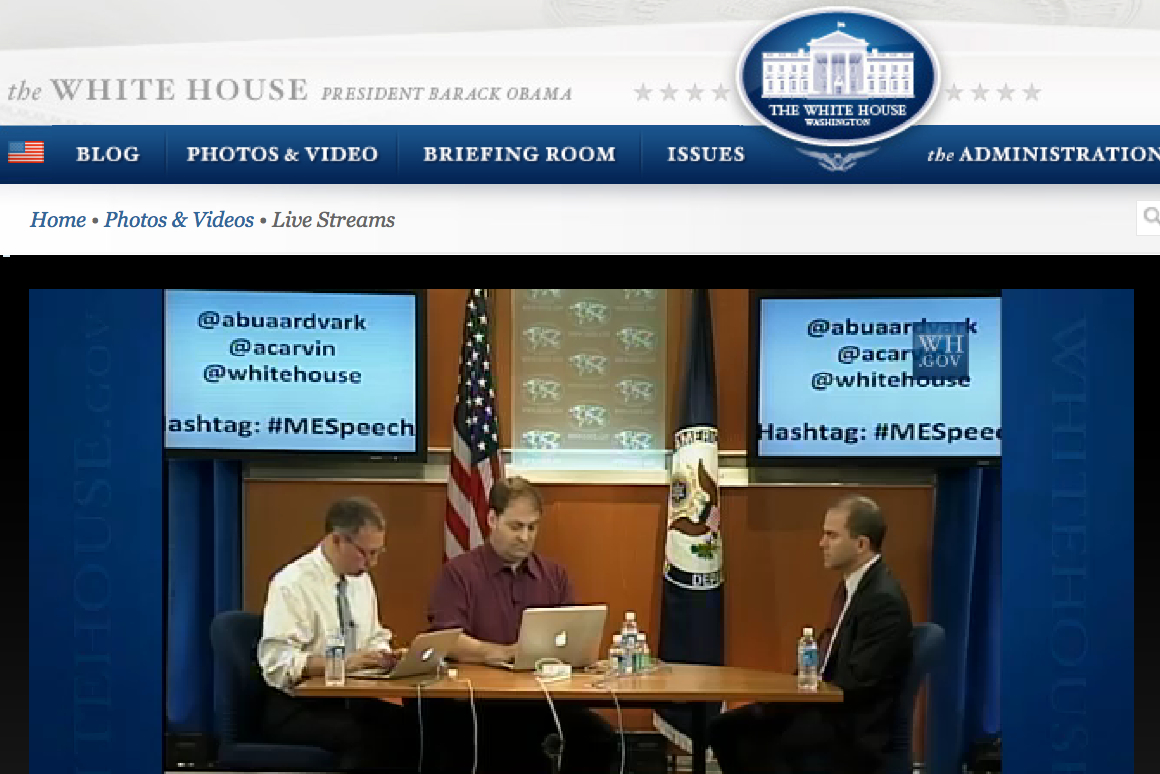
Tomorrow, President Obama will deliver a speech that many experts expect to reshape the Middle East policy debate. The speech will be live-streamed from the State Department and available to anyone online  at WhiteHouse.gov/live. In conjunction with the speech, the foremost curator of online media about the Arab Spring, Andy Carvin (@acarvin), will join with Foreign Policy’s Mark Lynch (@abuaardvark) in hosting a Twitter chat on the Middle East that will include an interview White House deputy national security advisor Ben Rhodes after the president concludes his remarks.

Earlier today, White House new media director Macon Phillips (@macon44) explained how the White House will continue the conversation on Twitter over at WhiteHouse.gov:

Immediately afterwards, the live-stream will switch to a follow-up Twitter chat with Deputy National Security Advisor Ben Rhodes, where anyone will be able to pose questions and reactions via Twitter.

NPR’s Andy Carvin (@acarvin) and Foreign Policy’s Marc Lynch (@abuaardvark), two experts who bring both a deep understanding of foreign policy and extensive online networks, will facilitate a world-wide conversation that will include participants from the Middle East and North Africa.  As Andy explains:

Rather than come up with all the questions ourselves, we’d like to invite you to help us craft the questions. If you’re on Twitter and want to submit a question, please post a tweet with your question and include the hashtag #MEspeech in the tweet. You can pose your question before or during the speech. We won’t be able to get to every question, of course, so we encourage everyone to follow the #MEspeech hashtag and join the broader conversation about the speech on Twitter.

Folks at the White House (@whitehouse) will be keeping an eye on the #MESpeech hashtag as well, so be sure to use that to share thoughts before, during and after the speech.

Keep an eye on that hashtag tomorrow: this will get interesting.

//

UPDATE: I’ve embedded the archive from today’s Twitter chat at the end of the post along with video from the White House. Quick thoughts on the outcome of today’s “Twitter chat.”

1) I thought Carvin and Lynch did a phenomenal job, and that this was well worth their considerable effort. Carvin described the experience of a Twitter interview as akin to “juggling and riding a unicycle simultaneously, all the while trying to interview a senior administration official.” The two men asked tough questions from a global audience, starting with fundamental issues of trust and policy towards Bahrain, shared the questions and answers as they went on Twitter, often including the @ handle of the person who asked them. The result was a fascinating window into one future of new media, geopolitics and journalism. The considerable trust that they were given to find and ask the best questions was, in my eyes, paid back with interest. Well done.

2) It was also hard not to see a marked contrast between the recent “Facebook townhall” where founder Mark Zuckerberg asked President Obama all of the questions and Andy Carvin bringing questions culled from a real time global conversation to Ben Rhodes.

3) On a week when the executive editor of the New York Times offered considerable skepticism about Twitter’s value, this event serves as a quiet, powerful reminder of the platform’s global reach in the hands of those willing to fully engage the public there.

4) Poynter has an excellent background post regarding why NPR’s Andy Carvin is moderating the White House Middle East speech Twitter chat. NPR’s managing editor for digital news explained:

“Andy has cultivated a unique audience and following around the world and is the right person to carry on a conversation and channel a wide range of questions from around the world. He’s been doing it for months.”

If the interview were being conducted another way, Stencel said, perhaps a program host or a beat reporter would’ve done it.

Carvin “has the talent in this format that our hosts have in commanding the air. Andy is in essence the Neal Conan [host of NPR’s “Talk of the Nation”] of social media. He understands the format and he can conduct the interview in a way that takes a combination of smarts and skills that’s rare in media.”

That’s about right. In May 2011, there is no one using Twitter in this way more effectively than Andy Carvin. He has been more actively and deeply engaged in finding, validating and distributing the digital documentary evidence emerging from the Middle East on social networks and video sharing sites over the past six months than anyone else on the planet. He’s been storytelling using what Zenyep Tufecki aptly called “Twitter’s oral history” in a way that brings the voices and vision of millions of people crying out for freedom to the rest of the world. Today, he brought their questions into the State Department and White House. Pairing him with a foreign policy expert in Lynch brought significant weight and contextual experience to interviewing Rhodes. Well done.

For more, Nancy Scola wrote up Carvin and Lynch’s ‘Twitter interview’ with Rhodes over at techPresident. As always, she’s worth reading on it.

WhiteHouse.gov puts data to use in its new federal property map.

As I reported at the O’Reilly Radar, The White House used interactive mapping and open data illustrate excess federal property around the United States. Check out the White House excess property map to see what that means in practice. I’ve embedded a similar map from MapBox below.

Selling excess federal property will be challenging. In contrast, open source mapping tools are making storytelling with data easier – and cheaper.

A little sweat never hurt nobody

The White House partnered with superstar musician Beyoncé Knowles and the National Association of Broadcasters on a “flash workout” that’s actually fun. First Lady Michelle Obama is using it as part of her Lets Move! campaign against child obesity.

The official dance video with Beyoncé and wide selection of teens is, in this thirtysomething correspondent’s opinion, both fun and well edited.

It says something about 2011 that the First Lady of the United States went out and danced around a bit herself.

My favorite video, by far, however, is when Beyoncé showed up and surprised students at PS/MS 161 Don Pedro Albizu Campus in New York City.

I can’t help but wish more celebrities donated their time, passion and interest to inspiring kids to get up and move more. Well played.

Can open government be embedded?

This morning, the White House posted President Obama’s long form birth certificate to the public. Now that the White House has released the president’s long form birth certificate to the media (and directly over Twitter to everyone) I hope that the country can move on to the much greater issues that confront the country and humanity as a whole.

Honestly, it was much cooler to watch Mr. Obama speak live using the White House iPhone application than to see the President of the United States take time to debunk the issue that has been settled for years. His remarks are embedded below:

It’s also worth noting the evolution of the White House’s new media strategy, where a government document was not only released directly to the American people as a PDF over social networks but was uploaded to Slideshare where it can be embedded on other webpages to be spread even further, as I have done below.

The White House is not alone in using SlideShare to create embeddable documents. The Congressional Budget OfficeDepartment of EnergyU.S. Environmental Protection Agency and U.S. National Library of Medicine are sharing information there as well. The military has created channels there too, including the Department of Defense and the U.S. Navy.

To be clear, releasing documents online in of itself is not nor will ever be a full measure of government transparency. Open government is a mindset, not just a matter of adopting new tools. For open government to endure in an era of budget austerity, it will need to be baked in to how government operates, with a clear connection to how it helps deliver on the mission of agencies and officials.

That said, creating online channels with embeddable content is taking more than a few steps forward from paper memos dropped into file cabinets or proclamation read over the radio.

Here’s to moving forward to work on the stuff that matters.

White House Office of Management and Budget hosts forum on federal IT reform

Last December, the White House proposed sweeping IT reforms. Today in Washington, the nation’s top IT executives will discuss progress on those proposals and assess the challenges that lie ahead. The livestream is embedded below:

http://www.whitehouse.gov/sites/default/modules/wh_multimedia/EOP_OVP_player.swf

This morning, President Obama issued an executive order streamlining service delivery and improving customer service.

Government managers must learn from what is working in the private sector and apply these best practices to deliver services better, faster, and at lower cost. Such best practices include increasingly popular lower-cost, self-service options accessed by the Internet or mobile phone and improved processes that deliver services faster and more responsively, reducing the overall need for customer inquiries and complaints. The Federal Government has a responsibility to streamline and make more efficient its service delivery to better serve the public.”

The White House Office of Management and Budget’s Jeff Zients, the national chief performance officer, will talk about productivity and efficiency enabled by information technology. As the Washington Post reported, Zients will unveil a new customer service initiative this afternoon as well.

According to Politico’s Morning Tech, federal “CIO Vivek Kundra will offer an update on the administration’s IT plans; Deputy Energy Secy Daniel Poneman will focus his remarks on cloud use and adoption; Deputy USDA Secy Kathleen Merrigan will chat about data centers; VA’s Roger Baker will discuss the administration’s plans to eliminate or revise underperforming IT projects and DHS CIO Richard Spires will outline efforts to set up IT best practices.”

More to come as the event goes forward.

Editor’s Note: The White House livestream went down about 18 minutes in and then went on and off. Unfortunately, as this correspondent did not attend in person, other first accounts will have to capture much of what occurred.