The NewsHour interviews Alec J. Ross on digital diplomacy and 21st Century Statecraft

What do State Department officials mean when they talk about ” 21st Century Statecraft?” The PBS Newshour’s digital correspondent, Hari Sreenivasan, sat down with Alec J. Ross, senior adviser for innovation at the State Department, to learn how technology is being leveraged to accomplish foreign policy goals. Sreenivasan subsequently published an excellent post on diplomacy and 21st Century statecraft at the Rundown, the Newshour blog, that includes the video below:

As Sreenivasan notes, the State Department has been rapidly moving forward in its use of technology, as reported in Radar on applying technology for Internet freedom. The question of whether the US should support Internet freedom through technology is a complex one, and deserves serious scrutiny as it moves forward, as evidenced by the Haystack fiasco.

What does 21st Century Statecraft mean? Sreenivasan takes a swing at reporting on Ross’s take:

In light of the seismic shifts taking place in how information and people interact and engage with one another, Ross says a broadening of the practice of statecraft is necessary. Going forward, that means using a balance of soft and hard power to enable and support relationships between non-state actors, and between representatives of governments.The prescription calls for far more than giving diplomats Twitter training, or simply using social media to push “the message” out. It is also about connecting people to resources efficiently and effectively, from NGOs to governments to people in need of aid.

In addition to spending money on new forms of digital diplomacy, the State Department has more often used its clout to convene bright minds from the private sector and the NGO world in a series of Tech@State conferences. They have included gatherings to share ideas on leveraging mobile technology, finding and empowering technology assistance in Haiti’s recovery and, more recently, rethinking Civil Society.

Sreenivasan included a host of excellent links to learn more about 21st Century statecraft, including:

  • An essay in Foreign Affairs entitled “America’s Edge” (requires one-time free registration) by Anne-Marie Slaughter. It was published around the same time that the former Dean of the Woodrow Wilson school at Princeton University was appointed as the new Director of Policy Planning at the State Department.
  • A essay by Eric Shmidt and Jared Cohen of Google titled The Digital Disruption, also in Foreign Affairs, which discusses the challenges facing diplomacy. As Sreenivasan notes, Cohen recently moved to Google from the State Department, where he had been working with Ross on 21st Century Statecraft. The New York Times Magazine covered their digital diplomacy efforts this this past summer.
  • Sam Dupont of NDN has gathered a list of 21st Century statecraft initiatives.

The Newshour has been extending its coverage into Gov 2.0 since Sreenivasan reported on the Gov 2.0 Expo and Summit earlier this year. For more of its past coverage, check out their conversation with Todd Park, the Chief Technology Officer of HHS, and excerpts from their conversation with White House Chief Technology Officer Aneesh Chopra and federak CIO Vivek Kundra. It’s a significant evolution to see Gov 2.0 be discussed on the Newshour, CBS or Dan Rather reports. Whether it’s enough to raise national awareness of open government challenges, success or failure is itself an open question.

Insight on what’s next from Bill Gates: mHealth, mCommerce and robots

“People underestimate the amount of innovation going on,” said Bill Gates at the mHealth Summit in Washington, D.C. today. “They assume tech remains the same.” Given the thousands of attendees walking around the floor to see the mobile technology on display, there will be more awareness of what’s happening by the end of the day. Those listening to Gates in person or online could take away a few more lessons as well.

First of all, the key applications in the mobile health world are those that are tied to better outcomes, said Gates. Metrics like the number of children dying is one such metric, he said, and could be mitigated by mobile apps that register every birth on a cellphone to track vaccine coverage. Tracking supply chain for medical supplies and online medical records also can lower key metrics like child mortality, said Gates. Highlights from Bill Gate’s keynote conversation with Dr. Kristin Tolle are embedded below:

“In general, the world underfunds research because the person who takes the risk doesn’t capture the full benefit,” said Gates. “Government comes in for things the market doesn’t work well on.” Some research and development simply won’t get funded otherwise, in the absence of a strong profit motive. That’s likely one reason the Gates Foundation has focused on malaria, a disease that big pharmaceutical companies haven’t put significant resources behind.

“As the world goes from 6 billion to 9 billion, all of that population growth is in urban slums,” said Gates. That context provides a target for innovation in mobile healthcare technology, particularly given the increasing penetration of cellphones. Improving mortality rates is also relevant to that burgeoning population, he reflected. “Within a decade of having better health outcomes, people decide to have less children,” said Gates. citing the research of Han Rosling. Rosling’s TED Talk is below:

http://video.ted.com/assets/player/swf/EmbedPlayer.swf

What’s the medical challenge for the aid community to target? “Funding vaccines is so clear,” said Gates. Polio may not get eradicated because of a  lack of funding, he said, reflecting on “going begging” around the world to try to get the last $800 million dollars for vaccine.

What’s next? Where will innovation be happening and change how societies work? “Now the idea is to do digital transactions where you don’t use currency at all,” said Gates, pointing to M-PESA in Africa and the huge growth in mcommerce.

Those changes may not be proportional to the greatest needs, however, nor grounded in the traditional frame of ‘first world vs developing world.’ According to Gates, “middle income countries are where the most innovation in healthcare is going to happen.” The poorest countries need to address the true basic for survival before mhealth can make progress.

In richer countries, meaningful change is already happening because of mobile apps. Some of those innovations are just beginning to filter in. “What percentage of people have to be put in longterm care, versus have someone stop by?” asked Gates. Cellphones already enable new monitoring capabilities for seniors, children and caregivers; he anticipates better sensors and connectivity to change how we communicate and watch one another even further in the decades to come.

In a bid for the hearts and minds (and perhaps wallets) of the entrepreneurs present, Gates observed that conditions like obesity, diabetes and smoking cessation are good candidates for mobile health technology to address in rich countries.

He also appealed to officials making decisions on government policy and funding decisions.  “The degree that health and education go together – I don’t think that’s surprising,” he said. “We should invest in both.”

Asked to reflect upon where to invest next, Gates was clear: “If you just pick one thing, it’s got to be robots,” citing improvements in robotic mobility, dexterity, productivity and the growing needs of both an aging population and childcare.

He also reflected upon the future hinted at by the increasing use of big data tools to deliver insight. “Our ability to discover drugs using computation – that is changing,” he said. “In a ten to fifteen year period, it will be utterly different.”

Curry and Co-Creation: A new US-Indian Partnership on Open Government

What will a new US-India partnership on open government mean to the two countries? Shared resources, shared technologies, and maybe, a culture that trends towards a more open, accountable and participatory government.

No one who has watched the progress of open government in the United States would posit that it’s been an easy path. In India, the challenges are, if anything, even greater, given the immensity of the issues posed to the country’s population by poverty or literacy, a legacy of bureaucratic intransigence or outright corruption. There’s a reality behind Ipaidabribe.com Indian website that speaks volumes about that culture.

That said, there are many reasons to be hopeful about this open government partnership, particularly around the growth of mobile technology as a means of reporting issues.

President Barack Obama and Prime Minister Manmohan Singh of India walk down the Cross Hall

Image Source: White House Flickr Account

As Nancy Scola points out at techPresident, learning Indian-style open government offers many opportunities to adopt the rapidly evolving platforms for mobile citizen participation from India.

For a sense of how such platforms can grow, look no further than Ushahidi, which was originally created to be an election reporting platform in Kenya.

Now we’ve got a joint statement from Obama and Singh, striking in how it frames the United States as a junior partner in the open government partnership. It noticeably credits the progress India has made in using technology to empower democratic engagement while striking a decidely more aspirational tone when it comes to the Obama adminstration’s work in the open government field: “This will build on India’s impressive achievements in this area in recent years and the commitments [link] that the President made to advance an open government agenda at the United Nations General Assembly.”

That statement is embedded below:

Us-India Open Government Partnership http://d1.scribdassets.com/ScribdViewer.swf

In his remarks to a joint session of the Indian parliament in New Delhi, President Obama elaborated further on his vision for an Indian-US partnership on open government:

In the United States, my administration has worked to make government more open and transparent and accountable to people. Here in India, you’re harnessing technologies to do the same, as I saw yesterday at an expo in Mumbai. Your landmark Right to Information Act is empowering citizens with the ability to get the services to which they’re entitled — (applause) — and to hold officials accountable. Voters can get information about candidates by text message. And you’re delivering education and health care services to rural communities, as I saw yesterday when I joined an e-panchayat with villagers in Rajasthan.

Now, in a new collaboration on open government, our two countries are going to share our experience, identify what works, and develop the next generation of tools to empower citizens. And in another example of how American and Indian partnership can address global challenges, we’re going to share these innovations with civil society groups and countries around the world. We’re going to show that democracy, more than any other form of government, delivers for the common man —- and woman.

The question, as ever, is what this will practically mean when the glow induced by lofty rhetoric fades and the hard work of open government moves forward. The US-Indian open government dialog might mean more open source collaboration. As Information Week reported, a US-India partnership on open government practically includes $1 million dollars “toward public efforts to share best practices in working toward improved services and democratic accountability.” In the United States, that might not go very far. In the Indian subcontinent, it might be enough to seed funding for a number of mobile platforms to grow.

As Steve Ressler pointed out at Govloop, the mobile aspect of open government mainstream deserves special note. Why? Tom Friedman’s recent New York Times op-ed on the growth of mobile technology in India highlighted the same thing that Scola did: the potential to leapfrog a generation in wireless tech and see the creation of many new businesses:

India today is this unusual combination of a country with millions of people making $2 and $3 a day, but with a growing economy, an increasing amount of cheap connectivity and a rising number of skilled technologists looking to make their fortune by inventing low-cost solutions to every problem you can imagine. In the next decade, I predict, we will see some really disruptive business models coming out of here — to a neighborhood near you. If you thought the rate of change was fast thanks to the garage innovators of Silicon Valley, wait until the garages of Delhi, Mumbai and Bangalore get fully up to speed. I sure hope we’re ready.

If just a few of those mobile entrepreneurs focus on creating platforms for open government, the civic surplus of hundreds of millions of citizens in India and abroad could be harnessed to co-create government on a scale never witnessed before in history. There are reasons to be be skeptical, naturally, but the opportunity is there.

Data BBQ features District tech entrepreneurs, passion and tasty open data.

Get off your index and build your Rolodex,” read the invite to last night’s Data BBQ in Washington, D.C.

And last night, that’s exactly what over a hundred people from around D.C.’s growing tech scene did, spilling out of the revamped officers of Insomniac Design in Bladgen Alley, near Mount Vernon Square.

The crowd was leavened with many attendees from the ongoing mHealth Summit 2010, manyof DC’s open data geeks and supporters and. Expert Labs’ Gina Trapani and Waxy.org’s Andy Baio came by from the FCC’s Open Developer Day to mix and mingle too. The highlight of the Data BBQ was the lightning talks, where attendees pitched projects, ideas, jobs or even spare rooms to the crowd. The talks are embedded below:

Many of the mHealth conferees no doubt know about the Health 2.0 Developer Challenge from the Department of Health and Human Services, where health data is being mashed up into new applications.

And, judging by the show of hands, many of the Data BBQ’ers had also heard about the World Bank’s Global Apps for Development Competition, which is looking to the development and practitioner communities to create innovative apps using World Bank data.

What might have been new to a few, at least, was the upcoming Apps for Army competition for the public, where the successful apps competition that Peter Corbett and iStrategy Labs helped the Army run will be rebooted for wider participation.

The Future is Mobile at Ignite NYC: Open Data, Open Government and Augmented Reality

“The future is already here – it’s just not evenly distributed.” —William Gibson.

http://blip.tv/play/AYKJtSgC

“An exploration of cyberpunk fiction, technology, where we’re headed, the challenges we face, and the solutions we need”-Ignite NYC. I gave a (very) similar talk called Pattern Recognition and Spimewatch at Ignite D.C. later that week. For whatever reason, this version seems to have come off much better. Rack it up to the first time on a big stage; there were close to a thousand people present in NYC.

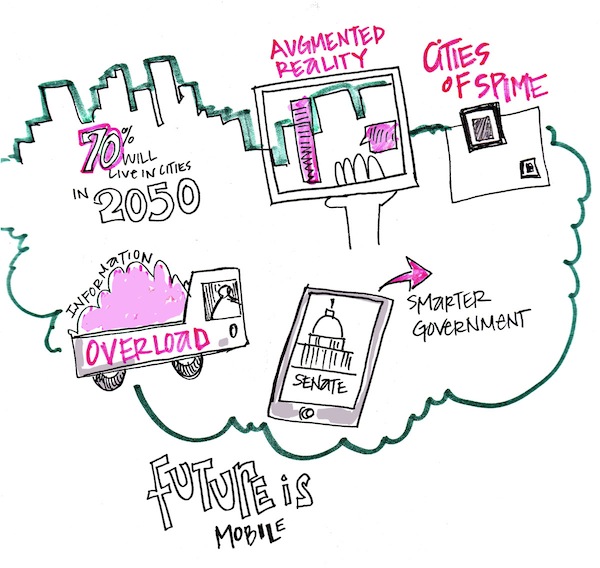
The creative graphic recording at Ignite NYC at Web 2.0 Expo was created during the talk by Nora Herting of ImageThink.

For a great Ignite talk with a related theme, check out In Coders We Trust, by Laurel Ruma.

Open Government and Civic Innovation on Display at Portland’s CivicApps Awards

What does the innovation on display at the Civic Apps contest by developers in Portland, Oregon mean to the city’s mayor?

“It’s bringing to the world knowledge of what exists in the real world but is so often unknown,” said Mayor Sam Adams in an interview at the awards ceremony for the winners of the contest.

“In Portland, like I think most cities, when people are armed with knowledge, they make wiser choices,” he said, pointing to applications like PDX Bus as examples of innovation that actually help citizens to navigate the city better.

Does open data lead to more economic value creation in the private sector and metropolitan areas alike?

“We are seeing folks that are sole proprietorships hire folks to help them build their business, their app business, their online business with our data sets.” he said. “For us, data has always been there, in some cases for decades. Putting it to use for the public and help people make money while they do it – we intend to be the open source capitol of the nation – and this is one contribution we can make, with our data sets.”

What’s next? “What CivicApps is about in part, providing the data, is sparking relationships, relationships which lead to economic opportunities,” he said. “Webtrends, Microsoft meets the local hacker or coder tonight at this event, who knows what will happen. Our job is to provide the data, provide the opportunity for relationships to occur, provide what in comparison is a tiny litte bit of money, a little incentive for people to keep going. And it’s also fun. It make the city more fun to live in, because you know what’s there.”

That incentive, incidentally, amounted to $1000 for each of the winners of the second round of Civic Apps awards, with another $3000 going to the Best of Show winner, Loqi.me. This afternoon, Skip Newberry, economic development policy advisor to Mayor Adams, congratulated the winners of CivicApps on Twitter.

.bbpBox29117818058 {background:url(http://a3.twimg.com/profile_background_images/26879991/Downtown_Portland_-_Twitter_image.png) #9AE4E8;padding:20px;} p.bbpTweet{background:#fff;padding:10px 12px 10px 12px;margin:0;min-height:48px;color:#000;font-size:18px !important;line-height:22px;-moz-border-radius:5px;-webkit-border-radius:5px} p.bbpTweet span.metadata{display:block;width:100%;clear:both;margin-top:8px;padding-top:12px;height:40px;border-top:1px solid #fff;border-top:1px solid #e6e6e6} p.bbpTweet span.metadata span.author{line-height:19px} p.bbpTweet span.metadata span.author img{float:left;margin:0 7px 0 0px;width:38px;height:38px} p.bbpTweet a:hover{text-decoration:underline}p.bbpTweet span.timestamp{font-size:12px;display:block}

Congrats to @caseorganic @elsewisemedia @pdxmele @maxogden & John Mosser for their award-winning @civicapps! #opensource #gov20 #teamadamsless than a minute ago via TweetDeck

Most Useful App and Best of Show

Amber Case for Loqi.me

As Mayor Adams mentioned later in the program, this Web app could be useful in a snowstorm in Oregon or, if adapted more broadly, for crisis response around the country or world.

App description: “This application is a resource for citizens, medical teams and governments before, during and after disasters. Loqi.me allows mobile users to send an emergency GPS beacon to a real-time map. Crises responders can view all of the help requests on the webpage, along with hospitals and fire stations, real-time 911 calls related to natural disasters. Ground teams can easily use Loqi.me on their mobile phones to send notices of supplies and terrain reports in real time. Remote helpers can easily see the whole picture on the website’s real-time map, handle help and information requests, and send messages to the network. Loqi.me supports subscription to group messages via SMS, AIM, Jabber and Twitter. No application installation is required. Location beacons can be sent simply by going to http://loqi.me on a mobile phone.”

Most Appealing

Matt Blair for PDX Trees.

App description: “PDX Trees is an app for iPhone and iPod Touch devices that makes it easy to find and and enjoy them. With this app, you can:

  • Search for nearby trees and see them on a map.
  • Tap a pin to see the name and view details for that particular tree.
  • Take and upload a photo of a Heritage Tree you’re visiting.
  • View photos of the tree taken by other tree enthusiasts.
  • Email a friend about the tree (includes tree name and location where available)
  • Read more about a type of tree from Wikipedia, without leaving the app.”

Most Original

Melelani Sax-Barnett for Portland Bike to Transit.

App Description: “This is a simple, handy web map that helps you figure out how to ride your bike to transit. It lets you choose from a variety of base layers, and toggle transit stops, routes, and current bike routes. You can also query transit stops and routes for basic information. I made this for a Web GIS class at PSU and I’m a total beginner (with some code thanks to Professor Percy and OpenLayers).”

Best Use of Data

Max Ogden for Civic Apps Data Previewer

“This helped make our data useful to a lot of other developers and the general public,” said Mayor Adams. “Why take it on?”

“I saw all of this great data at the core when civic apps launched,” said Ogden. “When you get data into the Web format, you get Web developers who are really used to making human interfaces for things make them.”

App Description: “A web application to preview any of the public geo data on CivicApps from your web browser. You can choose a dataset and view that data on a map. Individual objects are clickable and can provide details (metadata).”

Civic Choice

Joseph Mosser for PDXTrian

App Description: “Pdxtrian is a simple utility for riders of Portland’s excellent mass transit system, TriMet.

  • Uses GPS to find nearby transit stops
  • Displays a map of the stop location
  • Displays a list upcoming arrivals
  • Allows you to save stops and look them up anytime”

The livestream of the awards ceremony is embedded below:

http://www.ustream.tv/flash/video/10487185?v3=1

Eight lessons for social media and politics from Politico, Facebook and media

Ten years ago, staffers thought Al Gore was weird for texting Tipper. Fast forward a decade to late 2010, when any politician who doesn’t use check email on a smartphone or monitor what the media and voters are saying on social media platforms risks being judged out of step. As the midterm elections loom large next month, a large majority of the United States House and Senate are on Facebook. A smaller majority uses Twitter, YouTube and Flickr. While the effectiveness of that usage varies from candidate to candidate, the question of whether social media is a fad is largely settled.

One of the great unanswered questions of this election with respect to social media will be whether fan or follower numbers have any predictive value with respect to elections. Another will be whether more interactive candidates are more successful. What remains is to decide which strategies and tactics will make the difference in winning elections.

Earlier tonight, a panel of experts from media, campaigns and academia came together at George Washington University for “Going Viral: How Campaigns are Using Social Media,” an event jointly sponsored by Politico and Facebook. The panel featured:

What was the high level take away? You can judge yourself: Video of the panel on political campaigns and social media is available at CSPAN and embedded below:

http://c.brightcove.com/services/viewer/federated_f9?isVid=1

Politico’s own Meredith Shiner reported that “social media still has much to prove.” As Shiner noted, Finn told the audience that “Despite the increased attention paid by the media to political Facebook and Twitter accounts, campaigns today still spend less than 5 percent of their media expenditures online.” Determining whether that spend is consistent across all campaigns would be useful. That said, part of the allure of social media is that it requires an investment in time and expertise, not classical media buys. Sarah Palin, Scott Brown and Barack Obama could use Twitter, Facebook and YouTube to achieve awareness of their messages without huge campaign war chests. For underfunded campaigns, using those tools isn’t a choice. It’s a necessity.

Drawing from those take aways, here are eight more lessons for social media and politics:

1) Politicians have to use social media themselves to realize its full potential. Most campaigns are on Facebook. As Facebook’s Adam Conner pointed out, however, what remains is for candidates to understand tech personally and use it. “When you put a communications manager or staffer in between 140 characters or a Facebook update,” he said, “it’s much less authentic.”

2) Social media is not going away. “It’s the place we all have to be,” said Smith. As citizens turn to the Internet for government data, information, e-services, not to mention news, media and government entities have to “fish where the fish are.”

3) Very few Congressional candidates are doing a good job with these tools. At least, that was Professor Matthew Hindman’s take at the event. Judging from the feeds of many candidates, there’s clearly a learning curve with respect to style, conventions and technical acumen. Posting press releases to Twitter or Facebook does not realize their potential. Neither does treating the platforms the same way. For instance, Finn said that “tweeting from Facebook” is one of her pet peeves. Connor had seen enough “double third person posting” by staff to find it annoying. Voters are likely no different.

4) Social media enables candidates to build the intensity of support. While tweets and updates may not sway independents in of themselves, building strong online communities of supporters can translate into electoral success.

5) Friend power is important. Online, people are increasingly finding news stories from one other on Facebook, Twitter or other social networks, as opposed to through a search engine. That makes creating content with high “shareability” key, whether it’s embeddable videos, polling widgets or tweetable campaign slogans.

6. Leaving negative comments online builds trust, up to a point. In order for voters to see a page is a place for debate, you need to leave as many negative comments up as possible, said de Vellis, with the exception of abusive or pornographic content, which should be moderated. “Leave as much up as much as you can stomach,” said Finn. If the site is a place for supporters, “they’ll jump in and support you.” Conner suggested setting a policy up ahead of time, which a campaign can use to tramp down bad publicity. He said that it’s even more imporatnt to internal staff to have discussions ahead of time to get universal understanding of that policy.

7. This is the year of mobile. Again. As Pew Internet researcher Susannah Fox powerfully articulated in her presentation on the power of mobile this fall, 82 percent of American adults have a cell phone. Six in 10 American adults go online wirelessly with a laptop or mobile device. “Mobile was the final front in the access revolution,” she said. “It has erased the digital divide. A mobile device is the Internet for many people. Access isn’t the point anymore. It’s what people are doing with the access that matters.” As important as social media may become to the future of campaigns, reaching voters using email, text messages and calls to their cellphones – good old “Web 1.0” – is still paramount, along with a ground game to get them to the polls.

8. Candidates who use social media personally are more likely to use it on campaigns and ultimately in governance, says Adam Conner.

Once in office, the challenges of using technology for open government are even greater. Just ask the staffers at the Obama Administration and federal agencies, where open government initiatives in beta are moving from plans to implementation.

Telling the story of social media and politics

Befitting the occasion, below are selected tweets and images from the event, curated using Storify:

http://storify.com/digiphile/going-viral-how-campaigns-are-using-social-media.js

In Coders We Trust: Laurel Ruma breaks down Gov 2.0 at Ignite NYC

We’re moving from the Social Web to the Civic Web. IT and geeks matter. What we can do with open data and the internet is very important. If government is a platform, we need people to create apps and others to open up data sets.”-Laurel Ruma, Gov 2.0 Evangelist, O’Reilly Media

If you want a great introduction to what Gov 2.0 is and why it matters, look no further than her 5 minute talk from Ignite NYC is embedded below.

Slideshow: Fedtalks 2010

The slideshow above is a selection of pictures from today’s Fedtalks in Washington. (Look for more high quality photography soon from the event organizers). If you can’t see the Flash slideshow, you can view my full Fedtalks 2010 set on Flickr.

Pattern Recognition and Spimewatch: Visions of Open Cities of the Future

If you had five minutes to talk about the future, what would you say?

Last month, I had the privilege of presenting at two Ignite sessions, Ignite NYC at the Web 2.0 Expo and Ignite D.C. later in the week. If you’re not familiar, Ignites are 5 minute-long talks where presenters share subject they’re passionate about, using 20 slides that auto-advance every 15 seconds. If you’re not used to that rhythm, it can be tricky.

The video of my talk at Ignite D.C. is embedded below:

The presentation and associated links is embedded below:

Curious about the title for my talks? As fellow science fiction fans know, the title for these Ignite talks is an homage to two author: William Gibson, and Bruce Sterling. Gibson, sometimes called the “noir prophet” of cyberpunk, coined the term cyberspace and wrote “Pattern Recognition,” an enjoyable yarn about the future-present. Sterling, also an notable cyberpunk author, maintains the excellent Wired blog “Beyond the Beyond,” which has an entire category called “Spimewatch.”