In Coders We Trust: Laurel Ruma breaks down Gov 2.0 at Ignite NYC

We’re moving from the Social Web to the Civic Web. IT and geeks matter. What we can do with open data and the internet is very important. If government is a platform, we need people to create apps and others to open up data sets.”-Laurel Ruma, Gov 2.0 Evangelist, O’Reilly Media

If you want a great introduction to what Gov 2.0 is and why it matters, look no further than her 5 minute talk from Ignite NYC is embedded below.

Reflections from Manor Govfresh: Voices of Open Government and Gov 2.0

If you’re looking for the faces of government 2.0, look no further. The video above, released today by Manor New Tech High‘s “Digital Dojo,” features more than a dozen voices (including this correspondent) talking about what Manor.Govfresh meant to them and what open government means to the country.

“I am very excited to be at Manor Govfresh because it’s the first time I’ve ever been to a conference that doesn’t just talk about change but actually does it,” said White House deputy CTO for open government Beth Noveck. “What’s exciting about Manor Govfresh is that it’s brought together so many people who are interested in municipal innovation and using technology to actually make a difference in local communities here in Manor, Texas, in Deleon, Texas, and across America, to actually make government work better.”

When you watch the video, of course, you’ll hear many more voices than Noveck’s, which is of course the point. The movement towards open government at the local level puts the growth of government 2.0 in context. As Stacy Viselli said this morning in a comment on Radar, “Communities and neighborhoods have been moving their organizations online for a while now and are looking for ways to do more. It creates an optimum environment for collaborative projects that include local governments, business, civic associations, nonprofits, and community foundations. Sometimes it’s not about the data so much as it is about providing a platform that empowers communities do what they are already doing–better.”

For more on how local governments are using technology to deliver smarter government, read about how Gov 2.0 is growing locally. And for more on Manor Govfresh, read about harnessing the civic surplus for open government.

Slideshow: Fedtalks 2010

The slideshow above is a selection of pictures from today’s Fedtalks in Washington. (Look for more high quality photography soon from the event organizers). If you can’t see the Flash slideshow, you can view my full Fedtalks 2010 set on Flickr.

GSA launches Apps.gov NOW to offer Feds new citizen engagement tools

Will a platform for citizen engagement help federal government employees reach their open government goals?

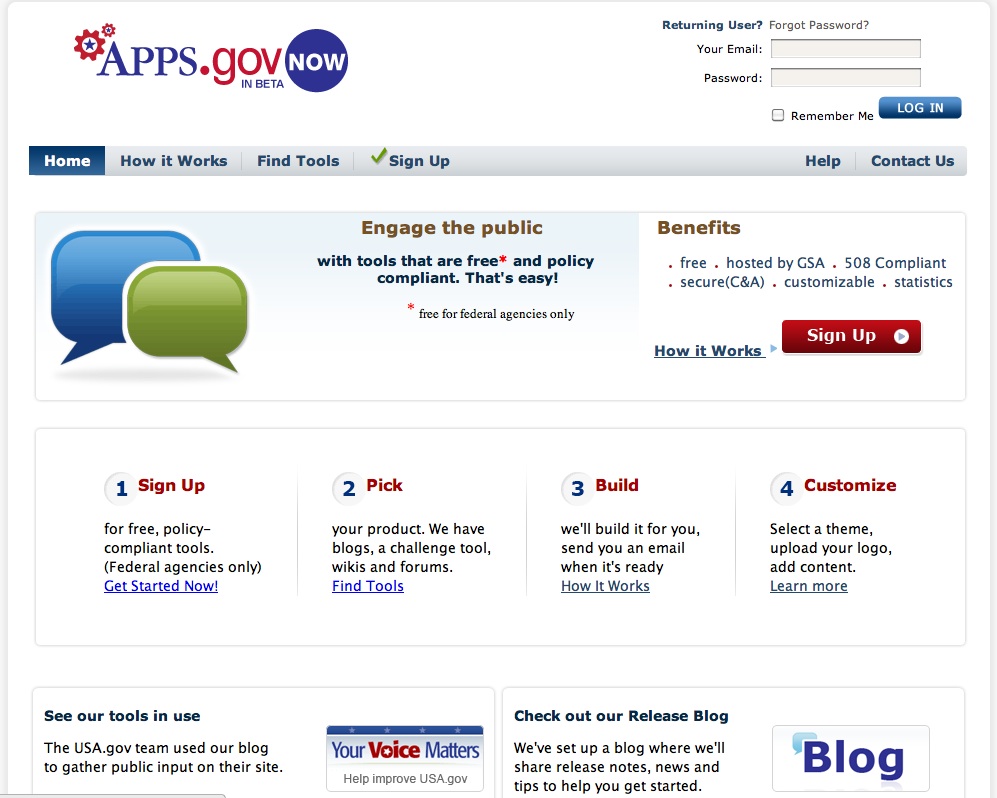
Today at Fedtalks in Washington, the General Services Administration’s director of citizen engagement, Gwynne Kostin, talked about its new open government platform, Apps.gov NOW. Apps.gov NOW launched in August but the Gov 2.0 community hasn’t heard much about it until this morning.

The new platform, available at citizen.apps.gov, allows federal employees to choose from technologies that enables them to create blogs, challenge tools, wikis or forums. Kostin talked about how employees can then upload a banner, add plug-ins or traffic reporting, and import data feeds. It’s essentially turnkey technology, with the regulatory compliance backhaul simplified for usage. 508 compliance for disability is particularly relevant to many feds.

“We cleared away a lot of the issues with policy,” said Kostin. “We expect this tool to be especially important to small agencies or for projects that need to get market fast.”

Pattern Recognition and Spimewatch: Visions of Open Cities of the Future

If you had five minutes to talk about the future, what would you say?

Last month, I had the privilege of presenting at two Ignite sessions, Ignite NYC at the Web 2.0 Expo and Ignite D.C. later in the week. If you’re not familiar, Ignites are 5 minute-long talks where presenters share subject they’re passionate about, using 20 slides that auto-advance every 15 seconds. If you’re not used to that rhythm, it can be tricky.

The video of my talk at Ignite D.C. is embedded below:

The presentation and associated links is embedded below:

Curious about the title for my talks? As fellow science fiction fans know, the title for these Ignite talks is an homage to two author: William Gibson, and Bruce Sterling. Gibson, sometimes called the “noir prophet” of cyberpunk, coined the term cyberspace and wrote “Pattern Recognition,” an enjoyable yarn about the future-present. Sterling, also an notable cyberpunk author, maintains the excellent Wired blog “Beyond the Beyond,” which has an entire category called “Spimewatch.”

US CTO pitches open government, innovation and health IT to Silicon Valley

What is the federal chief technology officer up to out in Silicon Valley? From afar, however, it’s looks like federal CTO Aneesh Chopra is stirring up awareness about open government and entrepreneurship in the venture capital community in California. He’s also traveling with Department of Health and Human Services (HHS) CTO Todd Park to add his compatriot’s considerable enthusiasm for innovation in healthcare information technology (HIT). Chopra’s slides follow:

Following is a quick rundown of the websites and initiatives Chopra referenced in the presentation:

For a classic dispatch written by a great tech journalist, Wade Roush, make sure to read his interview with Aneesh Chopra on entrepreneurship, health IT, open government and “data as a policy lever.”

During the event, I picked up some tweets coming out of a “D.C.-to-Silicon Valley” event and curated them using the Storify tool. It proved to be a bit unstable – apps in beta are fun! – but you’ll find a “living version” of the story embedded in the post below.

http://storify.com/digiphile/dc-to-vc-healthcare-it-summit-pitches-gov-20-and-o.js

HHS CTO announces HealthData.gov, explains Blue Button and next steps for Health2Challenge

Have you met Todd Park? He’s the first CTO of Health and Human Services Department of the United States. Earlier this week, he announced the upcoming launch of HealthData.gov, a new website that will publish open government health data. If you’re unfamiliar with Park, I interviewed him at this year’s Gov 2.0 Expo:

Park and I talked about his open government work at the Department of Health and Human Services, where he’s been trying to make community health information as useful as weather data. We also spoke about the Health 2.0 Developer Challenge, a series of code-a-thons and team competitions to build apps based upon community health data. “Games are a non-trivial information dissemination approach” that can drive actionable behavior, said Park at HealthCamp, referring to many of the entries that use game mechanics to socialize the data. The developer challenge culminated this week during the fourth annual Health 2.0 Conference in San Francisco.

The nation now can see more about what the tech community has come up since this spring, when the question of whether there’s a healthcare app for that was answered the first time. “Social value and economic value can go hand in hand,” he said to a health IT summit in San Francisco. Below, Park talks about the Veterans Administration’s new “Blue Button,” which provides access to downloadable personal health data.

In the video, Park outlines the agency’s plan to offer military veterans and Medicare recipients the ability to download their own health records using a digital “blue button” on MyMedicare.gov and MyHealthyVet. Fried reported on veterans getting downloadable health info at CNET.com. Park, VA CTO Peter Levin and federal CTO Aneesh Chopra blogged about the Blue Button at WhiteHouse.gov:

Veterans who log onto My HealtheVet at http://www.myhealth.va.gov and click the Blue Button can save or print information from their own health records. Using a similar Blue Button, Medicare beneficiaries who are registered users of http://www.mymedicare.gov can log onto a secure site where they can save or print their Medicare claims and self-entered personal information. Data from of each site can be used to create portable medical histories that will facilitate dialog with Veterans’ and beneficiaries’ health care providers, caregivers, and other trusted individuals or entities.

This new option will help Veterans and Medicare beneficiaries save their information on individual computers and portable storage devices or print that information in hard copy. Having ready access to personal health information from Medicare claims can help beneficiaries understand their medical history and partner more effectively with providers. With the advent of the Blue Button feature, Medicare beneficiaries will be able to view their claims and self-entered information—and be able to export that data onto their own computer. The information is downloaded as an “ASCII text file,” the easiest and simplest electronic text format. This file is also easy to read by the individual; it looks like an organized report.

More than 60,000 people have already downloaded their PHRs. As those technically savvy writers emphasize, however, this will create thousands of opportunities to have that sensitive data leak. They stressed the importance of using encryption and password protection to protect the records. For those watching the development of health IT, the future that the 3 CTOs hint about near the end of the post will be of particular interest:

Soon, Blue Button users may be able to augment the downloaded information that is housed on their computers—or that they transferred to a commercial personal health record or other health application—through automated connections to, and downloads from, major pharmacies including Walgreens and CVS; lab systems such as Quest and LabCorp; and an increasing number of inpatient and outpatient electronic medical records systems.

Keep an eye out for how that develops.

Below, Park kicks off the Healthcamp SF Bay event.

http://www.ustream.tv/flash/video/10033111?v3=1

Here are his slides from the event:

Below, he summarizes his Healthcamp session.

Making sense of Gov 2.0, Open Government and We Government at Ogilvy

What is Gov 2.0?

How does making government smarter relate to open government, e-government or “We government?”

As Sifry put it in the Huffington Post this week ,

At Personal Democracy Forum, we prefer the term “We-government,” the co-creating of new forms of collaboration and service that use technology, public data and the social web to address vital issues and solve public problems, that enables us to do more with less. It’s neither Right nor Left, not small government or big government, but effective do-it-ourselves-government.

What are the early success stories and challenges for an open government in betaThis morning in Washington, I dodged rain drops on my way to a Gov 2.0 panel moderated by Ogilvy Digital’s Rohit Bhargava to talk about that very topic, joining Personal Democracy Forum co-founder Micah Sifry; Mark Murray, deputy political director for NBC News; Ari Melber, correspondent and blogger for the Nation magazine and Politico; and Gwynne Kostin, Director at the Center for New Media and Citizen Engagement at the GSA.

The panel was livestreamed at Livestream.com and integrated with the Ogilvy’s 360 Digital Influence Facebook page for an online audience. Fast forward to about 30 minutes into the archive for the beginning of the event.

http://cdn.livestream.com/grid/LSPlayer.swf?channel=ogilvy360didc&clip=pla_450cc7e2-ce2f-487e-82d0-f8db28753ff1&autoPlay=false

“We’re just beginning to see the government using the Web in a more porous, participatory way,” said Sifry, who saw no reason that government workers couldn’t get technology in the same way other citizens else can. “Really, government workers have mastered the telephone,” he said. “The can probably use Web 2.0 tools.”

Gov 2.0 Case Studies

While Sifry was critical of the White House’s embrace of Gov 2.0 and open government, he observed that at the agency level he’s seeing “a flowering of initiative.” That’s backed up by what I’ve seen on the ground and have reported on in numerous studies. For instance:

“There is a civic surplus waiting to be tapped of people who want the country to succeed,” said Sifry. And, in fact, I reported on Harnessing the Civic Surplus for Open Government,” when Noveck spoke in Manor, Texas about all of these initiatives.

I’m shortchanging the comments of Melber, Kostin and Murray due to time, unfortunately, but the #Ogilvy360di tweetstream and archived livestream offer additional perspective. Both of the reporters provided ample insight into the hyper-charged world of national correspondents in Washington, where news and issues move almost as quickly as the polls. More of Kostin’s thoughts may also be fond at her blog, OnDotGov.

http://cdn.livestream.com/grid/LSPlayer.swf?channel=ogilvy360didc&clip=pla_4d3b3b86-4458-40b4-92af-ed14a203397a&autoPlay=false

Selected reflections from the online audience:

@msspinach: “The hot question: what exactly is #gov20? Gwynne Kostin: ‘We’re still throwing spaghetti on the wall and seeing what sticks.'”

@voleynik:#Gov20 = government using the web to create better services for citizens. Creating smarter more effective government.”

@SaBean21: “Our bill of rights is being used in a digital form. Open platform is a tiny & fragile thing we have right now.

@dlblack: “@digiphile: the gov20 / #opengov conversation can’t just be about Washington, it has to be about data people can use”

@msspinach: “#gov20 means whoever is in power gives up some cntrl. If u want group prticipation, ppl need to feel they’re being listened to.”

@merici:”Ok, social media exists. We get it. Moving fwd, what are ex of gov using web to be smarter, more efficient?”

@dlblack: “not all #gov20 projects need to be about mass participation, they need to be about exchanging knowledge w/right audience”

Exploring Gov 2.0, open data and open government in Canada

What’s going on with Gov 2.0 in Canada? I had the opportunity to interview David Eaves on Gov 2.0, open government and open data in Canada last week – and I took it. He shared even more perspective on the state of open government in Canada with my colleague Mac Slocum at Radar back in March. And if you’re not following his posts on government collaboration ( or the lack thereof), well, start. His talk about Gov 2.0 in Canada at the recent Gov 2.0 Summit is embedded below:

Eaves posted a wealth of links on Gov 2.0 in Canada at his blog after the talk.

For those interested in further perspective from north of the 49th parallel, flip through the presentation by Jury Konga, principal of the eGovFutures Group embedded below:

New Data.WorldBank.org fuels storytelling with the power of open data

Earlier today, the new data.worldbank.org launched. As I reported for Radar this afternoon, added widgets, maps and an API make World Bank data sing.

The Bank is increasing the number of indicators available on the site from 339 to more than 1,200, and it has substantially improved its API. Four different languages are supported on the site, along with an improved data browser, feedback buttons, instant search, and embeddable widgets.

“The new site shows the art of the possibility,” said Eric Gundersen of Development Seed, the D.C.-based Drupal shop behind the World Bank’s data catalog. “This is really actionable information. So many more NGOs [non-governmental organizations] can now make data-informed decisions if they have access.”

Below, I’ve embedded a video on the power of geo-coding aid.

From the blog:

A team of researchers from Development Gateway and AidData have worked with the World Bank to add detailed subnational geographical information to all of the Bank’s active projects in the Africa and Latin America region. This isn’t just pins in a map showing the country where the money is spent: they have looked through the project documentation to find out as far as possible the geographic coordinates of the actual locations where aid the activities take place.

This video by AidData explains brilliantly what geocoding means, and why its important.

As I also reported at Radar, the World Bank wil be running an Apps for Development contest, launching on Oct. 7.  In addition to the contest, the World Bank will host an open forum on Oct. 7 that will feature experts from the open data movement via live webcasts and a 24-hour chatroom.