The first chief technology officer of the Department of Health and Human Services (HHS), Todd Park, has been working hard to make community health data as useful as weather data. If that vision for open government at HHS matures, the innovation released in the private sector could meet or exceed the billions of dollars unlocked by GPS or NOAA data. To see the first steps in that direction, look no further than the healthcare apps that have already gone online, like the integration of community health data into Bing search results.
Park shared the next step in opening up health data last month out in California, when he announced HealthData.gov at the San Francisco Healthcamp. When interviewed yesterday at the mHealth Summit in Washington, Park shared more details about HealthData.gov, which he says will launch in December. He also shared a new goal for text4baby yesterday, which has now grown to be the biggest mobile health platform in the United States: 1 million moms by 2012.
HealthData.gov will be a new part of Data.gov with a health data catalog, including a roster of new public and private applications using the data, said Park. The site will launch with a new tool, a “Health Indicator Warehouse” with over 2000 metrics for United States, state and county health. HealthData.gov will also host an online community dedicated to health data, which should allow practitioners, technologists and entrepreneurs to learn from one another. The site is the next step in the framework HHS has created for government to act as a platform through the Community Health Data Initiative. The next question will be whether these applications lead to better outcomes for citizens and businesses that expand, bringing on new workers. Measuring that meaningful outcome will require more time.
“People underestimate the amount of innovation going on,” said Bill Gates at the mHealth Summit in Washington, D.C. today. “They assume tech remains the same.” Given the thousands of attendees walking around the floor to see the mobile technology on display, there will be more awareness of what’s happening by the end of the day. Those listening to Gates in person or online could take away a few more lessons as well.
First of all, the key applications in the mobile health world are those that are tied to better outcomes, said Gates. Metrics like the number of children dying is one such metric, he said, and could be mitigated by mobile apps that register every birth on a cellphone to track vaccine coverage. Tracking supply chain for medical supplies and online medical records also can lower key metrics like child mortality, said Gates. Highlights from Bill Gate’s keynote conversation with Dr. Kristin Tolle are embedded below:
“In general, the world underfunds research because the person who takes the risk doesn’t capture the full benefit,” said Gates. “Government comes in for things the market doesn’t work well on.” Some research and development simply won’t get funded otherwise, in the absence of a strong profit motive. That’s likely one reason the Gates Foundation has focused on malaria, a disease that big pharmaceutical companies haven’t put significant resources behind.
“As the world goes from 6 billion to 9 billion, all of that population growth is in urban slums,” said Gates. That context provides a target for innovation in mobile healthcare technology, particularly given the increasing penetration of cellphones. Improving mortality rates is also relevant to that burgeoning population, he reflected. “Within a decade of having better health outcomes, people decide to have less children,” said Gates. citing the research of Han Rosling. Rosling’s TED Talk is below:
What’s the medical challenge for the aid community to target? “Funding vaccines is so clear,” said Gates. Polio may not get eradicated because of a lack of funding, he said, reflecting on “going begging” around the world to try to get the last $800 million dollars for vaccine.
What’s next? Where will innovation be happening and change how societies work? “Now the idea is to do digital transactions where you don’t use currency at all,” said Gates, pointing to M-PESA in Africa and the huge growth in mcommerce.
Those changes may not be proportional to the greatest needs, however, nor grounded in the traditional frame of ‘first world vs developing world.’ According to Gates, “middle income countries are where the most innovation in healthcare is going to happen.” The poorest countries need to address the true basic for survival before mhealth can make progress.
In richer countries, meaningful change is already happening because of mobile apps. Some of those innovations are just beginning to filter in. “What percentage of people have to be put in longterm care, versus have someone stop by?” asked Gates. Cellphones already enable new monitoring capabilities for seniors, children and caregivers; he anticipates better sensors and connectivity to change how we communicate and watch one another even further in the decades to come.
In a bid for the hearts and minds (and perhaps wallets) of the entrepreneurs present, Gates observed that conditions like obesity, diabetes and smoking cessation are good candidates for mobile health technology to address in rich countries.
He also appealed to officials making decisions on government policy and funding decisions. “The degree that health and education go together – I don’t think that’s surprising,” he said. “We should invest in both.”
Asked to reflect upon where to invest next, Gates was clear: “If you just pick one thing, it’s got to be robots,” citing improvements in robotic mobility, dexterity, productivity and the growing needs of both an aging population and childcare.
He also reflected upon the future hinted at by the increasing use of big data tools to deliver insight. “Our ability to discover drugs using computation – that is changing,” he said. “In a ten to fifteen year period, it will be utterly different.”
“Get off your index and build your Rolodex,” read the invite to last night’s Data BBQ in Washington, D.C.
And last night, that’s exactly what over a hundred people from around D.C.’s growing tech scene did, spilling out of the revamped officers of Insomniac Design in Bladgen Alley, near Mount Vernon Square.
The crowd was leavened with many attendees from the ongoing mHealth Summit 2010, manyof DC’s open data geeks and supporters and. Expert Labs’ Gina Trapani and Waxy.org’s Andy Baio came by from the FCC’s Open Developer Day to mix and mingle too. The highlight of the Data BBQ was the lightning talks, where attendees pitched projects, ideas, jobs or even spare rooms to the crowd. The talks are embedded below:
And, judging by the show of hands, many of the Data BBQ’ers had also heard about the World Bank’s Global Apps for Development Competition, which is looking to the development and practitioner communities to create innovative apps using World Bank data.
What might have been new to a few, at least, was the upcoming Apps for Army competition for the public, where the successful apps competition that Peter Corbett and iStrategy Labs helped the Army run will be rebooted for wider participation.
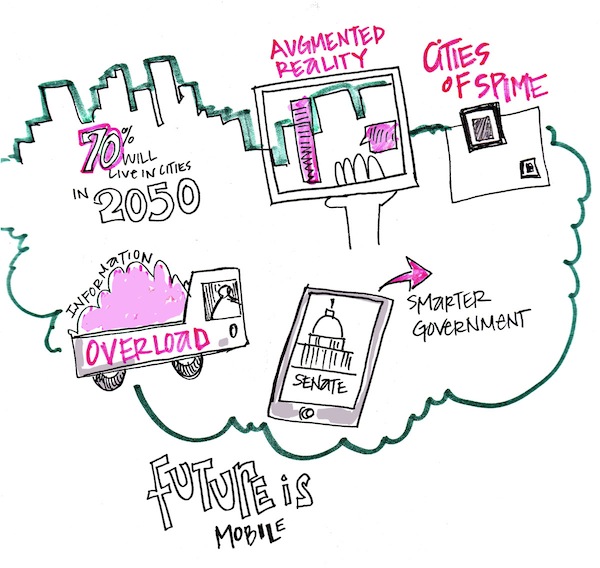
“An exploration of cyberpunk fiction, technology, where we’re headed, the challenges we face, and the solutions we need”-Ignite NYC. I gave a (very) similar talk called Pattern Recognition and Spimewatch at Ignite D.C. later that week. For whatever reason, this version seems to have come off much better. Rack it up to the first time on a big stage; there were close to a thousand people present in NYC.
What does the innovation on display at the Civic Apps contest by developers in Portland, Oregon mean to the city’s mayor?
“It’s bringing to the world knowledge of what exists in the real world but is so often unknown,” said Mayor Sam Adams in an interview at the awards ceremony for the winners of the contest.
“In Portland, like I think most cities, when people are armed with knowledge, they make wiser choices,” he said, pointing to applications like PDX Bus as examples of innovation that actually help citizens to navigate the city better.
Does open data lead to more economic value creation in the private sector and metropolitan areas alike?
“We are seeing folks that are sole proprietorships hire folks to help them build their business, their app business, their online business with our data sets.” he said. “For us, data has always been there, in some cases for decades. Putting it to use for the public and help people make money while they do it – we intend to be the open source capitol of the nation – and this is one contribution we can make, with our data sets.”
What’s next? “What CivicApps is about in part, providing the data, is sparking relationships, relationships which lead to economic opportunities,” he said. “Webtrends, Microsoft meets the local hacker or coder tonight at this event, who knows what will happen. Our job is to provide the data, provide the opportunity for relationships to occur, provide what in comparison is a tiny litte bit of money, a little incentive for people to keep going. And it’s also fun. It make the city more fun to live in, because you know what’s there.”
That incentive, incidentally, amounted to $1000 for each of the winners of the second round of Civic Apps awards, with another $3000 going to the Best of Show winner, Loqi.me. This afternoon, Skip Newberry, economic development policy advisor to Mayor Adams, congratulated the winners of CivicApps on Twitter.
As Mayor Adams mentioned later in the program, this Web app could be useful in a snowstorm in Oregon or, if adapted more broadly, for crisis response around the country or world.
App description: “This application is a resource for citizens, medical teams and governments before, during and after disasters. Loqi.me allows mobile users to send an emergency GPS beacon to a real-time map. Crises responders can view all of the help requests on the webpage, along with hospitals and fire stations, real-time 911 calls related to natural disasters. Ground teams can easily use Loqi.me on their mobile phones to send notices of supplies and terrain reports in real time. Remote helpers can easily see the whole picture on the website’s real-time map, handle help and information requests, and send messages to the network. Loqi.me supports subscription to group messages via SMS, AIM, Jabber and Twitter. No application installation is required. Location beacons can be sent simply by going to http://loqi.me on a mobile phone.”
App Description: “This is a simple, handy web map that helps you figure out how to ride your bike to transit. It lets you choose from a variety of base layers, and toggle transit stops, routes, and current bike routes. You can also query transit stops and routes for basic information. I made this for a Web GIS class at PSU and I’m a total beginner (with some code thanks to Professor Percy and OpenLayers).”
“This helped make our data useful to a lot of other developers and the general public,” said Mayor Adams. “Why take it on?”
“I saw all of this great data at the core when civic apps launched,” said Ogden. “When you get data into the Web format, you get Web developers who are really used to making human interfaces for things make them.”
App Description: “A web application to preview any of the public geo data on CivicApps from your web browser. You can choose a dataset and view that data on a map. Individual objects are clickable and can provide details (metadata).”
There’s a lot to consider in Gartner analyst Andrea DiMaio’s newest post, toward a more “balanced view of government 2.0. Balanced views are good, as are research, evidence, case studies and solid reporting.
Unfortunately, I’m at the GOSCON Conference at the moment, so I can’t respond at length. I’m very glad he finds this blog informative. I’d also direct readers to the Gov 2.0 section at O’Reilly Radar for more content and other perspectives.
One thing I’d pose as a cautionary note to his last post is that the state of government 2.0 or open government can’t be measured simply by the answers of government CIOs, particularly at the federal level. It’s in the hands of more people than that, with respect to the “we government” meme that the Personal Democracy Forum has articulated.
That’s why, while Gartner’s view is both influential and something that many executives will clearly still spend money to gain, watching what’s happening at the state and local level is critical – and perhaps not reflected in its data gathering. I could well be wrong, naturally.
Resource-starved government entities at the state level are more likely to adopt free and open tools that require investments in time, much like the campaigns that are bootstrapping using social media and YouTube this election season instead of expensive TV buys. Just look at the choices that California has made for a precedent, where open government is connecting citizens to e-services with social media.
I’ve been asking a lot more questions about private sector value created from open government data. There are definitely examples that weren’t in that blog post that DiMaio referenced. That post should not be taken as comprehensive or exhaustive, merely easily referenced initiatives that I could offer to an audience that came fresh to the topic. Those include BrightScope (whose government 2.0 story TechCrunch covered last weekend), Passur Aeropspace, transit apps, or numerous healthcare apps that fold in CHDI data.
That said, the CIO panel at GOSCON just dropped several data points you might consider:
The data.ca.gov California apps contest yielded several startups, said CarolynLawson, including:
NYSenate.gov uses Drupal and a host of other technology choices that apparently have affected their bottom line. “We spent one million less last year, relative to the historical timeline,” said NY Senate CIO Andrew Hoppin.
If that open source framework is adopted elsewhere, similar cost savings to open government might be be available for you to cite.
“We’re moving from the Social Web to the Civic Web. IT and geeks matter. What we can do with open data and the internet is very important. If government is a platform, we need people to create apps and others to open up data sets.”-Laurel Ruma, Gov 2.0 Evangelist, O’Reilly Media
If you want a great introduction to what Gov 2.0 is and why it matters, look no further than her 5 minute talk from Ignite NYC is embedded below.
What is the federal chief technology officer up to out in Silicon Valley? From afar, however, it’s looks like federal CTO Aneesh Chopra is stirring up awareness about open government and entrepreneurship in the venture capital community in California. He’s also traveling with Department of Health and Human Services (HHS) CTO Todd Park to add his compatriot’s considerable enthusiasm for innovation in healthcare information technology (HIT). Chopra’s slides follow:
During the event, I picked up some tweets coming out of a “D.C.-to-Silicon Valley” event and curated them using the Storify tool. It proved to be a bit unstable – apps in beta are fun! – but you’ll find a “living version” of the story embedded in the post below.


 E Pluribus Unum
