Architecting a city as a platform [VIDEO]

The 21st century metropolis can be a platform for citizens, government and business to build upon. The vision of New York City as a data platform has been getting some traction of late as the Big Apple’s first chief digital officer, Rachel Sterne, makes the rounds on the conference circuit. In the video below, Sterne gives a talk the recent PSFK Conference where she highlights various digital initiatives that NYC has rolled out.

PSFK CONFERENCE NYC 2011: Rachel Sterne from Piers Fawkes on Vimeo.

During her talk, Sterne talks about “The Daily Pothole,” how NYC is tumbling, QR code technology on building permits, a NYC 311 app and using Twitter, amongst other themes.

For more on how New York City is citizensourcing smarter government, head on over to Radar.

[Hat tip: PSFK]

Gov 2.0 gets applied in Oklahoma [#Gov20a]

In the Gov 2.0a conference going on today and tomorrow in Oklahoma, the “a” stands for “applied,” as in implementing technology, processes and people strategy to make government work better. There should be some video going up later, along with pictures from Adriel Hampton and a blog post or three from from the attendees. Until that goes online, the tweetstream has told the best tale of what’s been happening at the conference. I used Storify to chronicle the story online.

http://storify.com/digiphile/gov20a-gov-20-goes-to-oklahoma.js[View the story “Gov20a: Gov 2.0 Goes to Oklahoma” on Storify]

Open Government Camp: Sunlight’s tools for transparency

So this one time, at Transparency Camp

I’m still thinking through all of the things I learned at the Sunlight Foundation’s annual unconference last weekend. My top level takeaway was the large number of international campers solidified that transparency has gone global. At an operational level, I thought that the Sunlight Foundation used the combination of Internet and mobile technology to organize better than any of the previous unconferences I’ve attended. They raised the bar for interactivity with a new mobile app, integrated displays and livestreaming.

Putting the tools together to bring off a big camp is a lot harder than listing them, but by sharing the tools for transparency that the organizers used, Scott Stadum did the open government community a mitzvah. While that mobile app required development time and expertise, the vast majority of these tools are free on the Web.

Here’s a quick rundown of the tools that were used during Transparency Camp 2011:

Great stuff.

Stadum did forget one tool, even as he used it: the Sunlight Foundation’s blog.

From where I sit, a well designed and maintained blog continues to be extremely useful as the hub for organizing, particularly in a Web application ecosystem that supports the kind of diversity in platforms listed above. Sunlight does a great job with that, and in using it as a platform to track news that matter, like open government data.

Thanks again to the organizers, sponsors, hosts and, most of all, the attendees of Transparency Camp, who taught me a lot about open government over the course of two days.

US Senate hears testimony on the role of social media in crisis response

If you watched today’s hearing in the United States Senate on the role of social media in emergency management, “you witnessed a turning point in Gov 2.0,” says Brian Humphrey of the Los Angeles Fire Department. It’s certainly an important moment for the global community that has used these channels to communicate, coordinate and response to both recognize and share. CPAN’s video of the event is embedded below:


http://www.c-spanvideo.org/videoLibrary/assets/swf/CSPANPlayer.swf?pid=299342-1 

The Social Media for Emergency Management (SM4EM) blog has a great summary of SMEM on Capitol Hill, including a link to Crisis Commons co-founder Heather Blanchard’s written testimony.

The excellent speakers provided key examples of use and statistics on the use of social media during crisis situations. Some of these incredible examples included:

  • Direct communication between an eyewitness & Director Fugate during an emergency
  • Pace of fundraising that the Red Cross has experienced through their text campaign
  • The use of iPhone applications to share information about shelters
  • Google’s Person Finder application supporting recent disasters which was active 90 minutes after Japan’s earthquake
  • Skype use between communication between disaster victims and their families at home
  • Use of Google Maps by soldiers for planning

Here’s a few other insights that stuck me, along with related coverage:

  • “it’s not the technology tool, it’s the data behind it, and the people able to coordinate info”-Heather Blanchard (@poplifegirl)http://j.mp/fHhN2R
  • “The best thing would be no “social media” people but that it’s an integral part of every position”- Wendy Harman (@wharmanhttp://oreil.ly/gsocRc
  • “geotagged social media and data can provide real-time, on the ground situational information”-Heather Blanchard, http://oreil.ly/9VRguV
  • “When we talk about information overload, what we’re really talking about is a lack of filters”-Heather Blanchard http://oreil.ly/gsocRc
  • FEMA Administrator Craig Fugate (@CraigatFEMA) said under oath that he tweets himself. http://bit.ly/muJd9O
  • Fugate also said that some of his peers now rate social media and mobile as important a revolution as radio

Read more:

Taking stock of global freedom of expression on World Press Freedom Day

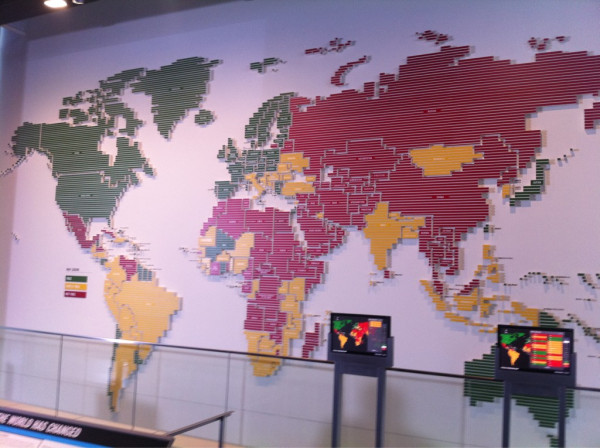
In 2010, only 1 in 6 people lives in countries with a free press, according to a new report on press freedom from Freedom House. There is a long road ahead to establishing and protecting freedom of expression for humanity.

This week, defenders of free expression are celebrating the progress of press freedom and recognizing the challenges that persist globally on World Press Freedom Day 2011. This is the 20th anniversary of the Windhoek Declaration that helped to establish UNESCO’s World Press Freedom Day. The United States is hosting this year’s World Press Freedom Day in Washington, D.C. at the Newseum. You can watch the livestream below and follow the conversation on Twitter on the #wpfd hashtag, both of which are embedded below.

wpfd2011 on livestream.com. Broadcast Live Free

new TWTR.Widget({
version: 2,
type: ‘search’,
search: ‘#wpfd OR #pressfreedom’,
interval: 6000,
title: ‘What\’s happening on’,
subject: ‘World Press Freedom Day’,
width: ‘auto’,
height: 500,
theme: {
shell: {
background: ‘#004382’,
color: ‘#ffffff’
},
tweets: {
background: ‘#ffffff’,
color: ‘#444444’,
links: ‘#1985b5’
}
},
features: {
scrollbar: false,
loop: true,
live: true,
hashtags: true,
timestamp: true,
avatars: true,
toptweets: true,
behavior: ‘default’
}
}).render().start();

To learn more about global freedom of expression and and the organizations that protect journalists and support the collection and dissemination of news about our world, visit:

Tools for the Citizen Scientist: measuring NASA’s open government progress [INFOGRAPHiC]

<img alt="http://www.nasa.gov/open/infographic.html" src="http://www.nasa.gov/533977main_opengov_tools_for_the_citizen.png " title="NASA Open Government Infographic" width="600" height ="1333"

NASA‘s celebration of the one year anniversary of its implementation of the Obama administration’s Open Government Directive included a beautiful new infographic, above.

To zoom in, you can download and explore a hi-resolution image of the infographic.

The sweeping, visually accessible representation of the galaxy of open government activity at NASA shows the progress that the air and space agency has taken to towards accomplishing the more than 150 milestones it committed to reaching in the NASA open government plan.

Overall, this infographic estimated the progress of NASA towards completing all of elements at 64%. The most recent step, NASA’s Open Source Summit, highlighted the progress, potential and problems with open source a NASA.

Overall, NASA currently rates the completion of the open source component of its open government plan at only 20%: there’s a long journey ahead in that area, as in others. Writes NASA: “We have made great progress in some areas; others have taken longer than we anticipated and extra time is required to fully realize the goals.”

Some missions will, by nature, take longer than others.

Open Government MAGIC: Media Access to Government Information Conference

The right of the governed to gain access to information about their government is a core pillar of the compact between “We the People” in the United States and those they elect to office. The quality, breadth and depth of that access, however, is often troubled.

Today in Washington, the Media Access to Government Information Conference (MAGIC) will explore these issues from within the august halls of the National Archives. MAGIC is a collaborative, one-day conference sponsored by the National Archives and Records Administration (NARA) and Duke University’s DeWitt Wallace Center for Media and Democracy. The primary focus of the conference is to highlight how journalists and others writing about public affairs can gain better access to government records by journalists. A liveblog of the proceedings, agenda and associated papers are embedded below:

Program and Papers

9:00-9:20 Welcome by David S. Ferriero, Archivist of the United States, NARA; Sanford Ungar, President Goucher College, and Member, Public Interest Declassification Board

9:20-10:30 Session 1: Media Access to Federal Government Records

Journalists and NGO participants on this panel will address how FOIA and access to federal records might be re-tooled as the federal government implements its open government and transparency policies. Government panelists will describe their vision for how new policies and technologies are changing access to government records. Additional topics may include:

  • Institutionalizing the release of common records used to monitor agency activity rather than waiting for FOIA requests to come in;
  • Centralizing, updating, and documenting information systems on agency FOIA websites; and
  • Building openness into administrative (records collecting) systems that are eventually released to the public.

Moderator: Irene Wu, Director of Research, SAND-MNIA International Bureau, FCC

  • Gary Bass, Founder and Executive Director, OMB Watch;
    (Paper)
  • Sarah Cohen, Knight Professor of the Practice of Journalism and Public Policy, Duke University;

    (Comments)
  • William Kammer, Chief, FOIA Division, U.S. Department of Defense, and Vice President, American Society of Access Professionals;
  • Miriam Nisbet, Director, Office of Government Information Services (OGIS), NARA
    (Paper)

10:30-10:45 Morning Break

10:45-Noon Session 2: Technical Hurdles, Research Solutions

Journalists on the panel will identify specific technical problems in dealing with government records at federal, state, local, and tribal levels. Government officials will identify specific technical solutions or research agendas to find solutions to these problems. Additional topics may include:

  • Re-tooling internal government information systems to improve the quality of records release;
  • Government agency support of research to improve the mining and analyzing of documents not born digital, handwritten responses on forms, and audio/video of government proceedings; and
  • Insights into emerging technologies and cyber infrastructure that may facilitate media access to government records.

Moderator: Robert Chadduck, Acting Director, National Archives Center for Advanced Systems and Technologies (NCAST), NARA

  • David Donald, Data Editor, Center for Public Integrity
    (Comments)
  • Richard Marciano, Professor and Director @ Sustainable Archives and Leveraging Technologies group, UNC School of Information and Library Science
  • George Strawn, Director, National Coordination Office, Networking and Information Technology Research and Development (NITRD) Program
  • Ken Thibodeau, Former Director (Retired), National Archives Center for Advanced Systems and Technologies (NCAST)
  • Derek Willis, Web developer, New York Times
    (Comments)

Noon-1:30 Luncheon

1:30-2:45 Session 3: Access to State, Local, and Tribal Government Records

Journalists on this panel will identify issues that arise frequently in seeking records at state, local, and tribal levels. Government panelists will discuss possible solutions to making these records more easily available, and how different levels of government may leverage IT to improve access to records. Additional topics may include:

  • Types of records sought at state, local, and tribal level;
  • Special challenges in variations in open access policies across states and localities; and
  • Federal funds expenditure rules that might trigger more transparency at state and local level.

Moderator: David McMillen, NARA External Affairs Liaison

2:45-3:15 Afternoon Break

3:15-4:30 Session 4: Private Sector Actions

NGO participants will discuss how they work to improve access to records, including participation in discussions to retool government records systems for better access by journalists. Additional topics may include:

  • What transparency advocates, journalism organizations, foundations, and academics could do to support access policies; and
  • The development of tools to aid in the analysis of government records.

Moderator: James Hamilton, Director, DeWitt Wallace Center for Media and Democracy, Duke University

  • Bill Allison, Editorial Director, Sunlight Foundation
  • Rick Blum, Coordinator, The Sunshine in Government Initiative
    (Paper)
  • Danielle Brian, Executive Director and Project on Government Oversight
    Bryan Rahija, Blog Editor, Project on Government Oversight
    (Paper)
  • Charles Lewis, Executive Editor, Investigative Reporting Workshop and Professor, School of Communication, American University

First Ignite Smithsonian spreads enlightened ideas from the “nation’s attic”

Today in Washington, Ignite Smithsonian is bringing innovative ideas about museums, design, art, technology and culture to life. As with every Ignite, each speaker had 5 minutes and 20 slides to communicate his or her message.

Ignite Smithsonian is being streamed live online from the stage of the National Museum of the American Indian this morning from 10 AM EST to 12 PM EST.

“It is the responsibility of museum as stewards of memory to help citizens think critically,” said Neal Stimler in the first talk

The archive is embedded below.

http://www.ustream.tv/flash/viewer.swf

The Ignite format has been earning more interest in Washington and government in general over the past year or so. Last May, the State Department hosted a Haiti tech meetup that Brady Forrest helped to host “Ignite style.”

Here’s the lineup for this morning

.

  • Phillip Auerswald: Creating a Place for the Future

    Phillip is an entrepreneurship enthusiast and aspiring innovation insurgent. Associate Professor, School of Public Policy, George Mason University; Associate, Belfer Center for Science and International Affairs, Harvard University; Co-Founder and Co-Editor, Innovations journal (MIT Press). Follow @auerswald on Twitter.
  • Brett Bobley: Digging into Data Challenge

    Brett is Chief Information Officer for the U.S. National Endowment for the Humanities (NEH) and is also the Director of the agency’s Office of Digital Humanities (ODH). Follow @brettbobley on Twitter.
  • Katie Filbert and Sarah Stierch: Be GLAMorous: Join WikiProject GLAM/SI

    Katie and Sarah are long-time Wikipedians. Follow @filbertkm and @Sarah_Stierch on Twitter.
  • Vanessa Fox

    Vanessa is a Google alumni, author of Marketing in the Age of Google, Entrepreneur In Residence for Ignition Partners, founder of Nine By Blue. Follow @vanessafox on Twitter.
  • Elissa Frankle: Citizen History: Making History with the Masses

    Elissa is an education consultant at the United States Holocaust Memorial Museum. Follow @museums365 on Twitter.
  • Tim Hart: Cultural Data Sculpting

    Tim is the Director of Information, Multimedia and Technology at Museum Victoria, Australia. Follow @timh01 on Twitter.
  • David Hart: The Cleveland Dilemma, Or How To Stop Making Things People Don’t Want

    David works in the Digital Media Department at MoMA, producing content for exhibitions and programs. Follow @senorcorazon on Twitter.
  • Carmen Iannacone: Hello, I’m a knowledge worker

    Carmen is the Chief Technology Officer at the Smithsonian Institution. Follow @SI_CTO on Twitter.
  • Clay Johnson

    Clay is a polycareerist: Founder of Blue State Digital, former Director of Sunlight Labs, government transparency and open data activist, Founder of Big Window Labs, Director of Engagement for ExpertLabs, and current author at infovegan.com. Follow @cjoh on Twitter
  • Martin Kalfatovic: ebooks for everybody

    Martin is a featherless bipedal librarian attempting to avoid extinction. Habitat: Smithsonian Institution Libraries. Follow @udcmrk on Twitter.
  • Steve Midgley: Learning Registry: free to be you and me

    Steve is the Deputy Director for Education Technology at the US Dept of Education, Education Director, FCC., Principal Mixrun. Program officer, Stupski Foundation. VP Engineering LoopNet. Grad school drop out. Follow @stevemidgley on Twitter.
  • Kevin Novak: The New White Space

    Kevin is the Vice President of Integrated Web Strategy and Technology for the American Institute of Architects, Co-chair of the W3C Electronic Government workgroup, Chair of the National Research Council/National Academies Panel on Communicating and Disseminating Engineering and Scientific Data for the National Science Foundation, former chair of the Internet in Developing Countries Task Force under the .MOBI Foundation, former Director of Web Services at the Library of Congress. Follow @NovakKevin on Twitter
  • Fiona Rigby: Making New Zealand Content Easier to Find, Share, Use

    Fiona is the Content Manager at DigitalNZ. Follow @nzfi on Twitter.
  • Margriet Schavemaker: The Museum as InnovatAR

    Margriet is an art historian, philosopher and media specialist. She’s the Head of Collections and Research at the Stedelijk Museum, Amsterdam. Follow @marschave on Twitter.
  • Camilla SDO: Camilla – The Who & Why!

    Camilla is the mission mascot for the NASA Solar Dynamics Array. Follow @Camilla_SD on Twitter.
  • Simon Sherrin: Giving everyone a bite of the Apple

    Simon is the Technical Manager for the Victorian Cultural Network, Australia. Follow @thesherrin on Twitter.
  • Koven Smith: What’s the Point of a Museum Website?

    Koven is a composer, drummer, and Director of Technology at the Denver Art Museum. Follow @5easypieces on Twitter.
  • Neal Stimler: Renewing American Democracy Through Museums & Digital Culture

    Neal is the Associate Coordinator of Images in The Image Library at The Metropolitan Museum of Art. Follow @nealstimler on Twitter.
  • Kate Theimer: How I Got Over My Hatred of "Archive" as a Verb, and Other Stories of Words and Evolutions

    Kate is the author of “Web 2.0 Tools and Strategies for Archives and Local History Collections” and the ArchivesNext blog. Former National Archives and Smithsonian Institution employee. Follow @archivesnext on Twitter.
  • Jasper Visser: A look at the wondrous world of automatic vending machines through the eyes of a museum professional

    Jasper is the project manager for new technology and media projects at the Museum of National History of the Netherlands. Follow @jaspervisser on Twitter.

Enjoy! You can follow the backchannel for the event at #IgniteSmithsonian on Twitter.

http://widgets.twimg.com/j/2/widget.js

new TWTR.Widget({
version: 2,
type: ‘search’,
search: ‘ignitesmithsonian’,
interval: 6000,
title: ‘What\’s happening at’,
subject: ‘Ignite Smithsonian’,
width: ‘auto’,
height: 400,
theme: {
shell: {
background: ‘#990000’,
color: ‘#ffffff’
},
tweets: {
background: ‘#ffffff’,
color: ‘#444444’,
links: ‘#1985b5’
}
},
features: {
scrollbar: false,
loop: true,
live: true,
hashtags: true,
timestamp: true,
avatars: true,
toptweets: true,
behavior: ‘default’
}
}).render().start();

Videos from the Web were interspersed with the speakers, like “Trade School.”

Or a flash mob doing the Hammer Dance.

Week in Review: Top Gov 2.0 and Open Government Stories

US Capitol Blooms

Open government made an appearance in popular culture, albeit not in an admiring sense. At the start of the week, Jon Stewart and the Daily Show mocked the Obama administration and the president for a perceived lack of transparency.

Stewart and many other commentators have understandably wondered why the president’s meeting with open government advocates to receive a transparency award wasn’t on the official schedule or covered by the media. A first hand account of the meeting from open government advocate Danielle Brian offered useful perspective on the issues that arose that go beyond a soundbite or one liner:

Gary, OMB Watch’s executive director, focused on the places where we have seen real change, including the Open Government Directive, the Executive Orders on Classified National Security and Controlled Unclassified Information, emphasis on affirmative disclosures of government information; and the President’s support of reporters’ privilege and shield law, as well as whistleblower protections.

Lucy, executive director for Reporters Committee for Freedom of the Press, pointed out that this was the first president in her 30 years of working in this field who had invited open government advocates into the Oval Office. She specifically thanked him for his strong support of a reporters’ shield law, which he affirmed he continues to support. Tom, executive director for the National Security Archive, emphasized that when it comes to FOIA reform and implementation we know it isn’t just a ship of state, but an entire flotilla including rowboats. And that while there has been notable improvement according to the National Security Archive’s survey of agencies, there continues to need be a need for leadership from the top to change cultures across the vast swath of government agencies. He also noted that we all believe the information we want to see is not simply that which is useful for consumers, but also that which holds the government accountable.

I knew my topic was likely to be sensitive. I began by thanking the President for his strong support of whistleblower protections, and noted that it was not for lack of effort on the part of the White House that the legislation didn’t pass at the end of the last Congress.

I noted, however, that the current aggressive prosecution of national security whistleblowers is undermining this legacy. That we need to create safe channels for disclosure of wrongdoing in national security agencies. That we need to work harder to shrink the amount of over-classified materials that unnecessarily prompt leak prosecutions.

The President shifted in his seat and leaned forward. He said he wanted to engage on this topic because this may be where we have some differences. He said he doesn’t want to protect the people who leak to the media war plans that could impact the troops. He differentiated these leaks from those whistleblowers exposing a contractor getting paid for work they are not performing. I was careful not to interrupt the President, but waited until he was done. I pointed out that few, if any, in our community would disagree with his distinction—but that in reality the current prosecutions are not of those high-level officials who regularly leak to the press to advance their policy agendas. Instead, the Department of Justice (DOJ) is prosecuting exactly the kind of whistleblower he described, for example one from the National Security Agency.

The President then did something that I think was remarkable. He said this is an incredibly difficult area and he wants to work through how to do a better job in handling it. He also agreed that too much information is classified, and asked us to work with his office on this. He wasn’t defensive nor was he dismissive. It was perhaps the dream moment for an advocate—hearing the most senior policymaker agree with you and offer to work together to tackle the problem.

Brian’s account is the most comprehensive account of the meeting on open government online. The irony that it was not recorded and released to the American people is, however, inescapable. For anyone tracking the progress of the Open Government Directive, the last six months have been an up and down experience. It was clear back in September that in the United States, open government remains in beta.

According to doctoral research by University of Texas academic, there are 358 open government projects in federal government. Former White House deputy chief technology officer Beth Noveck wrote about the semantics and the meaning of good government and open government mean in this context. One takeaway: don’t mistake open innovation policies for transparency guarantees.

The current White House deputy CTO for innovation, Chris Vein, wrote on the White House blog this week that the one year anniversary of open government plans were “a testament to hard work” at the agencies. As Vein acknowledged, “while there is always more to be done, we are proud of the important work that agencies have done and are doing to change the culture of government to one that encourages transparency and facilitates innovation.  We are committed to maintaining and building upon this momentum to make our Nation stronger and to make the lives of Americans better.”

Naturally, some projects are always going to be judged more as more or less effective in delivering on the mission of government than others. An open government approach to creating a Health Internet may be the most disruptive of them. For those that expected to see rapid, dynamic changes in Washington fueled by technology, however, the bloom has long since come off of the proverbial rose. Open government is looking a lot more like an ultramarathon than a 400 yard dash accomplished over a few years.

That said, something different is going on during what Micah Sifry has aptly called the age of transparency. We’re in new territory here, with respect to the disruption that new connection technologies represent to citizens, society and government. It’s worth taking stock of what’s happened recently. It’s been a while since I first posted a Gov 2.0 Week in Review at Radar, and three months since the 2010 Gov 2.0 year in review.

There’s a lot happening in this space. Following is a quick digest that might provide some perspective to those who might think that open government is a better punchline than policy.

1. The government stayed open. The budget crisis on Capitol Hill overshadowed every other issue this past week. It’s harder for a government to be open if it’s closed. The secrecy of the shutdown negotiations left folks over at the Sunlight Foundation wondering about how open government principles matched up to reality.

2. Proposed deep cuts to funding for open government data platforms like Data.gov or the IT Dashboard appear to be least partially restored in the new budget. That will likely salve (some of) the concerns of advocates like Harlan Yu, who wrote about what we would lose if we lost Data.gov. John Wonderlich’s questions on the budget deal, however, include one on exactly how much funding was restored.

3. FCC.gov relaunched as an open government platform. In any other week, this story would have led the list open government news. Having sat out the Aughts, FCC.gov stepped into the modern age FCC managing director Steve Van Roekel and his team worked hard to bring Web 2.0 principles into the FCC’s online operations. Those principles include elements of open data, platform thinking, collective intelligence, and lightweight social software. What remains to be seen in the years ahead is how much incorporating Web 2.0 into operations will change how the FCC operates as a regulator. The redesign was driven through an open government process that solicited broad comment from the various constituencies that visit FCC.gov. The beta.FCC.gov isn’t just a site anymore, however: it’s a Web service that taps into open source, the cloud, and collective intelligence. In the world of Gov 2.0, that’s a substantial reframing of what government can do online.

4. What happens to e-government in a shutdown? This near miss forced hundreds of thousands of people to consider how to make wired government go dark. That discussion should not end with this latest resolution.

5. The first NASA Open Source Summit explored why open source is a valuable tool for the space agency. Open source is a pillar of NASA’s open government plan.

6. The Russian blogosphere came under attack, quashing an online parliament initiative. Needless to say, it will be interesting to see if a Russian Gov 2.0 conference next week addresses the issue of press freedoms or open government transparency.

7. Simpl launched as platform to bridge the connection between social innovators and government.

8. National Builder launched as a new online activism platform.

9. Senator Jon Tester (D-MT) and Representative Steve Israel (D-NY) reintroduced the Public Online Information Act. With this transparency bill, the federal government would acknowledge the Internet, opined Mother Jones.

10. SeeClickFix launches its Facebook app.. “It looks like the entire SeeClickFix experience has been ported over to the Facebook environment,” writes Dan Kennedy. “Users can report problems and pinpoint them on a Google map, thus alerting government officials and the news media. I am far from being the world’s biggest Facebook fan, but it’s a smart move, given how much time people spend there.”

Editor’s Note This is by no means a definitive, comprehensive list. For instance, there’s plenty of open government news happening in countries around the world, from corruption mashups in India to the transparency challenges in various states. For a daily dose of transparency, make sure to read the Sunlight Foundation’s blog IBM’s Business of Government blog has also posted a weekly round up. If you have more stories that came across your desktop, inbox or television this week, please share them in the comments.

As its Star Trek videos launch, Social Security tries to connect with younger citizens

Patty Duke and Mr. Sulu (aka, George Takei) want you to boldly go where you may never have gone before: SocialSecurity.gov. (At least if you’re under 65.)The short, commercial length spots make no bones about Takai’s time on Star Trek, so to speak, and are laced with references to the iconic television series.

In another, Takei and Duke encourage viewers to “Go Direct” to get direct deposits of monthly social security checks. (No way to beam those over, Scotty?) While the new slate of videos, Social Security is making an effort to connect with older Americans through the aging icons of 20th Century pop culture. As my colleague Luke Fretwell put it, Social Security has gone Star Trek.

If the spots help an increasingly digital cohort of senior citizens to learn about SocialSecurity.gov and relevant benefits, the cornball humor might have been worth the investment.

On the same day that the Star Trek videos launched however, the Social Security Administration also posted the full version of a webinar for young people wondering. The webinar, below, is the first official communications from the agency the contains information about the future of the program for young workers.

To say that there’s a contrast in styles between the two communication efforts is an understatement. The care with which the agency has had to take in communicating about an uncertain future, as opposed to trying to raise awareness of an improved website, is notable. This more recent example of how Social Security operates in the Gov 2.0 era drives how just how difficult operating in the new media environment will be for many agencies.

Will Social Security get social media? Hard to say. They’re trying. The @SocialSecurity Twitter wasn’t able to attract the attention of Takei or produce much engagement. Facebook produced slightly better results, but no obvious spike in awareness or viewership of the webinar.

If you have any thoughts on their success, failure or what they could or should be doing better, the comments are open.