Data BBQ features District tech entrepreneurs, passion and tasty open data.

Get off your index and build your Rolodex,” read the invite to last night’s Data BBQ in Washington, D.C.

And last night, that’s exactly what over a hundred people from around D.C.’s growing tech scene did, spilling out of the revamped officers of Insomniac Design in Bladgen Alley, near Mount Vernon Square.

The crowd was leavened with many attendees from the ongoing mHealth Summit 2010, manyof DC’s open data geeks and supporters and. Expert Labs’ Gina Trapani and Waxy.org’s Andy Baio came by from the FCC’s Open Developer Day to mix and mingle too. The highlight of the Data BBQ was the lightning talks, where attendees pitched projects, ideas, jobs or even spare rooms to the crowd. The talks are embedded below:

Many of the mHealth conferees no doubt know about the Health 2.0 Developer Challenge from the Department of Health and Human Services, where health data is being mashed up into new applications.

And, judging by the show of hands, many of the Data BBQ’ers had also heard about the World Bank’s Global Apps for Development Competition, which is looking to the development and practitioner communities to create innovative apps using World Bank data.

What might have been new to a few, at least, was the upcoming Apps for Army competition for the public, where the successful apps competition that Peter Corbett and iStrategy Labs helped the Army run will be rebooted for wider participation.

Linking up WhiteHouse.gov and a new US-India Partnership on Open Government

After an election that saw open government make gains in statehouses across the United States, a new transcontinental partnership offers new opportunities for international collaboration. This afternoon, Samantha Power, special assistant to the President for multilateral affairs and human rights, blogged about a new US-India partnership on open government at WhiteHouse.gov. Her post describes President Obama’s visit to an “Expo on Democracy and Open Government” at St. Xavier’s College in Mumbai and the technologies and organizations he encountered there. According to Power:

“India’s dynamism in the technology sector is well known, as is Gandhi’s legacy in India of civic action and bottom-up change, but today’s expo highlighted something very fresh: Indian civil society’s harnessing of innovation and technology to strengthen India’s democracy — by fighting corruption, holding government officials accountable, and empowering citizens to be the change they seek.”

Power’s post is thorough, descriptive and contextualizes the president’s trip and the growing use of technology to fight corruption and improve accountability in India. It also contains only one link that’s relevant to the organizations that were at said “Expo on Democracy and Open Government.” Ipaidabribe.com was created by Janagraaha to enable “Indians upload videos of their experiences in paying a bribe, in refusing to pay a bribe, and in ‘not having to pay a bribe.'”

The expo itself does not appear to have a website, or at least one that could be discovered after a few minutes of searching online.

The closest thing to an online FAQ is the White House press release on “Indian Innovations in Expo for Democracy and Open Government posted at America.gov, where the participating organizations are listed and described. Neither the WhiteHouse.gov blog post nor the release contains that most elemental of online elements: hyperlinks to the relevant person, place or thing being described. For some readers, used to the limitations of print, that may not be a huge issue. For digital natives or immigrants, the absence of links is a big missed opportunity.

The reason that critique is particularly fresh this afternoon is that one of the archetypal bloggers on the Web, David Winer, made the argument at Scripting News today that WhiteHouse.gov should be a hyperlocal blog. Specifically:

The sitting President can’t run campaign ads as an aspiring President does. But he has the ability to communicate more effectively than anyone else on the planet, if that power is developed. If you send people away to places that involve them. The White House blog should be a daily link list of ideas and perspectives on what’s happening in the world.

For instance, Power could have linked to the press briefing at USAID.gov where she, Secretary of Agriculture Tom Vilsack, USAID Administrator Raj Shah and Chief Technology Officer Aneesh Chopra talk about yesterday’s agricultural exposition, including her comments on this open government partnership. For example:

one of the things that we’ve been doing is really learning as a government just how rich the innovations are in a lot of emerging democracies, and indeed, in a lot of new democracies and transitional democracies. No one country has a monopoly on innovation in this space. And it’s indeed quite inspiring to see how even with very few resources you can see how creative nongovernmental actors are, or indeed champions within government who are stepping forward and taking advantage of new technologies and so forth to try to enhance partnership or transparency.

So having said that, I still think India has a huge number of comparative advantages. I mean, for starters it has one of the most noble traditions in human history of bottom-up change and bottom-up activism. I mean, the whole history of modern India is rooted in what you might call the original “Yes, we can” with Mr. Gandhi and the movement that he created and the billions of people that he inspired around the world, one of whom, as the President said today, was Martin Luther King, without whom, arguably, we wouldn’t be where we are in my own country.

So this tradition of bottom-up change, of citizen demand the quality of demand that one encounters out in the most rural areas and some of the most impoverished areas here, even among people who haven’t yet acquired literacy in their communities.

For an administration that’s embraced the idea and practice of Gov 2.0 in many notable ways, failing to link in even a Web 1.0 way is surprising. And to be fair, this post was an exception. The White House blog has frequently made good use of links, video and images, as shown by this week’s WhiteHouse.gov weekly wrapup.

For the sake of the broader open government community who may be interested, here’s the list of participants in that Expo from the press release, this time with links to the relevant organizations or news coverage, where such websites are not available:

An Illustrative List of Exhibitors and Roundtable Participants:

· Mazdoor Kisan Shakti Sangathana (Workers and Peasants Strength Union – MKSS) is an organization that fights against government corruption and creates channels for citizens to oversee their local governments. Its leader, Aruna Roy, is best known as a prominent leader of the Right to Information movement in India which led to Parliament’s passage of the Right to Information Act in 2005, which has empowered millions of ordinary Indians.

· Satark Nagrik Sangathan (SNS) is a New Delhi based citizen’s group with a mandate to promote accountability and transparency in government functioning. SNS’s key activities have been to promote the use of the Right to Information Act (RTI) by training citizens, particularly women in slum areas, to use the RTI and on the functioning of the government in areas such as rations, civic works, education and social welfare schemes. More recently, SNS has used the RTI to collect information on the performance of elected representatives and develop report cards.

· Janaagraha is a Bangalore-based NGO that works with citizens and government to change the quality of life in India’s cities and towns, focusing on urban infrastructure and citizen engagement with public institutions, including volunteerism. They also recently launched an exciting initiative called IPAIDABRIBE.com, a web platform for where people who have been asked for or ever had to pay a bribe are encouraged to share their experiences (after only 2 months, it gets 30,000 hits per day).

· The Hunger Project (THP) is a global organization committed to ending hunger. In India, it is committed to ignite and sustain the leadership spirit of women elected to local village councils (panchayats). THP works in 13 states of India, including Maharashtra (where Mumbai is located). By partnering with more than 90 civil society organizations, THP has worked with and supported the leadership of more than 60,000 elected women representatives.

· ASER uses simple tools to empower people nationwide to test their children’s math and reading abilities, and then hold local government accountable to outcomes. With this data, ASER creates the Annual Status of Education Report, which surveys literacy in 570 districts and 700,000 children of India with citizen participation. Each year 25,000 volunteers donate 4 days of their time to gather the data for this report.

· PRS Legislative Research (PRS) works with Members of Parliament (MPs) across party lines to provide research support on legislative and policy issues. Its aim is to complement the base of knowledge and expertise that already exists in government, citizens groups, businesses, and other research institutions. PRS also enables citizens to track the progress of legislative and policy reforms through an on-line portal.

· The Association for Democratic Reforms (ADR) works on building fair and transparent electoral and political processes in India. ADR has organized Citizen Election Watch for all major elections and discloses candidate background information in a timely manner, including through SMS technology, to the media and the public, helping them to make informed voting choices.

The takeaway for government – or any organization, for that matter – is that blogs and the Web offer new opportunities to share information, create more surface area to expose ideas to citizens and create conversations. If official accounts of new partnerships or events consist of plaintext press releases, lack a website or a post on the most prominent government blog in the world fails to include images, video or relevant links, that opportunity is being neglected.
Exploring Civil Society 2.0 at the State Department

The Tech@State conference on Civil Society 2.0 offered insight into the future of technology and civics around the world from digital diplomats, nonprofit leaders and technologists. Tim O’Reilly delivered one of the most thoughtful lectures I’ve seen to date, exploring the factors that led to the success of the Web, Google, Microsoft, Amazon and the platforms that undergird our digital world.

“As you think about civil society 2.0, think about open ended platforms that you can build on, not just applications,” he said.

While his comments and those of the other presenters deserve more analysis and reporting, the four excerpts from O’Reilly’s talk below offer immediate access to the insight he shared. I’ll write more at Radar soon.

For more perspective on what civil society might mean in 2010 – or 2050 – read Nancy Scola at techPresident.

http://www.ustream.tv/flash/video/10632532?v3=1

http://www.ustream.tv/flash/video/10632190?v3=1

http://www.ustream.tv/flash/video/10632341?v3=1

http://www.ustream.tv/flash/video/10632304?v3=1

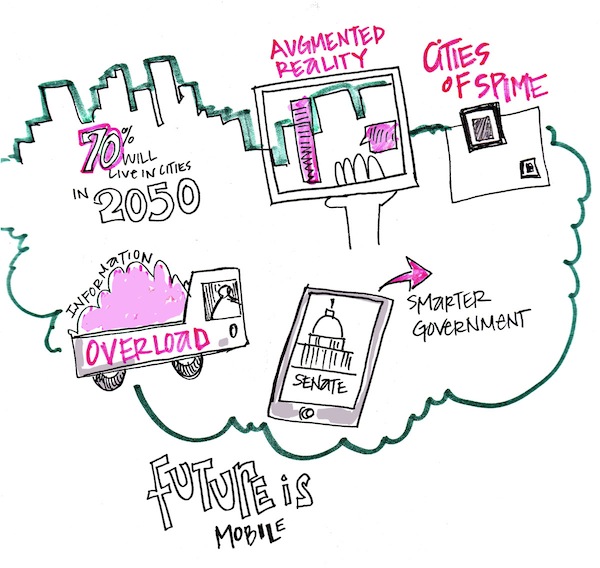
The Future is Mobile at Ignite NYC: Open Data, Open Government and Augmented Reality

“The future is already here – it’s just not evenly distributed.” —William Gibson.

http://blip.tv/play/AYKJtSgC

“An exploration of cyberpunk fiction, technology, where we’re headed, the challenges we face, and the solutions we need”-Ignite NYC. I gave a (very) similar talk called Pattern Recognition and Spimewatch at Ignite D.C. later that week. For whatever reason, this version seems to have come off much better. Rack it up to the first time on a big stage; there were close to a thousand people present in NYC.

The creative graphic recording at Ignite NYC at Web 2.0 Expo was created during the talk by Nora Herting of ImageThink.

For a great Ignite talk with a related theme, check out In Coders We Trust, by Laurel Ruma.

Open Government and Civic Innovation on Display at Portland’s CivicApps Awards

What does the innovation on display at the Civic Apps contest by developers in Portland, Oregon mean to the city’s mayor?

“It’s bringing to the world knowledge of what exists in the real world but is so often unknown,” said Mayor Sam Adams in an interview at the awards ceremony for the winners of the contest.

“In Portland, like I think most cities, when people are armed with knowledge, they make wiser choices,” he said, pointing to applications like PDX Bus as examples of innovation that actually help citizens to navigate the city better.

Does open data lead to more economic value creation in the private sector and metropolitan areas alike?

“We are seeing folks that are sole proprietorships hire folks to help them build their business, their app business, their online business with our data sets.” he said. “For us, data has always been there, in some cases for decades. Putting it to use for the public and help people make money while they do it – we intend to be the open source capitol of the nation – and this is one contribution we can make, with our data sets.”

What’s next? “What CivicApps is about in part, providing the data, is sparking relationships, relationships which lead to economic opportunities,” he said. “Webtrends, Microsoft meets the local hacker or coder tonight at this event, who knows what will happen. Our job is to provide the data, provide the opportunity for relationships to occur, provide what in comparison is a tiny litte bit of money, a little incentive for people to keep going. And it’s also fun. It make the city more fun to live in, because you know what’s there.”

That incentive, incidentally, amounted to $1000 for each of the winners of the second round of Civic Apps awards, with another $3000 going to the Best of Show winner, Loqi.me. This afternoon, Skip Newberry, economic development policy advisor to Mayor Adams, congratulated the winners of CivicApps on Twitter.

.bbpBox29117818058 {background:url(http://a3.twimg.com/profile_background_images/26879991/Downtown_Portland_-_Twitter_image.png) #9AE4E8;padding:20px;} p.bbpTweet{background:#fff;padding:10px 12px 10px 12px;margin:0;min-height:48px;color:#000;font-size:18px !important;line-height:22px;-moz-border-radius:5px;-webkit-border-radius:5px} p.bbpTweet span.metadata{display:block;width:100%;clear:both;margin-top:8px;padding-top:12px;height:40px;border-top:1px solid #fff;border-top:1px solid #e6e6e6} p.bbpTweet span.metadata span.author{line-height:19px} p.bbpTweet span.metadata span.author img{float:left;margin:0 7px 0 0px;width:38px;height:38px} p.bbpTweet a:hover{text-decoration:underline}p.bbpTweet span.timestamp{font-size:12px;display:block}

Congrats to @caseorganic @elsewisemedia @pdxmele @maxogden & John Mosser for their award-winning @civicapps! #opensource #gov20 #teamadamsless than a minute ago via TweetDeck

Most Useful App and Best of Show

Amber Case for Loqi.me

As Mayor Adams mentioned later in the program, this Web app could be useful in a snowstorm in Oregon or, if adapted more broadly, for crisis response around the country or world.

App description: “This application is a resource for citizens, medical teams and governments before, during and after disasters. Loqi.me allows mobile users to send an emergency GPS beacon to a real-time map. Crises responders can view all of the help requests on the webpage, along with hospitals and fire stations, real-time 911 calls related to natural disasters. Ground teams can easily use Loqi.me on their mobile phones to send notices of supplies and terrain reports in real time. Remote helpers can easily see the whole picture on the website’s real-time map, handle help and information requests, and send messages to the network. Loqi.me supports subscription to group messages via SMS, AIM, Jabber and Twitter. No application installation is required. Location beacons can be sent simply by going to http://loqi.me on a mobile phone.”

Most Appealing

Matt Blair for PDX Trees.

App description: “PDX Trees is an app for iPhone and iPod Touch devices that makes it easy to find and and enjoy them. With this app, you can:

  • Search for nearby trees and see them on a map.
  • Tap a pin to see the name and view details for that particular tree.
  • Take and upload a photo of a Heritage Tree you’re visiting.
  • View photos of the tree taken by other tree enthusiasts.
  • Email a friend about the tree (includes tree name and location where available)
  • Read more about a type of tree from Wikipedia, without leaving the app.”

Most Original

Melelani Sax-Barnett for Portland Bike to Transit.

App Description: “This is a simple, handy web map that helps you figure out how to ride your bike to transit. It lets you choose from a variety of base layers, and toggle transit stops, routes, and current bike routes. You can also query transit stops and routes for basic information. I made this for a Web GIS class at PSU and I’m a total beginner (with some code thanks to Professor Percy and OpenLayers).”

Best Use of Data

Max Ogden for Civic Apps Data Previewer

“This helped make our data useful to a lot of other developers and the general public,” said Mayor Adams. “Why take it on?”

“I saw all of this great data at the core when civic apps launched,” said Ogden. “When you get data into the Web format, you get Web developers who are really used to making human interfaces for things make them.”

App Description: “A web application to preview any of the public geo data on CivicApps from your web browser. You can choose a dataset and view that data on a map. Individual objects are clickable and can provide details (metadata).”

Civic Choice

Joseph Mosser for PDXTrian

App Description: “Pdxtrian is a simple utility for riders of Portland’s excellent mass transit system, TriMet.

  • Uses GPS to find nearby transit stops
  • Displays a map of the stop location
  • Displays a list upcoming arrivals
  • Allows you to save stops and look them up anytime”

The livestream of the awards ceremony is embedded below:

http://www.ustream.tv/flash/video/10487185?v3=1

Open source and open government community talks innovation at first IgniteGov

http://storify.com/digiphile/tracking-the-tweets-about-the-first-ignitegov-at-g.js

Weighing a more balanced view of Government 2.0

There’s a lot to consider in Gartner analyst Andrea DiMaio’s newest post, toward a more “balanced view of government 2.0. Balanced views are good, as are research, evidence, case studies and solid reporting.

Unfortunately, I’m at the GOSCON Conference at the moment, so I can’t respond at length. I’m very glad he finds this blog informative. I’d also direct readers to the Gov 2.0 section at O’Reilly Radar for more content and other perspectives.

One thing I’d pose as a cautionary note to his last post is that the state of government 2.0 or open government can’t be measured simply by the answers of government CIOs, particularly at the federal level. It’s in the hands of more people than that, with respect to the “we government” meme that the Personal Democracy Forum has articulated.

That’s why, while Gartner’s view is both influential and something that many executives will clearly still spend money to gain, watching what’s happening at the state and local level is critical – and perhaps not reflected in its data gathering. I could well be wrong, naturally.

Resource-starved government entities at the state level are more likely to adopt free and open tools that require investments in time, much like the campaigns that are bootstrapping using social media and YouTube this election season instead of expensive TV buys. Just look at the choices that California has made for a precedent, where open government is connecting citizens to e-services with social media.

I’ve been asking a lot more questions about private sector value created from open government data. There are definitely examples that weren’t in that blog post that DiMaio referenced. That post should not be taken as comprehensive or exhaustive, merely easily referenced initiatives that I could offer to an audience that came fresh to the topic. Those include BrightScope (whose government 2.0 story TechCrunch covered last weekend), Passur Aeropspace, transit apps, or numerous healthcare apps that fold in CHDI data.

That said, the CIO panel at GOSCON just dropped several data points you might consider:

The data.ca.gov California apps contest yielded several startups, said CarolynLawson, including:

NYSenate.gov uses Drupal and a host of other technology choices that apparently have affected their bottom line. “We spent one million less last year, relative to the historical timeline,” said NY Senate CIO Andrew Hoppin.

If that open source framework is adopted elsewhere, similar cost savings to open government might be be available for you to cite.

Eight lessons for social media and politics from Politico, Facebook and media

Ten years ago, staffers thought Al Gore was weird for texting Tipper. Fast forward a decade to late 2010, when any politician who doesn’t use check email on a smartphone or monitor what the media and voters are saying on social media platforms risks being judged out of step. As the midterm elections loom large next month, a large majority of the United States House and Senate are on Facebook. A smaller majority uses Twitter, YouTube and Flickr. While the effectiveness of that usage varies from candidate to candidate, the question of whether social media is a fad is largely settled.

One of the great unanswered questions of this election with respect to social media will be whether fan or follower numbers have any predictive value with respect to elections. Another will be whether more interactive candidates are more successful. What remains is to decide which strategies and tactics will make the difference in winning elections.

Earlier tonight, a panel of experts from media, campaigns and academia came together at George Washington University for “Going Viral: How Campaigns are Using Social Media,” an event jointly sponsored by Politico and Facebook. The panel featured:

What was the high level take away? You can judge yourself: Video of the panel on political campaigns and social media is available at CSPAN and embedded below:

http://c.brightcove.com/services/viewer/federated_f9?isVid=1

Politico’s own Meredith Shiner reported that “social media still has much to prove.” As Shiner noted, Finn told the audience that “Despite the increased attention paid by the media to political Facebook and Twitter accounts, campaigns today still spend less than 5 percent of their media expenditures online.” Determining whether that spend is consistent across all campaigns would be useful. That said, part of the allure of social media is that it requires an investment in time and expertise, not classical media buys. Sarah Palin, Scott Brown and Barack Obama could use Twitter, Facebook and YouTube to achieve awareness of their messages without huge campaign war chests. For underfunded campaigns, using those tools isn’t a choice. It’s a necessity.

Drawing from those take aways, here are eight more lessons for social media and politics:

1) Politicians have to use social media themselves to realize its full potential. Most campaigns are on Facebook. As Facebook’s Adam Conner pointed out, however, what remains is for candidates to understand tech personally and use it. “When you put a communications manager or staffer in between 140 characters or a Facebook update,” he said, “it’s much less authentic.”

2) Social media is not going away. “It’s the place we all have to be,” said Smith. As citizens turn to the Internet for government data, information, e-services, not to mention news, media and government entities have to “fish where the fish are.”

3) Very few Congressional candidates are doing a good job with these tools. At least, that was Professor Matthew Hindman’s take at the event. Judging from the feeds of many candidates, there’s clearly a learning curve with respect to style, conventions and technical acumen. Posting press releases to Twitter or Facebook does not realize their potential. Neither does treating the platforms the same way. For instance, Finn said that “tweeting from Facebook” is one of her pet peeves. Connor had seen enough “double third person posting” by staff to find it annoying. Voters are likely no different.

4) Social media enables candidates to build the intensity of support. While tweets and updates may not sway independents in of themselves, building strong online communities of supporters can translate into electoral success.

5) Friend power is important. Online, people are increasingly finding news stories from one other on Facebook, Twitter or other social networks, as opposed to through a search engine. That makes creating content with high “shareability” key, whether it’s embeddable videos, polling widgets or tweetable campaign slogans.

6. Leaving negative comments online builds trust, up to a point. In order for voters to see a page is a place for debate, you need to leave as many negative comments up as possible, said de Vellis, with the exception of abusive or pornographic content, which should be moderated. “Leave as much up as much as you can stomach,” said Finn. If the site is a place for supporters, “they’ll jump in and support you.” Conner suggested setting a policy up ahead of time, which a campaign can use to tramp down bad publicity. He said that it’s even more imporatnt to internal staff to have discussions ahead of time to get universal understanding of that policy.

7. This is the year of mobile. Again. As Pew Internet researcher Susannah Fox powerfully articulated in her presentation on the power of mobile this fall, 82 percent of American adults have a cell phone. Six in 10 American adults go online wirelessly with a laptop or mobile device. “Mobile was the final front in the access revolution,” she said. “It has erased the digital divide. A mobile device is the Internet for many people. Access isn’t the point anymore. It’s what people are doing with the access that matters.” As important as social media may become to the future of campaigns, reaching voters using email, text messages and calls to their cellphones – good old “Web 1.0” – is still paramount, along with a ground game to get them to the polls.

8. Candidates who use social media personally are more likely to use it on campaigns and ultimately in governance, says Adam Conner.

Once in office, the challenges of using technology for open government are even greater. Just ask the staffers at the Obama Administration and federal agencies, where open government initiatives in beta are moving from plans to implementation.

Telling the story of social media and politics

Befitting the occasion, below are selected tweets and images from the event, curated using Storify:

http://storify.com/digiphile/going-viral-how-campaigns-are-using-social-media.js

In Coders We Trust: Laurel Ruma breaks down Gov 2.0 at Ignite NYC

We’re moving from the Social Web to the Civic Web. IT and geeks matter. What we can do with open data and the internet is very important. If government is a platform, we need people to create apps and others to open up data sets.”-Laurel Ruma, Gov 2.0 Evangelist, O’Reilly Media

If you want a great introduction to what Gov 2.0 is and why it matters, look no further than her 5 minute talk from Ignite NYC is embedded below.

Reflections from Manor Govfresh: Voices of Open Government and Gov 2.0

If you’re looking for the faces of government 2.0, look no further. The video above, released today by Manor New Tech High‘s “Digital Dojo,” features more than a dozen voices (including this correspondent) talking about what Manor.Govfresh meant to them and what open government means to the country.

“I am very excited to be at Manor Govfresh because it’s the first time I’ve ever been to a conference that doesn’t just talk about change but actually does it,” said White House deputy CTO for open government Beth Noveck. “What’s exciting about Manor Govfresh is that it’s brought together so many people who are interested in municipal innovation and using technology to actually make a difference in local communities here in Manor, Texas, in Deleon, Texas, and across America, to actually make government work better.”

When you watch the video, of course, you’ll hear many more voices than Noveck’s, which is of course the point. The movement towards open government at the local level puts the growth of government 2.0 in context. As Stacy Viselli said this morning in a comment on Radar, “Communities and neighborhoods have been moving their organizations online for a while now and are looking for ways to do more. It creates an optimum environment for collaborative projects that include local governments, business, civic associations, nonprofits, and community foundations. Sometimes it’s not about the data so much as it is about providing a platform that empowers communities do what they are already doing–better.”

For more on how local governments are using technology to deliver smarter government, read about how Gov 2.0 is growing locally. And for more on Manor Govfresh, read about harnessing the civic surplus for open government.