Insight on what’s next from Bill Gates: mHealth, mCommerce and robots

“People underestimate the amount of innovation going on,” said Bill Gates at the mHealth Summit in Washington, D.C. today. “They assume tech remains the same.” Given the thousands of attendees walking around the floor to see the mobile technology on display, there will be more awareness of what’s happening by the end of the day. Those listening to Gates in person or online could take away a few more lessons as well.

First of all, the key applications in the mobile health world are those that are tied to better outcomes, said Gates. Metrics like the number of children dying is one such metric, he said, and could be mitigated by mobile apps that register every birth on a cellphone to track vaccine coverage. Tracking supply chain for medical supplies and online medical records also can lower key metrics like child mortality, said Gates. Highlights from Bill Gate’s keynote conversation with Dr. Kristin Tolle are embedded below:

“In general, the world underfunds research because the person who takes the risk doesn’t capture the full benefit,” said Gates. “Government comes in for things the market doesn’t work well on.” Some research and development simply won’t get funded otherwise, in the absence of a strong profit motive. That’s likely one reason the Gates Foundation has focused on malaria, a disease that big pharmaceutical companies haven’t put significant resources behind.

“As the world goes from 6 billion to 9 billion, all of that population growth is in urban slums,” said Gates. That context provides a target for innovation in mobile healthcare technology, particularly given the increasing penetration of cellphones. Improving mortality rates is also relevant to that burgeoning population, he reflected. “Within a decade of having better health outcomes, people decide to have less children,” said Gates. citing the research of Han Rosling. Rosling’s TED Talk is below:

http://video.ted.com/assets/player/swf/EmbedPlayer.swf

What’s the medical challenge for the aid community to target? “Funding vaccines is so clear,” said Gates. Polio may not get eradicated because of a  lack of funding, he said, reflecting on “going begging” around the world to try to get the last $800 million dollars for vaccine.

What’s next? Where will innovation be happening and change how societies work? “Now the idea is to do digital transactions where you don’t use currency at all,” said Gates, pointing to M-PESA in Africa and the huge growth in mcommerce.

Those changes may not be proportional to the greatest needs, however, nor grounded in the traditional frame of ‘first world vs developing world.’ According to Gates, “middle income countries are where the most innovation in healthcare is going to happen.” The poorest countries need to address the true basic for survival before mhealth can make progress.

In richer countries, meaningful change is already happening because of mobile apps. Some of those innovations are just beginning to filter in. “What percentage of people have to be put in longterm care, versus have someone stop by?” asked Gates. Cellphones already enable new monitoring capabilities for seniors, children and caregivers; he anticipates better sensors and connectivity to change how we communicate and watch one another even further in the decades to come.

In a bid for the hearts and minds (and perhaps wallets) of the entrepreneurs present, Gates observed that conditions like obesity, diabetes and smoking cessation are good candidates for mobile health technology to address in rich countries.

He also appealed to officials making decisions on government policy and funding decisions.  “The degree that health and education go together – I don’t think that’s surprising,” he said. “We should invest in both.”

Asked to reflect upon where to invest next, Gates was clear: “If you just pick one thing, it’s got to be robots,” citing improvements in robotic mobility, dexterity, productivity and the growing needs of both an aging population and childcare.

He also reflected upon the future hinted at by the increasing use of big data tools to deliver insight. “Our ability to discover drugs using computation – that is changing,” he said. “In a ten to fifteen year period, it will be utterly different.”

Curry and Co-Creation: A new US-Indian Partnership on Open Government

What will a new US-India partnership on open government mean to the two countries? Shared resources, shared technologies, and maybe, a culture that trends towards a more open, accountable and participatory government.

No one who has watched the progress of open government in the United States would posit that it’s been an easy path. In India, the challenges are, if anything, even greater, given the immensity of the issues posed to the country’s population by poverty or literacy, a legacy of bureaucratic intransigence or outright corruption. There’s a reality behind Ipaidabribe.com Indian website that speaks volumes about that culture.

That said, there are many reasons to be hopeful about this open government partnership, particularly around the growth of mobile technology as a means of reporting issues.

President Barack Obama and Prime Minister Manmohan Singh of India walk down the Cross Hall

Image Source: White House Flickr Account

As Nancy Scola points out at techPresident, learning Indian-style open government offers many opportunities to adopt the rapidly evolving platforms for mobile citizen participation from India.

For a sense of how such platforms can grow, look no further than Ushahidi, which was originally created to be an election reporting platform in Kenya.

Now we’ve got a joint statement from Obama and Singh, striking in how it frames the United States as a junior partner in the open government partnership. It noticeably credits the progress India has made in using technology to empower democratic engagement while striking a decidely more aspirational tone when it comes to the Obama adminstration’s work in the open government field: “This will build on India’s impressive achievements in this area in recent years and the commitments [link] that the President made to advance an open government agenda at the United Nations General Assembly.”

That statement is embedded below:

Us-India Open Government Partnership http://d1.scribdassets.com/ScribdViewer.swf

In his remarks to a joint session of the Indian parliament in New Delhi, President Obama elaborated further on his vision for an Indian-US partnership on open government:

In the United States, my administration has worked to make government more open and transparent and accountable to people. Here in India, you’re harnessing technologies to do the same, as I saw yesterday at an expo in Mumbai. Your landmark Right to Information Act is empowering citizens with the ability to get the services to which they’re entitled — (applause) — and to hold officials accountable. Voters can get information about candidates by text message. And you’re delivering education and health care services to rural communities, as I saw yesterday when I joined an e-panchayat with villagers in Rajasthan.

Now, in a new collaboration on open government, our two countries are going to share our experience, identify what works, and develop the next generation of tools to empower citizens. And in another example of how American and Indian partnership can address global challenges, we’re going to share these innovations with civil society groups and countries around the world. We’re going to show that democracy, more than any other form of government, delivers for the common man —- and woman.

The question, as ever, is what this will practically mean when the glow induced by lofty rhetoric fades and the hard work of open government moves forward. The US-Indian open government dialog might mean more open source collaboration. As Information Week reported, a US-India partnership on open government practically includes $1 million dollars “toward public efforts to share best practices in working toward improved services and democratic accountability.” In the United States, that might not go very far. In the Indian subcontinent, it might be enough to seed funding for a number of mobile platforms to grow.

As Steve Ressler pointed out at Govloop, the mobile aspect of open government mainstream deserves special note. Why? Tom Friedman’s recent New York Times op-ed on the growth of mobile technology in India highlighted the same thing that Scola did: the potential to leapfrog a generation in wireless tech and see the creation of many new businesses:

India today is this unusual combination of a country with millions of people making $2 and $3 a day, but with a growing economy, an increasing amount of cheap connectivity and a rising number of skilled technologists looking to make their fortune by inventing low-cost solutions to every problem you can imagine. In the next decade, I predict, we will see some really disruptive business models coming out of here — to a neighborhood near you. If you thought the rate of change was fast thanks to the garage innovators of Silicon Valley, wait until the garages of Delhi, Mumbai and Bangalore get fully up to speed. I sure hope we’re ready.

If just a few of those mobile entrepreneurs focus on creating platforms for open government, the civic surplus of hundreds of millions of citizens in India and abroad could be harnessed to co-create government on a scale never witnessed before in history. There are reasons to be be skeptical, naturally, but the opportunity is there.

Data BBQ features District tech entrepreneurs, passion and tasty open data.

Get off your index and build your Rolodex,” read the invite to last night’s Data BBQ in Washington, D.C.

And last night, that’s exactly what over a hundred people from around D.C.’s growing tech scene did, spilling out of the revamped officers of Insomniac Design in Bladgen Alley, near Mount Vernon Square.

The crowd was leavened with many attendees from the ongoing mHealth Summit 2010, manyof DC’s open data geeks and supporters and. Expert Labs’ Gina Trapani and Waxy.org’s Andy Baio came by from the FCC’s Open Developer Day to mix and mingle too. The highlight of the Data BBQ was the lightning talks, where attendees pitched projects, ideas, jobs or even spare rooms to the crowd. The talks are embedded below:

Many of the mHealth conferees no doubt know about the Health 2.0 Developer Challenge from the Department of Health and Human Services, where health data is being mashed up into new applications.

And, judging by the show of hands, many of the Data BBQ’ers had also heard about the World Bank’s Global Apps for Development Competition, which is looking to the development and practitioner communities to create innovative apps using World Bank data.

What might have been new to a few, at least, was the upcoming Apps for Army competition for the public, where the successful apps competition that Peter Corbett and iStrategy Labs helped the Army run will be rebooted for wider participation.

FCC hosts developer day focused on open government innovation

Will a rebooted FCC.gov become a platform for an ecosystem of applications driven by open government data? If that vision is going to come to fruition, the nation’s pre-eminent communication regulator will have to do more than just publish open data sets in machine readable formats online: it will have to develop a community of software developers that benefits to creating such applications.

Monday’s FCC developer day is a first step towards that future. Whether it’s a successful one will be in part predicated upon whether the applications created by the “civic hackers” present help citizens, businesses or other organizations do something new or ease a given process.

UPDATE: One key member of the open government community is the founder of Development Seed, Eric Gunderson. Gunderson has been involved in some of the most innovative mapping projects in open government over the past few years, along with the development of the platform for the new data.worldbank.org. If you’re looking for an unvarnished assessment of the meaning of the FCC’s effort and developer outreach, look no further:

Does it make sense to experiment? “In an online world, the best ideas can and do come from anyone, anywhere,” said FCC chairman Genachowski in a prepared statement. “Tapping into the innovation happening at the edge and in the cloud is a no brainer. The FCC’s first-ever Open Developer Day imports a best practice from the tech industry to help improve accessibility. It is part of our ongoing effort to harness technology to transform the FCC into a model of excellence in government.”

As the statement hints, addressing the requirements of the 21st Century Communications and Video Accessibility Act that President Obama signed into law last month.

In order to meet that goal, the FCC is taking an open government tack, asking the civic development community to contribute to that effort. The agency’s first data officer, Greg Elin, explained more about the constituents for today’s dev day on the Blogband blog:

Programmers from the Yahoo! Developer Network will be on hand to demo their tools and provide guidance. They will give an overview of YQL, their query language which allows developers to “access and shape data across the Internet through one simple language, eliminating the need to learn how to call different APIs.” We will also see a demonstration of their YUI Library, a set of “utilities and controls … for building richly interactive web applications.”

An undertone, pervading a significant strand of the discussion, will be the 21st Century Communications and Video Accessibility Act. In signing the act last month, President Obama said the act “will make it easier for people who are deaf, blind or live with a visual impairment to do what many of us take for granted…  It sets new standards so that Americans with disabilities can take advantage of the technology our economy depends on.”

The full day event will start at 9:00am and take place in Washington, DC at FCC headquarters. All developers are welcome free of charge. Bring a laptop and RSVP soon. If you’re not in the DC area and are unable to make it down here, we will be live streaming portions of the day. You can also join the discussion on Twitter using the hashtag #fccdevday. To email questions write to livequestions [at] fcc [dot] gov. You can participate by visiting Accessible Event, and entering the event code 00520237

For more context on what the FCC is trying to accomplish with FCC.gov/developer, watch a speech from the chairman and managing director Steve Van Roeckel at the 2010 Gov 2.0 Summit, below:

The Future is Mobile at Ignite NYC: Open Data, Open Government and Augmented Reality

“The future is already here – it’s just not evenly distributed.” —William Gibson.

http://blip.tv/play/AYKJtSgC

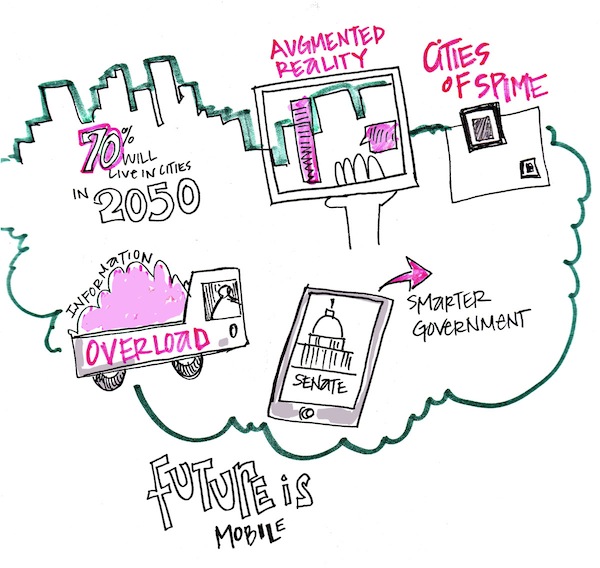
“An exploration of cyberpunk fiction, technology, where we’re headed, the challenges we face, and the solutions we need”-Ignite NYC. I gave a (very) similar talk called Pattern Recognition and Spimewatch at Ignite D.C. later that week. For whatever reason, this version seems to have come off much better. Rack it up to the first time on a big stage; there were close to a thousand people present in NYC.

The creative graphic recording at Ignite NYC at Web 2.0 Expo was created during the talk by Nora Herting of ImageThink.

For a great Ignite talk with a related theme, check out In Coders We Trust, by Laurel Ruma.

Open Government and Civic Innovation on Display at Portland’s CivicApps Awards

What does the innovation on display at the Civic Apps contest by developers in Portland, Oregon mean to the city’s mayor?

“It’s bringing to the world knowledge of what exists in the real world but is so often unknown,” said Mayor Sam Adams in an interview at the awards ceremony for the winners of the contest.

“In Portland, like I think most cities, when people are armed with knowledge, they make wiser choices,” he said, pointing to applications like PDX Bus as examples of innovation that actually help citizens to navigate the city better.

Does open data lead to more economic value creation in the private sector and metropolitan areas alike?

“We are seeing folks that are sole proprietorships hire folks to help them build their business, their app business, their online business with our data sets.” he said. “For us, data has always been there, in some cases for decades. Putting it to use for the public and help people make money while they do it – we intend to be the open source capitol of the nation – and this is one contribution we can make, with our data sets.”

What’s next? “What CivicApps is about in part, providing the data, is sparking relationships, relationships which lead to economic opportunities,” he said. “Webtrends, Microsoft meets the local hacker or coder tonight at this event, who knows what will happen. Our job is to provide the data, provide the opportunity for relationships to occur, provide what in comparison is a tiny litte bit of money, a little incentive for people to keep going. And it’s also fun. It make the city more fun to live in, because you know what’s there.”

That incentive, incidentally, amounted to $1000 for each of the winners of the second round of Civic Apps awards, with another $3000 going to the Best of Show winner, Loqi.me. This afternoon, Skip Newberry, economic development policy advisor to Mayor Adams, congratulated the winners of CivicApps on Twitter.

.bbpBox29117818058 {background:url(http://a3.twimg.com/profile_background_images/26879991/Downtown_Portland_-_Twitter_image.png) #9AE4E8;padding:20px;} p.bbpTweet{background:#fff;padding:10px 12px 10px 12px;margin:0;min-height:48px;color:#000;font-size:18px !important;line-height:22px;-moz-border-radius:5px;-webkit-border-radius:5px} p.bbpTweet span.metadata{display:block;width:100%;clear:both;margin-top:8px;padding-top:12px;height:40px;border-top:1px solid #fff;border-top:1px solid #e6e6e6} p.bbpTweet span.metadata span.author{line-height:19px} p.bbpTweet span.metadata span.author img{float:left;margin:0 7px 0 0px;width:38px;height:38px} p.bbpTweet a:hover{text-decoration:underline}p.bbpTweet span.timestamp{font-size:12px;display:block}

Congrats to @caseorganic @elsewisemedia @pdxmele @maxogden & John Mosser for their award-winning @civicapps! #opensource #gov20 #teamadamsless than a minute ago via TweetDeck

Most Useful App and Best of Show

Amber Case for Loqi.me

As Mayor Adams mentioned later in the program, this Web app could be useful in a snowstorm in Oregon or, if adapted more broadly, for crisis response around the country or world.

App description: “This application is a resource for citizens, medical teams and governments before, during and after disasters. Loqi.me allows mobile users to send an emergency GPS beacon to a real-time map. Crises responders can view all of the help requests on the webpage, along with hospitals and fire stations, real-time 911 calls related to natural disasters. Ground teams can easily use Loqi.me on their mobile phones to send notices of supplies and terrain reports in real time. Remote helpers can easily see the whole picture on the website’s real-time map, handle help and information requests, and send messages to the network. Loqi.me supports subscription to group messages via SMS, AIM, Jabber and Twitter. No application installation is required. Location beacons can be sent simply by going to http://loqi.me on a mobile phone.”

Most Appealing

Matt Blair for PDX Trees.

App description: “PDX Trees is an app for iPhone and iPod Touch devices that makes it easy to find and and enjoy them. With this app, you can:

  • Search for nearby trees and see them on a map.
  • Tap a pin to see the name and view details for that particular tree.
  • Take and upload a photo of a Heritage Tree you’re visiting.
  • View photos of the tree taken by other tree enthusiasts.
  • Email a friend about the tree (includes tree name and location where available)
  • Read more about a type of tree from Wikipedia, without leaving the app.”

Most Original

Melelani Sax-Barnett for Portland Bike to Transit.

App Description: “This is a simple, handy web map that helps you figure out how to ride your bike to transit. It lets you choose from a variety of base layers, and toggle transit stops, routes, and current bike routes. You can also query transit stops and routes for basic information. I made this for a Web GIS class at PSU and I’m a total beginner (with some code thanks to Professor Percy and OpenLayers).”

Best Use of Data

Max Ogden for Civic Apps Data Previewer

“This helped make our data useful to a lot of other developers and the general public,” said Mayor Adams. “Why take it on?”

“I saw all of this great data at the core when civic apps launched,” said Ogden. “When you get data into the Web format, you get Web developers who are really used to making human interfaces for things make them.”

App Description: “A web application to preview any of the public geo data on CivicApps from your web browser. You can choose a dataset and view that data on a map. Individual objects are clickable and can provide details (metadata).”

Civic Choice

Joseph Mosser for PDXTrian

App Description: “Pdxtrian is a simple utility for riders of Portland’s excellent mass transit system, TriMet.

  • Uses GPS to find nearby transit stops
  • Displays a map of the stop location
  • Displays a list upcoming arrivals
  • Allows you to save stops and look them up anytime”

The livestream of the awards ceremony is embedded below:

http://www.ustream.tv/flash/video/10487185?v3=1

Open source and open government community talks innovation at first IgniteGov

http://storify.com/digiphile/tracking-the-tweets-about-the-first-ignitegov-at-g.js

Weighing a more balanced view of Government 2.0

There’s a lot to consider in Gartner analyst Andrea DiMaio’s newest post, toward a more “balanced view of government 2.0. Balanced views are good, as are research, evidence, case studies and solid reporting.

Unfortunately, I’m at the GOSCON Conference at the moment, so I can’t respond at length. I’m very glad he finds this blog informative. I’d also direct readers to the Gov 2.0 section at O’Reilly Radar for more content and other perspectives.

One thing I’d pose as a cautionary note to his last post is that the state of government 2.0 or open government can’t be measured simply by the answers of government CIOs, particularly at the federal level. It’s in the hands of more people than that, with respect to the “we government” meme that the Personal Democracy Forum has articulated.

That’s why, while Gartner’s view is both influential and something that many executives will clearly still spend money to gain, watching what’s happening at the state and local level is critical – and perhaps not reflected in its data gathering. I could well be wrong, naturally.

Resource-starved government entities at the state level are more likely to adopt free and open tools that require investments in time, much like the campaigns that are bootstrapping using social media and YouTube this election season instead of expensive TV buys. Just look at the choices that California has made for a precedent, where open government is connecting citizens to e-services with social media.

I’ve been asking a lot more questions about private sector value created from open government data. There are definitely examples that weren’t in that blog post that DiMaio referenced. That post should not be taken as comprehensive or exhaustive, merely easily referenced initiatives that I could offer to an audience that came fresh to the topic. Those include BrightScope (whose government 2.0 story TechCrunch covered last weekend), Passur Aeropspace, transit apps, or numerous healthcare apps that fold in CHDI data.

That said, the CIO panel at GOSCON just dropped several data points you might consider:

The data.ca.gov California apps contest yielded several startups, said CarolynLawson, including:

NYSenate.gov uses Drupal and a host of other technology choices that apparently have affected their bottom line. “We spent one million less last year, relative to the historical timeline,” said NY Senate CIO Andrew Hoppin.

If that open source framework is adopted elsewhere, similar cost savings to open government might be be available for you to cite.

Gov 2.0 Daily Dispatch: A Storify Experiment in Open Government Curation

http://storify.com/digiphile/gov-20-daily-dispatch-october-18-2010.js

USA.gov launches new iPhone app on its 10th Anniversary

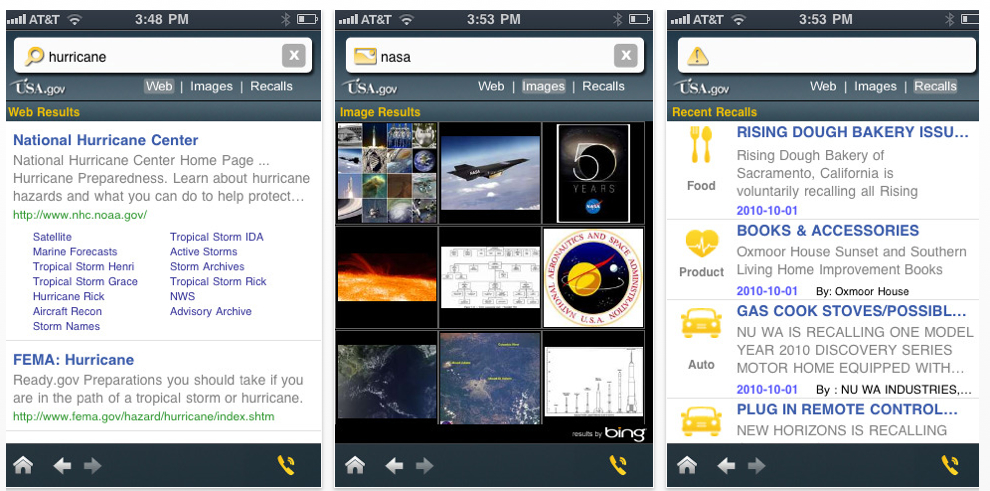
This October marks the 10th anniversary of USA.gov, the nation’s search engine for government. And, as it turns out, now there’s an app for that. Nope, it’s not Apps.gov of even Apps.USA.gov. The General Services Administration quietly added a new USA.gov iPhone app to iTunes a few days ago. Why is it important? When American look for government information, they use search engines. While most of them go to Google and Bing, now they have another option when they fire up a smartphone.

The new app integrates access to a useful government dataset for citizens: a product recall database. The same access is available through a Product Recall app online, for Android or on mobile devices at Recalls.gov. That also means that citizens don’t have to have a smartphone to access public data, a issue for accessibility and the digital divide. For those inclined, the app also provides mobile search for local, state and federal websites, including predictive search.

The new USA.gov app is beautifully designed, lightweight and didn’t crash on me after ten minutes of searching and browsing. The integration of a “tap to call” feature with the iPhone on the home screen also preserves a handy “Gov 1.0” feature as well: 1 800 FED INFO.

As the app description in iTunes notes, the app makes public data like birth, marriage and death records freely available to all citizens (provided that they have an iOS device with an Internet connection). Search.USA.gov provides similar access on both mobile and desktop users, for folks who prefer a Web browser to an app. Information about schools, passport and visas, tax codes, government jobs and Social Security benefits is also available.

The addition of the USA.gov to iTunes ends a quiet but important lag in getting a free government app onto the world’s largest mobile application platform. When Apps.USA.gov launched, Apple apps were conspicuously absent. Months later, the legal difficulties between the feds and Cupertino appear to resolved.

As a result, parents can search the FDA database to see which toys have been recalled. While it’s true that analysts can (and no doubt will) point to the USA.gov app as the latest example of “shiny app syndrome,” making a better interface for open data is a win for everyone.