The Department of Justice’s “FOIA Wizard” isn’t a magical solution for White House strategic silence on open government

In December 2021, President Biden urged “every nation in the Open Government Partnership to take up a call to action to fight the scourge of corruption, to “stand with those in civil society and courageous citizens around the world who are demanding transparency of their governments,” and to “all work together to hold governments accountable for the people they serve.”

Almost two years later, the United States is still not leading by the power of our example by including the priorities of US civil society organizations in additional commitments and engaging the American people and press using the bully pulpit of the White House, despite rejoining the Open Government Partnership’s Steering Committee.

That disconnect was evident at a public meeting with the Department of Justice’s Office of Information Policy (OIP) on September 26, 2023. Members of the public and press who are interested in a first look at the Freedom of Information “Wizard” the OIP has been building with Forum One Communications can watch recorded video of the meeting on YouTube, along with DoJ’s work on common business standards and the “self-assessment toolkit” the agency updated. All three of these pre-existing initiatives were submitted as commitments on FOIA in the 5th U.S. National Action Plan for Open Government last December.

The General Services Administration’s new Open Government Secretariat will post a “meeting record” at open.usa.gov — their summary of what happened — though it’s not online yet. (Slides are online, along with agenda and screenshots.)

We posed a number of questions via chat that Lindsey Steel from OIP acknowledged, though not always directly answered — like the U.S. government not co-creating any of the FOIA commitments that were being discussed with civil society, in the Open Government Partnership model. (Unlike other previous public meetings in 2022 and 2023, members of civil society were given the opportunity to ask questions on video.)

While it’s both useful and laudable for OIP to take public questions on its work, the pre-baked commitments they presented on were not responsive to the significant needs of a historic moment in which administration of the Freedom of Information Act appears broken to many close observers, and follow an opaque, flawed consultation that was conducted neither in the spirit nor co-creation standards of the Open Government Partnership itself.

While the Open Government Partnership’s Independent Review Mechanism is far slower that press cycles in 2023, the independent researchers there have caught up with the USA’s poor performance since 2016. (Unfortunately, the OGP’s Independent Review Mechanism and Steering Committee’s governance processes both move too slowly to sanction governments during or after the co-creation process for failing to meet co-creation standards in a way that would have empowered US civil society in 2022.)

In a letter dated August 13, 2023, the Open Government Partnership formally informed the US government on August that it has acted contrary to process in its co-creation of.4th National Action Plan for Open Government and implementation of the plan.

The U.S. government’s response did not directly acknowledge any of the substantive criticism in the IRM or by good government watchdogs, much less announce a plan to address its failure to co-create a 5th National Action Plan last fall by coming back to the table.

Instead, the General Services Administration simply promised to do better in 2024 in a 6th plan and to keep updating the public on the work U.S. government was already doing.

The request of the coalition prior to the Open Government Partnership Summit was for the U.S. government to come back to the table and co-create new commitments that are representative of our priorities, not to continue hosting virtual webinars at which civil servants provide “updates” on pre-existing commitments in order to be in compliance with the bare minimum that OGP asks of participating nations.

With respect to FOIA, doing more than the minimum would look like the White House making new commitments to effective implementation of the FOIA Improvement Act of 2016 and the Open Government Data Act through executive actions, including:

  • Building on U.S. Attorney General’s memorandum mandating the presumption of openness and ensure fair and effective FOIA administration.
  • Convening the U.S. Digital Service, 18F, and the nation’s civic tech community to work on improving FOIA.gov, using the same human-centric design principles for improved experience that are being applied to service delivery across U.S. government.
  • Making sure FOIA.gov users can search for records across reading rooms, Data.gov, USASpending.gov, and other federal data repositories.
  • Restoring a Cross-Agency Priority goal for FOIA.
  • Advising agencies to adopt the US FOIA Advisory Committee recommendations.
  • Tracking agency spending on FOIA and increase funding to meet the demand.
  • Directing the Department of Justice to roll out the “release-to-one, release-to-all” policy for FOIA piloted at the direction of President Obama, which the State Department has since adopted.
  • Collecting and publishing data on which records are being purchased under the FOIA by commercial enterprises for non-oversight purposes, and determine whether that data can or should be proactively disclosed.
  • Funding and building dedicated, secure online services for people to gain access to immigration records and veterans records — as the DHS Advisory Committee recommended — instead of forcing them to use the FOIA.
  • Commiting to extending the FOIA to algorithms and revive Code.gov as a repository for public sector code.”

We continue to hope that President Biden will take much more ambitious actions on government transparency, accountability, participation, and collaboration in order to restore broken public trust in our federal government, acting as a bulwark against domestic corruption and authoritarianism.

New US Chief FOIA Officer’s Council memo on the future of FOIA, online

In August, the U.S. Chief Freedom of Information Act Officers Council issued a memorandum on the deadline for interoperability with FOIA.gov & sunset of FOIAOnline on September 30.

The U.S. FOIA Advisory Committee discussed the memo at our public meeting on September 7, 2023.

I’ve shared this memorandum and some analysis about what it means for the future of FOIA online over on the public US Open Government listserv that the USGSA maintains.

There’s a story here, for any journalists looking more than “Commander bites man.”

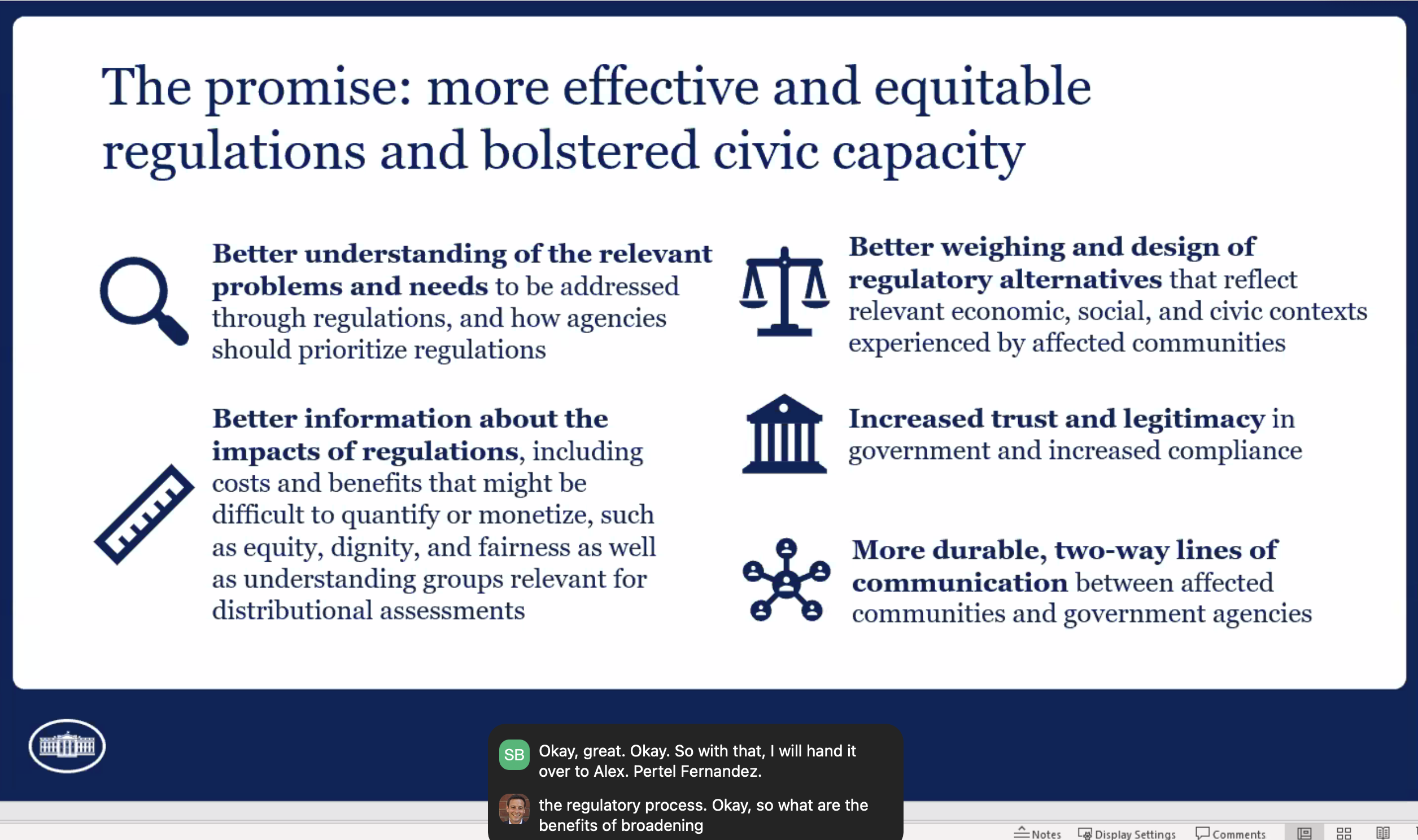
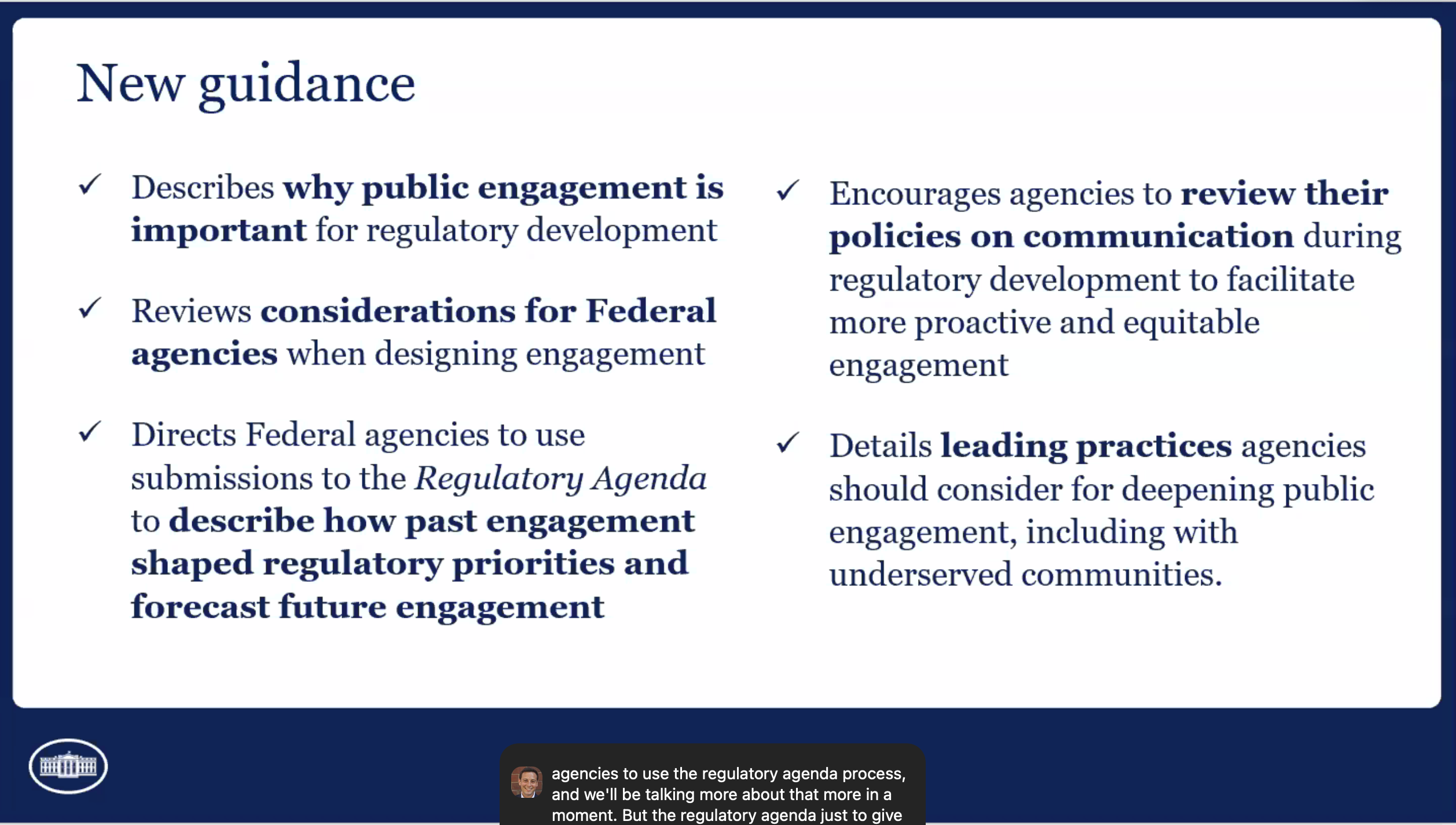
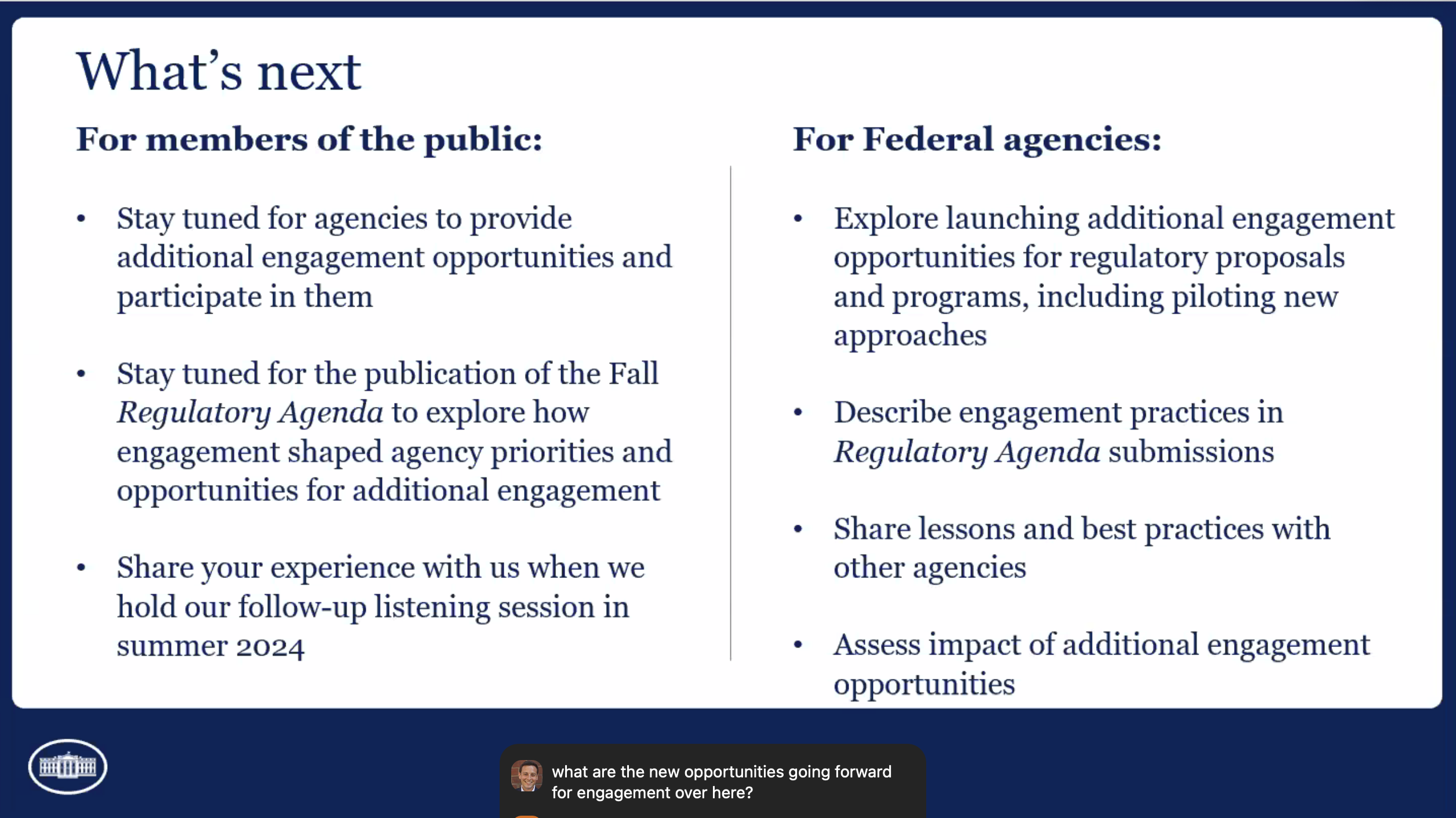
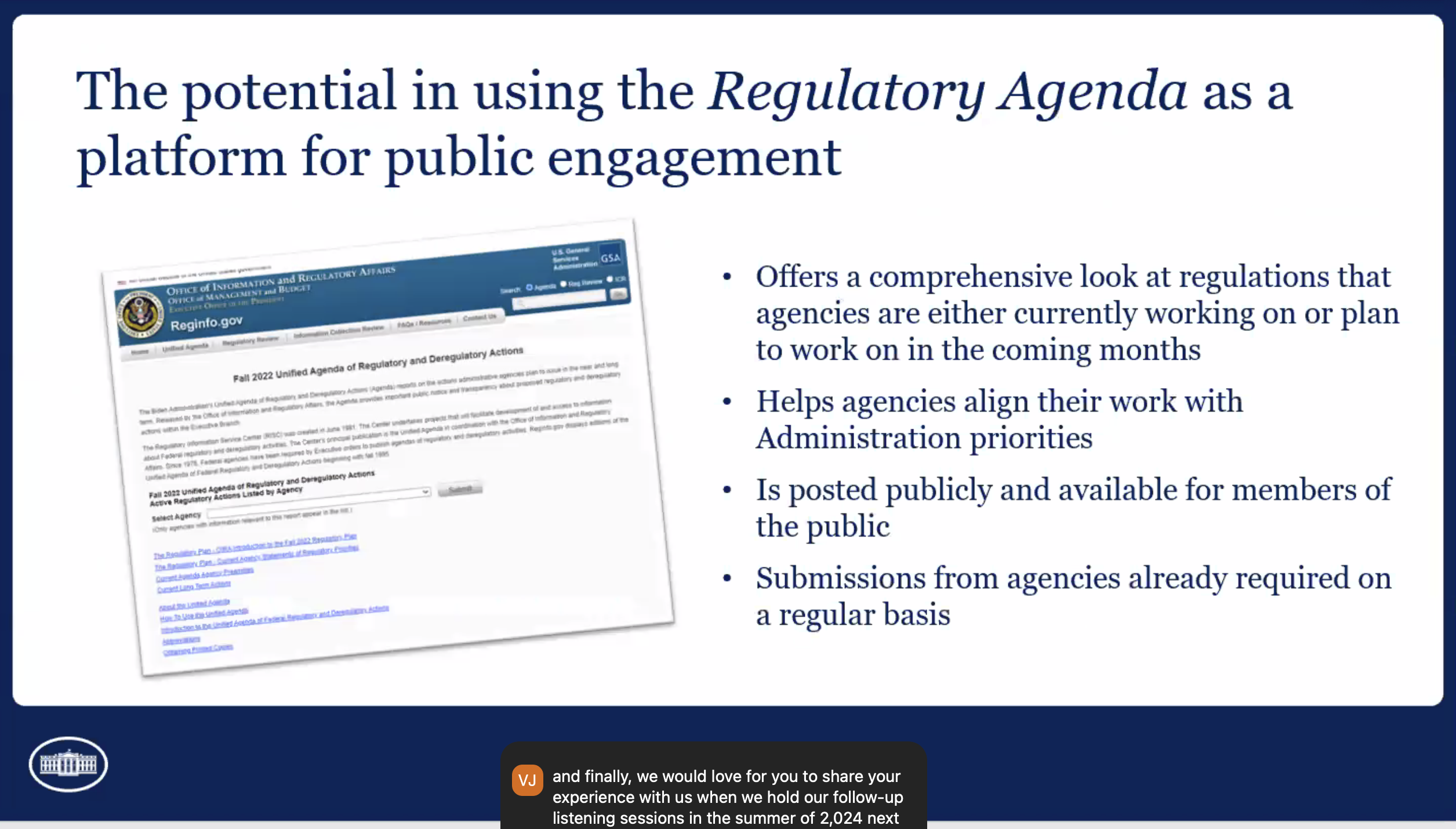
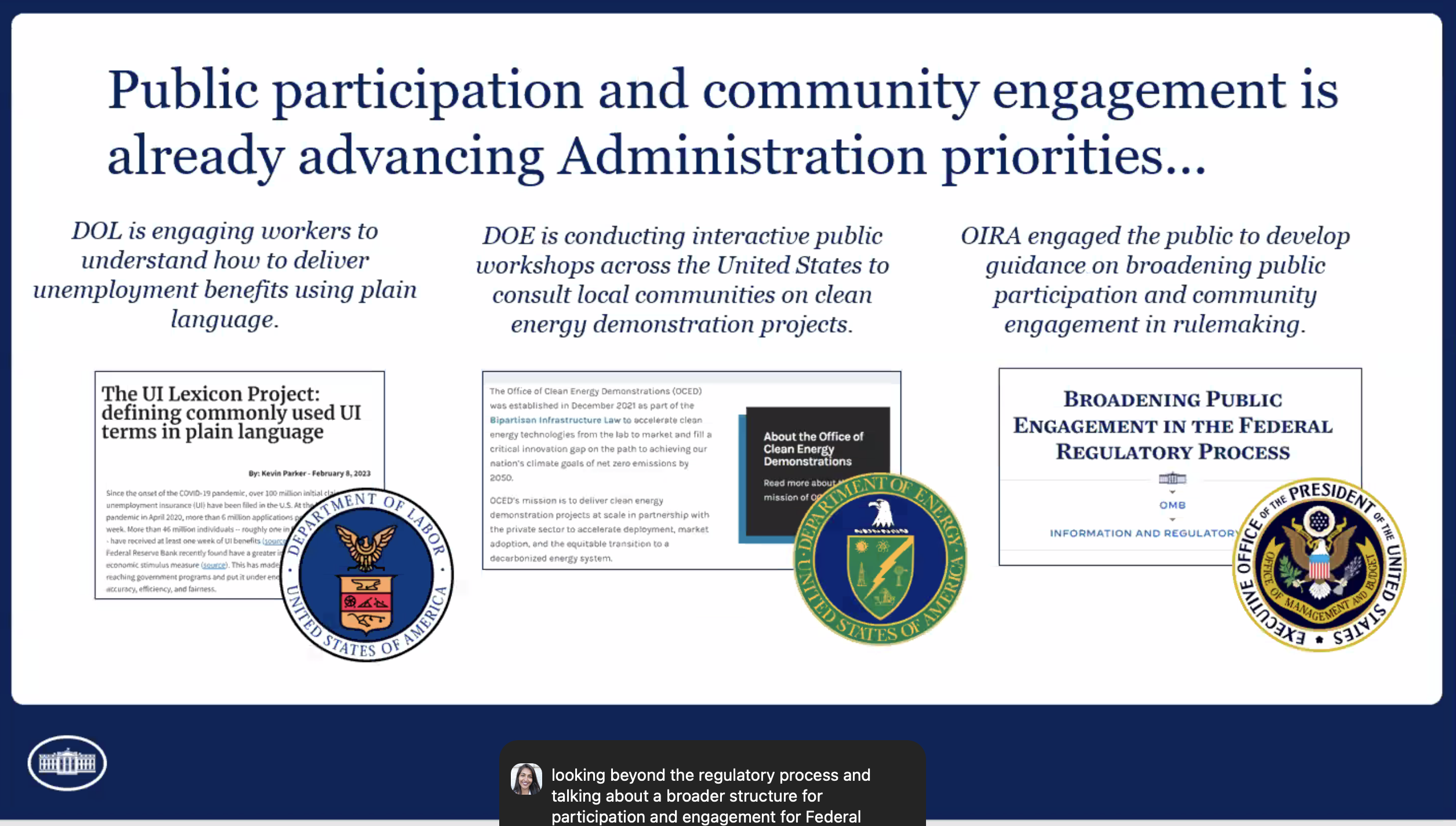
White House “virtual listening session” on new OIRA guidance on broadening public engagement in rulemaking

This post contains an audio recording (above) of a public Zoom call held on July 20, 2023 to update Americans on select commitments in the 5th U.S. National Action Plan for Open Government, more than six months after the White House published the plan online at the end of December 2022.

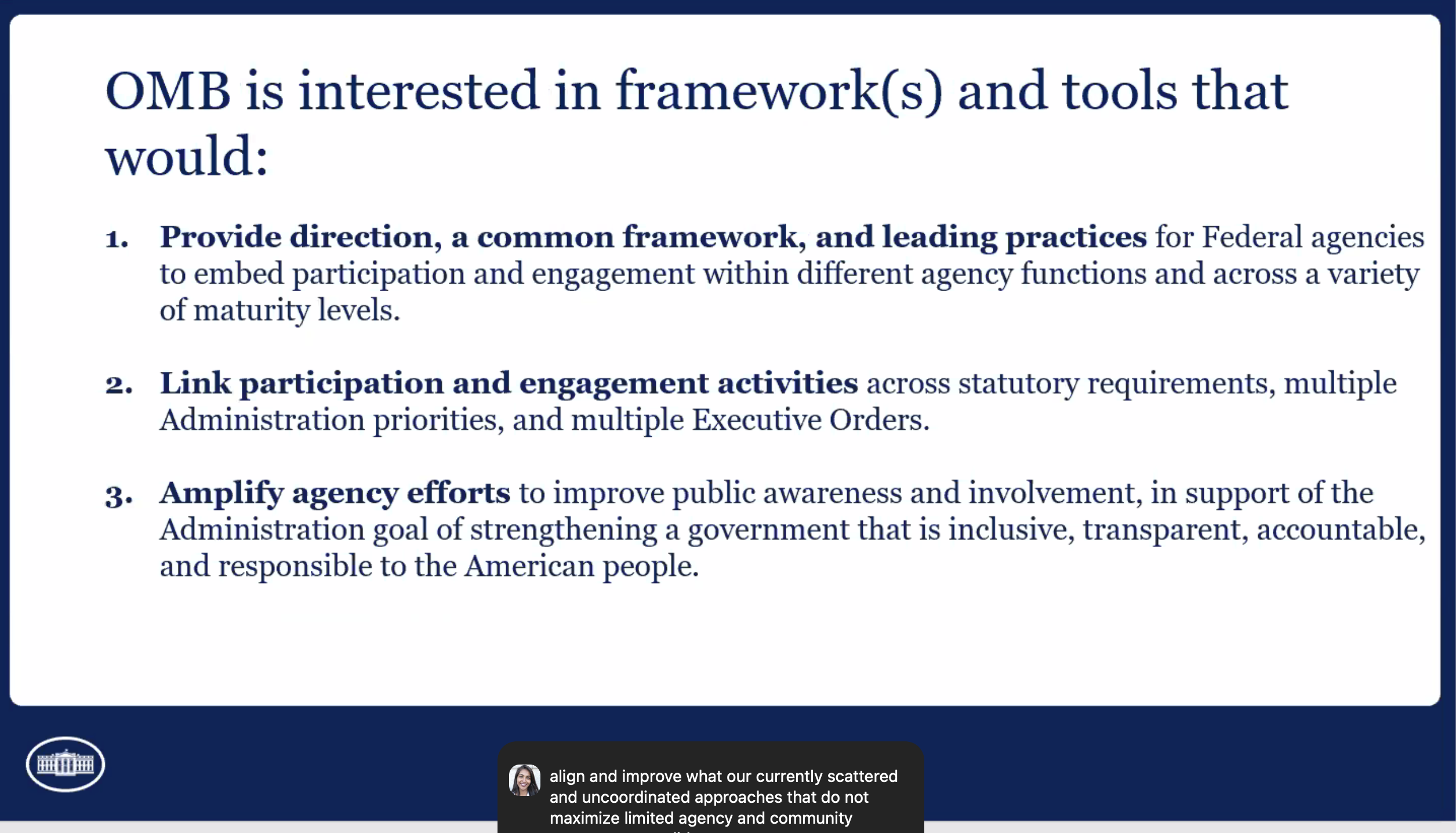
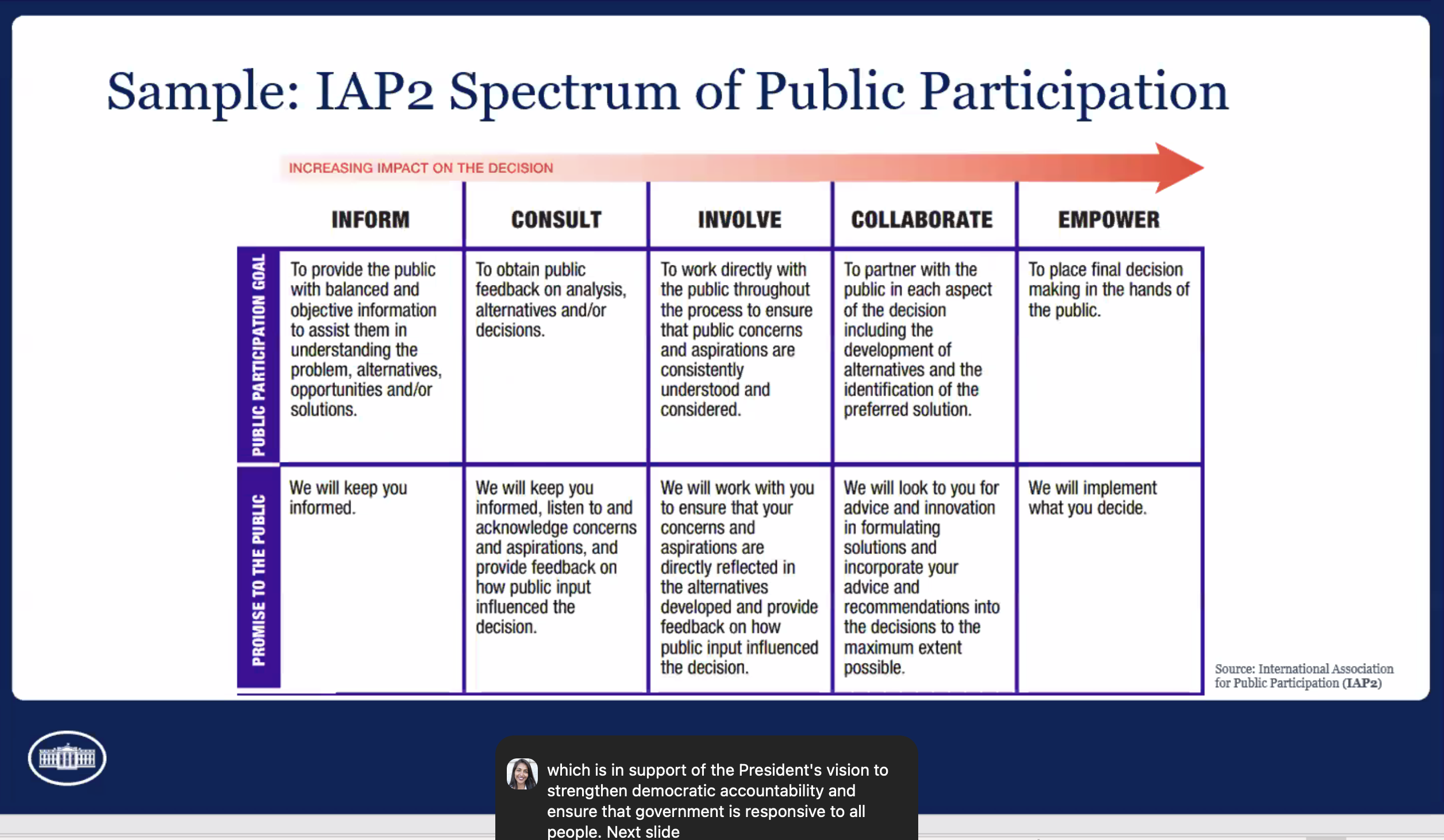
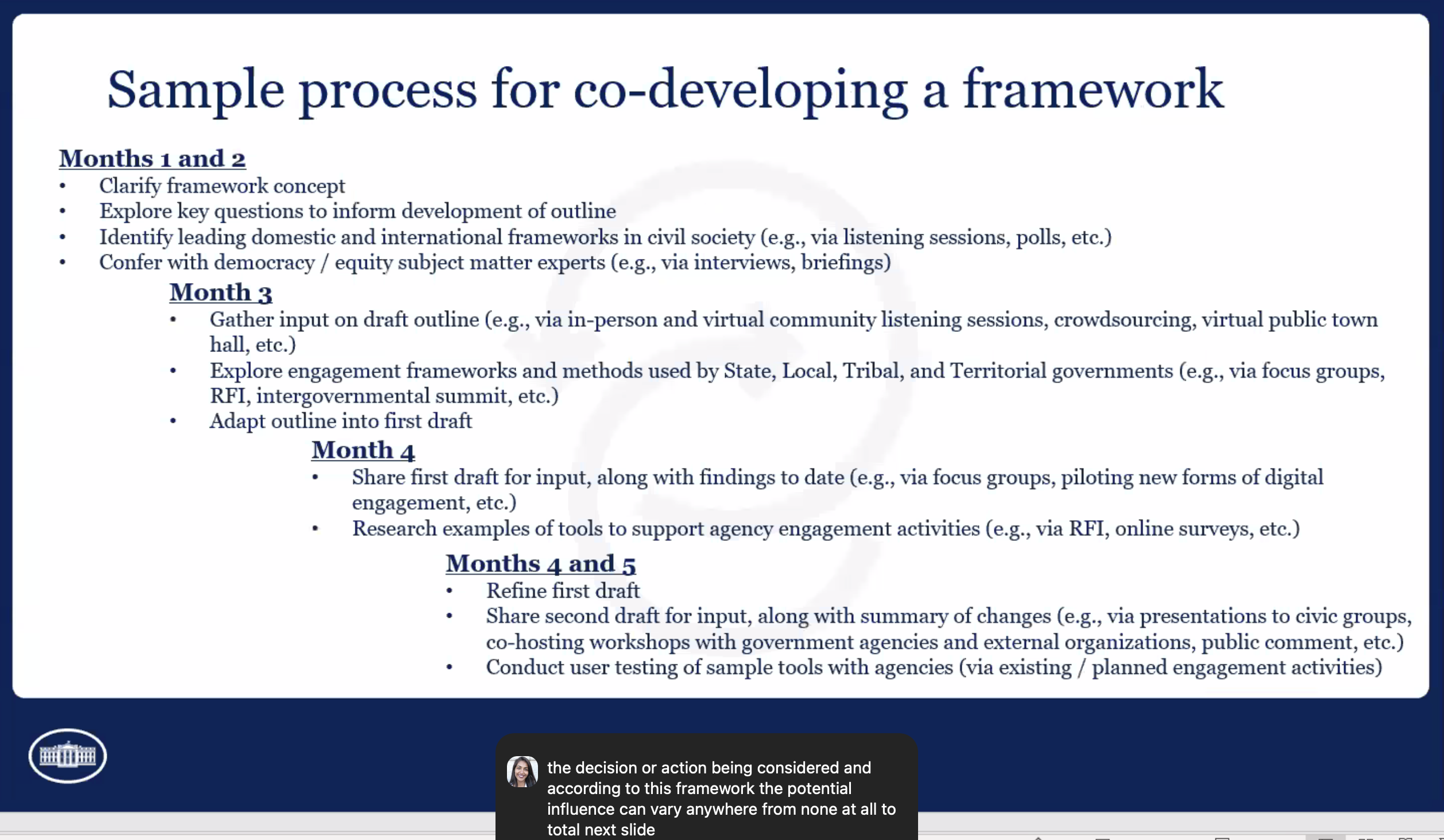
Officials at the White House Office of Management and Budget (OMB) and the Office of Information and Regulatory Affairs (OIRA) presented on their work on commitments to make the voices of the public heard.

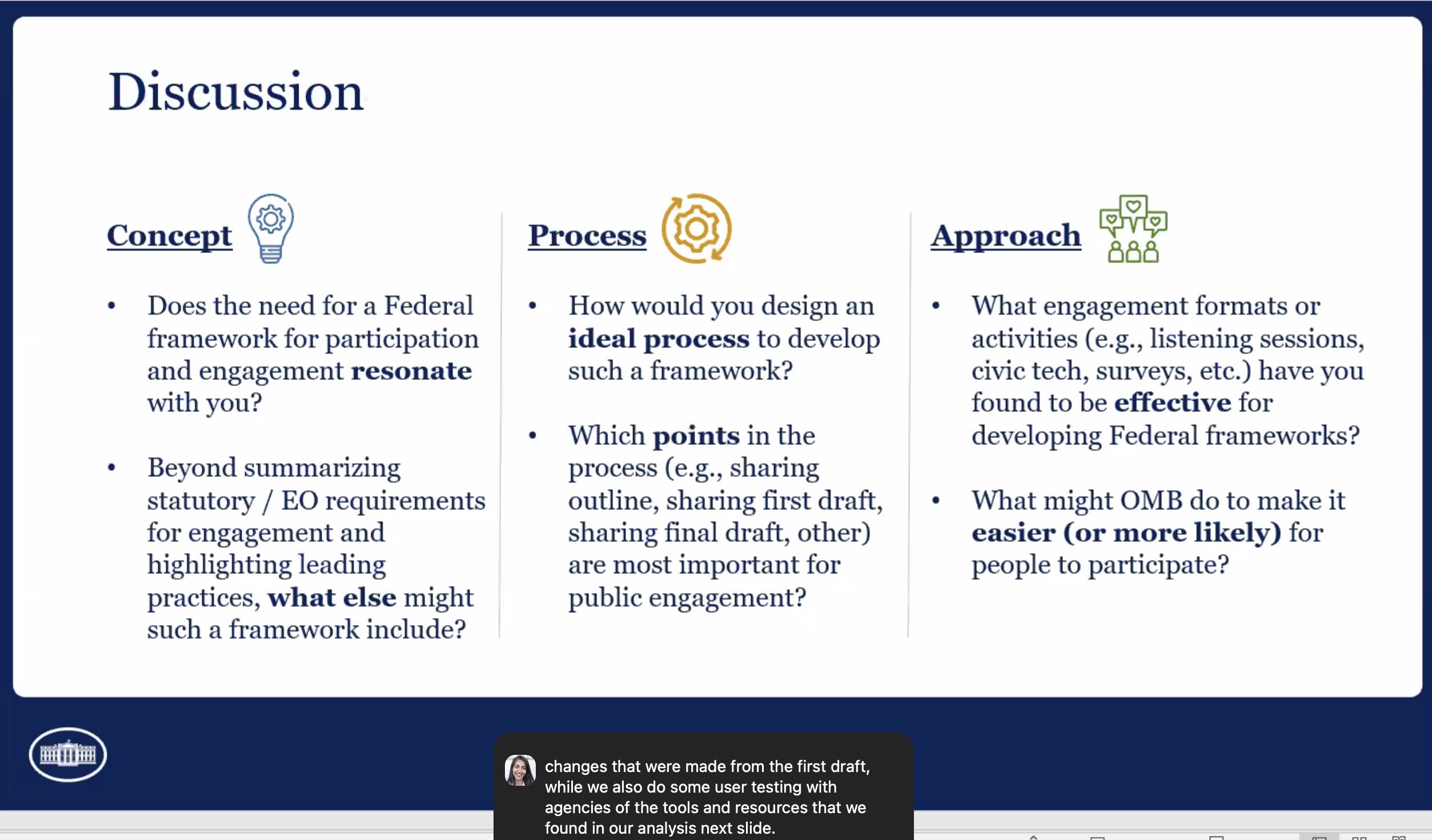
The first half of the forum discussed new guidance on broadening public engagement in the regulatory process issued on July 2019, followed by questions about developing a framework for engagement for use across the federal government. OMB requests feedback on the questions below to go to publicparticipation@omb.eop.gov.

  1. Should the Federal government adopt a common framework for participation and engagement? What might such a framework include?
  2. How would you design an ideal process to develop such a framework?
  3. What points in the process (e.g., outline, first draft, final draft) are most important for public engagement?
  4. What engagement formats or activities would be most effective for developing a Federal framework?
  5. What might the Federal government do to make it easier for people to participate?

Our view? OMB should go back to the future. Review the Public Participation Playbook the Obama White House developed with the public in 2015, as part of the US government’s efforts to open government. Then, working in collaboration with the Office of Public Engagement, host a series of open government roundtables with the nation’s leading authorities on civic engagement and public participation in 2023 and 2024 that inform guidance for the federal government.

Officials might review what approaches were effective in engaging Americans with public health information in the pandemic, voting information, and extreme weather — and which were not.

That work should be part of a new open government plans at OMB and OSTP that are hosted at whitehouse.gov/open, showing President Biden’s commitment to government transparency like whitehouse.gov/equity shows his administration’s commitment to equity.

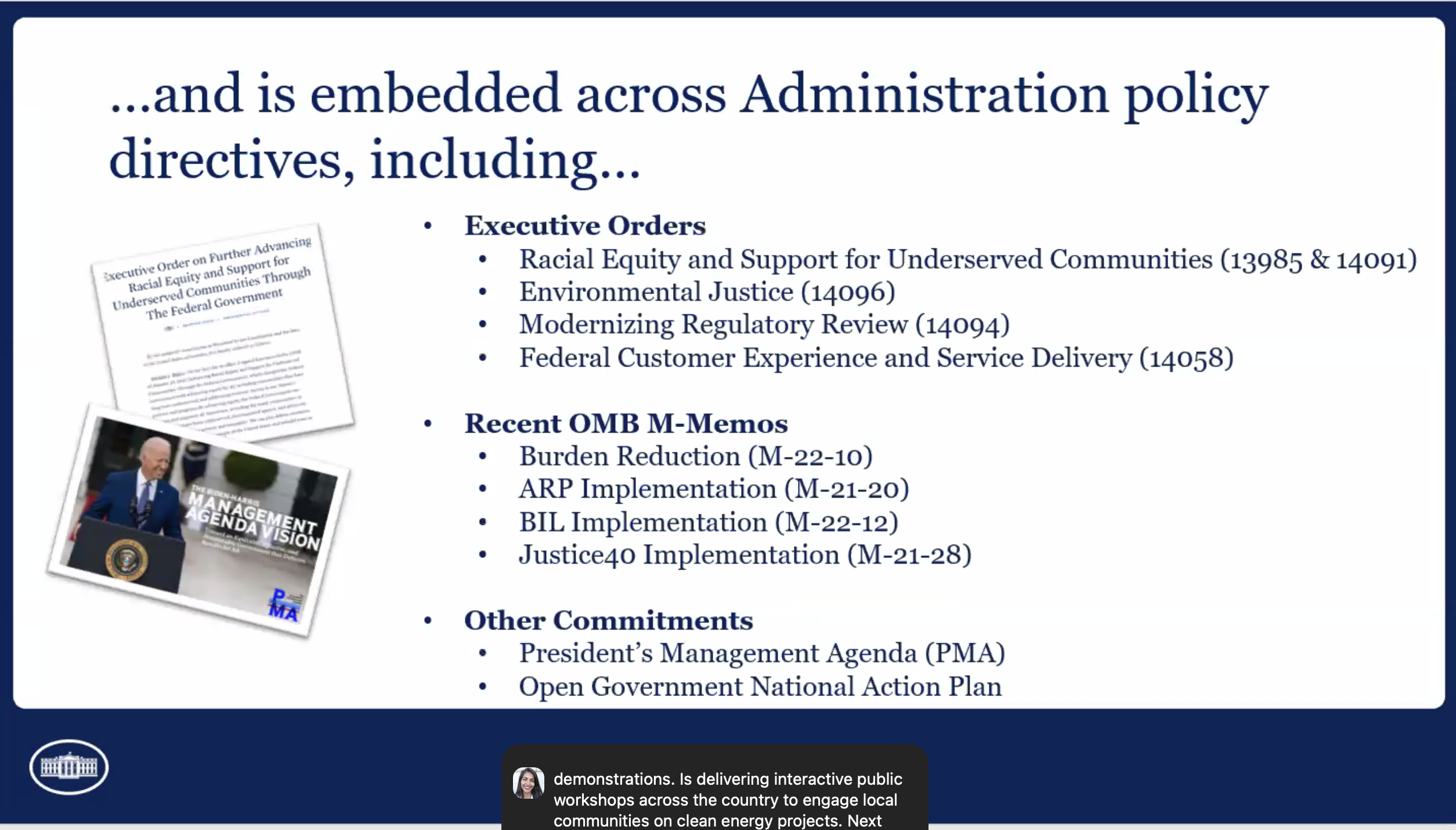
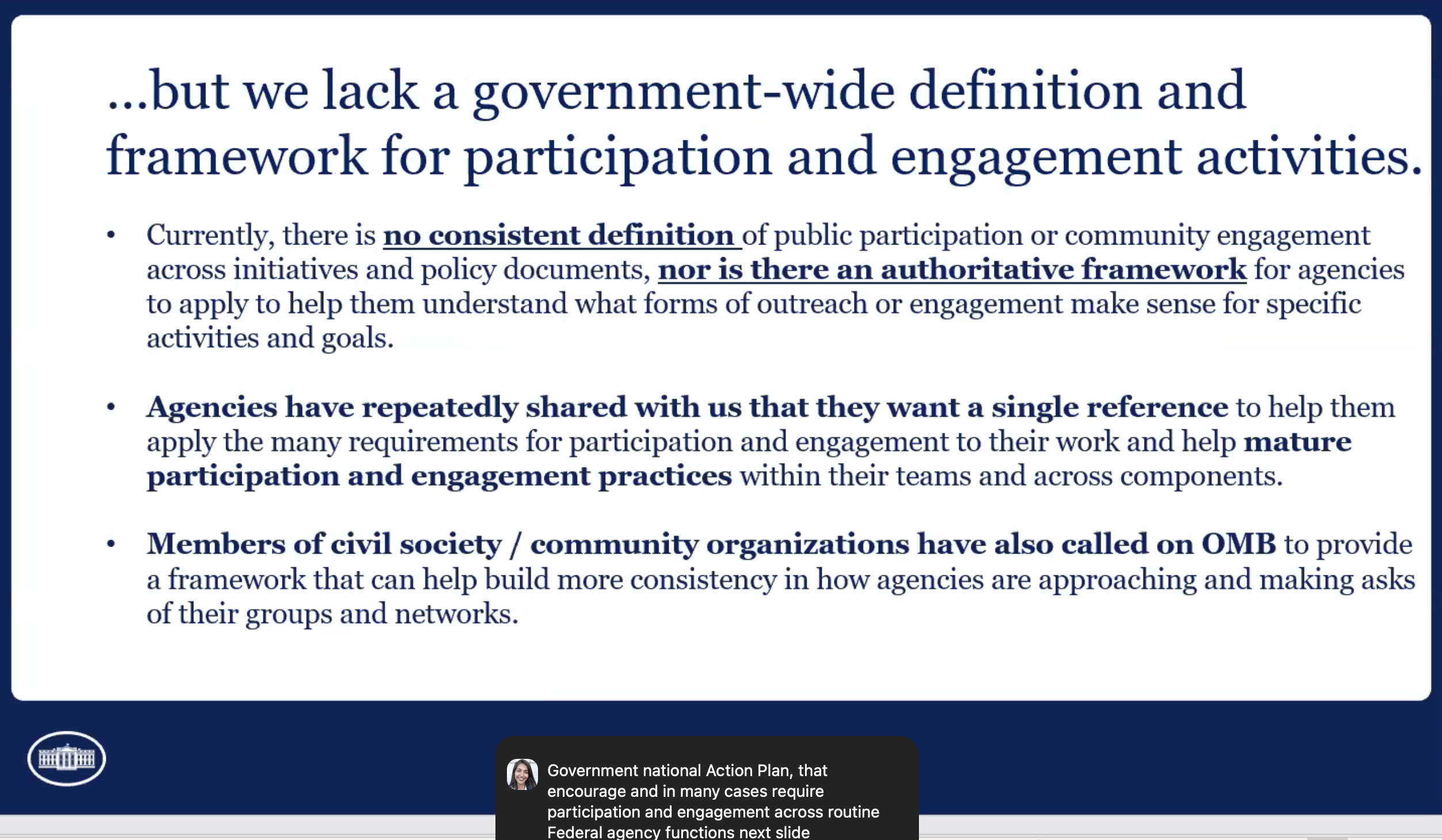
Screenshots of the presentation follow. (Our apologies: we missed slide 3 and 9.)

Should this White House publish slides or notes from this public session on its work implementing open government commitments, we will update this post.

(Officials said that the session was not recorded, so we are providing the above resources for the Americans who were unable to attend or who did not hear about this opportunity to engage with OMB and OIRA about broadening public engagement because this administration did not engage the public. As you’ll hear in the recording, the public participants in this listening session offered praise for the guidance and suggestions for improvement tempered with critiques of the opaque process, poor communications about the forum, and dissatisfaction at the lack of a cohesive way to track and understand this administration’s work on government transparency and accountability.)

July 12, 2023 US open government “virtual engagement session”

This post contains an audio recording (above) of the Zoom call held on July 12, 2023 to update the public on select commitments in the 5th U.S. National Action Plan for Open Government, more than six months after the White House published the plan online in December 2022.

The Office of Management and Budget presented on its work opening up the regulatory process, among other areas.

Should the General Services Administration publish video and transcript of this session, as the Open Government Secretariat indicated they would explore, we will add both.

Threats to transparency and election integrity in Mexico threaten democratic stability in the Americas

Imagine if senators were refusing to vote on a deputy attorney’s nomination, blocking the administration of the Freedom of Information Act at the Justice Department. Imagine if President Biden then proposed defunding the Office of Information Policy. Now, imagine if OIP didn’t just offer guidance and generated reports on FOIA but combined the functions of the National Archives, Justice Department, Congress & judicial ethics offices into one transparency institution that oversees all three branches of a federal constitutional republic under a strong freedom of information law.

Bienvenidos a Mexico. This is exactly what’s happening in Mexico right now as the AP reported on April 30.

This threat to freedom of information and public knowledge is not happening in isolation, either.

In February, President Andrés Manuel López Obrador proposed budget and staff cuts at Mexico’s independent electoral agency.

Now, President Obrador is now calling for USAID to defund Article 19.

Public accountability and privacy have been under threat in Mexico since 2021, but the growing risk has been under the radar in the USA. More recently, it has been obscured by rancor and fear regarding immigration at the southern border after Title 42 ended.

That’s a mistake: both Congress and news media should be focusing on what the changes to good governance in election systems, open government agencies, & chilling of NGOs would mean to Mexico, especially when combined with ongoing threats to journalists and activists from cartels, organized crime, & corrupted police.

The destabilization of Mexican democracy would represent a huge diplomatic, economic, and security challenge for the USA which must neither be ignored nor neglected.

What happens there will affect more than our politics, especially if conditions at the border deteriorate after a major natural disaster, from supply chains to labor supplies.

The looming challenges of migration from destabilized states should be driving comprehensive immigration reform, with investments in human capacity, courts, and services that would all increase resilience against the escalating stress that millions of people seeking asylum and economic opportunity in the USA will place on our own systems, as we are seeing today across the southern border of our union.

The renewed efforts to eliminate this transparency institution are a dagger of Damocles dangling over the heart of a still-young democracy whose stability and development are critical to American national security, public health, and public safety.

An assault on any one of institutions that provides checks and balances in a nation destabilizes the whole, from an independent judiciary to a free press to nonpartisan electoral administration.

An assault on all of them at once is a flashing WARNING sign that should be provoking an “all hands on deck response from the United States.

The long arc of our nation’s history with Mexico suggests to me that honesty, humility, and humanity from our nation’s leaders will be more effective here than bullying, bluster, or blunt demands or threats that would further fuel toxic headwinds.

In a different timeline, the President, Congress, and Supreme Court might be issuing a joint statement encouraging the Government of Mexico to invest in the laws, institutions, and people that are at the heart of a thriving democracy, reminding them that to allow any one party or politician to corrupt one organ risks killing the entire body politic.

In the world we have, such a public alignment between the leases of our own government seems inconceivable. It should be possible for the US government to speak as one to our neighbor in a new clear, stunning statement offering a hand in friendship to our neighbor partner to build more healthy democratic states together that center human rights, human dignity, and human potential.

Until that happens, it’s crucial for everyone else to call on Mexico’s leaders to uphold the public right to know and election integrity.

Every White House needs to inform and engage Americans “where we are,” online and offline

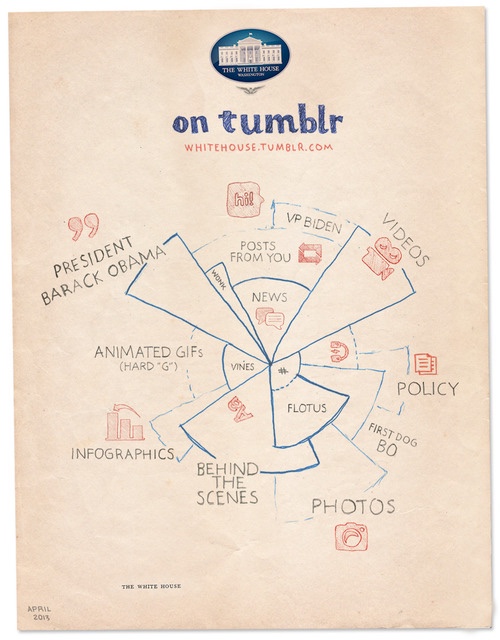
The Obama White House joined Tumblr on this day, one decade ago.

In 2023, the White House is not on Tumblr or many of the other social networks it was updating in 2013.

Twitter, Facebook, YouTube, GitHub, & Flickr endure.

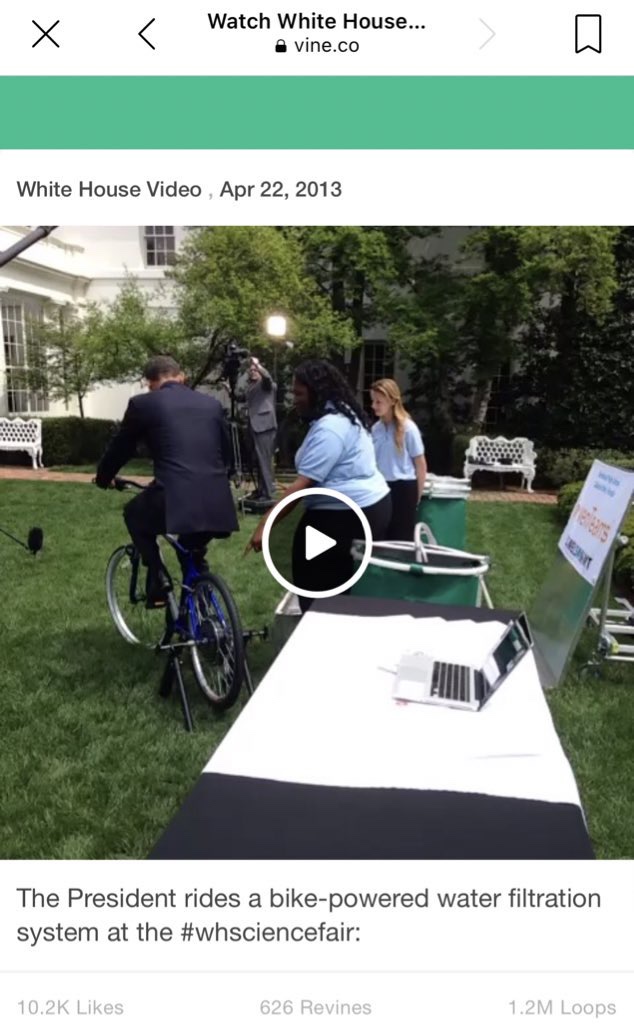
Digg, MySpace, Vine, Storify, GooglePlus, not so much.

It’s surprising that they’re not on LinkedIn.

Once a White House commits to reaching Americans “where we are”, then the offices of public engagement, press secretary, & communications need to apply online & offline strategies for public participation & public information, not just for politics.

Relevant vectors include:
📰 news
📻 radio
📺 TV
💬 texts
🤳social media
📧 email
🎙️town halls
📚libraries
🚉transit
🏫schools

Instead of banning TikTok, imagine if the White House tried to engage ~150 million Americans there, & then crossposted each video PSA across Instagram Snap Inc. & YouTube to ensure that info was available to all.

Start with vote.gov & serve.gov or. Build new .gov & services with us.

I know it looks dark online, but we should still be thinking bigger about how to do more than just get We the People Internet access, as foundational as that is: we need to make it matter, rebuilding trust through the delivery of trustworthy information over time on participatory platforms.

Better digital services won’t be enough: we need integrated offline and online strategies that find publics with information wherever we are.

We need a government communications revolution proportionate to the paired public health and civic crises we have collectively endured over the pandemic.

I still believe in the capacity of my fellow Americans to deliver on it, in no small part by learning about what the rest of the world is doing online and adapting, adopting, and improving civic technologies that meet our own needs.