
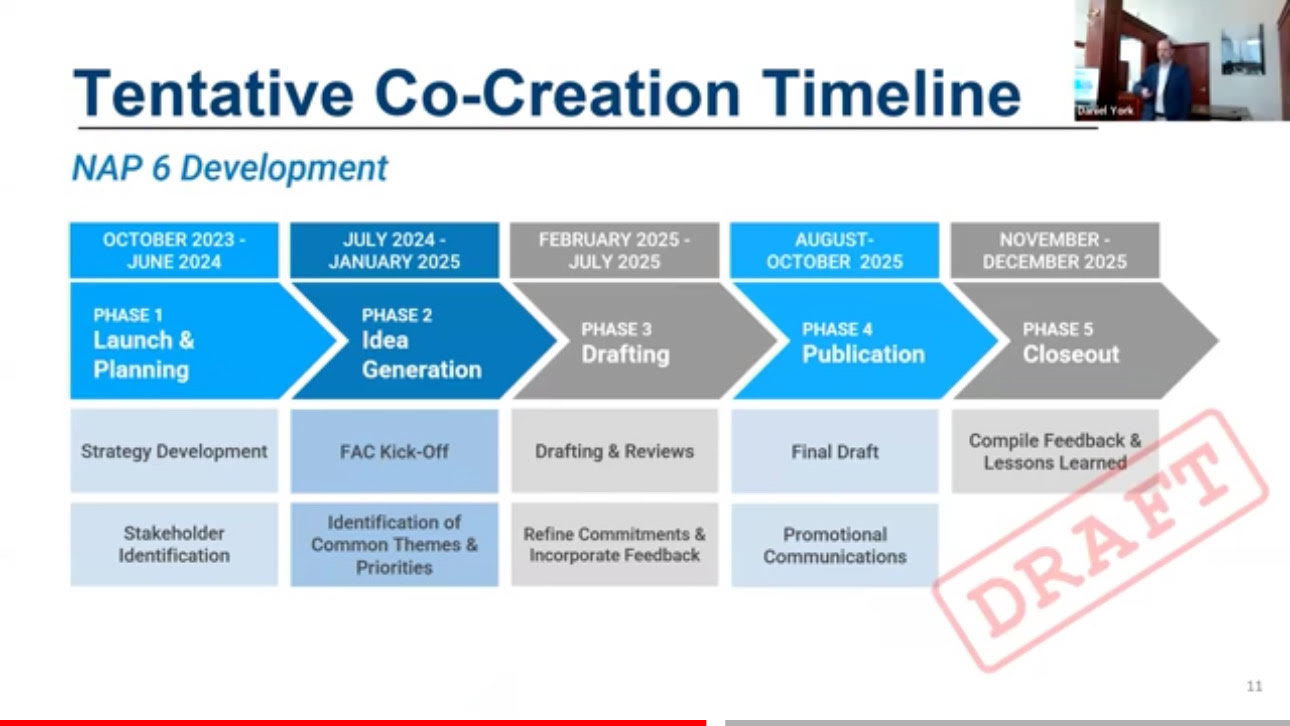
On Monday morning, I read Daniel Schuman’s excellent newsletter focused on the First Branch of the United States government, which included a section that collected several notable developments in the open government space. These updates include:
- The launch of the General Services Administration (GSA) Open Government Secretariat’s new website. This website replaces the now defunct page at open.usa.gov — which not to be confused with the GSA’s old and degraded open government website at GSA.gov/open which is required under the Open Government Directive. This new website does not list public meetings that were held prior to 2021 in its public engagement section, neatly memory-holing what occurred under the Trump and Obama administrations. (There will continue to be readouts available about that history on this website, however, for as long as it stays online.) I was interviewed about this new open government website for the GSA; I’m sorry to report that it does not include many of the government-wide resources and initiatives I’d requested. Instead, it’s primarily focused on compliance with the Open Government Partnership’s requirements to maintain an online repository of commitments, as is the Secretariat itself. Daniel has curated a useful set of links related to open government that’s more up to date than the GSA page,
- The GSA’s formal Request for Comment on the 6th National Action Plan for Open Government in the Federal Register, with the statement that “the United States Federal Government is initiating the co-creation process for its 6th U.S. Open Government National Action Plan” and seeks feedback by November 16th.
- The membership of the new Open Government Federal Advisory Committee, which Daniel now chairs. Speaking at at the iirst meeting of the FOIA Advisory Committee for the 2024-2026 term, Alina Semo, director of the Office of Government Information Services, said that the first public meeting of this new OG FAC will be in October – I believe on the 23rd. That has not been publicly announced, yet.
Generally speaking, this is all good news. I want to highlight a specific issue, however, which is crucial to understanding why the Open Government has not had the positive effects in the United States that people in other nations participating in the global multi-stakeholder initiative have seen: Neither Congress nor the judicial branch has ever been involved.
Daniel has framed the Secretariat’s efforts as an “executive branch” plan, which isn’t inaccurate within the scope of the mission that has been defined for them by GSA leadership — and presumably this White House:
But saying that OGP is only about the executive branch of the federal government in the United States reflects also a specific design and governance choice that the Obama White House made. That choice has undermined the impact, influence, and relevance of the Partnership in the United States ever since, given that neither the Trump administration nor Biden administration took any action to change it.
I raised this issue in April at the Transparency Caucus briefing in Congress. Jump ahead to 54:30, where I ask if U.S participation in the Open Government Partnership is “doomed” unless we see a President engaging the American people about it and Congress involved.
There are other factors that have led to the ongoing failure of OGP in the United States. The Open Government Partnership commissioned research in 2020 that explored that question and called on the U.S. government to “seize the moment” in spring of 2021, which I participated in.
Unfortunately, as with the recommendations for how the United States could lead by example that I made in June 2023, few of the policy or process recommendations were adopted by the Biden administration.
Neither Trump nor Biden ever called on all Americans to participate on air, online, or on the world stage using the bully pulpit, online or off. Championship sports teams and athletes have gotten far more presidential recognition – and thus public attention – than open government has since 2016. (Before, too, if we’re being honest, but former President Obama’s participation in a UN event in New York City in 2015 with other world leaders elevated this work far more than anyone since.)
Neither White House ever effectively engaged the American public, press, or media companies about OGP. They never formed partnerships with tech companies or non-government organizations that work on or deploy civic technologies like pol.is, while resetting the official defaults for public communications from the administration to opacity, “on background.”
The Biden White House ignored coalition letters and refused to co-create commitments, revise them, or add new ones based on our priorities.
Instead of “standing with the people demanding transparency” and accountability from our government – as President Biden called on everyone to do in December 2021, presumably including his own administration – the White House has mostly maintained strategic silence, leaving it to an extraordinary public servant – GSA Administrator Robin Carnahan – to gamely lead these efforts without top-down air cover.
The cumulative outcome of leadership, design, and governance choices over the last decade has meant that OGP’s platform or processes have not been a useful platform to reverse low trust and faith in U.S. government, despite the vigorous efforts of civil servants who remained engaged or scrubbed in, in hopes of helping keep it alive in other nations where the visibility was helpful to members of civil society there.
More than three years on, the future of OGP in the USA still depends on White House leadership — but it will be the next administration that co-creates that future or abandons it — unless President Biden decides to make open governance a priority in the last months of his term with the executive actions we’ve been calling for since he won election in November 2020.
I look forward to reading more responses to the GSA RFI that explore why OGP hasn’t worked in the USA, which the federal government and philanthropic community can apply to making this work meaningful in the future. No one involved wants to spend more time on an approach to open government that’s flailing.
Now that the GSA has officially kicked off the co-creation process, nongovernmental organizations, the press, and the American public will all need to decide whether legitimizing OGP through our participation is worth or not it in 2025.
The first step is in highlighting why OGP has failed to deliver the results domestically that former President Obama’s “signature good governance” initiative has provided internationally.
If the next President is not willing to reify OGP through their personal participation, making clear that policy, programs, and legislative reforms are on the table, and then acts to expand OGP’s remit to Congress and the courts, set your expectations for impact in the United States accordingly.
 E Pluribus Unum