Happy July 4th! (There’s a patriotic app for that, too.)

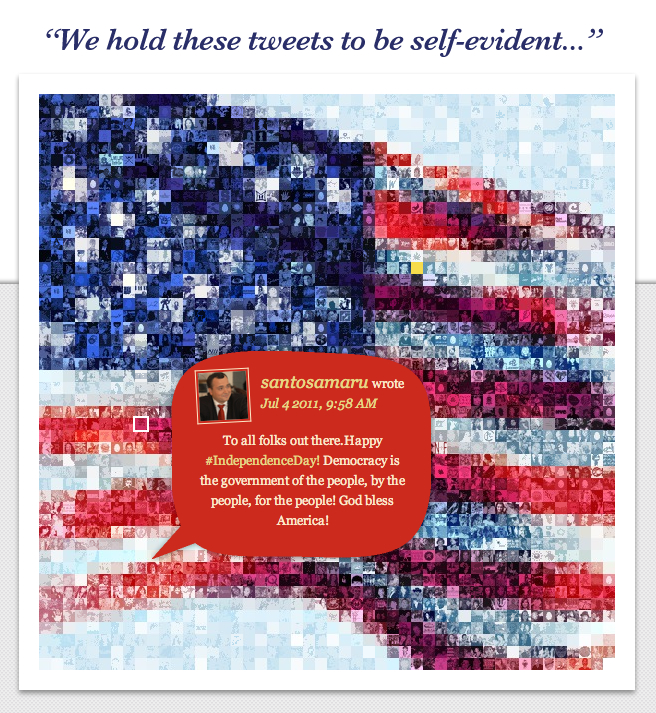
Civic developers at Code at America created a Web application in honor of this year’s Independence Day that features a number of patriotic values around: creativity, technical expertise and interest in the public discourse of their fellow citizens. Flag.CodeForAmerica.org aggregates Twitter avatars from users who tweet using the hashtag #July4th and mashes them up into a mosaic representing the Stars and Stripes. The first flag of the United States of America had a star and a stripe for each state. This flag has a tile for each human’s account.

“I have had the idea to do this for a while,” writes in Abhi Nemani, director of strategy and communication at Code for America, “soon after last year’s binary art campaign, but had to wait until we got the code infrastructure in place to be able to execute it at scale.”

Fortunately, Nemani said, the Mozilla Foundation worked with a development shop, Quodies, to create a similar mosaic when they launched Firefox 4 – check out their Firefox Tweet Machine.

“Given that it’s Mozilla, the code was open source of course,” said Nemani.”We rewired it some to get it working for us and added in some documentation so it should be easier for the next deployment,” said Nemani. Tyler Stadler was the development lead and Karla Macedo the designer.

If you want to check out the code for Twitter Collage, you can find it at Github. There’s no cap on #July4th responses, so tweet away.

The avatar mosaic is a 21st century update that captures some of the diversity and unity of that first flag by featuring some of the many voices that now can be heard on the public square of our time, the Internet. Not all of the tweets captured are positive. Some include strident political messages, divisive rhetoric or commercial promotions. It’s the public, in all of its uncensored, unvarnished, raw glory. The republic that the founding fathers fought and died for included the freedom of speech for its citizens. Over two centuries later, we’re seeing it today, coalesced around a national holiday.

“We hold these tweets to be self evident, that all humans are created equal…”

@Jack to moderate questions for President Obama in @Twitter @Townhall with @WhiteHouse [#AskObama]

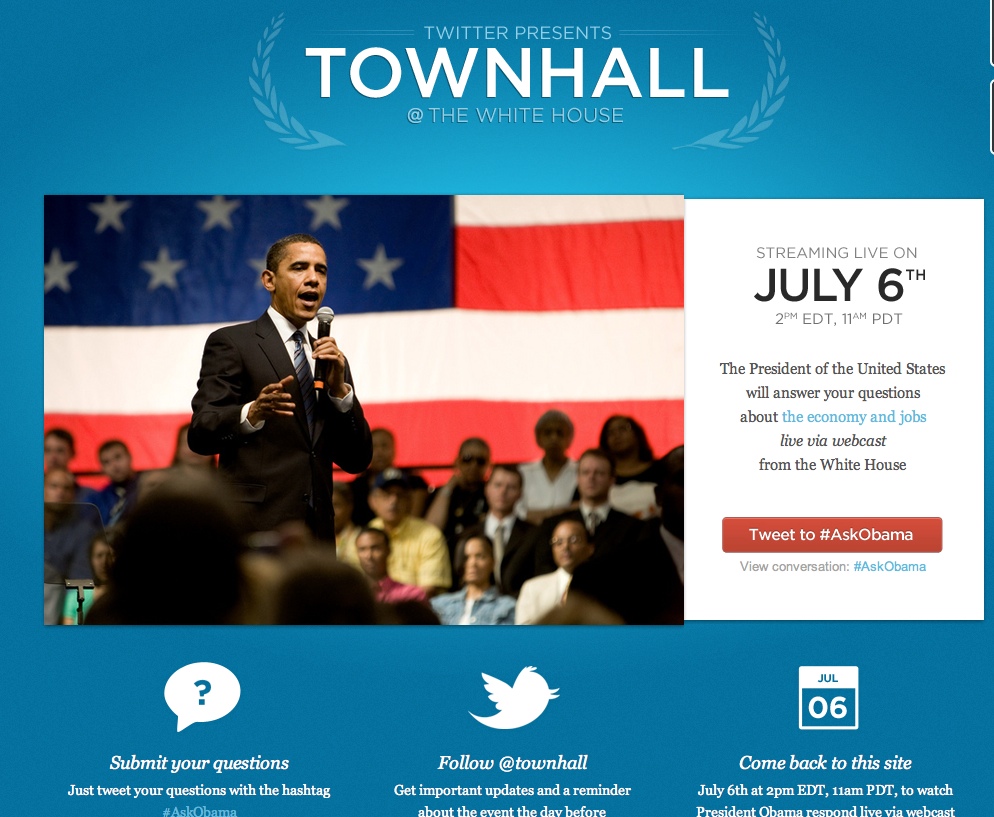
In coordinated tweets with Twitter, the White House announced that it will be holding a town hall on Twitter on July 6th, 2011 at 2 ET. Twitter launched a new @TownHall account for the event and a subdomain, AskObama.Twitter.com to host the live webcast.

According to Macon Phillips, director of digital for the White House, and Sean Garrett, Twitter’s vice president of communications, the digital town hall will be hosted by Twitter co-founder Jack Dorsey, who will provide the questions.

Phillips tweeted that “@Twitter has a cool approach to surfacing questions,” clarifying that “choosing the Q’s will be done by @twitter. Garrett tweeted that “there will be a fairly involved process by which they are selected” and more details and background on said process is on the way. UPDATE: Garrett emailed me “the basics”

“There will be multiple ways that questions will get to the President,” he wrote. “Twitter users will begin asking questions via the #AskObama hashtag today. To identify popular and relevant questions, Twitter is engaging with a third-party Twitter measurement company called Mass Relevance to provide a view on the most frequent topics and their geographical distribution. Additionally, Twitter will invite a group of highly active and engaged Twitter users (called “curators”) to help choose questions and comments both prior to and during the event. Twitter will collect questions in the days leading up to the Town Hall and in real-time during the event.”

Garrett also added some information regarding how Twitter will select this team of “question curators”:

“These curators will be a diverse group from around the country that are also active and engaged on Twitter,” he wrote. “These curators will ask those in their particular communities to also highlight what they think are the most important questions for the President. Curators will retweet questions and pose their own.”

The Twitter TownHall follows a Facebook TownHall earlier this year, in which Facebook founder Mark Zuckerberg posed live questions to President Obama. Nancy Scola wondered how much of a “TownHall” the event actually offered. With this Twitter version, the interesting detail will be in how much transparency goes into question selection, particularly with respect to how exact or tough they are. When the White House turned to Twitter to discuss President Obama’s Middle East speech, they included NPR’s Andy Carvin and Foreign Policy’s Mark Lynch as trusted interlocutors. It’s less clear how Dorsey will moderate, given his considerable different style of tweeting, but on one count there is no doubt: this will be interesting.

UPDATE: In his post on President Obama taking questions on Twitter, Nick Clark Judd raises similar questions over at techPresident on moderation. (And no, he didn’t call the event a “TownHall.”)

UPDATE II: The New York Times published more details on the “Twitter Town Hall,” including the news that there will be a “White House Tweetup,” the first of its kind. In terms of process, here’s what Twitter told the Times. (Spoiler: it’s quite similar to what Garrett told me, above).

Twitter will select the questions, using curation tools and a group of Twitter users to help identify the most popular questions raised both before and during the event. Twitter will be relying on its own search and curation features as well as a company called Mass Relevance to help find questions and topics that are most frequently mentioned.

… Adam Sharp, Twitter’s manager of government and political partnerships, said that the curators chosen by Twitter to help select the questions would be a politically and geographically diverse group. He said the curators would ask the people in their communities to highlight what they think are the most important questions for the president to address.

Curators will also be retweeting questions and posting their own.

“We will have highly-engaged Twitter users from around the country to provide that geographic diversity to help identify good questions, “ he said. “This helps us make sure that we are addressing the concerns that the Twitter universe cares about. “

Less clear whether the President of the United States will actually be doing any of the tweeting himself, as opposed to dictating a reply, which means we may not get to see any real-time presidential typos. According to reports by Paul Boutin, President Obama started tweeting for himself at @BarackObama over the Father’s Day Weekend, signing the tweet “-BO.”

CBS News White House correspondent and keeper of presidential lore Mark Knoller cautioned, however, that “Obama won’t be typing his responses.” Looking back at that Father’s Day tweet, Knoller tweeted that “a tweet was sent in his name by his campaign. He was not at a computer typing a tweet.”

We’ll see if the President decides to get more personally involved or not in the technology. Given that the presidential iPad appears to travel with him these days, it could happen.

[Photo Credit: President Barack Obama sits alone on the patio outside the Oval Office, following a meeting with his senior advisors, April 4, 2011. (Official White House Photo by Pete Souza)]

UPDATE III: Politico White House correspondent Mike Allen led his Tuesday’s Playbook with more details about Wednesday’s Twitter event:

The audience for tomorrow’s hour-long TWITTER TOWN HALL in the East Room (2 p.m. ET) will consist of 140 characters — er, people – in a nod to the maximum length of a tweet. President Obama, however, will face no such limit: He’ll answer questions for the audience, and @TownHall will carry summaries of what he says. Twitter co-founder and Executive Chairman Jack Dorsey will ask the questions. Three screens will be behind Obama and Dorsey: one with the current question; another will have a heat map of the U.S., showing where the town-hall tweets are concentrated; and the third will show the volume of tweets, by topic (jobs, taxes, spending, health care, etc.) Mass Relevance, a company that has worked with the broadcast networks on real-time Twitter data, will supply the analytics. Later, Radian6 will study the demographics of participants.

Representative questions will be chosen partly on how often they’re retweeted. The White House has also reached out to about 10 Twitter leaders in different parts of the country to help surface questions by curating themes and topics that are big among their followers and in their communities. So Dorsey may say: “We’re hearing a lot about the extension of unemployment benefits, especially from the upper Midwest, and here’s a question from Bob in Chicago.” The audience will include 20 people from around the country chosen through the White House Tweetups page, and they’ll also get to meet with Dorsey and with U.S. Chief Technology Officer Aneesh Chopra and perhaps other policy officials.

UPDATE IV: Twitter has blogged about the “Twitter Town Hall,” including a link to the 7 “curators” on Twitter who are selecting questions and a new study from Radian6 that found that “financial security is one of the most frequent topics of political conversation on Twitter.”

Tomorrow’s Town Hall is an invitation from the White House for anyone on Twitter to participate in an open exchange about the national and global economic issues facing the United States.

Questions addressed during the Town Hall will be selected both in advance and in real-time during the event. To narrow down the list of popular, relevant questions to ask on behalf of Twitter users, we’re doing the following:

• We’ve partnered with the visualization experts at Mass Relevance to identify the themes and regions driving the conversation.
• Algorithms behind Twitter search will identify the Tweets that are most engaged with via Retweets, Favorites and Replies.
• A team of seasoned Twitter users with experience discussing the economy will help flag questions from their communities through retweets.

Skype your Congressman? House adds VoIP for citizen-to-legislator communications

We the people can now add “Skype me” to the list of phrases your representative may utter in a commercial, town hall or stump speech. This morning, the leadership of the United States House of Representatives approved the use of low-cost video conferencing tools like Skype and ooVoo.

“This is another example of the new Republican majority using digital tools to better engage with and listen to the American people,” said Speaker Boehner in a prepared statement. “We’re committed to keeping our pledge to lead a House that is more open and that gives Americans a real-time voice in their government.”

On this count, the Speaker has firm ground to stand upon. The GOP has been steadily adopted new technologies into the House since the 2010 midterm elections. From livestreaming the transition to moving House.gov to Drupal, the Republican leadership has followed through on many of its commitments to innovation and transparency. Beyond new media adoption, structural changes through opening legislative data have the potential to permanently bake in open government to the People’s House.

Adopting the same low cost Voice over IP tools for videoconferencing that are in use all around the world makes sense on many levels, despite security concerns. Congressmen and their staff will be able to easily communicate with one another at a lower cost now. Daniel Lungren, chairman of House Administration, offered more context for the upgrade to VoIP in a “Dear Colleague” letter this week:

Improving constituent communications and increasing transparency has been a top priority for me as Chairman of House Administration and a member of the House Technology Operations Team. That’s why I am pleased to announce that the House’s Public Wi-Fi network has been enabled to allow Members and staff to conduct Skype and ooVoo video teleconference (VTC) calls.

To maintain the necessary level of IT security within the House network, the House has negotiated modified license agreements with Skype and ooVoo that will require Members, Officers, Committee Chairs, Officials and staff to accept House-specific agreements that comply with House Rules and maximize protection for Members and staff. Detailed requirements on how to comply with these agreements have been posted to HouseNet at http://housenet.house.gov/keywords/VTC. Please note that Skype users will be limited to conducting VTC sessions on the House’s public Wi-Fi to minimize security risks associated with peer-to-peer networking.

During a time when Congress must do more with less, utilizing low-cost, real-time communication tools is an effective way to inform and solicit feedback from your constituents. In addition to Skype and ooVoo, we are searching for additional means to help enhance constituent communications.

“Citizen-to-legislator” communications using VoIP will hold some challenges. Skype and ooVoo both allow conference calls between more than one party but neither will is ideal for one-to-many communications without some tweaking. If a representative’s staff can set up a projector and sound system, however, we may well see new kinds of virtual town halls spring up, whether someone calls back from Washington or from the campaign trail.

Less clear is how constituent queueing might be handled. If hundreds of citizens, activists or lobbyists are all trying to Skype a Congressman, how will priority be assigned? How will identity be handled, in terms of determining constituents from a home district? As I wrote this post, two other questions posed to the Speaker’s office also remained unanswered: will video chats be archived and, if so, how? And will Skype’s file transfer capabilities be allowed?

On the latter count, given the difficult past relationship of the House and P2P filesharing software, learning that file sharing capabilities were disabled would be in line with expectations. UPDATE: Salley Wood from the House Administrative Committee confirms that the current configuration does include file sharing. “Today’s announcement is simply that lawmakers can now take advantage of these platforms using official resources,” she related via email.

Archiving of constituent video chat is another issue, and one that will be added to the growing list of 21st century new media conundrums for politics, like the questions of whether lawmakers’ texts during public meetings become public documents.

What is clear is that one more domino in the adoption of Web 2.0 tools in government has fallen. What happens next is up for debate — except this time, the conversations will span hundreds of new Web connections. This will be, literally, fun to watch.

UPDATE: As Nick Judd blogs over at techPresident, the Hill was the first to report that the House enables use of Skype for members, basing its reporting off of “Dear Colleague” letter above. There’s no shortage of detail in the Hill’s piece, nor good linkage from Judd. So, you know, go read them.

UN: Disconnecting Internet users is a breach of human rights [REPORT]

As the role of the Internet as a platform for collective actions grows, access to the rest of wired humanity becomes more important. Today, United Nations special rapporteur Frank La Rue released a report on freedom of expression and the Internet that described cutting off Internet access as a breach of human rights. The report, which was presented to the Human Rights Council in Geneva, is an important data point as governments around the globe decide how to legislate, regulate or moderate the disruptive impact of the Internet.

The UN report comes at an important time. As Mathew Ingram wrote at GigaOm, reporting on the recently released UNESCO report on freedom of expression online, governments are still trying to kill, replace or undo the Internet.

“The report provides initial guidance for countries that are grappling with how to address complex Internet policy challenges while upholding their obligations to human rights,” said Leslie Harris, president and CEO of the Center for Democracy and Technology, in a statement released to the media.

“As Rapporteur La Rue affirms, the Internet’s unique ability to provide ample space for individual free expression can lead to the strengthening of other human rights, including political, economic and social rights,” said Cynthia Wong, director of the Center for Democracy and Technology’s Project on Global Internet Freedom. “In order for these rights to be realized, governments, civil society and industry must all continue to build on the work begun by the Special Rapporteur.”

Both reports and the recent eg8 Summit shows online innovation and freedom of expression still need strong defenders. “The primary reason we need to support the Net is because it is a foundational part of how we have our democracy,” said Yochai Benkler, co-director of the Berkman Center for Internet and Society, speaking in Paris.

What’s at stake today has been what’s at stake for more than 15 years, said Benkler: The possibility that a coalition of forces who are afraid of the internet will shut it down.”There is still a very powerful counter argument, one that says both for innovation and for freedom, we need an open Net.”

If an open Internet is the basis for democracy flourishing around the world, billions of people will be counting upon our leaders to keep it open and accessible.

Report of the Special Rapporteur on the promotion and protection of the right to freedom of opinion and exp…

[Hat Tip: TorrentFreak and Mathew Ingram]

Tim O’Reilly on the power of platforms – from Web 2.0 to Gov 2.0 [VIDEO]

Earlier this spring, Tim O’Reilly gave a talk about how Web 2.0 relates to Gov 2.0 to an ESRI conference. He explores how the idea of the Internet as an operating system and the role of data in future of society.

http://video.esri.com/embed/236/000000/width/600

O’Reilly ended with an encouragement to the conference of mapping professionals and developers there and at large: “We really need to focus on what matters.”

Social Security describes new online public credentialing and authentication process

In an announcement published in today’s Federal Register, the Social Security Administration requested comments and feedback on a proposed information collection method. Specifically, Social Security is exploring what the best way will be to identify citizens who who wish to access more electronic services benefit information online.

NextGov reported the driving need for this system yesterday: Social Security statements will go online …someday. According to Alan Lane, the agency’s associate chief information officer for open government, the agency has are no specific service plans at this time – nor is there a firm deadline for the statements going online. The Federal Register notice has much more detail and is quoted at length below.

Here’s some additional background, before you dive into the announcement below. For an agency like Social Security, taking careful steps into the Information Age isn’t just wise: it’s mandatory. The agency has enormous amounts of confidential data about American citizens. Rushing online holds considerable risks but carefully engaging there will be inevitable if Social Security is to embrace Gov 2.0.

In 2011, the Social Security Administration ranks as the largest government program by dollars paid in the United States federal government. It surpasses even discretionary defense and Medicare/Medicaid spending in the federal budget. As the 21st century dawns, new technology and a mandate for open government from the Obama administration provide an opportunity for the Social Security Administration to “reboot its relationship with the American people,” as its CIO, Frank Baitman, put it last last year.

Whether Social Security can better deliver on its mission through adopting social media, more data, better e-services and mobile technologies is an open question. Authentication and credentialing of citizens online is an important part of that progress. Online identity is a matter of plumbing, so to speak, but getting it right is no less important than real plumbing in a house.

Leaks are potentially catastrophic.

That’s why the United States national strategy for online identity is both complex and worth watching. Citizens and government alike need this to work if e-government services are to match their offline components. Getting this wrong would be disastrous, given the rise of identity theft across the nation.

Given how many more of those citizens will be retiring in the years ahead, providing e-services may not be a “nice-to-have” option. According to Social Security’s estimates, by 2036, there will be almost twice as many older Americans as today, from 41.9 million to 78.1 million. They’ll want to access their information online. Today, we learned a bit more about how the agency is thinking about getting there.

1. Social Security’s Public Credentialing and Authentication
Process–20 CFR 401.45–0960-NEW. Social Security is introducing a
stronger citizen authentication process that will enable a new user to
experience and access more electronic services.

Background:

Authentication is the foundation for secure, online transactions.
Identity authentication is the process of determining with confidence
that people are who they claim to be during a remote, automated
session. It comprises three distinct factors: something you know,
something you have, and something you are. Single-factor authentication uses one of
these factors, and multi-factor authentication uses two or more of
these factors.

SSA’s New Authentication Process:

Social Security’s new process features credential issuance, account
management, and single- and multi-factor authentication. With this
process, we are working toward offering consistent authentication
across Social Security’s secured online services, and eventually to
Social Security’s automated telephone services. We will allow our users
to maintain one User ID, consisting of a self-selected Username and
Password, to access multiple Social Security electronic services. This
new process: 1) enables the authentication of users of Social
Security’s sensitive electronic services, and 2) streamlines access to
those services.

Social Security is developing a new authentication strategy that
will:

Utah.gov 2.0: personalized, search-centric design, real-time content

Today, the citizens of Utah have one of the best state government websites online – or at least the newest and easily one of the most beautiful. Whether they notice the change or not, Utah.gov relaunched with a major redesign this morning.

The new site is organized around search, with a big search field front and center. Search now indexes agency information, office hours, interactive maps, and related forms. Utah.gov also uses personalization by location and integration of new media from state officials and agencies. And, in a nod to the Web 2.0 world, Utah.gov will show “what’s trending” as more citizens uses the site. Visitors can already see the most popular searches.

“We are thrilled to announce the re-design of Utah.Gov. Utahns are tech savvy and they expect their government to be the same,” said Utah Governor Gary Herbert in a prepared statement. “Economic development in the State has been a top priority and the new design focuses on utilizing the most innovative technology to better serve Utah citizens and business 24/7.”

For a quick introduction to the new Utah.gov, check out this introductory video:


UTG2011 from Utah Interactive on Vimeo.

“Utah’s new site introduces a new dimension in government web design,” tweeted state CIO David Fletcher a few hours before launch. He gave the new Utah.gov a warm reception over at his personal blog:

It’s been two years since the state of Utah did a major upgrade to its website and a lot has changed during that time. The internet continues to represent an enormous opportunity for state government. In just five short years, the number of visitors to the Utah.gov domain has doubled, reaching 1.4 million unique visitors in March 2011. The new site has been developed, based on extensive research, to address the most important needs of Utah citizens. It takes into account changes that have occurred in Utah society and with technology. We appreciate the fact that Utah.gov has come to represent a trusted source for all kinds of information.

Two years ago, social media services, such as Twitter and Facebook, were still new to many Utahns, so we provided aggregation services where citizens could discover new agency Twitter feeds and begin to interact. The new site, integrates collaborative features into more aspects of the site so you will find information from Twitter and Facebook, and videos from YouTube integrated into many of the pages of Utah.gov. We continue to use the internet to open up government and make it more accessible through services like Open.Utah.gov. There’s also lots of data available in a variety of formats at Data.Utah.gov. Of course, we try to be as open as possible while still maintaining the privacy of our individual citizens.
Still, the most important features on Utah.gov are the numerous services that save time and money for citizens, while bringing tremendous efficiencies to state government as well as the vast libraries of information on topics as varied as healthcare, transportation, caregivers, business creation, and hunting. In 2010, Utah citizens engaged the domain for over 25.1 million interactive transactions, saving hundreds of millions of dollars in the process.

Utah.gov was recognized as the best community resource in Utah in 2008 and has won many awards over the years. Looks like they’ll be in the running for more soon.

UPDATE: There are plenty of other folks commenting on the new Utah.gov. Luke Fretwell shared his review of the new Utah.gov here at Govfresh.

At Govloop, Andy Krzmarzick writes that Utah’s stunning web revitalization effort sets “a new bar not just for government web design, but for any location on the web.”

Reno.gov webmaster Kristy Fifelski’s video review for GovGirl.com includes a few concerns regarding YouTube and collecting user-submitted content:


Abhi Nemani called Utah.gov a beautiful new government website over at Code for America, focusing in on the importance of search:

A citizen coming to Utah.gov isn’t given a sprawling tree of links they have to cut their way through. It’s just a search box. It’s just that simple. As the state government put in its release, “search is unmistakable.” In Britain, some innovators within the government have too been experimenting with the interfaces for government websites; they too determined this search-centric model is ideal. Understandably so, I’d say, because it aligns with the motivations a user has in visiting a government website: namely, you have a question. You’re wondering what time that office is open till or where that other one is; which form do you need to fill out and how do you submit it. Government is just as much an information resource as a service provider. Smart web design, like we see on Utah.gov, helps it do both.

Bottom line: When it put search front and center, Utah.gov’s redesign reflected how citizens navigate online.

G8: the Internet has become the public arena for our time

President Barack Obama and other world leaders walk to the first working session at the G8 summit in Deauville, France, May 26, 2011. Pictured, from left are: European Commission President Jose Manuel Barroso; President Obama; French President Nicolas Sarkozy; Canadian Prime Minister Stephen Harper; Japanese Prime Minister Naoto Kan; German Chancellor Angela Merkel; and British Prime Minister David Cameron. May 26, 2011. (Official White House Photo by Official White House Photo by Lawrence Jackson)

President Barack Obama and other world leaders walk to the first working session at the G8 summit in Deauville, France, May 26, 2011. Pictured, from left are: European Commission President Jose Manuel Barroso; President Obama; French President Nicolas Sarkozy; Canadian Prime Minister Stephen Harper; Japanese Prime Minister Naoto Kan; German Chancellor Angela Merkel; and British Prime Minister David Cameron. May 26, 2011. (Official White House Photo by Official White House Photo by Lawrence Jackson)

At this year’s meeting of the “Group of 8” (G8) nations in France, a declaration about the Arab Spring included a “Deauville Partnership” with the people of the Middle East to support the growth of “democratic, open societies and inclusive economic modernisation.”

For the first time, the 2011 G-8 Summit included discussion of the Internet as a top-level issue, alongside the ongoing conflict in Libya, economic growth, nuclear safety, climate change, foreign aid and national security.

The G8 released an official communique that pledging renewed commitment for freedom and democracy that included a substantial section on the Internet. The communique included this summary of the principles discussed:

We discussed new issues such as the Internet which are essential to our societies, economies and growth. For citizens, the Internet is a unique information and education tool, and thus helps to promote freedom, democracy and human rights. The Internet facilitates new forms of business and promotes efficiency, competitiveness, and economic growth. Governments, the private sector, users, and other stakeholders all have a role to play in creating an environment in which the Internet can flourish in a balanced manner. In Deauville in 2011, for the first time at Leaders’ level, we agreed, in the presence of some leaders of the Internet economy, on a number of key principles, including freedom, respect for privacy and intellectual property, multi-stakeholder governance, cyber-security, and protection from crime, that underpin a strong and flourishing Internet. The “e-G8” event held in Paris on 24 and 25 May was a useful contribution to these debates.

That eG8 showed that online innovation and freedom of expression still need strong defenders. Some of the concerns will be assuaged in this communique.

While the body of the communique is comprised of high level principles and does not contain specific prescriptions, it does not specifically reference to international human rights laws or a “freedom to connect,” an exception that supporters of free expression like Article 19 have criticized as unsufficient. In addition, paragraph 15, below, renews a “commitment to ensuring effective action against violations of intellectual property rights in the digital arena, including action that addresses present and future infringements” that may obliquely refer to the Anti-Counterfeiting Trade Agreement, or “ACTA,” that the Electronic Frontier Foundation and others have expressed concerns about as it has moved through drafting stages.

That said, there is much in the official communique about the Internet that celebrates its power and choices that have driven its growth, including:

  • “The openness, transparency and freedom of the Internet have been key to its development and success. These principles, together with those of non-discrimination and fair competition, must continue to be an essential force behind its development.”
  • “The Internet has become the public arena for our time, a lever of economic development and an instrument for political liberty and emancipation. Freedom of opinion, expression, information, assembly and association must be safeguarded on the Internet as elsewhere. Arbitrary or indiscriminate censorship or restrictions on access to the Internet are inconsistent with States’ international obligations and are clearly unacceptable. Furthermore, they impede economic and social growth.

Coming on a week when Iran vowed to unplug the Internet, disconnecting Iranian citizens from the rest of the world, holding up those principles is both timely and notable. The full section of the communique regarding the Internet follows.

II. INTERNET

4. All over the world, the Internet has become essential to our societies, economies and their growth.

5. For citizens, the Internet is a unique information and education resource and thus can be a helpful tool to promote freedom, democracy and human rights.

6. For business, the Internet has become an essential and irreplaceable tool for the conduct of commerce and development of relations with consumers. The Internet is a driver of innovation, improves efficiency, and thus contributes to growth and employment.

7. For governments, the Internet is a tool for a more efficient administration, for the provision of services to the public and businesses, and for enhancing their relations with citizens and ensuring respect for and promotion of human rights.

8. The Internet has become a major driver for the global economy, its growth and innovation.

9. The openness, transparency and freedom of the Internet have been key to its development and success. These principles, together with those of non-discrimination and fair competition, must continue to be an essential force behind its development.

10. Their implementation must be included in a broader framework: that of respect for the rule of law, human rights and fundamental freedoms, the protection of intellectual property rights, which inspire life in every democratic society for the benefit of all citizens. We strongly believe that freedom and security, transparency and respect for confidentiality, as well as the exercise of individual rights and responsibility have to be achieved simultaneously. Both the framework and principles must receive the same protection, with the same guarantees, on the Internet as everywhere else.

11. The Internet has become the public arena for our time, a lever of economic development and an instrument for political liberty and emancipation. Freedom of opinion, expression, information, assembly and association must be safeguarded on the Internet as elsewhere. Arbitrary or indiscriminate censorship or restrictions on access to the Internet are inconsistent with States’ international obligations and are clearly unacceptable. Furthermore, they impede economic and social growth.

12. The Internet and its future development, fostered by private sector initiatives and investments, require a favourable, transparent, stable and predictable environment, based on the framework and principles referred to above. In this respect, action from all governments is needed through national policies, but also through the promotion of international cooperation.

13. We commit to encourage the use of the Internet as a tool to advance human rights and democratic participation throughout the world.

14. The global digital economy has served as a powerful economic driver and engine of growth and innovation. Broadband Internet access is an essential infrastructure for participation in today’s economy. In order for our countries to benefit fully from the digital economy, we need to seize emerging opportunities, such as cloud computing, social networking and citizen publications, which are driving innovation and enabling growth in our societies. As we adopt more innovative Internet-based services, we face challenges in promoting interoperability and convergence among our public policies on issues such as the protection of personal data, net neutrality, transborder data flow, ICT security, and intellectual property.

15. With regard to the protection of intellectual property, in particular copyright, trademarks, trade secrets and patents, we recognize the need to have national laws and frameworks for improved enforcement. We are thus renewing our commitment to ensuring effective action against violations of intellectual property rights in the digital arena, including action that addresses present and future infringements. We recognize that the effective implementation of intellectual property rules requires suitable international cooperation of relevant stakeholders, including with the private sector. We are committed to identifying ways of facilitating greater access and openness to knowledge, education and culture, including by encouraging continued innovation in legal on line trade in goods and content, that are respectful of intellectual property rights.

16. The effective protection of personal data and individual privacy on the Internet is essential to earn users’ trust. It is a matter for all stakeholders: the users who need to be better aware of their responsibility when placing personal data on the Internet, the service providers who store and process this data, and governments and regulators who must ensure the effectiveness of this protection. We encourage the development of common approaches taking into account national legal frameworks, based on fundamental rights and that protect personal data, whilst allowing the legal transfer of data.

17. The security of networks and services on the Internet is a multi-stakeholder issue. It requires coordination between governments, regional and international organizations, the private sector, civil society and the G8’s own work in the Roma-Lyon group, to prevent, deter and punish the use of ICTs for terrorist and criminal purposes. Special attention must be paid to all forms of attacks against the integrity of infrastructure, networks and services, including attacks caused by the proliferation of malware and the activities of botnets through the Internet. In this regard, we recognize that promoting users’ awareness is of crucial importance and that enhanced international cooperation is needed in order to protect critical resources, ICTs and other related infrastructure. The fact that the Internet can potentially be used for purposes that are inconsistent with the objectives of peace and security, and may adversely affect the integrity of critical systems, remains a matter of concern. Governments have a role to play, informed by a full range of stakeholders, in helping to develop norms of behaviour and common approaches in the use of cyberspace. On all these issues, we are determined to provide the appropriate follow-up in all relevant fora.

18. We call upon all stakeholders to combat the use of Internet for trafficking in children and for their sexual exploitation. We will also work towards developing an environment in which children can safely use the Internet by improving children’s Internet literacy including risk awareness, and encouraging adequate parental controls consistent with the freedom of expression.

19. We recognize the importance of enhanced access to the Internet for developing countries. Important progress has been achieved since the Okinawa Summit and we pay tribute to the efforts made by developing countries in this regard as well as the various stakeholders, governments, the private sector and NGOs, which provide resources, expertise and innovation. We encourage initiatives, in partnership with the private sector, on the use of the Internet with a development purpose, particularly for education and healthcare.

20. As we support the multi-stakeholder model of Internet governance, we call upon all stakeholders to contribute to enhanced cooperation within and between all international fora dealing with the governance of the Internet. In this regard, flexibility and transparency have to be maintained in order to adapt to the fast pace of technological and business developments and uses. Governments have a key role to play in this model.

21. We welcome the meeting of the e-G8 Forum which took place in Paris on 24 and 25 May, on the eve of our Summit and reaffirm our commitment to the kinds of multi-stakeholder efforts that have been essential to the evolution of the Internet economy to date. The innovative format of the e-G8 Forum allowed participation of a number of stakeholders of the Internet in a discussion on fundamental goals and issues for citizens, business, and governments. Its free and fruitful debate is a contribution for all relevant fora on current and future challenges.

22. We look forward to the forthcoming opportunities to strengthen international cooperation in all these areas, including the Internet Governance Forum scheduled next September in Nairobi and other relevant UN events, the OECD High Level Meeting on “The Internet Economy: Generating Innovation and Growth” scheduled next June in Paris, the London International Cyber Conference scheduled next November, and the Avignon Conference on Copyright scheduled next November, as positive steps in taking this important issue forward.

Crawford: The open Internet is the basis for democracy flourishing around the world

“Access to the Internet is fundamental,” said Susan Crawford, an American law professor and former White House official, speaking at the The inaugural eG8 forum, held in Paris. These are the most important policies that government should be embracing. We want to make sure that other voices are heard.”

At the eG8, 20th century ideas clashed with the 21st century economy. The forum, held before the G-8 summit of global leaders, showed that online innovation and freedom of expression still need strong defenders.

As Nancy Scola reported at techPresident, at the at the eG8, civil society groups restaked their claim to the ‘Net. I spoke with Crawford about what’s at stake following an impromptu press conference held to highlight their concerns. Our interview is below:

“What’s at risk is the future of the Internet,” she said. It’s “whether it continues to be a distributed, open, platform for innovation, economic growth, democratic discourse, participation by all peoples of the world or whether it becomes a balkanized, taxed, blocked, controlled broadcast medium, which is what many incumbents would like to see.”

How close are we to that happening? “Luckily, we have a long way to go,” said Crawford, “because the people who use the Internet will continue to fight back with everything they’ve got.”

Watch the whole thing to hear what her take on why this matters to citizens, educators, children, and entrepreneurs.

Dyson at the eG8: You don’t need to be from the Internet to believe in liberty or free speech

At the eG8, 20th century ideas clashed with the 21st century economy. The inaugural eG8 forum, held in Paris before the G-8 summit of global leaders, showed that online innovation and freedom of expression still need strong defenders. As Nancy Scola reported at techPresident, at the at the eG8, civil society groups restaked their claim to the ‘Net.

Several attendees, many who had traveled from the United States, strongly questioned whether the Internet should be regulated in the ways that Sarkozy implied. The “value of internet is not just efficiency but also transparency,” tweeted Esther Dyson, “a much better regulator than government could ever be.”

I spoke further in with Dyson in an interview embedded below. What matters about the eG “is that you have a lot of people being exposed to one another and you have a lot of government people being exposed to people they don’t normally listen to,” said Dyson. “As usual, it’s not what happens up on stage, or what happens on the video: it’s what happens on the tweets, in the personal interactions, in the dinner afterwards, and in the back hall of the meeting. And that – that was positive. The world doesn’t change overnight, mostly. ”

She spoke to the concerns of civil society about eG8 recommendations: “It is sort of justified. Some of them were precanned. I actually sat down with my guy after doing my panel and changed them. I don’t think that happened with all of them. But again, the community is aroused: it’s going to make its points around this.”

Dyson also emphasized the universality of some of these concerns and what’s at stake. “You don’t need to be ‘from the Internet’ to believe in liberty or free speech.”

How are startups helping the global transparency movement? “They’re providing tools to make the data meaningful,” said Dyson. “They’re providing tools for people to share the information. They’re providing the communication tools, again, that allow from everything from Wikileaks to people communicating with reporters. Tools like your phone, connected to the Internet, so that you can record interviews not just with me but with all of the other people you talk to, upload them, people can share them, people can comment on them. That’s all technology.”

Dyson shared other thoughts on the eG8 and Internet freedom, including how entrepreneurs are changing the world through their work. Dyson also shared an insight that transcends technology:

“Even when you have a revolution, what makes the revolution works is what changes in people’s minds, and that’s what’s going on here,” said Dyson.

“The world is changing. People in government are not special. They should be as transparent as everybody else. People deserve privacy. Officials, governments, institutions, they all should be transparent. That’s new thinking, and it was being heard.”