
National Archives launches redesigned Archives.gov under open government plan

Today the National Archives launched its redesign of Archives.gov redesign.

“It’s essential for the National Archives to have a user-friendly online presence,” said Archivist of the United States David S. Ferriero in a prepared statement. Ferriero is the first Archivist to blog, tweet (@dferriero), and launch a Facebook page. “We hope to reach new audiences while still engaging our long-time users, researchers and visitors. This redesign – part of the National Archives flagship Open Government Initiative – reflects the ongoing effort to engage the public and make records of the National Archives easier to find and use.”

If you’re not following the work of the National Archivist, today is a good day to reflect on his progress and the importance of his work. Reflect on what he told the New York Times:

How many digitized records should be available online? “If I had my way,” he replied, “everything.”

The Obama administration has also given the National Archives responsibility for reviewing the declassification of 400 million pages of secret documents by the end of 2013.

Mr. Ferriero’s goal, he said, is “to ensure that we have the user at the center of our thinking — historians, genealogists, open government folks. What can we do to make their lives easier?”

Each of these flagship initiatives, many of which are listed at the WhiteHouse.gov open government innovations gallery, are supposed to deliver upon the signature elements of each agency’s mission. In terms of the National Archives, the redesign was “intended to encourage online user participation in the redesign of our website.” Does it deliver?

Here’s the old design of Archives.gov:
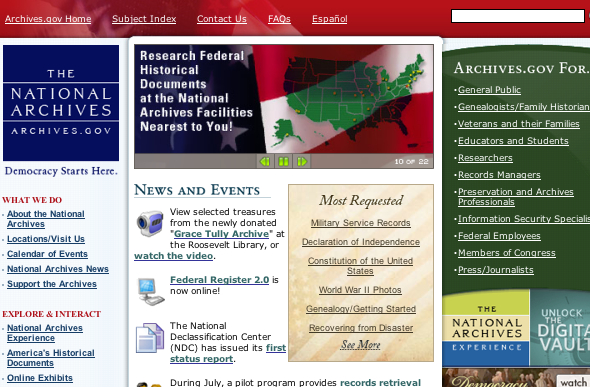
The research that preceded the redesign looked at what people do when they come to Archives.gov and what they do there.

Here are the results of the National Archives’ data analysis of Archives.gov “customers”:

How frequently do you visit this site?
69% First time
14% Every 6 months or less
9% About once a month
5% About once a week

In what role are you using the web site today?
30% Veteran or Veteran’s family
23% Genealogist or family historian
14% Educator or student
14% Researcher

What were you primarily looking for today?
28% Historical Documents
25% Veterans’ Service Records
19% Genealogy or family history information
9% Other

How would you most like to interact with this site?
41% Bookmark or tag pages
35% None
15% Receiving newsletters/email updates
8% Watching Vodcasts or video

The new Archives.gov was based in part on that feedback and user need:
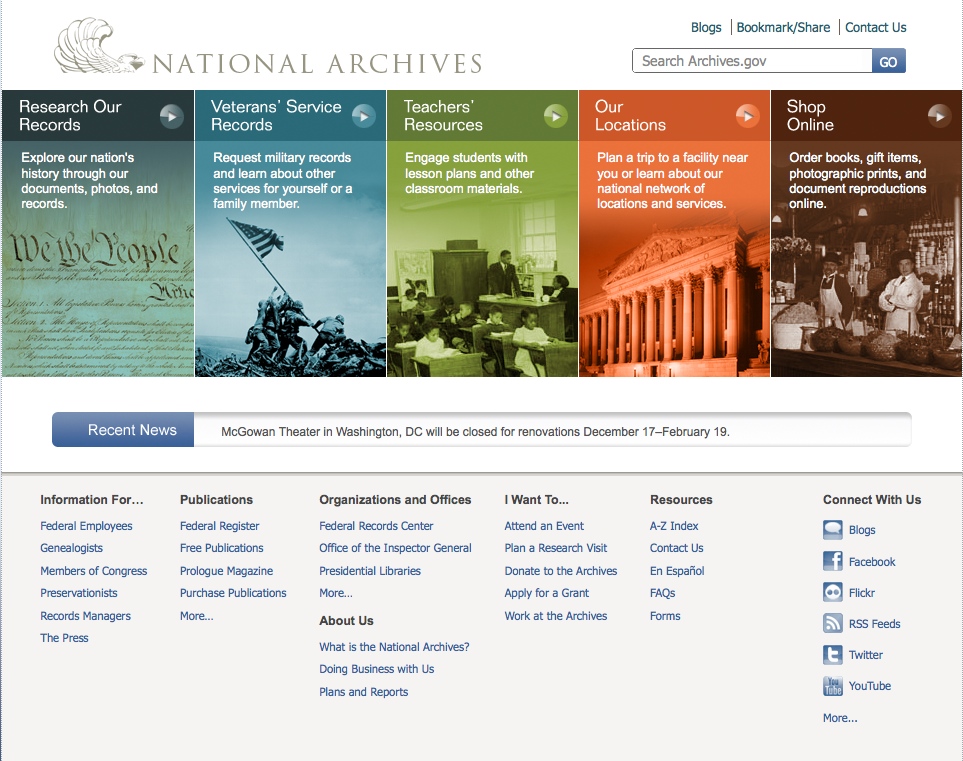
On first glance, and after some time clicking around, the answer is a qualified “yes.” This version of the Archives.gov redesign came about through a vote on the homepage design using Ideascale and in-person events, receiving in total some 3,257 votes. The redesign includes streamlined access to historical documents and military service records, an important improvement, given the eye-opening statistic that 81 percent of Archives.gov visitors are looking for this information.

The new design is cleaner, features clearer organization of content and loaded more quickly on my mobile device. The search field, one of the critical features of any modern website, is larger and raised to greater prominence in the redesign. I don’t see a mobile version of the site yet, and there is as of yet “no app for that,” unlike, say, the Library of Congress. That may change.

With respect to another stated aim of the project, the redesign does prominently display the Archives.gov social media accounts, although in muted colors that, while fitting look and feel, don’t catch the eye. No social content is featured on the homepage or the dedicated section, though it’s not hard to find those accounts on the master list of social media. There are some real gems to be fond in there, particularly in the NARA Flickr feed.

Archives Wiki: Our Archives Wiki
Blog – NARAtions, the U.S. National Archives: Blog - NARAtions, the U.S. National Archives
Facebook – US National Archives: Facebook - US National Archives
Flickr – US National Archives Photostream: Flickr - US National Archives Photostream
RSS Feed – News from the U.S. National Archives: RSS Feed - News from the U.S. National Archives
Twitter – @ArchivesNews: Twitter - @archivesnews
YouTube – US National Archives Channel: YouTube - US National Archives Channel

There are a host of other accounts in there for regional archives, presidential libraries or specific topics. For more on the back story behind the design, read over the minutes from last month’s researcher meeting:

The website was last updated several years ago. This time, we are revising it to focus on tasks that people are trying to accomplish when they come to our website.

We collected information from researchers on what you wanted in a variety of ways over several months including asking staff, researchers, veterans, patrons in line at exhibits, etc. This is part of Open Government from December 2009. The Flagship initiative is to redesign by matching the needs of all users (researchers, educators, students, and those just browsing to see the founding documents).

We have the new website categorized into sections. There are five main sections: veterans, researchers, educators and students, locations, and our online store.

Other pages will focus on genealogy, Congress, records preservation, Federal records managers, publications, offices in NARA, and information about us in general. It also includes an agency index, FAQs, and social media (e.g., blogs like NARAtions and AOTUS).

The research section has basic information on how to do research at each of the facilities and links to specific topics like the Civil War.

The new website rolls out next month in December. This is the first phase of the redesign. The focus is on the home page, researchers, veterans, education, and will then move onto other areas.

The 1940s census will be available online in 2012 spring.

“Hire a Researcher” will still be available. All content will migrate over. You do not need to resubmit information. All current information will come over. If you need to resubmit information, we will let you know. We do an annual contact check to revise the list.

This is a significant improvement and one that the Archives staff should be commended upon. If you have feedback, they’ve made it clear that they’re listening: comment on the NARAtions Blog or write to webprogram@nara.gov.

Social media, local government and elections: reflections on COGEL and @DCBOEE

This week, I was proud to be one of two speakers for a session on social media and government at the Council on Governmental Ethics Laws (COGEL) conference in Washington, D.C. I delivered an adapted version of the talk on social media and government I gave the Social Security Administration’s Open Government Awareness Day earlier this year, focusing on the elements that would be of greatest interest to a group of lawyers, regulators and academics. The presentation is embedded below:

The speaker that followed me, however, was able to share a fascinating view of what social media looks like from inside of government, specifically in the District of Columbia. Alysoun McLaughlin, the public affairs manager for the District of Columbia Board of Elections and Ethics. Here’s her bio, from the COGEL session description:

She joined the District last year, just in time to implement a long list of reforms for the 2010 election including new voting equipment, early voting and same-day registration. Prior to becoming an election official, she was a project manager for Election Initiatives at the Pew Center on the States. She previously spent a decade as a Washington lobbyist, focusing on election issues for the National Conference of State Legislatures and the National Association of Counties. She is here today to share her experience with social media during the 2010 election.

And share she did. Over the course of half an hour, she talked about Facebook, Twitter, local media, citizen engagement and much more. I captured most of her presentation on my iPhone (sorry about the unsteady hand) and have embedded her presentation, “To Tweet or not to Tweet: Engaging the Public through Social Media,” below.

If you want an excellent, practical perspective of the local government side of social media, these are worth watching. A couple of key takeaways from her presentation:

  • How can governments get insights from Twitter without using it? “Just type in the name of your agency and see what they’re saying.”
  • On D.C. elections: “We know there are going to be lines. Come to the website to see what they are.”
  • Don’t trust this to an intern. You “need someone skilled in crisis communications.”
  • “The days that I’m heavy on Twitter are the days my phone rings less.”
  • Viral tweets can raise awareness: “…and we just confirmed that a voter used a write-in stamp. on a touch screen.”

Part 1: Introductions

Part 2: Reflections on Twitter and Facebook

Part 3: Twitter and the 2010 DC Election

Part 4: Who follows @DCBOEE

Part 5: Listening and using social media in government

Washington, D.C. publishes its first digital divide strategy

The digital divide in D.C. is an issue that has been receiving increased sunlight under the District’s chief technology officer, Bryan Sivak. As the Kojo Nnamdi Show episode on the D.C. digital divide reported, “a 2009 study by the OCTO found that the digital divide runs very deep in the city – 90% of residents in Northwest D.C. have high-speed internet access in their homes, but in Southeast, that figure falls to just 36% – 40%.”

Earlier this year, Washington became the recipient of stimulus funding for a digital divide initiative. This summer, the city turned on free wifi in many neighborhoods, which can be viewed at DC.wifi.gov. Today, Sivak announced D.C.’s first digital divide strategy:
.bbpBox12514372882534400 {background:url(http://s.twimg.com/a/1291760612/images/themes/theme1/bg.png) #C0DEED;padding:20px;} p.bbpTweet{background:#fff;padding:10px 12px 10px 12px;margin:0;min-height:48px;color:#000;font-size:18px !important;line-height:22px;-moz-border-radius:5px;-webkit-border-radius:5px} p.bbpTweet span.metadata{display:block;width:100%;clear:both;margin-top:8px;padding-top:12px;height:40px;border-top:1px solid #fff;border-top:1px solid #e6e6e6} p.bbpTweet span.metadata span.author{line-height:19px} p.bbpTweet span.metadata span.author img{float:left;margin:0 7px 0 0px;width:38px;height:38px} p.bbpTweet a:hover{text-decoration:underline}p.bbpTweet span.timestamp{font-size:12px;display:block}

Proud to announce the release of DC’s first ever strategic plan for addressing the digital divide: http://octo.dc.gov/octostrategyless than a minute ago via Chromed Bird

It’s embedded below in the post. Interestingly, the digital divide strategy announcement at the Office of the Chief Technology Officer of D.C. indicated that it would be a “living document,” much like the Web itself:

OCTO is pleased to release a public draft of the District of Columbia’s first ever strategic plan to address the digital divide. This is intended to be a living document, updated quarterly or bi-annually as conditions warrant, and will reflect the current high-level vision of the District Government as it relates to tackling this important issue. Feedback is welcome so please feel free to share your thoughts and help us bridge this gap.

Digital Divide Strategy http://d1.scribdassets.com/ScribdViewer.swf?document_id=44785273&access_key=key-1zhdaz8pu43c1e8pmwzj&page=1&viewMode=list

For a feel for the thinking of the DC CTO on this count, watch Sivak’s closing statement from the District of Columbia’s first-ever “Community Broadband Summit” (DC-CBS) is embedded below. The summit was a public forum designed to address the city’s digital divide.

Bryan Sivak – Closing Remarks from DCNET Multimedia on Vimeo.

It’s not clear whether Sivak will stay on under incoming Mayor-Elect Vincent Gray’s administration. If not, here’s hoping his replacement works with the D.C. tech community to connect more citizens to the Internet. Online access has become a vital link for information, services, access to jobs, education and communication with family, friends, teachers and coworkers in the 21st century. The District should be commended for continuing to working to bridge it.

What do you think of the strategy? Leave your thoughts in the comments.

White House hosts online webchat on anniversary of Open Government Directive

Tomorrow, December 8, is the one year anniversary of the White House Open Government Directive, which which required federal agencies to take steps to achieve key milestones in transparency, participation, and collaboration. At 2:00 PM EST, the first United States chief technology officer, Aneesh Chopra, will join OMB chief information officer Vivek Kundra and Cass Sunstein, administrator of the Office of Information and Regulatory Affairs, in a live web chat at WhiteHouse.gov/live. Video of the webcast is embedded below:

The @OpenGov account and White House solicited questions through an online form tool at WhiteHouse.gov and through the White House Facebook page. The chat itself will be hosted using the White House Live Facebook app and streamed live online through WhiteHouse.gov/live or, presumably, the White House iPhone app. Watch for whether any three of the White House officials answer questions on Wikileaks and open government. (UPDATE: They didn’t.) President Obama’s press conference on a tax deal with the GOP superseded the original chat on Tuesday, which the @WhiteHouseOSTP account confirmed.

I’ll be liveblogging the chat here using CoverItLive, embedded below:

White House Open Government Live Chat

The Sunlight Foundation released the following statement on the one year anniversary of the open government directive:

“In its first year, the Open Government Directive made government transparency a priority and encouraged federal agencies to put important information online. While more government information is now available online, the Directive’s limitations have also become clearer. Simply put, the president’s commitment to transparency is not yet living up to its full potential. The Open Government Directive is a great starting point, but the hard work that is needed to create a truly open government is still ahead of us.

“Agencies such as the Department of Labor, Health and Human Services and NASA have led the way in releasing data, and the working groups created among key staff have brought about real cultural change within agencies. But all of these initiatives need a steady hand and a clear commitment from the White House to mature into permanent, reliable, effective policies that result in meaningful data online.

“More concentrated work is needed to move beyond the easy wins. The administration has to give stronger direction and urge the agencies to move forward if the promise of an open government is to be realized.”

Sunlight’s recommendations for a more open government are available online at http://sunlightfoundation.com/policy/documents/agenda/.

John Wonderlich of the Sunlight Foundation is also liveblogging.

For more context on White House open government innovation, review the following pieces:

The open government community will likely be discussing the chat on Twitter.  Embedded below is a curated list of open government accounts:

//

A Day in the Life of Twitter: Jakarta glows as brightly as New York and San Francisco

.bbpBox10716694204911616 {background:url(http://s.twimg.com/a/1290538325/images/themes/theme2/bg.gif) #C6E2EE;padding:20px;} p.bbpTweet{background:#fff;padding:10px 12px 10px 12px;margin:0;min-height:48px;color:#000;font-size:18px !important;line-height:22px;-moz-border-radius:5px;-webkit-border-radius:5px} p.bbpTweet span.metadata{display:block;width:100%;clear:both;margin-top:8px;padding-top:12px;height:40px;border-top:1px solid #fff;border-top:1px solid #e6e6e6} p.bbpTweet span.metadata span.author{line-height:19px} p.bbpTweet span.metadata span.author img{float:left;margin:0 7px 0 0px;width:38px;height:38px} p.bbpTweet a:hover{text-decoration:underline}p.bbpTweet span.timestamp{font-size:12px;display:block}

#Indonesia has the highest percentage of web users on #Twitter. Blogging/micro-blogging has been adopted and adapted in powerful ways here.less than a minute ago via txt

You can see that activity flare brightly in this extraordinary visualization of mapping a day in the life of Twitter by Chris McDowall.

From the video description of “Mapping a Day in the Life of Twitter” by Chris McDowall on Vimeo.

Last week I hooked a computer up to the Twitter data streaming API and, over the course of a day, grabbed every tweet that had geographic coordinates. I wrote a Python script to parse the 2GB of JSON files and used Matplotlib with the Basemap extension to animate 25 hours of data on a world map. The resulting animation plots almost 530,000 tweets — and remember these are just tweets with geo-coordinates enabled.

I recommend you full-screen this video, turn scaling off and high definition on.

The animation begins at 5am on November 18, Greenwich Mean Time (United Kingdom). This corresponds to midnight Eastern Standard Time, 9pm Pacific Time (Nov 17) and 6pm in New Zealand (Nov 18).

There are some interesting things to note:
– It is possible to infer the passage of the sun across the map as data begins to stream out of mobile phones and desktops and previously dark patches of the map begin to glow white.
– At 8:00, 9:00 and 10:00 GMT waves of tweets pass across the United States from East to West. This is an automated Twitter service that tweets local news for specific ZIP codes.
Turn your attention to Indonesia. Jakarta glows as brightly as New York and San Francisco.
– Note the black spots. With the exception of a few cities, such as Lagos and Johannesburg, Africa remains the dark continent.

Food for thought and a feast for the eyes as the weekend draws near.

U.S. House to hold online privacy hearings on “Do-Not-Track” legislation

Yesterday, the FTC online privacy report endorsed a “do not track” mechanism for Web browsers. This morning, the Subcommittee on Commerce, Trade and Consumer Protection in the United States House of Representatives will hold a hearing on “Do-Not-Track” legislation. The hearing will e”xamine the feasibility of establishing a mechanism that provides Internet users a simple and universal method to opt-out from having their online activity tracked by data-gathering firms (a.k.a. a ‘Do Not Track List’).”

A livestream of the hearing is available, along with testimony:

The subcommittee has posted a memo that sets the stage for the hearing, which is embedded below. Notably, the document heavily references the Wall Street Journal’s excellent “What Do They Know?” series on digital privacy.

In the Internet age, each keystroke or click of a mouse can betray the most mundane or even sensitive details of our lives, and those details are being collected and packaged into profiles by a data-gathering industry with an increasing hunger for information that can be sold and used to target consumers based on their tastes, needs, and even perceived desirability. Many Americans don’t know that the details of their online lives are being gobbled up and used in this way, much less how to stop it in the event that such collection offends their expectations of privacy.

This summer, the Wall Street Journal began reporting about the online gathering of information about Internet users in an ongoing investigative series called “What They Know.” For its first piece, the Journal uncovered the extent to which Internet users’ activity is being tracked. The Journal found that visiting the top 50 most popular websites in the U.S. resulted in the placement on a single test computer of 2,224 files by 131 companies that track Internet users’ activity across the Internet. In addition, not only is tracking of Internet users pervasive, but it has become more invasive through the use by some in the tracking industry of more sophisticated technologies that can keep tabs on an Internet users activity on a website (rather than collecting just the fact that the website was visited) and some can even re-spawn themselves if an Internet user tries to delete them.

If you haven’t read the series, take some time over the weekend or holiday. And if you’re interested in what the federal government is considering in the context of digital privacy, tune in to the livestream and follow the #DNTrack hashtag on Twitter for the live backchannel.
http://widgets.twimg.com/j/2/widget.js //

DNTrack House Briefing memo.12.01 http://d1.scribdassets.com/ScribdViewer.swf

What was the story of the first FTC online privacy chat? 17 questions and answers.

http://storify.com/digiphile/the-federal-trade-commissions-first-twitter-chat.js

FTC online privacy report endorses “Do-Not-Track” mechanism for Web browsers

The Federal Trade Commission released an online privacy report today that will reshape how companies, consumers and businesses interact on the Internet. The agency will take questions from reporters at 1 PM EST and from the public on Twitter in its first Twitter chat at 3 PM EST. The recommendation that “companies should adopt a ‘privacy by design’ approach by building privacy protections into their everyday business practices” is a key direction to every startup or Global 1000 corporation that comes under the FTC’s purview as the nation’s top consumer protection regulator.

The new FTC privacy report proposes a framework that would “balance the privacy interests of consumers with innovation that relies on consumer information to develop beneficial new products and services,” according to the agency’s statement, and recommends the implementation of a “Do Not Track” mechanism, which the agency describes as “a persistent setting on consumers’ browsers – so consumers can choose whether to allow the collection of data regarding their online searching and browsing activities.”

“Technological and business ingenuity have spawned a whole new online culture and vocabulary – email, IMs, apps and blogs – that consumers have come to expect and enjoy. The FTC wants to help ensure that the growing, changing, thriving information marketplace is built on a framework that promotes privacy, transparency, business innovation and consumer choice. We believe that’s what most Americans want as well,” said FTC Chairman Jon Leibowitz.

The report states that industry efforts to address privacy through self-regulation “have been too slow, and up to now have failed to provide adequate and meaningful protection.” The framework outlined in the report is designed to reduce the burdens on consumers and businesses.

“This proposal is intended to inform policymakers, including Congress, as they develop solutions, policies, and potential laws governing privacy, and guide and motivate industry as it develops more robust and effective best practices and self-regulatory guidelines,” according to the report, which is titled, “Protecting Consumer Privacy in an Era of Rapid Change: A Proposed Framework for Businesses and Policymakers.”

“Self-regulation has not kept pace with technology,” said David Vladeck, director of the FTC’s Consumer Protection Bureau, speaking this morning about the proposed online privacy rules. “We have to simplify consumer choice and ‘do not track’ will achieve that goal,” he said. “I don’t think that under the FTC authority we could unilaterally mandate ‘do not track.'”

One of the nation’s top technology policy advocates approved. “The FTC report hits all the right notes. It sets out a modern and forward looking framework for privacy protection that moves beyond a narrow focus on notice and choice toward a full set of fair information practices and accountability measures,” said Center for Democracy and Technology president Leslie Harris. “The FTC has provided the blueprint. Now it is time for Congress and industry to follow suit.”

“We are very pleased to see the FTC exerting strong leadership on privacy,” said CDT Privacy Project Director Justin Brookman. “This report should bolster efforts to enact a privacy bill next Congress. Its recommendations are consistent with what is being discussed on the Hill.”

In a novel move, the FTC tweeted out “key points” from the report, embedded below, using @FTCGov.

“FTC proposes new framework 2 guide policymakers & industry as they develop legislation & other solutions. Self-regulation on privacy has been too slow. Important privacy choices should be presented in relevant context, not buried in privacy policy. Baseline protections of FTC’s proposed framework include reasonable security & accuracy, confidence that data collected or kept only 4 legitimate needs & privacy considered at every stage of product development. Privacy notices should be clearer, shorter & more standardized to better understand privacy practices & promote accountability. Consumers should have reasonable access to data upon request. Commission supports a more uniform mechanism for behavioral advertising: a so-called “Do Not Track”. Do Not Track could signal consumer’s choices about being tracked & receiving targeted ads.”

Below are the prepared remarks of the FTC chairman, followed by a liveblog of the press call. Audio of the FTC online privacy press call is available as an MP3.

FTC Chairman Privacy Report Remarks

FTC Online Privacy Press Conference

FTC Online Privacy Report

FCC proposes new framework for an open Internet and net neutrality

Today in Washington, FCC Chairman Genachowski delivered a statement on a new net neutrality proposal that he says will preserve an open Internet. The statement, which was shared with selected media outlets last night, has already received considerable attention. As Wired reported, the FCC now has a net neutrality order for its December meeting on the 21st. According to the New York Times, this proposal for a net neutrality framework will “will allow broadband companies to impose usage-based pricing.” It will not reclassifiy broadband services under Title 2. The new net neutrality proposal will, according to the Washington Post, “bars the operators of broadband lines into homes from blocking Web sites, applications or any devices that attach to their networks. It would also prevent carriers from “unreasonable discrimination” that would, for example, serve up Comcast’s Internet video service Xfinity faster and at better quality than that of rival Netflix.”

The Center for Democracy & Technology released the following statement on the proposal: “We commend Chairman Genachowski for recognizing that the time to act is now,” said CDT President Leslie Harris. “The Internet is and should remain a medium that is open to innovation, not one where big network operators get to pick winners and losers.  This rulemaking is about preserving the characteristics that have made the Internet such an overwhelming success. It is a first step but a critical one. At the same time, adopting these historic rules will not be the end of the Internet Neutrality debate, it will be just the end of the beginning. The Commission will need to vigorously enforce the new rules. And it will need to address the critical question of protections for wireless Internet users, which appear limited in the current proposal.”

Genachowski’s full remarks are available at OpenInternet.gov or posted below.

FEDERAL COMMUNICATIONS COMMISSION
CHAIRMAN JULIUS GENACHOWSKI
REMARKS ON PRESERVING INTERNET FREEDOM AND OPENNESS WASHINGTON, DC
December 1, 2010

Good morning. After months of hard work at the FCC, in other parts of government, in the private sector, and in the public interest community, and after receiving more than 100,000 comments from citizens across America, we have reached an important milestone in our effort to protect Internet freedom and openness.

Yesterday, I circulated to my colleagues draft rules of the road to preserve the freedom and openness of the Internet. This framework, if adopted later this month, would advance a set of core goals: It would ensure that the Internet remains a powerful platform for innovation and job creation; it would empower consumers and entrepreneurs; it would protect free expression; it would increase certainty in the marketplace, and spur investment both at the edge and in the core of our broadband networks.

I am gratified by the broad support this proposal has already received this morning — including from leading Internet and technology companies, founders and investors; consumer and public interest groups, unions, civil rights organizations, and broadband providers.

The proposed rules of the road are rooted in ideas first articulated by Republican Chairmen Michael Powell and Kevin Martin, and endorsed in a unanimous FCC policy statement in 2005. Similar proposals have been supported in Congress on a bipartisan basis. And they are consistent with President Obama’s commitment to “keep the Internet as it should be – open and free.”

Their adoption would culminate recent efforts to find common ground — at the FCC, in Congress, and outside government, including approaches advanced by both Democrats and Republicans, and by stakeholders of differing perspectives. In particular, this proposal would build upon the strong and balanced framework developed by Chairman Henry Waxman, which garnered support from technology and telecommunications companies, big and small, as well as from consumer and public interest groups.

The animating force behind all of these efforts is a shared appreciation for the Internet’s wondrous contributions to our economy and our way of life.

Millions of us depend on the Internet every day: at home, at work, in school — and everywhere in between. The high-speed networks we call broadband are transforming health care, education, and energy usage for the better. It’s hard to imagine life today without the Internet — any more than we can imagine life without running water or electricity.

The Internet has been an unprecedented platform for speech and democratic engagement, and a place where the American spirit of innovation has flourished. We’ve seen new media tools like Twitter and YouTube used by democratic movements around the world.

Not only is the Internet becoming a central part of the daily lives of Americans, the Internet has been a strong engine of job creation and economic growth.

Internet companies have started as small start-ups, some of them famously in dorm rooms and garages with little more than a computer and access to the open Internet. Many have become large businesses, providing high-paying, high-tech jobs in communities across our country. It’s the American dream at work.

Small businesses and start-ups have accounted for more than 22 million new American jobs over the last 15 years. And broadband has played a central part, enabling small businesses to start, to lower their costs, and to reach new customers in new markets around the country and, indeed, the globe.

Why has the Internet proved to be such a powerful engine for innovation, creativity and economic growth? A big part of the answer traces back to one key decision by the Internet’s original architects: to make the Internet an open platform.

It is the Internet’s openness and freedom — the ability to speak, innovate, and engage in commerce without having to ask anyone’s permission — that has enabled the Internet’s unparalleled success.

This openness is a quality — a generative power — that must be preserved and protected. And the record in the proceeding we’ve run over the past year, as well as history, shows that there are real risks to the Internet’s continued freedom and openness. Broadband providers have natural business incentives to leverage their position as gatekeepers to the Internet. Even after the Commission announced open Internet principles in 2005, we have seen clear deviations from the Internet’s openness — instances when broadband providers have prevented consumers from using the applications of their choice without disclosing what they were doing.

The proposed open Internet framework is designed to guard against these risks, while recognizing the legitimate needs and interests of broadband providers.

In key respects, the interests of edge innovators – the entrepreneurs creating Internet content, applications and services — broadband providers, and American consumers are aligned.
Innovation at the edge catalyzes consumer demand for broadband. Consumer demand spurs private investment in faster broadband networks. And faster networks spark ever-cooler innovation at the edge.

A central goal of the proposed open Internet framework is to foster this cycle of massive investment in both the edge and the core of broadband networks, to the benefit of consumers and our economy.

Protecting Internet freedom will drive the Internet job creation engine.

The crux of the proposal, which would establish open Internet rules for the first time, is straightforward:

First, consumers and innovators have a right to know basic information about broadband service, like how networks are being managed. The proposed framework therefore starts with a meaningful transparency obligation, so that consumers and innovators have the information they need to make smart choices about subscribing to or using a broadband network, or how to develop the next killer app. Sunshine can help solve problems early, reducing the number of issues that even come to the FCC.

Second, consumers and innovators have a right to send and receive lawful Internet traffic — to go where they want and say what they want online, and to use the devices of their choice. Thus, the proposed framework would prohibit the blocking of lawful content, apps, services, and the connection of non-harmful devices to the network.

Third, consumers and innovators have a right to a level playing field. No central authority, public or private, should have the power to pick which ideas or companies win or lose on the Internet; that’s the role of the market and the marketplace of ideas. And so the proposed framework includes a bar on unreasonable discrimination in transmitting lawful network traffic.

The proposed framework also recognizes that broadband providers must have the ability and investment incentives to build out and run their networks. Universal high-speed Internet access is a vital national goal that will require very substantial private sector investment in our 21st century digital infrastructure. For our global competitiveness, and to harness the opportunities of broadband for all Americans, we want world-leading broadband networks in the United States that are both the freest and the fastest in the world.

To this end, broadband providers need meaningful flexibility to manage their networks — for example, to deal with traffic that’s harmful to the network or unwanted by users, and to address the effects of congestion. Reasonable network management is an important part of the proposal, recognizing that what is reasonable will take account of the network technology and architecture involved.

Our work has also demonstrated the importance of business innovation to promote network investment and efficient use of networks, including measures to match price to cost such as usage-based pricing.

The record in our proceeding reflects both the importance of openness principles to mobile broadband, and the appropriateness of recognizing differences between fixed and mobile broadband. This is not a new point, but one that I’ve made consistently since the beginning of this proceeding. For example, mobile broadband is at an earlier stage of development than fixed broadband, and is evolving rapidly.

Accordingly, the proposal takes important but measured steps in this area — including transparency and a basic no blocking rule. Under the framework, the FCC would closely monitor the development of the mobile broadband market and be prepared to step in to further address anti-competitive or anti-consumer conduct as appropriate.

The work of the FCC staff on this proceeding has been exceptional, no more so than in connection with the complex legal issues. Informed by the staff’s additional legal analysis and the extensive comments on this issue over the past year, the proposal is grounded in a variety of provisions of the communications laws, but would not reclassify broadband as a Title II telecommunications service. I am satisfied that we have a sound legal basis for this approach.

I want to emphasize that moving this item to a vote at the Commission is not designed or intended to preclude action by Congress. As always, I welcome the opportunity for the Commission to serve as a resource to Congress.

The Commission itself has a duty and an obligation to fulfill — a duty to address important open proceedings based on the record, and an obligation to be a cop on the beat to protect broadband consumers and foster innovation, investment, and competition. I believe the proposed framework advances this mission, and that its adoption will provide increased certainty and benefits to the American public.

I look forward to ongoing work with my Commission colleagues on this and other issues. We have very important work to do for the American people in the months ahead, as we strive to harness the opportunities of broadband and communications for the benefit of our economy and for all Americans.

Thank you.

FTC to release online privacy report, host first Twitter chat at #FTCpriv

This fall, online privacy debates have been heating up in Washington. Tomorrow, the Federal Trade Commission will finally deliver its long awaited online privacy report. Chairman. Over the past year FTC has explored new online privacy frameworks and examined the strength of cloud computing privacy in a series of privacy roundtables.

The FTC has issued a privacy advisory for tomorrow, stating that FTC chairman Jon Leibowitz, Jessica Rich, deputy director of the Bureau of Consumer Protection, and Edward W. Felten, the FTC’s new chief technologist, will answer reporters’ questions “about a new FTC report on privacy that outlines a framework for consumers, businesses and policymakers.”

This FTC online privacy report will be one of the most important government assessments this year. Look for widespread reaction to its contents across industry and technology media. Particular attention likely be paid to two events here in Washington:

First, David Vladeck, the FTC’s director of the Bureau of Consumer Protection Protection, will speak tomorrow at Consumer Watchdog’s policy conference on the future of online consumer protections. You can watch live here (if you can stream Windows Media files.)

Second, House of Representatives will hold a hearing on “Do-Not-Track legislation, which would consider whether citizens should be able to opting of from Web tracking

Will online privacy look different by the end of the day? As Jamie Court, Author, President of Consumer Watchdog, wrote in the Huffington Post:

There are few issues 9 out of 10 Americans agree on. A Consumer Watchdog poll shows that 90% of Americans agree it is important to protect their privacy online. 86% want a “make me anonymous” button and 80% want the creation of a “do not track me” list online that would be administered by the Federal Trade Commission.

The release of the FTC online privacy report also comes with a new media twist: According to @FTCGov, the agency’s Twitter account, the nation’s top regulator will also host its first Twitter chat at 3 PM. It remains to be seen how civil citizens are in the famously snarky medium. The agency has suggested the #FTCpriv hashtag to aggregate tweets. UPDATE: Although the White House OpenGov account and FTC tweeted on Wednesday that the chat would be at #FTCpriv hashtag, not #FTCpriv, the chat ended up being at the original hashtag.

Breaking News! Tomorrow we will release our #privacy report & host our 1st Twitter Chat to answer Qs. More details to come. #FTCprivless than a minute ago via web

http://widgets.twimg.com/j/2/widget.js // <![CDATA[
new TWTR.Widget({
version: 2,
type: 'search',
search: '#FTCpriv',
interval: 6000,
title: 'FTC Privacy',
subject: 'What are people saying about the FTC Privacy report?',
width: 'auto',
height: 300,
theme: {
shell: {
background: '#094561',
color: '#ffffff'
},
tweets: {
background: '#ffffff',
color: '#444444',
links: '#1985b5'
}
},
features: {
scrollbar: false,
loop: true,
live: true,
hashtags: true,
timestamp: true,
avatars: true,
toptweets: true,
behavior: 'default'
}
}).render().start();

http://widgets.twimg.com/j/2/widget.js //