Russian Minister Nikolay Nikiforov: more open data on budgets and contracts to come

Today at the World Bank, Nikolay Nikiforov, Minister of Communications and Mass Communications of the Russian Federation, answered two of my questions about providing access to data about government operations in response to requests from the media. While he didn’t directly answer my query regarding media request, he did say that the Russian government will be making more data available regarding government contracts available.

For more context on Russia, open data and digital government, read my post at Global Integrity.

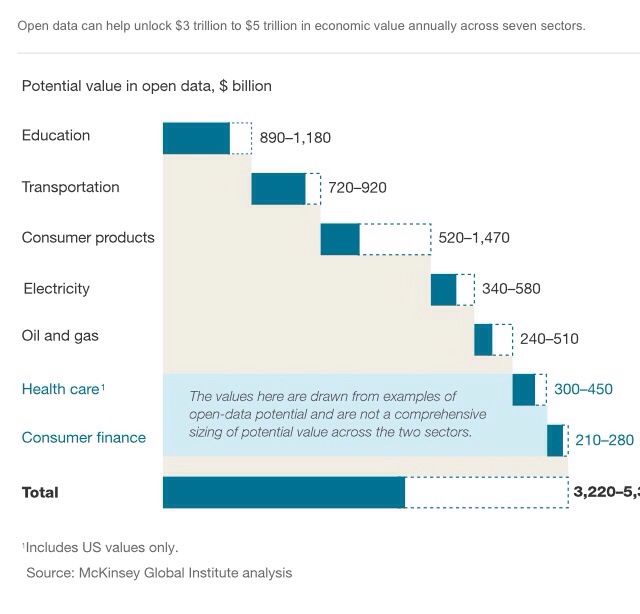
McKinsey estimates open data could add more than $3 trillion in economic value

According to a new McKinsey report, “research suggests that seven sectors alone could generate more than $3 trillion a year in additional value as a result of open data, which is already giving rise to hundreds of entrepreneurial businesses and helping established companies to segment markets, define new products and services, and improve the efficiency and effectiveness of operations.”

20131028-202720.jpg

That’s a mighty big carrot to open up public sector data to the public, keeping in mind potential privacy, political and national security consequences of doing so carelessly.

A growing number of open data entrepreneurs are mining these embryonic markets, finding fertile soil using different business models that focus on adding value to a national resource: data collected for the people, released back to the people.

Does privatizing government services require FOIA reform to sustain open government?

I read an editorial on “open government” in the United Kingdom by Nick Cohen today, in which he argues that Prime Minister David Cameron is taking “Britain from daylight into darkness. Cohen connects privatization to the rise of corporate secrecy … Continue reading

Roundup: who said what about the White House executive order on open data?

This morning, President Obama issued an historic executive order making open data the new default for releasing information in the federal government. The president announced the order on a trip to Austin, Texas, where he visited Manor New Tech High School, visited the Capital Factory incubator, where he saw a demonstration of StormPulse, a risk management startup that uses open data, and delivered remarks on open data at Applied Materials Inc.

Here’s what the tech media had to say about today’s news. (Got half an hour? Listen to the press briefing from today  at FierceGovernmentT or download this MP3 of the call that provides the source material for much of the following.)

Sean Gallagher and Nick Clark Judd both penned the most thoughtful, informed and well-reported pieces covering the news. Both are especially strong on covering what the order and associated initiatives actually mean.

At ArsTechnica, Gallagher highlights the challenges that implementing the policy will face: “Obama orders agencies to make data open, machine-readable by default.”

At techPresident, Judd parses out what’s new (Github!) and what actually relates to transparency in “Developers Are Already Submitting Patches to Obama’s New Open Data Policy.”

The Github angle was irresistable  to Wired reporter Bob McMillan (and pretty much anyone else interested in open source) who noted that “Now You Can Fork U.S. Government Policy … On GitHub.”

We’ll see if “the revolution will be forked,” as Githubber (and former White House staffer) Ben Balter put it.

The executive order was significant enough news to escape the tech orbit: The business and general press was also on the story, framing it in terms of jobs.

The Daily Caller earned the dubious distinction of writing the worst headline of the bunch, “Obama is going to tell people how the White House is organized.” (Not exactly.)

Out in the blogosphere and on Twitter, there’s a somewhat different flavor of reaction and commentary from reporters tasked to cover the news.

The Data.gov team is actively looking for feedback, as Data.gov evangelist Jeanne Holm made clear on Google+

Those of us at the Data.gov team are seeking your great ideas and constructive criticism as we move forward to the next phase of Data.gov. We want to scale up the quality and quantity of data, be more helpful to American businesses and entrepreneurs looking to use government data and research, more clearly support learning in classrooms, get government data in front of researchers and journalists, and bring the power of open data to American citizens.

It’s all about getting you to the data you need as quickly as possible in a variety of machine-readable formats with better search, more APIs, easier ways to share data, more data resources federated.  You can see an early view of our new CKAN-powered catalog http://geo.gov.ckan.org/dataset .

You’ve told us via forums, list serves, hack-a-thons, blogs, social media, and meetups around the country and the world that we need to have more and better capabilities for developers and innovators.  We are listening.Find out more details about the technical implementations underwayhttps://www.data.gov/blog/under-hood-open-data-engine and let us know what you think at Data.gov https://www.data.gov/developers/page/forum-topic/11?tid=28622 or via Twitter @usdatagov!

At the Sunlight Foundation, John Wonderlich says that the “open data executive order shows the way forward.”

Simon Rogers explored how the open data executive order compares to similar efforts in the United Kingdom.

Open government data advocate and Govpulse.us founder Josh Tauberer weighed in, regarding licensing: “New Open Data Memorandum almost defines open data, misses mark with open licenses.”

OpenTheGovernment.org praised aspects of the open data policy but expressed concern about exemptions, definitions for information systems and references to the mosaic effect.

Steven Aftergood questioned whether making government data open and machine-readable would have an effect on government secrecy, particularly in the intelligence world.

Jim Harper focused on a similar dynamic, praising President Obama’s new open data policy but questioning its relationship to government transparency.

Noel Dickover said the the new open data policy is terrific, but… notes that “creating and maintaining an enterprise data inventory is a massive undertaking.”

Clay Johnson also wondered about related costs  and found the part of the policy focused on grant and contract knowledge especially interesting.

Coming tomorrow: my interview with US CIO Steven VanRoekel and further analysis on why this matters.
Peixoto: Open government data’s impact depends on political agency and press freedom

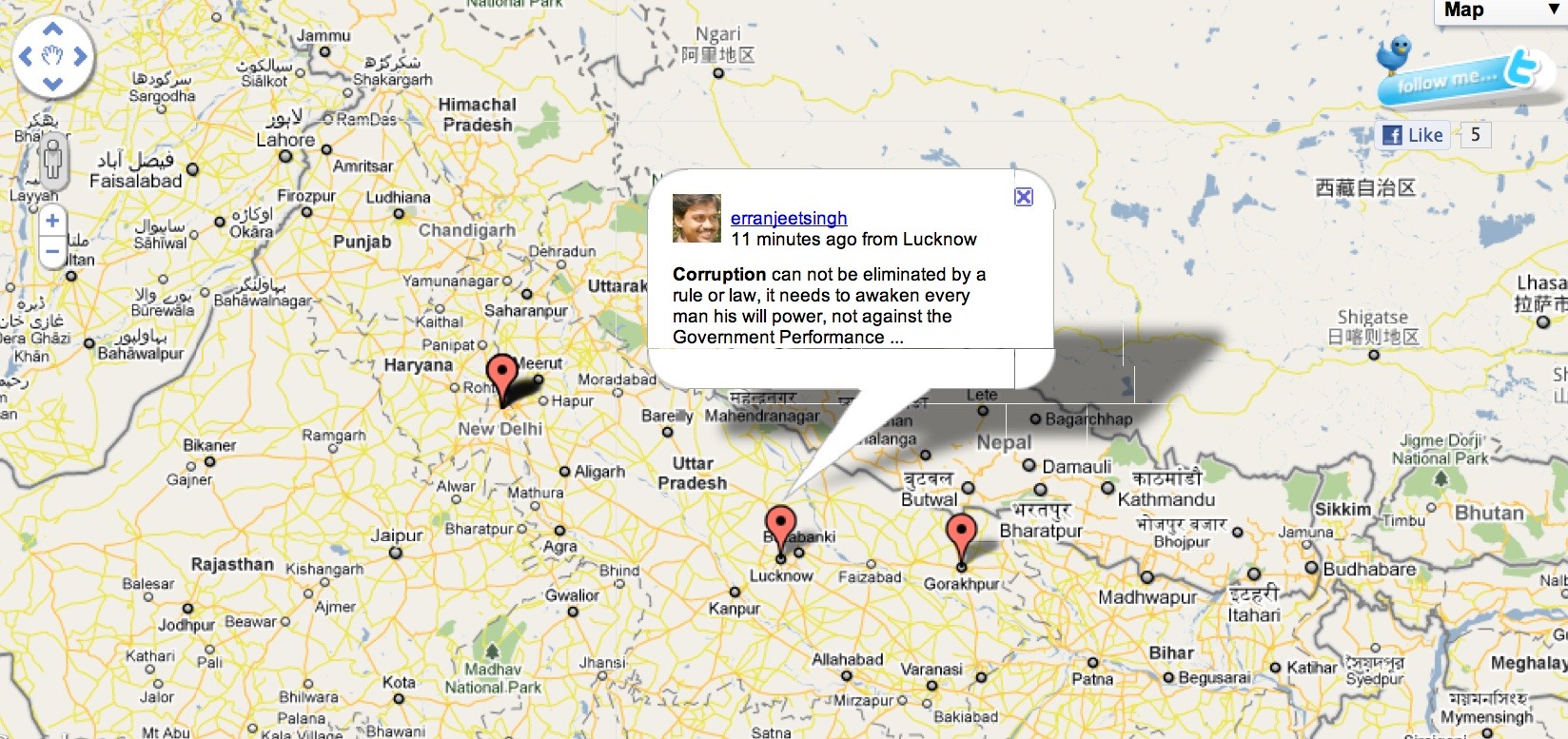
india-corruption-map

Tiago Peixoto has published a new law review article on the uncertain relationship between open data and accountability.

In it, he considers open government, transparency, accountability, press freedom and “open data” and comes to some interesting conclusions.

Peixoto suggests that for “adaptable data to engender accountability, it must fulfill at least two conditions: the publicity and political agency conditions.”

The former condition, although substantially enhanced by digital technologies and increased access to information, has traditionally been enabled by the media. The latter relies upon the basic conditions of democracy, from participatory institutions to free and fair elections.

If you’re interested in open government data, this is well worth the read.

Open government data shines a light on hospital billing and health care costs

If transparency is the best disinfectant, casting sunlight upon the cost of care in hospitals across the United States will make the health care system itself healthier.

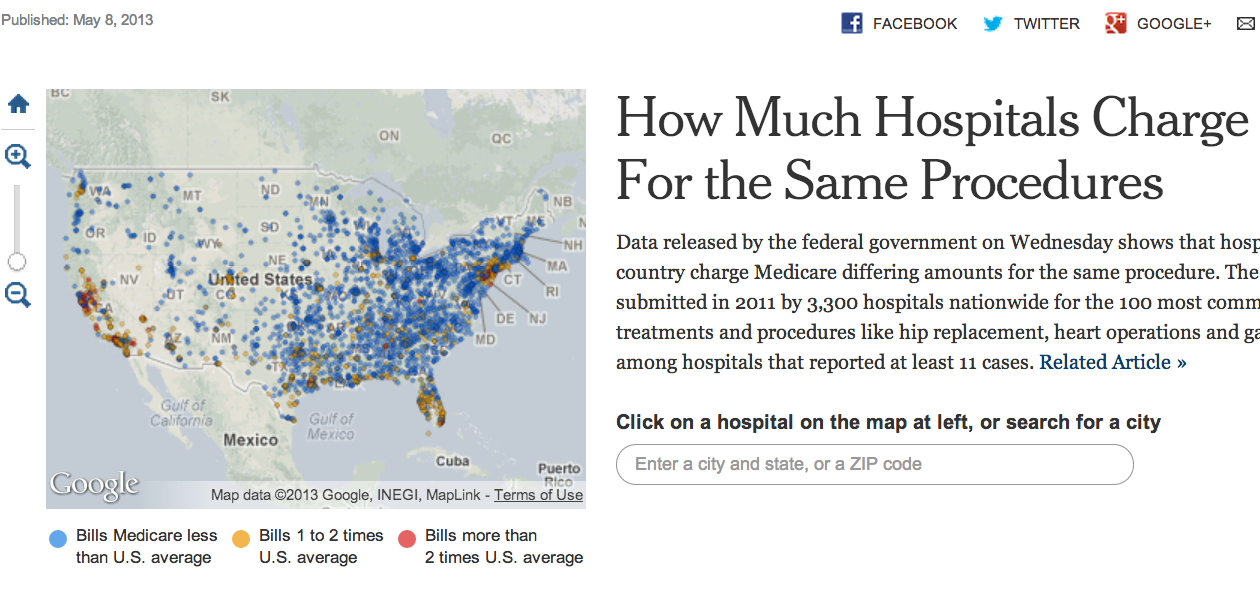
The Department of Health and Human Services has released open data that compares the billing for the 100 most common treatments and procedures performed at more than 3000 hospital in the U.S. The Medicare provider charge data shows significant variation within communies and across the country for the same procedures.

One hospital charged $8,000, another $38,000 — for the same condition. This data is enabling newspapers like the Washington Post to show people the actual costs of health care and create  interactive features that enable  people to search for individual hospitals and see how they compare. The New York Times explored the potential reasons behind wild disparities in billing at length today, from sicker patients to longer hospitalizations to higher labor costs.

hospital-costs


These graphics and features are only the tip of the iceberg for this health data to be baked into health applications and services. Given the spiraling costs of health care in the U.S., this kind of data has been sorely lacking. Health apps and services based upon this kind of data hold the potential to change how society accesses the quality and delivery of care, controls costs, connects patients to one another, creates jobs, empowers care givers and cuts fraud.

Progress on making health information as useful as weather data has been gradual over the past five years, pushed an Open Government Directive in 2009. The catalyst for change today, however, appears to be a member of the media.

According to Steven Brill, this end to hospital bill secrecy was prompted, at least in part, by his mammoth special report on healthcare pricing practices in the March 4 issue of TIME Magazine. If so, it’s one of the most important outcomes of a single feature of investigative journalism in this new century.

More, please.

Image Credit: Images of Money

New beginnings

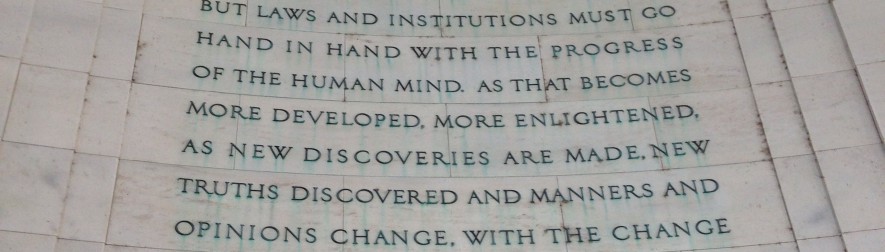
lincoln-memorial

“One nation, undivided, with liberty and justice for all.”

I remember those words well from my days as a schoolboy, reciting the Pledge of Allegiance to the flag of the United States of America.

Decades later, after I’ve spent years living in the the District of Columbia and writing about governance and technology, those words are imbued with a special poignance and power for me.

We live in extraordinary times, yet access to opportunities, capital and the law is not equal.

We can hear the voices of people crying out for help and justice from around the world at an unprecedented scale and velocity, yet our leaders do not always listen.

We can separate fact from fiction and publish the data that underlies those arguments, yet our capacity to reason and compromise is not always augmented.

We, the People, can do better. Whenever I run down to see Mr. Lincoln and stare out at the Mall, imagining what he might think of our own historic moment, I can’t help but conclude that he would agree.

I intend to share the stories and voices of people who are doing better here, drawing from years of interviews, reporting and exploration. You’ll find analysis, original essays, pictures, videos and data, mixed together and presented in what I hope will be a compelling mix. I hope that you find it worthy of your time.

-Alexander B. Howard