The official withdrawal of the United States from the Open Government Partnership (OGP) formalized what advocates, scholars, and watchdogs have been telling the American people from the last year: under President Trump, the executive branch of the United States government is no longer committed to government transparency, accountability, participation, and collaboration with the American people it serves. Official lies, corruption, and maladministration have become now the default, not the honesty, integrity, and trustworthy governance the public expects and deserves.
Instead of working with the American people to co-create new commitments to improve good governance, fix the broken Freedom of Information Act, open access to the public information our government holds in trust for all Americans, or invest in classification reforms, the Trump administration is simply walking away from the table.
In the letter of withdrawal, General Services Administration Administrator Scott Forst claimed that OGP “erodes sovereignty,” is “demonstrably ineffective,” has “divisive ideological agendas,” “wastes money,” and “degrades democratic integrity.” While some of this is false, it is accurate to state that OGP has been ineffective in the United States and that the most recent national action plan contained many commitments unrelated to open government.
This US government leaving OGP is no surprise, given the closure of the Federal Advisory Committee on Open Government that would have hosted this activity, dissolution of the Open Government Secretariat, lack of participation in OGP’s Summit, and illiberal claims about journalists and non-governmental organizations.
It is a confirmation, however, that this voluntary multi-stakeholder approach to improving government transparency and accountability in the executive branch is dead under this administration. In its place, Congress, the courts, the free press, watchdogs, and the American people will work together to make our government transparent and hold officials accountable for corruption under the rule of law.
A full statement on today’s news from the American Governance Institute follows:
Civil society groups had pressed U.S. to meet transparency commitments
January 28, 2026 — The United States has formally withdrawn from the Open Government Partnership (OGP), a voluntary international collaboration founded in 2011 by eight countries, including the United States, to advance government transparency, participation, and accountability in partnership with domestic civil society organizations.
In March 2025, eleven civil society organizations urged the Open Government Partnership to place the United States under review for “rolling back existing flagship commitments,” and calling for U.S. suspension if the administration failed to work with civil society to advance meaningful transparency commitments. A July 2025 letter renewed the request, citing accelerating attacks on government transparency, across anti-corruption efforts, civic space, fiscal openness, justice, and the foundation of open government.
A December 2025 OGP report found that “the second Trump administration revoked or replaced several executive orders that supported key commitments, including those related to equity, data transparency, and law enforcement accountability. It also disbanded the federal advisory committee in February 2025. These actions have undermined or halted the continuity and durability of reforms initiated during the action plan cycle.”
The U.S. government withdrawal statement, signed by General Services Administration Administrator Edward Forst, was replete with misstatements and omits the fact the first Trump administration participated in the Open Government Partnership. The statement takes no responsibility for its dismantling of the domestic Open Government Federal Advisory Committee. Nor does it note the administration’s increasing attacks on the press, the removal of data from government websites, the failure to collect and share information about government activities.
The following statement may be attributed to Daniel Schuman, executive director of the American Governance Institute and former chair of the Open Government Federal Advisory Committee:
“The Trump administration is not only the least transparent government in American history; its policies are antithetical to democracy, of which transparency is an essential element. Today’s withdrawal from the Open Government Partnership is yet another data point in a broader pattern of opacity by this administration.”
In a statement, Open Government Partnership CEO Aidan Eyakuze said, “Anyone who has followed developments over the last year will not be surprised by this decision of the US government. We recognize the impressive efforts of reformers in government and civil society who have advanced openness and accountability over the years.
Back in 2019, in response to a complaint filed by the Center for Biological Diversity under the Information Quality Act challenging the scientific integrity of government communications, the Environmental Protection Agency (EPA) claimed a blog post was not public information.
“The EPA Blog is an example of information that would not be considered disseminated by the EPA to the public,” argued an EPA staffer. “The guidelines do not apply to ephemeral information, as what is being offered is someone’s opinion rather than fact or EPA’s views,” he said.
That claim didn’t pass the smell test then, or now. In our view:
A public blog post published by a U.S. official on a federal website for public information clearly constitutes a public record.
A blog post is not ephemeral content, unlike an agency post on Snapchat, regardless of whether it had been published using a Web publishing software built for blogging, like WordPress, or another content management system, like Drupal.
Blog posts are subject to the Information Quality Act.
“From our review of what you forwarded, EPA appears to be speaking about whether a blog post is subject to the Information Quality Act, which is a fairly confusing law with more confusing guidance from OMB interpreting it. Whether or not something is subject to the Information Quality Act has nothing to do with the FRA, the definition of federal records, etc. That said, we agree with you on #1 and #2, but not necessarily with #3, which is really for OMB to explain.”
While OMB never explained, Brewer helped us to determine that in the view of the Chief Records Officer of the United States, blog posts are public records. That was exactly what we’d needed to know.
In the years since, Brewer continued to answer questions about public records when we visited the National Archives and Records Administration (NARA) to speak with the Archivist and staff, or in answer to my email. In 2024, he left NARA and began serving at the Department of Justice as the Director of the Office of Records Management Policy (ORMP) within the Justice Management Division.
I’ve reached out to the official designated as acting CROTUS last year with questions about any guidance NARA has offered to federal officials using Signal for public business on government-issued devices or personal smartphones but have not heard back.
In the interim, I went back into my email archives and found Brewer’s answers to questions I’d posed in December 2020 but found I had never published them here.
Given their relevance to the public debate to the scandal around the use of disappearing messages on Signal by the National Security Advisor, Vice President, Secretary of Defense, and Secretary of State – who is currently also acting Archivist – we are sharing them now.
We do so in hopes that all Americans will better understand the obligations that public servants have to uphold public trust by archiving public records when they conduct public business.
Our questions and his (evergreen) responses follow, edited for clarity.
You confirmed that a blog post on the EPA’s website was a public record. It seems straightforward to conclude that all content on a federal .gov website should generally be considered public record, with the exception of copyrighted material from a third party.
The standard I suggested to state, local, and national officials to adhere to while I was at the Sunlight Foundation resembles a first principle: if any update or interaction on social media or messaging service constitutes public business, then it should be memorialized. For instance, screenshots are how WhatsApp messages seem to be preserved in some agencies. Is this also where NARA stands?
CROTUS: “You stated, as a ‘first principle’, that “if any update or interaction constitutes public business, it should be memorialized.” This concept generally comports with the statutory provision under the Federal Records Act that requires agencies to ensure “adequate and proper documentation of the organization, functions, policies, decisions, procedures, and essential transactions of the agency and designed to furnish the information necessary to protect the legal and financial rights of the Government and of persons directly affected by the agency’s activities.” 44 U.S.C. 3101.
The challenge comes in how to implement records management requirements to the very fluid and dynamic nature of a complex government website.
With regard to the appropriate capture method for each record type, there are obviously many factors at play, including how long the record needs to be preserved and the available methods. However, I would note that in the letter to agency heads I shared with you, NARA stated: “Many apps, including WhatsApp, have electronic export capabilities, which should always be utilized. Screenshots should only be used as a last resort.”
You note that when content is on a .gov or other government domains, it should be designated as a record. We agree with this general notion, in the same way that emails on .gov accounts are presumed to be Federal records, but recognize that there can be exceptions.
Federal websites must go through the normal processes of scheduling and appraisal to determine appropriate retention periods, including those web pages that are permanent and would eventually be archived by NARA. Keep in mind that, depending on how agencies use their websites, the web version may not be the official recordkeeping copy (e.g., public version of a Secretary’s calendar), or the permanently valuable version for NARA preservation.”
We built upon that work with two bulletins covering social media records (NARA Bulletin 2014-02) and e-messaging (NARA Bulletin 2015-02) that provide more prescriptive guidance to agencies on managing these types of records. We also highlighted the management of social media and e-messaging records in a recent post on Records Express. Regarding the FDA matter, we currently have an open unauthorized disposition case for the FDA and Commissioner tweets.”
Should all official U.S. government accounts be frozen & memorialized on the platforms under @-name44, as with the @ObamaWhiteHouse? Spreadsheets shorn from platforms lose context, including public participation and meta data.
CROTUS: “This is an area of evolving practice. We have not issued specific Federal Records Act guidance to Federal agencies, with respect to preserving and renaming agency social media accounts. (NARA separately works with the White House on how best to manage and preserve social media accounts in accordance with the unique requirements of the Presidential Records Act.)
But, aside from the White House, we do not recommend that agencies use generic accounts like @SecState, because it is difficult to transition those accounts from one person to another. We instead recommend that the account be a unique combination of the name and position title, and that a new account be created for each new office holder.”
If a given platform or medium doesn’t allow archiving, like ephemeral messaging apps, should they be used for public business?
CROTUS: “In our experience with agencies, we have learned that trying to prohibit a practice that agencies use to carry out business is not the most effective path to compliance with record-keeping requirements, especially in cases where agencies receive messages from third parties or outside of government.
We do, however, expect agencies to issue policies and guidance, and deploy software or other tools if needed, to ensure the adequate and proper documentation of all official decisions, activities, transactions, etc.
This includes implementing procedures consistent with 44 U.S.C. 2911, which requires that electronic messages sent via personal accounts be copied to or forwarded to an official account within 20 days [after the original creation or transmission of the record].”
How should the U.S. government be treating posts on Signal?
To date, Congress has not passed an update to the Presidential Records Act or Federal Records Act that lays out specific expectations for how public officials across all three branches of government should use Signal, nor has the National Archives promoted specific guidance about this application.
End-to-end encrypted messaging apps like Signal are relatively new as a technology that’s commercially available to all Americans across the public and private sectors.
Should federal employees use encrypted apps for work, posts on them may be considered public records under the Freedom of Information Act and other public records laws.
As the comments from the former CROTUS drive home, the key issue is not the condition of encryption or which app or device records are created on. Rather, it is whether official government business has been conducted or not. If Signal was used for public business, then those public records should be memorialized.
Federal employees could use encrypted apps like Signal legally, if an agency CIO approved them, but as our editor told NextGov back in 2017, “if you are using a messaging platform—IM, collaborative chat, email, text messaging, Facebook Messenger, ephemeral messaging or encrypted applications—they are all subject to archiving requirements. If you conduct public business using any computing device, a record of messaging you exchange is something that should be archived, period.”
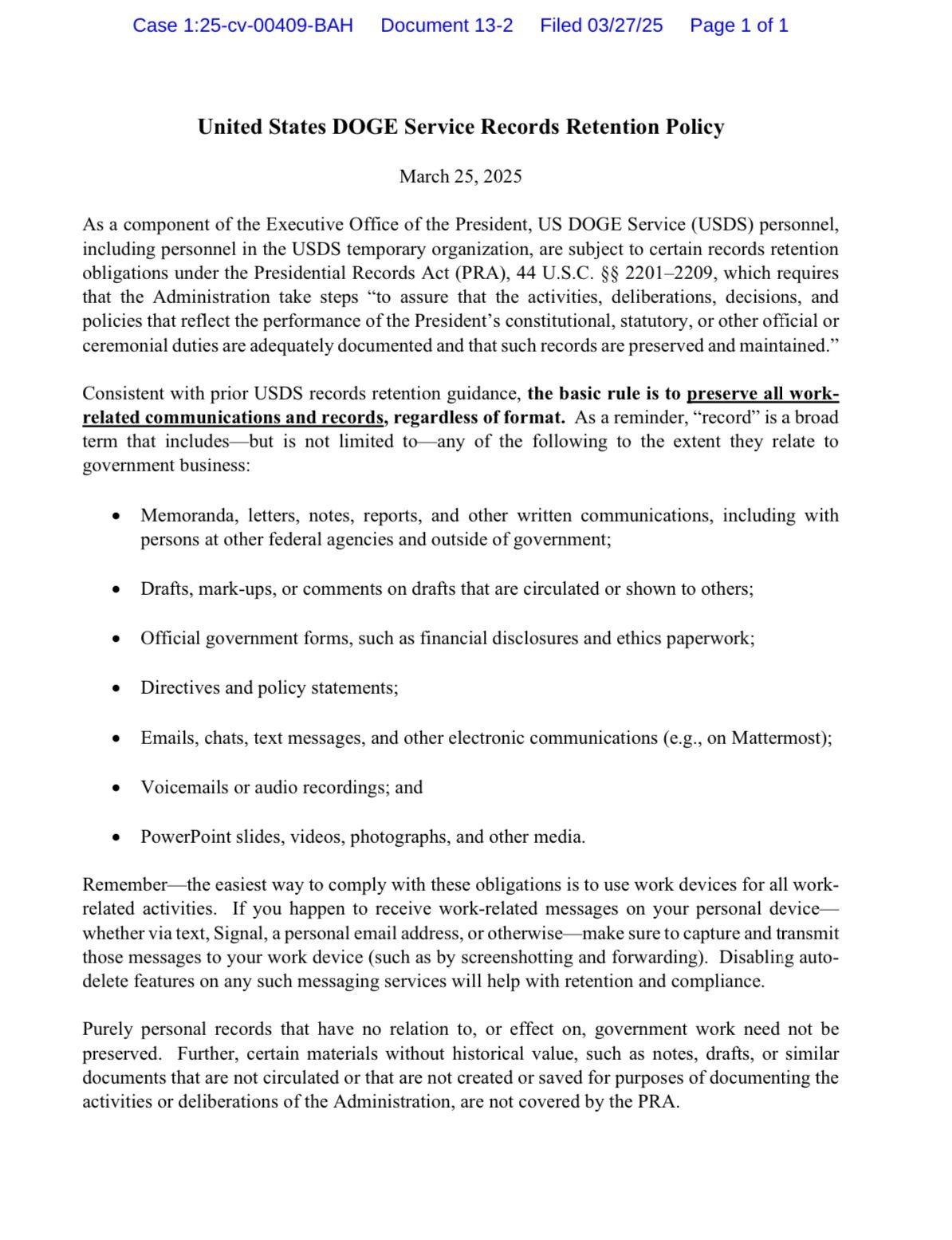
While there is no official public guidance from NARA, AOTUS, or CROTUS on the official use or Signal at present, Kyle Cheney reported that on Monday, March 25, 2025, the White House advised staff at the U.S. DOGE Service that work-related messages sent on personal devices and on Signal must be archived and that the auto-delete feature in the app should be disabled.
The policy emphasizes that “the basic rule is to preserve all work-related communications and records, regardless of format.”
Spot on.
We believe this basic rule applies to all federal agencies, as it’s in alignment with previous guidance from CROTUS and federal law on electronic messaging and collaboration platforms.
The acting Archivist of the United States, the President, and all of the Cabinet officials should now make it clear to the American people that they will uphold their oath to faithfully carry out those laws by preserving public records in the days and months to come. They should be saying they will hold accountable any officials who do not uphold public trust by intentionally using platforms or apps that destroy posts by default.
This must not become a partisan issue nor should it be further politicized. Public service is a public trust. Public records remain the backbone of an open government of, by, and for the People.
This afternoon, our editor texted the following letter in response to President Joe Biden’s text about federal disaster response on Monday. The letter was drafted after the White House posted a memorandum on fighting Hurricane Helene falsehoods with facts.
While the effort to use WhiteHouse.gov was worthy, the “opt-in texts” from POTUS referenced are woefully inadequate to the wicked challenge that lies and conspiracy theories pose for federal, state, and local agencies engaged in rescue and recovery operations.
We hope President Biden uses the National Wireless Emergency Alert System to text every American in the regions devasted by Hurricane Helene links to DisasterAssistance.gov, the FEMA app, and 80016213362.
It is legal to send a Presidential alert to “alert and warn the civilian population in areas endangered by natural disasters.” The President should do so to serve and protect the Americans who need trustworthy information and access to services.
E Pluribus Unum.
Dear President Biden,
Thank you for helping Americans affected by Hurricane Helene, President Biden. Could you please direct your team to surge connectivity & trustworthy information to everyone in the path of this disaster?
Your team is engaging Americans on social media, but I fear people without cell service or data can’t get info or access services.
The escalating impact of the information void that’s been left behind in the hurricane’s wake risks further damaging public trust in our democracy of, by, and for all of the American people. You’ve seen it and then spoken about the doubt, fear, and lies being used to divide our union as we begin casting our ballots in a historic election.
The White House communication team has put out a memo correcting the record and worked with FEMA to stand up a new website to debunk rumors about disaster response, as CISA did for rumors and conspiracies about election integrity in 2020, but it’s not enough.
Those efforts have run the same playbook that failed to combat a disinformation campaign that has successfully led tens of millions of Americans to hold false beliefs about the integrity of the election that sent you to the White House or the safety of the vaccines that have saved hundreds of millions of lives in the pandemic.
To beat the Authoritarian Playbook, you and your team need to come up with new plays from a democratic playbook that you co-create and run with federal, state and local governments agencies to reach the American people you seek to serve and protect.
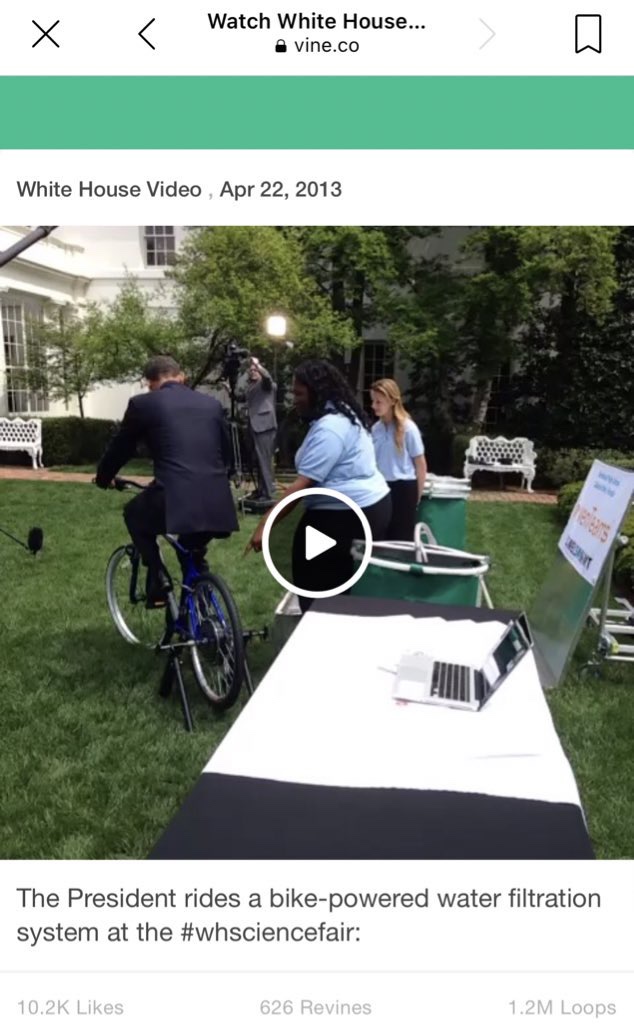
First, get us all online. Partner with every American company who’s willing to work with the U.S. government to provide open Internet access to people in the disaster zones. Literally surge power and connectivity to all affected counties. Challenge American industry to deliver better hand-cranked & pedaled dynamos to charge batteries that can power radios & phones.
Second, wake the sleeping giant. FEMA is already working full-out with state and local agencies, but talk with governors and mayors about how more members of the National Guard and U.S. military assets could be deployed in ways that rebuild trust with affected communities who are being told that the U.S. government and other Americans “hate them” and aren’t helping them.
Take away poisonous talking points about humanitarian aid being sent to help people caught in wars and disasters aboard by further mobilizing first responders across our great nation to bring help, health, and hope to Appalachian foothills and rural coastlines.
Create a shared ethos of “showing your work” in these response efforts. Embrace community news, public broadcasting, and civic media to create a powerful shared narrative around collective facts, where trust is built by participation and collaboration.
Third, empower Americans to help one another and keep validating those efforts by standing with governors and mayors. Show patriotism has no party and partisanship has no place in disaster response. You know we will rise to the occasion if you ask us what we will do for our country and give us ways to serve. You’ve already stood up a climate corps and institutionalized digital government fellowships.
Call on Congress to fund the next generation of first responders who can not only help respond to the decades of natural disasters ahead but build resilience in the most marginalized communities who will be disproportionately affected by hurricanes, wildfires, & droughts that lie ahead.
Fourth, restore trust in the rule of law. Partisans are falsely claiming that you have weaponized federal law enforcement against your political enemies. Your considered decision not to comment on ongoing investigations has allowed public understanding of how a former president conspired to overturn the results of a free and fair election with lies and abuses of power.
Declassify and disclose what the United States government knows about the foreign entanglements of our politicians now, so that all Americans are armed with the self-knowledge a healthy democracy requires.
Decry corruption as a pernicious blight upon liberal democracy. Members of your own party have been convicted of bribery by foreign governments, or stand indicted.
Make it clear to Americans that while all of us are entitled to due process and the presumption of innocence, public service is a public trust. Patriotism knows no party.
Finally, come meet us where we are, online and offline. Years of advancing truth decay have left far too many Americans infected with viral lies, increasingly vulnerable to the weapons of mass doubt, denial, distraction, deception, & disinformation wielded by those who would weaken our union and undermine public trust and faith in democracy itself.
Go far beyond fact sheets and tweets. Use online and offline participatory forums hosted with leaders from across the spectrum of American society to combat the epidemic of loneliness, fear, and disillusion that we can see infecting minds, weakening hearts, and breaking spirits across our union.
Remember how President Franklin Delano Roosevelt’s fireside chats built trust during the Great Depression. Run that play with today’s emerging technologies, in partnership with public media.
As you know, the stakes are existential for our union. Every American will suffer if we do not find a way to help a house divided stand together after the last ballots are cast a month from today.
While we have not been able to solve the wicked challlenge of broken public trust these past three years, I’m certain that the months ahead are a historic opportunity to show the world that there is nothing the United States cannot do if we, the people, decided to do it together.
Thank you for all that you have done to protect and defend the Constitution over half a century of public service.
There are reasons to be hopeful about open government as the United States as the new year begins, but also cause for grave concern. In December 2023, researchers at the Independent Review Mechanism (IRM) of the Open Government Partnership (OGP) confirmed what good governance advocates have said since 2017: the federal government is still not meeting the standards for open government domestically that the State Department and U.S. Agency for International Development (USAID) encourages other nations to adopt internationally.
Instead of standing with people demanding transparency from U.S. government, as President Biden encouraged other nations to do in December 2021, the White House refused to hold meetings in person in 2022 and 2023 and to incorporate the priorities of the (dwindling number of) good governance organizations and individuals willing to participate in voluntary multi-stakeholder processes after years of eroding trust and inaction.
Instead of seizing the moment and reviving the process with renewed leadership, the Biden administration starved OGP of attention, capacity, and relevance while creating a far weaker multi-stakeholder initiative, the Summit for Democracy.
The White House did not co-create a new “National Action Plan” for Open Government in 2022 with the American people and then announce it in a press conference, embrace accountability for the failures of the previous administration, and then use participation and collaboration to build back public trust.
Instead, the IRM found that the White House pre-drafted and then published a report full of vague, mostly pre-existing commitments – including many that were not relevant to government transparency and accountability – ignored expert feedback regarding opaque processes and flawed product, and then published yet another weak open government plan online over the holidays in December 2022.
This is unfortunately not novel. The OGP IRM has found the United States to have repeatedly acted contrary to process for years now. Nonetheless OGP restored the country to good standing after the Trump White House delivered a new plan in 2019 – despite ample cause for keeping a corrupt, secretive administration under review prior to a historic pandemic and attempted auto-coup.
After documenting the White House’s failures to engage the American public at scale, collaborate in choosing and drafting commitments on transparency and accountability, disclose comments, or provide a reasoned response for ignoring the consensus recommendations of good governance organizations, researchers at the Open Government Partnership Independent Review Mechanism recommended that the U.S. government collaborate with civil society to identify verifiable commitments with the most potential and refine them in 2024.
In their report, the IRM identified six “promising commitments” in a policy area that important to stakeholders or the national context which are verifiable, have an open government lens, and modest or substantial potential for results:
Commitment 1: Production, dissemination, and use of equitable data
Commitment 4: Public access to federally funded research
Commitment 8: Data for environmental justice Commitment 18: Government-wide anti-corruption strategy
Commitment 27: Access to government information through FOIA
Commitment 35: Effective and accountable policing and criminal justice
The good governance community also called on the US government to add new commitments to the 5th NAP in August, which the White House has so far declined to do — despite a mechanism that would allow it, as in the 3rd NAP.
Unfortunately, the White House has yet to acknowledge the (incredibly) constructive criticism from the researchers by revising selected commitments – much less added new ones, as the Obama White House did in 2016.
Instead, the administration invested a million dollars to fund an Open Government Secretariat within the General Services Administration to track progress on the commitments the White House chose and host a series of virtual seminars in 2023, complying with the bare minimum of the Open Government Partnership’s requirements for documenting implementation.
The Biden administration also has yet to respond formally to the “contrary to process” letter the Partnership sent in August or the letter a coalition of good governance groups sent to the President, bring senior officials to in-person roundtables in DC and around the nation, fix an opaque process, and heal badly broken relationships.
There continue to be good faith efforts across the agencies in the executive branch, from the National Archives to the General Services Administration, but strategic silence from the White House on open government has signaled to civil society and officials alike that this is not a priority.
If the President and his advisors see the value of investing political capitol, oversight capacity, and top-level leadership in open government across the federal government, change is possible. It’s crucial to provide dedicated civil servants with the air cover and capacity to do the work necessary to bring dormant or dissolved policies, programs, and partnerships back online to build resilience against headwinds for American democracy at home and abroad.
If the United States does not lead by the power of our example in 2024, our government will lose an opportunity to build trust in democratic governance through accountability and increase resilience against authoritarianism though transparency.
In August, the U.S. Chief Freedom of Information Act Officers Council issued a memorandum on the deadline for interoperability with FOIA.gov & sunset of FOIAOnline on September 30.
The U.S. FOIA Advisory Committee discussed the memo at our public meeting on September 7, 2023.
Imagine if senators were refusing to vote on a deputy attorney’s nomination, blocking the administration of the Freedom of Information Act at the Justice Department. Imagine if President Biden then proposed defunding the Office of Information Policy. Now, imagine if OIP didn’t just offer guidance and generated reports on FOIA but combined the functions of the National Archives, Justice Department, Congress & judicial ethics offices into one transparency institution that oversees all three branches of a federal constitutional republic under a strong freedom of information law.
Bienvenidos a Mexico. This is exactly what’s happening in Mexico right now as the AP reported on April 30.
This threat to freedom of information and public knowledge is not happening in isolation, either.
That’s a mistake: both Congress and news media should be focusing on what the changes to good governance in election systems, open government agencies, & chilling of NGOs would mean to Mexico, especially when combined with ongoing threats to journalists and activists from cartels, organized crime, & corrupted police.
The destabilization of Mexican democracy would represent a huge diplomatic, economic, and security challenge for the USA which must neither be ignored nor neglected.
What happens there will affect more than our politics, especially if conditions at the border deteriorate after a major natural disaster, from supply chains to labor supplies.
The looming challenges of migration from destabilized states should be driving comprehensive immigration reform, with investments in human capacity, courts, and services that would all increase resilience against the escalating stress that millions of people seeking asylum and economic opportunity in the USA will place on our own systems, as we are seeing today across the southern border of our union.
The renewed efforts to eliminate this transparency institution are a dagger of Damocles dangling over the heart of a still-young democracy whose stability and development are critical to American national security, public health, and public safety.
An assault on any one of institutions that provides checks and balances in a nation destabilizes the whole, from an independent judiciary to a free press to nonpartisan electoral administration.
An assault on all of them at once is a flashing WARNING sign that should be provoking an “all hands on deck response from the United States.
The long arc of our nation’s history with Mexico suggests to me that honesty, humility, and humanity from our nation’s leaders will be more effective here than bullying, bluster, or blunt demands or threats that would further fuel toxic headwinds.
In a different timeline, the President, Congress, and Supreme Court might be issuing a joint statement encouraging the Government of Mexico to invest in the laws, institutions, and people that are at the heart of a thriving democracy, reminding them that to allow any one party or politician to corrupt one organ risks killing the entire body politic.
In the world we have, such a public alignment between the leases of our own government seems inconceivable. It should be possible for the US government to speak as one to our neighbor in a new clear, stunning statement offering a hand in friendship to our neighbor partner to build more healthy democratic states together that center human rights, human dignity, and human potential.
Until that happens, it’s crucial for everyone else to call on Mexico’s leaders to uphold the public right to know and election integrity.
Relevant vectors include: 📰 news 📻 radio 📺 TV 💬 texts 🤳social media 📧 email 🎙️town halls 📚libraries 🚉transit 🏫schools
Instead of banning TikTok, imagine if the White House tried to engage ~150 million Americans there, & then crossposted each video PSA across Instagram Snap Inc. & YouTube to ensure that info was available to all.
Start with vote.gov & serve.gov or. Build new .gov & services with us.
I know it looks dark online, but we should still be thinking bigger about how to do more than just get We the People Internet access, as foundational as that is: we need to make it matter, rebuilding trust through the delivery of trustworthy information over time on participatory platforms.
Better digital services won’t be enough: we need integrated offline and online strategies that find publics with information wherever we are.
We need a government communications revolution proportionate to the paired public health and civic crises we have collectively endured over the pandemic.
I still believe in the capacity of my fellow Americans to deliver on it, in no small part by learning about what the rest of the world is doing online and adapting, adopting, and improving civic technologies that meet our own needs.
As I told CNBC yesterday, Twitter’s ban on promotion of selected social media services and restriction of links was not a good policy. Suspensions of journalists reporting on moderation decisions was similarly horrific, chilling journalism on the platform and serving notice that new management was willing to change policy and ban journalists.
Successful companies should compete in the markets for attention, advertising, & information online by making & deploying robust, compelling products and services, not suddenly imposing draconian limits to freedom of expression and linking to other services online, which key anti-competitive behavior & anti-consumer behavior.
After a massive backlash, Twitter owner Elon Musk apologized for sudden policy changes, Twitter deleted @TwitterSafety’s tweets and a webpage that outlined the regressive policy banned alternative social platforms, and Musk created a poll asking if he should step down.
Got all that?
It’s been helluva 48 hours online, especially for those of us who spend a lot of time on social media over the past two decades.
This rollercoaster ride to and from Hades is far from over.
If explicitly anti-press, anti-government, & transphobic rhetoric, suspensions of the press, & extraordinary restrictions on both freedom of expression & freedom to link continue, more institutions will be forced off the sidelines this week to suspend participation, shift to listening mode, or leave outright Twitter.
As with every platform where we spent time, attention, or money, online or off, individuals, corporations, news media, & democratic governments all must reassess what corporate behavior, norms, & policies they are willing to endorse through continued participation, much less support through paid promotion or subscriptions.
Since 2006, Twitter has acted as an information utility, along with a news browser, organizing tool, office watercooler, social network, & global platform for protests, campaigns, & lies that fueled an insurrection.
It’s always been driven and shaped by the action of humans on it, not just the product and policy and feature decisions of its operators. The emergent behavior we see in reaction to the past week of changes will shape what Twitter will be in 2023, & to whom.
The impact of Elon Musk’s purchase of Twitter and the subsequent exodus of staff from layoffs and resignations continues to ripple outwards today. While the platform remains online today, every person or institution that uses it should be preparing for downtime and continuing changes to the policies on Twitter, along with the diminished capacity of its remaining staff to fix technical issues or mitigate the range of governance crises associated with running one of the world’s most prominent social media companies.
Government agencies have special considerations, however, and can’t afford to fiddle around while Twitter’s servers burn. Putting aside the prospect of regulatory action by the Federal Trade Commission or European data protection agencies, there’s some basic block and tackling that leaders need to moeg on, now. Lindsey Crudele reached out with questions about what that might look like this past week and published a useful article on what government agencies should do. I’ve published the answers I sent her in full, with an addendum to the last.
Why does Twitter matter to government agencies in 2022? Examples of usage you’d consider notable)?
Social media has been where publics have been online in increasing majorities across nations since the dominant platforms of today launched in the 2000s: YouTube, Facebook, Twitter, Instagram – along with hundreds of social media startups that died, or faded, like Tumblr or Flickr or Delicious, though many still have millions of active users. MySpace still exists!
More seriously, while Twitter is much smaller than other global social platforms, in terms of daily active users and time spent, it has developed disproportionate influence and impact because of who those users are: world leaders, journalists, politicians, and thousands of institutions, from governments to universities to corporations.
Former President Trump’s use and abuse of Twitter made it even more of a central clearinghouse for US politics and US government policy. While banning him significantly reduced the amount of misinformation and lies on the platform, the Biden administration and other governments haven’t retreated from using Twitter to make announcements, break news, push back on misleading narratives, or engage publics.
If Twitter went away tomorrow, that broadcasting activity would likely be distributed across other services, from Facebook to Mastodon. What would be missing is the (mostly) open platform to listen in natural disasters or crises that Twitter provided and the default backchannel for many public conversations across industries and culture.
Given staffing cuts and leadership changes, what does platform and policy instability mean for government agencies on Twitter?
It means they should be making a plan for Twitter to go down, due to infrastructure issues, or for the integrity of the platform to decrease as content moderation capacity, support, and security are degraded, the level of misinformation and disinformation surges, and people leave the platform. (This is the same disaster recovery and business continuity plan that agencies should have had in case Twitter was taken offline by a hostile nation state around election day.)
It’s critical for governments to go where people and press are online to listen and engage, but never to become dependent on any company. No one — government, politicians, media, academia, nonprofits, private corporations, activists, foundations, or scientists — should allow a third party company, much less one owned by a capricious billionaire who espouses anti-government and anti-democratic views, to own their relationships with communities, clients, or constituents. It’s crucial for the stewards of public institutions and the services and information they provide to avoid any single point of failure so as to avoid a singular crisis.
What is your advice for agencies who use Twitter at this time in light of the changes?
As I said elsewhere, the first step is not to panic. Keep calm and tweet on. Let the constituents, residents, citizens, and communities who depend on you know that you will keep listening and link to your website and other channels to request help or get information
Second, turn on multi-factor authentication now. (Use an app, not SMS.) Disconnect third party apps.
The next step is to make sure agencies are ready for Twitter to go down, cease to be useful, or put their accounts behind a paywall, which may limit its utility as a public engagement channel – parallel to op-eds placed behind newspaper paywalls or interviews on subscription-based streaming services. If there’s a large enough engaged group of constituents and residents on a given platform, it makes sense for government agencies to at least be listening there.
The fourth step is to download agency social media archives, to ensure all public records are properly memorialized, and proactively disclose them on agency websites.
The fifth step is to secure all institutional social media accounts (not just Twitter) and connected email accounts – all of which should be connected to a .gov email! – with two-factor authentication.
The sixth step is to think bigger. Agency leadership should think about how all public communications and civic engagement efforts are working together in a holistic way, including email, texting, websites, social media, PR, direct mail, print/radio/digital ads, and press relations.
Finally, explore an institutional presence on Mastodon, in coordination with local, state, and federal leadership: it may make sense for one agency to create an instance to host accounts on, like the German government and MIT has stood up.
In the USA, President Biden should direct U.S. Digital Service and 18F to pilot a U.S. government instance on Mastodon, in collaboration with the Library of Congress and U.S. National Archives, and request Office of Management and Budget Shalanda Young to issue guidance to all federal agencies on Twitter to download an archive of our public records from all official accounts. Imagine something like mastodon.usa.gov with agency accounts on it, for example, or mastodon.congress.gov with all official Congressional accounts.
P.S. Over on Twitter, consultant and CTO Shannon Clarke suggested that “potentially specific agencies might want their own instance of Mastodon (or similar ActivityPub platform) so like email all users/accounts there would be clear which agency so perhaps name at agency.social dot is .gov or similar.”
That may make sense across local, state, and federal agencies – particularly for those with tens of thousands of staff. It might not be the right fit for tiny state or local agencies, though running a open, federal social system as a part of a polity’s websites may become table stakes for webmasters & IT staff. It’s certainly possible to imagine schools and libraries creating instances for students as alternatives to commercial social media, but that would be predicated on internal capacity, the ability to pay vendors, or the presence of state or local digital services that can delivery or maintain those systems.
I expect we’re going to see a riotous combination of approaches if there isn’t clear leadership. Clarke further posited that “there will be a reasonably good business (or service of an agency) in managing hosted instances of ActivityPub servers perhaps with government specific additional features (like formal, permanent archives; integration to identity management systems etc).”
I suspect he’s right and that will bear out over time in parallel ways to how Drupal and WordPress have been adopted and maintained by agencies – but
P.P.S. Also on Twitter, technologist Bob Wyman made an important point about how a “federal fediverse” should be configured: “If government uses Mastodon, or some other software, its public addresses or names should not include the software’s name. Government names should be generic. They should refer either to protocol (i.e. http://activitypub.gov), or to function (e.g. http://announce.gov).”
This makes sense to me, in terms of how domain names interact with the underlying technologies and protocols. Imagine social.usa.gov as a entry point for all executive branch .gov social media accounts or social.congress.gov.
In many ways, one future is already here: the metaverse Meta imagines is just not evenly distributed yet. But, as with the Internet that the nascent virtual worlds Facebook founder is building has in many senses been built upon, what the metaverse (or metaverses!) will be has yet to be written – much less the ways humanity will use it.
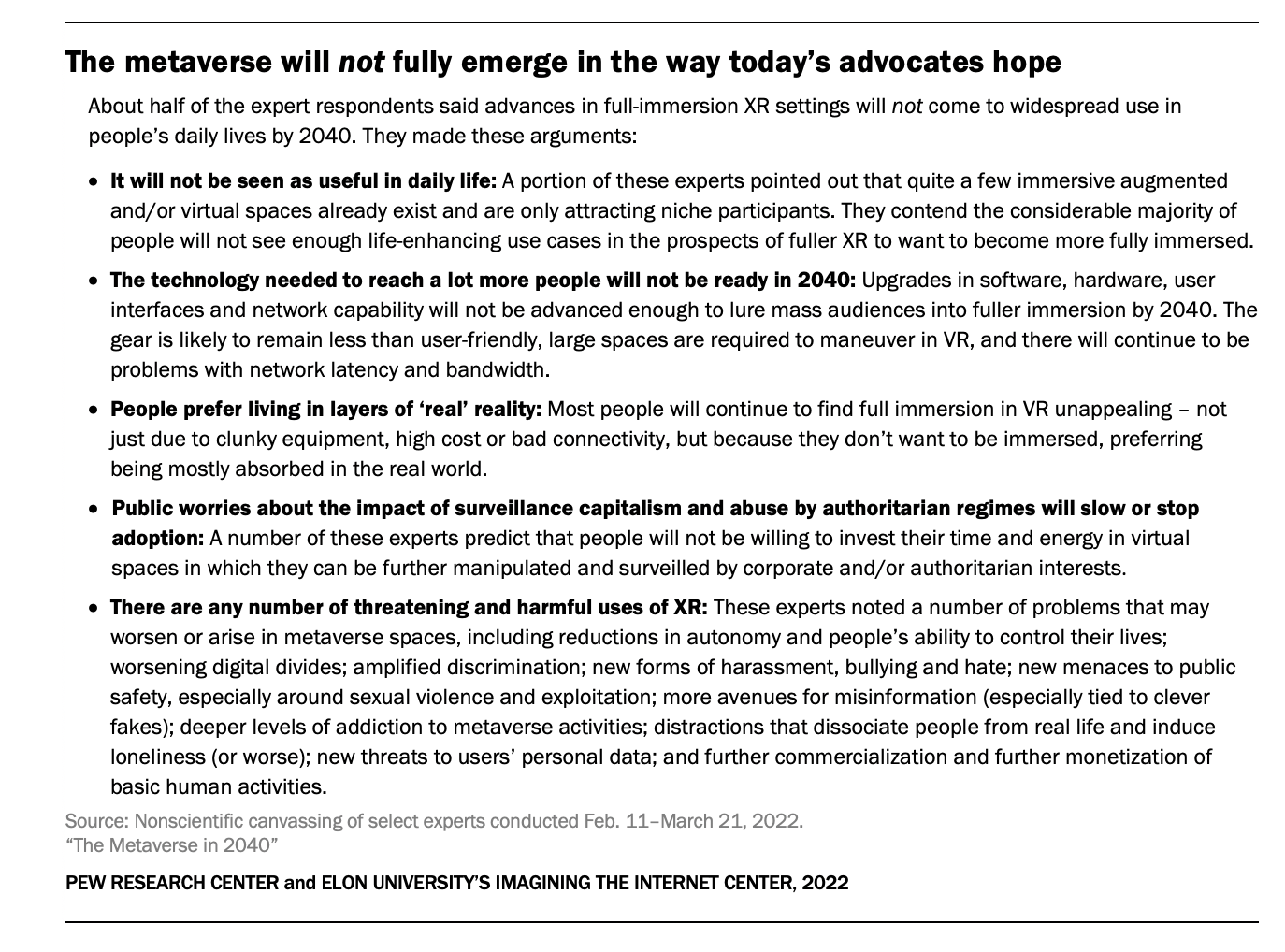
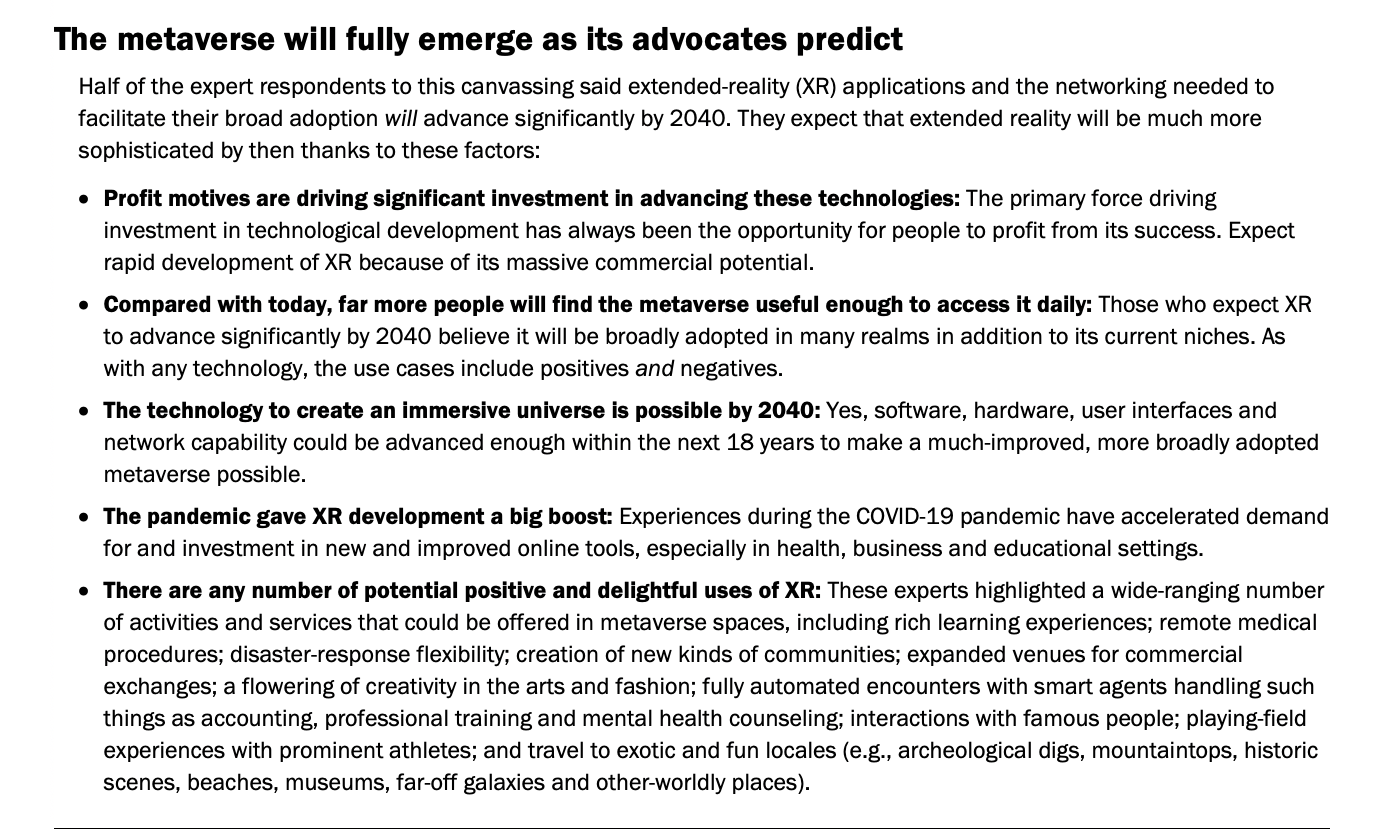
In 2022, the Pew Research Center and Elon University’s Imagining the Internet Center surveyed hundreds of technology experts about what the metaverse will look like in 2040.
Two key themes emerged from that non-scientific canvasing:
A “notable share of these experts argued that the embrace of extended reality in people’s daily lives by 2040 will be centered around augmented-reality and mixed-reality tools, not in the more-fully-immersive virtual reality worldsmany people define today as being ‘the metaverse.’”
Experts “warned that these new worlds could dramatically magnify every human trait and tendency – both the bad and the good. They especially focused their concerns on the ability of those in control of these systems to redirect, restrain or thwart human agency and stifle people’s ability to self-actualize through exercise of free will, and they worried over the future freedom of humans to expand their native capacities.”
This following is our full answer to Pew’s questions, with two summaries distilled from the survey results. (You can read the rest in this PDF or Pew’s website.)
What we imagine about the future has always shaped by great authors and filmmakers whose vision inspires humans to invent the future. It can take decades or centuries or even millennia for many technology to catch up with someone’s imagination, though the future we experience may differ from the one we expected because of an accelerant like a global pandemic or a war. It may take years for the relevance or full impact of a new technology upon society to become apparent, like the Internet, smartphone, social media, bulk surveillance, drones, artificial intelligence, or mRNA vaccines.
The metaverse will be no different.
We may think of of it as conceived by Neal Stephenson in “Snow Crash,” the iconic cyberpunk novel from the 1990s that described a virtual world that could be accessed using personal terminals with goggles, public terminals and booths, or portable rigs operated by “gargoyles” who were always online. In many ways, such a space has existed and endures Second Life for the past two decades, but – unlike text and video-based social media platforms – never reached planetary scale. Around two hundred thousand people log onto Second Life daily in 2022, but the other 7 billion of us do not.
By 2040, we should expect the personal and public terminals that Stephenson once envisaged to exist in many forms around the globe, from public kiosks to university pods to private homes to library booths to commercial gear operated corporations to police and military interfaces. If the world is anything like today, each will have its own affordances, stigma, power, and privileges that will be reflected in capacity and appearance.
We should also expect that the smartglasses, VR goggles, and AR browsers in our smartphones today will be akin to the personal computers of the 1980s and cellphones of the 1990s in two decades time. The emerging panoply of computing devices that augment what we see and enable us to explore virtual worlds using avatars project images onto lenses or our eyeballs are still in their relative infancy today, as are the smartwatches, health bands, and fitness trackers of today.
In 2040, we should expect spoken and gestural interfaces like the ones we saw in “Minority Report” that enable us to interact in augmented reality layers in a given physical location, viewing the annotations and glyphs others have left, with background systems pulling up information about the people, places, and objects we observe. This will have some implications for how we live, work, play, govern, conduct business, pursue romance, as these new civic, corporate, and private spaces become commercialized or co-opted by the same societal forces and institutions that shaped the development and extension of Internet technologies in the 20th century.
When combined, all of these devices, our activity on them, the sensors in them, and the urban environments around us and above us will make up an “embodied Internet” on which we leave digital exhaust with each action or movement.
As with smartphones and the data collection practices of 2022, people won’t need to be wearing goggles, smartglasses or other wearable computers to be affected by adding more Internet-connected cameras, sensors, and autonomous devices to public and private spaces. This will put a premium on nations and states enacting data protection laws that protect children, consumers, citizens, and seniors as they move through these sensorized spaces.
While dystopian outcomes aren’t assured, there is gathering risk that failures in collective action will allow today’s ransomware and speak phishing to persist and become even more pernicious as more and more human activity is tracked as we navigate a planet overlaid with a metaverse. As with rapidly emerging systems that currently are being used in concentration camps by authoritarians in modern surveillance states, such a metaverse could empower authoritarians to track, control, and coerce billions of humans in silicon prisons ringed by invisible barbed wire, governed by opaque algorithmic regulation and vast artificial intelligences.
By 2040, we should expect to see positive applications of augmented reality in education, the sciences, entertainment, manufacturing, governance, and more, combined with virtual experiences that mix up holographic avatars with humans in ways that recall Star Trek’s holodeck.
In the most optimistic timeline, we will see the best of the generative aspects of today’s crude virtual worlds on Roblox or Minecraft evolve into global marketplaces in which people can buy synthetic goods and services with digital assets. If nation states can shape democratic norms into globally respected laws, billions of humans will be able to work, learn, play, and share in new civic spaces in which privacy and security by default protect human rights and civil liberties across platforms and media. Human nature itself will not change, but the nature of being human will be informed by this shift, as will our capacity to push for collective action to mitigate the worst effects of climate change.
If nations do not enact data protection laws that center human rights online, however, and insist upon open standards and democratic norms for the emergent civic spaces of today, then the metaverses of 2040 will be pervasive closed platforms of coercion & control driven by surveillance capitalism, not open platforms for expression, connection, & generativity.




 E Pluribus Unum